After Missing the 20x, I've Found a 'Dumb' Method for AI Investing

marsbitОпубліковано о 2026-06-23Востаннє оновлено о 2026-06-23

Анотація

**Missing the 20x Opportunity: A Simple 'Dumb' Approach to AI Investing** The AI boom, driving NVIDIA's revenue from $60B to $216B in two years, creates immense investment pressure. However, like the internet bubble of 2000, the largest AI opportunities likely lie ahead, perhaps after a correction. Instead of rushing in now or waiting paralyzed for a crash, the author proposes a third way: building a "knowledge warehouse" by systematically mapping the AI industry to be ready when opportunities arise. The core of the strategy is understanding AI's four-layer value chain: 1. **Compute Infrastructure (The "Engine"):** This foundational layer, where all money eventually flows, includes: a) **Chip Design:** NVIDIA's dominance via its CUDA ecosystem, b) **Chip Manufacturing/Packaging/Memory:** TSMC's near-monopoly in advanced manufacturing and SK Hynix's lead in High Bandwidth Memory (HBM), c) **Optical Interconnects:** Essential for large-scale AI clusters (e.g., Lumentum, Coherent), d) **Cooling & Power:** Critical for high-density AI data centers (e.g., Vertiv), e) **Servers/Data Centers & Cloud Platforms:** The physical and virtual wholesale providers. 2. **Models & Tools (The "OS"):** The competitive layer of foundation models (OpenAI, Anthropic, Google, Meta, xAI), now generating real revenue. A key shift is the center of gravity moving from **Training** models to **Inference** (running models), which demands different chip characteristics and could challenge NVIDIA's mon...

Forty years ago, on October 22, 1978, Deng Xiaoping visited Japan for the first time. Traveling the 370-kilometer journey from Tokyo to Kyoto on the world's first high-speed railway—Japan's 'Hikari' Shinkansen—the Japanese accompanying personnel asked him for his impressions. He said: "It just feels like it urges one to run faster. So right now, we are just suited to ride such a train."

AI also has that effect of urging people to run faster.

Over the past two years, Nvidia's revenue has surged from $60 billion to $216 billion, and its stock price has increased tenfold. The wave of investment around AI has swept the globe—optical modules, data centers, cooling, robotics, AI applications—one wave after another. Every day there are new stories of price surges, and every day someone regrets not getting in earlier.

But while AI urges one to run, before running, one must first see the road clearly.

AI is the longest track our generation can encounter. The internet took ten years from 1995 to Google's IPO, and another eight years to Facebook's IPO. In between, it experienced the 2000 bubble burst, with the NASDAQ falling 78%. AI will likely follow a similar path—we might currently be in a position similar to 1998 or 1999. The truly biggest opportunities might only appear after the future bubble bursts, or perhaps they are hidden in some corner nobody is paying attention to today.

Currently, model capabilities are advancing at a rapid pace, capital is pouring in frantically, and valuations are pushed to uneasy heights. In this environment, there are two types of people:

The first type rush in to buy now—gambling that they've timed it right. They might make money, but are more likely to buy halfway up the mountain and then be shaken out by a correction.

The second type wait for the crash—but the problem is, when the crash really comes, will you dare to buy? Do you know what to buy? If you know nothing about this industry, you will only panic more in the face of panic.

I choose a third way: Don't rush to buy stocks now, but first build a position—build a 'knowledge position'.

Because no matter how AI develops, when the real opportunities appear, if we don't want to miss them—we must first become experts with a comprehensive understanding of the entire industry. So-called 'killer intuition' is nothing more than coming from a cognitive state of 'having a clear mental map'.

Starting today, I will begin doing something slow and 'dumb': systematically researching the AI industry from a holistic perspective, studying it bit by bit, understanding the entire AI industry chain from start to finish. Who is making money? Where does the money come from? Where does it flow? Who is irreplaceable? Who is feeding on leftovers?

So that when the day comes that the market gives us an opportunity—whether it's a crash, a correction, or some overlooked corner—I can make a judgment in seconds: 'Is this price worth acting on?'

Furthermore, in doing this, I will have two differentiators:

First, my investment foundation is solid. I have extensive experience and an extremely fast pace of evolution in investing. My return rate over the past three years, as my long-time followers are very clear, has reached a level few can match. Of course, the key isn't the return rate, as that might involve luck. The most important thing, and what is generally recognized, is my pace of evolution—I think this is even more crucial in the AI era. It's not about who is better, but about who evolves faster.

There's no need to dwell on the past. The future starts now. Let's 'wait and see'.

Second, I focus on one thing: how does this thing make money? My rapid evolution in recent years is mainly due to my focus: I only pay attention to the wealth opportunities behind phenomena. Most of the articles we see now teach you to use new Skills, new GitHub repos, pursuing trends and new things every day. These things are important, but from an investor's perspective, I care more about the wealth opportunities behind them.

When the iPhone 4 was released, did you, like others, marvel at the phone's design and performance, or did you research the investment opportunities behind it?

This article is the first in a series of research, aiming to do one main thing: light up the map. If systematically researching the entire AI industry chain is like playing a large open-world game—the first step isn't to rush to fight the Boss, but to first light up the map: which major regions, which key nodes, what is the main quest, what are the side quests. Once the map is clear, no matter what situation arises later, judgments can be made in seconds.

Chapter 1: Why View AI from a Holistic Perspective?

Nvidia's tenfold increase in two years is the most dazzling story in AI investing. But if you only see Nvidia, it's like only seeing one tree—you'll miss the structure of the entire forest beneath it.

Every major technological wave sees money spread outward along the industry chain, layer by layer. This has been repeatedly proven in history:

In the internet era, the first wave of money rushed into Cisco (network equipment), the second wave into Google, Amazon (platforms), the third wave into Facebook, Netflix (applications). In the mobile internet era, the first wave was Qualcomm (chips), the second wave was Apple (terminals), the third wave was WeChat, TikTok (super-apps).

AI is no exception. We can see a rough diffusion chain:

First Circle (2023-2024, already fully priced): GPU—Nvidia
Second Circle (2024-2025, currently being priced): Optical Interconnect, Power—LITE up 16x, Vertiv up 10x
Third Circle (2025-2026, not yet fully priced): Cooling, Storage, Specialized Foundry
Fourth Circle (2026+, awaiting catalyst): AI Applications, Energy Infrastructure, Robotics

For investors, the key insight is: The more foundational the infrastructure layer, the fewer players, the lower the substitutability, and the stronger the pricing power.

There might be thousands of companies competing in the 4th layer AI applications. This is why Nvidia earns $216 billion a year, while most AI application companies are still losing money.

But this also means that within the second, third, and even fourth circles of the infrastructure layer—those companies not yet labeled as 'AI concepts' by the market—may hide a wealth of opportunities. We need to first understand which players exist, what they do, and what they are worth.

Understanding this is significant because: When future market corrections, panic, or divergence occur, we will know where we should be looking.

The diffusion circles described above outline the sequence of market sentiment and capital flow—what money chases first, what later. But to truly understand the business logic of each segment, another map is needed: the hierarchical structure of the industry chain. Next, we will deconstruct it layer by layer, from the bottom up.

I divide the entire AI industry chain into a 4-layer structure, 4 main quest maps.

Chapter 2: Four-Layer Structure, Four Main Quest Maps

The four maps are: Computing Power Infrastructure, Model Layer, Middleware, Application Layer, plus one ultimate constraint: Power.

First Layer: Computing Power Infrastructure—The 'Engine' of AI

This layer is the physical foundation of the entire industry chain. All money—no matter which layer it flows in from—will ultimately settle here.

(1) Chip Design: The Arms King

Nvidia is the undisputed hegemon. In FY 2026 (ending January 2026), total revenue was $216 billion, with data centers contributing $193.7 billion—just two years ago it was less than $50 billion. This growth rate is unprecedented in semiconductor history.

What do these numbers mean? A specific example: training a cutting-edge large model costs hundreds of millions of dollars just for GPUs. And training is a one-time cost; after the model goes live, it needs to process hundreds of millions of user requests daily, each consuming computing power—this is the 'inference' cost. A model's lifetime inference cost can be more than ten times its training cost. This means as long as AI is being used, Nvidia continues to collect a 'tax'.

Nvidia's moat isn't just hardware. Its real barrier is CUDA—a software ecosystem with over 5 million developers. Like iOS for Apple, CUDA makes it hard for users to leave once they're in. AMD (MI300X) and Intel (Gaudi) are catching up, but the ecosystem gap is at least several years.

Another route is custom AI chips. Broadcom provides custom designs for Google's TPU, Amazon's Trainium, etc. The logic is simple: tech giants don't want to be 'choked' by one company forever. But at least for now, self-developed chips are supplements, not replacements.

Core Question: How long can Nvidia's monopoly last? Duan Yongping also said he doesn't understand—"Nvidia will definitely still be around in 10 years, but will it still hold its current market position?" This is a question worth trillions of dollars. And behind this, chip manufacturing involves a long industry chain, which has already boosted many companies. I will pay more attention to this.

(2) Chip Manufacturing, Packaging & Memory: The Armory

Chips designed need to be made. TSMC almost monopolizes the manufacturing of the world's most advanced AI chips. Nvidia, AMD, Broadcom, Apple's core chips are all fabricated by TSMC. In the 3nm, 2nm race, Samsung and Intel's foundry businesses lag far behind.

A more critical bottleneck is High-Bandwidth Memory (HBM). No matter how powerful an AI chip's computing power is, if data can't be 'fed' in, it's useless. SK Hynix leads the HBM field, with HBM3E being almost an exclusive supplier to Nvidia. Samsung and Micron are catching up, with a significant yield gap.

Advanced Packaging (CoWoS) is another capacity bottleneck—supply has been unable to meet demand for over a year.

Core Question: TSMC and SK Hynix's capacity is power. Whoever controls capacity controls the pace of the AI arms race.

(3) Optical Interconnect & Networking: The Nervous System

AI training clusters have expanded from thousands of GPUs to hundreds of thousands. How do chips communicate at high speed? Traditional copper cables hit a physical limit beyond 800Gbps—signal attenuation, power consumption surge, heat dissipation out of control. Optical interconnect is the only way out; this isn't something engineering optimization can solve, it's a hard constraint set by the fundamental laws of electromagnetics.

Key players: Lumentum (LITE, InP laser leader, 16x stock), Coherent (COHR, optical vertical integration), Tower Semiconductor (TSEM, silicon photonics foundry, I've previously written in-depth reports on this), Arista Networks (ANET, AI data center switches), Astera Labs (ALAB, connectivity chips).

Core Question: Optical interconnect is a second-circle opportunity—already being priced, but perhaps not fully priced yet. The key is distinguishing which companies still have room, and which are already priced in. I've recently written several reports related to this.

(4) Cooling & Power Supply: The City Sewer

Nvidia's latest GB200 cabinet power consumption is as high as 120 kilowatts. Putting tens of thousands of cards together generates astonishing heat. Liquid cooling has gone from 'optional' to 'essential'. Microsoft's two-phase immersion cooling technology has already reduced Azure server cooling energy consumption by 95%. Vertiv (VRT) is the leader in this field, with nVent (NVT), Modine (MOD) also growing rapidly.

Core Question: Not sexy, but indispensable. Typical third-circle—most people don't see it, but without it, AI data centers can't run. I will have related reports coming soon.

(5) Servers & Data Centers

Dell, Supermicro integrate chips, memory, networking, and cooling into AI servers. Equinix, Digital Realty provide physical facilities. CoreWeave (IPO expected 2025) is a representative of pure GPU cloud.

(6) Cloud Computing Platforms: Computing Power Wholesalers

AWS, Azure, GCP are the 'wholesalers' of computing power—the three clouds together account for about 65% global market share. Oracle became an unexpected winner with its AI cloud growth.

Second Layer: Models & Tools—The 'Operating System' of AI

This is the most watched, fastest-growing, but most uncertain layer in the AI industry chain.

Five strong contenders: OpenAI (GPT), Anthropic (Claude), Google (Gemini), Meta (Llama open-source), xAI (Grok). The revenue growth in this layer is staggering—Anthropic's ARR (Annualized Recurring Revenue) soared from $1 billion at the end of 2024 to $9 billion by the end of 2025, and surpassed $30 billion by April 2026.

Salesforce took 20 years to reach $30 billion in annual revenue; Anthropic did it in less than 3 years. OpenAI's current ARR is about $24 billion; the two combined exceed $50 billion. Model companies are no longer 'cash-burning stories', but real, gold-earning businesses.

But behind the revenue surge, there's a noteworthy structural change occurring: The focus of AI computing power is shifting from 'training' to 'inference'.

Over the past two years, AI's main computing power consumption was on training large models—pouring massive amounts of data to teach the model to understand the world. But once a model is trained, what follows is 'inference'—actually having the model answer questions and perform tasks.

Research by Deloitte shows that inference's computing power consumption had already surpassed training by the end of 2025, accounting for over 55% of AI cloud infrastructure spending. Some even point out, "In the past, 80% of computing power was spent on training and 20% on inference. In the future, this ratio will reverse."

What does this mean? The inference market may be far larger than the training market (projected to reach $255 billion by 2030), and inference's requirements for chips differ from training—it emphasizes cost efficiency and low latency more than extreme peak computing power. This could be a breakthrough point for challenging Nvidia's monopoly: AMD, Marvell (just received a $2 billion investment from Nvidia), and various self-developed chips are all targeting the inference market.

The most thought-provoking question in this layer is: Will AI models form an oligopoly, or will they be 'commoditized'?

Meta's Llama is free and open-source; DeepSeek created a competitive model at extremely low cost. GLM-5's current API packages are out of stock. Open-source is lowering the barrier to entry for the model layer. But 'commoditization' isn't that simple either—the capability gaps between models are narrowing but haven't disappeared.

Especially in deep usage scenarios, the experiential differences between models remain significant. Moreover, enterprises' API integrations, workflow customizations, and data accumulation create switching costs. The final landscape might be neither 'winner-takes-all' nor 'fully commoditized', but somewhere in between—a few major models occupy the primary market but maintain differentiated competition among themselves.

If profits in the model layer are compressed by open-source, real value will shift upward and downward. Upward to the infrastructure layer because everyone needs to run models, and computing power demand increases rather than decreases. Downward to the application layer because calling costs decrease, making AI applications easier to monetize. This process of profit redistribution might be one of the most important variables in the AI industry chain over the next few years.

Third Layer: Middleware & Platforms—The Glue Layer

The middle layer connecting models and applications. Representative companies: Scale AI (data labeling & AI evaluation, valuation $13.8 billion), LangChain (LLM application development framework), Hugging Face (model sharing platform, the GitHub of AI).

Most companies in this layer are not yet public and are relatively small. But once the AI application layer explodes, these 'glue' companies might experience explosive growth—just like Shopify and Stripe rose with the e-commerce boom. Worth continuous attention.

Fourth Layer: Vertical Applications—The Money Entry Point

Where AI directly creates value for end-users. Several directions:

Enterprise AI Platforms: Palantir sells AI operating systems to governments and enterprises. ServiceNow, Salesforce are grafting AI onto traditional SaaS.

Code Tools: GitHub Copilot is the de facto standard; Cursor is challenging it. The logic is clear—if AI can double programmer efficiency, every enterprise will pay.

Medical AI: Isomorphic Labs (under Alphabet, AlphaFold lineage) might be the most noteworthy long-term prospect, potentially IPO in 2027.

Robotics & Embodied AI: The direction with the largest long-term TAM (Total Addressable Market). Tesla Optimus, Figure AI, Unitree Robotics. But it's still very early.

Autonomous Driving: Waymo has the most mature commercialization; Tesla FSD is catching up with a vision-only approach.

The application layer is where a hundred flowers bloom and also the hardest layer to pick winners. But a noteworthy trend is: The global AI application market size is projected to exceed the upstream infrastructure market for the first time in 2026—money is shifting from 'building the city' to 'opening shops'. Meanwhile, AI Agents (autonomous agents) are becoming a new form of enterprise applications. By the end of 2026, over 40% of enterprise applications are expected to contain built-in AI Agent functionality, compared to less than 5% in 2025.

Cross-Cutting Dimension: Energy—The Ultimate Constraint of AI

All layers cannot avoid one question: Where does the electricity come from?

AI data center power consumption is growing exponentially. Microsoft has $80 billion in Azure orders that cannot be delivered due to insufficient power. This has sparked a wave of energy investment: Constellation Energy (nuclear), NuScale and Oklo (small modular reactors), GE Vernova (gas turbines).

AI will continue to expand; energy infrastructure is a derivative sector with extremely high certainty.

Chapter 4: Four Questions Beyond the Consensus

After drawing the map, the most valuable part isn't confirming consensus, but identifying what the market might be overlooking. Currently, I'm focusing on 4 questions, and subsequent research will start more from these angles.

Question 1: The shift from training to inference—whose fate will it change?

Over the past two years, the main demand for AI computing power was training large models. But now inference (making models actually work) has surpassed training to become a larger market. Inference has different chip requirements than training—more focused on cost-performance ratio than ultimate computing power.

This might open a window: Nvidia's monopoly in the training market is almost unshakeable, but the inference market is more fragmented. AMD, Marvell, Broadcom, and various self-developed chips all have opportunities. Meanwhile, the 'continuous consumption' nature of inference means computing power demand isn't a one-time event but grows continuously with AI application adoption—good news for the entire supply chain.

Question 2: Where is the return on the $600 billion investment?

In 2026, the capital expenditures of the five major tech giants will exceed $600 billion, but the revenue generated by AI applications is roughly a fraction of that figure. A similar input-output gap in history only occurred once—the telecom infrastructure boom in the late 1990s. The outcome then was bankruptcy for many fiber optic companies.

Of course, the key difference is: telecom companies back then relied on debt; today's tech giants rely on their own profits, with debt-to-asset ratios at historical lows. But if AI application monetization speed can't keep up, the capital expenditure growth rate will inevitably slow down—and this will ripple through the entire supply chain. Which companies' risks does this pose?

Question 3: What does the landscape of the second and third circles look like?

Nvidia is the first circle, already fully researched and priced. Optical interconnect and power supply are the second circle, being re-recognized by the market. What about the third circle? Cooling, specialized foundry, AI security, edge inference chips—which companies are in these segments? What are their business models? What is the competitive landscape? If these aren't clarified now, it will be too late when real opportunities appear. This is precisely what the subsequent layer-by-layer research aims to do.

Question 4: How does geopolitics affect the industry chain?

The U.S. export controls on AI chips to China are splitting the global AI industry chain in two. Nvidia's H20 is banned; China is building an independent AI infrastructure set. This means two parallel industry chains are both investing, potentially making the total volume larger than expected. But it also means some suppliers face the risk of 'choosing sides'.

Chapter 5: The Path Forward

The map is drawn; next is the main quest.

I will start from the first layer, delving into each segment one by one. Like clearing areas in a game—first do the main quest (the most core companies and logic of each layer), then the side quests (marginal but potentially surprising corners).

At each stop, clarify three things: What is the business model of this segment? What does the competitive landscape look like? What valuation level is it at? Once these three things are clear, no matter how the market changes in the future, we will have the basis for judgment.

Some Closing Remarks

While writing this industry chain overview, I remembered the LITE story.

I previously did an in-depth review of Lumentum (LITE) on my public account: 'How did others catch LITE's 20x in a year?' It's a textbook case: mid-2024, the market still viewed it as a 'telecom cycle stock', unwanted at $50 per share. But its essence was the 'nervous system' of AI data centers, with a 50-60% global share in InP lasers, the physical limits of copper cables, management expanding capacity counter-cyclically during losses, and book asset value higher than market cap.

All information was public, but I didn't have an industry chain map in my mind to recognize it.

Ultimately, all missed opportunities are not due to 'acting too slowly', but to 'researching too little'.

That's why I want to build a 'knowledge position'. AI is a sufficiently long track—long enough not to need anxiety about not getting on board now, but also not to do nothing and just wait. Understanding every layer, every segment of the industry chain is itself the best preparation. When the day comes that the market gives us an opportunity—whether in the ruins after a bubble burst, or at some suddenly appearing inflection point—with a map in hand, a judgment can be made in seconds.

'Killer intuition is not innate; it's earned through thousands of hours of research.'

Трендові криптовалюти

Пов'язані питання

QAccording to the author, what is the 'foolish but effective' approach to AI investment mentioned in the title?

AThe 'foolish but effective' approach is not to rush into buying stocks immediately, but to first build a 'knowledge warehouse'—to systematically research and understand the entire AI industry chain from the ground up, from the infrastructure layer to the application layer.

QThe article divides the AI industry chain into four layers. What are they, from the foundational layer upwards?

AThe four layers, from foundational to top, are: 1. Computing Infrastructure (the 'engine'), 2. Models & Tools (the 'operating system'), 3. Middleware & Platforms (the 'glue layer'), and 4. Vertical Applications (where value is created for end-users). Additionally, Energy is highlighted as a cross-cutting ultimate constraint.

QWhat key structural shift in the AI compute market is highlighted in the article, and what potential impact could it have on the industry landscape?

AThe key shift is the transition from 'training' to 'inference' as the primary driver of AI compute demand. Inference is projected to become a larger market than training. This could challenge NVIDIA's dominance, as inference chips prioritize cost efficiency and low latency over peak compute power, potentially opening opportunities for competitors like AMD, Marvell, and custom in-house chips from major companies.

QWhat are the 'four consensus-breaking questions' the author plans to focus on in future research?

A1. How will the shift from training to inference change the fate of different players? 2. Where will the return on the massive (over $600B) capital investment from tech giants come from? 3. What does the landscape of the 'second circle' and 'third circle' opportunities (like cooling, specialized manufacturing, AI security) look like? 4. How will geopolitics and export controls affect the global AI supply chain?

QUsing the example of Lumentum (LITE), what broader investment lesson does the author draw about missing major opportunities?

AThe lesson is that missing major opportunities like LITE's 20x rise is fundamentally not about 'acting too slowly,' but about 'researching too little.' The information was publicly available, but the lack of a comprehensive mental map of the AI industry chain prevented recognition of its crucial role in AI data centers (as a leader in InP lasers for optical interconnects). This underscores the value of building deep industry knowledge ('knowledge warehouse') before making investment decisions.

Пов'язані матеріали

Ethlabs Founded, Treasury Companies to Fund Ethereum Post-EF

Former Ethereum Foundation (EF) core researchers Ansgar Dietrichs, Barnabé Monnot, Caspar Schwarz-Schilling, Josh Rudolf, and Julian Ma announced the launch of Ethlabs, an independent non-profit R&D lab focused on Ethereum core protocol research and institutional-grade infrastructure. The initiative, backed by over 50 community participants including ETH treasury companies BitMine and Sharplink, Joseph Lubin, Hayden Adams, and Jesse Pollak, aims to make Ethereum the global economic settlement layer. This move comes amidst significant pressure on the EF, which has seen key departures and a strategic narrowing of its focus. A critical funding gap of approximately $30 million annually for core client development, following the expiration of the client incentive program, poses a near-term risk to the network's development. The context includes the evolution of ETH's value narrative. While mechanisms like EIP-1559 and the Merge previously supported the "ultrasound money" thesis, the success of L2 scaling via EIP-4844 has drastically reduced L1 fee revenue, leading to net ETH issuance and challenging that narrative. Ethlabs has listed ETH monetary economics as a primary research focus. Backing from corporate ETH treasuries like BitMine and Sharplink represents a strategic alignment, as these entities' asset values are directly tied to Ethereum's health and adoption. Their support is an investment rather than a pure donation. Ethereum's governance is shifting from a centralized EF model to a distributed network of specialized "manager nodes," including Ethlabs and a streamlined EF. While this promotes efficiency and reduces single-point failure risk, it introduces new challenges in coordination, priority alignment, and filling critical funding gaps across the decentralized ecosystem.

Foresight News15 хв тому

Ethlabs Founded, Treasury Companies to Fund Ethereum Post-EF

Foresight News15 хв тому

From Logo to Bo Niu: TRON Further Perfects Its Brand Visual Assets

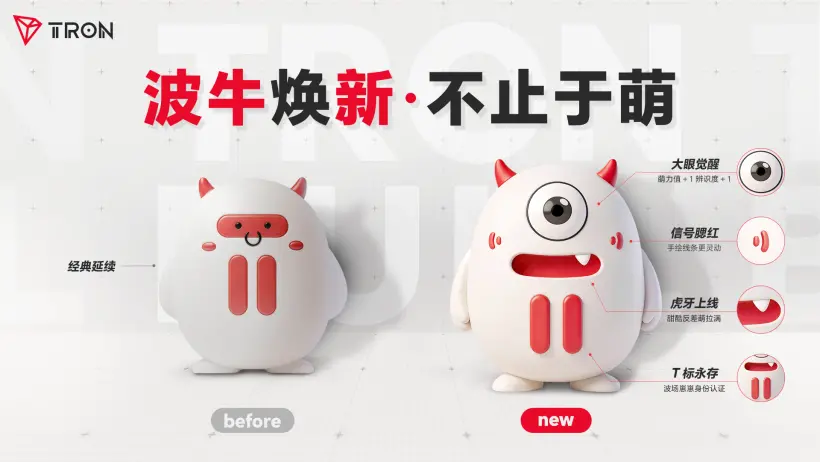
On June 23rd, TRON completed a significant upgrade to its official mascot, Bo Niu. The revamped character features larger, brighter eyes, more expressive facial details, and a clearer "T" structural motif, while retaining its signature red-and-white color scheme and horned design. This refresh aims to enhance Bo Niu's approachability, emotional range, and versatility for use across social media, community interactions, offline events, and branded merchandise. The redesign focuses on creating a stronger first impression. A more open facial structure with distinct, expressive eyes and the addition of a mouth with a small fang make the character friendlier and more suitable for dynamic content like animations and emojis. Subtle brand elements are integrated, such as stylized cheek lines inspired by "signal" icons, referencing the "wave" in "TRON," and a "T" shape formed by its smile and chest markings. Bo Niu has also been given a more defined personality as "TRON's Chief Luck Officer," with traits like being playful and sweet. This persona provides a more accessible and emotionally resonant entry point to the TRON brand, contrasting with often technical Web3 narratives. This mascot upgrade is part of TRON's ongoing effort to build a comprehensive and extensible visual identity system, following its recent logo refresh. Bo Niu is positioned as a key asset to connect with users, foster community, and convey brand warmth in everyday contexts.

marsbit19 хв тому

From Logo to Bo Niu: TRON Further Perfects Its Brand Visual Assets

marsbit19 хв тому

TRON Refreshes the Bull Image, Creating a More Approachable Brand Character

TRON's official mascot "BONiu" (Wave Bull) has received a comprehensive visual upgrade. Retaining its core red-and-white color scheme, horned silhouette, and brand DNA, the refreshed character features larger, brighter eyes, more expressive facial details including a mouth with a small fang, and enhanced emotive capabilities. The redesign aims to strengthen the mascot's亲和力, emotional expressiveness, and adaptability across various scenarios. Key updates include a clearer facial structure for instant recognition, a simplified and more intuitive五官 design, and the integration of subtle brand language. The cheek blushes are now inspired by a "signal" icon, while the smile and chest lines form a stable "T" structure, creating a cohesive超级符号 for the brand. The character has also been equipped with a 12-phoneme lip-sync system to support future动画 and interactive content. Beyond its visual role, BONiu's persona has been enriched. Now titled "TRON's Chief Luck Officer," it carries playful personality tags like "foodie enthusiast" and "full-of-tricks," allowing it to engage with the community in a more approachable and relatable manner. This update provides a lower-barrier, emotionally warm entry point for users amidst the often technical and abstract narratives of Web3. This mascot revamp is part of TRON's ongoing effort to refine its visual asset system, following the earlier logo update. By evolving from a static visual into a dynamic, expressive brand角色, the new BONiu is positioned to become a key asset for connecting with users, building brand记忆, and conveying TRON's personality across社交传播, community互动,线下活动, and merchandise.

链捕手36 хв тому

TRON Refreshes the Bull Image, Creating a More Approachable Brand Character

链捕手36 хв тому

Торгівля

Спот
Ф'ючерси

Популярні статті

Що таке GROK AI

Grok AI: Революція в розмовних технологіях ери Web3 Вступ У швидко змінюваному ландшафті штучного інтелекту Grok AI вирізняється як помітний проєкт, що поєднує сфери передових технологій та взаємодії з користувачами. Розроблений компанією xAI, яку очолює відомий підприємець Ілон Маск, Grok AI прагне переосмислити, як ми взаємодіємо зі штучним інтелектом. Оскільки рух Web3 продовжує процвітати, Grok AI має на меті використати потужність розмовного ШІ для відповіді на складні запитання, надаючи користувачам досвід, який є не лише інформативним, але й розважальним. Що таке Grok AI? Grok AI — це складний розмовний чат-бот, розроблений для динамічної взаємодії з користувачами. На відміну від багатьох традиційних систем ШІ, Grok AI охоплює ширший спектр запитів, включаючи ті, які зазвичай вважаються недоречними або виходять за межі стандартних відповідей. Основні цілі проєкту включають: Надійне міркування: Grok AI акцентує увагу на здоровому глузді, щоб надавати логічні відповіді на основі контекстуального розуміння. Масштабоване управління: Інтеграція допоміжних інструментів забезпечує моніторинг та оптимізацію взаємодій користувачів для покращення якості. Формальна верифікація: Безпека є пріоритетом; Grok AI впроваджує методи формальної верифікації для підвищення надійності своїх результатів. Розуміння довгого контексту: Модель ШІ відзначається здатністю зберігати та згадувати обширну історію розмов, що сприяє змістовним та контекстуально обізнаним дискусіям. Стійкість до атак: Зосереджуючись на покращенні своїх захистів від маніпульованих або зловмисних вхідних даних, Grok AI прагне зберегти цілісність взаємодій з користувачами. По суті, Grok AI — це не просто пристрій для отримання інформації; це занурюючий розмовний партнер, який заохочує динамічний діалог. Творець Grok AI Геній, що стоїть за Grok AI, — це ніхто інший, як Ілон Маск, особа, яка стала синонімом інновацій у різних сферах, включаючи автомобільну промисловість, космічні подорожі та технології. Під егідою xAI, компанії, що зосереджена на розвитку технологій ШІ на користь суспільства, бачення Маска прагне переосмислити розуміння взаємодій з ШІ. Лідерство та основоположна етика глибоко впливають на прагнення Маска розширити технологічні межі. Інвестори Grok AI Хоча конкретні деталі щодо інвесторів, які підтримують Grok AI, залишаються обмеженими, загальновідомо, що xAI, інкубатор проєкту, заснований і підтримується переважно самим Ілоном Маском. Попередні підприємства та активи Маска забезпечують надійну підтримку, що додатково зміцнює довіру до Grok AI та потенціал для зростання. Однак наразі інформація про додаткові інвестиційні фонди або організації, що підтримують Grok AI, не є доступною, що позначає область для потенційного майбутнього дослідження. Як працює Grok AI? Операційна механіка Grok AI є такою ж інноваційною, як і його концептуальна структура. Проєкт інтегрує кілька передових технологій, які сприяють його унікальним функціональним можливостям: Надійна інфраструктура: Grok AI побудований з використанням Kubernetes для оркестрації контейнерів, Rust для продуктивності та безпеки, і JAX для високопродуктивних числових обчислень. Ця трійка забезпечує ефективну роботу чат-бота, його масштабованість та швидке обслуговування користувачів. Доступ до знань у реальному часі: Однією з відмінних рис Grok AI є його здатність отримувати дані в реальному часі через платформу X — раніше відому як Twitter. Ця можливість надає ШІ доступ до останньої інформації, що дозволяє надавати своєчасні відповіді та рекомендації, які можуть бути пропущені іншими моделями ШІ. Два режими взаємодії: Grok AI пропонує користувачам вибір між “Розважальним режимом” та “Звичайним режимом”. Розважальний режим дозволяє більш ігровий та гумористичний стиль взаємодії, тоді як Звичайний режим зосереджується на наданні точних і правильних відповідей. Ця універсальність забезпечує індивідуальний досвід, що відповідає різним уподобанням користувачів. По суті, Grok AI поєднує продуктивність із залученням, створюючи досвід, який є одночасно збагачуючим і розважальним. Хронологія Grok AI Шлях Grok AI відзначений важливими етапами, які відображають його розвиток та етапи впровадження: Початковий розвиток: Фундаментальна фаза Grok AI тривала приблизно два місяці, протягом яких проводилося початкове навчання та налаштування моделі. Випуск бета-версії Grok-2: У значному досягненні була оголошена бета-версія Grok-2. Цей випуск представив дві версії чат-бота — Grok-2 та Grok-2 mini — кожна з яких оснащена можливостями для спілкування, кодування та міркування. Публічний доступ: Після бета-розробки Grok AI став доступним для користувачів платформи X. Ті, хто має акаунти, підтверджені номером телефону та активні принаймні сім днів, можуть отримати доступ до обмеженої версії, що робить технологію доступною для ширшої аудиторії. Ця хронологія відображає систематичний розвиток Grok AI від початку до публічної взаємодії, підкреслюючи його прагнення до постійного вдосконалення та взаємодії з користувачами. Ключові особливості Grok AI Grok AI охоплює кілька ключових особливостей, які сприяють його інноваційній ідентичності: Інтеграція знань у реальному часі: Доступ до актуальної та релевантної інформації відрізняє Grok AI від багатьох статичних моделей, забезпечуючи захоплюючий та точний досвід для користувачів. Універсальні стилі взаємодії: Пропонуючи різні режими взаємодії, Grok AI задовольняє різноманітні уподобання користувачів, запрошуючи до творчості та персоналізації у спілкуванні з ШІ. Передова технологічна основа: Використання Kubernetes, Rust та JAX надає проєкту надійну основу для забезпечення надійності та оптимальної продуктивності. Етичні міркування в дискурсі: Включення функції генерації зображень демонструє інноваційний дух проєкту. Однак це також піднімає етичні питання, пов'язані з авторським правом та поважним зображенням впізнаваних фігур — триваюча дискусія в спільноті ШІ. Висновок Як піонер у сфері розмовного ШІ, Grok AI втілює потенціал трансформаційних користувацьких досвідів в цифрову епоху. Розроблений компанією xAI та керований візією Ілона Маска, Grok AI інтегрує знання в реальному часі з передовими можливостями взаємодії. Він прагне розширити межі того, що може досягти штучний інтелект, зберігаючи при цьому акцент на етичних міркуваннях та безпеці користувачів. Grok AI не лише втілює технологічний прогрес, але й представляє нову парадигму спілкування в ландшафті Web3, обіцяючи залучити користувачів як глибокими знаннями, так і ігровою взаємодією. Оскільки проєкт продовжує розвиватися, він слугує свідченням того, що може досягти перетин технологій, творчості та людської взаємодії.

465 переглядів усьогоОпубліковано 2024.12.26Оновлено 2024.12.26

Що таке GROK AI

Що таке ERC AI

Euruka Tech: Огляд $erc ai та його амбіцій у Web3 Вступ У швидко змінюваному ландшафті технології блокчейн та децентралізованих додатків нові проекти з'являються часто, кожен з унікальними цілями та методологіями. Одним з таких проектів є Euruka Tech, який працює у широкій сфері криптовалют та Web3. Основна увага Euruka Tech, зокрема його токена $erc ai, зосереджена на представленні інноваційних рішень, розроблених для використання зростаючих можливостей децентралізованих технологій. Ця стаття має на меті надати всебічний огляд Euruka Tech, дослідження його цілей, функціональності, ідентичності його творця, потенційних інвесторів та його значення в ширшому контексті Web3. Що таке Euruka Tech, $erc ai? Euruka Tech характеризується як проект, який використовує інструменти та функціональність, що пропонуються середовищем Web3, зосереджуючи увагу на інтеграції штучного інтелекту у своїй діяльності. Хоча конкретні деталі про структуру проекту дещо неясні, він розроблений для покращення залучення користувачів та автоматизації процесів у крипто-просторі. Проект має на меті створити децентралізовану екосистему, яка не лише полегшує транзакції, але й включає прогностичні функції через штучний інтелект, звідси і назва його токена, $erc ai. Мета полягає в тому, щоб надати інтуїтивно зрозумілу платформу, яка сприяє розумнішим взаємодіям та ефективній обробці транзакцій у зростаючій сфері Web3. Хто є творцем Euruka Tech, $erc ai? На даний момент інформація про творця або засновницьку команду Euruka Tech залишається невизначеною та дещо непрозорою. Ця відсутність даних викликає занепокоєння, оскільки знання про бекграунд команди часто є важливим для встановлення довіри в секторі блокчейн. Тому ми класифікували цю інформацію як невідому, поки конкретні деталі не стануть доступними в публічному домені. Хто є інвесторами Euruka Tech, $erc ai? Аналогічно, ідентифікація інвесторів або організацій, які підтримують проект Euruka Tech, не надається через доступні дослідження. Аспект, який є критично важливим для потенційних зацікавлених сторін або користувачів, які розглядають можливість співпраці з Euruka Tech, - це впевненість, що походить від встановлених фінансових партнерств або підтримки від авторитетних інвестиційних компаній. Без розкриття інформації про інвестиційні зв'язки важко зробити всебічні висновки про фінансову безпеку або довговічність проекту. Відповідно до знайденої інформації, цей розділ також має статус невідомий. Як працює Euruka Tech, $erc ai? Незважаючи на відсутність детальних технічних специфікацій для Euruka Tech, важливо враховувати його інноваційні амбіції. Проект прагне використовувати обчислювальну потужність штучного інтелекту для автоматизації та покращення досвіду користувачів у середовищі криптовалют. Інтегруючи ШІ з технологією блокчейн, Euruka Tech має на меті надати такі функції, як автоматизовані угоди, оцінка ризиків та персоналізовані інтерфейси користувачів. Інноваційна суть Euruka Tech полягає в його меті створити безшовний зв'язок між користувачами та величезними можливостями, які пропонують децентралізовані мережі. Завдяки використанню алгоритмів машинного навчання та ШІ, він має на меті мінімізувати труднощі для нових користувачів і спростити транзакційні досвіди в рамках Web3. Ця симбіоз між ШІ та блокчейном підкреслює значення токена $erc ai, який виступає як міст між традиційними інтерфейсами користувачів та розвиненими можливостями децентралізованих технологій. Хронологія Euruka Tech, $erc ai На жаль, через обмежену інформацію про Euruka Tech ми не можемо представити детальну хронологію основних подій або досягнень у подорожі проекту. Ця хронологія, яка зазвичай є безцінною для відстеження еволюції проекту та розуміння його траєкторії зростання, наразі недоступна. Як тільки інформація про значні події, партнерства або функціональні доповнення стане очевидною, оновлення, безумовно, підвищать видимість Euruka Tech у крипто-сфері. Роз'яснення щодо інших проектів “Eureka” Варто зазначити, що кілька проектів та компаній мають схожу назву з “Eureka”. Дослідження виявило ініціативи, такі як AI-агент від NVIDIA Research, який зосереджується на навчанні роботів складним завданням за допомогою генеративних методів, а також Eureka Labs та Eureka AI, які покращують користувацький досвід в освіті та аналітиці обслуговування клієнтів відповідно. Однак ці проекти відрізняються від Euruka Tech і не повинні бути змішані з його цілями чи функціональністю. Висновок Euruka Tech, разом із його токеном $erc ai, представляє обіцяючого, але наразі невідомого гравця в ландшафті Web3. Хоча деталі про його творця та інвесторів залишаються невідомими, основна амбіція поєднання штучного інтелекту з технологією блокчейн є центром інтересу. Унікальні підходи проекту до сприяння залученню користувачів через передову автоматизацію можуть виділити його на фоні прогресу екосистеми Web3. Оскільки крипто-ринок продовжує еволюціонувати, зацікавлені сторони повинні уважно стежити за новинами, пов'язаними з Euruka Tech, оскільки розвиток задокументованих інновацій, партнерств або визначеного дорожньої карти може представити значні можливості в найближчому майбутньому. На даний момент ми чекаємо на більш суттєві інсайти, які можуть розкрити потенціал Euruka Tech та його позицію в конкурентному крипто-ландшафті.

443 переглядів усьогоОпубліковано 2025.01.02Оновлено 2025.01.02

Що таке ERC AI

Що таке DUOLINGO AI

DUOLINGO AI: Інтеграція вивчення мов з Web3 та інноваціями штучного інтелекту В епоху, коли технології змінюють освіту, інтеграція штучного інтелекту (ШІ) та блокчейн-мереж відкриває нові горизонти для вивчення мов. З'являється DUOLINGO AI та його асоційована криптовалюта, $DUOLINGO AI. Цей проект прагне об'єднати освітні можливості провідних платформ для вивчення мов з перевагами децентралізованих технологій Web3. У цій статті розглядаються ключові аспекти DUOLINGO AI, його цілі, технологічна структура, історичний розвиток та майбутній потенціал, зберігаючи чіткість між оригінальним освітнім ресурсом та цією незалежною криптовалютною ініціативою. Огляд DUOLINGO AI В основі DUOLINGO AI лежить прагнення створити децентралізоване середовище, де учні можуть отримувати криптографічні винагороди за досягнення освітніх етапів у мовній компетенції. Застосовуючи смарт-контракти, проект має на меті автоматизувати процеси перевірки навичок та розподілу токенів, дотримуючись принципів Web3, які підкреслюють прозорість та власність користувачів. Модель відрізняється від традиційних підходів до вивчення мов, акцентуючи увагу на структурі управління, що базується на спільноті, що дозволяє власникам токенів пропонувати поліпшення змісту курсів та розподілу винагород. Деякі з помітних цілей DUOLINGO AI включають: Гейміфіковане навчання: Проект інтегрує досягнення на блокчейні та невзаємозамінні токени (NFT), щоб представляти рівні мовної компетенції, сприяючи мотивації через захоплюючі цифрові винагороди. Децентралізоване створення контенту: Це відкриває можливості для викладачів та мовних ентузіастів вносити свої курси, сприяючи моделі розподілу доходів, яка вигідна всім учасникам. Персоналізація на основі ШІ: Використовуючи сучасні моделі машинного навчання, DUOLINGO AI персоналізує уроки, щоб адаптуватися до індивідуального прогресу навчання, подібно до адаптивних функцій, що є в усталених платформах. Творці проекту та управління Станом на квітень 2025 року команда, що стоїть за $DUOLINGO AI, залишається псевдонімною, що є поширеною практикою в децентралізованому криптовалютному середовищі. Ця анонімність має на меті сприяти колективному розвитку та залученню зацікавлених сторін, а не зосереджуватися на окремих розробниках. Смарт-контракт, розгорнутий на блокчейні Solana, зазначає адресу гаманця розробника, що свідчить про зобов'язання до прозорості щодо транзакцій, незважаючи на те, що особи творців залишаються невідомими. Згідно з його дорожньою картою, DUOLINGO AI прагне перетворитися на Децентралізовану Автономну Організацію (DAO). Ця структура управління дозволяє власникам токенів голосувати з важливих питань, таких як реалізація функцій та розподіл скарбниці. Ця модель узгоджується з етикою розширення прав і можливостей спільноти, що спостерігається в різних децентралізованих додатках, підкреслюючи важливість колективного прийняття рішень. Інвестори та стратегічні партнерства На даний момент немає публічно відомих інституційних інвесторів або венчурних капіталістів, пов'язаних з $DUOLINGO AI. Натомість ліквідність проекту в основному походить з децентралізованих бірж (DEX), що є різким контрастом до стратегій фінансування традиційних компаній у сфері освітніх технологій. Ця модель знизу вгору вказує на підхід, орієнтований на спільноту, що відображає зобов'язання проекту до децентралізації. У своєму білому документі DUOLINGO AI згадує про формування співпраці з неуточненими “блокчейн-освітніми платформами”, спрямованими на збагачення своїх курсів. Хоча конкретні партнерства ще не були розкриті, ці спільні зусилля натякають на стратегію поєднання інновацій блокчейну з освітніми ініціативами, розширюючи доступ та залучення користувачів у різноманітні навчальні напрямки. Технологічна архітектура Інтеграція ШІ DUOLINGO AI включає два основні компоненти на основі ШІ для покращення своїх освітніх пропозицій: Адаптивний навчальний двигун: Цей складний двигун навчається на основі взаємодій користувачів, подібно до власних моделей великих освітніх платформ. Він динамічно регулює складність уроків, щоб вирішувати конкретні проблеми учнів, зміцнюючи слабкі місця через цілеспрямовані вправи. Розмовні агенти: Використовуючи чат-боти на базі GPT-4, DUOLINGO AI надає платформу для користувачів, щоб брати участь у симульованих розмовах, сприяючи більш інтерактивному та практичному досвіду вивчення мови. Інфраструктура блокчейну Побудований на блокчейні Solana, $DUOLINGO AI використовує комплексну технологічну структуру, яка включає: Смарт-контракти для перевірки навичок: Ця функція автоматично нагороджує токенами користувачів, які успішно проходять тести на компетентність, підкріплюючи структуру стимулів для справжніх навчальних результатів. NFT значки: Ці цифрові токени позначають різні етапи, яких досягають учні, такі як завершення розділу курсу або оволодіння конкретними навичками, що дозволяє їм обмінюватися або демонструвати свої досягнення в цифровому форматі. Управління DAO: Члени спільноти, наділені токенами, можуть брати участь в управлінні, голосуючи за ключові пропозиції, що сприяє культурі участі, яка заохочує інновації в курсах та функціях платформи. Історичний хронологічний графік 2022–2023: Концептуалізація Основи DUOLINGO AI закладаються з створення білого документа, що підкреслює синергію між досягненнями ШІ у вивченні мов та децентралізованим потенціалом блокчейн-технологій. 2024: Бета-реліз Обмежений бета-реліз представляє пропозиції з популярних мов, винагороджуючи ранніх користувачів токенами в рамках стратегії залучення спільноти проекту. 2025: Перехід до DAO У квітні відбувається повний запуск основної мережі з обігом токенів, що спонукає обговорення в спільноті щодо можливих розширень на азійські мови та інші розробки курсів. Виклики та майбутні напрямки Технічні труднощі Незважаючи на свої амбітні цілі, DUOLINGO AI стикається з суттєвими викликами. Масштабованість залишається постійною проблемою, особливо в балансуванні витрат, пов'язаних із обробкою ШІ, та підтриманням чутливої, децентралізованої мережі. Крім того, забезпечення якості створення контенту та модерації в умовах децентралізованої пропозиції створює складнощі у підтримці освітніх стандартів. Стратегічні можливості Дивлячись у майбутнє, DUOLINGO AI має потенціал використовувати партнерства з мікрокреденційними академічними установами, надаючи блокчейн-верифіковані підтвердження мовних навичок. Крім того, розширення через різні блокчейни може дозволити проекту залучити ширші бази користувачів та додаткові екосистеми блокчейну, покращуючи його взаємодію та охоплення. Висновок DUOLINGO AI представляє інноваційне злиття штучного інтелекту та блокчейн-технологій, пропонуючи альтернативу, орієнтовану на спільноту, традиційним системам вивчення мов. Хоча його псевдонімна розробка та нова економічна модель несуть певні ризики, зобов'язання проекту до гейміфікованого навчання, персоналізованої освіти та децентралізованого управління освітлює шлях вперед для освітніх технологій у сфері Web3. Оскільки ШІ продовжує розвиватися, а екосистема блокчейну еволюціонує, ініціативи на кшталт DUOLINGO AI можуть переосмислити, як користувачі взаємодіють з мовною освітою, наділяючи спільноти та винагороджуючи залучення через інноваційні механізми навчання.

473 переглядів усьогоОпубліковано 2025.04.11Оновлено 2025.04.11

Що таке DUOLINGO AI

Обговорення

Ласкаво просимо до спільноти HTX. Тут ви можете бути в курсі останніх подій розвитку платформи та отримати доступ до професійної ринкової інформації. Нижче представлені думки користувачів щодо ціни AI (AI).

活动图片