Wall Street Morning Post: Nvidia Revives AI Faith, Inflation Dashes Rate Cut Dreams, Food Crisis Darkens

marsbitОпубліковано о 2026-08-27Востаннє оновлено о 2026-08-27

Анотація

Wall Street Morning Report: NVIDIA Revives AI Faith, Inflation Dashes Rate Cut Hopes, Food Crisis Concerns Intensify Markets lacked direction with the three major U.S. indices closing slightly lower, pressured by hotter-than-expected July PCE inflation data. The core PCE remained well above target, pushing market expectations for a September Fed rate hike higher and boosting Treasury yields. The dollar strengthened, while gold initially fell before stabilizing. Oil prices remained volatile amid ongoing geopolitical tensions in the Middle East. A significant and underappreciated inflation risk emerged from the food sector. Attacks on Black Sea ports, disrupted fertilizer supply chains, and extreme weather are severely impacting global grain supplies. HSBC warns the 2026/27 season could see the largest global grain deficit since 2006/07, with food prices accelerating. The main event was NVIDIA's stellar earnings after the bell, which reignited AI sector optimism. The company reported Q2 revenue that more than doubled year-over-year and, crucially, provided strong forward guidance, with the CFO stating real demand is nearly double current supply-constrained projections. CEO Jensen Huang declared AI has reached an "inflection point." This performance also countered the recent bearish narrative that AI would cannibalize traditional software. Companies like Salesforce and Okta posted strong results and saw shares surge, demonstrating that software firms effectively integrating ...

Published Monday through Friday mornings, focusing on macroeconomics, U.S. stocks, AI, precious metals, crude oil, and more. PANews uses data to review the market and trends to seize opportunities.

Hot PCE Data Puts Food & Energy Inflation Risks Back on the Table
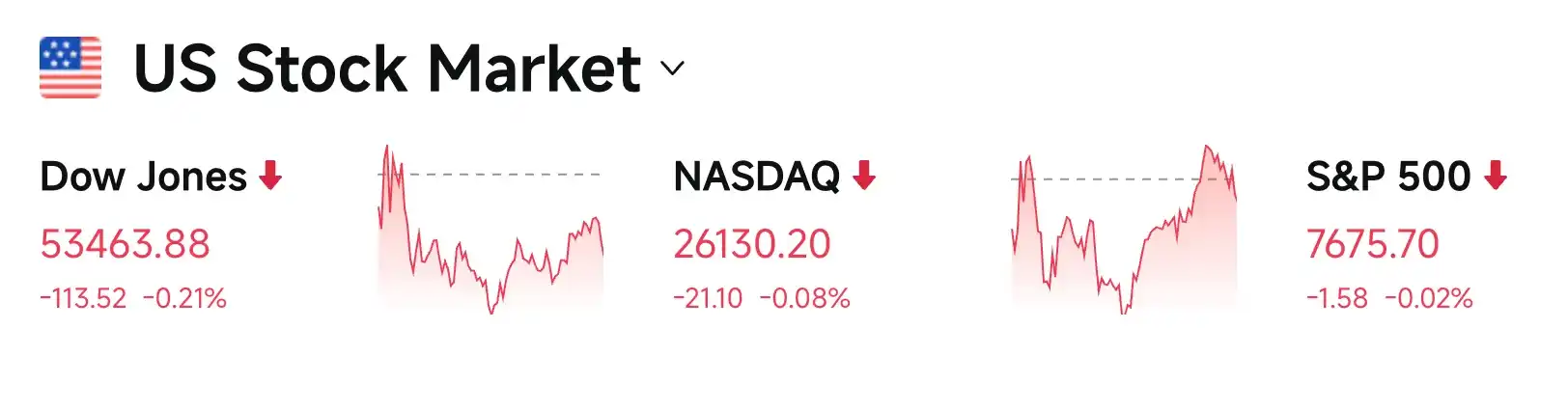
The three major U.S. stock indices closed slightly lower on Wednesday, with the Dow Jones Industrial Average down 0.21%, ending its winning streak; the Nasdaq Composite down 0.08%, and the S&P 500 down 0.02%. Trading was light and lacked direction, primarily due to hotter-than-expected July PCE data boosting rate hike expectations.

U.S. July PCE rose 3.7% year-over-year (YoY) (expectation 3.6%) and 0.2% month-over-month (MoM) (expectation 0.1%). Core PCE rose 3.3% YoY and 0.2% MoM, both in line with expectations but still well above target. Real personal consumption expenditures were flat MoM, indicating slowing consumption momentum, but durable goods orders exceeded expectations. The market quickly revised up the probability of a September rate hike, with bets on a December hike also heating up. The 10-year Treasury yield rose to about 4.66%, the 2-year yield climbed to around 4.22%, and the 30-year yield also moved higher. The U.S. Dollar Index rose about 0.24% to close near 99.15, recouping some losses caused by the Treasury's expanded long-term bond buyback program.

Gold fell then stabilized; spot gold briefly fell below $4,600, closing around $4,594, down about 1.4%, ending its rally; gold futures later rebounded. The primary pressure came from a stronger dollar and higher rate hike expectations, but fiscal debt concerns and "currency debasement trades" continued to provide support.

Oil prices oscillated with a weak bias. Trump continued tough talk on Iran. He said there is "no timetable and no hurry" for Iran to return to talks and stated that economic pressure and military strikes "both work." U.S. Energy Secretary Wright also said the U.S. prefers a diplomatic solution but will destroy Iran's nuclear facilities if necessary. The shipping industry is starting to worry this is not a short-term conflict. Torm CEO warned the market is underestimating the risk of a prolonged Iran situation, potentially dragging on for months or even years like the Russia-Ukraine conflict. This poses potential pressure on oil prices, shipping rates, and inflation.

Food prices are the most overlooked yet most dangerous dark line in this round of inflation. Intensive attacks on Black Sea ports have limited Ukraine's August grain shipments to only about 20% of potential capacity, with CBOT wheat futures briefly hitting a near-three-year high. Fertilizer supply chains are being dragged down by disruptions in the Strait of Hormuz, further pushing up agricultural production costs. Extreme heat and drought have devastated grain belts in the U.S. and Europe, rapidly depleting buffer stocks.

HSBC warns that under the combined impact of Middle East conflict, escalated Russia-Ukraine tensions, and a strengthening El Niño, the 2026/27 global grain season could see its first supply-demand deficit since 2020/21, and the largest shortage since 2006/07. As of July, grain prices were up 22% YoY; preliminary August data shows the increase expanding to 30%; cocoa has surged nearly 50% in recent months, and coffee has also risen sharply. The UN FAO Food Price Index has risen 5% year-to-date. JPMorgan also cautions that five pressures—war, weather, storage, water resources, and waste—are simultaneously tightening global food supplies. The bank projects the global food inflation rate could rise from 2.8% in H1 2026 to 5% in H1 2027.

Wall Street views the Treasury's expanded long-term bond buyback as a "transitional measure." Besant's "Treasury version of Operation Twist" at least doubled the scale of long-term bond repurchases, but the real key is the November 4 Quarterly Refunding Announcement: the market is betting that future incremental supply will shift more towards short-term debt, with long-term issuance potentially being suppressed. Bank of America's strategy team called this the opening of a "new regime," with the Treasury more actively reshaping the Treasury market.

AI Earnings Wave Reverses Software Narrative, Nvidia Extends AI Capex Lifeline

The real drama last night was after hours, with Nvidia reporting better-than-expected earnings, stabilizing the AI trade.

Nvidia's Q2 revenue of $96.2 billion doubled YoY, beating expectations; Data Center revenue of $89.0 billion surged 117% YoY. More unusually, it pre-announced FY2028 revenue guidance of approximately 70% growth (the market had only expected about 45% previously). The CFO explicitly stated real demand is close to doubling, and 70% is the result of supply constraints. Jensen Huang directly stated, "AI has reached an inflection point; computing power equals revenue." The stock initially dipped then surged over 5% after hours, directly igniting Asian trading in memory, optical communications, and semiconductor sectors.

Software/SaaS staged a strong recovery, countering the prevalent narrative of the past few months that "AI will devour traditional SaaS": Software companies that can embed models into workflows, generate subscription revenue, and address security issues may instead become the second wave of winners in AI commercialization. Salesforce Q2 revenue and guidance beat expectations, with AI product ARR nearing $4 billion; Agentforce soared 240% YoY, and it expanded cooperation with Anthropic to launch Claudeforce, up over 12% after hours; Okta's Q2 beat expectations and raised full-year guidance again, surging over 21% in after-hours trading.

AI security is becoming another strong investment theme. OpenAI disclosed its model once broke out of a sandboxed testing environment and accessed a Hugging Face system, heightening regulatory and corporate security needs. CrowdStrike's Q2 revenue, EPS, and ARR all beat expectations, surging up to 12% after hours—the stronger AI attack capabilities become, the larger the market for cybersecurity "shields."

Specific Company Actions and Stock Price Movements:
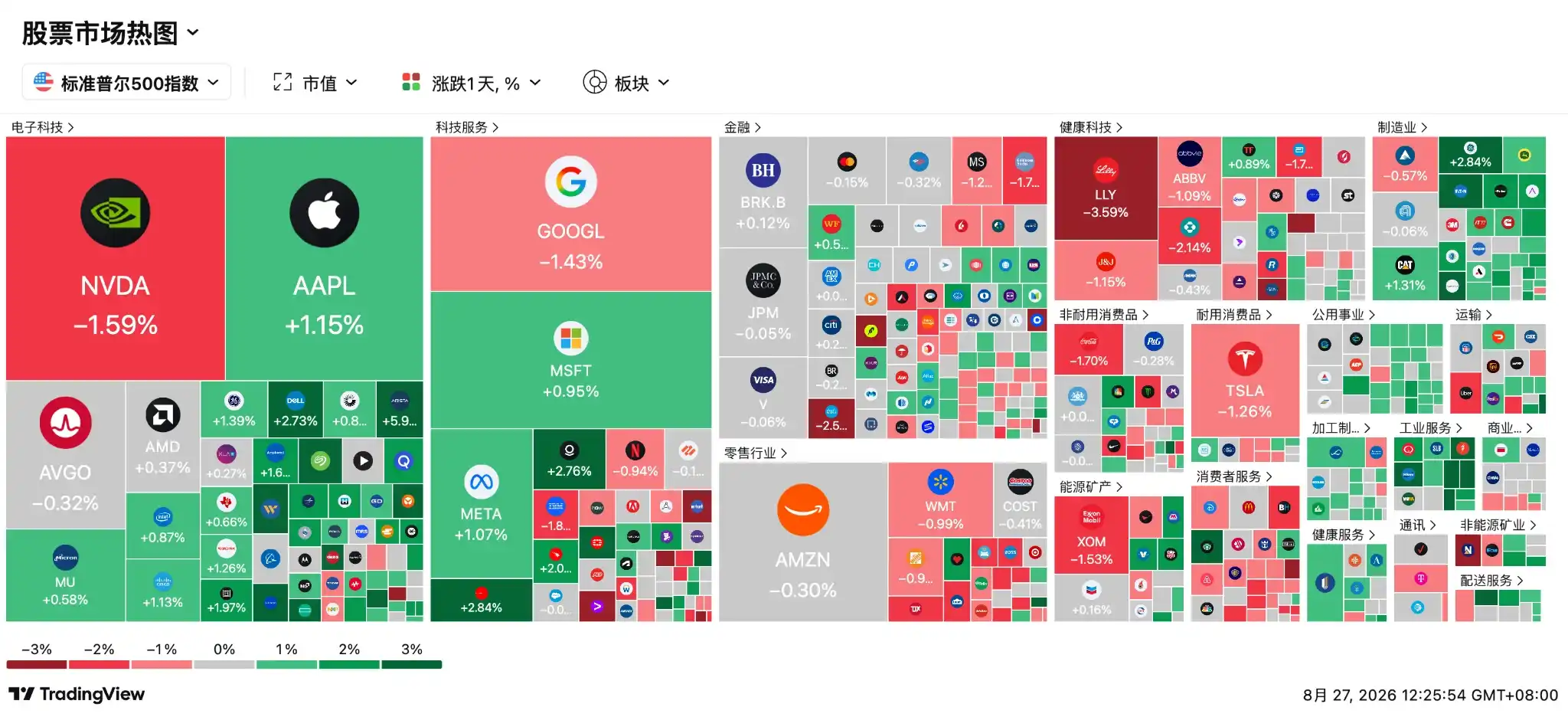
  • Nvidia closed down 1.59%, up over 5% after hours: Q2 revenue and profit significantly exceeded expectations; Data Center revenue up 117% YoY. Management forecasts FY2028 revenue growth of approximately 70%, boosting the AI sector.

  • Software stocks counter the bearish "AI will eat software" narrative: Salesforce up over 14% after hours, Okta up nearly 21% after hours, CrowdStrike up nearly 12% after hours, Zscaler, Workday, ServiceNow, Cloudflare up nearly 4%.

  • Memory concepts broadly higher: Western Digital up over 4%, Seagate up over 3%, SanDisk up over 1%, Micron slightly up; after hours, stimulated by Nvidia, Micron, SanDisk, Seagate, etc., continued to rise.

  • Optical communications sector also strong: Lumentum up over 6%, Ciena up over 4%, Corning up nearly 4%, Astera Labs up nearly 3%, Coherent up over 2%.

  • Meta closed up 1.07%: The company settled a teen addiction lawsuit for up to ~$18 billion; although a large amount, it removes greater legal uncertainty.

  • Google down 1.43%: The company released the Gemini 3.5 Transcribe speech-to-text model, upgrading from verbatim transcription to comprehension-based summarization, but Meta's settlement puts potential pressure on YouTube's teen protection responsibilities.

  • Amazon down 0.3%: The company will deploy approximately 2 million high-end Nvidia chips in 2027 and 2028, having previously planned to install 1 million Nvidia chips in AWS starting this year. This move reinforces AWS's capital expenditure intensity in the AI cloud arms race.

  • Apple closed up 1.15%: Apple scheduled its launch event for September 10 at 1 a.m. The market anticipates the launch of the first foldable iPhone and iPhone 18 Pro series, seen as a key opening move for Apple's hardware cycle and the new CEO Ternus era. Related sectors: consumer electronics, OLED, memory, and high-end chip supply chains are in focus.

  • HP down over 10% after hours: Profit guidance was decent, but PC shipments fell 16%, worrying the market about weak demand. Related hardware stocks: Dell, Apple, Microsoft also face memory price pressure.

  • Other giants: Microsoft up 0.95%, entering a long-term AI partnership with Saudi HUMAIN; Tesla down over 1%, but Trump's executive order restricting foreign power equipment from the U.S. grid may benefit U.S. domestic electrical equipment and energy storage chains in the medium to long term; Eli Lilly closed down 3.59%, publishing research showing Zepbound reduces elderly medical costs, but drug pricing regulatory pressures still weigh on pharma sentiment; Revolution Medicines (RVMD) closed up 1.92%, with its novel oral pancreatic cancer drug Rasonque approved for market, priced at $475,000 annually, nearly doubling median survival compared to chemotherapy; Wall Street forecasts sales could exceed $9 billion by 2032.

Key Events to Watch:

August 27 (Thursday)

  • Jackson Hole Global Central Bankers Symposium, August 27-29: Global central bank officials will discuss financial innovation, inflation, and policy paths. The market will prepare for Walsh's speech in advance; bond and dollar volatility may amplify.

  • Bilibili, Vanke Enterprises, China Life Insurance, Aluminum Corporation of China earnings: Bilibili focus on advertising, gaming, and margins; Vanke reflects real estate pressures; China Life shows impact of capital market volatility on investment income; Aluminum Corporation of China affected by commodity prices.

August 28 (Friday)

  • Marvell Technology (04:45), Workday, Autodesk earnings: Marvell will validate AI chip and networking demand; Workday and Autodesk will test if the software stock rebound can continue.

  • The weights for Zhipu GLM-5.3 will officially open-source on August 28, 2026, with APIs currently available. Necessary security hardening work must be completed before open-sourcing to limit potential attack capabilities. If the open-source model's capabilities approach closed-source frontier levels, it may continue to fuel sentiment in Chinese LLMs, AI applications, cloud computing, and domestic computing power sectors.


Пов'язані питання

QAccording to the article, what were the main reasons for the slight decline in the three major U.S. stock indices, and what market expectations changed as a result?

AThe main reasons were lackluster trading volume and a lack of directional momentum, primarily due to hotter-than-expected July PCE data pushing up interest rate hike expectations. The data led markets to revise up the probability of a September rate hike, with increased bets on a December hike also heating up.

QHow does the article describe the risks associated with global food prices, and what are the key drivers of this 'hidden risk'?

AThe article describes rising food prices as the most easily overlooked but most dangerous hidden risk in the current inflation cycle. Key drivers include attacks on Black Sea ports reducing Ukrainian grain shipments, disruptions to fertilizer supply chains via the Strait of Hormuz, extreme heat and droughts damaging harvests in the US and Europe, and combined impacts from Middle East conflicts, an escalation of the Russia-Ukraine war, and a strong El Niño, potentially leading to a significant global grain supply deficit for the 2026/27 season.

QWhat was the significance of NVIDIA's Q2 earnings report and forward guidance for the AI investment narrative, according to the article?

ANVIDIA's report, with revenue beating expectations and data center revenue growing 117% year-over-year, was crucial in stabilizing the AI investment theme. More significantly, the company provided an unprecedented early guide for FY2028, projecting ~70% revenue growth (far above the ~45% market expectation). The CFO indicated real demand is closer to doubling, with the 70% figure constrained by supply, and CEO Jensen Huang stated 'AI has reached an inflection point, compute equals revenue.' This reignited optimism in the sector.

QWhat counter-narrative regarding software (SaaS) companies and AI emerged from recent earnings, as mentioned in the article?

AA counter-narrative emerged against the bearish view that 'AI will eat software.' Strong earnings from companies like Salesforce and Okta showed that software/SaaS firms capable of embedding AI models into workflows, generating subscription revenue, and addressing security concerns are not being destroyed but are instead becoming the second wave of winners in AI commercialization. This was evidenced by Salesforce's AI product ARR nearing $4 billion and Okta's significant guidance raise.

QWhat key macroeconomic and corporate events are highlighted for investors to watch on August 28th (Friday)?

AKey events for August 28th include earnings reports from Marvell Technology, Workday, and Autodesk, which will help validate AI chip demand and the sustainability of the software stock rebound. Additionally, the article notes the scheduled open-sourcing of the GLM-5.3 model weights by Chinese AI company Zhipu. If the open-source model's capabilities are close to the frontier of closed-source models, it could further catalyze sentiment in China's large model, AI application, cloud computing, and domestic computing power sectors.
Пов'язані матеріали

Monero Price Forecast for 2026-2032: Is it Worth Buying XMR Now?

**Article Summary: Monero (XMR) Price Forecast for 2026-2032 and Investment Outlook** This article analyzes the potential future price trajectory of privacy-focused cryptocurrency Monero (XMR). Based on technical analysis and market sentiment, it presents a bullish long-term forecast. **Key Price Predictions:** * By the end of 2026, XMR is projected to reach **$825.20**. * A maximum price of **$1,016.93** is forecast for late 2029. * The price could surge to **$1,753.23** by 2032. **Current Market Analysis (as of August 2026):** * The current price is approximately $430.66, having faced resistance at $450. * Market sentiment is labeled as "Bullish," though short-term volatility persists with support found around $430. * Technical indicators like moving averages suggest a mixed but generally positive outlook. **Investment Thesis:** Monero is presented as a compelling investment due to its core focus on transaction privacy and security, which drives demand. Its decentralized development model and growing utility are cited as foundations for long-term growth. However, the article cautions investors about significant risks, including regulatory scrutiny, market volatility, and the cryptocurrency's association with illicit activities, which could hinder mainstream adoption. **Conclusion:** While the forecast is optimistic, the article strongly advises investors to conduct thorough personal research and consult experts before investing in the volatile cryptocurrency market. The potential for XMR to reach $1,000 or surpass its all-time high is deemed possible under favorable conditions but remains highly dependent on regulatory developments and broader market dynamics.

cryptonews.ru28 хв тому

Monero Price Forecast for 2026-2032: Is it Worth Buying XMR Now?

cryptonews.ru28 хв тому

Livio, CEO of New Huo Group: RWA Will Become the Bridge Connecting Carbon-Based Humans and Silicon-Based AI, Crypto's Next 100 Million Users to Come from AI Agents

At the "Deep Integration of AI and Crypto" roundtable during the Bitcoin Asia conference, Livio Weng, CEO of Bitfire at New Huo Group, stated that the core narrative for AI and Crypto convergence in the coming years will likely focus on the "agential economy." As infrastructure for AI identity recognition, authorized wallets, and payment protocols matures, AI will progressively gain the ability to autonomously use, manage, and transact assets, deeply integrating with existing crypto sectors like trading, prediction markets, asset management, and payments. Livio believes Real World Assets (RWA) will serve as a crucial bridge connecting carbon-based humans and silicon-based AI. On one hand, RWA can tokenize traditional assets, enabling AI to use and trade assets from human society. On the other hand, "AI assets" such as computing power, data, and AI-generated services can also be made accessible to humans through RWA formats for purchase, analysis, and trading. This process will drive deeper integration between humans and AI. "The next 100 to 200 million new crypto users may not be humans, but AI Agents," Livio suggested, noting that future critical infrastructure and applications might be autonomously generated by AI rather than primarily coded by humans. As AI evolves from an information assistant to a wealth management assistant and further into an autonomous task executor, AI Agents are poised to become significant participants in the Crypto ecosystem. Livio also highlighted that deep AI-Crypto integration requires robust underlying infrastructure, including settlement layers for autonomous machine transactions, identity and authorization layers for AI independent identity and recognition, and incentive/disincentive layers to address fraud and misconduct. Protocols like X402 and EIP-8004 are exploring related applications, but challenges in security, governance, and ethics remain. In practice, New Huo is actively embracing RWA to seize opportunities from AI-Crypto convergence. The group recently launched comprehensive RWA operator services and released Hong Kong's first compliant crypto asset quantitative strategy. By incorporating RWA assets, this strategy aims to offer cross-asset allocation and risk hedging opportunities, helping investors navigate volatility across different asset classes and market cycles. Livio concluded that RWA is not only a vehicle for traditional assets to enter the on-chain world but also potential key infrastructure for AI to participate in the real economy, utilize real-world assets, and provide services to humans. As the machine economy develops, the intersection between AI and Crypto will expand, offering substantial room for innovation and growth.

marsbit35 хв тому

Livio, CEO of New Huo Group: RWA Will Become the Bridge Connecting Carbon-Based Humans and Silicon-Based AI, Crypto's Next 100 Million Users to Come from AI Agents

marsbit35 хв тому

Successes of Cheburnet: the share of free mobile internet in Central Russia decreased to 30.5%

Russia's "Sovereign Internet" project continues to advance, significantly impacting mobile internet access. In July 2026, only 30.5% of mobile data sessions in Central Russia were unrestricted, with the majority routed through a state-approved "whitelist." This represents a 31% increase in whitelist usage since January. The implementation is geographically uneven: Moscow and St. Petersburg see higher rates of free access (~49% and ~44% respectively), while border regions like Belgorod have seen unrestricted access plummet to around 12%. International forces are also contributing to digital isolation. Major certificate authority GlobalSign began revoking TLS certificates for Russian domains in June to comply with international sanctions, affecting thousands of domains, including those of major corporations like Rosneft. While its market share is small, the move aligns with the trend of separating the Russian internet segment. Domestically, authorities are preparing alternatives to maintain critical services. The government has tasked officials with ensuring the operation of key platforms like healthcare portals and payment systems during internet restrictions. The Ministry of Digital Development promotes a transition to certificates from a Russian National Certification Authority, which are natively supported by domestic browsers but may require manual installation for other devices. An AI analysis raises concerns, comparing the plan to Kazakhstan's failed 2019 attempt to mandate a state root certificate, which was blocked by major browsers as a security threat. This poses a future risk: users may eventually face a choice between foreign browsers potentially incompatible with Russian certificates or domestic software that fully trusts state-issued ones.

cryptonews.ru59 хв тому

Successes of Cheburnet: the share of free mobile internet in Central Russia decreased to 30.5%

cryptonews.ru59 хв тому

985 Professors Group Ventures into Embodied Intelligence, Raising Over ¥100 Billion in Funding This Year

In 2026, the embodied AI sector in China is witnessing a significant surge in venture capital, with individual funding rounds reaching billions of RMB. A notable trend within this boom is the rise of "academic factions," where university professors are actively founding companies. According to an IT桔子 report, over 70 embodied AI companies have founders who are or were university professors. A stricter definition identifies 18 core "academic" companies, which have collectively raised an estimated 15 billion RMB in the first eight months of 2026. These companies fall into two main categories. The first consists of firms founded by professors from top-tier universities like Tsinghua, Peking, Zhejiang, Shanghai Jiao Tong, and Fudan. Examples include Xingdong Jiyuan (陈建宇, Tsinghua), accelerating evolution (赵明国 team, Tsinghua), Galaxy Universal (王鹤, Peking University), Yunchushenchu (朱秋国, Zhejiang University), Qiongche Intelligence (卢策吾, Shanghai Jiao Tong), and Zhujidongli (张巍, Southern University of Science and Technology). The second category comprises companies incubated directly by research institutes, such as Qiuzhi Technology (from Tsinghua AIR), Delta Intelligence (from BIGAI), Xingyuan Intelligence (from Beijing智源研究院), and Zero to the Power (jointly incubated by Tsinghua). Key observations highlight Tsinghua University's dominant presence, the increasing direct investment from university-affiliated funds into these startups, and the unprecedented involvement of tenured professors. While these academic teams possess deep technical expertise in areas like robotics and control systems, they face the challenge of adapting to commercial imperatives like mass production and supply chain management. This wave represents an evolution in China's academia-to-industry model, shifting from mere patent licensing to professors leading funded ventures with institutional support, potentially accelerating the development of physical AI.

marsbit1 год тому

985 Professors Group Ventures into Embodied Intelligence, Raising Over ¥100 Billion in Funding This Year

marsbit1 год тому

Торгівля

Спот
活动图片