The Monero price forecast has always hinged on two distinct charts, and this week both have become clearer. $XMR is trading at $371.07, pressing against the neckline of a cup and handle pattern targeting $427, supported by developments like the Cuprate and Serai code releases. Strong development progress is not in question. The question is whether the rally can sustain itself, as 73 exchanges have already delisted Monero and the EU is preparing to ban it entirely in 2027.
Monero Price Analysis: Cup and Handle Neckline in Sight as RSI Tops 60
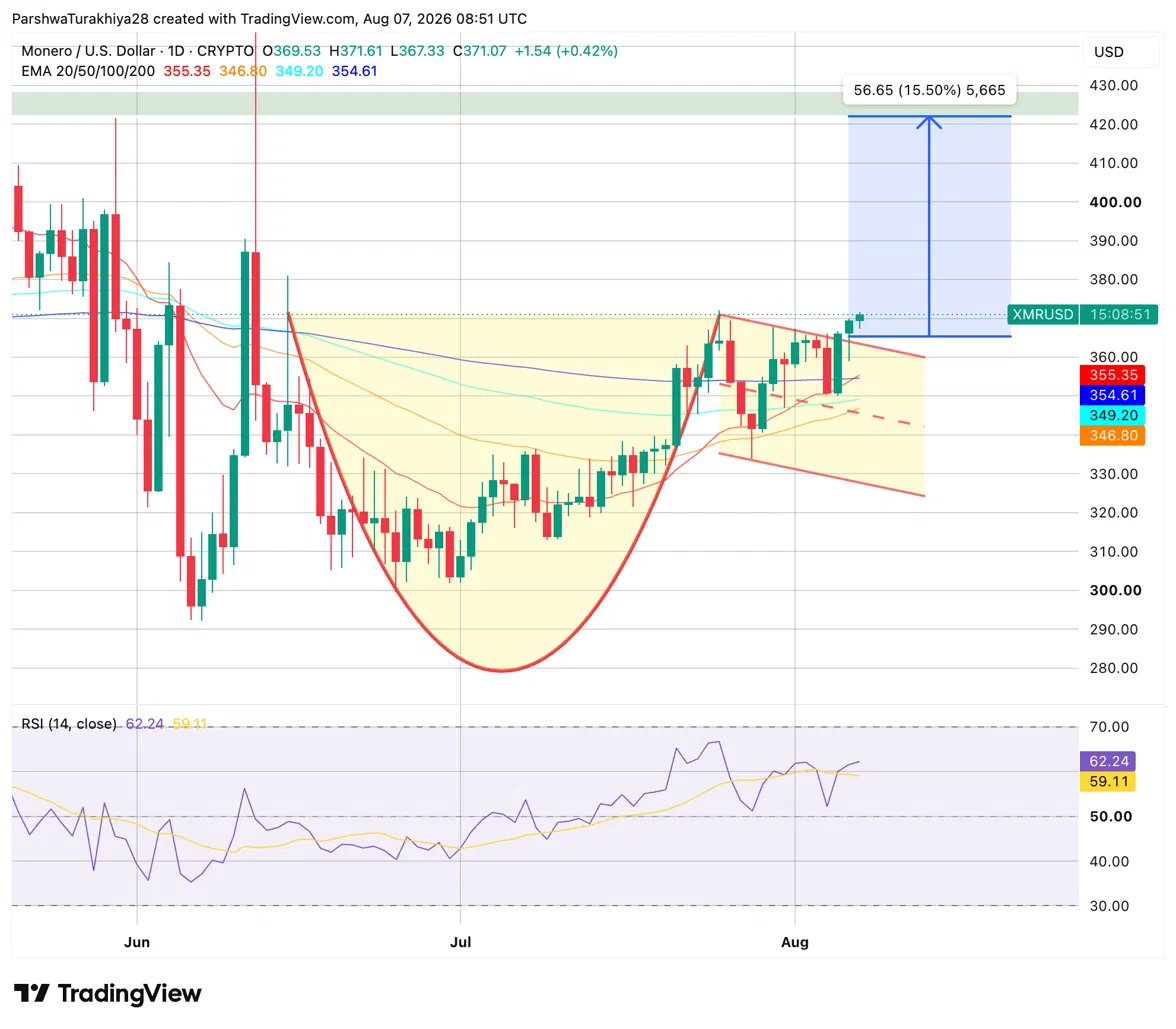
The daily chart shows $XMR pressing against the neckline of a cup and handle pattern formed between the June low around $280 and the August recovery. During June and July, the cup formed a shallow handle between $345 and $365, and the price is now moving towards the breakout level. A confirmed daily close above $370-$371 will confirm this pattern, with the measured move projected to $427, roughly 15.5% above the neckline.
Related: Cardano Price Forecast: Will ADA Reach $0.20 – A Breakout or Another Fakeout?
All four EMAs are tightly grouped just below the current price in a bullish order. The 20-day EMA at $355.35 serves as the first support, followed by the 50-day at $346.80, the 100-day at $349.20, and the 200-day at $354.61. The RSI at 62.24 is above the neutral line and above its signal at 59.11, confirming buyer momentum as it approaches a test of the neckline.
$XMR Support and Resistance Levels for August 2026
| Type | Price | Level |
| Resistance | $370–$371 | Cup and Handle Neckline, Trigger Point |
| Resistance | $400 | Round Number and Psychological Level |
| Resistance | $427 | Measured Move Target from Cup and Handle |
| Support | $355.35 | 20-day EMA |
| Support | $354.61 | 200-day EMA, Clustering with 20-day |
| Support | $349.20 | 100-day EMA |
| Support | $346.80 | 50-day EMA |
$XMR August Seasonality: Average is Extraordinary, Median is Harsh
August has historically been Monero's strongest month by a wide margin, averaging +44.6% returns across all years with available data. This figure is almost entirely driven by +371.6% in 2016 and +252.1% in 2017.
Removing these two outliers paints a dramatically normalized picture. The median August return is just -3.69%, with recent years being mixed: +7.17% in 2024, -14.2% in 2025, and -11.4% in 2023. $XMR has already posted +3.55% in August 2026, starting the month from a base after a 17.5% decline in June and an 18.2% recovery in July.
| Year | August Return |
| 2016 | +371.6% |
| 2017 | +252.1% |
| 2020 | +10.2% |
| 2021 | +19.8% |
| 2024 | +7.17% |
| 2026 (YTD) | +3.55% |
| 2023 | -11.4% |
| 2025 | -14.2% |
| Historical Average | +44.6% |
| Historical Median | -3.69% |
Monero News: Cuprate and Serai Ship as Development Accelerates
A new version of Cuprate (an alternative and independent Monero node software written in Rust) has been released!
— Monero ($XMR) (@monero) August 4, 2026
'With default settings, users with fast enough internet can expect to sync the blockchain in an hour.' https://t.co/0SxmppVQiB
Monero shipped two significant codebases on August 6th. Cuprate, a new Rust-based node client, shipped alongside code for Serai – a decentralized exchange designed for native, private cross-chain trading. $XMR rose about 2.6% on the day of the release, indicating the market is responding to development progress rather than ignoring it.
Related: SkyAI Price Forecast for August 2026: Can SKYAI Hold Its Breakout?
Cuprate adds node diversity to the Monero ecosystem, reducing reliance on the existing C++ implementation and making the network more resilient. Serai is especially relevant in the context of ongoing exchange delistings, as it would allow $XMR holders to swap into other assets without relying on centralized platforms that are exiting the market under regulatory pressure.
While Bitcoin is now under the full control of banks and other institutions, the very entities that should not be treated as 'friends', and other majors are stuck in limbo, the only thing that interests me in 'crypto' right now, is Monero ($XMR).
— CR1337 (@CR1337) August 4, 2026
Over the last years, its... pic.twitter.com/bQPXHUZUzB
Analyst CR1337 stated on X on August 4th that Monero is the only crypto asset holding his attention now, citing its ongoing development, privacy properties, and fungibility as most important as Bitcoin falls increasingly under institutional control.
Big sellers from the seller side have started to appear on Retoswap, which means trust in this DEX is increasing, bullish for Monero monero:native pic.twitter.com/gE5v89S6ck
— Moneronomic (@moneronomic) August 7, 2026
Additionally, analyst Moneronomic noted that large sellers have started appearing on Retoswap, Monero's decentralized exchange – which they view as a sign of growing trust in the DEX and a bullish signal for the broader ecosystem.
Monero News: 73 Delistings Complete, EU Ban Looms for 2027
The regulatory picture for Monero is the most obvious long-term risk to the setup. $XMR has been delisted from 73 centralized exchanges since the compliance wave began earlier this year, with BitMEX removing $XMR and 34 other contracts in late July ahead of a September 23rd shutdown. Dubai's DIFC has banned privacy coins on licensed platforms, and the EU's MiCA-linked Regulation 2024/1624, taking effect July 10, 2027, will completely ban regulated exchanges from listing privacy coins.
The EU's 2027 ban is the most significant overhang. It gives $XMR roughly eleven months until a major liquidity fragmentation event, and is already being priced into the market structure. The integration of Serai DEX and THORChain for native $XMR swaps, slated for mid-2026, is the ecosystem's direct response to this challenge, attempting to shift trading volume from centralized to decentralized venues before the ban takes effect.
| Regulatory Event | Details | Timeline |
| Exchange Delistings | 73 CEXs have removed $XMR | Ongoing 2025-2026 |
| BitMEX Delisting | $XMR and 34 contracts removed | Late July 2026 |
| Dubai DIFC Ban | Privacy coins banned on licensed platforms | Effective |
| EU MiCA Ban | Regulated exchanges banned from listing privacy coins | July 10, 2027 |
Weekly Monero Forecast for August 2026
| Week | Price Range | Level to Watch | Scenario |
| August 1–8 | $355 to $390 | Cup and Handle Neckline - $370–$371 | Daily close above $371 confirms breakout |
| August 11–15 | $360 to $410 | Round number at $400 | Breakout targets $400; Losing $355 opens retest of handle lows near $345 |
| August 18–22 | $370 to $427 | Measured move target at $427 | Mid-month push towards $427 if $400 is cleared; Rejection at $400 keeps range-bound price action |
| August 25–31 | $350 to $427 | Monthly close above $400 | Monthly close above $400 would be a strong signal for continuation into September |
$XMR Price Forecast for August 2026: Upside and Downside Targets
Bull Case, Target: $427 (Measured Move)
$XMR closes above the cup and handle neckline at $370–$371 on a daily basis, with RSI holding above 60, confirming sustained momentum. The rollout of Cuprate and Serai draws renewed attention to Monero's development trajectory, while growing Retoswap volume provides decentralized liquidity to offset further CEX delistings. Price clears $400 in the second week of August and approaches the measured move target of $427 by month's end.
Bear Risk, Risk Level: $346 (50-day EMA)
The $370–$371 neckline rejects price, and $XMR loses the 20-day EMA cluster at $354–$355 on a daily close. Fears around the EU ban weigh on sentiment as the 2027 deadline approaches and centralized liquidity continues to shrink. Price declines towards the 50-day EMA at $346.80 and the handle low near $345, where buyers must step in to preserve the cup and handle pattern.
Related: Top 3 Price Forecasts: Bitcoin (BTC), Ethereum (ETH), $XRP ($XRP)
Conclusion
Monero's chart and its regulatory backdrop tell two different stories at once. The cup and handle setup, rising RSI, and back-to-back releases of Cuprate and Serai give bulls a clean technical and fundamental argument for $427.
But 73 exchange delistings and an EU ban less than a year away mean the network's future increasingly hinges on whether decentralized infrastructure like Serai and Retoswap can absorb liquidity quickly enough to replace what centralized exchanges are removing. The $370–$371 neckline is the short-term signal: hold it and $400 comes into view; lose the $355 EMA cluster and the setup shifts back towards the handle lows near $345.