Why Is DeFi Insurance Unpopular?

Foresight NewsОпубліковано о 2026-06-23Востаннє оновлено о 2026-06-23

Анотація

The article explores the core reasons why DeFi insurance remains largely unutilized despite its potential to eliminate traditional insurance inefficiencies and malicious claim denials through automated smart contracts. Key points include: 1. **Low Adoption & Minimal Payouts:** Leading provider Nexus Mutual has paid only ~$18M in claims since 2019, dwarfed by single hack losses (e.g., Kelp DAO's $292M loss). 2. **High Correlation Risk:** Unlike traditional insurance (e.g., house fires), DeFi risks (oracle failures, bridge hacks) are systemic and can simultaneously impact multiple protocols, threatening to drain entire insurance pools. 3. **Prohibitive Cost vs. Reward:** For many protocols (Aave, Morpho, Compound), insurance premiums (1.5%-6%) consume a significant portion or even all of the native yield (3%-4%), leaving investors with meager returns. In some cases (Maple Finance, Ethena), premiums can even result in net-negative yields. 4. **Inadequate Capacity:** The total DeFi insurance pool (e.g., Nexus Mutual's $81.56M) is minuscule compared to the hundreds of billions in total value locked (TVL), creating a massive supply-demand gap. 5. **Structural Flaws:** The claims assessment model (e.g., Nexus Mutual's member voting) creates a conflict of interest, as voters bear the loss if a claim is paid. There is also no regulatory mandate forcing DeFi protocols to obtain insurance. The industry is adapting by focusing on preventative measures (e.g., bug bounty coverage) a...


Authored by: Thejaswini M A

Compiled by: Luffy, Foresight News


"Insurance is nothing but a scam," is almost a consensus in the market.


People think this way for a reason. Cigna, a U.S. insurance company, developed an algorithm that could directly deny claims without reviewing medical records. UnitedHealth, when the time set by its algorithm expired, directly stopped paying for care, completely disregarding the opinions of attending physicians. The traditional insurance business model has always been: collect client funds first, take a hefty cut, and then set up barriers at every step to impede claims.


Today, bank deposits are insured by the Federal Deposit Insurance Corporation (FDIC), but the coverage limit is only $250,000, a standard that has remained largely unchanged since its establishment in 1934. Brokerage accounts are protected by the Securities Investor Protection Corporation (SIPC) with a limit of $500,000; once account assets exceed this figure, the protection becomes meaningless. The public perception of security is far lower than reality, with coverage limits set entirely at the discretion of insurance companies.


DeFi insurance was supposed to completely solve this pain point: eliminate intermediaries, with payouts automatically executed as long as the smart contract's preset conditions are triggered, completely removing the possibility of malicious claim denials.


But the reality is that almost no one is buying. Insurance premiums would severely erode investment returns, and after deducting premiums, the remaining yield simply cannot match the investment risks users bear.


This article will explain this market situation and why, even though everyone wants to solve the problem, it's difficult to reverse the core root cause of the predicament.


Nexus Mutual is currently the largest DeFi insurance provider. Since its launch in 2019, its total cumulative claims paid amount to just over $18 million.
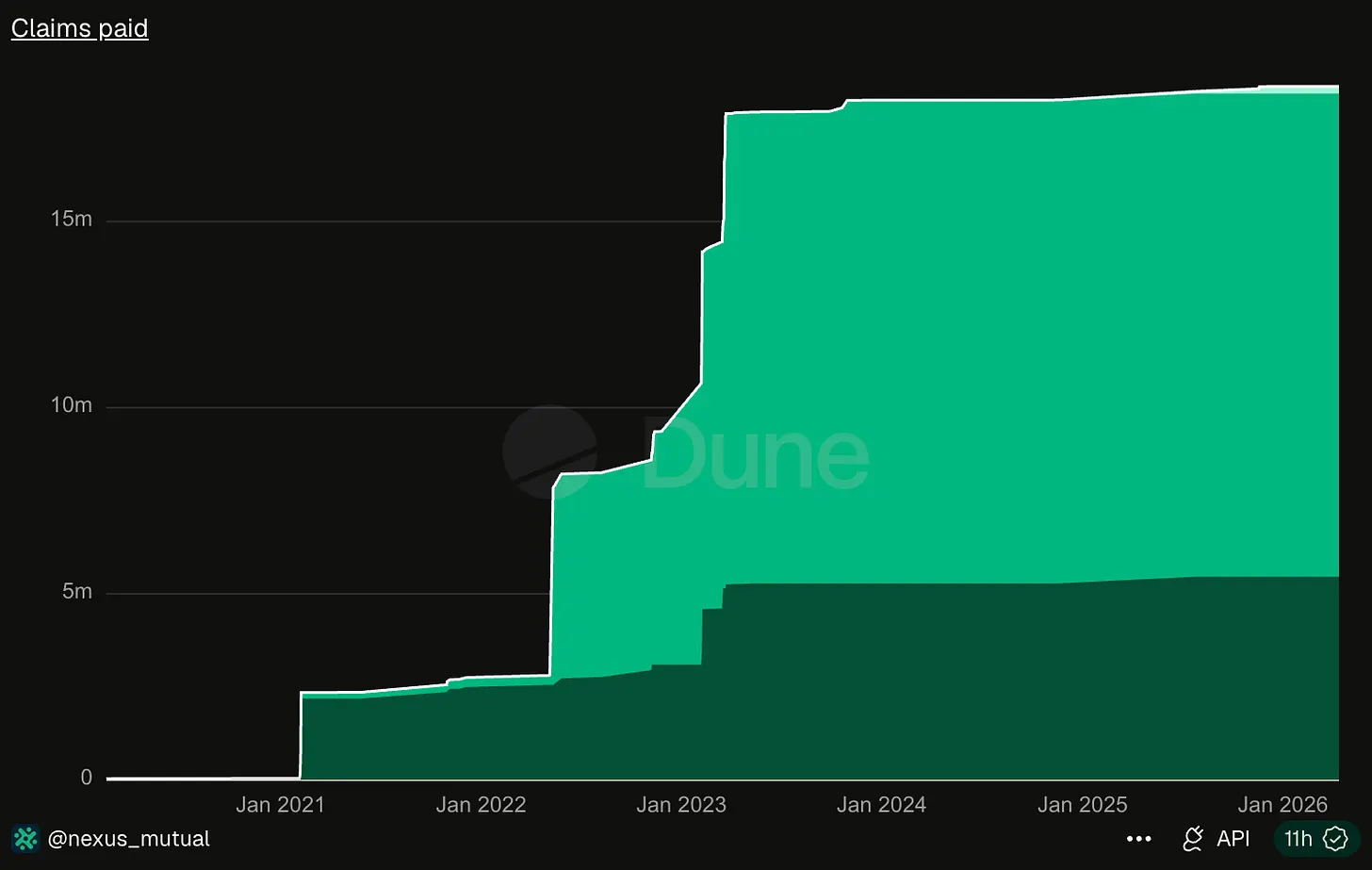

Data source: Dune Analytics


In April 2026, Kelp DAO suffered a hack, resulting in losses of up to $292 million. The amount stolen in this single incident alone is equivalent to 16 times the total claims paid by this leading insurance institution over seven years.


This forms an extreme contrast with the current situation of traditional insurance's frantic claim denials. Traditional insurance collects high premiums but goes to great lengths to obstruct claims; DeFi insurance, however, generates meager premium income because almost no investors are willing to purchase coverage.


The stable operation of traditional insurance relies on the principle of uncorrelated risks. One house catching fire doesn't cause other houses to be damaged. An insurance company can sell policies to 1 million users, and a single fire claim can be covered by the premiums collected from all. However, DeFi lacks this risk isolation mechanism: security incidents like oracle failures or cross-chain bridge vulnerabilities can chain-react, impacting all lending protocols and liquidity pools built on that underlying asset. The USDC de-pegging event in March 2023 affected all protocols that used USDC as collateral on that day. For a DeFi insurance pool, risks are highly correlated. The underwriter can only bet that losses from security incidents are controllable and that the pool's funds are sufficient to cover them.


In March 2023, Euler Finance was hacked for $197 million, and the risk spread rapidly: Angle Protocol lost $17 million due to holding Euler liquidity tokens, Yield Protocol shut down operations urgently, and other platforms like Inverse Finance were also affected.


Once a protocol has a security vulnerability, it often affects multiple projects. A single extreme incident in one day could even directly deplete the entire claim reserve of an insurance pool.


I compiled the current premium rates for Nexus Mutual and InsurAce and compared them to the native annual percentage yield (APY) of the protocols they insure: Aave V3's USDC deposit APY is about 3.14%, while the insurance premium range is 1.5%–2.5%. After deducting premiums, the net yield is only 0.6%–1.6%. Investors bear on-chain security risks only to end up with returns slightly higher than ordinary bank savings.
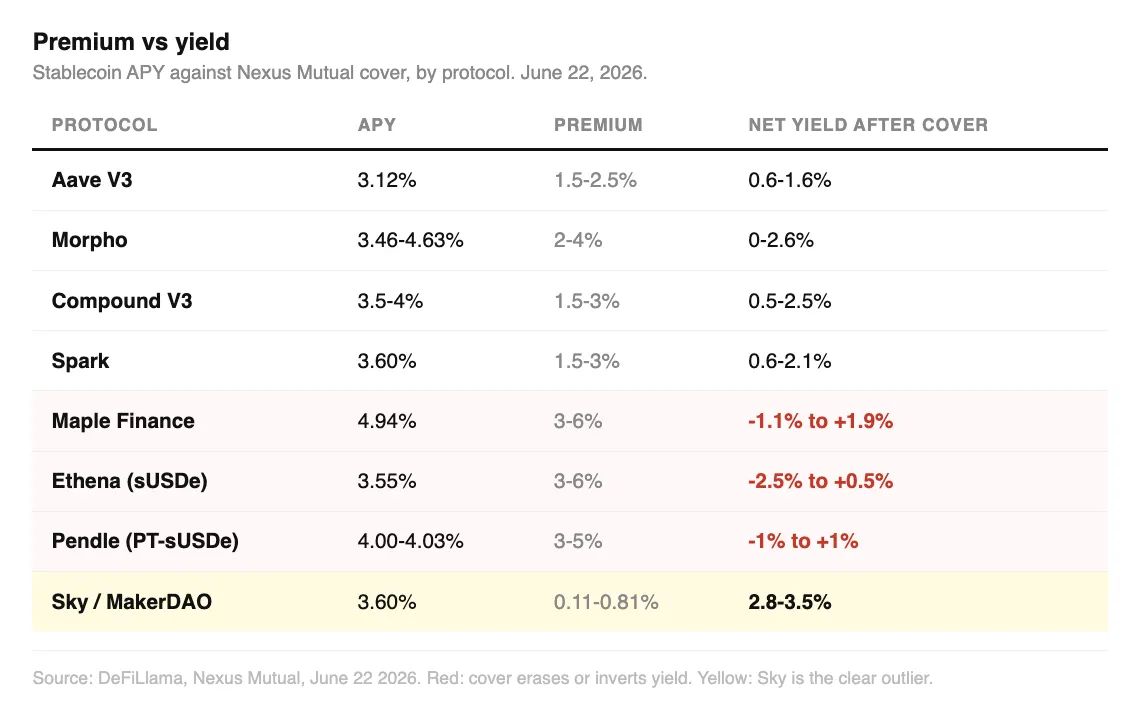


Morpho, Compound, and Spark show similar situations, with native APYs of 3.5%–4%. Premiums consume one-third to half of the yield, leaving minimal profits but with extremely low cost-effectiveness.


Maple Finance's institutional lending pools offer APYs of 4.77%–4.90%, but insurance premiums are as high as 3%–6%. The net yield after insurance ranges from -1.1% to 1.9%. Ethena staking offers APYs of 3.6%–4%, with premiums also at 3%–6%, resulting in net yields of -2.4% to 1%. Purchasing insurance on these two types of platforms can, in extreme cases, lead to losses on the principal for investors.


Only the original MakerDAO (Sky) stands out. Its savings product offers a 3.6% APY, with the lowest insurance premium being only 0.11%. It is widely recognized as the lowest-risk entity within DeFi, retaining a net yield of 2.8%–3.5% after insurance, preserving most of the returns.


Premium pricing strictly corresponds to risk levels, but premiums for emerging platforms are too high, directly consuming the high yields users seek when entering the market.


Crypto investors choose to forgo insurance not out of laziness or recklessness; they understand that in most cases, purchasing insurance equates to zero returns. Even if all DeFi depositors collectively chose full coverage tomorrow, the entire industry could not meet the demand: Nexus Mutual's total pool size is about $81.56 million, and the entire industry's effective coverage capacity is at most a few hundred million dollars. In contrast, the total value locked (TVL) in major protocols amounts to hundreds of billions, a gap of astronomical proportions.


A single large-scale security incident like Kelp DAO would directly drain the vast majority of the industry's insurance reserves.


The historical claims total of $18 million precisely exposes the fragility of the industry's capital pools; the market has never experienced a catastrophic risk event capable of breaching underwriting reserves.


After a user submits a claim to Nexus Mutual, all token-holding members of the platform must vote on whether to pay. Members who vote in favor of paying a claim risk having their own assets directly impaired if the claim ultimately fails to be paid. This mechanism naturally fosters a tendency to deny claims. Traditional insurance employs dedicated underwriters and claims adjusters to balance conflicts, whereas DeFi insurance design merges all responsibilities onto the same group.


Before the 2008 financial crisis, financial risk pricing agencies generally believed a nationwide U.S. housing price collapse was impossible, as they had never experienced it. Insurance giant AIG massively sold risk protection contracts but was completely unable to pay when the market crisis truly erupted.


Before the U.S. government introduced FDIC deposit insurance, ordinary savers had no asset safety net. The Great Depression forced the government to mandate bank insurance, making coverage a hard cost for banks to operate.


In the DeFi space, no one can force protocols like Aave or Morpho to purchase insurance. Smart contract deployment is completely permissionless; there is no entity that can mandate projects to configure risk protection. This also leads to a lack of a safety net to withstand extreme market conditions in the industry.


The three largest claims in Nexus Mutual's history are: the FTX collapse, paid in two installments totaling about $7.3 million; the TribeDAO hack, a $5 million payout; and the Euler Finance hack, a $3.4 million payout. The sum of these three amounts almost equals the platform's total cumulative claims of $18.6 million over seven years.


Now, this mutual insurance platform is shifting towards proactive risk prevention. It has partnered with security audit agencies like Immunefi, Cantina, and Sherlock to launch bug bounty protection products. The protocol only needs to bear 20% of the critical bug bounty cost, with Nexus Mutual covering the rest, pre-funding incentives for white-hat hackers to identify vulnerabilities and avoid theft incidents at the source. Meanwhile, Nexus Mutual is expanding into compliant insurance tranches, attempting to connect crypto risks to reinsurance capital pools and introduce larger external capital to supplement underwriting capacity.


In March 2025, Cantina took a step further by launching an independent native protocol protection product, ensuring users can still receive payouts even if a vulnerability is not discovered early by bounty hunters and the protocol is hacked.


Both of these strategic shifts essentially acknowledge a core reality: on-chain native capital is insufficient to cover on-chain risks. Three fundamental flaws are irreparable: the insurance pool size is too small, risks are highly correlated, and the claim adjudicators and capital providers are the same group.


Nexus Mutual has $81.56 million in Total Value Locked (TVL) according to DeFiLlama, capturing 85% of the DeFi insurance market share. Other players are continuously shrinking: InsurAce peaked at $150 million TVL and is now only $132,000, having completed only one major claim after the UST de-peg in 2022; Sherlock's pool shrank from $60 million to $505,000 within a year; Unslashed Finance has millions of dollars trapped in outdated, un-updated code since late 2024. Other insurance projects have either shut down completely or pivoted to different business models.


A lighthouse warns all ships of hidden reefs but cannot charge passing vessels a fee, making it difficult for anyone to voluntarily fund its construction. The benefits are shared by all, but the cost is borne by the builder alone.


The value of DeFi insurance lies in preventing the spread of chain-reaction liquidation stampedes. Crypto market assets are highly interconnected; only when everyone simultaneously obtains coverage can overall market stability be maintained. But if everyone expects others to buy insurance as a safety net while unwilling to bear the premium cost themselves, ultimately no one will configure insurance, and the risk protection system becomes useless. Protection that no one actively underpins ultimately safeguards no assets.

Трендові криптовалюти

Пов'язані питання

QWhat is the core reason why DeFi insurance has low adoption, as explained in the article?

AThe core reason is that insurance premiums heavily erode user yields. After deducting premiums, the net returns often barely exceed or even fall below traditional savings rates, making insurance an unattractive cost for risk-seeking DeFi users.

QHow does the risk profile in DeFi differ from traditional insurance, and why is this a problem?

AIn traditional insurance, risks are largely uncorrelated (e.g., one house fire doesn't affect others). In DeFi, risks are highly correlated—a single oracle failure or bridge hack can impact multiple protocols and their underlying assets simultaneously, threatening to drain an entire insurance pool from one event.

QWhat specific example does the article use to illustrate the insufficiency of DeFi insurance pool sizes?

AThe article cites the Kelp DAO hack in April 2026, which resulted in a loss of $292 million. This single loss was 16 times greater than the total historical claims paid out by Nexus Mutual, the largest DeFi insurer, over seven years (~$18 million).

QWhat is a key structural flaw in the claims process for platforms like Nexus Mutual?

AA key flaw is that the same group of token holders who provide the capital for the insurance pool also vote on whether to pay out claims. Since their own assets are at risk if a claim is approved and paid, the system has a built-in incentive to deny claims.

QWhat fundamental economic dilemma does the 'lighthouse' analogy at the end of the article highlight for DeFi insurance?

AThe 'lighthouse' analogy highlights a public goods dilemma. DeFi insurance provides stability and prevents cascading liquidations for the entire ecosystem (a shared benefit), but the cost is borne individually by those who pay premiums. If everyone relies on others to buy insurance, no one will, and the protective system fails.

Пов'язані матеріали

The Final Piece of Franklin Templeton's Crypto Ambition

Franklin Templeton Completes Crypto Ambition with Acquisition of 250 Digital On June 22, Franklin Templeton announced the acquisition of 250 Digital and established Franklin Crypto, a new division focused on actively managed cryptocurrency strategies for institutional investors. The unit is led by Christopher Perkins and Seth Ginns. This acquisition marks a key piece in Franklin Templeton's multi-year crypto strategy, which began in 2018 with a digital assets team. The firm's crypto product suite now spans three layers: tokenized funds like the blockchain-based money market fund BENJI (~$831M AUM); a series of passive ETFs including Bitcoin (EZBC, ~$368M), Ethereum (EZET), XRP (XRPZ, ~$252M), Solana (SOEZ), and a multi-crypto index fund (EZPZ); and the newly added active management strategies from Franklin Crypto. The company has also expanded its crypto ecosystem through investments in projects like Ethena and Crossmint, and collaborations with blockchains such as Aptos and Sui. With approximately $18B in digital asset AUM and a total firm AUM of ~$1.78T, Franklin Templeton is positioning itself as a comprehensive crypto asset manager for pensions and sovereign wealth funds. In contrast, competitor Fidelity Investments has taken a different path, focusing early on building its own custody and trading infrastructure. Fidelity's Bitcoin ETF (FBTC) holds over $11B, significantly larger than Franklin Templeton's equivalent offering. Both giants' moves underscore the deepening trend of traditional finance entering the crypto space.

Foresight News9 хв тому

The Final Piece of Franklin Templeton's Crypto Ambition

Foresight News9 хв тому

Black Tuesday in Japanese and Korean Stock Markets: South Korea Triggers Circuit Breaker, Nikkei Plummets, AI Boom Undergoes Phased Adjustment

"Black Tuesday" for Asian Markets: Korean Stocks Halted by Circuit Breaker, Nikkei Plunges as AI Rally Undergoes Correction Asian stock markets experienced severe turbulence on Tuesday, with South Korea's benchmark KOSPI index plummeting nearly 10% after triggering a market-wide trading halt when its losses exceeded 8%. Japan's Nikkei 225 index also fell sharply by approximately 3.5%, ending an eight-day winning streak. The sell-off was heavily concentrated in the technology and semiconductor sectors, with giants like Samsung Electronics and SK Hynix leading the declines. The plunge reflected a rapid reversal from recent highs, with the KOSPI having retreated over 12% from its mid-June peak. Analysts attribute the sharp correction to multiple converging factors. The direct trigger was weakness in U.S. tech stocks, which fueled profit-taking in overbought Asian markets. Furthermore, stronger-than-expected U.S. jobs data has reinforced expectations that the Federal Reserve will maintain or even raise interest rates, putting pressure on rate-sensitive growth stocks. Structural vulnerabilities also played a role, particularly in South Korea, where the market is highly concentrated in a few semiconductor heavyweights, making it susceptible to shifts in global AI demand and foreign capital outflows. Despite the short-term volatility, the long-term narrative for AI and semiconductors remains intact. Industry forecasts still point to massive growth in global AI capital expenditure over the coming years. South Korean firms like SK Hynix maintain a dominant position in critical segments like High Bandwidth Memory (HBM), with long-term orders secured well into 2027. While near-term fluctuations are expected to continue, driven by U.S. monetary policy signals and upcoming corporate earnings, the current correction may present a buying opportunity for quality assets tied to the enduring AI infrastructure build-out.

marsbit25 хв тому

Black Tuesday in Japanese and Korean Stock Markets: South Korea Triggers Circuit Breaker, Nikkei Plummets, AI Boom Undergoes Phased Adjustment

marsbit25 хв тому

Торгівля

Спот
Ф'ючерси

Популярні статті

Що таке DOGE M

Doge Matrix ($doge m): Нова порода криптовалюти, що керується спільнотою Вступ У постійно змінюваному ландшафті криптовалюти нові проекти постійно з'являються, кожен з яких прагне привернути увагу інвесторів та ентузіастів. Одним з останніх учасників цього домену є Doge Matrix, представлений тикером $doge m. Цей проект привернув увагу завдяки своїм корінням у популярній культурі мемів навколо Dogecoin, закріплюючи своє місце в просторі web3. Ця стаття має на меті надати всебічний аналіз Doge Matrix, охоплюючи його огляд, творця, інвесторів, функціональність, хронологію та помітні аспекти. Що таке Doge Matrix ($doge m)? Doge Matrix — це проект криптовалюти, що керується спільнотою, який, здається, будує на широкій привабливості Dogecoin, цифрової валюти, відомої своїм маскотом Shiba Inu та мем-походженням. Хоча загальні цілі Doge Matrix не є детально визначеними, він характеризується зобов'язанням залучати участь та підтримку спільноти. На відміну від традиційних криптовалют, які часто підкреслюють корисність або внутрішню цінність через підлягаючі технології, Doge Matrix позиціонує себе в просторі, що охоплює культурне явище криптовалют, особливо приваблюючи тих, хто резонує з етикою активів на основі мемів. Спираючись на сильні сторони спільноти Dogecoin, Doge Matrix працює як частина більш широкої екосистеми, запрошуючи участь та залучення користувачів, які поділяють інтерес до криптовалюти та цифрового простору. Хто є творцем Doge Matrix ($doge m)? Особистість творця Doge Matrix залишається невідомою. Ця відсутність прозорості не є рідкісним явищем у сфері криптовалют, де деякі проекти запускаються без розкриття ідентичностей своїх засновників. Відсутність інформації про засновницьку команду може викликати питання серед потенційних інвесторів щодо відповідальності та напрямку проекту. Хто є інвесторами Doge Matrix ($doge m)? На даний момент немає публічно доступної інформації про інвесторів або інвестиційні фонди, які підтримують Doge Matrix. Проект, здається, покладається переважно на підтримку спільноти, а не на інституційні інвестиції. Ця модель узгоджується з природою ініціативи, що керується спільнотою, сприяючи середовищу, де напрям проекту формується його учасниками, а не диктується вибраними фінансовими спонсорами. Як працює Doge Matrix ($doge m)? Специфіка операційних механізмів Doge Matrix є дещо розмитою, відображаючи ширшу тенденцію проектів у просторі мем-коінів, де інноваційні функціональності не завжди чітко сформульовані. Проте Doge Matrix, здається, розроблений для того, щоб використовувати існуючу екосистему криптовалют, заохочуючи участь користувачів, одночасно використовуючи знайомі культурні посилання, пов'язані з Dogecoin. Його потенційно унікальні характеристики походять від взаємодій у спільноті, а не від технологічних досягнень, підкреслюючи спільний досвід та співпрацю серед власників токенів. Хоча точні інновації не були чітко окреслені, проект, здається, створює простір, де члени спільноти можуть взаємодіяти, ділитися ідеями та просувати потенціал проекту вперед. Хронологія Doge Matrix ($doge m) Розглядаючи хронологію проекту, можна виявити помітні події, які визначили його шлях до цього часу: 25 листопада 2024: Doge Matrix досяг свого історичного максимуму, що стало значною віхою в його ранній історії. 1 січня 2025: Навпаки, Doge Matrix досяг свого історичного мінімуму, ілюструючи волатильність, яка часто асоціюється з криптовалютами, особливо на ранніх етапах життєвого циклу проекту. Триває: Проект продовжує активно торгуватися та підтримуватися своєю спільнотою, хоча конкретні майбутні віхи або цілі ще не були розкриті. Ключові моменти про Doge Matrix ($doge m) Орієнтація на спільноту У центрі Doge Matrix лежить зобов'язання до залучення спільноти. Проект процвітає на основі співпраці та спільних цілей серед своїх учасників, підкреслюючи важливість колективних зусиль. На відміну від централізованих проектів, які часто мають визначену структуру керівництва, Doge Matrix наразі демонструє більш гнучкий підхід до управління, де голос кожного члена спільноти має значення. Волатильність Ринок криптовалют відомий своєю волатильністю, і Doge Matrix не є винятком. Його історія цін відображає значні коливання між високими та низькими значеннями, що є типовим для багатьох нових криптовалют, але підкреслює ризики, пов'язані з інвестиціями в нові токени. Відсутність детальної інформації Однією з найпомітніших рис Doge Matrix є брак детальної інформації щодо його технологічних основ та операційних механізмів. Ця невизначеність вимагає від потенційних інвесторів провести ретельну перевірку перед залученням до проекту. Висновок Підсумовуючи, Doge Matrix ($doge m) ілюструє нову хвилю проектів криптовалюти, які сильно покладаються на залучення спільноти та культурну значущість. Хоча йому бракує певних специфікацій — таких як чітке керівництво, визначені цілі та детальна функціональність — проект зміг викликати інтерес у криптоспільноті, використовуючи вже встановлену привабливість культури мемів. Як і з будь-якими інвестиціями в сфері криптовалют, розуміння вроджених ризиків і проведення всебічного дослідження є важливими для потенційних учасників. Doge Matrix слугує нагадуванням про динамічну, іноді непередбачувану природу криптоіндустрії, що відзначається постійною еволюцією та ентузіазмом щодо ініціатив, що керуються спільнотою.

485 переглядів усьогоОпубліковано 2025.02.03Оновлено 2025.02.03

Що таке DOGE M

Що таке $M

Розуміння Mantis ($M): Нова ера в кросчейн-інтероперабельності У постійно змінюваному ландшафті Web3 та криптовалют нові проекти прагнуть запропонувати інноваційні рішення, спрямовані на покращення користувацького досвіду та розширення функціональних можливостей у рамках децентралізованої фінансової екосистеми. Один з таких проектів, що привертає увагу, - це Mantis ($M), піонерський протокол, заснований на принципах кросчейн-інтероперабельності та угод на основі намірів. Ця стаття розглядає основні аспекти Mantis, включаючи його основну функціональність, творців, інвестиційну підтримку, інноваційні особливості та ключові етапи. Що таке Mantis ($M)? Mantis описується як протокол врегулювання намірів у кількох доменах, який спрощує кросчейн-взаємодії, дозволяючи користувачам безперешкодно виконувати складні фінансові транзакції на різних блокчейн-платформах. Протокол працює через три основні шари: Вираження намірів: Користувачі можуть формулювати свої цілі транзакцій, використовуючи природну мову, що забезпечується DISE LLM, передовою мовною моделлю штучного інтелекту. Наприклад, користувач може висловити бажання обміняти Ethereum (ETH) на Solana (SOL) з певною допустимою похибкою в 1%. Виконання: Цей шар використовує мережу розв'язувачів, які змагаються за виконання намірів користувачів. Транзакції виконуються за допомогою механізмів, таких як Coincidence of Wants (CoWs) та Order Flow Auctions (OFAs), які забезпечують оптимальне задоволення запитів користувачів. Врегулювання: Використовуючи протокол міжблокчейн-комунікації (IBC), Mantis дозволяє атомарні кросчейн-транзакції, що дозволяє користувачам працювати на різних підтримуваних ланцюгах, включаючи Ethereum, Solana та Cosmos. Mantis розроблений для впровадження рідної генерації доходу для бездіяльних активів, використовуючи криптографічні докази для підтримки цілісності транзакцій протягом усього процесу. Творці та команда розробників Mantis був задуманий Composable Foundation, дослідницькою організацією, відомою своїм акцентом на рішеннях для блокчейн-інтероперабельності. Ця організація співпрацює з відомими академічними установами, такими як Гарвардський університет та Університет Лісабона, сприяючи широким дослідженням та розробкам, які формують архітектуру та функціональність Mantis. Зобов'язання Composable Foundation сприяти інноваціям у сфері блокчейн-технологій позиціонує Mantis як надійне рішення для зростаючого попиту на інтероперабельність між кількома блокчейн-мережами. Інвестори та підтримка Хоча конкретні деталі про окремих інвесторів не були публічно розкриті, Mantis користується значною підтримкою від різних суб'єктів, включаючи: Гранти екосистеми від ланцюгів, що підтримують IBC, які підтримують зростання протоколу та інтеграцію в децентралізовані фінансові екосистеми. Стратегічні партнерства з постачальниками інфраструктури, які покращують мережеві можливості Mantis та стратегії впровадження. Фінансування через казну Composable Foundation, що забезпечує стабільну фінансову підтримку для поточних розробок та операційних витрат. Ці спільні зусилля відображають консенсус серед зацікавлених сторін щодо важливості покращення кросчейн-функціональності та потенційної корисності інфраструктурних інновацій Mantis. Ключові інновації Mantis вирізняється кількома піонерськими інноваціями, які покращують його функціональність та корисність: Незалежні від ланцюга наміри: Користувачі можуть ініціювати транзакції з будь-якого підтримуваного ланцюга, при цьому врегулюючи їх на іншому. Ця гнучкість надає користувачам більше можливостей, стимулюючи взаємодію між різними платформами. Інтерфейс на базі штучного інтелекту: Інтеграція DISE LLM дозволяє користувачам виконувати складні DeFi-операції, використовуючи природну мову, що спрощує взаємодію та робить технологію блокчейн доступною для ширшої аудиторії. Захоплення MEV у кросдоменному середовищі: Mantis створює внутрішній ринок для максимального екстракційного значення (MEV) через конкуренцію серед розв'язувачів. Цей інноваційний підхід дозволяє досягати більшої ефективності та екстракції вартості в складних транзакціях. Модульний шар врегулювання: Протокол підтримує різні методи верифікації, включаючи нульові знання та оптимістичні роллапи, забезпечуючи універсальну структуру, яка може адаптуватися до нових блокчейн-технологій. Історична хронологія Розвиток Mantis відзначений кількома критичними етапами, які окреслюють його траєкторію та зростання: | Рік | Етап | |————|————————————————————————-| | 2022 | Початкова розробка концепції в дослідницькому підрозділі Composable Foundation. | | Q3 2024 | Запуск тестової мережі з можливостями мосту між Solana та Ethereum. | | Q1 2025 | Очікувана подія генерації токенів (TGE) разом із запуском основної мережі. | | Q2 2025 | Очікувана інтеграція DISE LLM та розширення кросчейн-можливостей. | | 2025 H2 | Запланована підтримка понад 15 ланцюгів через подальші оновлення IBC. | Ця хронологія окреслює еволюцію Mantis, від концептуальних обговорень до активної реалізації та майбутніх етапів зростання. Стратегія зростання екосистеми Стратегія Mantis щодо зростання екосистеми включає кілька ініціатив, спрямованих на заохочення участі користувачів та залучення розробників: Система кредитів: Користувачі можуть заробляти кредити протоколу, надаючи ліквідність та беручи участь у реферальних програмах. Ці кредити можна буде обміняти на винагороди в майбутньому, сприяючи формуванню сильної спільноти користувачів. Модульний набір для розробки програмного забезпечення (SDK): Цей набір інструментів надає розробникам можливість створювати додатки на основі моделей, що керуються намірами, використовуючи інфраструктуру Mantis, тим самим сприяючи інноваціям у його екосистемі. Модель управління: У міру розвитку протоколу, власники токенів $M отримають можливість брати участь в управлінні протоколом, що дозволить їм голосувати за запропоновані оновлення та зміни, підвищуючи залученість спільноти та децентралізацію. Mantis представляє собою значний прогрес у сфері кросчейн-архітектури. Завдяки безперешкодній інтеграції передових алгоритмів штучного інтелекту з надійною структурою врегулювання, Mantis прагне вирішити проблеми фрагментації в багатоланцюгових екосистемах. Його інноваційний підхід ставить на перше місце покращення користувацького досвіду, дотримуючись основоположних принципів децентралізації та безпеки, встановлюючи новий стандарт для майбутньої інтероперабельності блокчейн-технологій. Оскільки Mantis продовжує свій шлях зростання та реалізації, він обіцяє стати проектом, за яким варто уважно стежити в конкурентному середовищі Web3 та децентралізованих фінансів. Зосереджуючись на подоланні кордонів та підвищенні залученості користувачів, Mantis готовий стати невід'ємною частиною майбутніх розробок у сфері криптовалют.

51 переглядів усьогоОпубліковано 2025.03.18Оновлено 2025.03.18

Що таке $M

Як купити M

Ласкаво просимо до HTX.com! Ми зробили покупку MemeCore (M) простою та зручною. Дотримуйтесь нашої покрокової інструкції, щоб розпочати свою криптовалютну подорож.Крок 1: Створіть обліковий запис на HTXВикористовуйте свою електронну пошту або номер телефону, щоб зареєструвати обліковий запис на HTX безплатно. Пройдіть безпроблемну реєстрацію й отримайте доступ до всіх функцій.ЗареєструватисьКрок 2: Перейдіть до розділу Купити крипту і виберіть спосіб оплатиКредитна/дебетова картка: використовуйте вашу картку Visa або Mastercard, щоб миттєво купити MemeCore (M).Баланс: використовуйте кошти з балансу вашого рахунку HTX для безперешкодної торгівлі.Треті особи: ми додали популярні способи оплати, такі як Google Pay та Apple Pay, щоб підвищити зручність.P2P: Торгуйте безпосередньо з іншими користувачами на HTX.Позабіржова торгівля (OTC): ми пропонуємо індивідуальні послуги та конкурентні обмінні курси для трейдерів.Крок 3: Зберігайте свої MemeCore (M)Після придбання MemeCore (M) збережіть його у своєму обліковому записі на HTX. Крім того, ви можете відправити його в інше місце за допомогою блокчейн-переказу або використовувати його для торгівлі іншими криптовалютами.Крок 4: Торгівля MemeCore (M)Легко торгуйте MemeCore (M) на спотовому ринку HTX. Просто увійдіть до свого облікового запису, виберіть торгову пару, укладайте угоди та спостерігайте за ними в режимі реального часу. Ми пропонуємо зручний досвід як для початківців, так і для досвідчених трейдерів.

513 переглядів усьогоОпубліковано 2025.07.02Оновлено 2026.06.02

Як купити M

Обговорення

Ласкаво просимо до спільноти HTX. Тут ви можете бути в курсі останніх подій розвитку платформи та отримати доступ до професійної ринкової інформації. Нижче представлені думки користувачів щодо ціни M (M).

活动图片