Harvard and Others Exit, Six Core Talents Depart in a Month: What's Happening to Ethereum?

链捕手Опубліковано о 2026-05-20Востаннє оновлено о 2026-05-20

Анотація

Ethereum faces significant internal and external pressures, marked by a wave of high-profile departures from its core development team and a loss of confidence from major institutional investors. Within four months, at least seven key figures—including researchers, protocol leads, and a former executive director—have left the Ethereum Foundation. This exodus, partly triggered by controversy over a new "mission statement" requiring employee sign-off, risks derailing critical roadmap upgrades like PeerDAS and Verkle trees, and has already contributed to delays in the planned Glamsterdam upgrade. Compounding the internal instability, major institutions are reducing their exposure. Goldman Sachs slashed its iShares Ethereum Trust holdings by approximately 70%, and Harvard's endowment fund completely exited its $87 million Ethereum ETF position. Concurrently, the Ethereum Foundation itself has been unstaking and selling ETH for "treasury rebalancing," further unsettling the market. These challenges emerge as Ethereum's competitive dominance erodes. Its share of the total DeFi market has fallen to around 54%, with rivals like Solana and Base gaining ground. In fee revenue, it was recently outpaced by newer chains like Hyperliquid. Furthermore, a trend of institutions exploring proprietary or hybrid blockchains (exemplified by Circle's Arc) threatens Ethereum's position as the premier settlement layer for institutional assets. While founder Vitalik Buterin's vision for Ethereum a...

Author: Zhou, ChainCatcher

Recently, the Ethereum Foundation has once again been hit by personnel changes, with core researchers Carl Beek and Julian Ma officially announcing their departure.

Since the beginning of this year, at least 7 core members or senior contributors have left one after another, from the Co-Executive Director to protocol researchers, from upgrade coordinators to cryptography experts. This has sparked clear concerns in the community about the Foundation's stability and execution capabilities.

Meanwhile, institutional holdings data have been released one after another. Goldman Sachs reduced its position in BlackRock's ETHA by about 70%, the Harvard University Endowment Fund completely liquidated its previously purchased nearly $87 million Ethereum ETF holdings, and Korea's seventh-largest pension relief company recorded a loss of approximately $32.73 million due to investing in an Ethereum leveraged ETF.

Furthermore, the Ethereum Foundation recently unstaked 21,271 ETH from Lido and has repeatedly sold ETH on-chain for treasury rebalancing.

The internal core team is leaving, external large capital is exiting, and the Foundation itself is reducing its holdings. Ethereum is being 'voted with their feet' by different types of participants simultaneously.

Trigger for the Departure Wave: The Signing Controversy Over the Mission Statement

The direct trigger for this wave of departures is the new 38-page Mission Statement released by the Foundation in March.

The statement explicitly states that the Foundation is not the owner or central authority of Ethereum, but merely one of many supporters. It proposes gradually reducing its own influence and introduces the concept of a walkaway test, meaning the Ethereum ecosystem should be able to operate independently and healthily even if the Foundation completely withdraws.

The statement also emphasizes the CROPS principles: Censorship Resistance & Capture Resistance, Open Source, Privacy, and Security.

Vitalik Buterin subsequently publicly expressed support, stating he would double down on Ethereum and positioning it as a "technical safe haven" — maintaining user self-sovereignty and ensuring that no individual, organization, or ideology can form absolute control in cyberspace.

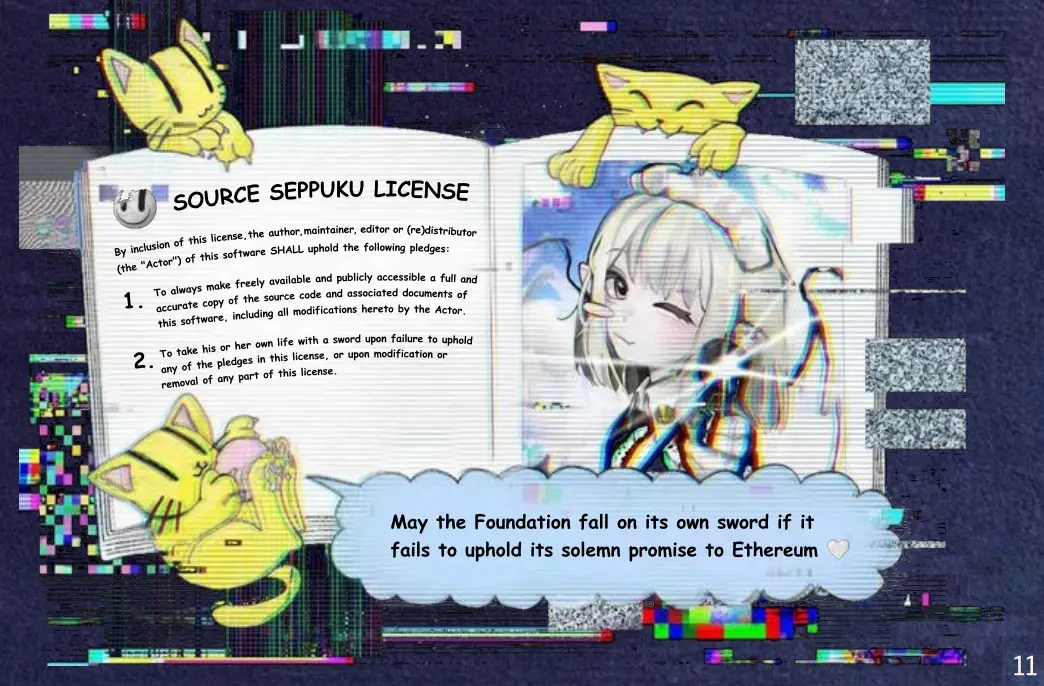
However, the execution of the statement has sparked controversy. Reportedly, the Foundation required internal employees to sign off on the statement's content, or potentially face departure or compensation adjustments. The Foundation even created a "SOURCE SEPPUKU LICENSE" meme graphic, expressing the resolve to "self-terminate" if it fails to fulfill its commitments.

This contradictory approach of "declaring an intention to step back, yet mandating loyalty signatures" became a significant catalyst for this round of departures.
Within just four months, 7 core members or senior contributors have left one after another:

  • February: Co-Executive Director Tomasz Stańczak stepped down after only 11 months in the role;
  • April: Josh Stark, deeply involved in upgrades like The Merge and Dencun, and Protocol Guild coordinator Trent Van Epps, departed;
  • May: Protocol co-leads Barnabé Monnot, Tim Beiko, Alex Stokes (on leave) as well as researcher Carl Beek (7-year tenure, led KZG ceremony and early Beacon Chain design) and Julian Ma (4-year tenure, led FOCIL and Fast Confirmation Rule) left.
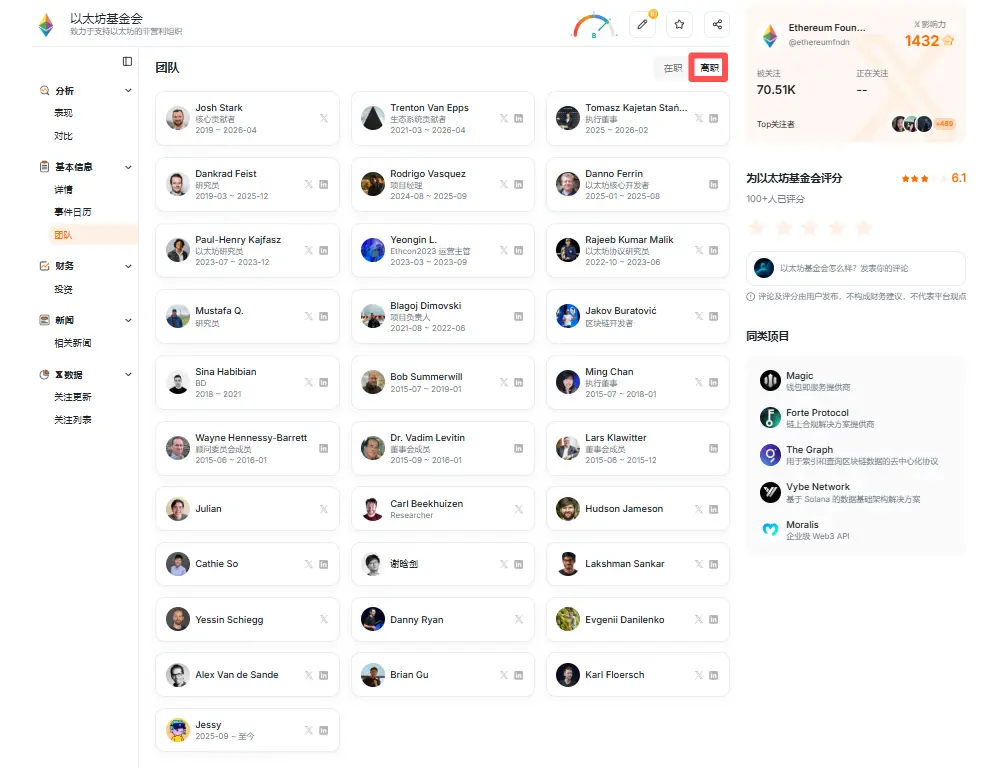
List of Ethereum Foundation Departures Source: RootData

What these people took with them is far more than just job titles; it's a wealth of tacit knowledge and intuition difficult to document. This includes the trade-offs and judgments made in past upgrades, the trust relationships between different teams, how to handle controversies during EIP proposal advancement, and the coordination skills in All Core Devs meetings that can only be understood implicitly.

Protocol Guild contributor cheeky-gorilla stated at the EthCC[9] conference that salaries for Ethereum L1 core developers are 50% to 60% lower than comparable market positions, while high-performance new chains like Monad and leading L2 projects are poaching with compensation packages over 10 times higher. He pointed out that once experienced senior researchers familiar with the underlying protocol logic are lost, key roadmap items like PeerDAS and Verkle trees face the risk of a substantive standstill.

This risk might already be materializing. The Glamsterdam upgrade, originally planned for June 2026, has seen delays. Based on the latest testnet progress and Interop meeting feedback, the actual mainnet launch is more likely to be postponed to the third quarter. The core goal of Glamsterdam is to increase the Gas limit from the current ~60 million to 200 million, a crucial step for Ethereum to enhance its mainnet competitiveness.

Recently, the EF appointed three new co-leads — Will Corcoran, Kev Wedderburn, and Fredrik Svantes — to take over the Protocol team. Their tenures at EF range from 2 to 7 years. However, trust takes time to build, coordination networks take time to rebuild, and Ethereum's upgrade pace doesn't seem to be able to wait that long.

Meanwhile, the EF recently unstaked 21,271 ETH from Lido and has repeatedly sold ETH on-chain for treasury rebalancing. Against the backdrop of personnel turmoil already raising external concerns, this series of on-chain operations has further amplified market anxiety.

Dual Pressure from External Competition and Institutional Confidence

The internal turmoil coincides with the most intense period of external competition.

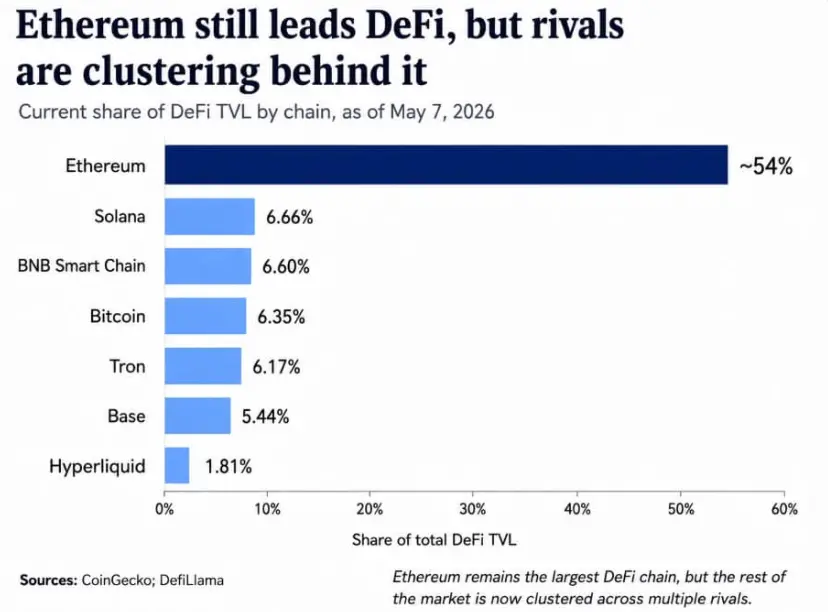
According to DefiLlama data, as of early May, Ethereum's share of Total Value Locked in DeFi has dropped from 63.5% at the beginning of 2025 to about 54% currently, hitting a near one-year low. Ethereum's DeFi TVL is approximately $45.4 billion, still significantly leading, but public chains like Solana (6.66%), BNB Chain (6.60%), Bitcoin (6.35%), Tron (6.17%), Base (5.44%), and Hyperliquid (1.81%) are gradually eroding its share.
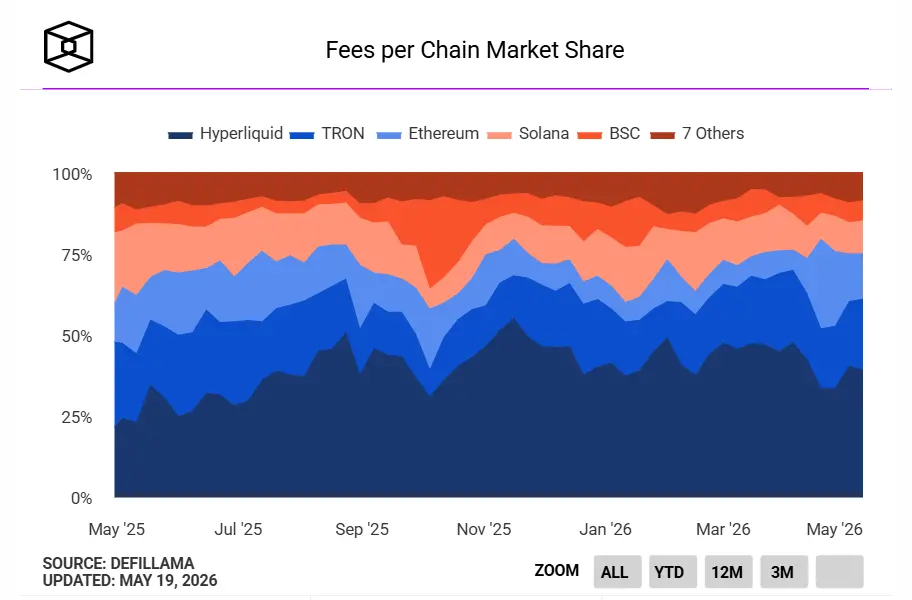
In terms of fee revenue, in the first week of May, Hyperliquid captured about 43% of the market share with approximately $11 million in fees, leading all public chains. In contrast, Ethereum's fee revenue was about $3 million, accounting for only about 13%. Solana's fee revenue was about $2 million, making up about 10%.
Regarding the RWA market, as traditional asset management institutions accelerate the push for on-chain assets, various public chains are competing for institutional issuers. The current on-chain RWA market cap exceeds $65 billion, up about 44% from around $45 billion at the beginning of the year. Among them, Ethereum currently holds about 33% market share and remains the primary deployment network for institutional tokenized assets; Provenance Blockchain accounts for about 27%, while BNB Chain, XRP Ledger, and Solana each hold about 6%.

Meanwhile, a new trend is emerging. Crypto KOL Kaylyn (@kaylyn_0x) pointed out that due to the decreasing cost and technical barriers of launching a chain, Wall Street institutions are beginning to actively explore building their own public chains or hybrid architectures to gain stronger compliance control and predictable performance. Circle's Arc public chain is a typical case; its testnet has already processed over 150 million transactions, has secured $222 million in funding from institutions like BlackRock, and its mainnet is about to launch. Its future threat to Ethereum's position as an institutional settlement layer should not be underestimated.

At the secondary market operation level, Q1 holdings reports show that Goldman Sachs significantly reduced its Ethereum exposure in the first quarter, cutting its position in BlackRock's iShares Ethereum Trust (ETHA) by about 70%, leaving only about $114 million. The Harvard University Endowment Fund completely liquidated its previously purchased nearly $87 million in Ethereum ETF holdings.

Additionally, Korea's seventh-largest pension relief company, Bumo Sarang, invested 59.5 billion won of operating funds last year into the daily double-return leveraged ETF of Ethereum-themed stock Bitmine, incurring a loss of 49.3 billion won (approximately $32.73 million).

These actions may reflect that some traditional institutions are losing patience with Ethereum's short-term returns and long-term stability.

Conclusion

Multiple signals collectively point to Ethereum's current core challenge: a dual lag in execution capability and narrative appeal regarding its positioning as an institution-grade mature infrastructure.

In his speech at the Hong Kong Web3 Carnival, Vitalik Buterin clearly stated that Ethereum is not competing on speed, but aims to be the most secure and decentralized "world computer" and "technical safe haven." His latest lengthy article further elaborates that AI-assisted formal verification is the core of Ethereum's next stage, with the goal of making Ethereum a "safety kernel" whose security can be mathematically proven.

This vision is clear, and the technical path is credible. But realizing the vision requires stable coordination capabilities and continuous accumulation of experience — it's just that precisely during this most critical window, these two things are rapidly diminishing.

Пов'язані питання

QWhat is the direct trigger for the recent wave of departures at the Ethereum Foundation according to the article?

AThe direct trigger is the Ethereum Foundation's new 38-page mission manifesto released in March. It introduced a 'walkaway test' and required internal staff to sign it, creating a perceived contradiction between announcing a reduced role and demanding formal agreement.

QHow has the competitive landscape for Ethereum changed in the DeFi space, according to the data mentioned?

AAs of early May, Ethereum's share of the total DeFi Total Value Locked (TVL) has dropped to about 54% from 63.5% at the start of 2025. Competitors like Solana, BNB Chain, Bitcoin, Tron, Base, and Hyperliquid are gradually gaining market share.

QWhat is the Glamsterdam upgrade, and why is its potential delay concerning?

AGlamsterdam is a key upgrade aimed at increasing Ethereum's gas limit from about 60 million to 200 million, a crucial step for improving the mainnet's competitiveness. Its potential delay from a planned June 2026 pushback to Q3 highlights the impact of losing experienced core developers on the project's roadmap execution.

QWhat new trend regarding blockchain infrastructure is emerging among traditional financial institutions, as mentioned in the article?

AWall Street institutions are beginning to explore building their own public or hybrid blockchains to gain greater compliance control and predictable performance. The article cites Circle's Arc blockchain, backed by BlackRock, as a prime example of this trend that could threaten Ethereum's role in institutional settlement.

QWhat is Vitalik Buterin's stated long-term vision for Ethereum's role, as mentioned in the conclusion?

AVitalik Buterin envisions Ethereum not competing on speed, but as the most secure and decentralized 'world computer' and 'technical safe haven'. He emphasizes that the next phase focuses on AI-assisted formal verification to make Ethereum a mathematically provably secure 'safe core'.

Пов'язані матеріали

Can Alibaba Cloud Rewrite Itself?

Over the past five months, Alibaba Cloud's MaaS (Model as a Service) revenue has surged 15x, marking a strategic overhaul where the company is shifting its 17-year-old system designed for "humans using cloud" to a new paradigm centered on "Agents consuming Tokens." At its recent summit, Alibaba Cloud announced a full-stack upgrade encompassing "chip-cloud-model-inference," all optimized for AI Agents. Key launches include the new AI product portal "QianWen Cloud," hyper-node servers powered by the in-house AI chip Zhenwu M890, and the latest flagship model, Qwen3.7-Max. Senior VP Liu Weiguang described this as building "China's largest AI factory," where chips are raw materials, the cloud is the workshop, models are machines, and the inference platform is the assembly line, with Tokens as the final product. The company is now emphasizing its chip strategy, unveiling the Zhenwu M890 and a two-year roadmap for future chips. With over 560,000 chips deployed across 400+ clients, Alibaba Cloud aims to control the marginal cost per Token, mirroring Google's integration of TPU and Gemini for optimal cost-performance. The cloud infrastructure itself is being rewritten. Traditional cloud interfaces are being transformed into standardized, Agent-callable Skills. A new scheduling logic focuses on "task scheduling" over "resource scheduling" to handle the unpredictable, elastic workloads of Agents. Liu noted that AI applications now automatically provision cloud resources, with one customer's daily automated provisioning equaling two weeks of manual work. For models, the focus has shifted from conversational prowess to execution capability. Qwen3.7-Max demonstrated this by autonomously writing and optimizing a production-grade AI compute kernel for the new Zhenwu M890 chip over 35 hours, achieving a 10x performance improvement. The underlying Bailian platform was upgraded for efficiency, and it maintains an open ecosystem, hosting third-party models. This restructuring extends beyond technology to sales, organization, and metrics. Alibaba Cloud has established dedicated MaaS sales teams, separated from traditional IaaS, with new KPIs focusing on high-quality Tokens that solve real problems, the number of core business systems integrated with models, and the efficiency of Agent task completion. The underlying bet is clear: AI represents an opportunity orders of magnitude larger than before. Despite the uncertainty, Alibaba Cloud is aggressively rebuilding its entire system, betting on an AI-driven future where Tokens could become its largest product line.

marsbit3 хв тому

Can Alibaba Cloud Rewrite Itself?

marsbit3 хв тому

Warsh's First Conundrum: Rate Cuts, Inflation, and a Fractured Fed

Walsh's First Dilemma: Rate Cuts, Inflation, and a Divided Fed Kevin Warsh officially assumed the Fed Chairmanship on May 15th, inheriting a central bank deeply divided over inflation. Contrary to market expectations of a dovish stance due to his appointment by President Trump, Warsh's historical record shows early and consistent hawkish concerns about inflation. The Fed he leads is fractured, with three FOMC members recently dissenting against even hinting at future rate cuts. The immediate challenge is surging inflation. While the Iran-related oil shock is a temporary factor, core CPI and services inflation are accelerating, showing signs of becoming entrenched—echoing the Fed's 2022 "transitory" misstep. Warsh faces the task of building consensus within a committee where several members believe policy may not be restrictive enough, especially if the neutral interest rate (r-star) is higher than currently estimated. Politically, Warsh is caught between Trump's desire for rate cuts and the economic reality of persistent price pressures. Any move perceived as bowing to political pressure could undermine Fed independence. Market implications are significant. Long-term Treasury yields (e.g., 30-year at 5.19%) could rise further, especially if the June FOMC statement hints at possible tightening. Tech stocks face continued valuation pressure from higher rates. The key variable is progress in Iran negotiations; a breakthrough before the June meeting could temporarily ease oil-driven inflation, but stubborn services inflation would remain. All eyes are on Warsh's first post-FOMC press conference on June 17th. His wording on inflation and policy will reveal how much the market has mispriced his stance and the Fed's likely path forward.

marsbit24 хв тому

Warsh's First Conundrum: Rate Cuts, Inflation, and a Fractured Fed

marsbit24 хв тому

IOSG | After the Halving of Developer Count: Crypto Isn't Dead, It's Just Handing Over Talent to AI

IOSG Report: Crypto's Developer Exodus Masks a "Talent Deleveraging" and Migration to AI The number of monthly active crypto developers on GitHub has roughly halved from its 2022 peak to around 23,000. This decline is not a sign of industry collapse but a "talent deleveraging." The exodus consists largely of newcomers who entered during the bull market, while the cohort of established developers (2+ years of experience) has grown to a record high, now contributing about 70% of the code. These core builders are consolidating in ecosystems with real users and activity, like Bitcoin and Solana. The crypto industry has forged a unique skill set: building operational, trusted systems from scratch in environments with no external authority, near-zero tolerance for error, and missing rules. This involves creating trust through pure code/mechanisms and making judgments under profound technical and economic uncertainty. This capability is finding new, high-value applications in the AI era, which faces structurally similar problems: trust in opaque autonomous systems, a lack of governance frameworks, and coordination among self-interested AI agents. Key migration patterns include: 1. **Direct Hardware/Infrastructure Translation:** Projects like CoreWeave pivoted from GPU mining to AI compute supply. 2. **Mechanism Design & Trust Engineering:** Crypto's experience in decentralized coordination and incentive design (e.g., via tokenomics, staking/slashing) is being applied to critical AI challenges: * **Compute Aggregation & Verification:** Solving trust and efficiency problems in decentralized GPU networks (e.g., Hyperbolic). * **AI Agent Governance:** Using cryptoeconomic mechanisms to align the behavior of multiple autonomous AI agents (e.g., EigenLayer's approach). * **Autonomous Agent Payments:** Leveraging stablecoins and programmable money for fast, permissionless micro-transactions between AI agents (e.g., x402 protocol). The builder's role is evolving from "writing smart contracts" to "designing trust mechanisms for autonomous AI systems." This convergence is reflected in hiring trends at major firms and significant capital allocation from top venture funds like Paradigm and a16z into the crypto-AI intersection. While regional approaches differ—with the US focusing more on foundational protocol innovation and Asia on application-layer integration—the core thesis remains: the systemic skills honed in crypto's trustless environments are becoming a scarce and critical asset for scaling AI.

marsbit1 год тому

IOSG | After the Halving of Developer Count: Crypto Isn't Dead, It's Just Handing Over Talent to AI

marsbit1 год тому

Торгівля

Спот
Ф'ючерси

Популярні статті

Як купити CORE

Ласкаво просимо до HTX.com! Ми зробили покупку CORE (CORE) простою та зручною. Дотримуйтесь нашої покрокової інструкції, щоб розпочати свою криптовалютну подорож.Крок 1: Створіть обліковий запис на HTXВикористовуйте свою електронну пошту або номер телефону, щоб зареєструвати обліковий запис на HTX безплатно. Пройдіть безпроблемну реєстрацію й отримайте доступ до всіх функцій.ЗареєструватисьКрок 2: Перейдіть до розділу Купити крипту і виберіть спосіб оплатиКредитна/дебетова картка: використовуйте вашу картку Visa або Mastercard, щоб миттєво купити CORE (CORE).Баланс: використовуйте кошти з балансу вашого рахунку HTX для безперешкодної торгівлі.Треті особи: ми додали популярні способи оплати, такі як Google Pay та Apple Pay, щоб підвищити зручність.P2P: Торгуйте безпосередньо з іншими користувачами на HTX.Позабіржова торгівля (OTC): ми пропонуємо індивідуальні послуги та конкурентні обмінні курси для трейдерів.Крок 3: Зберігайте свої CORE (CORE)Після придбання CORE (CORE) збережіть його у своєму обліковому записі на HTX. Крім того, ви можете відправити його в інше місце за допомогою блокчейн-переказу або використовувати його для торгівлі іншими криптовалютами.Крок 4: Торгівля CORE (CORE)Легко торгуйте CORE (CORE) на спотовому ринку HTX. Просто увійдіть до свого облікового запису, виберіть торгову пару, укладайте угоди та спостерігайте за ними в режимі реального часу. Ми пропонуємо зручний досвід як для початківців, так і для досвідчених трейдерів.

215 переглядів усьогоОпубліковано 2024.12.13Оновлено 2025.03.21

Як купити CORE

Обговорення

Ласкаво просимо до спільноти HTX. Тут ви можете бути в курсі останніх подій розвитку платформи та отримати доступ до професійної ринкової інформації. Нижче представлені думки користувачів щодо ціни CORE (CORE).

活动图片