Channel Dividends Are Dwindling, What Can DeFi Protocols Rely on to Resist Giants' Harvesting?

Foresight NewsОпубліковано о 2026-06-22Востаннє оновлено о 2026-06-22

Анотація

As the era of channel-driven growth ends, major tech giants like Coinbase, Stripe, and Kraken are vertically integrating by acquiring or building core infrastructure, capturing profits from underlying protocols. For instance, Coinbase leverages its Base blockchain to earn sequencing fees from protocols like Morpho, while Stripe acquired Bridge to internalize stablecoin yields, and Kraken bought NinjaTrader for derivatives licenses. This trend creates a power imbalance: entities controlling distribution channels can extract value from open-source DeFi protocols. However, protocols are developing a defense through multi-chain expansion. Examples like Morpho (with significant TVL on Ethereum and Base) and Uniswap (dominant across many chains) show that by deploying across multiple blockchains, protocols reduce dependency on any single chain operator, making them costly and risky to replace. The article argues that the future landscape will be shaped by the race between institutional vertical integration and protocol horizontal, multi-chain scaling. Protocols that embed themselves deeply across ecosystems and become indispensable due to high switching costs are most likely to survive and thrive amidst this consolidation.


Author: Thejaswini M A

Compiled by: Saoirse, Foresight News


In Goodfellas, Ray Liotta has a line: 'Fuck you, pay me.' This line shreds the romanticized filter of mafia honor found in works like The Godfather, starkly revealing the cold, parasitic, and purely profit-driven essence of organized crime. Following a similar logic, let's talk about big tech companies.


You control value by controlling profits. To achieve this, you don't even need to build a public blockchain protocol or a project. It's a profit grab with no rules. But we can't blame Coinbase, Stripe, or Kraken for making such choices.


From the most fundamental business logic, their maneuvers are akin to a shrewd real estate play: be the first to secure the traffic distribution channels. Now holding the power of these channels, they look down and ask: 'Who exactly holds the bargaining power?'


Coinbase built its own blockchain; Stripe spent $1.1 billion acquiring infrastructure it could have rented; Kraken spent $1.5 billion acquiring a derivatives trading platform; Apple built the App Store. The logic of this playbook is: let others develop the market and bear the early risks, then acquire the underlying infrastructure when the profit potential in the sector becomes sufficiently attractive. The core question this article explores: Where will the industry head when traffic distribution channels are no longer the core value?


Coinbase has 110 million verified users. For years, its lending products for users were built on top of the open-source protocol Morpho, with all protocol fees going to Morpho. Later, Coinbase launched its own L2 blockchain, Base. Morpho chose to deploy on Base because Coinbase's massive user base could bring transaction volume. Now, the sequencer fee generated by every transaction on Base flows entirely into Coinbase's pockets, not Morpho's.


Base generated $76 million in net sequencer fee revenue in 2024 and $74 million in 2025. Until February 2026, per the licensing agreement, Coinbase had to share a portion of the revenue with Optimism. But eventually, Coinbase severed the partnership, switched to a self-developed underlying architecture, and now keeps the entire $64 million revenue. Meanwhile, Morpho remains rooted on Base, developing robustly with a Total Value Locked (TVL) of $2.5 billion. However, every transaction processed by Morpho now has to share profits with Coinbase.
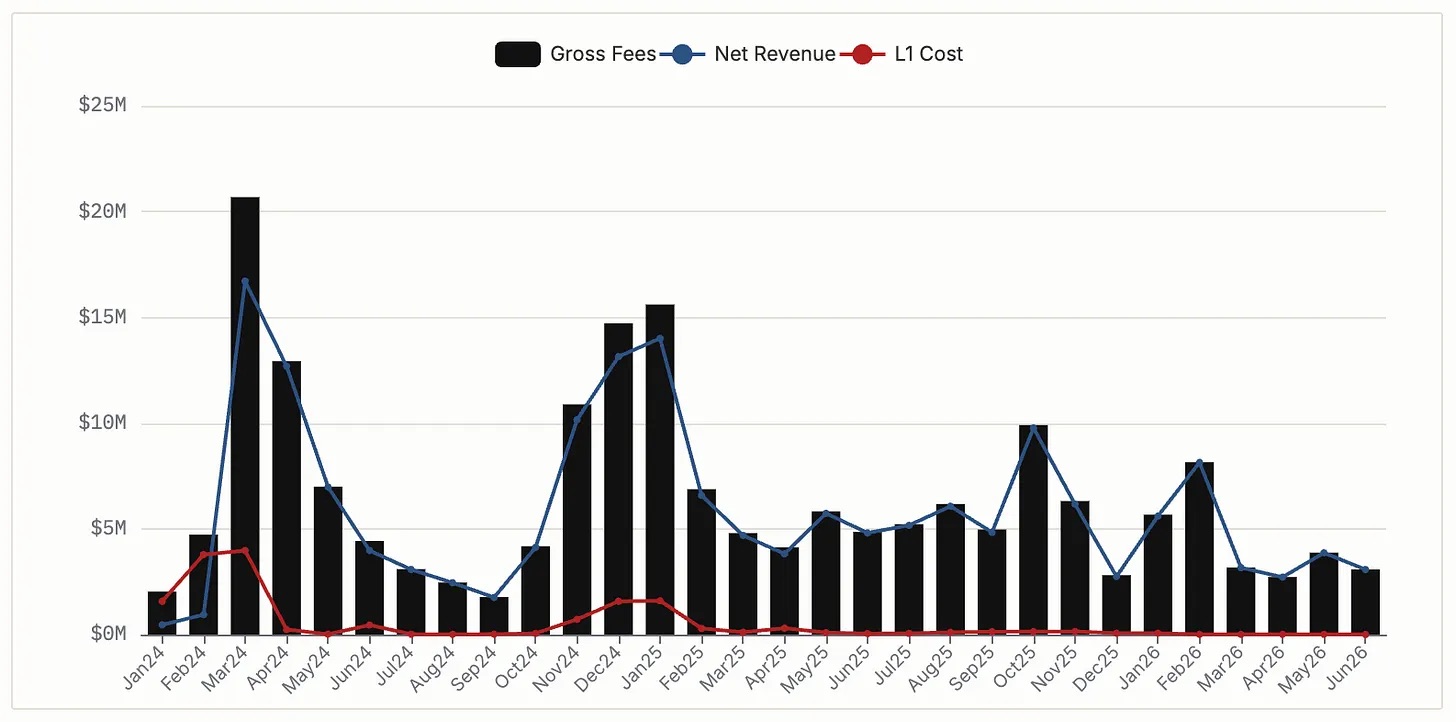

Base Monthly Sequencer Fee Revenue, source: DeFiLlama


Coinbase launched a $300 million Bitcoin-collateralized lending product, relying on Morpho's underlying architecture. Its wrapped Bitcoin, cbBTC, is the largest collateral asset within Morpho, accounting for 38% of the protocol's total TVL. This creates a mutually restraining dynamic: Morpho holds the core underlying capability for Coinbase's credit product, while Coinbase can extract a revenue share from all of Morpho's business, making it difficult for either to easily sever the partnership.


Look at Stripe's case: In early 2025, it spent $1.1 billion to acquire Bridge. Before this, Stripe's stablecoin business relied on Circle's infrastructure. Circle held the stablecoin issuance rights and earned the floating interest generated by the reserve collateral assets. At that time, all revenue from Stripe's trillion-level stablecoin transactions flowed to Circle. Acquiring Bridge completely reversed this situation. Bridge issues its own stablecoin, USDB, collateralized by a BlackRock money market fund. After switching to USDB, the massive interest income from these reserves stays entirely within the Stripe ecosystem. With annual payment processing volume of $1.4 trillion, Stripe was losing hundreds of millions in profit annually by long-term renting its competitor's profit-generating infrastructure.


Patrick Collison once called stablecoins 'the room-temperature superconductors of finance.' Spending $1.1 billion to own this underlying tool outright is far more economical than continuously paying tolls to a competitor.


A pure spot exchange has a natural growth ceiling, with users trading only hundreds of tokens. But Kraken wanted to attract institutional investors and professional retail traders, groups that primarily engage in trading via futures and clearing derivatives. Operating a derivatives business requires registration with the CFTC, NFA membership, and broker-dealer licenses—a compliance system that takes years to build. Even if built from scratch, regulators could reject the application for various uncontrollable reasons.


This is why Kraken set its sights on NinjaTrader. The $1.5 billion acquisition in January 2025 brought not just 1.7 million funded trading accounts, but more crucially, the full suite of broker-dealer licenses that Kraken would have found difficult to quickly develop and obtain on its own.


By acquiring ready-made compliant qualifications, Kraken completely shed its dependence on external partners. It now wholly owns the entire technology stack and licenses, needing neither to rely on others nor spend years waiting for regulatory approval.


Some might say: Large enterprises swallowing small protocols, isn't that just business as usual? What's new here?


Morpho's total TVL is $6.4 billion, with $3.308 billion deployed on Ethereum and $2.488 billion on Base. If Coinbase decided to delist Morpho and switch to a self-developed lending protocol, Morpho would immediately lose 39% of its TVL. However, it would still retain 52% on Ethereum, while continuously expanding to multiple chains like Hyperliquid L1, Monad, and Arbitrum, allowing its overall business to continue operating stably.
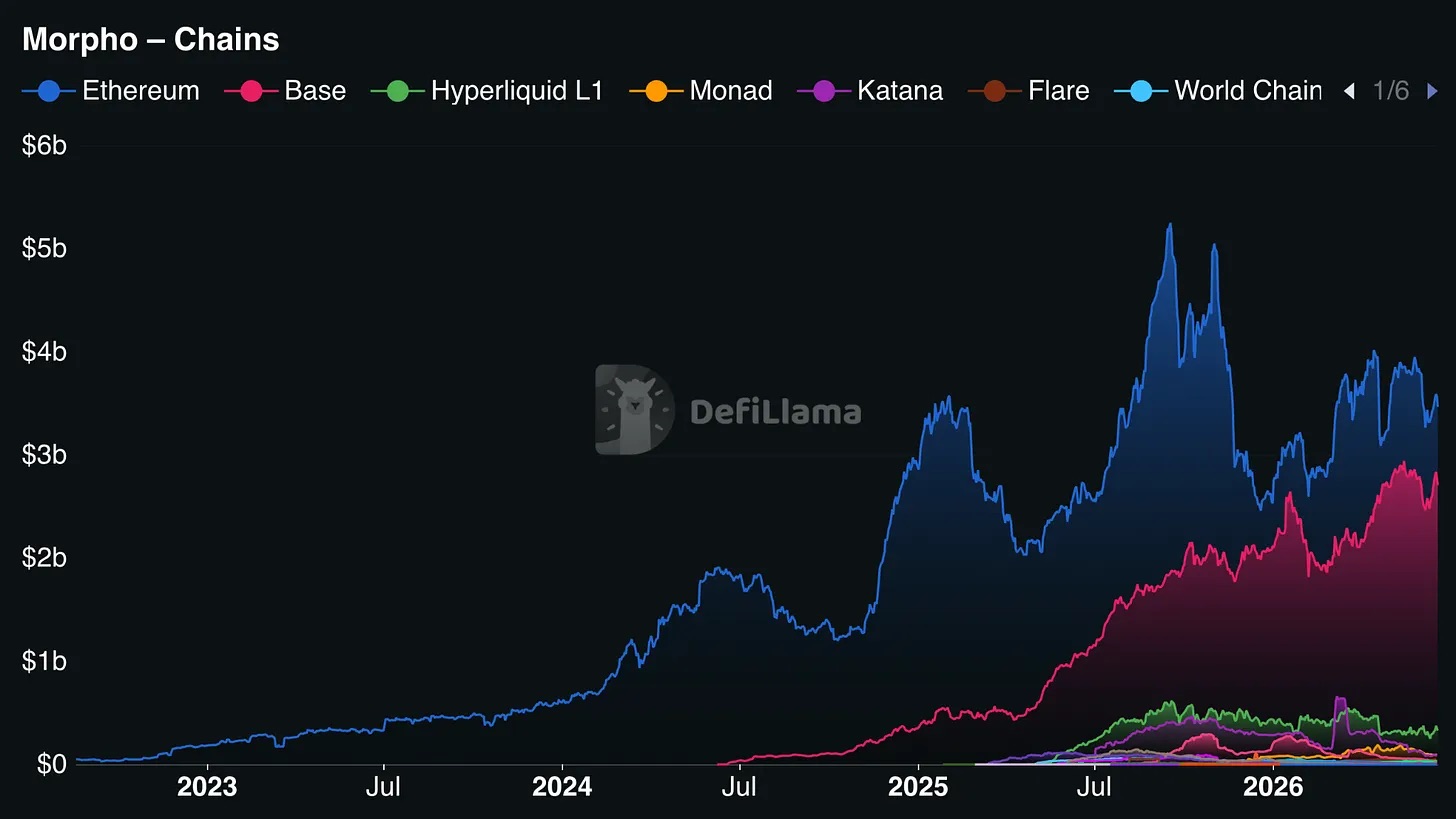

Morpho TVL Distribution Across Chains, source: DeFiLlama


The case of Aerodrome on the Base blockchain vividly demonstrates the impact when a chain operator promotes its own competitor. Aerodrome is Base's native decentralized exchange, optimized for Base's architecture. Coinbase Ventures holds approximately $20 million worth of AERO tokens, its largest liquidity token investment. Meanwhile, the project guides liquidity towards Coinbase's products, including the cbBTC pool, through AERO token lock-up voting. Aerodrome handles about 51% of Base's DEX volume, peaking at 77% in September 2024. Uniswap, deployed across 44 chains, is Base's second-largest DEX, holding 30% volume. Even after losing its leading position on a single chain, Uniswap hasn't perished: in 2025 it processed $212 billion in volume on Base, with estimated cross-chain monthly volume around $73 billion.
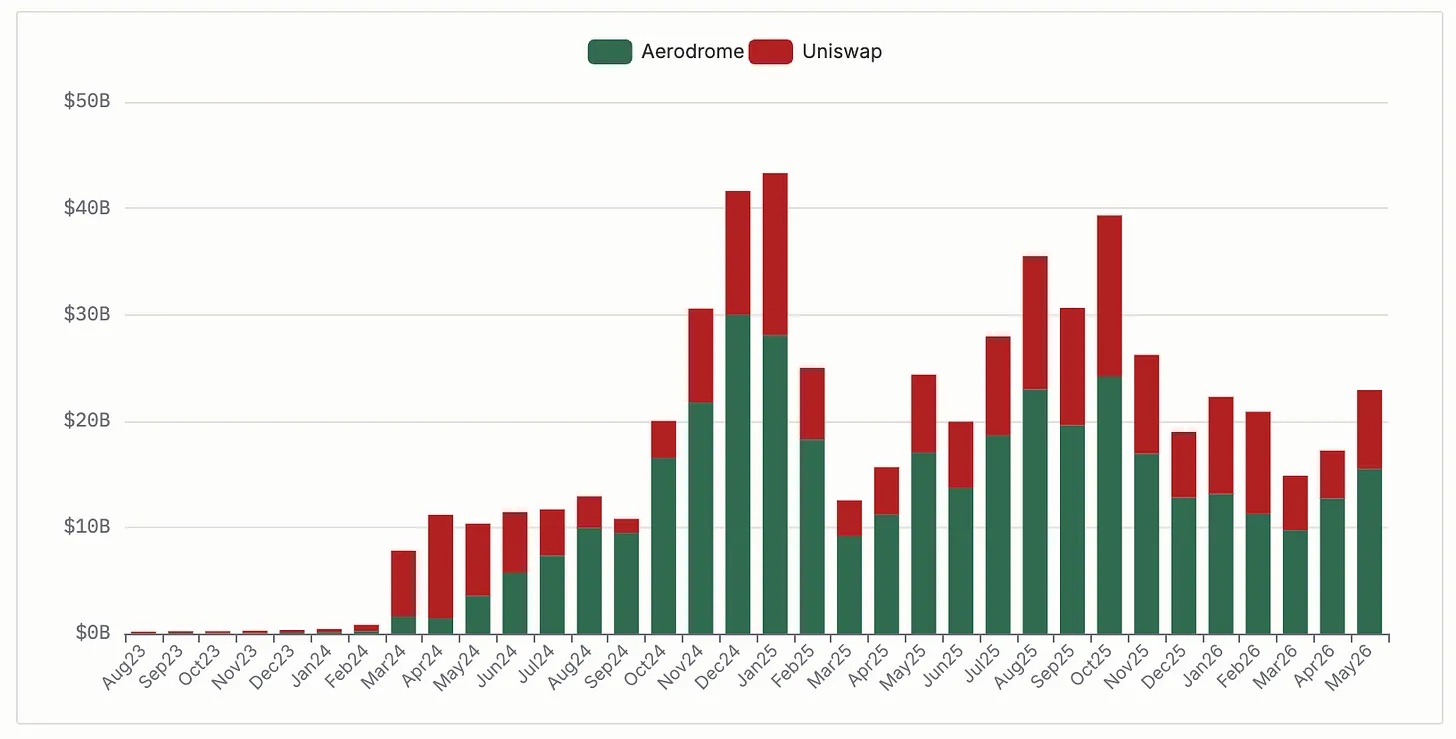

Base DEX Volume Share, source: DeFiLlama


This case confirms: Multi-chain deployment is a protocol's natural moat. A project deployed on a single chain is entirely at the mercy of the chain operator—they can always promote a competitor to squeeze your survival space. Conversely, a multi-chain protocol can continue normal operations in other sectors even after losing a particular chain's market. After witnessing Uniswap's traffic being diverted by Aerodrome on Base, Morpho rapidly expanded its multi-chain deployment. Large traffic platforms can vertically integrate into the underlying layer, while open-source protocols can horizontally expand across multiple chains to diversify risk.


If you rely on underlying infrastructure you don't own, you don't truly control your business. The party controlling the underlying layer holds overwhelming bargaining power over you, can define your product experience, and ultimately influence your operational stability. For enterprises of this scale, this dependency relationship translates into tangible profit losses every single day. This business logic isn't unique to crypto: Amazon built its moat relying on AWS; Apple, constrained by Intel's chip roadmap for years, spent many years developing custom chips to break free.


Everyone can check in real-time how much revenue Coinbase earns from Base sequencer fees, and clearly see Morpho's TVL across various chains. This value extraction process is fully transparent—something internal infrastructure profits at companies like Amazon, in the traditional internet space, cannot achieve.


There is a potential direction for the industry: the future market could be entirely controlled by giants like Coinbase, Stripe, Kraken, and a few banks. They control the entire industry chain from underlying protocols to payment cards, with open-source protocols only used to fill niche gaps the giants haven't yet covered. This is a fully plausible development path for fintech. Open-source technology would no longer be a free and vast fertile ground for innovation, but merely become patches of adhesive tape for the tiny crevices giant corporations haven't yet figured out how to monetize. Like a quip: 'Look at this high-quality little open-source protocol. Let's just build a commercial system on top of it to harvest the traffic.'


However, I lean towards an optimistic assessment: Considering the current wave of acquisitions, the probability of such a complete monopoly isn't as high as it seems. Underlying protocols are difficult to be monopolized by giants in the same way traffic channels can be. Morpho can deploy on a new chain in just weeks; replacing a battle-tested lending protocol deeply embedded in institutional operations carries an extremely high cost, not easily perceivable by outsiders. Coinbase's $300 million Bitcoin lending product still relies on Morpho because replicating Morpho's security system from scratch would take years and introduce security risks Coinbase is unwilling to bear.


Protocols that can survive this wave of giant consolidation all meet one core condition: they completed full multi-chain deployment before the traffic giants built their own ecosystems, deeply embedding themselves into the backend systems of major enterprises, making the economic cost of replacing them prohibitively high. Even Robinhood, a traffic giant with a massive user base, chose to integrate Lighter, a third-party zk-proof perpetuals exchange, as its trading backend. Robinhood Ventures participated in Lighter's $68 million funding round, and founder Vlad Tenev maintains close communication with the project.


If only traffic channels could build moats, Robinhood could have built its own underlying tech like Coinbase did. But it didn't: achieving a system that combines CEX-like trading speed with verifiable zk-proof matching logic is an extremely difficult, niche technical problem; the Lighter team spent over a year cracking it. After calculation, Robinhood concluded that purchasing the right to use mature technology is far more economical than building from scratch.


Currently, Morpho occupies this advantageous position of mutual restraint, while Uniswap was the pioneer of this path. The speed of institutional expansion and the speed of open-source protocol horizontal multi-chain expansion are in a game of chess; the final outcome will determine the direction of the industry landscape.


The underlying businesses of giants like Stripe and Coinbase still rely on open-source technology at this stage. In the short term, open-source protocols can still stand firm. We'll re-examine the industry landscape in two years.

Трендові криптовалюти

Пов'язані питання

QWhat is the main business strategy employed by large tech companies like Coinbase and Stripe in the crypto industry according to the article?

AThe article describes a strategy where large tech companies like Coinbase, Stripe, and Kraken act as distribution channels, capturing and controlling user traffic. They let smaller protocols bear the early risk and development costs, and then acquire or build competing infrastructure once the market becomes profitable. This allows them to capture the value and profits generated by the underlying protocols, exemplified by Coinbase capturing sequencer fees from protocols like Morpho on Base.

QHow does the acquisition of Bridge by Stripe change its business model in the stablecoin sector?

APrior to acquiring Bridge for $1.1 billion, Stripe's stablecoin business relied on Circle's infrastructure, meaning all interest from the reserve assets backing the stablecoins flowed to Circle. By acquiring Bridge, which issues its own stablecoin USDB backed by BlackRock money market funds, Stripe now keeps the substantial interest revenue generated by the massive reserves within its own ecosystem, rather than paying it to a competitor.

QWhy does the article argue that multi-chain deployment is a crucial defense for DeFi protocols against large platforms?

AMulti-chain deployment acts as a natural moat for protocols. If a protocol is only deployed on a single chain, its fate is tied to that chain's operator, who could favor or build a competing protocol. A multi-chain protocol, like Uniswap or Morpho, can survive the loss of dominance on one chain because its business on other chains continues to operate. This diversification reduces dependency and risk from any single entity.

QWhat example does the article use to show that even large platforms sometimes choose to rely on third-party protocols instead of building everything in-house?

AThe article cites Robinhood as an example. Instead of building its own perpetual futures exchange from scratch like Coinbase did with Base, Robinhood integrated with Lighter, a third-party zero-knowledge proof perpetual exchange. Robinhood determined that licensing this specialized, proven technology was more economical and efficient than developing it internally, despite having a massive user base.

QWhat is the "two-way checkmate" position that Morpho currently holds in its relationship with Coinbase, according to the article?

AMorpho is in a "two-way checkmate" with Coinbase. On one hand, Coinbase's $300 million Bitcoin-backed lending product is built on Morpho's infrastructure, making Morpho's security and technology core to that offering. Replacing it would be risky and costly for Coinbase. On the other hand, Morpho's significant deployment on Coinbase's Base chain means a large portion of its activity generates sequencer fees for Coinbase. This mutual dependency makes it difficult for either party to easily sever the relationship.

Пов'язані матеріали

27-Year Reign Ends: SK Hynix Market Cap Surpasses Samsung for First Time, an AI-Driven Reshuffle of Korean Chip Power

On June 22, 2026, SK Hynix made history by surpassing Samsung Electronics in market capitalization, ending Samsung's 27-year reign as South Korea's most valuable company. This dramatic reversal is powered by the AI boom and SK Hynix's dominant position in High Bandwidth Memory (HBM), a critical component for AI model training. Once a heavily indebted firm on the brink of bankruptcy, SK Hynix bet early on HBM, which has evolved from a niche product to essential AI infrastructure. It now commands a 59% share of the global HBM market. Its financial performance is staggering, with Q1 2026 net profit soaring nearly fourfold year-over-year to KRW 40.35 trillion, translating to over 2 billion RMB in daily net profit. HBM now drives roughly 40% of its revenue with exceptionally high margins. In contrast, Samsung, with its broad portfolio spanning memory chips, smartphones, and foundry services, has lagged in the HBM race while facing headwinds in other divisions. This shift signifies a deeper restructuring of South Korea's economy, moving from consumer electronics to AI-driven growth. However, the future remains competitive. With major capacity expansions planned industry-wide by 2028 and Samsung aiming to catch up in HBM technology, the new market leader cannot afford complacency. This event marks a pivotal moment in the global semiconductor industry's ongoing power realignment.

marsbit4 хв тому

27-Year Reign Ends: SK Hynix Market Cap Surpasses Samsung for First Time, an AI-Driven Reshuffle of Korean Chip Power

marsbit4 хв тому

Why Does 'AGI Godfather' Ben Goertzel Believe the Future of AI Relies on Blockchain?

Ben Goertzel, known as the "AGI Godfather," argues that the future of Artificial General Intelligence (AGI) must be built on blockchain to prevent its control by a few corporations or venture capital firms. He believes the core AGI code should be free and open-source, but that this alone is insufficient without a decentralized infrastructure to run it affordably. His blockchain project, SingularityNET, and the broader Artificial Superintelligence Alliance aim to create a user-owned, decentralized network for hosting and deploying AGI, contrasting with the closed models of companies like OpenAI and Anthropic. Goertzel criticizes the shift of other labs from open to closed development. He argues that while a closed path is simpler, an open, decentralized model—akin to Linux and the internet—is both possible and ultimately better for humanity. He envisions an "Agent economy" where individuals orchestrate teams of AI agents to perform tasks, including transactions, on an open network rather than corporate clouds. While his current model relies on cryptocurrency, plans include offering paid AI services to businesses with the decentralized blockchain as the backend. Goertzel predicts human-level AGI could arrive by 2029 and warns that a gap in understanding and access to AGI could drastically worsen inequality. The first test of his decentralized approach will be the upcoming release of the Agent Omega Claw.

Foresight News34 хв тому

Why Does 'AGI Godfather' Ben Goertzel Believe the Future of AI Relies on Blockchain?

Foresight News34 хв тому

Торгівля

Спот
Ф'ючерси

Популярні статті

Що таке DOGE M

Doge Matrix ($doge m): Нова порода криптовалюти, що керується спільнотою Вступ У постійно змінюваному ландшафті криптовалюти нові проекти постійно з'являються, кожен з яких прагне привернути увагу інвесторів та ентузіастів. Одним з останніх учасників цього домену є Doge Matrix, представлений тикером $doge m. Цей проект привернув увагу завдяки своїм корінням у популярній культурі мемів навколо Dogecoin, закріплюючи своє місце в просторі web3. Ця стаття має на меті надати всебічний аналіз Doge Matrix, охоплюючи його огляд, творця, інвесторів, функціональність, хронологію та помітні аспекти. Що таке Doge Matrix ($doge m)? Doge Matrix — це проект криптовалюти, що керується спільнотою, який, здається, будує на широкій привабливості Dogecoin, цифрової валюти, відомої своїм маскотом Shiba Inu та мем-походженням. Хоча загальні цілі Doge Matrix не є детально визначеними, він характеризується зобов'язанням залучати участь та підтримку спільноти. На відміну від традиційних криптовалют, які часто підкреслюють корисність або внутрішню цінність через підлягаючі технології, Doge Matrix позиціонує себе в просторі, що охоплює культурне явище криптовалют, особливо приваблюючи тих, хто резонує з етикою активів на основі мемів. Спираючись на сильні сторони спільноти Dogecoin, Doge Matrix працює як частина більш широкої екосистеми, запрошуючи участь та залучення користувачів, які поділяють інтерес до криптовалюти та цифрового простору. Хто є творцем Doge Matrix ($doge m)? Особистість творця Doge Matrix залишається невідомою. Ця відсутність прозорості не є рідкісним явищем у сфері криптовалют, де деякі проекти запускаються без розкриття ідентичностей своїх засновників. Відсутність інформації про засновницьку команду може викликати питання серед потенційних інвесторів щодо відповідальності та напрямку проекту. Хто є інвесторами Doge Matrix ($doge m)? На даний момент немає публічно доступної інформації про інвесторів або інвестиційні фонди, які підтримують Doge Matrix. Проект, здається, покладається переважно на підтримку спільноти, а не на інституційні інвестиції. Ця модель узгоджується з природою ініціативи, що керується спільнотою, сприяючи середовищу, де напрям проекту формується його учасниками, а не диктується вибраними фінансовими спонсорами. Як працює Doge Matrix ($doge m)? Специфіка операційних механізмів Doge Matrix є дещо розмитою, відображаючи ширшу тенденцію проектів у просторі мем-коінів, де інноваційні функціональності не завжди чітко сформульовані. Проте Doge Matrix, здається, розроблений для того, щоб використовувати існуючу екосистему криптовалют, заохочуючи участь користувачів, одночасно використовуючи знайомі культурні посилання, пов'язані з Dogecoin. Його потенційно унікальні характеристики походять від взаємодій у спільноті, а не від технологічних досягнень, підкреслюючи спільний досвід та співпрацю серед власників токенів. Хоча точні інновації не були чітко окреслені, проект, здається, створює простір, де члени спільноти можуть взаємодіяти, ділитися ідеями та просувати потенціал проекту вперед. Хронологія Doge Matrix ($doge m) Розглядаючи хронологію проекту, можна виявити помітні події, які визначили його шлях до цього часу: 25 листопада 2024: Doge Matrix досяг свого історичного максимуму, що стало значною віхою в його ранній історії. 1 січня 2025: Навпаки, Doge Matrix досяг свого історичного мінімуму, ілюструючи волатильність, яка часто асоціюється з криптовалютами, особливо на ранніх етапах життєвого циклу проекту. Триває: Проект продовжує активно торгуватися та підтримуватися своєю спільнотою, хоча конкретні майбутні віхи або цілі ще не були розкриті. Ключові моменти про Doge Matrix ($doge m) Орієнтація на спільноту У центрі Doge Matrix лежить зобов'язання до залучення спільноти. Проект процвітає на основі співпраці та спільних цілей серед своїх учасників, підкреслюючи важливість колективних зусиль. На відміну від централізованих проектів, які часто мають визначену структуру керівництва, Doge Matrix наразі демонструє більш гнучкий підхід до управління, де голос кожного члена спільноти має значення. Волатильність Ринок криптовалют відомий своєю волатильністю, і Doge Matrix не є винятком. Його історія цін відображає значні коливання між високими та низькими значеннями, що є типовим для багатьох нових криптовалют, але підкреслює ризики, пов'язані з інвестиціями в нові токени. Відсутність детальної інформації Однією з найпомітніших рис Doge Matrix є брак детальної інформації щодо його технологічних основ та операційних механізмів. Ця невизначеність вимагає від потенційних інвесторів провести ретельну перевірку перед залученням до проекту. Висновок Підсумовуючи, Doge Matrix ($doge m) ілюструє нову хвилю проектів криптовалюти, які сильно покладаються на залучення спільноти та культурну значущість. Хоча йому бракує певних специфікацій — таких як чітке керівництво, визначені цілі та детальна функціональність — проект зміг викликати інтерес у криптоспільноті, використовуючи вже встановлену привабливість культури мемів. Як і з будь-якими інвестиціями в сфері криптовалют, розуміння вроджених ризиків і проведення всебічного дослідження є важливими для потенційних учасників. Doge Matrix слугує нагадуванням про динамічну, іноді непередбачувану природу криптоіндустрії, що відзначається постійною еволюцією та ентузіазмом щодо ініціатив, що керуються спільнотою.

485 переглядів усьогоОпубліковано 2025.02.03Оновлено 2025.02.03

Що таке DOGE M

Що таке $M

Розуміння Mantis ($M): Нова ера в кросчейн-інтероперабельності У постійно змінюваному ландшафті Web3 та криптовалют нові проекти прагнуть запропонувати інноваційні рішення, спрямовані на покращення користувацького досвіду та розширення функціональних можливостей у рамках децентралізованої фінансової екосистеми. Один з таких проектів, що привертає увагу, - це Mantis ($M), піонерський протокол, заснований на принципах кросчейн-інтероперабельності та угод на основі намірів. Ця стаття розглядає основні аспекти Mantis, включаючи його основну функціональність, творців, інвестиційну підтримку, інноваційні особливості та ключові етапи. Що таке Mantis ($M)? Mantis описується як протокол врегулювання намірів у кількох доменах, який спрощує кросчейн-взаємодії, дозволяючи користувачам безперешкодно виконувати складні фінансові транзакції на різних блокчейн-платформах. Протокол працює через три основні шари: Вираження намірів: Користувачі можуть формулювати свої цілі транзакцій, використовуючи природну мову, що забезпечується DISE LLM, передовою мовною моделлю штучного інтелекту. Наприклад, користувач може висловити бажання обміняти Ethereum (ETH) на Solana (SOL) з певною допустимою похибкою в 1%. Виконання: Цей шар використовує мережу розв'язувачів, які змагаються за виконання намірів користувачів. Транзакції виконуються за допомогою механізмів, таких як Coincidence of Wants (CoWs) та Order Flow Auctions (OFAs), які забезпечують оптимальне задоволення запитів користувачів. Врегулювання: Використовуючи протокол міжблокчейн-комунікації (IBC), Mantis дозволяє атомарні кросчейн-транзакції, що дозволяє користувачам працювати на різних підтримуваних ланцюгах, включаючи Ethereum, Solana та Cosmos. Mantis розроблений для впровадження рідної генерації доходу для бездіяльних активів, використовуючи криптографічні докази для підтримки цілісності транзакцій протягом усього процесу. Творці та команда розробників Mantis був задуманий Composable Foundation, дослідницькою організацією, відомою своїм акцентом на рішеннях для блокчейн-інтероперабельності. Ця організація співпрацює з відомими академічними установами, такими як Гарвардський університет та Університет Лісабона, сприяючи широким дослідженням та розробкам, які формують архітектуру та функціональність Mantis. Зобов'язання Composable Foundation сприяти інноваціям у сфері блокчейн-технологій позиціонує Mantis як надійне рішення для зростаючого попиту на інтероперабельність між кількома блокчейн-мережами. Інвестори та підтримка Хоча конкретні деталі про окремих інвесторів не були публічно розкриті, Mantis користується значною підтримкою від різних суб'єктів, включаючи: Гранти екосистеми від ланцюгів, що підтримують IBC, які підтримують зростання протоколу та інтеграцію в децентралізовані фінансові екосистеми. Стратегічні партнерства з постачальниками інфраструктури, які покращують мережеві можливості Mantis та стратегії впровадження. Фінансування через казну Composable Foundation, що забезпечує стабільну фінансову підтримку для поточних розробок та операційних витрат. Ці спільні зусилля відображають консенсус серед зацікавлених сторін щодо важливості покращення кросчейн-функціональності та потенційної корисності інфраструктурних інновацій Mantis. Ключові інновації Mantis вирізняється кількома піонерськими інноваціями, які покращують його функціональність та корисність: Незалежні від ланцюга наміри: Користувачі можуть ініціювати транзакції з будь-якого підтримуваного ланцюга, при цьому врегулюючи їх на іншому. Ця гнучкість надає користувачам більше можливостей, стимулюючи взаємодію між різними платформами. Інтерфейс на базі штучного інтелекту: Інтеграція DISE LLM дозволяє користувачам виконувати складні DeFi-операції, використовуючи природну мову, що спрощує взаємодію та робить технологію блокчейн доступною для ширшої аудиторії. Захоплення MEV у кросдоменному середовищі: Mantis створює внутрішній ринок для максимального екстракційного значення (MEV) через конкуренцію серед розв'язувачів. Цей інноваційний підхід дозволяє досягати більшої ефективності та екстракції вартості в складних транзакціях. Модульний шар врегулювання: Протокол підтримує різні методи верифікації, включаючи нульові знання та оптимістичні роллапи, забезпечуючи універсальну структуру, яка може адаптуватися до нових блокчейн-технологій. Історична хронологія Розвиток Mantis відзначений кількома критичними етапами, які окреслюють його траєкторію та зростання: | Рік | Етап | |————|————————————————————————-| | 2022 | Початкова розробка концепції в дослідницькому підрозділі Composable Foundation. | | Q3 2024 | Запуск тестової мережі з можливостями мосту між Solana та Ethereum. | | Q1 2025 | Очікувана подія генерації токенів (TGE) разом із запуском основної мережі. | | Q2 2025 | Очікувана інтеграція DISE LLM та розширення кросчейн-можливостей. | | 2025 H2 | Запланована підтримка понад 15 ланцюгів через подальші оновлення IBC. | Ця хронологія окреслює еволюцію Mantis, від концептуальних обговорень до активної реалізації та майбутніх етапів зростання. Стратегія зростання екосистеми Стратегія Mantis щодо зростання екосистеми включає кілька ініціатив, спрямованих на заохочення участі користувачів та залучення розробників: Система кредитів: Користувачі можуть заробляти кредити протоколу, надаючи ліквідність та беручи участь у реферальних програмах. Ці кредити можна буде обміняти на винагороди в майбутньому, сприяючи формуванню сильної спільноти користувачів. Модульний набір для розробки програмного забезпечення (SDK): Цей набір інструментів надає розробникам можливість створювати додатки на основі моделей, що керуються намірами, використовуючи інфраструктуру Mantis, тим самим сприяючи інноваціям у його екосистемі. Модель управління: У міру розвитку протоколу, власники токенів $M отримають можливість брати участь в управлінні протоколом, що дозволить їм голосувати за запропоновані оновлення та зміни, підвищуючи залученість спільноти та децентралізацію. Mantis представляє собою значний прогрес у сфері кросчейн-архітектури. Завдяки безперешкодній інтеграції передових алгоритмів штучного інтелекту з надійною структурою врегулювання, Mantis прагне вирішити проблеми фрагментації в багатоланцюгових екосистемах. Його інноваційний підхід ставить на перше місце покращення користувацького досвіду, дотримуючись основоположних принципів децентралізації та безпеки, встановлюючи новий стандарт для майбутньої інтероперабельності блокчейн-технологій. Оскільки Mantis продовжує свій шлях зростання та реалізації, він обіцяє стати проектом, за яким варто уважно стежити в конкурентному середовищі Web3 та децентралізованих фінансів. Зосереджуючись на подоланні кордонів та підвищенні залученості користувачів, Mantis готовий стати невід'ємною частиною майбутніх розробок у сфері криптовалют.

51 переглядів усьогоОпубліковано 2025.03.18Оновлено 2025.03.18

Що таке $M

Як купити M

Ласкаво просимо до HTX.com! Ми зробили покупку MemeCore (M) простою та зручною. Дотримуйтесь нашої покрокової інструкції, щоб розпочати свою криптовалютну подорож.Крок 1: Створіть обліковий запис на HTXВикористовуйте свою електронну пошту або номер телефону, щоб зареєструвати обліковий запис на HTX безплатно. Пройдіть безпроблемну реєстрацію й отримайте доступ до всіх функцій.ЗареєструватисьКрок 2: Перейдіть до розділу Купити крипту і виберіть спосіб оплатиКредитна/дебетова картка: використовуйте вашу картку Visa або Mastercard, щоб миттєво купити MemeCore (M).Баланс: використовуйте кошти з балансу вашого рахунку HTX для безперешкодної торгівлі.Треті особи: ми додали популярні способи оплати, такі як Google Pay та Apple Pay, щоб підвищити зручність.P2P: Торгуйте безпосередньо з іншими користувачами на HTX.Позабіржова торгівля (OTC): ми пропонуємо індивідуальні послуги та конкурентні обмінні курси для трейдерів.Крок 3: Зберігайте свої MemeCore (M)Після придбання MemeCore (M) збережіть його у своєму обліковому записі на HTX. Крім того, ви можете відправити його в інше місце за допомогою блокчейн-переказу або використовувати його для торгівлі іншими криптовалютами.Крок 4: Торгівля MemeCore (M)Легко торгуйте MemeCore (M) на спотовому ринку HTX. Просто увійдіть до свого облікового запису, виберіть торгову пару, укладайте угоди та спостерігайте за ними в режимі реального часу. Ми пропонуємо зручний досвід як для початківців, так і для досвідчених трейдерів.

512 переглядів усьогоОпубліковано 2025.07.02Оновлено 2026.06.02

Як купити M

Обговорення

Ласкаво просимо до спільноти HTX. Тут ви можете бути в курсі останніх подій розвитку платформи та отримати доступ до професійної ринкової інформації. Нижче представлені думки користувачів щодо ціни M (M).

活动图片