WSJ: Fake Websites, Fake Trades, Real Promotion: Polymarket's Traffic Scam

marsbitОпубліковано о 2026-06-23Востаннє оновлено о 2026-06-23

Анотація

The Wall Street Journal investigation reveals that prediction market platform Polymarket hired dozens of creators, primarily students, to produce and disseminate deceptive promotional content on social media. These creators used fake, near-identical clone websites (like "poiymarket.com") to simulate placing bets and winning large sums—totaling $1.9 million in fake wagers and nearly $900,000 in fake winnings across over 1,100 analyzed videos—without disclosing their paid partnership with Polymarket, as required by federal advertising regulations. The videos, often promoting unrealistic "free money" claims, were amplified by a coordinated "army" of social media accounts managed by a marketing contractor to target U.S. users, despite Polymarket's crypto platform being barred from serving the U.S. since a 2022 settlement. Polymarket stated it is committed to fair and transparent markets and plans a comprehensive audit of its promotional content. The article also notes internal discussions about potentially overturning the 2022 settlement to reintroduce its crypto platform in the U.S.

Original article from WSJ, by Katherine Long, Caitlin Ostroff, Neil Mehta and Brenna T. Smith

Compiled by|Odaily Planet Daily Qin Xiaofeng(@QinXiaofeng 888 )

Editor's Note: A recent Wall Street Journal investigation found that prediction market platform Polymarket paid dozens of creators to make fake trades and profit videos on simulated websites, and used social media "water armies" for viral marketing to attract U.S. users. None of these videos disclosed the paid relationships as required by federal regulations, and the "handsome returns" shown were entirely fabricated. Polymarket stated it is committed to maintaining accurate, fair, and transparent markets and plans to conduct a comprehensive audit of its promotional content.

The following is the WSJ investigation article, compiled by Odaily Planet Daily. Enjoy~

————————

From George Makihara's videos, it appeared he had a lucrative side hustle: placing bets on Polymarket.

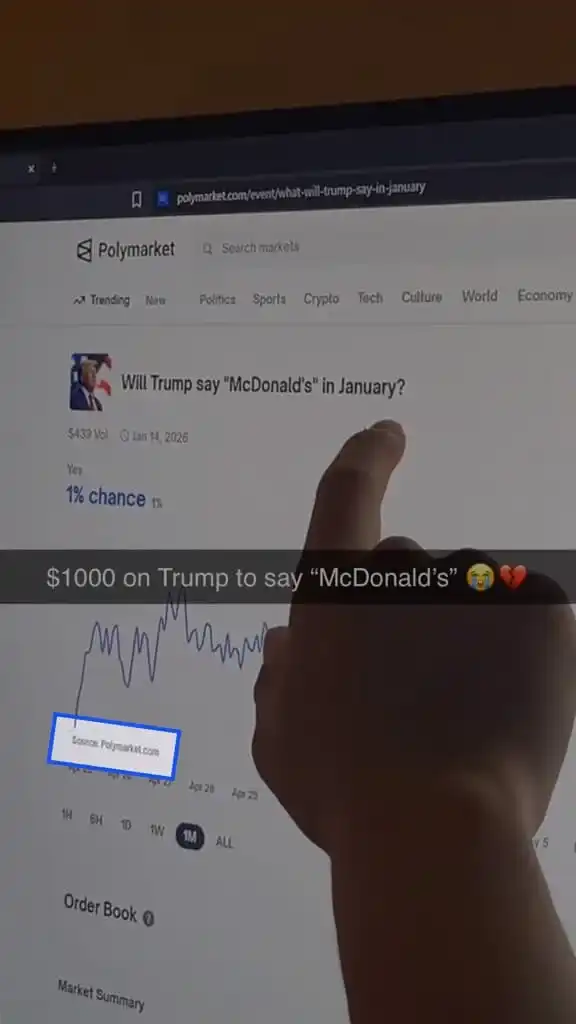
In January of this year, this college student posted a video showing he won $100,000 by betting that President Trump would publicly say the word "McDonald's" that month.

According to his videos, from January to mid-May, George Makihara seemingly placed 145 bets on the Polymarket website – with a total amount close to $410,000.

But according to a Wall Street Journal investigation, none of those trades were real.

George Makihara jumps when Trump says the word "McDonald's"; however, Trump never publicly said that phrase that month, this video was filmed two months ago

Based on the Journal's analysis of over 1,100 videos, related instructional materials, and interviews with creators who have worked with the company, George Makihara is one of dozens of creators paid by Polymarket, mostly college students, who film themselves making fake trades and sometimes showcasing fake profits. George Makihara declined to comment.

Public data shows that on Polymarket's actual website in January, over 50 accounts participated in the "McDonald's" bet. All of these accounts lost money.

To attract users to its unregulated platform, Polymarket flooded social media with videos like George Makihara's that appear genuine at first glance. In reality, Polymarket created near-perfect clones of its website and then instructed creators to make simulated trades on these virtual sites, while concealing that they were paid by Polymarket.

To make the videos go viral, Polymarket recruited a social media "army" to duplicate and repost the creators' content. Even though this New York-based company has been banned from offering its core crypto platform services in the U.S. since 2022, these social media creators, paid for their work, specifically targeted U.S. users – who can still access the site via virtual private networks (VPNs).

Polymarket said in a statement, "the company is committed to maintaining accurate, fair, and transparent markets. We are part of a fast-growing industry and are constantly evaluating how to improve how we engage and earn the trust of our audience." The company said it plans to conduct a comprehensive review of its existing promotional content.

Polymarket hired and worked closely with a marketing contractor to promote the site. In a message reviewed by the Journal, the contractor told its social media "army" to focus on reposting content from 10 Polymarket creators, including George Makihara. These creators initially did not label themselves as paid partners of Polymarket, though one provided a $20 referral code in their social media bio. After the Journal began asking the company about the marketing operation, these creators started adding "@polymarket partner" labels to their bios.

The Journal reviewed 1,105 videos posted between late December 2025 and mid-May by 10 creators endorsed by Polymarket's contractor. In 70% of the videos, the creators placed bets; clues in the videos indicate all these bets – totaling $1.9 million – were fake. Most videos just showed the betting process, but 118 videos showed creators reacting to winning, collectively winning nearly $900,000 in prizes – actually from fake trades; if you had actually placed those bets, you would have lost over $166,000.(Note: Polymarket has a data partnership with Dow Jones & Company, publisher of the Wall Street Journal. The Journal used only public data in this analysis.)

According to creators who have worked with the company, Polymarket instructed creators not to disclose they were paid. They said compensation typically accumulated to between $2,000 and $3,000 per month.

Investigating Fake Trades

One of the earliest videos showing signs of fake trades was posted to social media in June 2025, filmed at Polymarket's New York office. Someone placed a $100,000 bet that Powell would say "good afternoon" at a press conference, with a caption calling the bet a "valid manhood test."

The Journal investigation found over a dozen differences between the real Polymarket website and the simulated one.
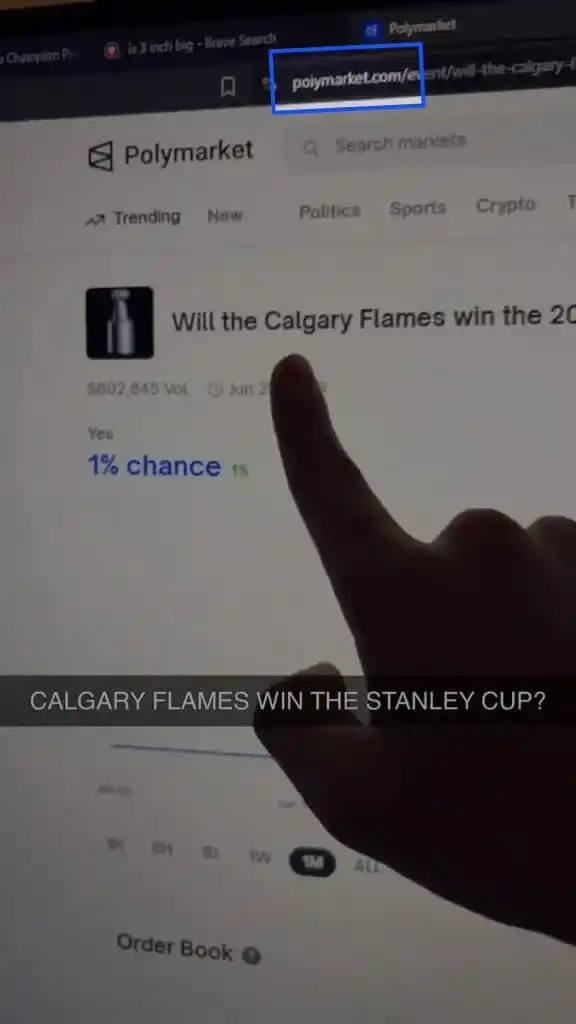
The fake simulated website was called "poiymarket.com"; when the "i" was capitalized, it was indistinguishable from polymarket.com. According to a person familiar with the matter, the site was built by Polymarket. Price charts on the site were labeled as sourced from "Polymarket.com." But Polymarket's real official website does not display any source information.
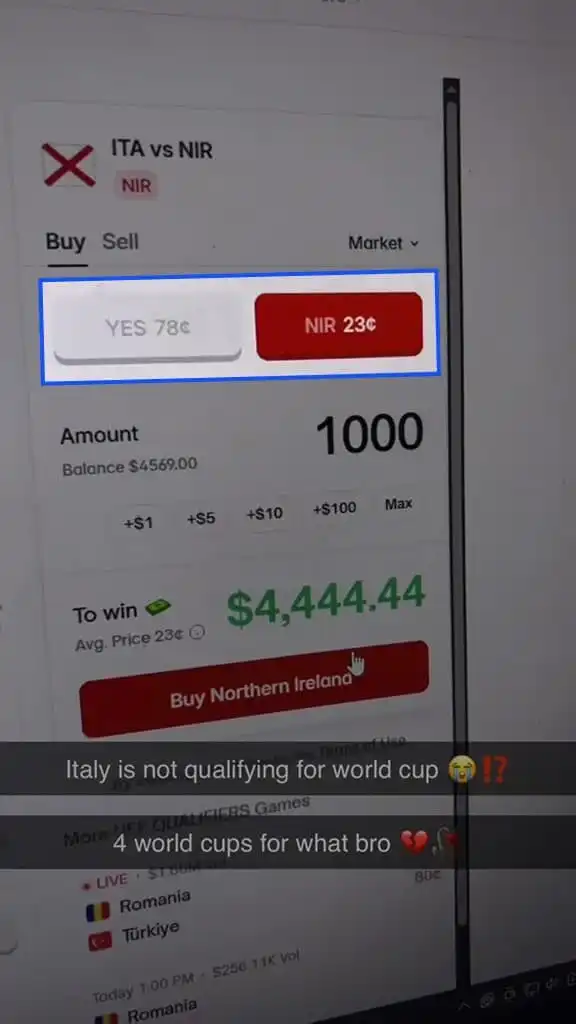
Additionally, the fake website sometimes had errors. For example, buttons would show "YES" and "NIR," while the real site has "YES" and "NO."
Several videos reviewed by the Journal also briefly flashed URL addresses, revealing the sites were test environments for Polymarket engineers. After the Journal contacted Polymarket for comment, the fake "poiymarket" website was taken down.

Federal advertising law requires brands to make truthful claims in their promotions and requires individuals paid to endorse products to disclose their connections; though there remains some gray area about what is permissible. Commodity laws governing prediction markets also prohibit deceptive and misleading conduct.

A spokesperson for the Federal Trade Commission, which enforces advertising laws, declined to comment on the Journal's findings, citing the agency's policy of not commenting on potential investigations.

Razeen Khan, a California college student who worked as a Polymarket creator for several months until March, compared the videos to fast-food commercials – where the food looks more appealing than it actually is.

"We're showing what actually happens," he said. "You're still going to buy that burger."

Creators said they would send finished videos to Polymarket for approval. If a video wasn't engaging enough or was obviously fake, Polymarket would ask for a reshoot.

Haian Nguyen was one of Polymarket's top-performing creators, filming her trades on the platform from a bedroom in San Francisco. In a video posted to Instagram, Haian Nguyen celebrated winning $60,000 after betting Trump would say "Olympics."

In another video of her dancing on a beach by the Golden Gate Bridge, the text overlay read "Polymarket funds my life."

Haian Nguyen declined to comment and cleared all videos from her profile after the Journal contacted her.

These promotional videos all followed the same template: the creator opens Polymarket, places a bet, and calls the profit "free money." Dozens of social media creators posted videos in nearly identical formats. According to creators who have worked with the company and a recruitment site, Polymarket sent creators bullet-pointed talking points.

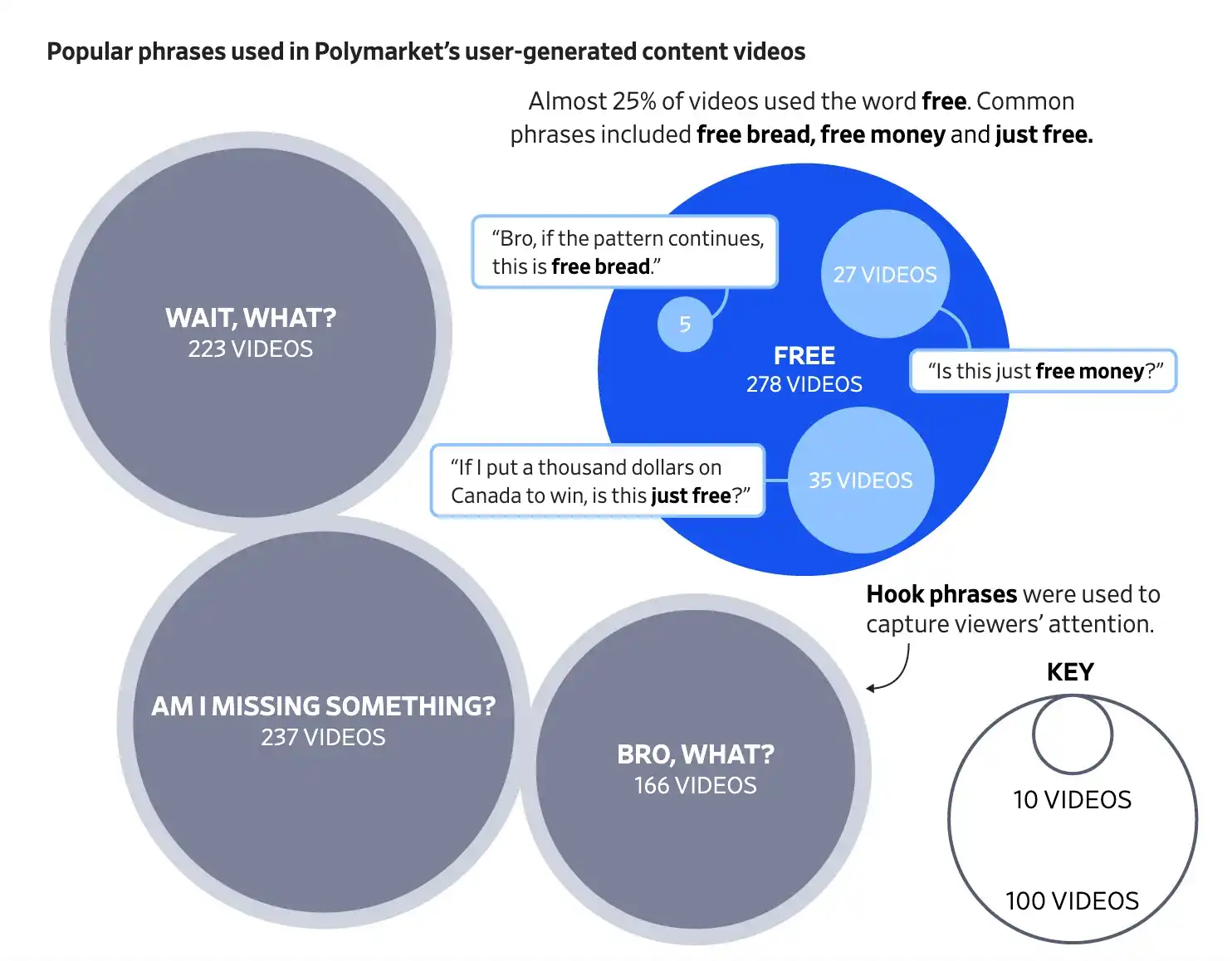
Common catchphrases in Polymarket user-generated content videos were:

Nearly 25% of videos used the word "free." Common phrases included "free bread," "free money," and "just free."

  • "Bro, if this trend continues, this is free bread." – 27 videos
  • "Wait, what?" – 223 videos
  • Free – 278 videos
  • "Isn't this free money?"
  • "If I bet a thousand dollars on Canada to win, isn't this free?" – 35 videos
  • "Am I missing something?" – 237 videos
  • "Bro, what?" – 166 videos
  • "Wait" – 100 videos

Source: Wall Street Journal analysis of 1,105 Polymarket creator videos on TikTok

The U.S. Commodity Futures Trading Commission (CFTC), which regulates prediction markets, has previously taken enforcement actions against companies using simulated trades to market products and making unrealistic profit promises.

The Trump administration has taken a permissive stance on regulating prediction markets. The CFTC has filed multiple lawsuits to stop states from regulating and taxing prediction markets. Trump recently posted on Truth Social that it is "critical" the CFTC has exclusive jurisdiction over prediction markets so they can flourish, calling politicians who want states to regulate them "scum." Trump's son, Donald Trump Jr., is an investor in Polymarket and a paid adviser to rival Kalshi.

A White House spokesperson said there was no conflict of interest and that Trump's actions were in the best interest of the American public. A CFTC spokesperson, in response to the Journal's reporting, said it is important to bring offshore prediction markets back to the U.S. so regulators can oversee them more effectively.

The Hype Machine

For Polymarket, virality is everything.

According to two people familiar with his thinking, founder Shayne Coplan told Polymarket's growth team to make the company impossible to ignore online. His close friend since high school, Matthew Modabber, oversees Polymarket's growth as chief marketing officer.

In 2024, Matthew Modabber (left) with Polymarket founder Shayne Coplan (right)

Polymarket is striving to attract more trading volume than its main competitor – the U.S.-regulated prediction market Kalshi. Polymarket was initially ahead; for most of 2025, both grew in sync; but in recent months, Kalshi has taken the lead. According to data provider The Block, last month Kalshi's trading volume was roughly double that of Polymarket.
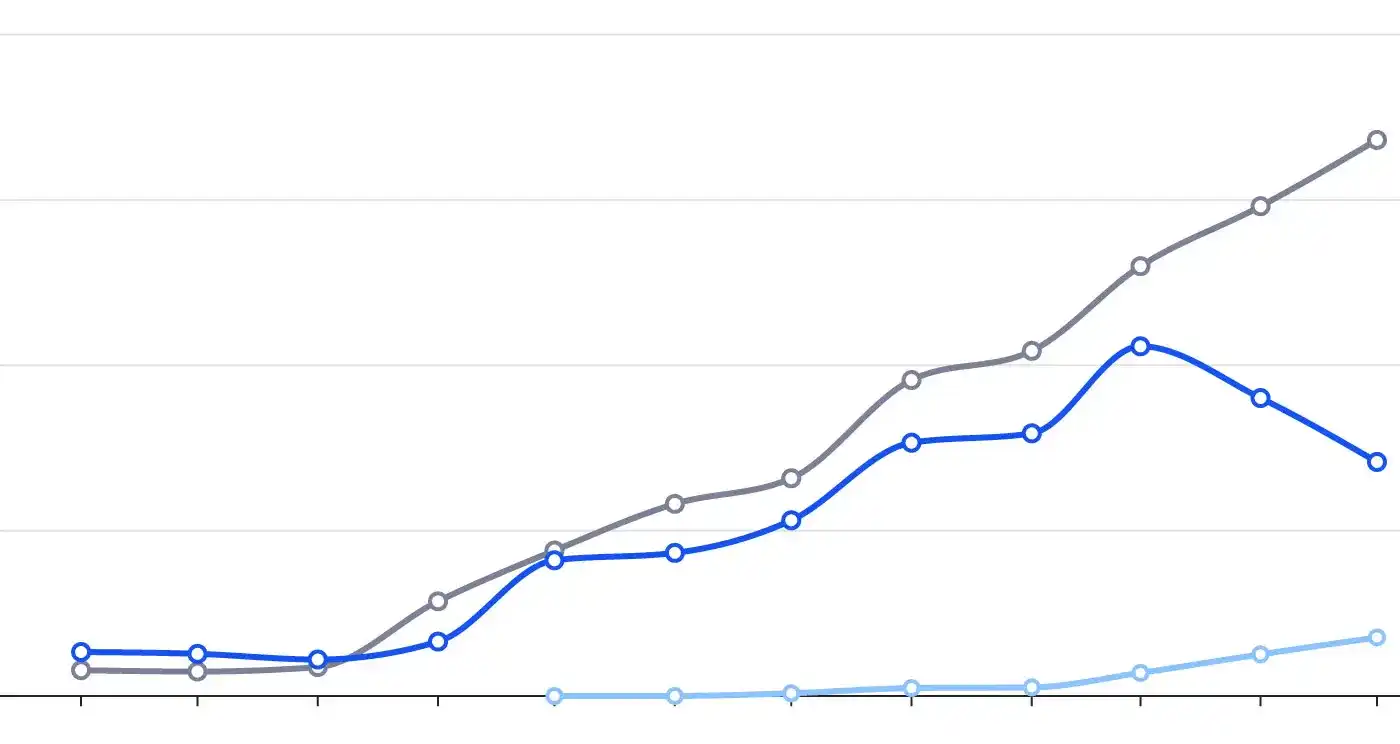
Monthly Trading Volume of Prediction Markets, data as of end of May 2026; Source: The Block

In 2022, Polymarket settled allegations of operating an unregistered options exchange, agreeing to stop offering its crypto-based trading services to U.S. customers and formally re-registering in Panama. Late last year, it launched a regulated U.S. version, available only as a mobile app. The app's trading volume is only a fraction of the offshore crypto exchange.

According to a person familiar with the matter, Polymarket is now seeking to overturn the outcome of the 2022 settlement and bring its crypto platform back to the U.S.

In the meantime, it is turning to social media to draw Americans to Polymarket.

Polymarket's Social Media "Army"

Polymarket's strategy leverages three groups of social media producers to portray the platform as a source of quick, easy money, gaining viral attention.

  • Streamers: Online personalities stream for hours on platforms like Twitch and Kick, discussing Polymarket and sometimes trading.
  • Creators: Social media users, mostly college students, make short videos talking about or trading on Polymarket.
  • Editors (known domestically as "slicers"): People around the world – especially teens in Asia – repost videos from streamers and creators.
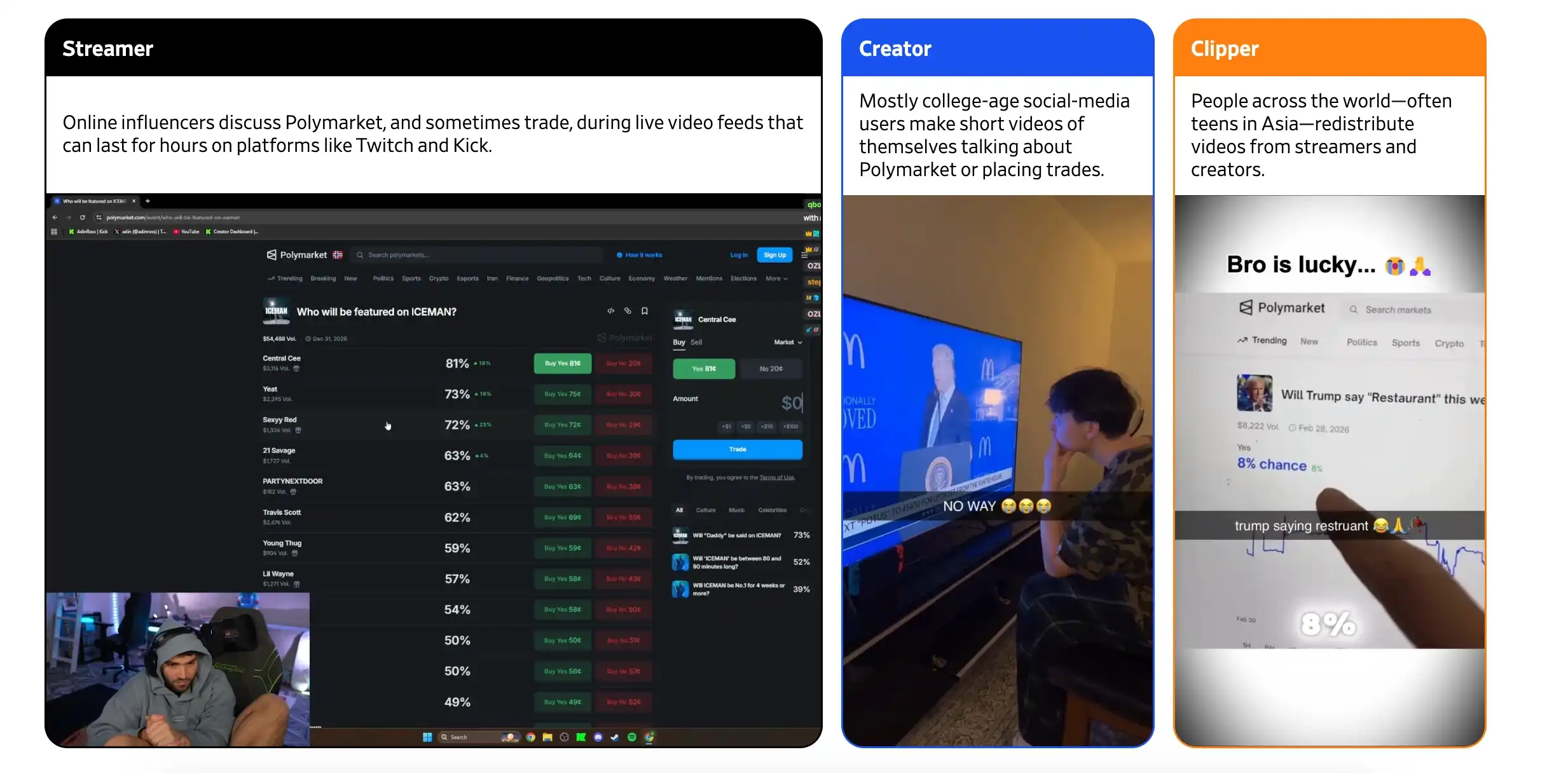
Polymarket hired marketing company Virality to manage the "slicer" team. Their promotional campaigns targeted Americans: according to instructional materials, as of early June, the slicer team could only get paid if at least 60% of their audience was U.S.-based.

Polymarket publicly distances itself from these ads. Based on the Journal's review of nearly 20,000 messages in a chat group for Polymarket's online content creator contractors, as well as instructional files and videos prepared for them, Virality asked the slicer team's posts to look "personal and natural."

"Everyone, if your account name contains 'Polymarket,' please rename and delete as soon as possible," a Virality employee told a group of slicers in the group chat. "Continued use would violate our guidelines and could lead to submissions being rejected. Not even 'poly' is allowed, change that too." Virality declined to comment.

Virality's editing promotion campaigns brought significant results.

A video posted by a Polymarket creator on TikTok had only received 151 views by mid-May. The slicer team reposted his video using secondary accounts, but most reposts were virtually unnoticed, with minimal view counts. But Polymarket works with many video editors to increase the odds of its videos going viral. Eventually, one video would always break through.

According to analytics provider Tubular, Polymarket's viral editing promotion campaigns have accumulated over 140 million views on TikTok, YouTube, and Instagram combined.

A TikTok U.S. spokesperson said several accounts identified by the Journal and other related accounts had been restricted for violating platform rules. A YouTube spokesperson said creators and brands must comply with legal obligations, otherwise YouTube may take action against them. A Meta spokesperson said while the platform requires creators to disclose if they are paid to promote or endorse products, it could not confirm if these specific contents violated its policies, as it had not independently verified whether these creators were paid by Polymarket.

Influencer Livestream Endorsements

Polymarket and Virality targeted dozens of videos by Adin Ross for promotion. Ross is a 25-year-old "manosphere" influencer with millions of followers. According to a person familiar with the negotiations, Ross has a multi-million dollar deal with Polymarket, averaging about half an hour per week browsing Polymarket and commenting on potential trades during his livestreams.

In at least five videos, Ross pointed out how he could trade on the platform using inside information.

In one promotional video, Ross said he could easily use inside information to trade on the release date of rapper Drake's (an acquaintance of Ross) upcoming new album.

Representatives for Ross and Drake declined to comment.

Internal materials show Polymarket and Virality promoted videos showcasing how easy it is to engage in insider trading on the platform. Polymarket has paid editors to promote at least 19 videos discussing opportunities to manipulate the market using insider information or other means.

Polymarket stated it "prohibits trading based on information obtained through theft, unlawful insider information, or in breach of trust, confidentiality, or other legal obligations." It added, "Polymarket's market integrity framework includes trade monitoring, on-chain transparency, reporting channels, and escalation processes to detect, review, and respond to suspicious activity. Where appropriate, we cooperate with regulators and law enforcement to maintain the integrity of our markets."

As the World Cup approached, some of Polymarket's creators turned to filming themselves trading on the company's newly launched, CFTC-regulated U.S. app.

Initially, these trades also looked legitimate. The app interface shown in social media videos was almost identical to that of Polymarket's U.S. app.

But a closer look revealed differences. For example, a market on the official app was "26 World Cup," while on the simulated Polymarket U.S. app it was "2026 FIFA World Cup."

The fake simulated trades continued.

Трендові криптовалюти

Пов'язані питання

QAccording to the WSJ investigation, how did Polymarket attract U.S. users to its platform despite being barred from the U.S. market?

APolymarket hired dozens of creators, mostly college students, to create videos showing fake trades and profits on simulated websites. These videos were then virally promoted by a social media army, specifically targeting U.S. audiences who could still access the site via VPN.

QWhat were some of the key differences between the fake 'poiymarket' simulation website and the real Polymarket website as identified in the article?

AKey differences included the fake URL (poiymarket.com vs polymarket.com), the fake site attributing price charts to 'Polymarket.com' (whereas the real site showed no source), occasional typos on buttons like 'NIR' instead of 'NO', and the fake site sometimes showing URLs for test environments used by Polymarket engineers.

QWhat actions did Polymarket announce it would take in response to the WSJ's findings about its promotional activities?

APolymarket stated it was committed to maintaining accurate, fair, and transparent markets and announced plans to conduct a comprehensive audit of its existing promotional content.

QHow much fake winnings and losses were shown in the 1105 videos analyzed by The Wall Street Journal, and what was the actual outcome for those bets if placed on the real platform?

AThe videos showed creators placing fake bets totaling $1.9 million, with 118 videos depicting fake wins of nearly $900,000. If those bets had actually been placed on the real Polymarket platform, they would have resulted in losses of over $166,000.

QWhat was the role of the marketing firm Virality in Polymarket's promotional strategy, and what specific requirement did it have for the 'slicer' team's content?

AVirality was hired by Polymarket to manage a 'slicer' team that reposted and promoted creator videos. Virality required that the slicer team's posts appear 'personal and natural' and specifically mandated that their accounts must not contain 'Polymarket' or even 'poly' in the username. Furthermore, to get paid, the slicers' content needed to have an audience with at least 60% U.S. users.

Пов'язані матеріали

Deep Insight: Decentralized Inference is Not Hype, but a Key Track for AI to Break Through Centralized Monopoly

Decentralized Reasoning: Beyond the Hype, a Key to Breaking AI's Centralized Monopoly A future scenario where a powerful AI model is banned by a major government illustrates the core value proposition of decentralized AI: resistance to censorship. The core bet of decentralized inference networks is mitigating this risk, with other benefits like cost being secondary. The path is extremely difficult, involving four key challenges: 1. **Running Massive Models:** Distributing a single model across a decentralized GPU swarm requires sophisticated techniques like pipeline and speculative decoding to overcome crippling network latency, aiming for usable speeds (e.g., 30-40 tokens/second). 2. **Proving Model Integrity:** Verifying that a node runs the correct model is critical. Solutions range from cryptographically secure but slow ZKML to faster, economically-secure methods like statistical fingerprints, deterministic re-execution, or live-weight proofs, each involving trade-offs between integrity, latency, and cost. 3. **Ensuring Prompt Privacy:** Simply sharding a model does not protect user inputs from nodes. Robust solutions currently require trusted hardware (TEEs) or advanced cryptography (FHE), which are not yet widely deployed in consumer swarms. 4. **Building a Real Market:** Identifying the ideal customer is tough. Beyond speculative AI agents, the viable market currently consists of startups embedding AI and projects needing batch processing (e.g., synthetic data generation), where decentralized aggregation can be an advantage over low-latency needs. The article analyzes several projects tackling these problems, such as Dolphin Network (live-weight proofs), Inference.net (statistical verification), Morpheus (TEE-based), and Darkbloom (Apple Secure Enclave). It provides a framework: decentralization is a "tax" for latency-sensitive applications (e.g., chat) but a potential supply-side advantage for throughput-oriented tasks (e.g., batch processing). The long-term vision is a closed data loop where decentralized inference generates valuable data (traces, preferences) to feed decentralized training networks, which in turn produce better open-weight models for the inference networks. A due diligence checklist advises focusing on projects that: are truly decentralized at specific layers; have a credible integrity method; offer real cost benefits; ensure genuine privacy; handle node reliability; have paying users; and are built by teams with deep AI expertise. The ultimate goal should be products that appeal beyond the crypto-native audience, using crypto mechanisms invisibly to deliver better cost, performance, or privacy.

Foresight News9 хв тому

Deep Insight: Decentralized Inference is Not Hype, but a Key Track for AI to Break Through Centralized Monopoly

Foresight News9 хв тому

The Final Piece of Franklin Templeton's Crypto Ambition

Franklin Templeton Completes Crypto Ambition with Acquisition of 250 Digital On June 22, Franklin Templeton announced the acquisition of 250 Digital and established Franklin Crypto, a new division focused on actively managed cryptocurrency strategies for institutional investors. The unit is led by Christopher Perkins and Seth Ginns. This acquisition marks a key piece in Franklin Templeton's multi-year crypto strategy, which began in 2018 with a digital assets team. The firm's crypto product suite now spans three layers: tokenized funds like the blockchain-based money market fund BENJI (~$831M AUM); a series of passive ETFs including Bitcoin (EZBC, ~$368M), Ethereum (EZET), XRP (XRPZ, ~$252M), Solana (SOEZ), and a multi-crypto index fund (EZPZ); and the newly added active management strategies from Franklin Crypto. The company has also expanded its crypto ecosystem through investments in projects like Ethena and Crossmint, and collaborations with blockchains such as Aptos and Sui. With approximately $18B in digital asset AUM and a total firm AUM of ~$1.78T, Franklin Templeton is positioning itself as a comprehensive crypto asset manager for pensions and sovereign wealth funds. In contrast, competitor Fidelity Investments has taken a different path, focusing early on building its own custody and trading infrastructure. Fidelity's Bitcoin ETF (FBTC) holds over $11B, significantly larger than Franklin Templeton's equivalent offering. Both giants' moves underscore the deepening trend of traditional finance entering the crypto space.

Foresight News32 хв тому

The Final Piece of Franklin Templeton's Crypto Ambition

Foresight News32 хв тому

Торгівля

Спот
Ф'ючерси

Популярні статті

Що таке $S$

Розуміння SPERO: Комплексний огляд Вступ до SPERO Оскільки ландшафт інновацій продовжує еволюціонувати, виникнення технологій web3 та криптовалютних проектів відіграє ключову роль у формуванні цифрового майбутнього. Один з проектів, який привернув увагу в цій динамічній сфері, — це SPERO, позначений як SPERO,$$s$. Ця стаття має на меті зібрати та представити детальну інформацію про SPERO, щоб допомогти ентузіастам та інвесторам зрозуміти його основи, цілі та інновації в рамках web3 та крипто-сектору. Що таке SPERO,$$s$? SPERO,$$s$ — це унікальний проект у криптопросторі, який прагне використати принципи децентралізації та технології блокчейн для створення екосистеми, що сприяє залученню, корисності та фінансовій інклюзії. Проект розроблений для полегшення взаємодії між користувачами новими способами, надаючи їм інноваційні фінансові рішення та послуги. У своїй основі SPERO,$$s$ прагне надати можливості індивідам, забезпечуючи інструменти та платформи, які покращують користувацький досвід у криптовалютному просторі. Це включає в себе можливість більш гнучких методів транзакцій, сприяння ініціативам, що підтримуються спільнотою, та створення шляхів для фінансових можливостей через децентралізовані додатки (dApps). Основна концепція SPERO,$$s$ обертається навколо інклюзивності, прагнучи зменшити розриви в традиційній фінансовій системі, використовуючи переваги технології блокчейн. Хто є творцем SPERO,$$s$? Особистість творця SPERO,$$s$ залишається дещо невідомою, оскільки є обмежені публічно доступні ресурси, що надають детальну інформацію про його засновників. Ця відсутність прозорості може бути наслідком зобов'язання проекту до децентралізації — етики, яку багато проектів web3 поділяють, ставлячи колективні внески вище за індивідуальне визнання. Зосереджуючи обговорення навколо спільноти та її колективних цілей, SPERO,$$s$ втілює суть наділення без виділення конкретних осіб. Таким чином, розуміння етики та місії SPERO є більш важливим, ніж ідентифікація єдиного творця. Хто є інвесторами SPERO,$$s$? SPERO,$$s$ підтримується різноманітними інвесторами, починаючи від венчурних капіталістів до ангельських інвесторів, які прагнуть сприяти інноваціям у крипто-секторі. Зосередження цих інвесторів зазвичай узгоджується з місією SPERO — пріоритет надається проектам, які обіцяють технологічний прогрес у суспільстві, фінансову інклюзію та децентралізоване управління. Ці інвесторські фонди зазвичай зацікавлені в проектах, які не лише пропонують інноваційні продукти, але й позитивно впливають на спільноту блокчейн та її екосистеми. Підтримка з боку цих інвесторів підкріплює SPERO,$$s$ як значного конкурента в швидко змінюваній сфері крипто-проектів. Як працює SPERO,$$s$? SPERO,$$s$ використовує багатогранну структуру, яка відрізняє його від традиційних криптовалютних проектів. Ось деякі ключові особливості, які підкреслюють його унікальність та інноваційність: Децентралізоване управління: SPERO,$$s$ інтегрує моделі децентралізованого управління, надаючи користувачам можливість активно брати участь у процесах прийняття рішень щодо майбутнього проекту. Цей підхід сприяє відчуттю власності та відповідальності серед членів спільноти. Корисність токена: SPERO,$$s$ використовує свій власний криптовалютний токен, розроблений для виконання різних функцій в екосистемі. Ці токени дозволяють здійснювати транзакції, отримувати винагороди та полегшувати послуги, що пропонуються на платформі, підвищуючи загальну залученість та корисність. Шарова архітектура: Технічна архітектура SPERO,$$s$ підтримує модульність та масштабованість, що дозволяє безперешкодно інтегрувати додаткові функції та додатки в міру розвитку проекту. Ця адаптивність є надзвичайно важливою для збереження актуальності в постійно змінюваному крипто-ландшафті. Залучення спільноти: Проект підкреслює ініціативи, що підтримуються спільнотою, використовуючи механізми, які стимулюють співпрацю та зворотний зв'язок. Підтримуючи сильну спільноту, SPERO,$$s$ може краще задовольняти потреби користувачів та адаптуватися до ринкових тенденцій. Фокус на інклюзію: Пропонуючи низькі комісії за транзакції та зручні інтерфейси, SPERO,$$s$ прагне залучити різноманітну базу користувачів, включаючи осіб, які раніше не брали участі в крипто-просторі. Це зобов'язання до інклюзії узгоджується з його загальною місією наділення через доступність. Хронологія SPERO,$$s$ Розуміння історії проекту надає важливі уявлення про його розвиток та етапи. Нижче наведено пропоновану хронологію, що відображає значні події в еволюції SPERO,$$s$: Етап концептуалізації та ідеації: Початкові ідеї, що стали основою SPERO,$$s$, були сформовані, тісно пов'язані з принципами децентралізації та фокусом на спільноті в індустрії блокчейн. Запуск білого паперу проекту: Після концептуального етапу був випущений комплексний білий папір, що детально описує бачення, цілі та технологічну інфраструктуру SPERO,$$s$, щоб залучити інтерес та зворотний зв'язок від спільноти. Створення спільноти та ранні залучення: Активні зусилля були спрямовані на створення спільноти ранніх прихильників та потенційних інвесторів, що полегшило обговорення цілей проекту та отримання підтримки. Подія генерації токенів: SPERO,$$s$ провів подію генерації токенів (TGE) для розподілу своїх рідних токенів серед ранніх прихильників та встановлення початкової ліквідності в екосистемі. Запуск початкового dApp: Перший децентралізований додаток (dApp), пов'язаний з SPERO,$$s$, став доступним, дозволяючи користувачам взаємодіяти з основними функціями платформи. Постійний розвиток та партнерства: Безперервні оновлення та вдосконалення пропозицій проекту, включаючи стратегічні партнерства з іншими учасниками блокчейн-простору, сформували SPERO,$$s$ у конкурентоспроможного та еволюціонуючого гравця на крипто-ринку. Висновок SPERO,$$s$ є свідченням потенціалу web3 та криптовалют для революціонізації фінансових систем та наділення індивідів. Завдяки зобов'язанню до децентралізованого управління, залучення спільноти та інноваційно спроектованих функцій, він прокладає шлях до більш інклюзивного фінансового ландшафту. Як і з будь-якими інвестиціями в швидко змінюваному крипто-просторі, потенційним інвесторам та користувачам рекомендується ретельно досліджувати та обдумано взаємодіяти з поточними подіями в SPERO,$$s$. Проект демонструє інноваційний дух крипто-індустрії, запрошуючи до подальшого дослідження його численних можливостей. Хоча подорож SPERO,$$s$ ще триває, його основні принципи можуть справді вплинути на майбутнє того, як ми взаємодіємо з технологією, фінансами та один з одним у взаємопов'язаних цифрових екосистемах.

81 переглядів усьогоОпубліковано 2024.12.17Оновлено 2024.12.17

Що таке $S$

Що таке AGENT S

Агент S: Майбутнє автономної взаємодії в Web3 Вступ У постійно змінюваному ландшафті Web3 та криптовалюти інновації постійно переосмислюють, як люди взаємодіють з цифровими платформами. Один з таких новаторських проектів, Агент S, обіцяє революціонізувати взаємодію людини з комп'ютером через свою відкриту агентну структуру. Прокладаючи шлях для автономних взаємодій, Агент S прагне спростити складні завдання, пропонуючи трансформаційні застосування в штучному інтелекті (ШІ). Це детальне дослідження заглиблюється в складності проекту, його унікальні особливості та наслідки для сфери криптовалюти. Що таке Агент S? Агент S є революційною відкритою агентною структурою, спеціально розробленою для вирішення трьох основних викликів в автоматизації комп'ютерних завдань: Набуття специфічних знань у галузі: Структура інтелектуально навчається з різних зовнішніх джерел знань та внутрішнього досвіду. Цей подвійний підхід дозволяє їй створити багатий репозиторій специфічних знань у галузі, покращуючи її продуктивність у виконанні завдань. Планування на довгих горизонтах завдань: Агент S використовує планування з підкріпленням досвіду, стратегічний підхід, який полегшує ефективний розподіл та виконання складних завдань. Ця функція значно підвищує її здатність ефективно та результативно управляти кількома підзавданнями. Обробка динамічних, неоднорідних інтерфейсів: Проект представляє Інтерфейс Агент-Комп'ютер (ACI), інноваційне рішення, яке покращує взаємодію між агентами та користувачами. Використовуючи багатомодальні великі мовні моделі (MLLMs), Агент S може безперешкодно орієнтуватися та маніпулювати різноманітними графічними інтерфейсами користувача. Завдяки цим новаторським функціям Агент S надає надійну структуру, яка вирішує складнощі, пов'язані з автоматизацією людської взаємодії з машинами, прокладаючи шлях для численних застосувань у ШІ та за його межами. Хто є творцем Агент S? Хоча концепція Агент S є фундаментально новаторською, конкретна інформація про його творця залишається невідомою. Творець наразі невідомий, що підкреслює або початкову стадію проекту, або стратегічний вибір зберегти засновників у таємниці. Незважаючи на анонімність, акцент залишається на можливостях та потенціалі структури. Хто є інвесторами Агент S? Оскільки Агент S є відносно новим у криптографічній екосистемі, детальна інформація про його інвесторів та фінансових спонсорів не задокументована. Відсутність публічно доступних відомостей про інвестиційні фонди або організації, що підтримують проект, викликає питання щодо його фінансової структури та дорожньої карти розвитку. Розуміння підтримки є критично важливим для оцінки стійкості проекту та потенційного впливу на ринок. Як працює Агент S? В основі Агент S лежить передова технологія, яка дозволяє йому ефективно функціонувати в різних умовах. Його операційна модель побудована навколо кількох ключових функцій: Взаємодія з комп'ютером, подібна до людської: Структура пропонує розширене планування ШІ, прагнучи зробити взаємодії з комп'ютерами більш інтуїтивними. Імітуючи людську поведінку при виконанні завдань, вона обіцяє підвищити досвід користувачів. Наративна пам'ять: Використовується для використання високорівневого досвіду, Агент S використовує наративну пам'ять для відстеження історій завдань, тим самим покращуючи свої процеси прийняття рішень. Епізодична пам'ять: Ця функція надає користувачам покрокові інструкції, дозволяючи структурі пропонувати контекстуальну підтримку в міру виконання завдань. Підтримка OpenACI: Завдяки можливості працювати локально, Агент S дозволяє користувачам зберігати контроль над своїми взаємодіями та робочими процесами, узгоджуючи з децентралізованою етикою Web3. Легка інтеграція з зовнішніми API: Його універсальність і сумісність з різними платформами ШІ забезпечують те, що Агент S може безперешкодно вписатися в існуючі технологічні екосистеми, роблячи його привабливим вибором для розробників та організацій. Ці функціональні можливості колективно сприяють унікальному положенню Агент S у крипто-просторі, оскільки він автоматизує складні, багатоступеневі завдання з мінімальним втручанням людини. У міру розвитку проекту його потенційні застосування в Web3 можуть переосмислити, як відбуваються цифрові взаємодії. Хронологія Агент S Розробка та етапи Агент S можуть бути узагальнені в хронології, яка підкреслює його значні події: 27 вересня 2024 року: Концепція Агент S була представлена в комплексній науковій статті під назвою “Відкрита агентна структура, яка використовує комп'ютери як людина”, що демонструє основи проекту. 10 жовтня 2024 року: Наукова стаття була опублікована на arXiv, пропонуючи детальне дослідження структури та її оцінки продуктивності на основі бенчмарку OSWorld. 12 жовтня 2024 року: Було випущено відеопрезентацію, що надає візуальне уявлення про можливості та особливості Агент S, ще більше залучаючи потенційних користувачів та інвесторів. Ці маркери в хронології не лише ілюструють прогрес Агент S, але й вказують на його прихильність до прозорості та залучення громади. Ключові моменти про Агент S У міру розвитку структури Агент S кілька ключових характеристик виділяються, підкреслюючи її новаторський характер та потенціал: Інноваційна структура: Розроблена для забезпечення інтуїтивного використання комп'ютерів, подібного до людської взаємодії, Агент S пропонує новий підхід до автоматизації завдань. Автономна взаємодія: Здатність автономно взаємодіяти з комп'ютерами через GUI означає стрибок до більш інтелектуальних та ефективних обчислювальних рішень. Автоматизація складних завдань: Завдяки своїй надійній методології він може автоматизувати складні, багатоступеневі завдання, роблячи процеси швидшими та менш схильними до помилок. Безперервне вдосконалення: Механізми навчання дозволяють Агенту S покращуватися на основі минулого досвіду, постійно підвищуючи свою продуктивність та ефективність. Універсальність: Його адаптивність до різних операційних середовищ, таких як OSWorld та WindowsAgentArena, забезпечує його здатність служити широкому спектру застосувань. Оскільки Агент S займає своє місце в ландшафті Web3 та криптовалюти, його потенціал покращити можливості взаємодії та автоматизувати процеси означає значний прогрес у технологіях ШІ. Завдяки своїй інноваційній структурі Агент S є прикладом майбутнього цифрових взаємодій, обіцяючи більш безперешкодний та ефективний досвід для користувачів у різних галузях. Висновок Агент S представляє собою сміливий крок вперед у поєднанні ШІ та Web3, з можливістю переосмислити, як ми взаємодіємо з технологією. Хоча проект все ще на ранніх стадіях, можливості для його застосування є величезними та переконливими. Завдяки своїй комплексній структурі, що вирішує критичні виклики, Агент S прагне вивести автономні взаємодії на передній план цифрового досвіду. У міру того, як ми заглиблюємося в сфери криптовалюти та децентралізації, проекти, подібні до Агент S, безсумнівно, відіграватимуть ключову роль у формуванні майбутнього технологій та співпраці людини з комп'ютером.

706 переглядів усьогоОпубліковано 2025.01.14Оновлено 2025.01.14

Що таке AGENT S

Як купити S

Ласкаво просимо до HTX.com! Ми зробили покупку Sonic (S) простою та зручною. Дотримуйтесь нашої покрокової інструкції, щоб розпочати свою криптовалютну подорож.Крок 1: Створіть обліковий запис на HTXВикористовуйте свою електронну пошту або номер телефону, щоб зареєструвати обліковий запис на HTX безплатно. Пройдіть безпроблемну реєстрацію й отримайте доступ до всіх функцій.ЗареєструватисьКрок 2: Перейдіть до розділу Купити крипту і виберіть спосіб оплатиКредитна/дебетова картка: використовуйте вашу картку Visa або Mastercard, щоб миттєво купити Sonic (S).Баланс: використовуйте кошти з балансу вашого рахунку HTX для безперешкодної торгівлі.Треті особи: ми додали популярні способи оплати, такі як Google Pay та Apple Pay, щоб підвищити зручність.P2P: Торгуйте безпосередньо з іншими користувачами на HTX.Позабіржова торгівля (OTC): ми пропонуємо індивідуальні послуги та конкурентні обмінні курси для трейдерів.Крок 3: Зберігайте свої Sonic (S)Після придбання Sonic (S) збережіть його у своєму обліковому записі на HTX. Крім того, ви можете відправити його в інше місце за допомогою блокчейн-переказу або використовувати його для торгівлі іншими криптовалютами.Крок 4: Торгівля Sonic (S)Легко торгуйте Sonic (S) на спотовому ринку HTX. Просто увійдіть до свого облікового запису, виберіть торгову пару, укладайте угоди та спостерігайте за ними в режимі реального часу. Ми пропонуємо зручний досвід як для початківців, так і для досвідчених трейдерів.

1.6k переглядів усьогоОпубліковано 2025.01.15Оновлено 2026.06.02

Як купити S

Обговорення

Ласкаво просимо до спільноти HTX. Тут ви можете бути в курсі останніх подій розвитку платформи та отримати доступ до професійної ринкової інформації. Нижче представлені думки користувачів щодо ціни S (S).

活动图片