Unveiling the 'White-haired Stock God' Serenity: A Spiritual Remedy for Anxious Retail Investors

Odaily星球日报Опубліковано о 2026-06-11Востаннє оновлено о 2026-06-11

Анотація

The article details the rise of Serenity, dubbed the "White-Haired Stock God," whose social media posts have recently caused significant volatility in China's A-share market. Previously gaining fame in international retail investor communities, Serenity is known for his "Chokepoint Investment" strategy targeting small monopolies in the AI supply chain, reportedly achieving returns over 3612% this year. His influence stems from his background as a former AI research scientist, detailed analysis, and a massive following on X, where his subscriber count has surpassed Elon Musk's. In early June, Serenity's Chinese-language posts mentioning A-shares like LeaderDrive (Lide Xiebo), Easun, and Innolight triggered immediate 20% surges in their stock prices. He later clarified that some recommendations were crowdsourced from followers and claimed he did not hold positions in these stocks, stating his actions were "just for fun" to offer a foreign perspective on Chinese markets. This activity drew scrutiny from Chinese financial media, which warned of potential "pump-and-dump" schemes and legal risks. While anonymous, clues suggest Serenity is likely a Chinese-speaking individual living in Japan. He maintains his anonymity due to past harassment but enjoys substantial monthly income from his paid subscriptions. The article posits that Serenity embodies the market's current appetite for a charismatic, successful figure during the AI bull run, serving as an "outward projection" of bulli...

Original | Odaily Planet Daily(@OdailyChina)

Author|Golem(@web 3_golem)

In the A-share market, the 'White-haired Stock God' Serenity has completely exploded in popularity.

From June 5th to June 9th, Serenity successively "called" three A-shares on the X platform: LeaderDrive, a concept stock for embodied intelligent robots, Easy Sight, a concept stock for digital intelligence new energy, and Innolight, a leading stock in the optical module sector. The stock prices of the first two were straight-line pulled to a 20cm limit-up on the same day, and LeaderDrive's June gain has already exceeded 30%.

The reason Serenity has such strong "call-signaling ability" is that before entering the sight of domestic A-share investors, he had already gained extremely high recognition in international retail investor communities.

Serenity's investment characteristic is to screen out small monopolistic enterprises on the AI industry chain that are not fully priced according to the "Chokepoint Investment Method." Because the over 16 stocks he called this year have all achieved investment returns exceeding 100%, with his personal year-to-date investment return exceeding 3612%, combined with his professional background as a former AI research scientist and his rigorous analysis of the AI industry and favored companies each time, Serenity has amassed a large number of loyal retail fans in Europe, America, Japan, and South Korea. His X account subscriber count surpasses that of Elon Musk, ranking first on the platform. Therefore, his influence on a stock's price fluctuations also exceeds that of ordinary stock analysts.

For example, on May 27th, Serenity posted on the X platform announcing that he had completed building a position in XFAB on the European stock market at a market cap of $1.28 billion. XFAB's stock price was subsequently pushed higher, with an intraday peak increase of 77%, reaching a high of 13.13 euros. After that, XFAB's stock price began a continuous decline, currently reporting around 8.8 euros, having returned to the level before Serenity's call.

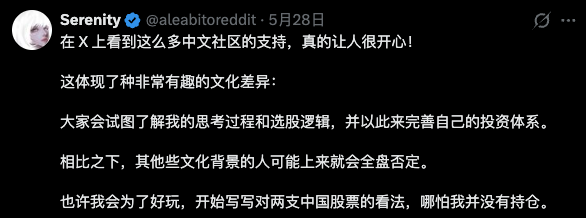
The day after causing significant volatility in XFAB's stock price, Serenity posted on the X platform in Chinese, saying, "Because I see so much support from the Chinese community... maybe for fun, I'll start writing about my views on two Chinese stocks."

A storm sweeping through the A-share market thus began.
Disrupting the A-Share Market Without Holding Positions, Just for Fun?

In hindsight, the two stocks Serenity mentioned were LeaderDrive and Easy Sight.

On June 5th, Serenity posted in Chinese, specifically emphasizing "written especially for my Chinese readers," stating that LeaderDrive (688017, 57.73 billion RMB) was his most favored listed Chinese target while deploying in the humanoid robot sector. The main reason is its absolute dominance in certain robot component supply chains, with over 60% domestic market share and more than 1,800 global customers.
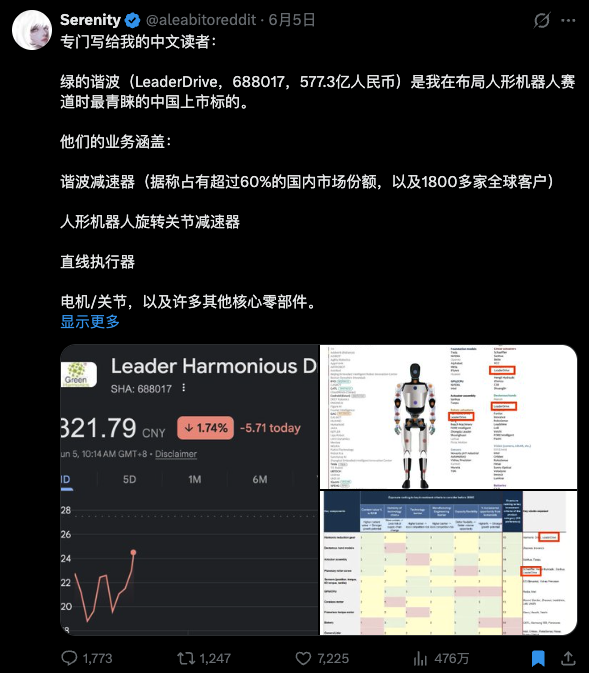
As of now, this post has been viewed over 4 million times and has been disseminated secondarily to multiple domestic social media platforms. LeaderDrive's stock price triggered a 20% limit-up on June 5th. By June 10th, in just 4 trading days, the stock price had risen over 30%.

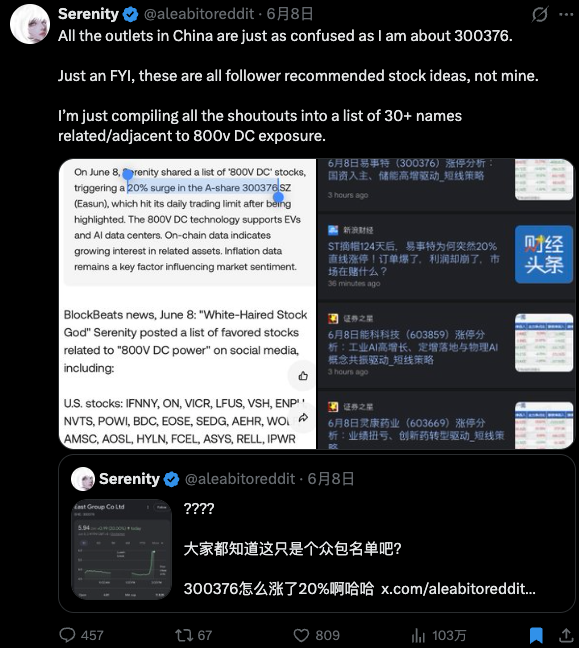
On June 8th, the same market script played out again. Serenity posted a crowdsourced list of over 30 companies related to the "800V DC" concept on the X platform, which included the A-share company Easy Sight. The news quickly fermented domestically, and Easy Sight's stock price happily received a 20CM limit-up within an hour. By June 10th, its gain also exceeded 30%.

Even Serenity himself was surprised, posting in wonder, "Does everyone know this is just a crowdsourced list, right? How did 300376 (Easy Sight) rise 20%?"

He immediately followed up with another post stating, "These are stocks recommended by fans, not my personal recommendations," attempting to distance himself from it.
Besides these two stocks, Serenity also mentioned a third A-share, Innolight, on June 9th, stating that Innolight was the only Chinese listed company he invested in last year. However, because some AI mistranslated "Innolight" as another A-share listed company, Inno Laser, Inno Laser was violently pulled up nearly 10% in 10 minutes. This "mistaken identity" incident also reveals retail investors' FOMO (Fear Of Missing Out) towards Serenity himself, "blindly asking what to buy, afraid of missing out on the hot stuff."

Serenity's actions quickly drew the attention of domestic financial media and securities analysts, who began speculating about his purpose for "cross-border stock promotion." On June 9th, Cailian Press published a long article reminding domestic investors to be vigilant about overseas information backflow. If Serenity's sharing involves profit-sharing, then the behavior is classic "export-for-domestic-sale-style cross-border stock promotion," which carries legal liabilities. Some domestic securities analysts even angrily posted on their social media circles, "These bastards will get their comeuppance sooner or later, thinking they can act lawlessly just by running abroad."

Facing domestic media's questioning about him "harvesting retail investors," Serenity responded that calling A-shares was just because he believed "foreigners could bring a different perspective to A-shares." He further stated, "Although I really like LeaderDrive, I don't hold its stock." Perhaps, as he initially said, the original intention for doing all this was just for fun.
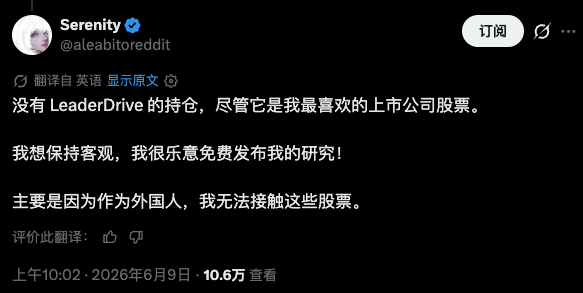
Serenity appears like a "philanthropist." He emphasizes that he does not do any paid promotions or marketing. The only paid thing is a $1 monthly subscription service. He is not a member of any institution or the Illuminati. The reason for his continuous free sharing is his belief that the stock market is a positive-sum game process. He hopes retail investors can buy quality stocks without joining any expensive paid communities, even before institutions enter. He claims he is promoting information democratization.

In the investment field, don't overly deify anyone. Serenity may not seek profit, but he certainly seeks fame. Since starting to call A-shares on June 5th, Serenity's follower count has surged by over 200,000 again. As of June 11th, his X platform follower count exceeds 810,000, and account subscribers have grown to 54,000, leaving Musk (46,000) behind. With such a large subscriber base, even at a price of $1, Serenity's monthly fixed income reaches $54,000, easily earning millions of RMB annually.

Serenity's pinned posts are all celebrating his account subscriber count surpassing Musk, calling it his goal. An anonymous account having such high influence and attention makes investors even more curious about his real identity. Behind this account, is it an individual, a team, or even just an AI?

Very Likely a Chinese Person Residing in Japan?

Serenity explains that the reason for maintaining anonymity is to be able to freely express ideas online. He stated that when he first published negative views about IREN (a NASDAQ-listed stock), he received threats and harassment from dozens of accounts in real life, which is why he chose to remain anonymous.

Nevertheless, the community has slowly pieced together an image of Serenity from various collected fragments of information. It is highly likely he is a Chinese person living in Japan.

Serenity revealed some personal information in late May. He said he is quite international, currently studying Japanese in Japan. Because he once lived in mainland China for a while and frequently traveled to Taiwan, he knows a bit of Chinese. Additionally, he played soccer in Mexico for two or three years and went to South Korea specifically to play League of Legends... His life seems quite comfortable.
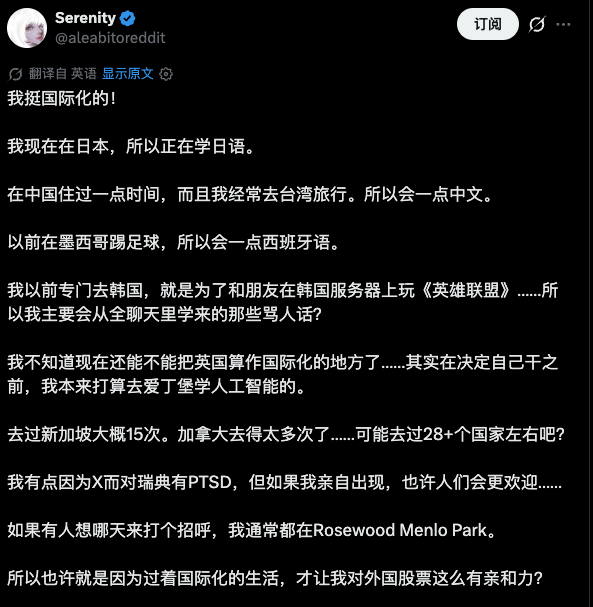
Serenity has lived in Japan for at least half a year. At the end of 2025, he often posted photos of his life in Japan on the X platform, but since becoming popular, he rarely mentions his personal life.

Serenity in Japan

Serenity is a high-frequency poster, averaging 9-10 posts per day, peaking at over 20 posts. Analyzing his daily posting frequency with AI shows he has an absolute silence period of about 5 hours each day. This silence period is likely when Serenity is resting or sleeping. This timeframe conveniently corresponds to the early morning hours (3:00 to 8:00) in some Asian time zones (UTC+8, UTC+9). Combined with the previous information, this basically locks Serenity's location to Japan.

The community leans towards believing Serenity is a Chinese person, but Serenity emphasizes that English is his native language. Most of his posts are still in English. Occasionally posting in Chinese seems to be just to cater to Chinese fans. Moreover, if counting posts in different languages, his Japanese post count is even higher than his Chinese post count.

Combining this with Serenity's early experiences—being active on Reddit WSB (Odaily Note: WallStreetBets is the largest retail trading community in the US) before moving to X, rejecting an offer from Nvidia's AI team in 2018, and being reported by overseas renowned media like Bloomberg and Reuters—it's basically possible to rule out Serenity being a Chinese national.

Serenity's anonymous identity, non-transparent investment returns, and excessive desire for influence are all increasing market controversy about him. But interestingly, everyone who questions him is also constantly refreshing his homepage.

Stock investment has always had its own icons for each era: Warren Buffett, Cathie Wood, Roaring Kitty. Every era has its own spiritual totem. A bull market amplifies returns and also amplifies beliefs. When more and more people start making money, we always want to find someone who can "scientifically explain the bubble." Serenity might just be the outward projection of this round of AI bull market sentiment—mysterious, professional, successful, fitting all the public's imagination of a "stock god."

But next to the altar is the chopping block. Because when the market turns, people will again want to find someone to blame for the losses, and Serenity might then be the most suitable candidate. History repeats itself, the market always moves forward. People enjoy creating gods and are also skilled at "destroying gods." As for who Serenity really is, it probably isn't that important anymore.


Пов'язані питання

QWhat is Serenity's claimed investment methodology for selecting stocks in the AI industry?

ASerenity's claimed investment methodology is the 'Chokepoint Investment Method.' He uses this to filter for small monopoly companies within the AI industrial chain that he believes are underpriced or not fully valued by the market.

QWhat immediate market impact did Serenity's 'callouts' of specific A-share stocks have, according to the article?

AAccording to the article, Serenity's 'callouts' of specific A-share stocks (Lide Hexie, Yishite, and Zhongji Innolight) immediately led to significant price surges. The first two stocks saw their prices pulled straight up to a 20% daily limit up on the days he mentioned them.

QWhat primary reason does Serenity give for maintaining anonymity online?

ASerenity explains that he maintains anonymity to freely express his ideas online. He cites an incident where he faced threats and harassment from numerous accounts after posting negative views about a stock (IREN) as the reason for choosing to remain anonymous.

QBased on community analysis in the article, what is the most likely identity and location of Serenity?

ABased on community analysis of his posting patterns, personal disclosures, and shared photos, the article suggests Serenity is most likely a Chinese person residing in Japan. His posts show activity patterns aligning with Asian time zones, and he has shared details about living in Japan and learning Japanese.

QAccording to the article's analysis, what are Serenity's potential motivations, beyond just 'for fun'?

AThe article suggests that while Serenity may claim his actions are 'for fun' and not for profit, he likely seeks fame and influence. His subscriber count surged significantly after his A-share callouts, generating substantial monthly income from his paid subscription service. His public celebration of surpassing Elon Musk in subscriber numbers also indicates a desire for recognition.

Пов'язані матеріали

Female Crypto Mogul Survived Mining Crackdown and Market Plunge, but Paid a $60 Million Tuition to a U.S.-Style 'Pig-Butchering' Scam

An 80s-born Chinese entrepreneur, Fiona Lyu (also known as Lv Yongshuang), CEO of the mining firm Chengdu Valarhash Technology, was defrauded of over $9.4 million (approx. RMB 60 million) in the US, according to a Caixin report. Lyu's company once operated the 1THash and Bytepool mining pools, which collectively controlled about 9% of the global Bitcoin hash rate at their peak in early 2020. The scam began in 2021 after China's crackdown on crypto mining forced Lyu to seek overseas relocation for her operations. She was introduced to Zubair Al Zubair, who posed as an "UAE royal family member" with connections to Middle Eastern capital and US local government resources. He and his brother, who impersonated a hedge fund manager, orchestrated a fake contract signing for a mining facility in Ohio, witnessed by local officials. Lyu transferred millions in contract payments. The brothers, both US citizens with fabricated backgrounds, later fraudulently sold 1,067 of her miners for $6.17 million. The scheme involved bribing a mayor's chief of staff for legitimacy. In May 2026, US courts sentenced Zubair to 24 years in prison, his brother to 23 years, and the official to 8 years. Simultaneously, Lyu faced a separate legal battle in China. A subsidiary of listed company ST Zhongchang sued her firm, seeking refunds for a 2021 contract involving Bitcoin mining equipment. Chinese courts ruled the mining contract invalid and ordered a refund of nearly RMB 19.3 million. This dual blow marked a stark downturn for the once-prominent figure in the crypto mining industry.

Foresight News10 хв тому

Female Crypto Mogul Survived Mining Crackdown and Market Plunge, but Paid a $60 Million Tuition to a U.S.-Style 'Pig-Butchering' Scam

Foresight News10 хв тому

Trade.xyz Pricing Controversy Exposes Fatal Weakness of Pre-IPO Perpetual Contracts

The Trade.xyz pricing controversy surrounding its SPCX (SpaceX) pre-IPO perpetual contract on Hyperliquid has exposed a critical vulnerability in decentralized finance (DeFi) platforms offering such instruments. The dispute erupted after SpaceX's updated filing revealed its total shares outstanding were approximately 10% higher than market estimates. While centralized exchanges (CEXs) paused trading and repriced contracts based on the new data, Trade.xyz maintained its position that its "IPOP" contract tracks market expectations for the per-share price, not the company's fundamental valuation or share count. This discrepancy triggered cross-platform arbitrage and led to significant losses for leveraged long positions on Trade.xyz, as the contract price gaped down without a value-neutral adjustment mechanism. The incident highlights the absence of a "Rebase" function—a mechanism that proportionally adjusts contract prices and user positions to reflect corporate actions like share count changes—within many decentralized perpetual exchanges (Perp DEXs). Unlike CEXs, which can centrally execute such adjustments, implementing Rebase on-chain involves significant technical complexity, gas costs, and potential security risks. Trade.xyz's architecture, which allows independent market deployment, further complicates platform-wide Rebase implementation. The controversy underscores broader challenges for Perp DEXs venturing into real-world assets (RWA) like pre-IPO shares. It raises questions about pricing reliability, transparent rule disclosure, and the ability to handle corporate events, testing user trust and the long-term viability of these synthetic markets for price discovery before official listings.

链捕手26 хв тому

Trade.xyz Pricing Controversy Exposes Fatal Weakness of Pre-IPO Perpetual Contracts

链捕手26 хв тому

When AI Traffic Surpasses Humans, How Do You Prove You're Human?

As AI-generated web traffic now surpasses human activity, the internet's foundational business models—built on human attention, browsing, and advertising—face severe disruption. AI agents crawl websites at immense scale without generating ad revenue, while AI summaries divert traffic from original content sites. In response, over 2.5 million sites are blocking AI crawlers, and protections like Cloudflare's "honeypot" traps have emerged, though advanced AI can bypass these. The collapse of traditional CAPTCHAs, which assumed machines were weaker than humans, has led to a shift toward behavioral biometrics for human verification. Companies like IBM and BioCatch now analyze unique human patterns—cursor movements, typing rhythms, keystroke dynamics, and even cognitive delays like the Stroop effect—to distinguish real users from bots. These biometric signatures are difficult to fake or alter, offering a new layer of security but raising significant privacy concerns. Two competing visions for a reliable human verification system are emerging. One, exemplified by Sam Altman’s World (formerly Worldcoin), uses centralized iris scanning to generate unique credentials, though it faces bans and criticism over unauthorized data collection. The other employs cryptographic zero-knowledge proofs, allowing users to prove they are human without revealing identity or biometric data, as advocated by Vitalik Buterin. However, decentralized approaches risk exploitation through identity renting in economically unequal regions. The central dilemma is between a scalable but privacy-invasive centralized system that permanently controls users' biometric data, and a privacy-preserving cryptographic system vulnerable to real-world economic manipulation. The author expresses a preference for the cryptographic path, arguing that despite its flaws, it avoids the irreversible biometric surveillance inherent in centralized alternatives.

Foresight News34 хв тому

When AI Traffic Surpasses Humans, How Do You Prove You're Human?

Foresight News34 хв тому

Crypto Primary Market Investment and Financing Forward-Looking Weekly Report | Stablecoin Regulation Nears Implementation, ETF Funds Continue to Withdraw, Capital Begins Betting on Payment and Cash Flow

Crypto Market Weekly Report (Jun 1-7, 2026): Capital Shifts Focus to Payments & Cash Flow Market data indicates a significant divergence: while traditional institutional funds continue exiting via BTC and ETH ETFs (recording net outflows of $1.72B and $168M this week, respectively), stablecoin supply continues growing. This suggests capital is shifting from speculative asset allocation toward defensive positioning within on-chain liquidity, awaiting new, concrete opportunities. This trend is reflected in venture capital focus. Weekly fundraising fell 27% to $302M, with investments concentrating on infrastructure with tangible revenue potential: 1. **Stablecoin Infrastructure (28% of funding):** Projects like M0 Protocol ($35M raise) are gaining attention as regulatory clarity (e.g., the GENIUS Act) nears, shifting the focus from legitimacy to building payment and settlement networks. 2. **AI Agent Infrastructure (26%):** Investments are moving from conceptual AI Agents towards the execution and economic layers required for a functional "Agent economy." Key raises include OpenRouter ($40M) and Halliday ($20M). 3. **Real World Assets (RWA) (18%):** The search for on-chain yield and cash flow drives continued interest in RWA platforms like Ondo Finance. Security threats are evolving from smart contract exploits toward key management failures, permission control issues, and regulatory execution risks (e.g., court-ordered asset freezes). **Key Takeaways:** The investment thesis is shifting from narrative-driven bets to revenue and cash-flow-generating protocols. Future attention should be on the progression of stablecoin regulations, the commercial validation of AI Agent economies, and the performance of high-revenue protocols like derivatives platforms.

marsbit41 хв тому

Crypto Primary Market Investment and Financing Forward-Looking Weekly Report | Stablecoin Regulation Nears Implementation, ETF Funds Continue to Withdraw, Capital Begins Betting on Payment and Cash Flow

marsbit41 хв тому

Торгівля

Спот
Ф'ючерси
活动图片