Decoding Unitree's IPO Prospectus: The True Picture of the Robot Market

marsbitОпубліковано о 2026-05-25Востаннє оновлено о 2026-05-25

Анотація

Unitree Robotics's IPO prospectus reveals a profitable and rapidly growing company, dominating the global humanoid robot market by shipment volume (5,500 units in 2025). A key shift is that humanoids now constitute over half of its revenue, up from just 1.9% in 2023. However, the current market reality is stark: 74% of humanoid sales are for academic research, 17% for commercial "display" purposes, and only 9% for genuine industrial applications. In contrast, its quadruped robots see more mature industrial use (e.g., inspection). Financially, Unitree is strong with 335% revenue growth to ~$252M in 2025, ~60% gross margins (bolstered by deep vertical integration of key components like motors), and GAAP profitability since 2024. The company plans to invest nearly half of its $620M IPO proceeds into AI and "embodied" large model development, signaling a strategic push beyond hardware into the critical software layer for future differentiation. Unitree's story highlights that while advanced, cost-effective hardware exists, widespread commercial and industrial adoption awaits more capable AI models.

Author:Tanay Jaipuria

Compiled by: Deep Tide TechFlow

Deep Tide Guide: Unitree robotics is about to conduct an IPO on the Shanghai Stock Exchange's Sci-Tech Innovation Board, raising $620 million. The prospectus reveals for the first time the complete financial data of a profitable robot company. The company shipped 5,500 humanoid robots in 2025, ranking first globally, but 74% were sold to universities for research, with genuine industrial applications accounting for only 9%—this is the current reality of the robotics industry: hardware is ready, but commercialization is waiting for AI models to catch up.

Unitree Robotics recently submitted an IPO application to the Shanghai Stock Exchange's Sci-Tech Innovation Board, planning to raise $620 million. This prospectus is quite interesting because it gives us a clear view of the current state of the robot market.

Unitree is already profitable, growing rapidly, and leads in global humanoid robot shipments.

This article will discuss:

  • What Unitree produces
  • The shift in revenue structure towards humanoid robots
  • Who is buying robots (and why)
  • The vertical integration strategy
  • Financial status
  • Ambitions at the model layer

1. What Unitree Produces

Unitree was founded in 2016 and is based in Hangzhou. Its founder, Wang Xingxing, is a self-taught robotics expert who built the first quadruped robot in his own apartment. The company currently has 480 employees, with about 175 engaged in R&D.
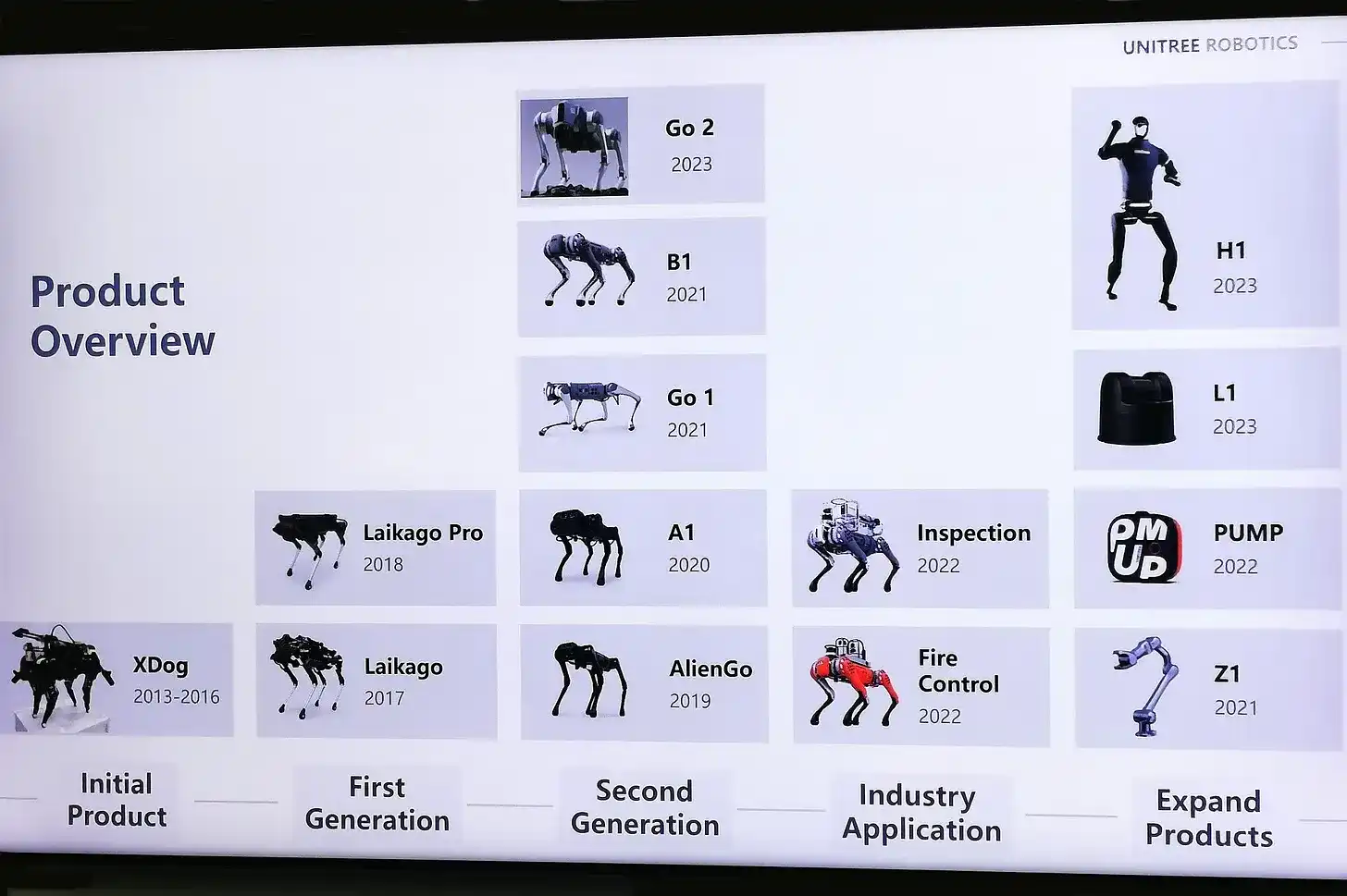
The company sells two product lines:

Quadruped Robots: Go2 (consumer and research grade), B2 (industrial grade), and A2

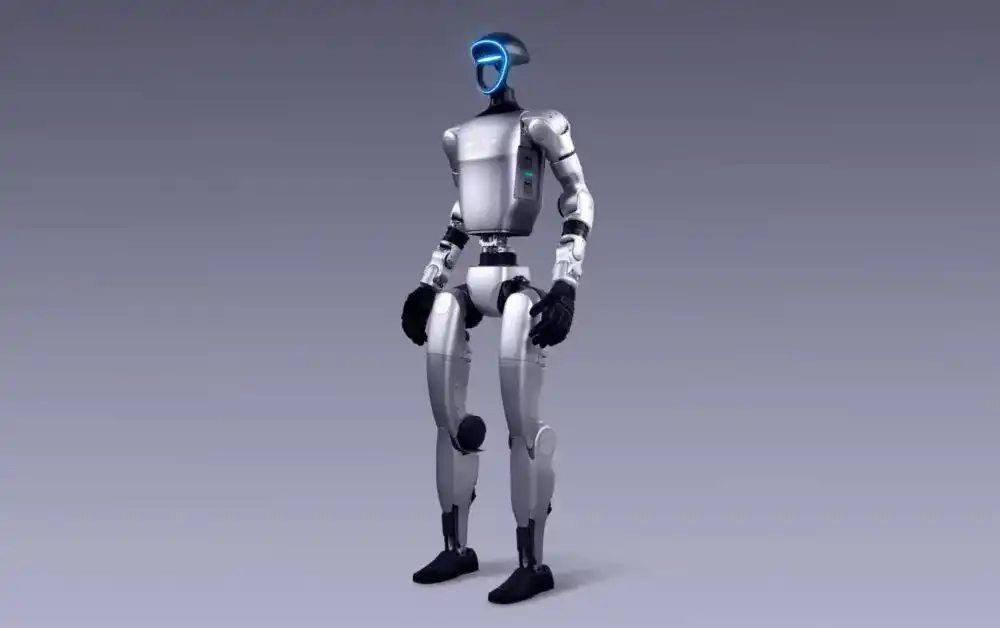
Humanoid Robots: H1, H2, G1, and R1. The G1 is the one you might have seen in viral videos, standing 1.32 meters tall and weighing 35 kg.
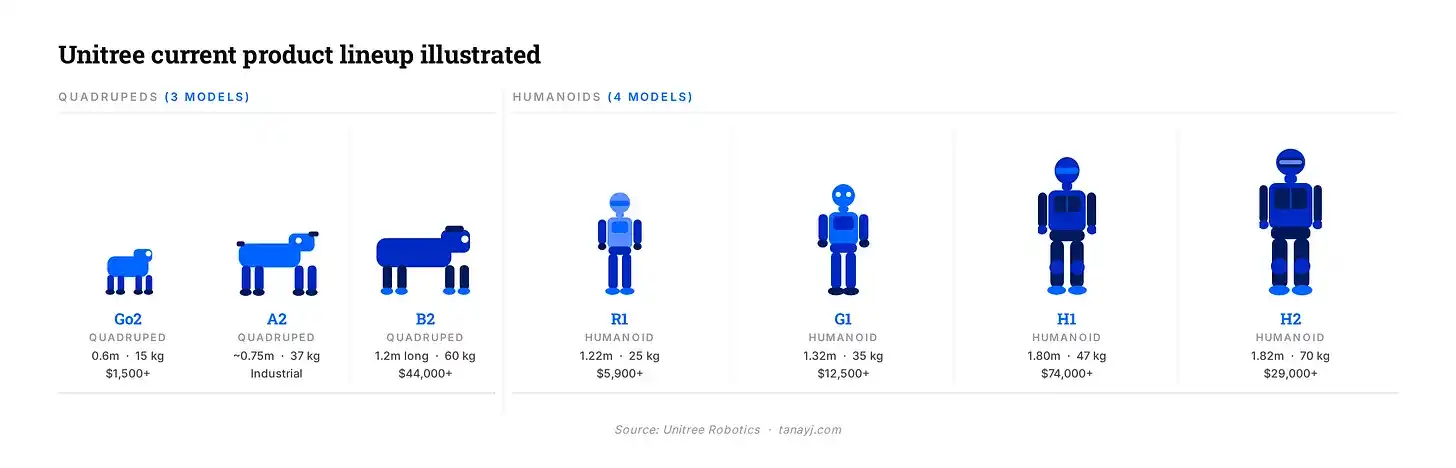
The company began international sales in 2018. Over 35% of revenue comes from outside China, including a significant number of academic customers in the US.

2. The Shift in Revenue Structure Towards Humanoid Robots

Two years ago, Unitree was essentially a robot dog company, primarily selling quadruped robots. Humanoid robots accounted for only 1.9% of revenue in 2023.

By the first three quarters of 2025, humanoid robots already accounted for over half of core revenue.
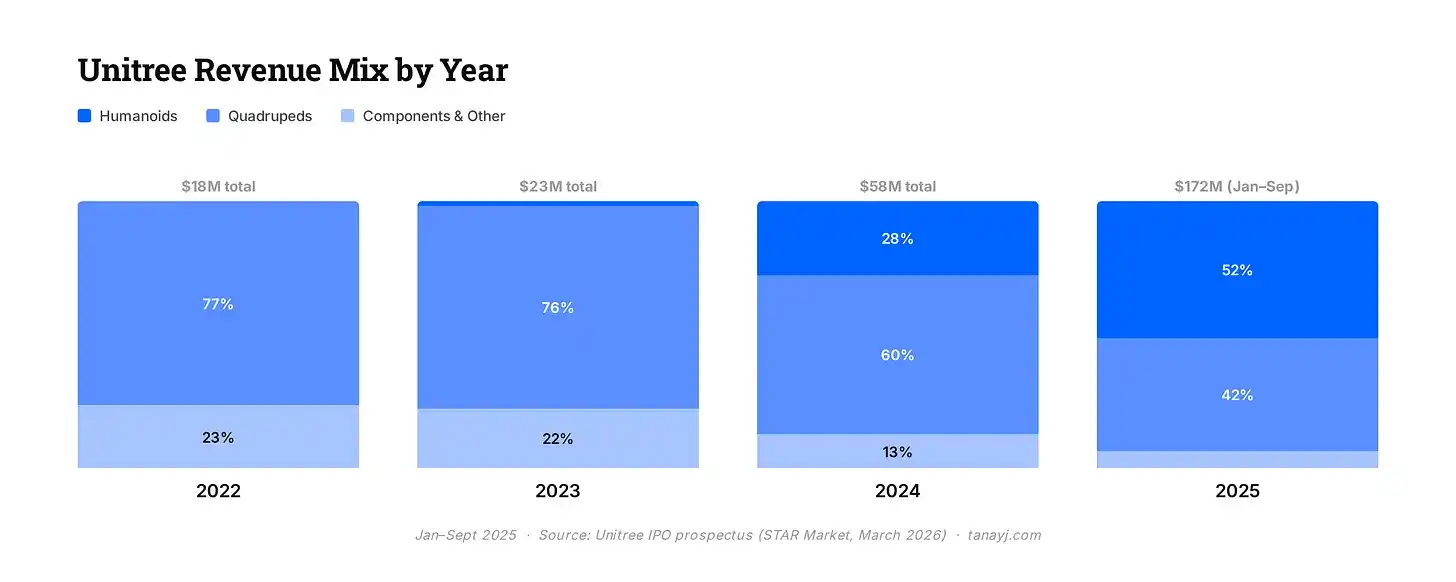
This shift was driven by improved product-market fit and aggressive marketing. The company's humanoid robots have appeared on CCTV's Spring Festival Gala for two consecutive years, one of the most-watched programs globally. Jensen Huang brought Unitree robots on stage at the 2024 GTC conference.
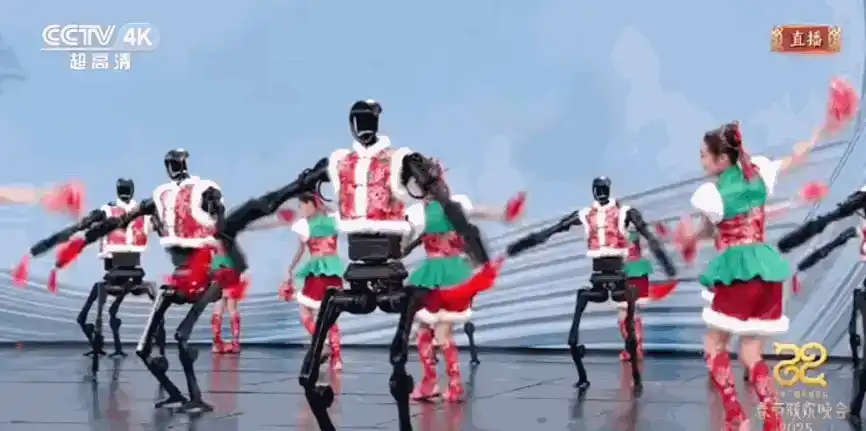
This brand exposure translated into commercial and research demand, something most Chinese hardware companies have never truly achieved.

The shipment data for humanoid robots is particularly impressive. Unitree shipped about 5,500 humanoid robots in 2025, making it the world's largest manufacturer of humanoid robots by shipment volume. China's Zhiyuan Robotics comes closest to this number. In contrast, well-known US companies like Figure AI and Agility Robotics have only shipped in the hundreds.
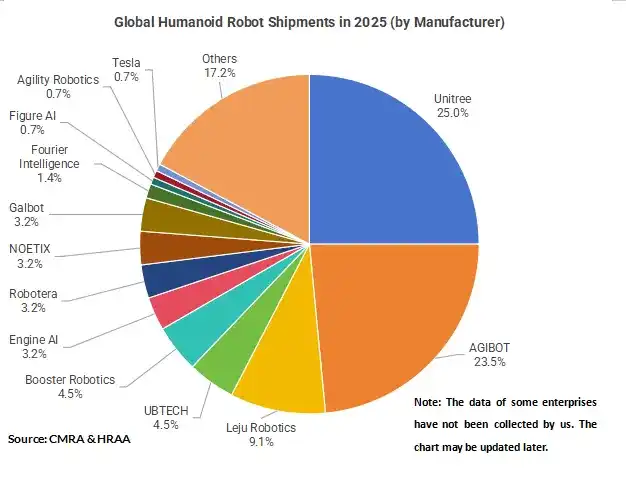
The 5-year target in the prospectus is an annual production capacity of 75,000 humanoid robots and 115,000 quadruped robots. This is about 14 times the humanoid robot shipments in 2025. The goal is aggressive but also highlights how early stage we still are.

3. Who is Really Buying Robots

The prospectus categorizes buyers into three types: Research & Education, Commercial & Consumer, and Industrial Applications.

The reality is that most current demand for humanoid robots comes from research and education purposes.
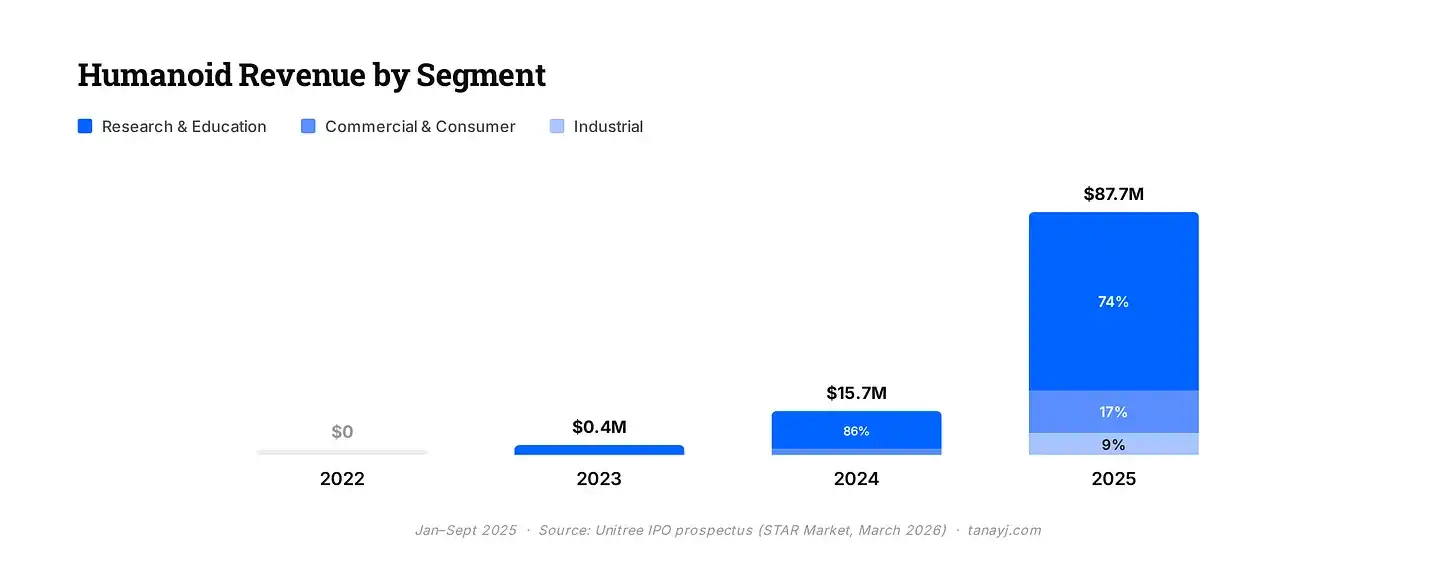
1/ Research & Education accounts for 74% of humanoid robot revenue/shipments. Academic buyers have been Unitree's core support since at least 2022 and remain the company's largest revenue source.

2/ Commercial & Consumer accounts for 17% of humanoid robot shipments. Non-academic consumers who buy these robots mainly use them for "showcasing": acting as eye-catching promoters in retail stores, tourist spots, performances, and exhibitions. Consumer revenue grew nearly fourfold year-on-year in the first nine months of 2025, which sounds impressive, but the base was actually very small. In reality, the practical use of a $25,000 humanoid robot today is to stand at the entrance of a store in Shenzhen attracting tourists.

3/ Industrial Applications account for only 9% of humanoid robot shipments. Unitree acknowledges that industrial deployment is more limited because the technology is not yet mature enough, which illustrates the current technological state. Within this 9% of shipments, about 50-70% are used in scenarios like corporate reception and guiding tours. So overall, only 3-4% of humanoid robot shipments are genuinely used for work like corporate reception and inspection.

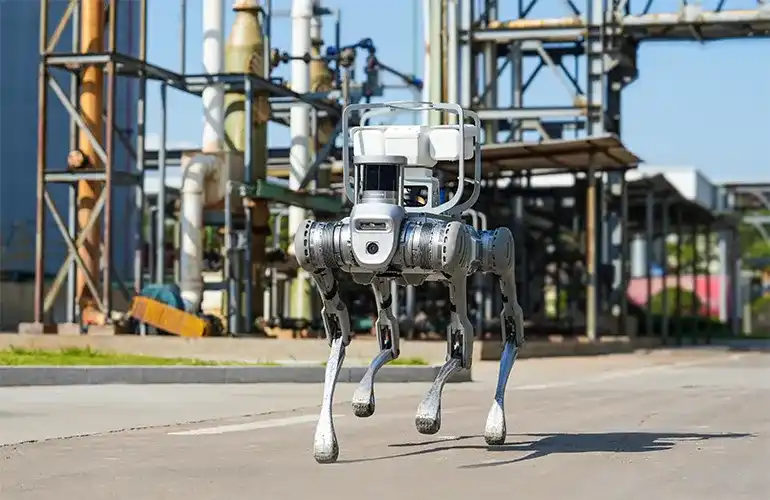
For quadruped robots, the situation is better: only about one-third of revenue comes from research, over 40% from commercial use, and the rest from industrial use. Productive use cases there are relatively more mature. Clients include State Grid, Southern Grid, PetroChina, Sinopec, Baowu Group, and JD.com (Unitree's largest customer). These companies use quadruped robots for real inspection scenarios in chemical plants, substations, coal mines, pipelines, etc.
4. Vertical Integration Strategy

A unique aspect of Unitree is that it independently designs and manufactures most of its key components: high-torque motors, precision reducers, encoders, joint modules, intelligent controllers, high-precision sensors, dexterous hands, lidars, and cameras. According to McKinsey data, the drive system (motors, reducers, and the joint systems that actually make the robot move) typically accounts for 40-60% of the total BOM cost of a humanoid robot.

Most companies in this field source these components externally, but Unitree manufactures them itself. Outsourced components account for only about 14-18% of the total cost. What it outsources are only generic parts like batteries, flash memory, and differentiated parts like the core computing board.

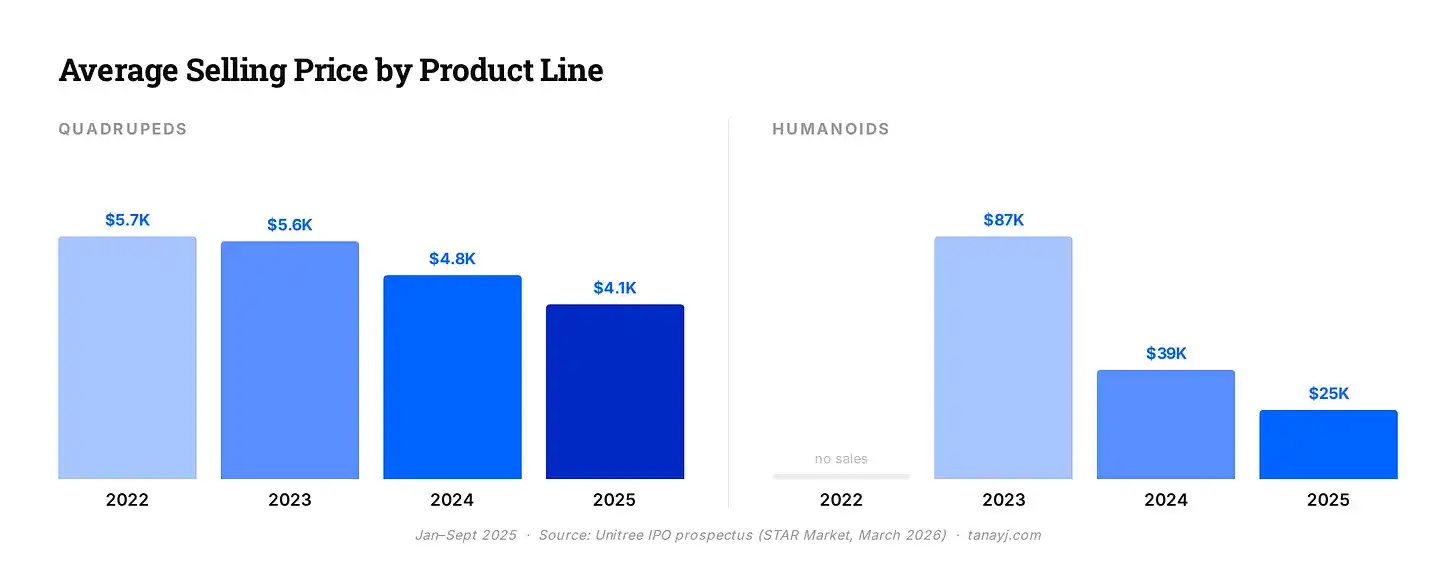
The unit manufacturing cost for quadruped robots has decreased from about $3,300 in 2022 to about $1,800 in mid-2025, a 46% reduction. Humanoid robot costs have also decreased, from about $10,800 to $9,200 over the same period.

Interestingly, as shown in the chart below, the average selling prices for both quadruped and humanoid robots have also dropped significantly year by year. However, gross margins have actually expanded over the period, rising from the low 40s in 2022-2023 to nearly 60% in 2025, largely due to their vertical integration strategy.
5. Financial Status

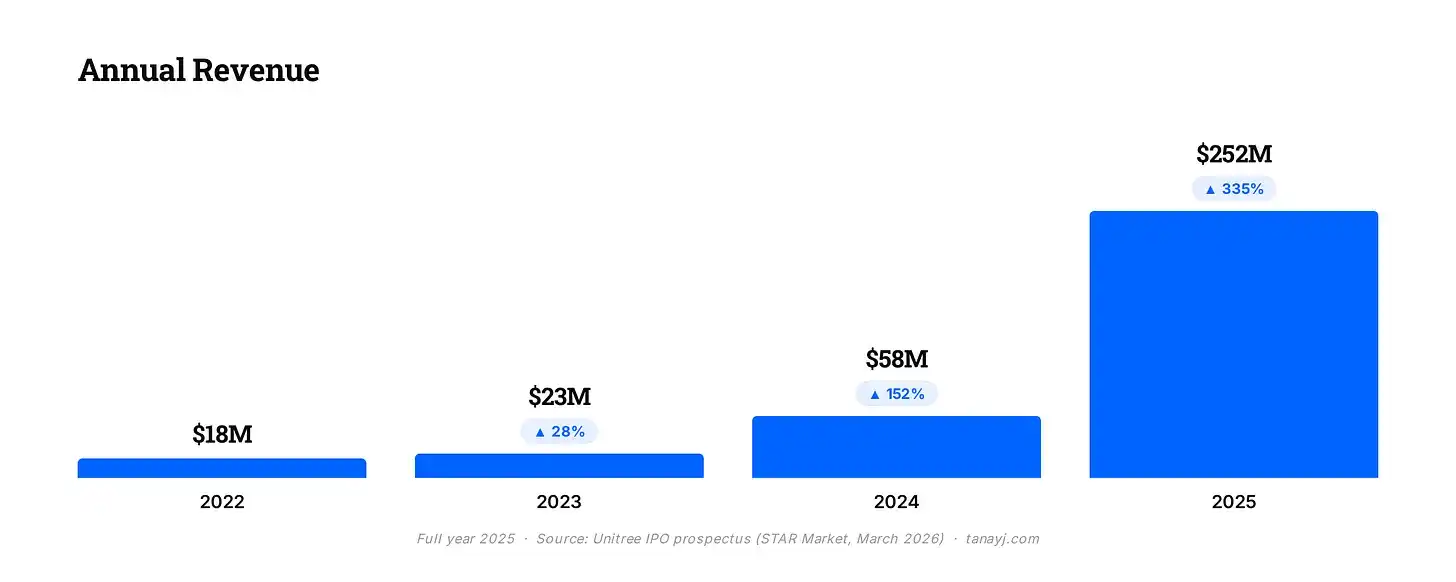
Revenue grew from $58 million in 2024 to an estimated ~$252 million in 2025, a 335% increase, primarily driven by strong performance in humanoid robots. For most of the company's history, international sales accounted for over 55% of revenue. In 2025, the domestic Chinese market surpassed exports for the first time, although the absolute value of export revenue still more than doubled year-on-year.
Gross margins are close to 60% and have been expanding over the years.
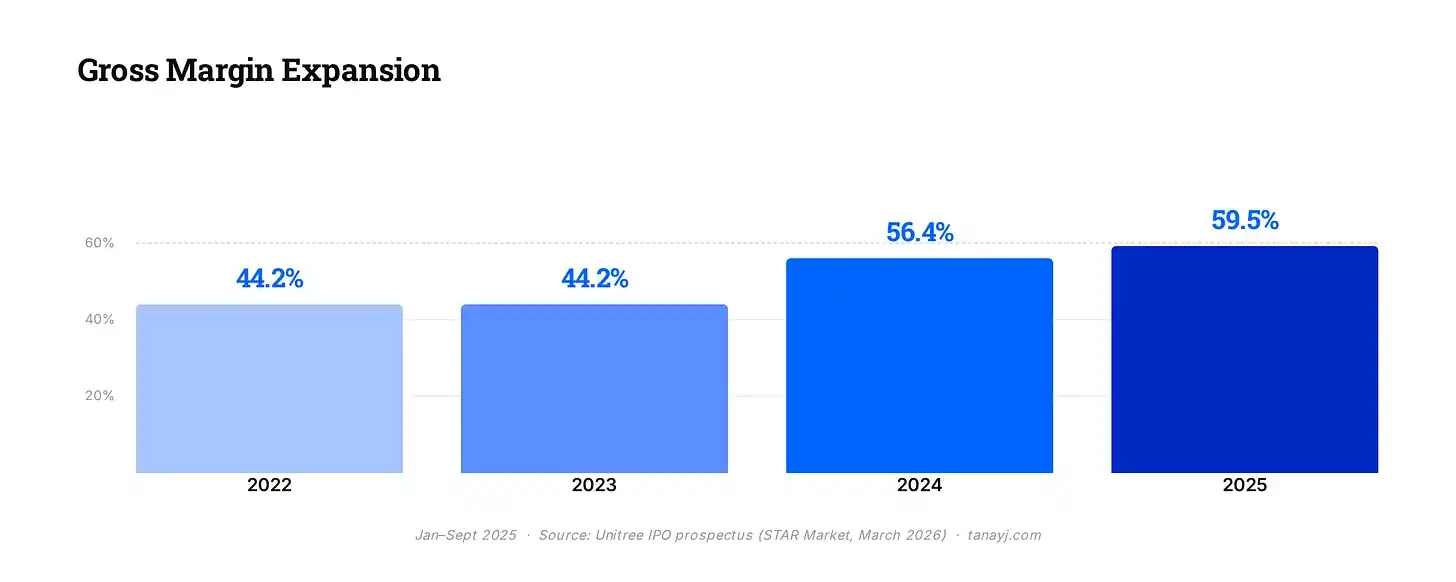
For comparison: Most hardware companies have gross margins of 30-40%. Software companies typically achieve 70-80%. For a company selling physical robots, Unitree's gross margins are relatively high, benefiting from their vertical integration strategy and currently relatively differentiated products.

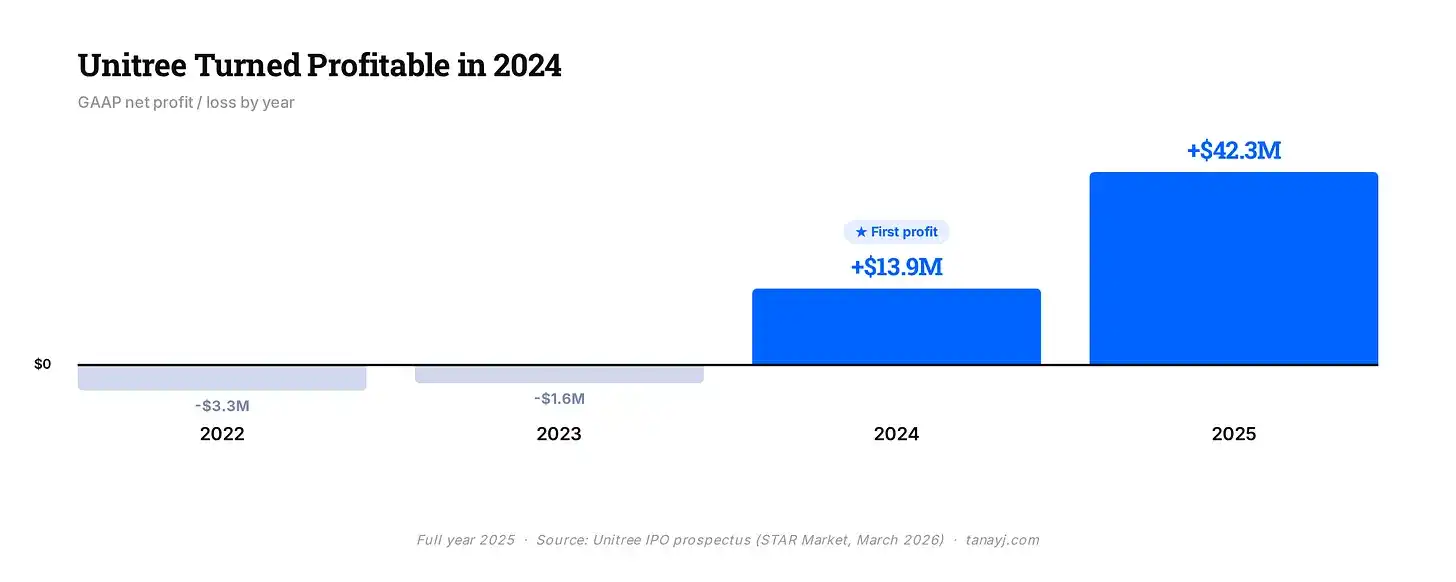
The company became profitable on a GAAP basis in 2024, with a profit margin of about 18%, and close to 35% on an adjusted basis.
Unitree's IPO target valuation is approximately $6-7 billion.

6. Ambitions at the Model Layer

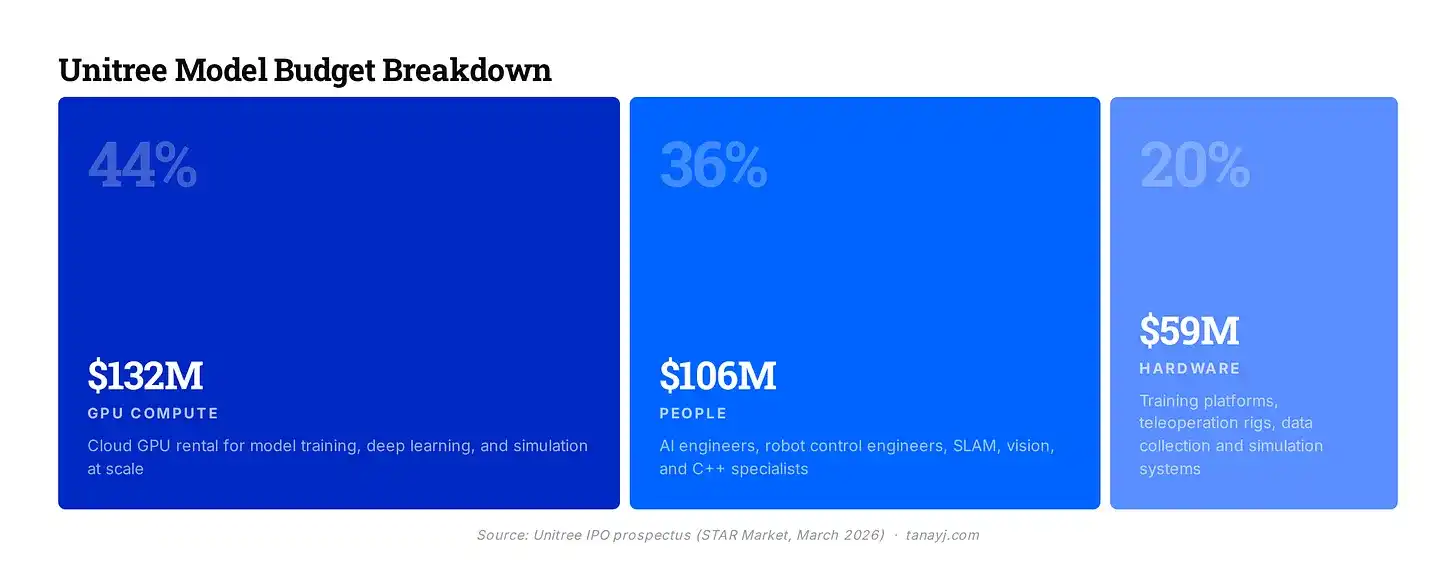
Unitree plans to allocate nearly half of the IPO proceeds to software. Out of the $620 million raised, about $300 million will be used for AI model training over the next three years, with approximately $100 million invested annually in what the company calls the "Embodied Large Model."

The prospectus describes two parallel model architectures. The first is VLA (Vision-Language-Action): a model that directly maps visual and language inputs to motor commands, allowing the robot to generalize to unfamiliar tasks without manually coded instructions. The second is WMA (World Model + Action), which is their preferred direction. The WMA model builds an internal simulation of physical reality. The robot predicts what will happen before acting, rather than learning purely through trial and error.

They have already released initial versions of both. They open-sourced UnifoLM-WMA-0 in September 2025; UnifoLM-VLA-0 was released in January 2026.

They also detailed the approximate allocation of spending on the model side, as shown below:
Unitree's current hardware leadership is real, but the company understands that lasting advantage in robotics may require control over the model layer: the systems that decide what the robot does and how it moves. Software ambition is also a hedge against commoditization. Unitree has built a moat in hardware manufacturing.

But if actuators and joint modules eventually become standard components like batteries in electric vehicles, then defensibility shifts to the model layer.

7. Summary

Unitree has a profitable hardware business, a genuine manufacturing moat, and ships more humanoid robots than anyone else, at prices others cannot match. But as the actual usage patterns of humanoid robots show, the story of widespread commercial application is still in its early stages. "Showcase" use cases dominate consumer demand, and industrial deployment is narrow.

Unitree gives us a glimpse of the current state of the robotics market; there is still much work to be done in models, hardware, and use cases. If you're building in robotics and embodied AI, feel free to reach out at tanay at wing.vc.


Пов'язані питання

QWhat were the key financial highlights and performance metrics revealed in Unitree Robotics' IPO prospectus?

AUnitree's prospectus shows rapid growth, with revenue expected to reach approximately $252 million in 2025, a 335% increase from 2024's $58 million. The company achieved GAAP profitability in 2024 with margins around 18% (nearly 35% on an adjusted basis). Gross margins are near 60%, which is high for a hardware company, largely due to its vertical integration strategy. The IPO aims to raise $620 million at a target valuation of $6-7 billion.

QWho are the primary customers for Unitree's humanoid robots, and what does this indicate about the current state of the market?

AAs of 2025, 74% of Unitree's humanoid robot shipments were for scientific research and education, 17% for commercial/consumer 'showcase' uses (like retail displays), and only 9% for industrial applications. Furthermore, within that 9%, 50-70% are used for enterprise reception and guided tours. This indicates that widespread commercial and industrial deployment is still in its early stages. The primary productive use for robots today remains in research and niche, non-autonomous applications, highlighting that hardware capabilities may be ahead of the AI models and software needed for complex tasks.

QWhat is Unitree's vertical integration strategy, and what benefits has it provided?

AUnitree's vertical integration strategy involves independently designing and manufacturing most of its robots' key components, including high-torque motors, precision reducers, encoders, joint modules, controllers, sensors, dexterous hands, LiDAR, and cameras. Only generic components like batteries and flash memory are outsourced. This strategy has reduced manufacturing costs (e.g., quadruped robot costs dropped 46% from ~$3300 in 2022 to ~$1800 in mid-2025) while allowing the company to expand its gross margins to nearly 60% despite falling average selling prices. It provides cost control, supply chain security, and a hardware moat.

QWhat are Unitree's ambitions in the AI model layer, and how does it plan to use funds from the IPO?

AUnitree plans to invest heavily in AI software development, allocating roughly $300 million (about half of the $620 million IPO proceeds) over the next three years for AI model training. The focus is on developing 'Embodied Large Models,' specifically two architectures: VLA (Vision-Language-Action) models for direct mapping from sensory input to action, and WMA (World Model + Action) models, which it favors. WMA models create an internal simulation of physical reality to predict outcomes before acting. The company has already released open-source versions of both. This investment is a strategic move to build a defensible advantage in the software layer as hardware components potentially become commoditized.

QHow has Unitree's product mix and market focus shifted in recent years?

AUnitree has undergone a significant shift from being primarily a quadruped robot company to a leader in humanoid robots. In 2023, humanoids accounted for only 1.9% of its revenue. By the first three quarters of 2025, humanoid robots constituted over half of its core revenue. This shift was driven by improved product-market fit and aggressive marketing (e.g., appearances on China's Spring Festival Gala and NVIDIA's GTC stage). The company shipped approximately 5,500 humanoid robots in 2025, making it the world's largest manufacturer by volume. Its ambitious 5-year goal is to produce 75,000 humanoids annually.

Пов'язані матеріали

DeFi Has Reached Its Most Dangerous Moment: The Real Vulnerabilities Are Not in the Code

DeFi in Peril: The Real Vulnerability Isn't in the Code April 2026 marked a paradigm shift in DeFi security, with over $625 million lost across 30 incidents—the worst month in crypto history by event count. Crucially, none of the major exploits (Drift Protocol: $285M, KelpDAO: $292M, Wasabi Protocol: $4.5M) resulted from smart contract vulnerabilities. Instead, failures occurred in the operational "plumbing": social engineering to compromise multi-signature councils, a single-point-of-failure 1-of-1 bridge validator, and stolen admin private keys. These events expose a fundamental misalignment: the industry's security model has long focused on code audits, while the actual attack surface has shifted to privileged access points and off-chain infrastructure. The article introduces the term "OpenFi" to describe this reality: permissionless, on-chain, yet operationally dependent on trusted third parties (admins, validators, oracles) at key junctures. The KelpDAO exploit vividly demonstrated asymmetric "contagion risk." A configuration error in a smaller protocol triggered a panic, causing approximately $13.2 billion in outflows from larger, unaffected protocols like Aave within 48 hours, as users fled uncertain collateral. The core dilemma is the double-edged sword of centralization. Operational levers like emergency councils (e.g., Arbitrum freezing stolen funds post-KelpDAO) enable crisis response but also create catastrophic attack surfaces if compromised (e.g., Drift). The path forward demands radical honesty: protocols must clearly disclose their trust assumptions, operational levers, and failure modes. The industry must treat operational security (key management, configurations, incident response) with the same rigor as code security. Survival depends on building systems whose risks can be understood, priced, and insured, moving beyond the outdated "code is law" mantra to a mature model of disclosed and managed trust.

链捕手5 год тому

DeFi Has Reached Its Most Dangerous Moment: The Real Vulnerabilities Are Not in the Code

链捕手5 год тому

Vitalik's Article Emphasizes Ethereum Must Be 'Amazing', But Foundation Is Not the Center

Vitalik Buterin has published a lengthy response to recent community criticism directed at the Ethereum Foundation (EF). Acknowledging a sense of "unease," he addresses concerns about the EF's strategic direction, its perceived disconnect from ETH's price performance, and calls for its reduced central role. Vitalik rejects the notion that the EF should be the central governing body of Ethereum, framing it instead as one "node with a clear mandate" among many within the ecosystem. He highlights the EF's limited ETH holdings (≈0.16% of supply) compared to other blockchain foundations and states it will no longer sell significant amounts of ETH. Its future focus will be on long-term, critical projects that align with Ethereum's core values of censorship-resistance and decentralization, which might not otherwise happen. A core argument is that Ethereum must be "amazing," but not by merely chasing higher transaction speeds at the cost of decentralization. He proposes focusing on the "CROPS" dimensions: creating a Cryptographically provable, Reliable, Open, Private, and Secure network. This includes pursuing goals like a formally verifiable, bug-free Ethereum client and minimizing protocol-level reliance on intermediaries. The article concludes by noting that while Vitalik clarifies the EF's refocused role, he does not directly address community suggestions for creating a new organization explicitly aligned with ETH's economic interests. This "alignment gap" is presented as a key challenge for Ethereum's future.

链捕手6 год тому

Vitalik's Article Emphasizes Ethereum Must Be 'Amazing', But Foundation Is Not the Center

链捕手6 год тому

Galxe: How a Quest Platform Evolved into Web3's Growth Infrastructure

Galxe, once perceived as a simple Web3 quest platform, has evolved into a core growth infrastructure within the Web3 ecosystem. It addresses a fundamental Web3 growth dilemma: the lack of a mature, systematic user acquisition and retention system akin to Web2's advertising and analytics platforms. While users complete quests (social tasks, on-chain interactions) for rewards, Galxe's true innovation lies in transforming these fragmented, one-off actions into lasting, verifiable identity credentials. This process of *behavioral assetization* creates a persistent record of a user's activities across projects and chains. For users, their wallet accumulates a valuable history that can unlock future access and rewards, fostering a "profile-building" mentality. For projects, Galxe provides a pre-screened user pool with rich behavioral data, enabling targeted outreach to users based on their specific on-chain history and community engagement. Galxe employs a gamefied growth path, guiding users from low-friction social tasks into deeper, valuable on-chain interactions through a structured progression of quests. This solves the incentive-behavior mismatch common in Web3, filtering users by their willingness to engage. Beyond quests, products like Passport (identity verification) and Starboard (community analytics) position Galxe as a comprehensive growth operating system. The platform's defensible advantage is its self-reinforcing data and network flywheel: more projects attract more users, enriching behavioral data; richer data enables better user targeting, attracting more projects. Ultimately, Galxe is shifting Web3's growth logic from short-term "reward-driven" traffic towards a long-term "identity-driven" relationship model, where a user's accumulated on-chain履历 becomes a core asset.

marsbit6 год тому

Galxe: How a Quest Platform Evolved into Web3's Growth Infrastructure

marsbit6 год тому

Торгівля

Спот
Ф'ючерси

Популярні статті

Що таке $S$

Розуміння SPERO: Комплексний огляд Вступ до SPERO Оскільки ландшафт інновацій продовжує еволюціонувати, виникнення технологій web3 та криптовалютних проектів відіграє ключову роль у формуванні цифрового майбутнього. Один з проектів, який привернув увагу в цій динамічній сфері, — це SPERO, позначений як SPERO,$$s$. Ця стаття має на меті зібрати та представити детальну інформацію про SPERO, щоб допомогти ентузіастам та інвесторам зрозуміти його основи, цілі та інновації в рамках web3 та крипто-сектору. Що таке SPERO,$$s$? SPERO,$$s$ — це унікальний проект у криптопросторі, який прагне використати принципи децентралізації та технології блокчейн для створення екосистеми, що сприяє залученню, корисності та фінансовій інклюзії. Проект розроблений для полегшення взаємодії між користувачами новими способами, надаючи їм інноваційні фінансові рішення та послуги. У своїй основі SPERO,$$s$ прагне надати можливості індивідам, забезпечуючи інструменти та платформи, які покращують користувацький досвід у криптовалютному просторі. Це включає в себе можливість більш гнучких методів транзакцій, сприяння ініціативам, що підтримуються спільнотою, та створення шляхів для фінансових можливостей через децентралізовані додатки (dApps). Основна концепція SPERO,$$s$ обертається навколо інклюзивності, прагнучи зменшити розриви в традиційній фінансовій системі, використовуючи переваги технології блокчейн. Хто є творцем SPERO,$$s$? Особистість творця SPERO,$$s$ залишається дещо невідомою, оскільки є обмежені публічно доступні ресурси, що надають детальну інформацію про його засновників. Ця відсутність прозорості може бути наслідком зобов'язання проекту до децентралізації — етики, яку багато проектів web3 поділяють, ставлячи колективні внески вище за індивідуальне визнання. Зосереджуючи обговорення навколо спільноти та її колективних цілей, SPERO,$$s$ втілює суть наділення без виділення конкретних осіб. Таким чином, розуміння етики та місії SPERO є більш важливим, ніж ідентифікація єдиного творця. Хто є інвесторами SPERO,$$s$? SPERO,$$s$ підтримується різноманітними інвесторами, починаючи від венчурних капіталістів до ангельських інвесторів, які прагнуть сприяти інноваціям у крипто-секторі. Зосередження цих інвесторів зазвичай узгоджується з місією SPERO — пріоритет надається проектам, які обіцяють технологічний прогрес у суспільстві, фінансову інклюзію та децентралізоване управління. Ці інвесторські фонди зазвичай зацікавлені в проектах, які не лише пропонують інноваційні продукти, але й позитивно впливають на спільноту блокчейн та її екосистеми. Підтримка з боку цих інвесторів підкріплює SPERO,$$s$ як значного конкурента в швидко змінюваній сфері крипто-проектів. Як працює SPERO,$$s$? SPERO,$$s$ використовує багатогранну структуру, яка відрізняє його від традиційних криптовалютних проектів. Ось деякі ключові особливості, які підкреслюють його унікальність та інноваційність: Децентралізоване управління: SPERO,$$s$ інтегрує моделі децентралізованого управління, надаючи користувачам можливість активно брати участь у процесах прийняття рішень щодо майбутнього проекту. Цей підхід сприяє відчуттю власності та відповідальності серед членів спільноти. Корисність токена: SPERO,$$s$ використовує свій власний криптовалютний токен, розроблений для виконання різних функцій в екосистемі. Ці токени дозволяють здійснювати транзакції, отримувати винагороди та полегшувати послуги, що пропонуються на платформі, підвищуючи загальну залученість та корисність. Шарова архітектура: Технічна архітектура SPERO,$$s$ підтримує модульність та масштабованість, що дозволяє безперешкодно інтегрувати додаткові функції та додатки в міру розвитку проекту. Ця адаптивність є надзвичайно важливою для збереження актуальності в постійно змінюваному крипто-ландшафті. Залучення спільноти: Проект підкреслює ініціативи, що підтримуються спільнотою, використовуючи механізми, які стимулюють співпрацю та зворотний зв'язок. Підтримуючи сильну спільноту, SPERO,$$s$ може краще задовольняти потреби користувачів та адаптуватися до ринкових тенденцій. Фокус на інклюзію: Пропонуючи низькі комісії за транзакції та зручні інтерфейси, SPERO,$$s$ прагне залучити різноманітну базу користувачів, включаючи осіб, які раніше не брали участі в крипто-просторі. Це зобов'язання до інклюзії узгоджується з його загальною місією наділення через доступність. Хронологія SPERO,$$s$ Розуміння історії проекту надає важливі уявлення про його розвиток та етапи. Нижче наведено пропоновану хронологію, що відображає значні події в еволюції SPERO,$$s$: Етап концептуалізації та ідеації: Початкові ідеї, що стали основою SPERO,$$s$, були сформовані, тісно пов'язані з принципами децентралізації та фокусом на спільноті в індустрії блокчейн. Запуск білого паперу проекту: Після концептуального етапу був випущений комплексний білий папір, що детально описує бачення, цілі та технологічну інфраструктуру SPERO,$$s$, щоб залучити інтерес та зворотний зв'язок від спільноти. Створення спільноти та ранні залучення: Активні зусилля були спрямовані на створення спільноти ранніх прихильників та потенційних інвесторів, що полегшило обговорення цілей проекту та отримання підтримки. Подія генерації токенів: SPERO,$$s$ провів подію генерації токенів (TGE) для розподілу своїх рідних токенів серед ранніх прихильників та встановлення початкової ліквідності в екосистемі. Запуск початкового dApp: Перший децентралізований додаток (dApp), пов'язаний з SPERO,$$s$, став доступним, дозволяючи користувачам взаємодіяти з основними функціями платформи. Постійний розвиток та партнерства: Безперервні оновлення та вдосконалення пропозицій проекту, включаючи стратегічні партнерства з іншими учасниками блокчейн-простору, сформували SPERO,$$s$ у конкурентоспроможного та еволюціонуючого гравця на крипто-ринку. Висновок SPERO,$$s$ є свідченням потенціалу web3 та криптовалют для революціонізації фінансових систем та наділення індивідів. Завдяки зобов'язанню до децентралізованого управління, залучення спільноти та інноваційно спроектованих функцій, він прокладає шлях до більш інклюзивного фінансового ландшафту. Як і з будь-якими інвестиціями в швидко змінюваному крипто-просторі, потенційним інвесторам та користувачам рекомендується ретельно досліджувати та обдумано взаємодіяти з поточними подіями в SPERO,$$s$. Проект демонструє інноваційний дух крипто-індустрії, запрошуючи до подальшого дослідження його численних можливостей. Хоча подорож SPERO,$$s$ ще триває, його основні принципи можуть справді вплинути на майбутнє того, як ми взаємодіємо з технологією, фінансами та один з одним у взаємопов'язаних цифрових екосистемах.

73 переглядів усьогоОпубліковано 2024.12.17Оновлено 2024.12.17

Що таке $S$

Що таке AGENT S

Агент S: Майбутнє автономної взаємодії в Web3 Вступ У постійно змінюваному ландшафті Web3 та криптовалюти інновації постійно переосмислюють, як люди взаємодіють з цифровими платформами. Один з таких новаторських проектів, Агент S, обіцяє революціонізувати взаємодію людини з комп'ютером через свою відкриту агентну структуру. Прокладаючи шлях для автономних взаємодій, Агент S прагне спростити складні завдання, пропонуючи трансформаційні застосування в штучному інтелекті (ШІ). Це детальне дослідження заглиблюється в складності проекту, його унікальні особливості та наслідки для сфери криптовалюти. Що таке Агент S? Агент S є революційною відкритою агентною структурою, спеціально розробленою для вирішення трьох основних викликів в автоматизації комп'ютерних завдань: Набуття специфічних знань у галузі: Структура інтелектуально навчається з різних зовнішніх джерел знань та внутрішнього досвіду. Цей подвійний підхід дозволяє їй створити багатий репозиторій специфічних знань у галузі, покращуючи її продуктивність у виконанні завдань. Планування на довгих горизонтах завдань: Агент S використовує планування з підкріпленням досвіду, стратегічний підхід, який полегшує ефективний розподіл та виконання складних завдань. Ця функція значно підвищує її здатність ефективно та результативно управляти кількома підзавданнями. Обробка динамічних, неоднорідних інтерфейсів: Проект представляє Інтерфейс Агент-Комп'ютер (ACI), інноваційне рішення, яке покращує взаємодію між агентами та користувачами. Використовуючи багатомодальні великі мовні моделі (MLLMs), Агент S може безперешкодно орієнтуватися та маніпулювати різноманітними графічними інтерфейсами користувача. Завдяки цим новаторським функціям Агент S надає надійну структуру, яка вирішує складнощі, пов'язані з автоматизацією людської взаємодії з машинами, прокладаючи шлях для численних застосувань у ШІ та за його межами. Хто є творцем Агент S? Хоча концепція Агент S є фундаментально новаторською, конкретна інформація про його творця залишається невідомою. Творець наразі невідомий, що підкреслює або початкову стадію проекту, або стратегічний вибір зберегти засновників у таємниці. Незважаючи на анонімність, акцент залишається на можливостях та потенціалі структури. Хто є інвесторами Агент S? Оскільки Агент S є відносно новим у криптографічній екосистемі, детальна інформація про його інвесторів та фінансових спонсорів не задокументована. Відсутність публічно доступних відомостей про інвестиційні фонди або організації, що підтримують проект, викликає питання щодо його фінансової структури та дорожньої карти розвитку. Розуміння підтримки є критично важливим для оцінки стійкості проекту та потенційного впливу на ринок. Як працює Агент S? В основі Агент S лежить передова технологія, яка дозволяє йому ефективно функціонувати в різних умовах. Його операційна модель побудована навколо кількох ключових функцій: Взаємодія з комп'ютером, подібна до людської: Структура пропонує розширене планування ШІ, прагнучи зробити взаємодії з комп'ютерами більш інтуїтивними. Імітуючи людську поведінку при виконанні завдань, вона обіцяє підвищити досвід користувачів. Наративна пам'ять: Використовується для використання високорівневого досвіду, Агент S використовує наративну пам'ять для відстеження історій завдань, тим самим покращуючи свої процеси прийняття рішень. Епізодична пам'ять: Ця функція надає користувачам покрокові інструкції, дозволяючи структурі пропонувати контекстуальну підтримку в міру виконання завдань. Підтримка OpenACI: Завдяки можливості працювати локально, Агент S дозволяє користувачам зберігати контроль над своїми взаємодіями та робочими процесами, узгоджуючи з децентралізованою етикою Web3. Легка інтеграція з зовнішніми API: Його універсальність і сумісність з різними платформами ШІ забезпечують те, що Агент S може безперешкодно вписатися в існуючі технологічні екосистеми, роблячи його привабливим вибором для розробників та організацій. Ці функціональні можливості колективно сприяють унікальному положенню Агент S у крипто-просторі, оскільки він автоматизує складні, багатоступеневі завдання з мінімальним втручанням людини. У міру розвитку проекту його потенційні застосування в Web3 можуть переосмислити, як відбуваються цифрові взаємодії. Хронологія Агент S Розробка та етапи Агент S можуть бути узагальнені в хронології, яка підкреслює його значні події: 27 вересня 2024 року: Концепція Агент S була представлена в комплексній науковій статті під назвою “Відкрита агентна структура, яка використовує комп'ютери як людина”, що демонструє основи проекту. 10 жовтня 2024 року: Наукова стаття була опублікована на arXiv, пропонуючи детальне дослідження структури та її оцінки продуктивності на основі бенчмарку OSWorld. 12 жовтня 2024 року: Було випущено відеопрезентацію, що надає візуальне уявлення про можливості та особливості Агент S, ще більше залучаючи потенційних користувачів та інвесторів. Ці маркери в хронології не лише ілюструють прогрес Агент S, але й вказують на його прихильність до прозорості та залучення громади. Ключові моменти про Агент S У міру розвитку структури Агент S кілька ключових характеристик виділяються, підкреслюючи її новаторський характер та потенціал: Інноваційна структура: Розроблена для забезпечення інтуїтивного використання комп'ютерів, подібного до людської взаємодії, Агент S пропонує новий підхід до автоматизації завдань. Автономна взаємодія: Здатність автономно взаємодіяти з комп'ютерами через GUI означає стрибок до більш інтелектуальних та ефективних обчислювальних рішень. Автоматизація складних завдань: Завдяки своїй надійній методології він може автоматизувати складні, багатоступеневі завдання, роблячи процеси швидшими та менш схильними до помилок. Безперервне вдосконалення: Механізми навчання дозволяють Агенту S покращуватися на основі минулого досвіду, постійно підвищуючи свою продуктивність та ефективність. Універсальність: Його адаптивність до різних операційних середовищ, таких як OSWorld та WindowsAgentArena, забезпечує його здатність служити широкому спектру застосувань. Оскільки Агент S займає своє місце в ландшафті Web3 та криптовалюти, його потенціал покращити можливості взаємодії та автоматизувати процеси означає значний прогрес у технологіях ШІ. Завдяки своїй інноваційній структурі Агент S є прикладом майбутнього цифрових взаємодій, обіцяючи більш безперешкодний та ефективний досвід для користувачів у різних галузях. Висновок Агент S представляє собою сміливий крок вперед у поєднанні ШІ та Web3, з можливістю переосмислити, як ми взаємодіємо з технологією. Хоча проект все ще на ранніх стадіях, можливості для його застосування є величезними та переконливими. Завдяки своїй комплексній структурі, що вирішує критичні виклики, Агент S прагне вивести автономні взаємодії на передній план цифрового досвіду. У міру того, як ми заглиблюємося в сфери криптовалюти та децентралізації, проекти, подібні до Агент S, безсумнівно, відіграватимуть ключову роль у формуванні майбутнього технологій та співпраці людини з комп'ютером.

655 переглядів усьогоОпубліковано 2025.01.14Оновлено 2025.01.14

Що таке AGENT S

Як купити S

Ласкаво просимо до HTX.com! Ми зробили покупку Sonic (S) простою та зручною. Дотримуйтесь нашої покрокової інструкції, щоб розпочати свою криптовалютну подорож.Крок 1: Створіть обліковий запис на HTXВикористовуйте свою електронну пошту або номер телефону, щоб зареєструвати обліковий запис на HTX безплатно. Пройдіть безпроблемну реєстрацію й отримайте доступ до всіх функцій.ЗареєструватисьКрок 2: Перейдіть до розділу Купити крипту і виберіть спосіб оплатиКредитна/дебетова картка: використовуйте вашу картку Visa або Mastercard, щоб миттєво купити Sonic (S).Баланс: використовуйте кошти з балансу вашого рахунку HTX для безперешкодної торгівлі.Треті особи: ми додали популярні способи оплати, такі як Google Pay та Apple Pay, щоб підвищити зручність.P2P: Торгуйте безпосередньо з іншими користувачами на HTX.Позабіржова торгівля (OTC): ми пропонуємо індивідуальні послуги та конкурентні обмінні курси для трейдерів.Крок 3: Зберігайте свої Sonic (S)Після придбання Sonic (S) збережіть його у своєму обліковому записі на HTX. Крім того, ви можете відправити його в інше місце за допомогою блокчейн-переказу або використовувати його для торгівлі іншими криптовалютами.Крок 4: Торгівля Sonic (S)Легко торгуйте Sonic (S) на спотовому ринку HTX. Просто увійдіть до свого облікового запису, виберіть торгову пару, укладайте угоди та спостерігайте за ними в режимі реального часу. Ми пропонуємо зручний досвід як для початківців, так і для досвідчених трейдерів.

1.4k переглядів усьогоОпубліковано 2025.01.15Оновлено 2025.03.21

Як купити S

Обговорення

Ласкаво просимо до спільноти HTX. Тут ви можете бути в курсі останніх подій розвитку платформи та отримати доступ до професійної ринкової інформації. Нижче представлені думки користувачів щодо ціни S (S).

活动图片