The Battle for Global Asset Pricing Power: Starting from $500 Billion in Trading Volume

marsbitОпубліковано о 2026-08-25Востаннє оновлено о 2026-08-25

Анотація

Summary: The battle for global asset pricing is intensifying as crypto-based derivatives platforms like Trade.xyz, built on Hyperliquid, challenge traditional financial markets. These platforms operate 24/7, allowing trading of perpetual contracts linked to assets like oil, stock indices, and even pre-IPO companies like SpaceX. During events like Middle East conflicts when traditional oil markets are closed, these on-chain markets continue price discovery, generating over $500 billion in volume since late 2023. Supported by figures like former President Trump and backed by firms like Paradigm, the sector seeks U.S. regulatory approval to offer pre-IPO perpetuals, arguing they improve price discovery ahead of public listings. However, challenges remain: extreme leverage has caused volatile liquidations (e.g., a SpaceX contract briefly implied a $3 trillion valuation), and established players like CME oppose regulatory moves seen as favoring crypto derivatives. While liquidity and first-mover advantage give Trade.xyz an edge, experts warn of risks like weekend market crashes spilling into traditional finance. The rise of these markets forces regulators and Wall Street to confront a new, borderless, always-on trading reality.

Authors: Ryan Weeks, Spe Chen, Muyao Shen, Bloomberg News

Compiled by: Jiahuan, ChainCatcher

On the last Saturday of February this year, when the US and Israel launched airstrikes on Iran, the world's major oil markets were closed, but crude oil prices did not stop fluctuating.

On Trade.xyz, built on the crypto exchange Hyperliquid, traders were buying and selling a chain-based oil derivative throughout the weekend. By the time traditional futures markets reopened, on-chain traders had already spent hours pricing in the potential impact of the conflict.

For decades, modern financial markets have operated around a common architecture: recognized trading venues, fixed trading hours, and benchmark prices that serve as references for other markets. Crypto markets have shattered this convention. They operate 24/7, easily cross borders, and are increasingly filling the gaps left when traditional exchanges are closed.

Trade.xyz is a prime example of testing how far this change can go.

With a team of only about a dozen people, this startup has launched perpetual contracts linked to crude oil, precious metals, stock indices, and pre-IPO companies like SpaceX in less than a year. Since its launch last October, these markets have generated approximately $500 billion in trading volume, accounting for over 99% of the total trading activity in Hyperliquid's third-party market system, HIP-3.

This achievement has led Trade.xyz and Hyperliquid to pursue a bigger goal. They are lobbying US regulators to allow pre-listing perpetual contracts into the US market, arguing that such products can lead to more adequate price discovery before a company officially goes public, thereby modernizing the traditional IPO process.

Currently, Hyperliquid operates outside the US and is not formally open to US traders, a restriction that also applies to Trade.xyz.

However, Hyperliquid seems to have won over an important ally. Crypto-friendly President Trump, whose family is also widely involved in related businesses, said last week that regulators were studying how to bring Hyperliquid into the US market.

Unlike traditional futures contracts that settle on a fixed date, perpetual contracts have no expiration. Investors can hold positions long-term without repeatedly rolling expiring contracts into new ones. These products may also offer extremely high leverage, with some platforms allowing investors to borrow $100 for every $1 invested.

Walter Li, a former ETF trader at RBC who now manages a personal trading portfolio primarily through Trade.xyz, said, "There's always going to be a bull market somewhere."

He added that if a popular asset class hasn't yet been brought onto the blockchain, Trade.xyz can build a market for it.

Bloomberg's analysis of Trade.xyz contracts during the US-Iran conflict shows that during relatively calm periods, these contracts largely tracked traditional oil prices; when traditional markets were closed, they could also reflect trader sentiment in real-time.
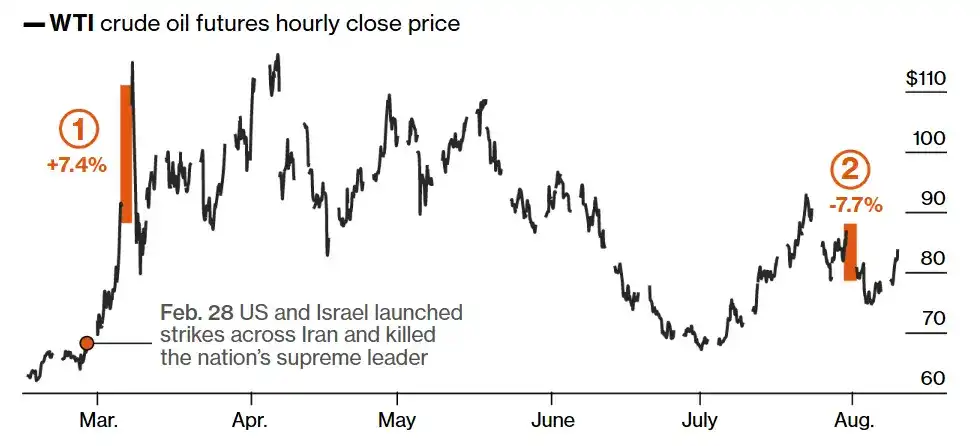
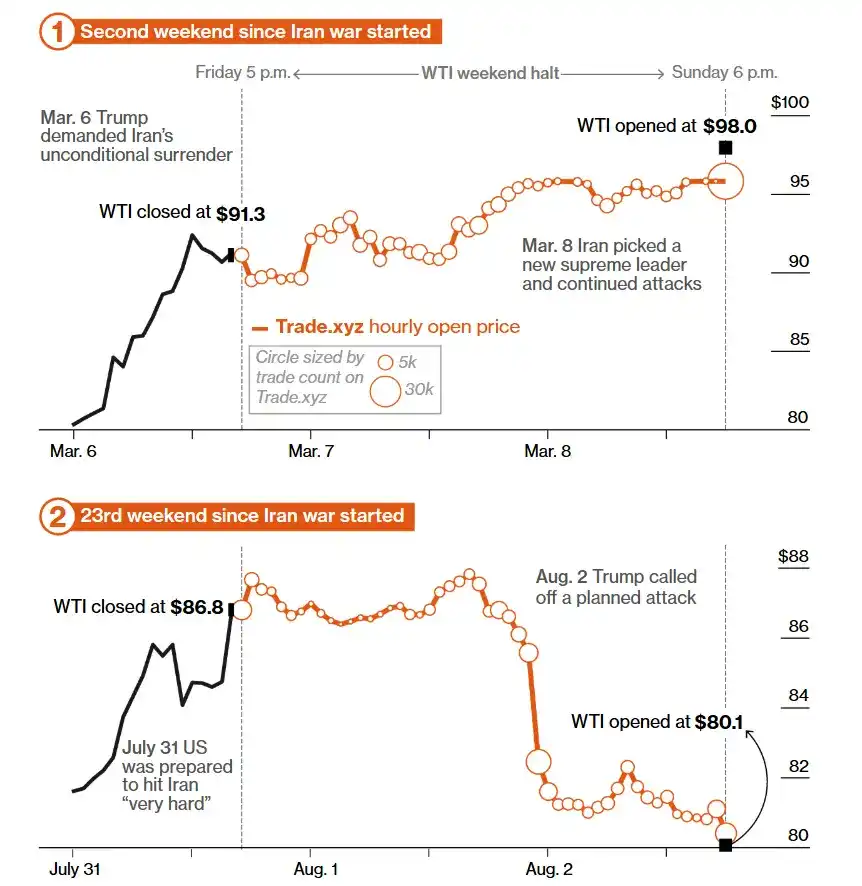
However, during some of the most turbulent periods of the conflict, the price changes in Trade.xyz contracts were smaller than the fluctuations that occurred after traditional markets reopened.

Trade.xyz uses a mechanism called "price discovery boundaries" to limit extreme price changes during periods of high volatility. As the market matures, the platform has gradually relaxed these limits.

A Trade.xyz spokesperson said the purpose of this mechanism is to allow market price discovery while preventing weekend markets from being manipulated.

The participants and sources of liquidity in these weekend contracts differ from the traditional crude oil futures markets used for comparison. Several professional oil traders said they view these contracts as indicators of market sentiment, but not necessarily as predictive tools for the reopening price of Brent or West Texas Intermediate crude.

Trade.xyz was developed by Unit Labs, whose team members mostly use pseudonyms. People familiar with the matter revealed that Unit Labs received investment from venture capital firm Paradigm over a year ago. Spokespersons for both Unit Labs and Paradigm declined to comment on the deal.

Today, Trade.xyz's business has deeply penetrated traditional financial markets.

In March of this year, Trade.xyz and S&P Global launched what they called the first formally authorized perpetual contract linked to the S&P 500 index. The open interest for this product is currently around $450 million. Trade.xyz also offers perpetual contracts tracking the Nasdaq 100 index.

The largest markets on HIP-3 were all developed by Trade.xyz, linked to the S&P 500 index, SK Hynix stock, and gold, with a combined open interest value of approximately $1.2 billion.

The Regulatory Challenge of 24/7 Trading

Before Hyperliquid launched the HIP-3 system, perpetual contracts linked to assets like stocks already existed, but HIP-3 has significantly accelerated the shift towards globally distributed, 24/7 trading.

Yesha Yadav, a professor at Vanderbilt University Law School specializing in digital asset research, said that Wall Street regulators, once accustomed to markets trading only on weekdays, must now "confront the possibility of liquidity migrating to other markets and price discovery occurring in offshore markets, especially during traditional market closures."

Collins Belton, COO and General Counsel of Unit Labs, said at an industry conference in July that this emerging field is dealing with an administration that is "very willing to be supportive." He originally expected more concerns from institutions and regulators.

This has also put regulators in conflict with CME Group, the world's largest derivatives exchange.

In June, CME sued the US Commodity Futures Trading Commission and its Chairman, Michael Selig, because a guidance issued by the commission was seen as paving the way for US platforms to launch crypto perpetual contracts.

The CFTC issued a statement at the time calling the lawsuit "baseless."

SpaceX's Pre-Listing Pricing Experiment

Compared to oil contracts, pre-IPO company contracts fill a different kind of market gap.

Companies like SpaceX do not have continuously traded public share prices before listing. Their valuations are typically only gauged by different rounds of financing and secondary market trades, which can be months apart.

The perpetual contracts launched by Trade.xyz and its competitors do not grant traders ownership of the underlying company's stock. Since these companies are not yet public, there are no publicly traded securities that can provide an anchor for contract prices through direct arbitrage.

The function of these contracts is to publicly reflect traders' judgment of a company's value before it goes public.

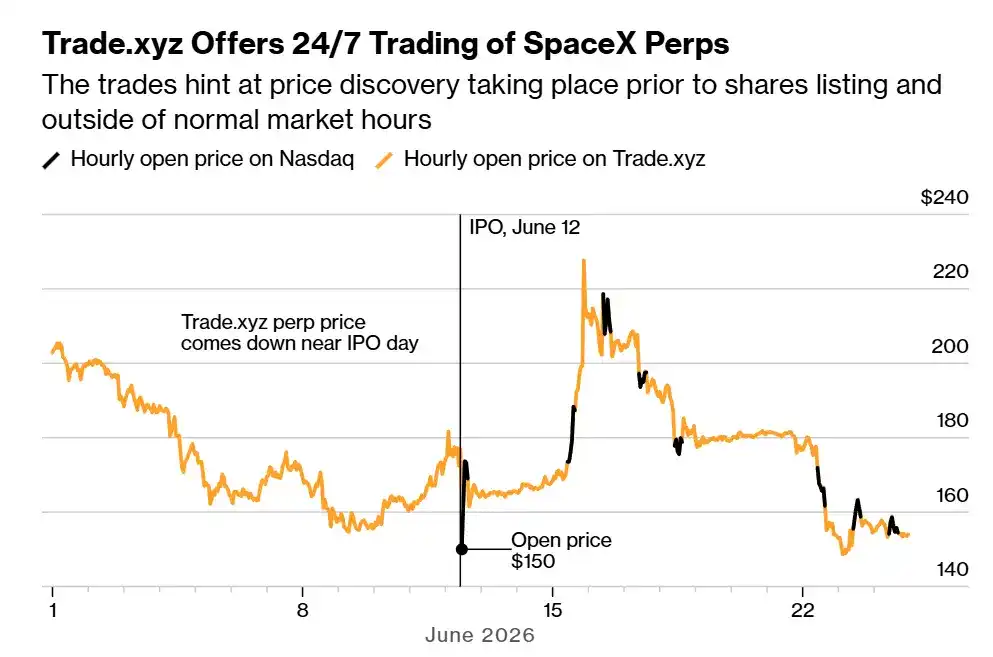
So far, Trade.xyz's pre-listing perpetual contracts have largely accurately predicted the opening performance of the related stocks. In several major listings this year, including SpaceX and SK Hynix, these contracts indicated in advance that the stock price at the start of trading would be higher than the offering price set by the underwriting banks.

David Schamis, CEO of Hyperliquid Strategies, which focuses on accumulating Hyperliquid's native token, said:

"A group of market participants who have never actually seen the stock of this company had a judgment on the opening price that was closer to the actual result than the underwriting syndicate that spent two weeks promoting the deal."

In a letter dated August 18 to US Securities and Exchange Commission Secretary Vanessa Countryman, Trade.xyz and a lobbying group associated with Hyperliquid cited the previous performance of pre-listing perpetual contracts, arguing that such products could provide public market signals before a company goes public, thereby improving the IPO pricing process.
High Leverage Amplifies Abnormal Volatility

Extremely high leverage has also quickly exposed problems in this emerging market.

In mid-June, a few days after SpaceX stock began trading, a short squeeze occurred in the Trade.xyz perpetual contract linked to this Musk-owned rocket and satellite company, momentarily pushing its implied valuation to $3 trillion, surpassing Amazon or Microsoft at the time.

As a result, over $50 million in short positions were automatically liquidated.

About a month later, the same market mechanism caused an abnormally large reverse fluctuation in the Trade.xyz perpetual contract linked to SK Hynix.

After the contract fell 20%, holders were forced to close nearly $60 million in long positions. Previously, SK Hynix stock had fallen up to 30% in pre-market trading. This drop was triggered by a single-share trade on the Nextrade market that executed at a price suspected to be anomalous.

Trade.xyz stated it would compensate for losses caused by the abnormal price fluctuation portion of the SK Hynix incident.

The platform said: "In the future, we will further refine our pricing system to handle extreme events."

Liquidity as a Competitive Moat

To open a perpetual contract market on Hyperliquid, the operator must stake 500,000 HYPE tokens, currently worth about $39 million.

Some early entrants have shut down. Meanwhile, new competitors backed by institutions like Multicoin Capital and Hyperion DeFi are targeting markets where Trade.xyz does not yet dominate.

Skew, backed by Hyperion, plans to focus on developing pricing data that is "not easily replicable." Hyunsu Jung, CEO of Hyperion, said this will be the platform's point of differentiation.

However, Trade.xyz's liquidity remains a difficult barrier to cross. This advantage stems from launching new markets earlier and having lower fee levels than competitors.

Although Trade.xyz perpetual contracts' total trading volume reached $107 billion in July this year, data aggregated by DefiLlama shows that, at current levels, their annualized revenue is only about $27 million.

Pratik Kala, Portfolio Manager at digital asset hedge fund Apollo Crypto, said:

"I don't even look at other markets. The most important thing is liquidity, and liquidity in other markets is very poor. If I wanted to place an order for even $500,000, the bid-ask spread would widen immediately."

Yadav said that a potential risk brought by Trade.xyz's rapid development is that large-scale liquidations like those seen in the SpaceX and SK Hynix perpetual contracts could, in the future, transmit to traditional markets.

In the worst-case scenario, a market crash occurring over the weekend could plunge institutions also holding traditional financial assets into a "balance sheet crisis."

She said: "Come Monday morning, will they still have sufficient funds to continue trading in the traditional markets? That's the potential danger that may emerge in the future."

In contrast, former ETF trader Walter Li is more worried about missing trading opportunities while he sleeps.

He said he used ChatGPT to design a monitoring system to scan market activity on Trade.xyz. When activity in any 24/7 traded perpetual contract picks up, the system sends him an alert.

"If you set up the right monitoring system and truly know what you're looking for, you don't need to be at your trading desk all the time."


Пов'язані питання

QWhat is the main disruptive change that crypto markets, as exemplified by Trade.xyz, introduce to the traditional financial system according to the article?

ACrypto markets, as exemplified by Trade.xyz, operate 24/7, easily cross national borders, and are increasingly filling the gaps left when traditional exchanges are closed. This challenges the conventional financial architecture of recognized venues, fixed trading hours, and benchmark prices.

QWhat specific event is used in the article to illustrate how Trade.xyz allows trading outside traditional market hours?

ADuring the airstrikes on Iran by the US and Israel in late February, while major global oil markets were closed, traders on Trade.xyz were able to buy and sell an on-chain oil derivative throughout the weekend, pricing in the potential impact of the conflict hours before traditional futures markets reopened.

QWhat is one of the larger ambitions that Trade.xyz and Hyperliquid are pursuing, as mentioned in the article?

AThey are lobbying US regulators to allow pre-IPO perpetual contracts into the US market, arguing that these products could enable better price discovery before a company's formal listing and modernize the traditional IPO process.

QWhat significant risk does Professor Yesha Yadav highlight regarding the rapid growth of platforms like Trade.xyz?

AShe highlights the risk that large-scale liquidations, like those seen in the SpaceX and SK Hynix perpetual contracts, could spill over into traditional markets. In a worst-case scenario, a weekend market crash could put institutions holding traditional financial assets into a 'balance-sheet crisis,' potentially leaving them without sufficient funds to trade when traditional markets reopen on Monday.

QAccording to the article, what is a key competitive barrier for new entrants trying to challenge Trade.xyz's dominance on Hyperliquid?

ATrade.xyz's established liquidity is a key competitive barrier that is difficult for new entrants to overcome. This advantage comes from launching new markets earlier and having lower fee levels than competitors. A fund manager quoted in the article stated that other markets have very poor liquidity, making even moderately sized trades difficult due to wide bid-ask spreads.

Пов'язані матеріали

Franklin Templeton to Include Tokenized Assets BENJI in ETF and Mutual Fund Lineups

Franklin Templeton is preparing to incorporate tokenized assets into its traditional investment funds, marking a deeper integration of blockchain into mainstream asset management. According to reports, the firm plans to use its Franklin Onchain U.S. Government Money Fund (BENJI) as an asset or collateral within its exchange-traded funds (ETFs) and mutual funds, pending board approvals. The SEC has cleared this structure, permitting the use of this natively digital money market product for cash management and collateral purposes—a first-of-its-kind approval. This move goes beyond simply issuing blockchain versions of existing securities. Franklin already distributes tokenized funds via digital wallets but now aims to use these assets within conventional portfolios to enhance liquidity management and improve the efficiency of idle cash. The firm manages over 130 ETFs globally with around $82 billion in assets and approximately $790 billion in mutual fund assets. Its tokenized money market funds currently manage about $2.6 billion. This step occurs as tokenized real-world assets gain traction on Wall Street, with the total market value exceeding $38 billion. Other major firms like Blackrock and BNY are also expanding blockchain-based fund and settlement initiatives. Tokenization offers benefits like faster settlements, 24/7 transfers, and more efficient collateral use. Franklin's approach integrates these assets seamlessly into traditional fund operations, signaling an evolution where blockchain transitions from an external "wrapper" to a core operational mechanism. The company also plans to launch additional tokenized products for broader use across its fund lineup.

cryptonews.ru7 хв тому

Franklin Templeton to Include Tokenized Assets BENJI in ETF and Mutual Fund Lineups

cryptonews.ru7 хв тому

Liquidity Improvement Upgraded Again: Bonds, Gold, and Bitcoin Rise Simultaneously. Why Do Tech Stocks Continue to Fall?

On August 25th, US financial markets exhibited an unusual pattern: US Treasury bonds, gold, and Bitcoin rose simultaneously, the dollar remained strong, crude oil prices declined, and tech stocks continued to fall. The core drivers were two policy signals from US Treasury Secretary Scott Bessent. First, reports suggested the Treasury might use cash from its General Account (TGA) at the Fed to fund an expansion of long-term bond buybacks. Second, the US policy focus on Iran appeared to shift toward economic sanctions rather than further military escalation. These developments collectively lowered long-term Treasury yields and oil prices, while supporting gold and crypto assets. However, US equities did not broadly rally, with AI and semiconductor stocks continuing to weigh on the Nasdaq. The potential use of TGA cash, estimated at $80-$200 billion, was seen as a stronger tool to stabilize the long-end of the bond market by improving liquidity and altering the supply structure of tradable bonds. This led to a flatter yield curve. However, analysts from Goldman Sachs and others argue such buybacks may not address the fundamental pressures on long-term yields stemming from fiscal deficits, debt supply, sticky inflation, and term premiums. Regarding Iran, the US emphasis on "economic D-Day" sanctions against entities facilitating Iranian oil trade was interpreted as a de-escalation of immediate military risks, leading to a pullback in oil's geopolitical risk premium. However, risks remain for refined products due to transport bottlenecks and global refining capacity constraints. Despite the decline in interest rates, tech stocks, led by semiconductors and AI-related names like Nvidia, extended their losses. This suggests the AI trade is transitioning from a liquidity-driven phase to one focused on validating earnings, valuations, and returns on capital expenditure. Market volatility increased at the index level but decreased for individual stocks, indicating concerns are centered on systemic macro and sector risks rather than company-specific events. In summary, the day's moves reflected a complex mix of factors: improved bond market liquidity expectations, a temporary downgrade of Iran-related oil risks, and support for alternative assets from lower real rates. Tech stocks' divergence highlights a shift toward fundamental scrutiny amid ongoing macro policy uncertainty.

marsbit14 хв тому

Liquidity Improvement Upgraded Again: Bonds, Gold, and Bitcoin Rise Simultaneously. Why Do Tech Stocks Continue to Fall?

marsbit14 хв тому

Goldman Sachs Research Report Analysis: Cryptocurrency Trading Declines for Ten Consecutive Months, Turning Point May Be Approaching

Gold Sachs Research Note: Crypto Trading Declines for Ten Months, Inflection Point May Be Near Crypto trading volumes fell 30% in July and 21% in August, marking ten consecutive months of decline—a duration now exceeding the median of past five cycles. However, in a report dated August 24, Goldman Sachs expresses "cautious optimism" for the second half, suggesting a market recovery could provide significant upside potential. The current crypto trading volume downturn has seen a 75% drop from its peak over ten months. While a brief rebound in April-May failed to sustain, a recent 21% market cap increase, if maintained, could signal a volume inflection point. Goldman notes sector valuations are near the 30th percentile of the past five years, presenting a favorable risk-reward profile. Key catalysts include regulatory progress, such as the SEC's innovation exemption proposal and over 15 crypto firms receiving federal banking charters by 2026, which could bolster institutional adoption. Furthermore, crypto companies have cut costs by ~5% on average in 2026, improving operating margins and preserving cash flow. The report highlights four Buy-rated stocks: HOOD ($124 target), IBKR ($114 target, on Conviction List), FIGR ($43 target), and COIN ($196 target), each benefiting from distinct growth drivers like structural account growth, international expansion, or regulatory tailwinds. Overall, Goldman argues the sector has priced in significant pessimism, with a potential reversal supported by seasonal trends, election cycles, and a combination of market cap recovery, cost-cutting, and regulatory reforms.

marsbit16 хв тому

Goldman Sachs Research Report Analysis: Cryptocurrency Trading Declines for Ten Consecutive Months, Turning Point May Be Approaching

marsbit16 хв тому

Stanford Business School Internal Guide: Look Beyond the Reputation, How to Accurately Identify the 5% of Truly 'Top VCs'

"Stanford Business School Internal Guide: Beyond Reputation, How to Precisely Identify the Top 5% of 'Elite VCs'" Professor Ilya Strebulaev of Stanford Graduate School of Business, using data from 230,000 investments, reveals that the top 5% of venture capital firms generate approximately 90% of the industry's profits. For founders, choosing the wrong investor can mean a tenfold difference in returns. The article introduces the data-driven 2026 Strebulaev-Jackson VC Ranking, an alternative to lists like Forbes Midas. It scores nearly 13,000 investors across 30 years based on six factors: dilution-adjusted ownership, net profit (investment cost subtracted), value-add (e.g., lead investor/board role), and attribution of credit between firms and individual partners. Key findings from the top 100 firms: - Sequoia Capital leads with 10,158 points. - Performance follows a power law: the #1 firm scores ~41x more than #100. - Unicorn count is a poor performance proxy (e.g., SV Angel with 139 unicorns ranks #31). - 21 of the top 100 were founded in 2015 or later. - 23 firms have their top-scoring investment in frontier AI/AI infrastructure. - Geography remains concentrated: 62 in California, 19 in New York. The author cautions against using the rank order blindly. Founders must prioritize: 1. Strategic fit (stage, sector, involvement model) over raw rank. 2. Due diligence on the specific partner, not just the firm brand. 3. Recognizing that VC partnerships are long-term commitments akin to marriages. The ranking is a tool to identify the elite 5%, but the final choice requires deeper research into partner dynamics and how investors behave during a company's difficult times.

marsbit17 хв тому

Stanford Business School Internal Guide: Look Beyond the Reputation, How to Accurately Identify the 5% of Truly 'Top VCs'

marsbit17 хв тому

Торгівля

Спот
活动图片