Comics Illustration: Helping You Understand China's New Regulations on Outbound Investment

marsbitОпубліковано о 2026-06-01Востаннє оновлено о 2026-06-01

Анотація

Summary: Understanding China's New Regulations on Overseas Investment The State Council has announced new regulations on overseas investment, effective July 1, 2026. The core message is not a prohibition on international investment, but a call for both companies and individuals to operate with strong regulatory awareness. Here are the key points: 1. **Scope is Broad:** The rules apply not only to companies but also to other organizations and individual residents. 2. **Definition of Investment is Wide:** It encompasses not just capital transfers but also asset contributions, obtaining equity or rights, financing, providing guarantees, and direct or indirect acquisition of rights related to overseas entities or assets. 3. **Companies Must Plan Comprehensively:** Beyond simple ownership charts, firms need clear plans covering the investing entity, required approvals or filings, fund transfer paths, and compliance with technology, data, and security reviews. 4. **Individuals Should Prioritize Compliance:** Before focusing on returns, individuals must first assess their eligibility, understand legal channels for capital outflow, know what they are acquiring, and identify responsible parties in case of issues. 5. **Penalties are Significant:** Violations can result in fines and potentially restrictions on future overseas investment activities. In essence, overseas investment remains possible, but it must be approached with regulatory compliance as a fundamental priority, no...

Author: Liu Honglin, Mankun Blockchain

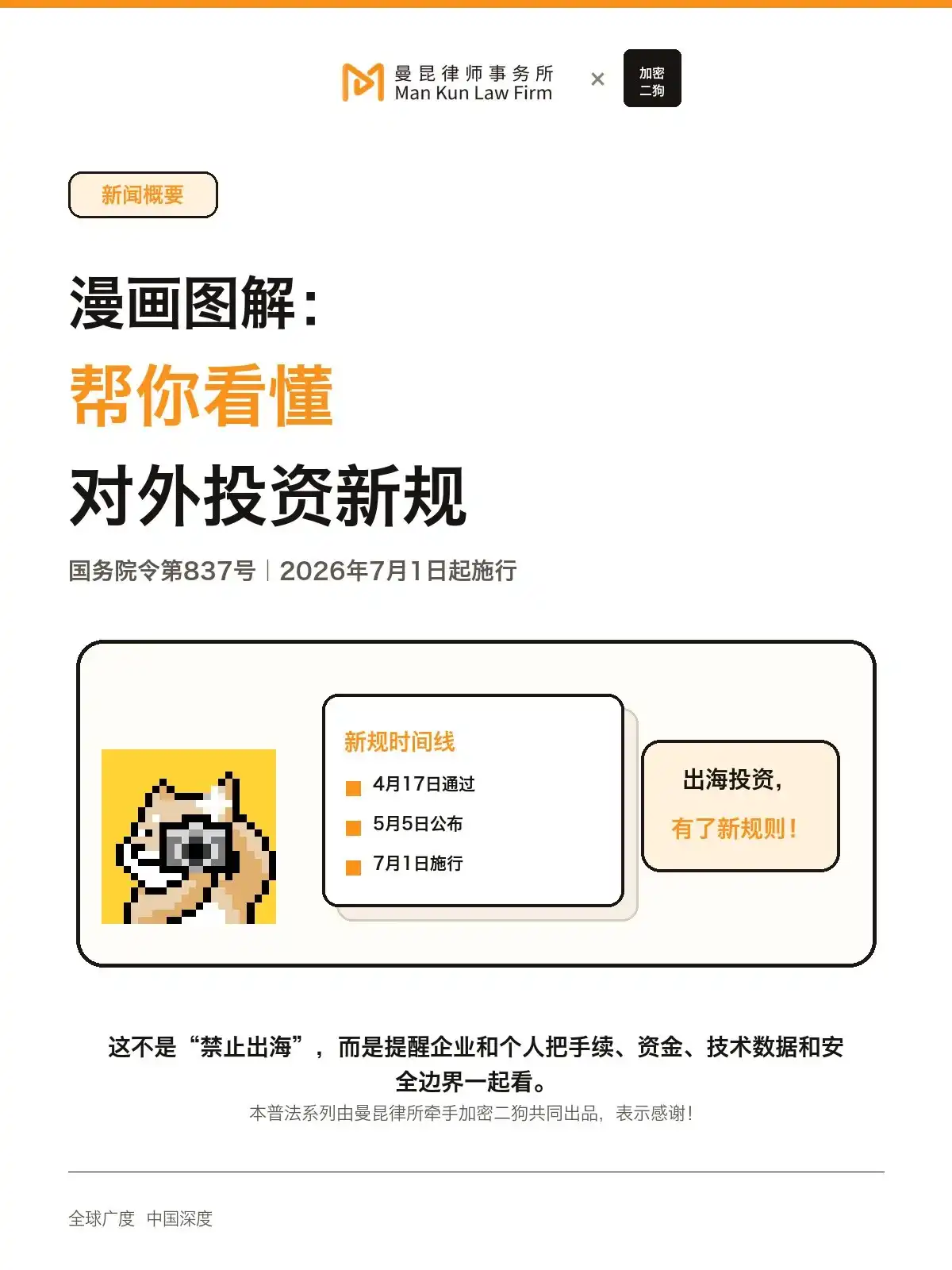
The State Council has promulgated the "State Council Regulations on Outbound Investment," which will take effect from July 1, 2026.

This is not simply a matter of "cannot go overseas."

More accurately, it serves as a reminder to enterprises and individuals: outbound investment must follow rules.

To understand this new regulation, keep the following points in mind first:

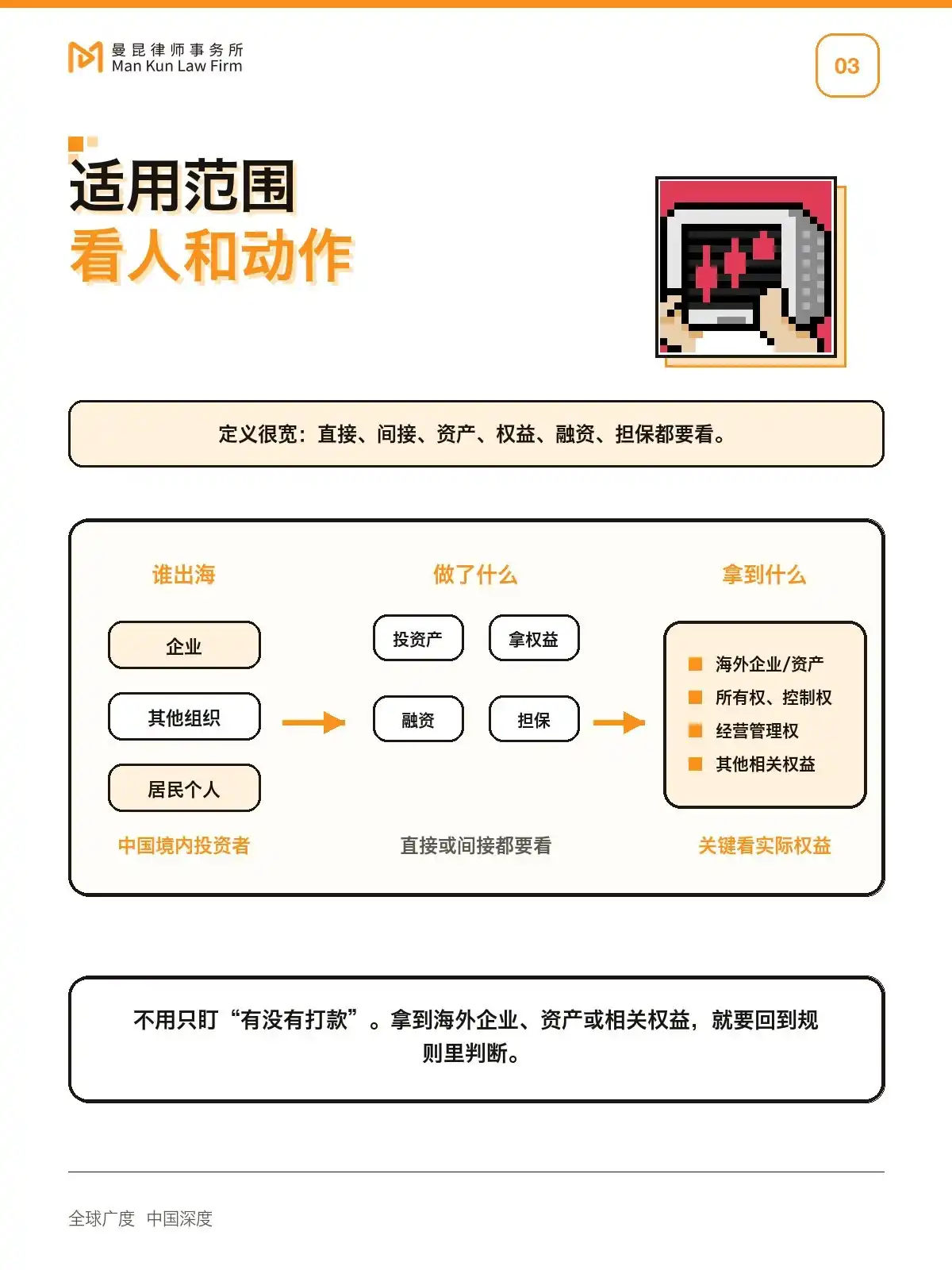
1️⃣ It's not just enterprises that are regulated. The scope of investors includes domestic enterprises, other organizations, and resident individuals.

2️⃣ It's not just about transferring money. Acquiring assets, obtaining equity rights, providing financing or guarantees, and directly or indirectly acquiring rights and interests related to overseas enterprises or assets all require assessment.

3️⃣ Enterprises shouldn't just draw equity structure charts. They also need to clearly chart the entities, approval/filing procedures, fund flow paths, technology, data, and security reviews.

4" Individuals shouldn't just look at returns. First, consider whether you are eligible to invest, how the funds will go out, what you are actually buying, and whom to turn to if something goes wrong.

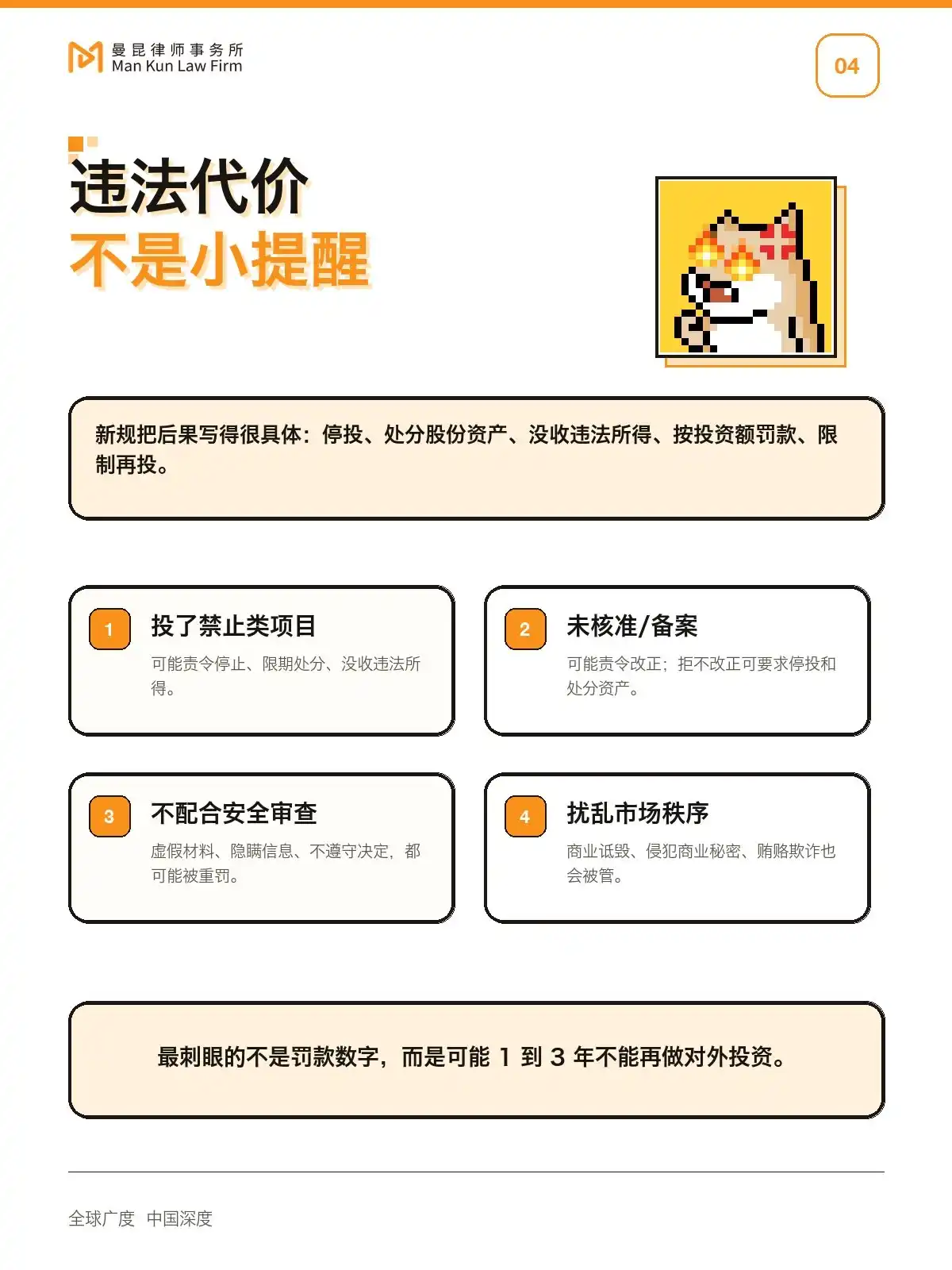
5️⃣ The price of non-compliance is not light. Beyond fines, there may be restrictions on continuing outbound investment activities.

In a nutshell: Outbound investment is not prohibited, but it cannot be pursued solely based on commercial opportunities.

The above is for general information sharing only and does not constitute legal advice or investment recommendations.

Пов'язані питання

QWhat is the core message of China's new regulations on outward investment according to the article?

AThe core message is that outward investment is not prohibited, but it must be conducted with a strong awareness of and compliance with the rules. The regulations emphasize that decisions cannot be based solely on commercial opportunities.

QWho is covered as 'investors' under these new regulations?

AThe regulations cover not only domestic enterprises but also other domestic organizations and resident individuals. All are explicitly included within the scope of investors subject to the rules.

QWhat are some of the forms of outward investment mentioned that require consideration under the new rules?

AThe rules apply not just to monetary transfers. Activities like investing assets, acquiring equity interests, providing financing, offering guarantees, and obtaining rights related to overseas entities or assets, either directly or indirectly, all fall under consideration.

QWhat additional requirements do enterprises need to prepare for besides their corporate ownership structure charts?

AEnterprises must also clearly outline and prepare documentation related to the involved entities, the processes for obtaining necessary approvals or filings, the paths for fund transfers, and considerations for technology, data, and security reviews.

QWhat are the potential consequences for violating these regulations?

ABeyond financial penalties, violators may face restrictions or prohibitions on their ability to continue engaging in outward investment activities in the future.

Пов'язані матеріали

Pantera Partner: In the Age of Agents, Blockchain is the Inevitable Answer for AI

Summary: AI and blockchain are converging around four key pillars: payment settlement, identity systems, open systems, and resource aggregation, with commercial projects already emerging in each area. The two technologies are fundamentally complementary: AI enables infinite supply (content, agents), while blockchain establishes scarcity and verifiable ownership. AI agents generate content and services, and blockchain handles the verification and value settlement. A significant valuation mismatch exists, with leading AI companies historically overvalued compared to crypto assets, despite their deep underlying integration. The emergence of autonomous AI agents—which require assets, value transfer, and large-scale coordination—creates a need for a non-human-centric financial infrastructure. Blockchain, with its programmability, 24/7 access, and low-trust settlement, is the only suitable foundation. AI agents will not use traditional bank accounts or payment rails; they will transact using stablecoins and on-chain systems. Examples include OpenFX, which settles hundreds of billions in forex trades on-chain for AI agents, and Alchemy, a core development platform. For human identity verification in an age of AI-generated content, projects like World (Worldcoin) use blockchain-based biometric verification, while TransCrypts focuses on self-sovereign identity and verifiable credentials. The current divergence presents a unique investment opportunity. AI valuations are highly elevated, while crypto assets trade at a significant discount, even though the future smart agent economy will be built on blockchain infrastructure. The fusion of AI and blockchain is not a future trend but an ongoing reality, creating a prime environment for entrepreneurs in areas like agent-native finance, decentralized identity, and on-chain AI coordination.

marsbit11 хв тому

Pantera Partner: In the Age of Agents, Blockchain is the Inevitable Answer for AI

marsbit11 хв тому

API Stories Can't Support Valuations, AI Giants Start Offering Consulting Services

The AI industry is shifting from simply selling APIs to providing intensive, on-site consulting services, as major players like OpenAI and Anthropic seek new revenue streams to justify high valuations. OpenAI has established "Deploy Co," raising over $40 billion from investors led by TPG at a $140 billion valuation. The deal has an unusual structure, guaranteeing investors a minimum 17.5% return with a profit cap, resembling debt more than equity. OpenAI also acquired the AI consulting firm Tomoro to gain over 150 "Frontline Deployment Engineers" (FDEs). Similarly, Anthropic formed a $15 billion joint venture with Blackstone, Hellman & Friedman, and Goldman Sachs with the same goal: embedding engineers within client companies. A key driver is Anthropic's rapid market share growth, now holding 40% of the enterprise LLM API market compared to OpenAI's 27%, which has put pressure on OpenAI to accelerate its enterprise strategy. Notably, major consulting firms Bain & Company, McKinsey & Company, and Capgemini are among the investors in OpenAI's venture, a move seen as either seeking deeper insight into AI or funding their potential future disintermediation. This pivot is creating a major shift in tech employment. Demand for FDEs—who integrate AI into client workflows on-site—has surged over 800% in the past year, with salaries reaching $350,000-$550,000. Meanwhile, demand for traditional software engineers has declined significantly. The trend marks a strategic inflection point: core AI models are becoming commoditized, while the complex, labor-intensive work of deployment is becoming the new high-value, capitalized service layer. The $55 billion in combined funding represents a bet that hands-on consulting, not just API access, is the future of enterprise AI monetization.

marsbit1 год тому

API Stories Can't Support Valuations, AI Giants Start Offering Consulting Services

marsbit1 год тому

Торгівля

Спот
Ф'ючерси
活动图片