Hong Kong Issues First Stablecoin Licenses To HSBC, Standard Chartered JV

bitcoinistОпубліковано о 2026-04-11Востаннє оновлено о 2026-04-11

Анотація

The Hong Kong Monetary Authority (HKMA) has issued its first stablecoin licenses to The Hongkong and Shanghai Banking Corporation Limited (HSBC) and Anchorpoint Financial Limited, a joint venture between Standard Chartered, Animoca Brands, and Hong Kong Telecom. This follows the implementation of Hong Kong’s Stablecoins Ordinance in August 2025, which established a licensing framework for fiat-backed cryptocurrency issuers. The HKMA received 36 applications but approved only two in this initial phase, as anticipated by Chief Executive Eddie Yue. Amid a broader downturn in digital assets, the stablecoin market has remained resilient, with its combined market cap holding near all-time highs since Q4 2025. Meanwhile, Bitcoin has declined over 42% in the same period. At the time of writing, Bitcoin was trading around $72,200, up more than 8% over the past week.

The Hong Kong Monetary Authority (HKMA) has handed out its first stablecoin licenses, and the winners are Standard Chartered’s JV and HSBC.

HKMA Has Released First Stablecoin Licenses After A Delay

According to HKMA’s website, two entities have now become registered stablecoin issuers in Hong Kong: Anchorpoint Financial Limited and The Hongkong and Shanghai Banking Corporation Limited.

Hong Kong launched its stablecoin bill called the Stablecoins Ordinance back in August 2025, establishing a licensing regime for stablecoin issuers. Under this law, parties interested in issuing fiat-tied cryptocurrencies in the Chinese city have to first obtain a license from the HKMA.

Major names quickly lined up to apply for a license. This included HSBC and Anchorpoint Financial Limited. The latter is a joint venture (JV) created by Standard Chartered, Animoca Brands, and Hong Kong Telecom. In total, the HKMA ended up receiving applications from 36 entities. Despite the high interest, though, Eddie Yue, the financial regulator’s chief executive, said in February that a “very small number” of licenses would be granted in the first wave.

Yue also said that these licenses would arrive in March, but in the end, no licenses were issued during that month, suggesting a delay from the HKMA. However, today, on April 10th, the first batch has finally gone out.

With just two licenses being handed out, Yue indeed set up the correct expectations. As mentioned earlier, Standard Chartered’s JV and HSBC are the applicants who have received the first approval. Thus, these banks have a head start over the rest when it comes to stablecoins in the region.

Hong Kong’s stablecoins advance is just one example of positive regulation that these fiat-tied tokens have seen the world over in the past year. One of the most important wins for the sector has been the GENIUS Act signed into law by United States President Donald Trump last year.

Because of all the regulatory momentum and adoption, the stablecoins sector has performed relatively well amid the wider downturn in the digital assets market. As data from DefiLlama shows, stablecoins have seen their combined market cap move sideways at all-time highs (ATHs) since Q4 2025. In the same period as this flat phase in these fiat-tied tokens, Bitcoin has gone down by more than 42%.
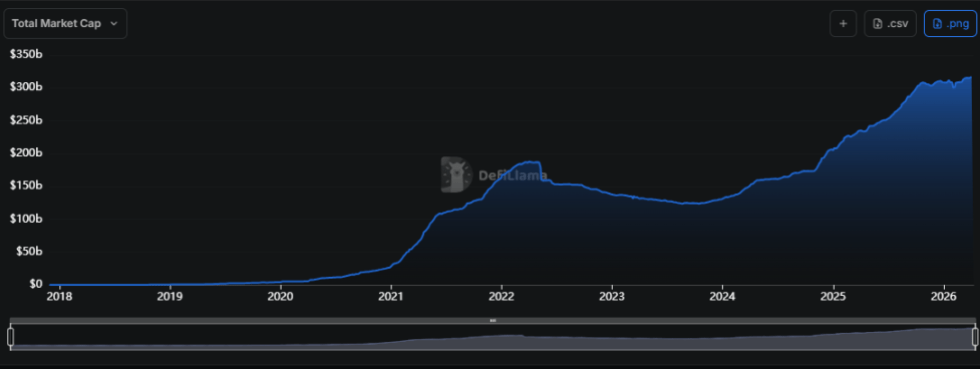
The trend in the market cap of the stablecoins over the years | Source: DefiLlama

While the stablecoin market cap is significant in size, the vast majority of it is covered by just two assets pegged to the US Dollar: USDT and USDC. Moves like the euro-pegged token from a consortium of major European banks could shake up this dominance, but it only remains to be seen how the landscape will evolve.

Bitcoin Price

At the time of writing, Bitcoin is floating around $72,200, up more than 8% in the last seven days.

Looks like the price of the coin has surged recently | Source: BTCUSDT on TradingView


Пов'язані питання

QWhich two entities received the first stablecoin licenses from the Hong Kong Monetary Authority?

AAnchorpoint Financial Limited and The Hongkong and Shanghai Banking Corporation Limited (HSBC).

QWhat is the name of the stablecoin bill that established the licensing regime in Hong Kong and when was it launched?

AThe Stablecoins Ordinance, launched in August 2025.

QHow many entities applied for a stablecoin license from the HKMA, and how many were granted in this first wave?

A36 entities applied, and 2 licenses were granted in the first wave.

QAccording to the data from DefiLlama, how has the stablecoin market cap performed compared to Bitcoin since Q4 2025?

AThe stablecoin market cap has moved sideways at all-time highs, while Bitcoin has declined by more than 42% in the same period.

QWhat is the current price of Bitcoin mentioned in the article and its 7-day performance?

ABitcoin is floating around $72,200, up more than 8% in the last seven days.

Пов'язані матеріали

Will Quantum Computing Kill Bitcoin and Mining? Is This Alarmist?

The article addresses the recurring concern that quantum computing could break Bitcoin's encryption and disrupt mining. It references a Google Quantum AI white paper from March 2026, which suggests that the resources needed for a quantum computer to crack Bitcoin’s elliptic curve digital signature algorithm (ECDSA) have been reduced by about 20 times. Under ideal conditions, such an attack could theoretically derive a private key from a public key in roughly 9 minutes using 500,000 physical qubits. However, the threat is not immediate. Current quantum processors, like Google’s Willow (105 qubits) or IBM’s Condor (~1,121 qubits), are far from the scale required. The risk primarily targets transaction signatures—especially during the brief window when a transaction is broadcast but not yet confirmed, or when public keys have been historically exposed. It is estimated there is only a 10% probability of a “quantum break” by 2032. The impact on mining is considered negligible. Research indicates that quantum mining would require astronomically high qubit counts and energy—far exceeding entire national grids—making it economically and physically infeasible. The broader solution lies in post-quantum cryptography (PQC). Standards like ML-DSA and SLH-DSA are being developed, and Bitcoin improvement proposals such as BIP 360 aim to reduce quantum vulnerability by modifying transaction structures to avoid exposing public keys. While quantum computing poses a future risk to all public-key encryption systems—not just Bitcoin—the cryptocurrency ecosystem has time to adapt. Upgrades and migration to quantum-resistant algorithms are underway, ensuring the network evolves ahead of the threat.

marsbit4 год тому

Will Quantum Computing Kill Bitcoin and Mining? Is This Alarmist?

marsbit4 год тому

Торгівля

Спот
Ф'ючерси
活动图片