From KYC to KYA, Is It Time to Give AI Agents Their Own 'ID Cards'?

marsbitОпубліковано о 2026-05-10Востаннє оновлено о 2026-05-10

Анотація

Titled "From KYC to KYA: Is It Time to Issue 'Identity Cards' for AI Agents?", this article discusses the emerging concept of Know Your Agent (KYA) as AI agents become increasingly autonomous. In Agent-to-Agent (A2A) scenarios, where agents execute contracts, payments, and trades without human intervention, the lack of a shared identity standard creates risks like unauthorized transactions, fraud, and accountability gaps. KYA acts as a trust layer to verify an agent's origin, authority, and accountability. The need for KYA is most critical outside centralized platforms (like Google or Coinbase), such as in decentralized exchanges (DEX), A2A payments, and merchant payments. Several key players are building KYA infrastructure: - **ERC-8004**: A proposed Ethereum standard that issues a unique AgentID as an NFT, building on-chain identity, reputation, and validation systems. - **Visa TAP**: Visa's solution issues agent identity credentials, with transactions verified via triple signatures (legitimacy, delegator, payment method). - **Trulioo**: Extends its KYC/KYB compliance infrastructure using a Digital Passport for Agents (DAP), issued after verifying both the developer and user, and refreshed per transaction. - **Sumsub**: Focuses on post-issuance real-time verification, detecting agent anomalies during transactions using its existing compliance systems. Regulatory bodies are also acting. The EU AI Act mandates operator identification in logs for high-risk AI systems, the US...

Authored by: Tiger Research

Compiled by: AididiaoJP, Foresight News

The era of AI agents is accelerating, and alongside it, concerns about the uncontrolled creation and behavior of agents are growing. Know Your Agent (KYA) systems, which assign identities to agents and regulate their behavior, are receiving increasing attention. Why is a KYA identity infrastructure needed? Which companies are building it?

Summary

  • AI agents have entered an era of autonomously executing contracts, payments, and transactions, but there are currently no shared standards to verify "who this agent is." In Agent-to-Agent (A2A) scenarios, KYA is gaining more focus than KYC.
  • KYA is not needed in all scenarios. Within centralized platforms (Google, OpenAI, Coinbase), existing KYC is sufficient. Where KYA truly becomes important is in scenarios where independently deployed autonomous agents interact with DEXs, A2A payments, and merchant payments.
  • The KYA standards race has begun:
  • ERC-8004: Issues AgentIDs on top of NFTs, building an on-chain system for identity, reputation, and verification.
  • Visa TAP: Visa issues identity credentials for agents, verified through TAP's triple signature (legitimacy, delegator, payment method).
  • Trulioo: Adopts the SSL CA model, with DPAs issuing DAPs.
  • Sumsub: Layers a KYA system on top of its own compliance system.

Regulatory action has begun at the national level. The EU's AI Act requires high-risk AI system behavior logs to include operator identity. The US NIST has listed agent identity management as a priority standard area. Singapore has released the world's first national-level AI agent governance framework. Just as the 2019 FATF Travel Rule determined which crypto exchanges survived, whether one possesses KYA infrastructure will determine who enters the next market cycle.

Why is KYA Emerging Now?

KYC: The Layer That Reshaped Finance

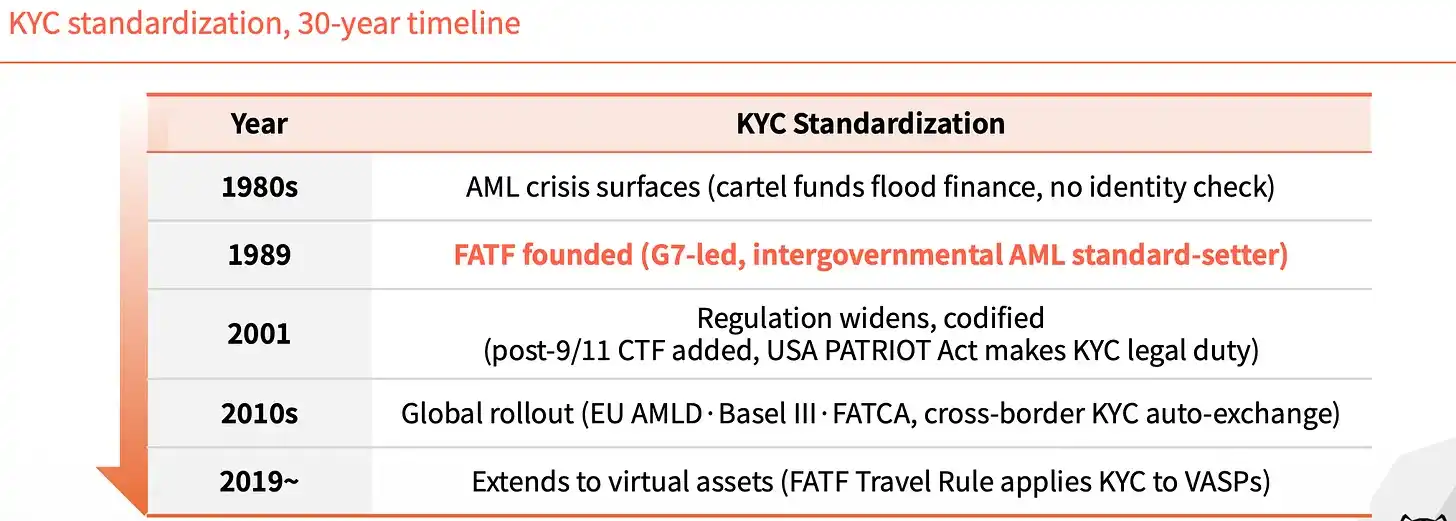
  • Before 1989, global finance lacked a unified identity standard. This gap made it difficult to track drug money and illicit funds.
  • After the FATF was founded in 1989, KYC became a mandatory requirement in finance, blocking illicit funds at the entry point.
Without Agent Identity, Systems Regress

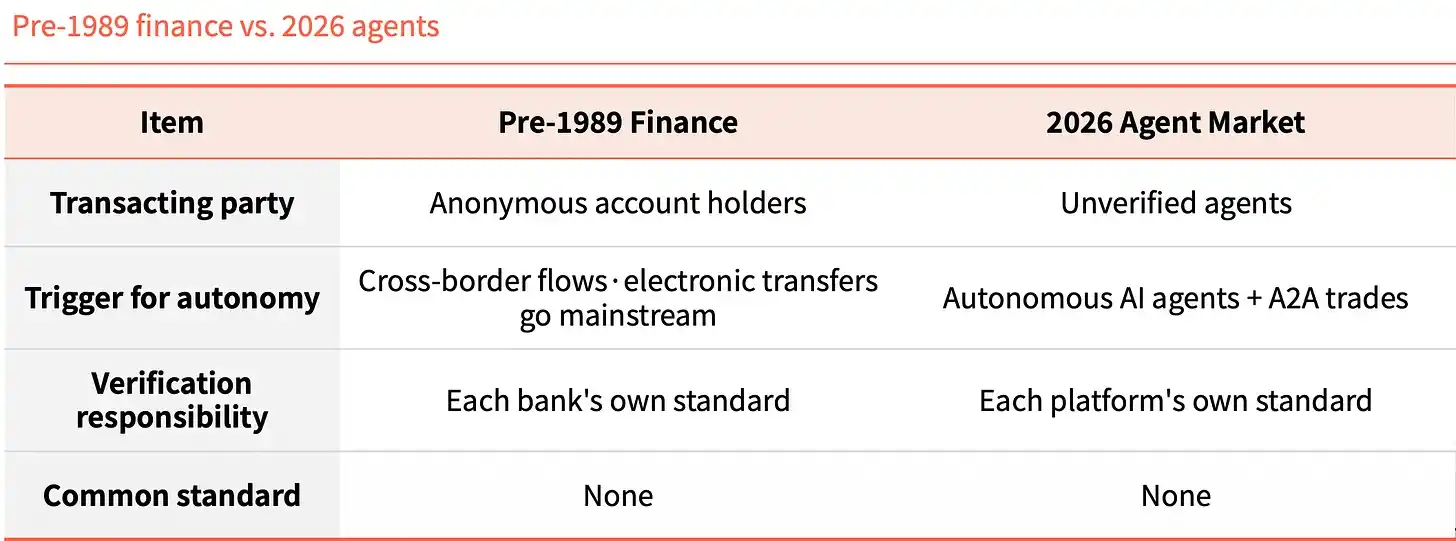
  • AI agents execute contracts, payments, and transactions without human involvement, but currently, it's impossible to verify "who it is."
  • In A2A environments, accountability becomes blurred, dispute risks increase, and users are exposed to fraud patterns like money laundering.
The Role and Response of KYA (Know Your Agent)

  • KYA (Know Your Agent) is a trust layer that pre-verifies an agent's origin, permissions, and accountability framework.
  • Unverified agents bring three major risks simultaneously: unauthorized transactions, fraud, and accountability gaps.
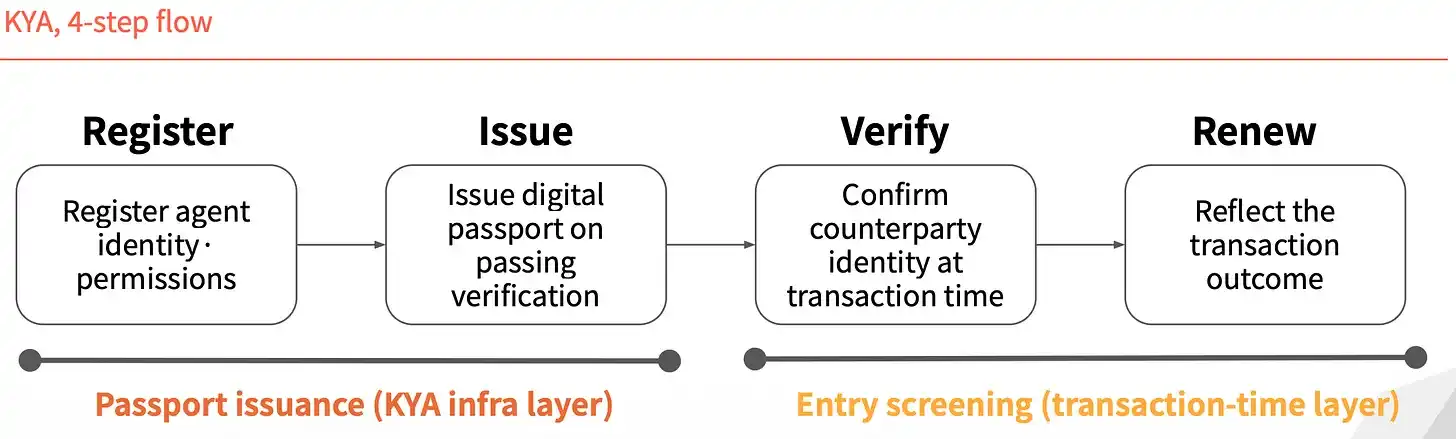
The Manifestation of KYA's Necessity

KYA is Needed at Every Level

  • Within centralized platforms, user KYC + platform accountability is sufficient. In interoperable scenarios outside platforms, KYA becomes crucial for verifying an agent's specific actions and safety.
  • Within a country (inside a platform), one ID (KYC) is enough to move freely. But once crossing borders (outside a platform), the environment changes, and entry review (KYA) of purpose and trust is needed.
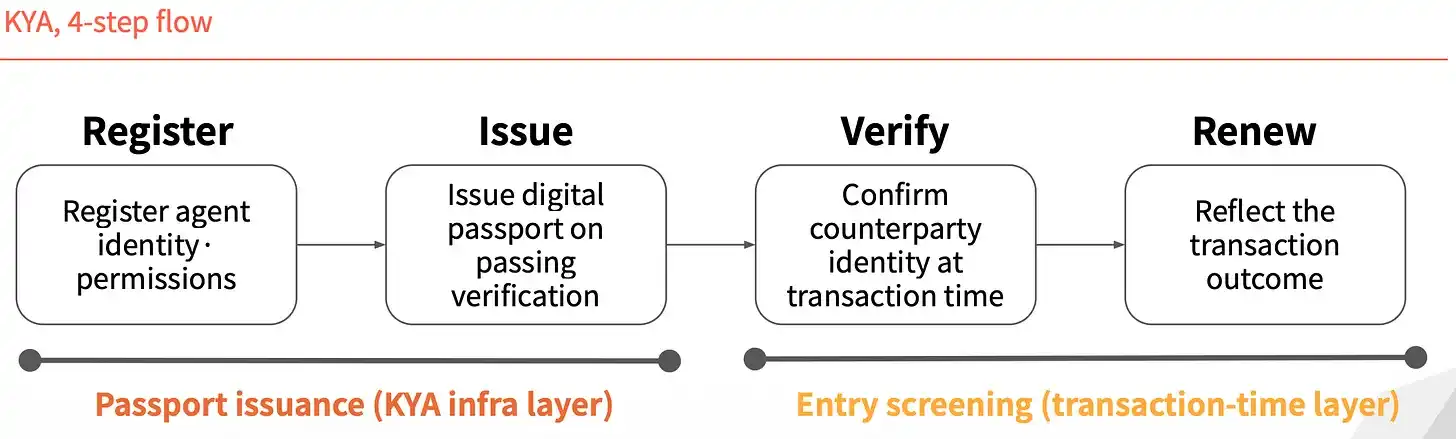
Market Players

ERC-8004: NFT-Based Agent Identity

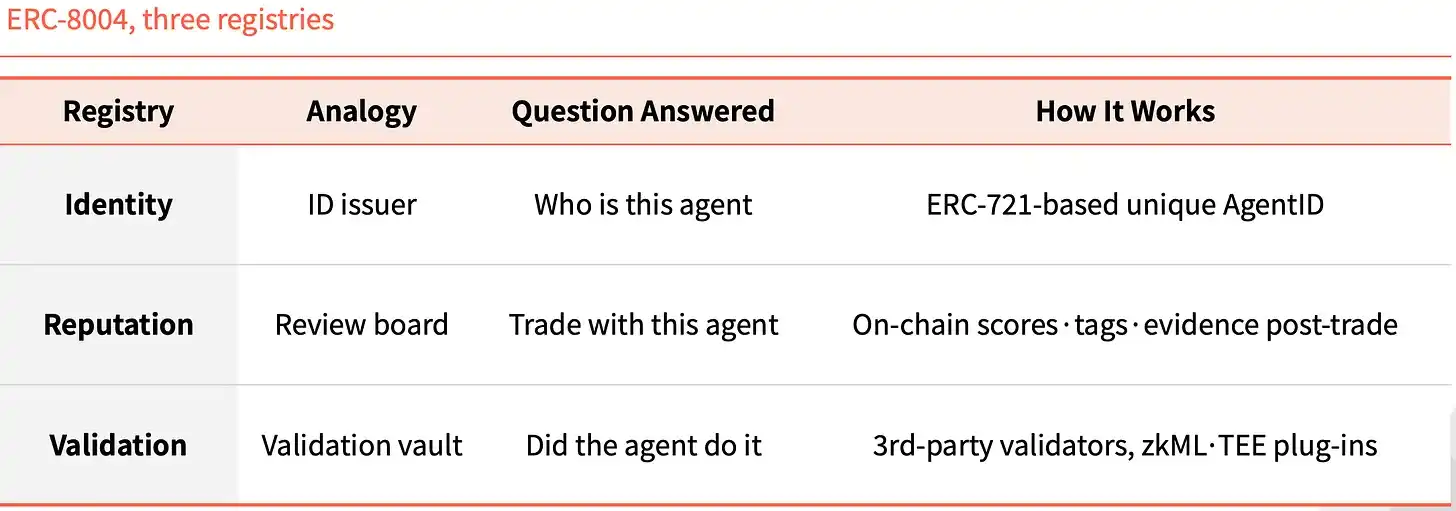
  • ERC-8004 adds an identity layer on top of ERC-721, minting an NFT as a unique ID for each agent.
  • It also adds three on-chain registries (Identity, Reputation, Validation), serving as identity, reputation board, and verification record respectively.
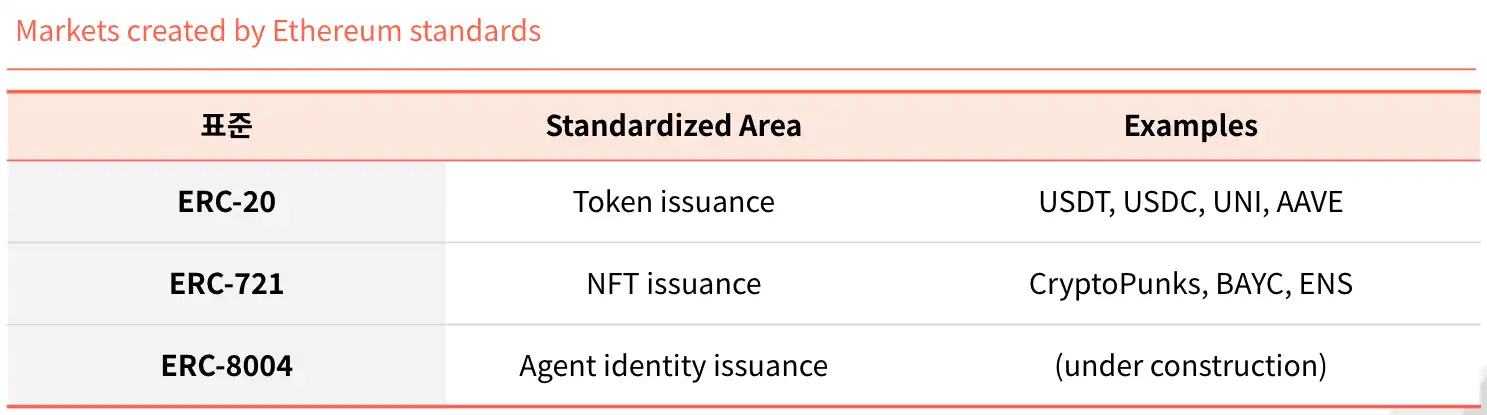
Two Markets Built by Ethereum Standards, a Third is Coming

  • ERC-20 (Token Issuance Standard): Before standardization, every token needed brand-new code. After ERC-20, most major assets were issued on it.
  • ERC-721 (NFT Standard): CryptoPunks, BAYC, ENS built the NFT market itself upon it. As blockchain integration accelerates in the agent era.
  • ERC-8004 will play the same standardizing role for Agents.
Visa TAP: Authentication on the Visa Rail

Visa issues identity credentials (Agent Intent) to agents, akin to an identity card. Without a key, transactions cannot occur. Keys are issued only after Visa pre-approval. Every transaction is signed and submitted to the merchant.

The merchant receives three signatures, not one: Visa approval, delegator, payment method, all confirmed simultaneously.
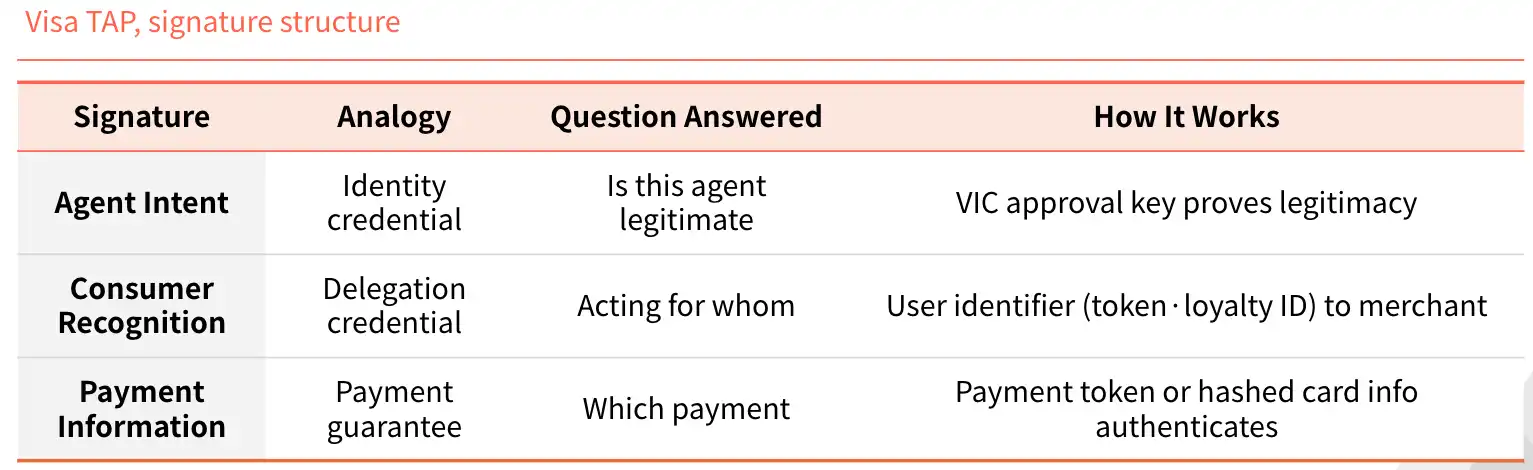
Visa: A Strategy to Pull Every Transaction into the Visa Network

  • Just as Visa previously captured payment rails, it is now encapsulating the agent era.
  • Through Visa Intelligent Commerce (VIC), Visa offers a solution bundle that packages KYA with payments.
  • If agent payments still use the card rail, and this bundle becomes the default option, then Visa's market share can remain stable even through the transition.

Trulioo: Extending KYC-Era Verification Infrastructure

  • Trulioo is a compliance operator on the global KYC/KYB rail and is expanding its verification stack to KYA.
  • DPAs play the role of SSL-CAs. Unlike SSL (domain only), DPAs verify developer KYB and user KYC before issuing a DAP.
  • Banks and fintechs legally require human and business identity. As agents enter finance, Trulioo's KYC/KYB position will be further solidified.
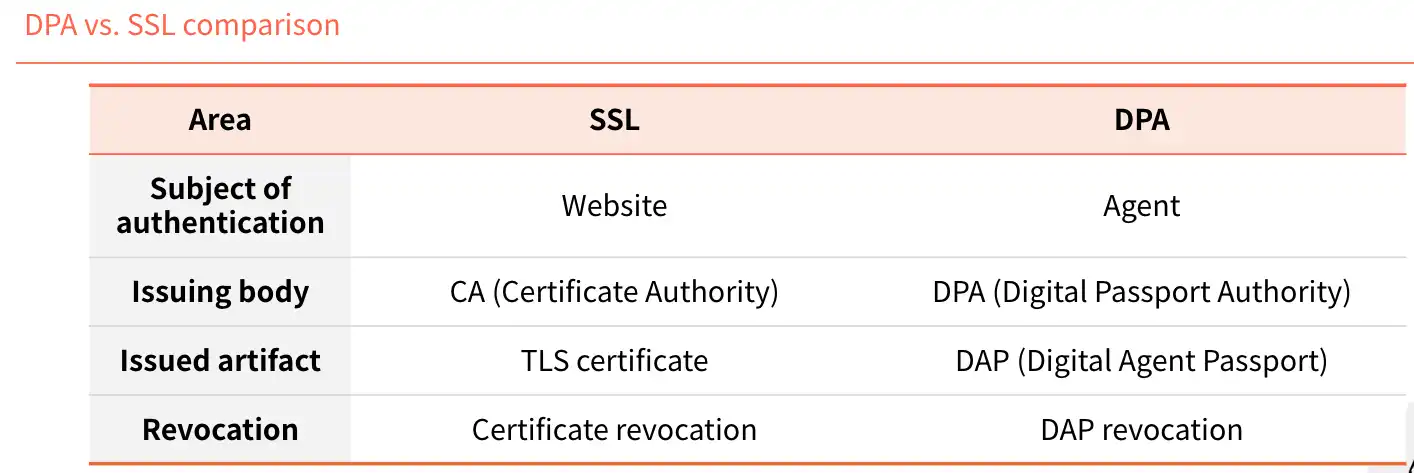
DAP, an Agent's Digital Passport, Refreshed with Each Transaction

  • DAP is an agent's digital passport. A DPA verifies the developer (KYB) and user (KYC), packages both into a token, and grants it to the agent.
  • Unlike a paper passport, it is a live token, refreshed and re-verified with every transaction. Once delegation is revoked or anomalies are detected, the DAP is invalidated immediately.
  • KYA is not a one-time verification. Trust must be reconfirmed with every transaction.
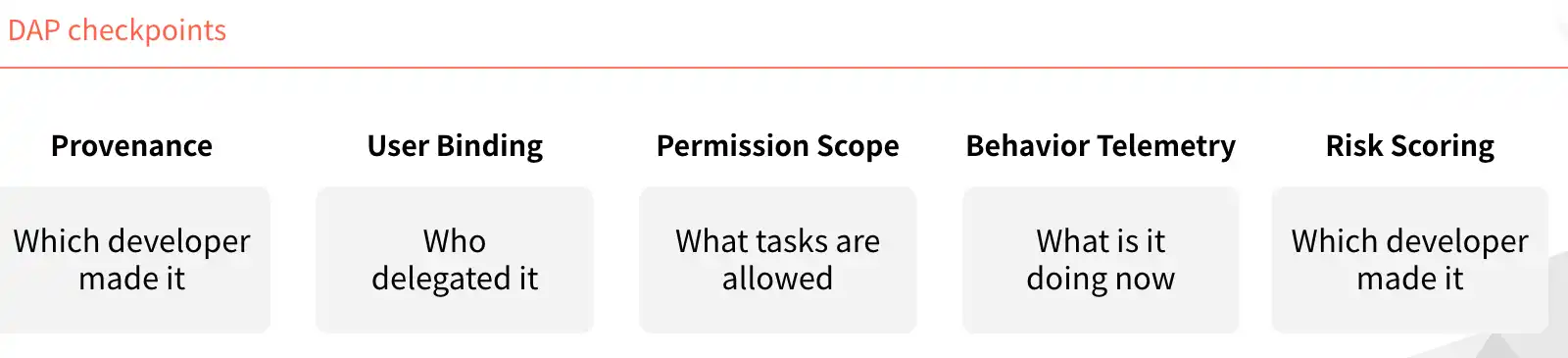
Sumsub (AI Agent Verification): Detecting Agent Anomalies

  • Sumsub's approach is: whenever an agent attempts an anomalous transaction, re-verify the currently active human identity.
  • It leverages its verification systems from its compliance business since 2015 to detect agent anomalies more accurately.
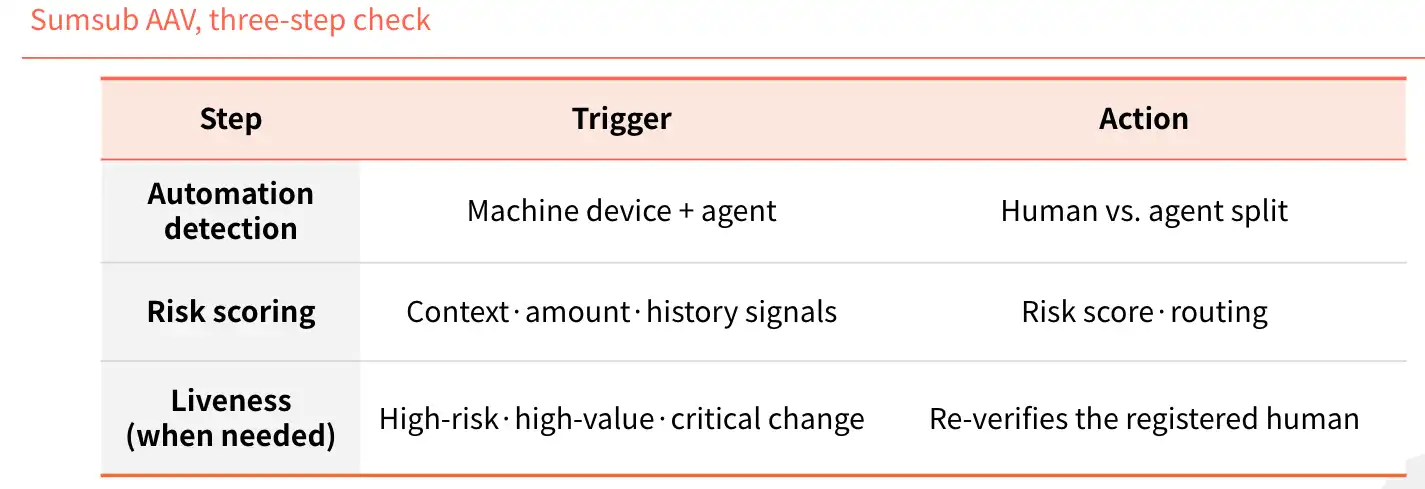
Operators with Technology to Address New Threats of the AI Era

  • Other KYA players focus on one-time pre-transaction identity verification. Sumsub focuses on real-time verification post-issuance.
  • As agent permissions expand, anomaly detection becomes crucial; as fraud scales with technology, Sumsub's real-time verification stack gains attention.
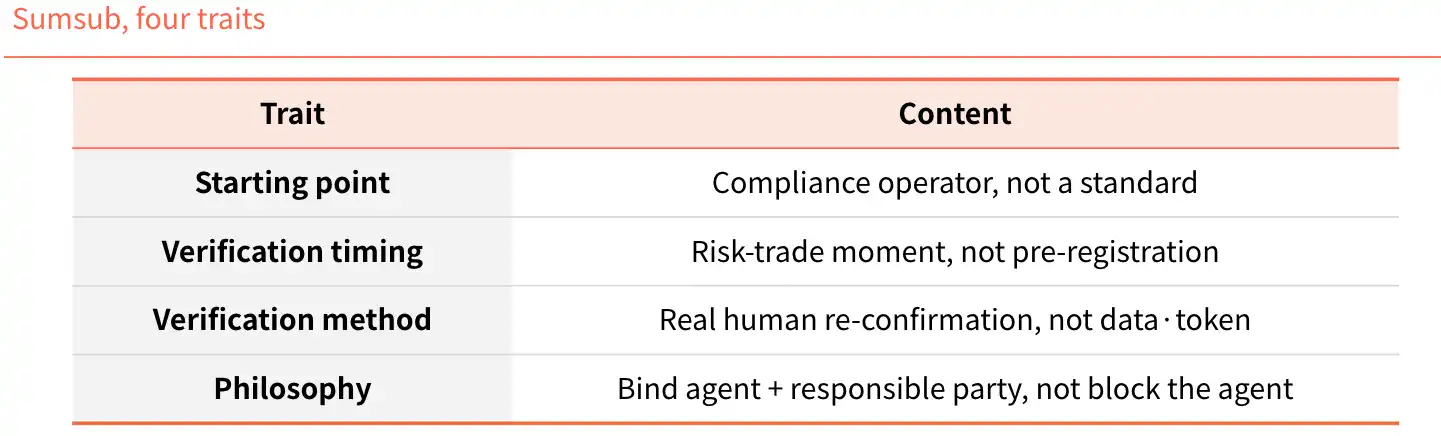
Proactive Regulatory Positioning, Shaping Entry Rules

The Gap Caused by the FATF Travel Rule May Recur with KYA

After the 2019 FATF Travel Rule, VASPs diverged based on their ability to bear KYC/AML infrastructure costs. Peers like CryptoBridge and Deribit, unable to afford it, either shut down or moved to less regulated regions.

The EU, Singapore, and the US are already vying for leadership. KYA will become a core layer of the agent era.
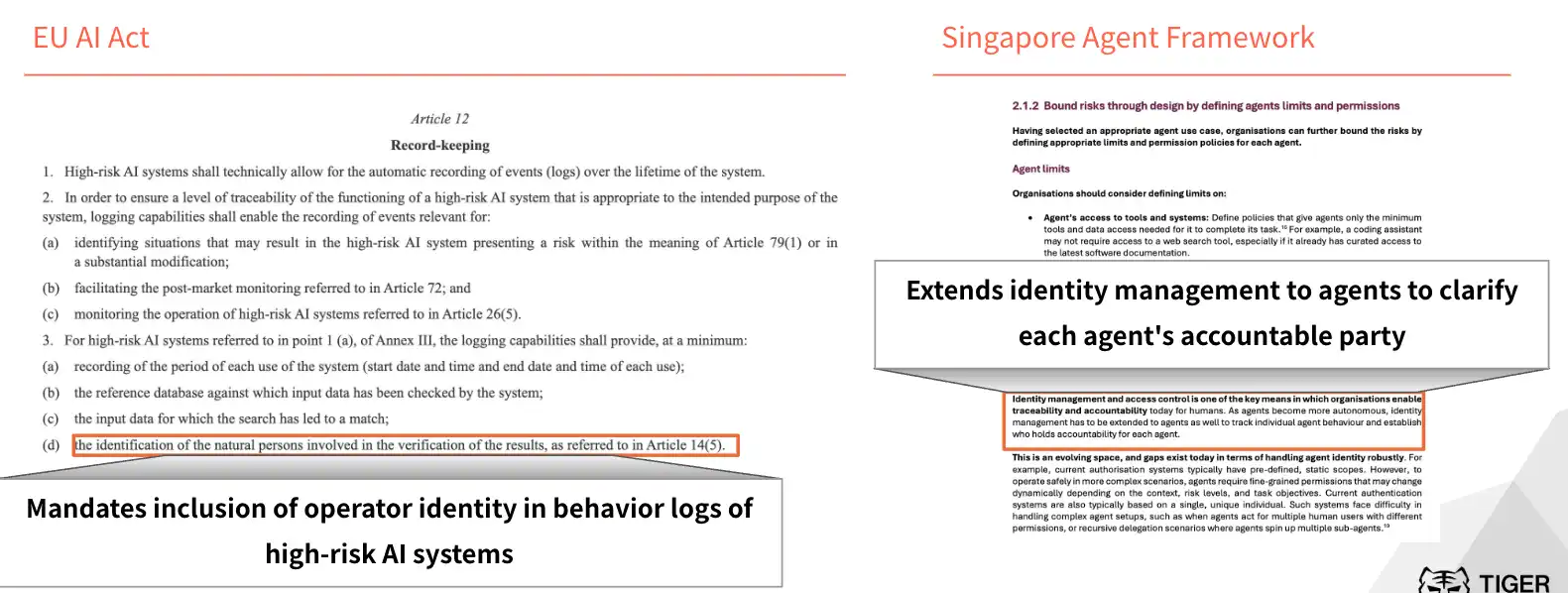
KYA Will Differentiate by Market Segment, Not a Single Winner

The real variable in the standards race is not technology, but combinations. Mainstream players have entered the collaboration and combination phase. In the future, who pairs with which merchants, payment networks, and KYC customer bases will determine the leader in each segment.

The market will not have a single winner; it will differentiate by market segment.
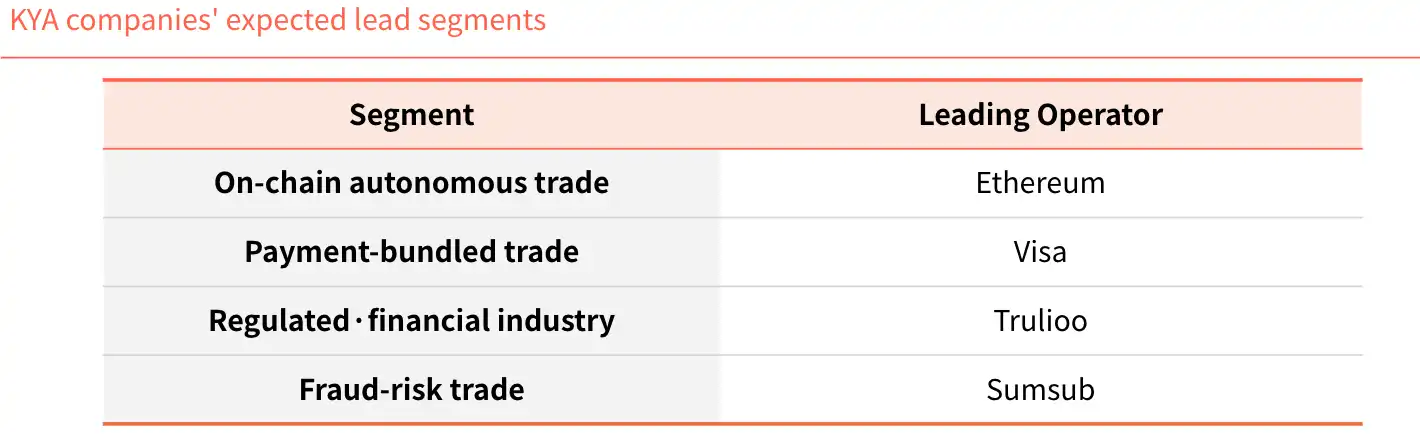
Пов'язані питання

QWhat is KYA (Know Your Agent), and why is it emerging as an important concept in the AI agent era?

AKYA (Know Your Agent) is a system designed to verify the identity, authority, and accountability of AI agents, especially in scenarios where they operate autonomously without direct human oversight. It is emerging as a crucial trust layer due to the rise of AI agents that autonomously execute contracts, payments, and transactions. In these Agent-to-Agent (A2A) environments, there is currently no shared standard to verify 'who the agent is,' leading to increased risks like unauthorized transactions, fraud, and accountability gaps. KYA addresses these risks by establishing a trust infrastructure for pre-verifying an agent's source, permissions, and purpose.

QWhat are some key standards and solutions being developed for KYA?

ASeveral standards and solutions are being developed for KYA. Notable examples include: 1) **ERC-8004**: An Ethereum-based standard that uses NFTs (ERC-721) as unique AgentIDs and adds on-chain registries for identity, reputation, and validation. 2) **Visa TAP (Triple Authorization Protocol)**: Visa's solution that issues identity credentials (Agent Intent) to agents and requires triple signatures (from Visa, the delegator, and the payment method) for transaction approval. 3) **Trulioo's DAP**: Extends their KYC/KYB infrastructure to issue a dynamic Digital Agent Passport (DAP) that is re-validated per transaction. 4) **Sumsub (AI Agent Verification)**: Focuses on post-issuance, real-time verification of agents to detect and prevent abnormal behavior using their existing compliance stack.

QIn what scenarios is KYA most necessary, according to the article?

AAccording to the article, KYA is most necessary outside of centralized, walled-garden platforms (like Google, OpenAI, or Coinbase), where traditional user KYC and platform accountability are sufficient. KYA becomes critical in scenarios involving independent, autonomously deployed agents interacting across platforms, particularly in: 1) **Agent-to-Agent (A2A) transactions** (e.g., payments between agents). 2) **Accessing decentralized exchanges (DEXs)**. 3) **Making payments to merchants**. These represent interoperable environments where a lack of agent identity verification creates significant operational and financial risks.

QHow are governments and regulatory bodies responding to the need for AI agent identity management?

AGovernments and regulatory bodies are beginning to act on AI agent governance, effectively pushing the need for KYA infrastructure. Key actions include: 1) **The EU AI Act**: Requires operators of high-risk AI systems to be identifiable in activity logs. 2) **US NIST**: Has prioritized AI agent identity management as a key standard-setting area. 3) **Singapore**: Released the world's first national-level AI governance framework specifically for agents. The article draws a parallel to the 2019 FATF Travel Rule, suggesting that the ability to implement compliant KYA systems will be a determining factor for which entities can participate in the next phase of the AI agent market.

QWhy does the article suggest the KYA market will be segmented, with no single winner?

AThe article suggests the KYA market will be segmented because the key variable for success is not just technology, but the combination and integration of solutions with existing business ecosystems. Major players are entering a 'cooperation-combination' phase. The future market leader in each segment will be determined by which KYA provider successfully partners with which merchants, payment networks (like Visa's approach), and existing KYC customer bases. Therefore, different KYA standards and solutions (e.g., ERC-8004 for the crypto-native ecosystem, Visa TAP for card-based commerce) are likely to dominate different application areas, leading to a fragmented market rather than a single universal winner.

Пов'язані матеріали

Gensyn AI: Don't Let AI Repeat the Mistakes of the Internet

In recent months, the rapid growth of the AI industry has attracted significant talent from the crypto sector. A persistent question among researchers intersecting both fields is whether blockchain can become a foundational part of AI infrastructure. While many previous AI and Crypto projects focused on application layers (like AI Agents, on-chain reasoning, data markets, and compute rentals), few achieved viable commercial models. Gensyn differentiates itself by targeting the most critical and expensive layer of AI: model training. Gensyn aims to organize globally distributed GPU resources into an open AI training network. Developers can submit training tasks, nodes provide computational power, and the network verifies results while distributing incentives. The core issue addressed is not decentralization for its own sake, but the increasing centralization of compute power among tech giants. In the era of large models, access to GPUs (like the H100) has become a decisive bottleneck, dictating the pace of AI development. Major AI companies are heavily dependent on large cloud providers for compute resources. Gensyn's approach is significant for several reasons: 1) It operates at the core infrastructure layer (model training), the most resource-intensive and technically demanding part of the AI value chain. 2) It proposes a more open, collaborative model for compute, potentially increasing resource utilization by dynamically pooling idle GPUs, similar to early cloud computing logic. 3) Its technical moat lies in solving complex challenges like verifying training results, ensuring node honesty, and maintaining reliability in a distributed environment—making it more of a deep-tech infrastructure company. 4) It targets a validated, high-growth market with genuine demand, rather than pursuing blockchain integration without purpose. Ultimately, the boundaries between Crypto and AI are blurring. AI requires global resource coordination, incentive mechanisms, and collaborative systems—areas where crypto-native solutions excel. Gensyn represents a step toward making advanced training capabilities more accessible and collaborative, moving beyond a niche controlled by a few giants. If successful, it could evolve into a fundamental piece of AI infrastructure, where the most enduring value in the AI era is often created.

marsbit1 год тому

Gensyn AI: Don't Let AI Repeat the Mistakes of the Internet

marsbit1 год тому

Why is China's AI Developing So Fast? The Answer Lies Inside the Labs

A US researcher's visit to China's top AI labs reveals distinct cultural and organizational factors driving China's rapid AI development. While talent, data, and compute are similar to the West, Chinese labs excel through a pragmatic, execution-focused culture: less emphasis on individual stardom and conceptual debate, and more on teamwork, engineering optimization, and mastering the full tech stack. A key advantage is the integration of young students and researchers who approach model-building with fresh perspectives and low ego, prioritizing collective progress over personal credit. This contrasts with the US culture of self-promotion and "star scientist" narratives. Chinese labs also exhibit a strong "build, don't buy" mentality, preferring to develop core capabilities—like data pipelines and environments—in-house rather than relying on external services. The ecosystem feels more collaborative than tribal, with mutual respect among labs. While government support exists, its scale is unclear, and technical decisions appear driven by labs, not state mandates. Chinese companies across sectors, from platforms to consumer tech, are building their own foundational models to control their tech destiny, reflecting a broader cultural drive for technological sovereignty. Demand for AI is emerging, with spending patterns potentially mirroring cloud infrastructure more than traditional SaaS. Despite challenges like a less mature data industry and GPU shortages, Chinese labs are propelled by vast talent, rapid iteration, and deep integration with the open-source community. The competition is evolving beyond a pure model race into a contest of organizational execution, developer ecosystems, and industrial pragmatism.

marsbit3 год тому

Why is China's AI Developing So Fast? The Answer Lies Inside the Labs

marsbit3 год тому

3 Years, 5 Times: The Rebirth of a Century-Old Glass Factory

Corning, a 175-year-old glass company, is experiencing a dramatic revival as a key player in AI infrastructure, driven by surging demand for high-performance optical fiber in data centers. AI data centers require vastly more fiber than traditional ones—5 to 10 times as much per rack—to handle high-speed data transmission between GPUs. This structural demand shift, coupled with supply constraints from the lengthy expansion cycle for fiber preforms, has created a significant supply-demand gap. Nvidia has invested in Corning, along with Lumentum and Coherent, in a $4.5 billion total commitment to secure the optical supply chain for AI. Corning's competitive edge lies in its expertise in producing ultra-low-loss, high-density, and bend-resistant specialty fiber, which is critical for 800G+ and future 1.6T data rates. Its deep involvement in co-packaged optics (CPO) with partners like Nvidia further solidifies its position. While not the largest fiber manufacturer globally, Corning's revenue from enterprise/data center clients now exceeds 40% of its optical communications sales, and it has secured multi-year supply agreements with major hyperscalers including Meta and Nvidia. Financially, Corning's optical communications revenue has surged, doubling from $1.3 billion in 2023 to over $3 billion in 2025. Its stock price has risen nearly 6-fold since late 2023. Key future catalysts include the rollout of Nvidia's CPO products and the scale of undisclosed customer agreements. However, risks include high current valuations and potential disruption from next-generation technologies like hollow-core fiber. The company's long-term bet on light over electricity, maintained even through the telecom bubble crash, is now being validated by the AI boom.

marsbit3 год тому

3 Years, 5 Times: The Rebirth of a Century-Old Glass Factory

marsbit3 год тому

Торгівля

Спот
Ф'ючерси

Популярні статті

Як купити ID

Ласкаво просимо до HTX.com! Ми зробили покупку SPACE ID (ID) простою та зручною. Дотримуйтесь нашої покрокової інструкції, щоб розпочати свою криптовалютну подорож.Крок 1: Створіть обліковий запис на HTXВикористовуйте свою електронну пошту або номер телефону, щоб зареєструвати обліковий запис на HTX безплатно. Пройдіть безпроблемну реєстрацію й отримайте доступ до всіх функцій.ЗареєструватисьКрок 2: Перейдіть до розділу Купити крипту і виберіть спосіб оплатиКредитна/дебетова картка: використовуйте вашу картку Visa або Mastercard, щоб миттєво купити SPACE ID (ID).Баланс: використовуйте кошти з балансу вашого рахунку HTX для безперешкодної торгівлі.Треті особи: ми додали популярні способи оплати, такі як Google Pay та Apple Pay, щоб підвищити зручність.P2P: Торгуйте безпосередньо з іншими користувачами на HTX.Позабіржова торгівля (OTC): ми пропонуємо індивідуальні послуги та конкурентні обмінні курси для трейдерів.Крок 3: Зберігайте свої SPACE ID (ID)Після придбання SPACE ID (ID) збережіть його у своєму обліковому записі на HTX. Крім того, ви можете відправити його в інше місце за допомогою блокчейн-переказу або використовувати його для торгівлі іншими криптовалютами.Крок 4: Торгівля SPACE ID (ID)Легко торгуйте SPACE ID (ID) на спотовому ринку HTX. Просто увійдіть до свого облікового запису, виберіть торгову пару, укладайте угоди та спостерігайте за ними в режимі реального часу. Ми пропонуємо зручний досвід як для початківців, так і для досвідчених трейдерів.

157 переглядів усьогоОпубліковано 2024.12.12Оновлено 2025.03.21

Як купити ID

Обговорення

Ласкаво просимо до спільноти HTX. Тут ви можете бути в курсі останніх подій розвитку платформи та отримати доступ до професійної ринкової інформації. Нижче представлені думки користувачів щодо ціни ID (ID).

活动图片