Original Author: Shao Jiadian
Recently, a topic has been widely discussed in the market: Can companies "customize" a stablecoin through Circle or Coinbase?
This question sounds novel, but the underlying business logic is not unfamiliar. Companies wish to embed stablecoin capabilities into their own wallets, payment systems, trading platforms, merchant networks, or ecosystem scenarios. What users see is the company's own brand, while the underlying issuance, reserves, redemption, and compliance infrastructure are provided by institutions like Circle or Coinbase.
Thus, a term that is easily disseminated has emerged in the market: white-label stablecoins.
The problem is, "white-label stablecoin" is not a precise legal concept. The white-label stablecoin referred to by different institutions may point to entirely different product forms: some are USDC-backed stablecoins for a blockchain, some help regional stablecoin issuers connect to a global network, some provide enterprises with branded digital asset accounts, and some are truly stablecoins where enterprises can customize the name, ticker (the token code displayed in wallets, exchanges, and on-chain interfaces, such as USDC, USDF, JPYC, or ABCUSD), and brand visuals.
If one only hears "Circle can help you make a custom stablecoin," it's easy to conflate these different models.
Based on public information, Circle and Coinbase currently have at least four distinct new stablecoin approaches worth differentiating
- Circle xReserve: Creating USDC-backed stablecoins for blockchain ecosystems;
- Circle Partner Stablecoins: Helping regional stablecoin issuers connect to the Circle network;
- Circle Digital Asset Accounts: Providing enterprises with branded digital asset accounts;
- Coinbase Custom Stablecoins: The model closest to the market's understanding of enterprise-branded stablecoins.
These four models all seem related to "stablecoins," but their target customers, business nature, division of responsibilities, and risk boundaries are all different.
White-Label Stablecoins Are Not Ordinary SaaS
In the traditional internet industry, "white-label" usually means putting a different brand shell on a product. For example, a SaaS provider offers the underlying system, and a company can put its own logo, domain, and front-end interface on it to provide services externally. Users see the company's brand, while the underlying software is provided by the service provider.
But stablecoins are not ordinary software. A stablecoin involves at least four core components:
- First, Issuance. Who legally issues this token? Who promises the 1:1 redemption? Who is the issuer of record?
- Second, Reserves. What are the reserve assets? Cash, short-term bonds, money market funds, USDC, or other stablecoins? Where are the reserve assets held? Are they segregated? Are there audits or proof of reserves?
- Third, Accounts and Custody. Who holds the user assets? Self-custody wallets, custodial wallets, or platform accounts? Who handles account opening, KYC, AML, sanctions screening, and Travel Rule?
- Fourth, Distribution. Who pushes this coin to users? Who operates the wallet, payment network, merchant network, loyalty system, rebate campaigns? Who handles customer service, complaints, and marketing communication?
So-called white-label stablecoins are essentially different combinations of these modules. The differences in the several products from Circle and Coinbase also mainly lie here.
Circle xReserve: Providing USDC-Backed Stablecoins for "Chains"
First, let's look at Circle xReserve.
Circle's official page positions xReserve quite clearly: It helps blockchain teams launch USDC-backed, interoperable stablecoins. Its reserves are not US dollars in a bank account, but USDC locked in the xReserve smart contract deployed by Circle; partner chains mint USDC-backed stablecoins on their own chains based on proofs from the xReserve API. Circle's official page also displays logos of ecosystems like Aleo, Canton, Cardano, Movement, Stacks, etc.
A typical scenario for this model is: A chain wants a native stablecoin for its ecosystem but doesn't want to build the dollar reserves, banking relationships, and issuance system from scratch. Therefore, through xReserve, it can issue a stablecoin backed by USDC on its chain.
For example, a new L2 called Alpha Chain wants a stablecoin called alphaUSD in its ecosystem. Following the xReserve approach, users can deposit USDC into the xReserve contract deployed by Circle. The xReserve API confirms the deposit and issues proof, and Alpha Chain then mints alphaUSD to the user on its own chain. For reverse redemption, the user burns alphaUSD on Alpha Chain, the chain party processes the burn request and submits a withdrawal request to xReserve, which verifies and releases the corresponding USDC.
It's important to note here: xReserve is not about "an ordinary company asking Circle to issue ABCUSD."
Circle's official FAQ is quite clear: The xReserve smart contract is deployed by Circle, but the partner blockchain team will deploy its own stablecoin token contract on its chain, and that token is backed 1:1 by USDC in the xReserve contract. Circle's development documentation also states that the remote blockchain is responsible for deploying, operating, and securing the smart contract managing its USDC-backed stablecoin, and that contract handles minting, burning, and token logic.
Therefore, xReserve is more accurately understood as: A chain obtains a native stablecoin backed by USDC and interoperable with USDC.
It is suitable for L1s, L2s, Appchains, and public chain ecosystems, not quite what an ordinary company might imagine as an "enterprise-branded stablecoin."
Division of Responsibilities
In this model, Circle mainly provides the xReserve contract, USDC locking, proof mechanism, and interoperability infrastructure. The partner chain is responsible for deploying the native stablecoin contract, on-chain security, mint/burn logic, user scenarios, and ecosystem operations.
For users, alphaUSD is not native USDC. It is a native stablecoin backed by USDC and interoperable with USDC via xReserve. Circle's page also distinguishes between USDC and "USDC-backed stablecoin via xReserve": USDC is deployed by Circle, while the USDC-backed stablecoin is deployed by the Partner Blockchain; the trust model includes both Circle and the Partner Blockchain.
Thus, the risk focus of xReserve is not on "whether a company issues a stablecoin," but on on-chain security, smart contract security, user understanding of the difference between this asset and native USDC, the pass-through impact of USDC's own reserve and redemption mechanisms, and the role of the partner chain in ecosystem distribution.
If you are a chain, L2, or Appchain itself, xReserve is worth studying. If you are just a wallet, payment platform, or e-commerce platform, xReserve is usually not the most directly relevant model.
Circle Partner Stablecoins: Regional Stablecoins Connecting to the Circle Network
The second model is Circle Partner Stablecoins.
This model is also easily misunderstood as "Circle helping companies issue stablecoins." But based on Circle's official statements, it targets regional stablecoin issuers.
Circle's official page states that Partner Stablecoins help regional stablecoin issuers scale, connecting fragmented local markets to a global network. Participants need to meet eligibility criteria including reserve management, independent audits, and robust operational practices.

In Circle's official blog introducing StableFX and Partner Stablecoins, it mentions that this program supports the deployment of some non-USD stablecoins to Arc. Members need to meet technical, operational, reserve management, and risk management standards. After participation, they can access real payments, remittances, and FX flows through the Circle Payments Network and StableFX, connect to Circle's global liquidity provider network, and gain interoperability capabilities with USDC.
The initial expected participants listed by Circle at the time included Avenia (BRLA), BDACS (KRW1), Coins\.ph (PHPC), Forte (AUDF), Juno (MXNB), JPYC (JPYC), Stablecorp (QCAD), and ZAR Universal Network (ZARU).
This model is more like: Local stablecoin issuers are responsible for their own local stablecoin and its ticker, while Circle helps them connect to cross-border payment, stablecoin FX, and USDC liquidity networks.
For example, a Japanese institution issues a yen stablecoin, a Philippine institution issues a peso stablecoin, and a Brazilian institution issues a real stablecoin. They already need to handle local licenses, local reserves, local redemption, and local user services. What Circle provides is network connectivity and liquidity infrastructure, not taking over all issuance responsibilities for them.
Division of Responsibilities
The local issuer remains the core responsible entity for the local stablecoin, handling issuance, reserves, redemption, local regulation, and user disclosure. Circle provides network connectivity, liquidity connections, payment networks, StableFX, Arc, and other infrastructure.
Circle's page footnotes also clarify the role boundaries: Circle Technology Services is the technology service provider for the Circle Payments Network, does not hold funds, does not manage accounts on behalf of customers, and is not a party to transactions between participating financial institutions; StableFX is provided by Circle Technology Services, whose role is limited to broadcasting information between transaction-related parties and enabling direct settlement between related parties via on-chain smart contracts; Circle Technology Services does not accept or transmit digital assets on behalf of StableFX users. Circle also notes that users are responsible for their own services provided to end-users, obtaining necessary licenses or approvals, and complying with applicable laws.
Therefore, the focus of Partner Stablecoins is not "Circle issuing coins for companies," but "existing or planned regional stablecoin issuers connecting to the Circle network."
The main compliance issues for this model still focus on local stablecoin issuance, reserve management, redemption arrangements, cross-border payments, foreign exchange conversion, and local regulatory access. For institutions already equipped with local payment or financial compliance capabilities, it can be a tool to expand liquidity and cross-border usage scenarios. For ordinary companies, it is not a simple stick-your-brand-on-it coin issuance scheme.
Circle Digital Asset Accounts: Branded Accounts, Not Branded Stablecoins
The third model is Circle Digital Asset Accounts.
This might be the product most easily misinterpreted by the market as a "white-label stablecoin."
Circle's official page states that enterprises can launch Digital Asset Accounts under their own brand, with Circle handling custody, fiat-to-stablecoin conversion, specific onboarding, and compliance operations; while the enterprise manages the branded customer experience. The page also lists capabilities like end-user accounts, fiat-to-stablecoin conversion, digital asset custody, send/receive, on-chain Travel Rule / AML compliance, cross-chain interoperability, multi-chain custody, gas fee abstraction, and reporting.

The core of this model is not issuing a new token, but providing a branded digital asset account within the company's own product.
For example, a cross-border freelancer platform called WorkABC serves freelancers in Latin America, Southeast Asia, and the Middle East. Previously, when a US client paid a Filipino freelancer, it might have gone through bank accounts, international wire transfers, correspondent banks, and local clearing—slow, costly, and with a non-negligible failure rate.
If WorkABC integrates Circle Digital Asset Accounts, it can provide users with a "WorkABC Dollar Account" within its own app. Users see the WorkABC account experience, but the underlying layer might involve USDC/EURC accounts, custody, conversion, on-chain sending/receiving, and compliance modules provided by Circle.
Circle previously wrote about a similar developer case: Using Bridge's virtual accounts and Circle's Programmable Wallets, users could get a virtual US dollar account; clients send dollars to that account, Bridge automatically converts the fiat to USDC, and then the USDC goes into the Circle Programmable Wallet assigned to that user. The real scenario Circle's article cited was a freelance marketplace: freelancers get a virtual US bank account, clients pay in US dollars, Bridge automatically converts it to USDC, and sends it to the user's wallet.
This example well illustrates the play of Digital Asset Accounts: It's more like a "white-label digital asset account" or a "branded stablecoin account," not a white-label stablecoin issuance.
Division of Responsibilities
Circle provides the underlying accounts, custody, stablecoin conversion, and specified onboarding, screening, transaction monitoring, compliance operations, and other capabilities. The enterprise remains responsible for the brand, user experience, user relationships, local license assessment, marketing compliance, customer complaint handling, front-end presentation, and business scenarios.
The risk boundaries of this model are clearer than those of truly issuing a new ticker as a white-label stablecoin. Because what users hold is typically still an existing stablecoin like USDC or EURC, not a newly issued ABCUSD by the enterprise.
But it's not entirely devoid of legal issues. Whether the enterprise triggers local regulation by providing account, payment, withdrawal, conversion, wallet, or payment services at the front-end still needs to be judged based on user location, fund flows, asset flows, platform role, and marketing methods.
Circle's page footnotes also remind that Digital Asset Accounts are not bank accounts and are not insured deposits. Circle Wallets are provided by Circle Technology Services (CTS), which is a software service provider and does not offer regulated financial or advisory services; users are still responsible for their own services provided to end-users, necessary licenses, approvals, and compliance with applicable laws.
For self-custody wallet projects, this model particularly requires distinguishing product boundaries. The core selling point of self-custody wallets is users controlling their own private keys, with the platform not holding assets; Digital Asset Accounts include custody, accounts, and compliance processes. If a wallet project adds a custodial account module beyond its self-custody functions, legal analysis can no longer be handled entirely as a "pure tool-based self-custody wallet."
However, this doesn't mean the model is necessarily high-risk. For platforms that are already planning to build account-based products, cross-border payments/receipts, freelancer payments, merchant settlements, or enterprise wallets, Digital Asset Accounts might actually reduce the complexity of building their own custody, conversion, and on-chain compliance systems. The key lies in how the front-end product is designed, how users are disclosed to, how local licenses are assessed, and whether the responsibility boundaries between the enterprise and Circle are clearly defined.
Coinbase Custom Stablecoins: Closest to Enterprise-Branded Stablecoins
The fourth model is Coinbase Custom Stablecoins.
This is the one closest to the market's usual understanding of "white-label stablecoins."
Coinbase's official page title is direct: Launch your own stablecoin. The page states that businesses can use their own stablecoin to support payments, treasury, rewards, and DeFi, while Coinbase handles issuance, reserves, and on-chain ops. Custom Stablecoins can be stamped with the business's own brand, making holding, paying, and sending more familiar; the stablecoin can be redeemed 1:1 for USDC; businesses can keep customer or company balances in their own stablecoin and earn rewards; Coinbase manages issuance, reserves, and smart contract deployment.
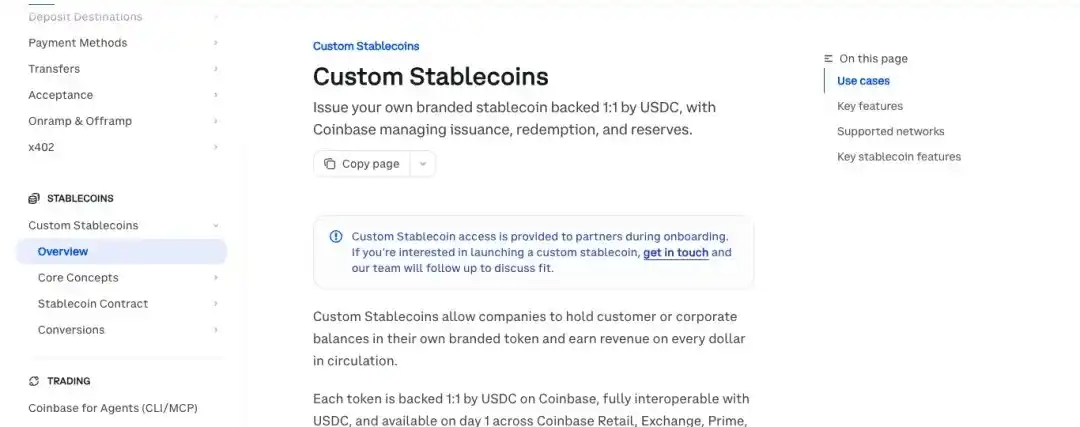
Coinbase's blog is also quite direct: Custom Stablecoins are a stablecoin-as-a-service, allowing businesses to create a new custom-branded stablecoin, backed 1:1 by a basket of USD stablecoin collateral assets including USDC, with assets custodied by Coinbase, so businesses don't need to build the underlying infrastructure themselves. Businesses can customize the asset name, ticker, and visual identity; Coinbase handles issuance, redemption, security, and compliance mechanisms, though specific reserve composition and user rights should still be based on product terms and disclosures.
This is a more typical enterprise-branded stablecoin model:
The enterprise owns its own ABCUSD, while Coinbase handles issuance, reserves, contracts, redemption, and platform-level compliance in the background.
Coinbase's official page also mentions that the product can be backed 1:1 by USDC reserves, with reserves held in Coinbase segregated wallets, with Proof of Reserves published and updated every minute; product capabilities include branded, fully backed stablecoin, revenue from circulating supply, permissionless on-chain swapper for end users, enterprise-grade operations with Coinbase, and policy and control layers.
Case Study: Flipcash's USDF
Coinbase has already announced a relatively fitting case: Flipcash USDF.
In May 2026, Coinbase and Flipcash announced the launch of USDF. Coinbase's official article states that USDF is a US dollar stablecoin created through the Coinbase Custom Stablecoin platform, issued on Solana and fully backed by USDC. On Flipcash, users can create fixed-supply currencies and use them like digital cash, with these currencies priced and settled in USDF.
Coinbase further explains that Coinbase Custom Stablecoins allows partners like Flipcash to create their own branded stablecoins, which are issued by Coinbase and backed 1:1 by USDC and other USD stablecoins, without needing to develop complex underlying blockchain architecture themselves. Reasons Flipcash chose this solution include transparent 1:1 USDC backing, USDC rewards growing with circulating supply, providing users with fiat on-ramps via Coinbase Onramp, and the reliability and scale of Coinbase's infrastructure.
This case shows that enterprise-branded stablecoins are no longer just a concept.
Division of Responsibilities
Coinbase undertakes underlying issuance, reserves, contracts, redemption, platform-level compliance, and on-chain operations. The enterprise undertakes the brand, name, ticker, visual identity, user entry points, product scenarios, promotion, user relationships, merchant ecosystems, and some risk controls.
From a commercial perspective, this division is natural. Coinbase has issuance, reserve, contract, custody, and compliance infrastructure; enterprises have users, traffic, brands, scenarios, and payment needs. Combining the two, enterprises don't have to become stablecoin issuers from scratch to launch their own branded stablecoins.
From a legal perspective, the focus is not on negating this model, but on clarifying the boundaries.
If legal documents clearly state that the issuer is Coinbase, and users can understand that reserves, redemption, and compliance infrastructure are handled by Coinbase, with the brand party only responsible for front-end scenarios and user experience, then risks can be managed in a structured way.
But if the brand party describes ABCUSD in promotions as "our dollars," "our stablecoin account," "risk-free income account," or promises returns, promises instant redemption, or promises that the brand party will underwrite risks, it may shift its role from a brand partner/distributor towards heavier financial responsibilities.
The US OCC's proposed rules under the GENIUS Act have already included white-label relationships in the discussion. The proposed rules mention that certain related third parties include persons for whose benefit or under whose brand a payment stablecoin issuer issues payment stablecoins. Simultaneously, the OCC is also seeking comment on whether to limit an approved payment stablecoin issuer from issuing multiple branded stablecoins, as multi-brand/white-label arrangements could introduce uncertainty about reserve assets and create contagion and run risks between different brands.
This regulatory trend doesn't mean white-label stablecoins can't be done, but it shows that regulators have noticed that when multiple branded stablecoins exist under the same issuer, reserves, redemption, disclosure, revenue, and brand responsibilities need to be arranged more clearly.
The Four Models Are Not the Same Business
Circle xReserve
Nature: Providing USDC-backed stablecoins for chains
Main clients: L1s, L2s, Appchains, public chain ecosystems
Generates new ticker?: Yes
Responsibility core: Circle provides xReserve and USDC backing; partner chain deploys and operates the native token
Compliance focus: Chain security, contract security, user disclosure, distinction from native USDC
Circle Partner Stablecoins
Nature: Regional stablecoins connecting to the Circle network
Main clients: Local stablecoin issuers, licensed payment/financial institutions
Generates new ticker?: The regional issuer issues or connects its local stablecoin ticker
Responsibility core: Local issuer responsible for issuance, reserves, redemption; Circle provides network and liquidity connections
Compliance focus: Local licenses, reserve management, redemption, cross-border payments, FX
Circle Digital Asset Accounts
Nature: Branded digital asset accounts
Main clients: Fintech, payment platforms, marketplace platforms, financial apps
Generates new ticker?: Typically no
Responsibility core: Circle provides account/custody/conversion capabilities; enterprise responsible for front-end and user relationships
Compliance focus: Payments, wallets, custody, marketing, outsourced compliance, local regulatory judgment
Coinbase Custom Stablecoins
Nature: Enterprise-branded stablecoin SaaS
Main clients: Wallets, trading platforms, payment platforms, merchant networks, DeFi ecosystems
Generates new ticker?: Yes
Responsibility core: Coinbase manages issuance, reserves, and contracts; enterprise responsible for brand and distribution
Compliance focus: Brand responsibility, distribution/payment regulation, revenue arrangements, redemption disclosure, user perception
This comparison table can explain many market misunderstandings. When someone says "Circle can help me issue a white-label stablecoin," it doesn't necessarily correspond to an enterprise-branded stablecoin. It could be xReserve, or Digital Asset Accounts, or just connecting to USDC account and payment capabilities. If it's about an enterprise customizing the name, ticker, logo, with the platform managing issuance, redemption, and reserves, then based on current public information, it's actually closer to Coinbase Custom Stablecoins.
How Risks Are Shared Depends on What the Project Actually Does
White-label stablecoins are not without risk, nor are they inherently high-risk. The judgment focus is on the project's actual role.
Issuance Risk and Distribution Risk Can Be Viewed Separately
If Coinbase is the issuer, matters at the issuance level such as reserves, redemption, compliance reporting, smart contract deployment, etc., are in principle primarily borne by Coinbase and related entities.
But if the brand party is responsible for user entry points, wallet display, merchant expansion, user incentives, payment scenarios, and market promotion, it still needs to assess whether it constitutes a distributor, payment service provider, digital asset service provider, marketer, or other regulated role.
This is somewhat similar to traditional financial products. The fund manager is responsible for product management, but that doesn't mean the sales agency has no sales compliance responsibilities; a bank or payment institution handles clearing, but that doesn't mean the merchant platform has no user disclosure and fund flow compliance responsibilities whatsoever.
Of course, if the brand party only displays or supports a compliantly issued stablecoin to a limited extent, does not control redemption, does not promise returns, does not participate in custody, is not responsible for fiat on/off-ramps, the risk will be relatively limited. The key is that role boundaries must be clear, and promotional language must match the actual structure.
Reserves and Redemption Depend on How User Rights Are Designed
The core of a stablecoin is not its name, but redemption.
When a user holds ABCUSD, can they directly redeem it 1:1 with Coinbase or Circle? Or can they only exchange it through the brand party's app? Does redemption require KYC? Are there minimum redemption thresholds? Are there fees, time limits, or regional restrictions? What happens if sanctions screening or risk control freezes an account? If the cooperation between the issuer and the brand party terminates, how do users exit?
These arrangements do not necessarily constitute risks, but they must be clearly disclosed.
The OCC's proposed rules have a relatively specific regulatory approach to payment stablecoin reserves: An approved payment stablecoin issuer needs to maintain identifiable reserves at the issuer level of at least 1:1, reserves must be segregated and not commingled with the issuer's other assets, and fair value must always equal or exceed the outstanding issued value. The OCC is also concerned about reserve asset uncertainty and contagion between brands that may arise from multi-brand stablecoins.
This means that what white-label stablecoins need to address in the future is not just "who issues," but also: Do multiple branded stablecoins share a reserve pool or are they managed separately? How are user redemption rights reflected? How are user rights protected if the issuer goes bankrupt? How are existing users handled if the brand party exits?
If these issues are handled clearly in contracts, token terms, user disclosures, and operational processes, risks can be managed. If they are not handled clearly, subsequent disputes will be very difficult.
Revenue Arrangements Require Extra Caution
One selling point of Coinbase Custom Stablecoins is that enterprises can earn rewards or revenue based on the stablecoin's circulating supply. Coinbase's official page and blog both mention that enterprises can earn revenue based on the circulating supply of their Custom Stablecoin, accruing daily and paying out periodically to their Coinbase Prime account.
It's not inherently problematic for an enterprise to earn revenue from a commercial partnership. The issue lies in how the revenue is designed, disclosed, and whether it is passed on to users.
If it's just a commercial revenue share between Coinbase and the enterprise, the focus is on contracts, accounting, taxes, disclosure, and regulatory boundaries.
If the enterprise packages the revenue as "earn interest on holdings," "stable returns," or "USD account yield" for users, the nature becomes significantly more complex and may touch on interest, deposits, securities, investment products, or other financial regulatory issues.
The OCC's proposed rules also discuss the risk of paying interest or yield to payment stablecoin holders through affiliates or third parties in white-label relationships and include "issuer issuing payment stablecoins under a third-party's brand" in the related third-party analysis. Regulators are concerned about whether restrictions on paying returns to holders are being circumvented through the brand party or partners.
Therefore, while white-label stablecoins can discuss revenue sharing, it is not advisable to easily promise returns to users.
Consumer Perception Needs to Align with Legal Structure
Users won't carefully study issuance structure diagrams.
Users see the app page, coin name, logo, promotional posters, and customer service responses. If the page says "ABC Dollar," "ABCUSD," or "Official Wallet USD Account," users will naturally assume this is a dollar asset backed by the ABC project.
This doesn't mean the brand party must assume issuer liability, but the brand party needs to avoid creating misperceptions among users.
A more prudent disclosure approach should make it clear to users:
- Who is the issuer?
- Who is responsible for reserves and redemption?
- Is this asset equivalent to a bank deposit?
- Is there deposit insurance?
- What are the redemption conditions and limitations?
- What role does the brand party play?
Circle's Digital Asset Accounts page also notes that Digital Asset Accounts are not bank accounts and are not insured deposits. Circle also states that digital assets carry risks such as price volatility, digital asset markets and exchanges may not have the same regulatory controls and customer protections as traditional financial products, digital assets generally are not legal tender, and are not covered by deposit protection insurance.
In external promotions, it is generally inadvisable to use expressions like "equivalent to USD," "bank-grade deposits," "risk-free USD account," "principal and return guaranteed," "insured by deposit insurance," "redeemable unconditionally at any time," or "completely underwritten by Circle/Coinbase so there is no risk."
If the actual structure supports 1:1 redemption, the redemption mechanism can be explained clearly. If the underlying reserves are USDC or USD stablecoins, the reserve backing method can be explained clearly. If Coinbase or Circle provides infrastructure, their role can be explained clearly. But infrastructure support should not be packaged as unlimited underwriting.
Regulatory Boundaries in Different Jurisdictions Still Need Separate Assessment
Even if the underlying layer is provided by Circle or Coinbase, project parties still need to consider the regulatory requirements of their own region, their users' regions, and where business is conducted.
Hong Kong's Stablecoin Ordinance came into effect on August 1, 2025. Engaging in regulated stablecoin activities in Hong Kong, or actively promoting such activities to the Hong Kong public, requires a license or is subject to corresponding restrictions. The HKMA's register of licensed stablecoin issuers clearly states that unless licensed, one must not engage in regulated stablecoin activities or claim to do so.
Under the EU's MiCA, asset-referenced token and electronic money token issuers also require corresponding authorization. The EBA page clearly states that ART and EMT issuers need to hold relevant authorizations to operate in the EU.
The US GENIUS Act and related OCC proposed rules further focus on payment stablecoin issuance, reserves, redemption, custody, third-party relationships, and white-label arrangements.
These regulatory frameworks collectively illustrate one point: The issuer being licensed or having infrastructure provided by compliant institutions can mitigate some risks, but it may not cover the project party's responsibilities in local distribution, payments, wallets, conversion, custody, marketing, or user services.
Conclusion: The Name Can Be Customized, Responsibilities Must Be Allocated According to Structure
The commercial value of white-label stablecoins is clear.
For Circle and Coinbase, they are transforming stablecoin capabilities from a single product into infrastructure: providing reserves and interoperability for chains, global networks for regional issuers, account capabilities for platforms, and branded stablecoin issuance capabilities for enterprises.
For wallets, payment platforms, exchanges, and merchant networks, this is an opportunity to gain a "USD entry point." Whoever can settle stablecoin balances within their own brand and scenarios may control the distribution power of the next-generation on-chain payment network.
But legal analysis must not be misled by the two words "white-label."
Enterprises can customize names, tickers, logos, front-end experiences, and user scenarios; responsibilities, however, must be allocated according to the actual structure. Who issues is responsible for issuance; who custodies is responsible for custody; who redeems is responsible for redemption; who markets is responsible for marketing; who provides the user entry point must consider local rules regarding payments, wallets, conversion, distribution, and consumer protection.
For most project parties, especially self-custody wallet projects, a more prudent discussion approach is not to start by saying "I want to issue my own ABCUSD," but to first determine what they actually want:
Is it to integrate USDC payment capabilities?
Is it to provide branded digital asset accounts?
Is it to introduce a USDC-backed stablecoin for their own chain?
Or is it to formally enter the enterprise-branded stablecoin issuance and distribution network?
These four things are all related to stablecoins, but they are not the same business.
The name of a stablecoin can be white-labeled, but responsibility cannot be redefined by slapping on a label.