Nvidia's Jensen Huang, Fei-Fei Li, and Bin Lin All Invest in the Same Robotics Company

marsbitОпубліковано о 2026-08-25Востаннє оновлено о 2026-08-25

Анотація

Generalist, a San Francisco-based AI startup focused on developing a "universal brain" for robots, has rapidly raised significant funding, attracting high-profile investors including Nvidia, Jeff Bezos' Bezos Expeditions, AI pioneer Fei-Fei Li, and Xiaomi co-founder Bin Lin. Founded in 2024 by former Google DeepMind researchers Pete Florence, Andy Zeng, and former Boston Dynamics engineer Andrew Barry, the company has secured approximately $750 million across four rounds, reaching a valuation surpassing $2 billion. The company's core innovation is its GEN-1.5 model, which aims to give robots powerful generalization capabilities. Unlike traditional systems requiring extensive reprogramming for each new task, GEN-1.5 can learn from a single, brief human demonstration (3-12 seconds) without needing retraining or fine-tuning. This "physical prompting" allows a robot to perform tasks like opening jars or using new tools after seeing them done once. While current single-demo success rates average 59% on simple tasks (improving to 83% with minor fine-tuning), the technology promises to drastically reduce robot deployment time from months to seconds. Generalist's strategy is to provide the AI intelligence layer that can run on various robotic hardware, rather than building robots themselves. The founding team combines DeepMind's expertise in AI model generalization with Boston Dynamics' practical robotics experience, targeting the industry bottleneck where robot "brains" lag behind...

Wow, Generalist's funding progress bar seems to be running on a 2x speed hack, their development is moving so fast!

I'm not exaggerating. According to an Axios report, after Generalist completed a $400 million (¥2.87 billion) Series B funding round in June this year, propelling it to unicorn status, just under three months later, Generalist has quietly completed another $200 million (approx. ¥1.44 billion) funding round, with its latest valuation surpassing the $2 billion mark (approx. ¥14.36 billion).

Prominent names like Nvidia, Jeff Bezos's Bezos Expeditions, and 'AI Godmother' Fei-Fei Li are all listed among its shareholders.

Generalist is an AI company focused on 'building a general brain for robots'. Founded in 2024 in the San Francisco Bay Area, USA, the company was co-founded by former Google DeepMind researchers Pete Florence and Andy Zeng, along with former Boston Dynamics engineer Andrew Barry.
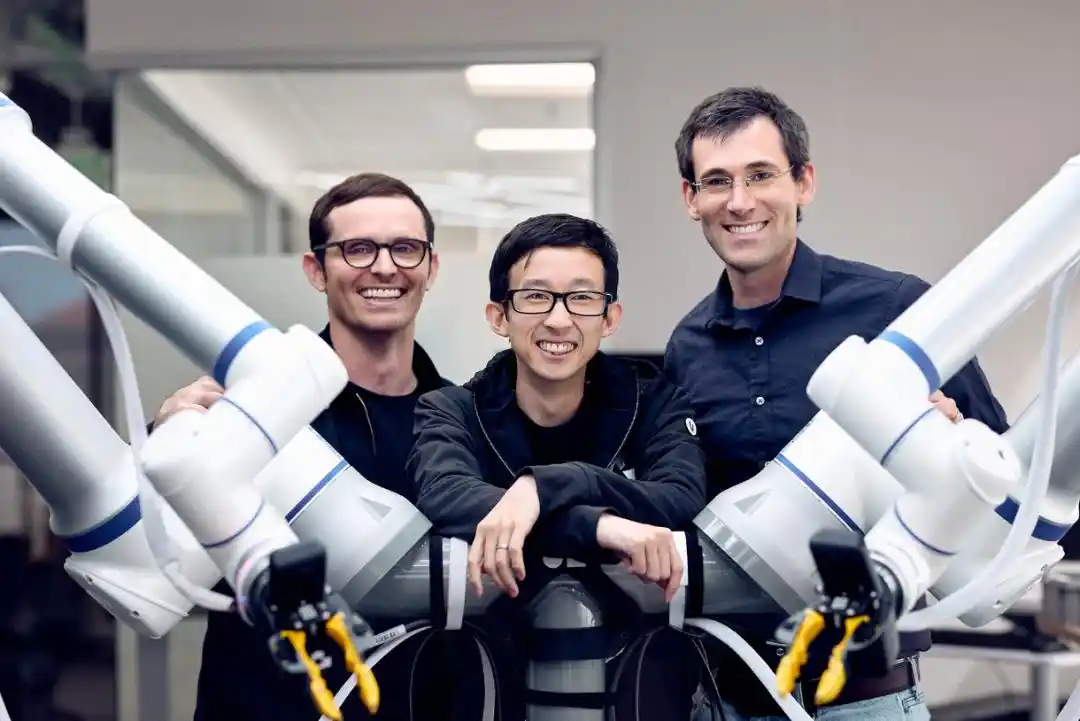
According to Forge, as of publication, Generalist has completed 4 rounds of financing, with total funding reaching approximately $750 million (approx. ¥5.39 billion). Investors include Nvidia, Boldstart Ventures, Xiaomi co-founder Bin Lin, Fei-Fei Li, Naval Ravikant, and Zoom founder Eric Yuan, among others.

Generalist doesn't release flashy humanoid robot bodies, nor does it rely on robotic arm orders for its narrative. They rapidly gained prominence solely through their team background from Google DeepMind, OpenAI, and Boston Dynamics, and the powerful generalization capability demonstrated by GEN-1.5—'learning new tasks from a single demonstration without requiring retraining'. This propelled them to become a rising star in the embodied AI field, securing approximately $600 million (approx. ¥4.308 billion) in funding within just two months.

So, what's the story behind this company? What exactly makes GEN-1.5's generalization so strong? And what aspect of Generalist are investors betting on?

You'll find out after reading this:

No Retraining Needed, Learning from a Single Demonstration

If traditional industrial robots are chefs who can only cook from a fixed recipe, then Generalist's newly released GEN-1.5 is more like a new apprentice who can take over immediately after watching the master operate once.

In the past, robots had to undergo a lengthy 'pre-job development' phase before starting work. Their problem-solving approach largely followed the pattern of 'one scenario, one policy'—tightening screws on a production line required one program, while sorting parts required another;

Even if the task remained the same, any change in object position, shape, or tools might require engineers to re-collect data, adjust parameters, and retrain the model.

GEN-1.5 aims to lower the barrier for deploying robots from 'hiring engineers for redevelopment' to 'on-site personnel demonstrating once.'
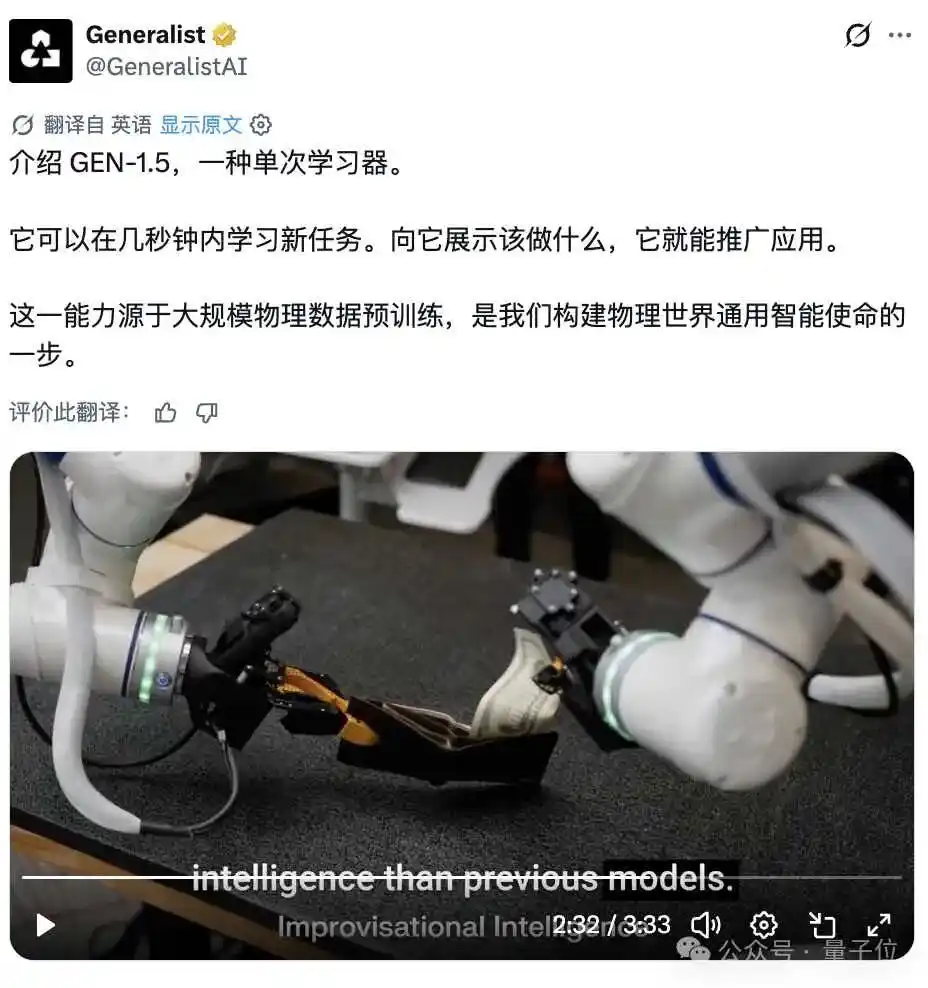
In Generalist's demo video, a worker only needs to demonstrate once using a handheld gripper or the robot itself. The model can then use the 3 to 12 seconds of sensor and motion data as 'physical prompts' to directly understand the task and begin operation, all without requiring gradient updates or fine-tuning.

For instance, unscrewing a glass jar, unzipping a pencil case, sweeping blocks into a bowl, or even using previously unseen brushes and dustpans—it can organize actions based on the demonstration.

Of course, GEN-1.5 isn't so magical that it succeeds every time at first glance.

Official tests show its average single-demonstration success rate across 10 simple, short-duration tasks is 59%; if fine-tuned with about 5 minutes of data over 10 gradient update steps, the success rate can rise to 83%.
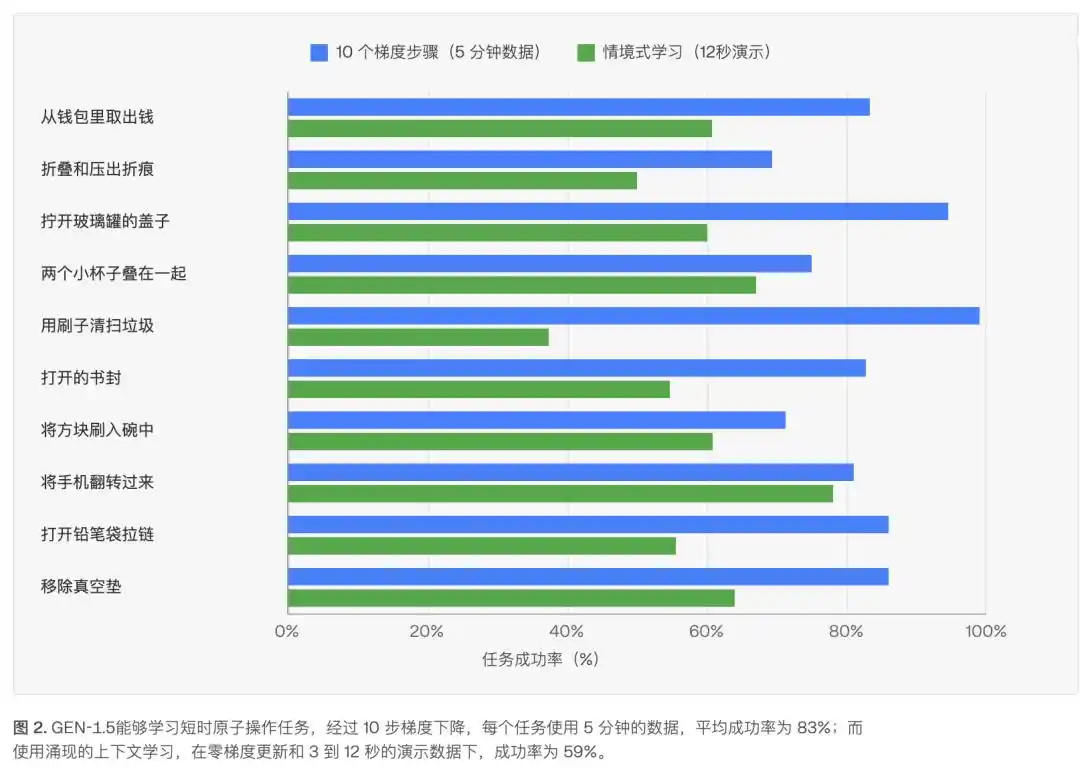
This result isn't perfect, but it proves something more important: adapting robots to tasks has the potential to be compressed from months to seconds.

This potential to become a universal foundation for robots is likely what capital is eyeing.

For clients, the same model can be deployed faster across different factories, warehouses, and labs, reducing costs associated with engineering deployment, data collection, and downtime for debugging.

For investors, Generalist isn't selling a specific robot; they're selling the intelligence layer that runs on various hardware, naturally expanding the market boundaries.

And for Generalist itself, this general capability can also set a data flywheel in motion:

The stronger the model, the more real-world tasks it can handle; the more deployments, the richer the physical interaction data collected; new data, in turn, trains the next generation of models. Ultimately, GEN-1.5 aims to give robots the ability to continuously learn and work.

This ability to 'replace month-long development with second-long adaptation' doesn't come out of thin air. It stems precisely from the founding team's decade-long firsthand experience with the pain points in the robotics industry.

A Group of DeepMind and Boston Dynamics Veterans Building a 'Robot Brain'

Generalist's founding team essentially combines the two most crucial capabilities for the robotics industry.

CEO Pete Florence holds a Ph.D. in Computer Science from MIT, studied under roboticist Russ Tedrake, was a Senior Research Scientist at Google DeepMind, helped pioneer vision-language-action models, and trained DeepMind's first multimodal large model.

Chief Scientist Andy Zeng earned his bachelor's degree from UC Berkeley, majoring in Computer Science and Mathematics, and later obtained his Ph.D. in Computer Science from Princeton University.

He served as a Research Scientist at Google DeepMind, researching robots that can write their own code and inventing methods for large-scale robot data collection using handheld grippers.

Responsible for actually embedding ideas into robotic bodies is CTO Andrew Barry.

He earned his bachelor's from Olin College of Engineering and his Ph.D. from MIT, focusing on robot control and high-speed autonomous obstacle avoidance;

Before joining Generalist, he worked at Boston Dynamics for about 5 years as a Senior Robotics Specialist, contributing to the development of the robotic arm for the Spot robot dog.

In other words, he not only knows what the model should output but also understands how a robot should move in the real world to avoid falling, shaking, or jamming.
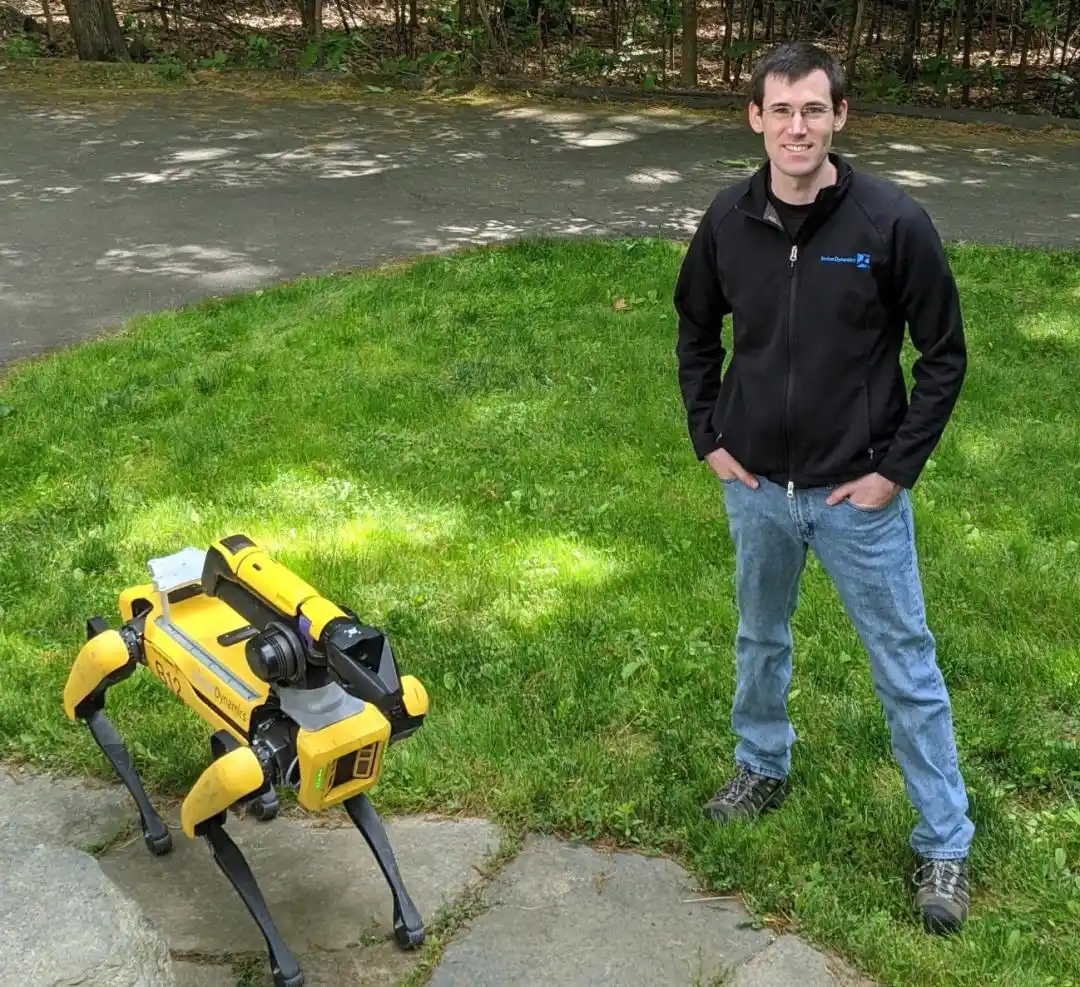
These three individuals didn't just form a team chasing a trend because AI became hot; their work over the past decade-plus has coincidentally pointed to the same bottleneck in the robotics industry:

Hardware can already run, jump, and grasp; what truly limits real-world deployment is that the robot's 'brain' can't keep up with its 'body.'

What DeepMind brings is the model's generalization capability across different tasks, objects, and scenes;

What Boston Dynamics brings is the 'physical sense' for mechanical structures, control systems, and real environments.

This is also why Generalist chose to train a general robot brain instead of betting on a specific robot body. They understand that only when both the model and the hardware are proficient can robots move from lab demos to factories and warehouses.

Otherwise, no matter how elegant the model, it might just result in publishing more papers; no matter how flashy the robot's movements, it might still only perform pre-programmed routines.

However, GEN-1.5 still has significant room for improvement.

Learning at First Glance Doesn't Mean Ready for the Job

However, learning from a single glance doesn't mean GEN-1.5 is ready to start working in a factory.

Generalist has proactively tempered expectations for this capability. The official technical blog states that the team's current testing mostly involves simple, short-duration tasks like unscrewing jar lids, zipping zippers, and grasping objects.
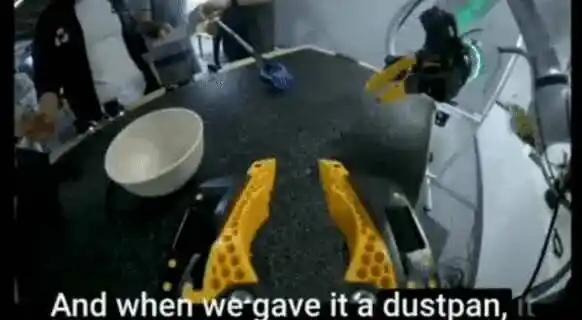
GEN-1.5's average single-demonstration success rate across 10 task categories is 59%, still far from the long-duration, low-failure stable operation required on production lines.

In a real factory setting, robots must also handle variations in materials, equipment wear, human interference, and sudden malfunctions, which pose far greater challenges than lab demonstrations.

More importantly, 'learning from a single demo' primarily addresses task adaptation and doesn't automatically equate to low-cost commercialization.

Large-scale robot deployment also depends on hardware cost, operational speed, maintenance cost, safety, and system integration capabilities. Even if the model learns quickly, if the robotic arm is expensive, prone to frequent failures, or still requires extensive engineering debugging for each deployment, the business case may still not work out.

But the value of GEN-1.5 shouldn't be measured solely by its current success rate.

The emergence of GEN-1.5 demonstrates that robots have the potential to rapidly understand new tasks through a few seconds of 'physical prompts,' similar to how large models understand text prompts.

Although it hasn't yet placed robots on production lines for long-term operation, it has already made progress in reducing the time for robots to learn new tasks from months to seconds.

Moving from 'developing one program per task' to 'the same model learning different tasks'—this is the more noteworthy aspect of GEN-1.5.

It might not be a qualified worker yet, but at least it shows the potential learning method for future general robot brains.

In this sense, GEN-1.5 currently resembles a roadmap towards general-purpose robots more than a fully mature product manual.

What truly excites the market isn't just what it can do today, but the possibility it demonstrates for robots to continuously learn to do more things.

General-Purpose Robots Are Hitting the Road

If past robotics companies were vying to be 'champions in specific skills,' the story Generalist tells investors is one about a 'robot generalist.'

When robotic arms being able to grasp, place, and twist is no longer novel, the standards for capturing capital attention shift accordingly.

Rather than how many pre-programmed actions a robot knows, the market cares more about how quickly it can learn new actions, how much data it requires, and how high the deployment cost is.

Although GEN-1.5 still has a long way to go in completing its transformation from 'learning at first glance' to 'working stably for eight hours a day,' Generalist has at least validated a possibility: robots don't have to be forever confined to 'one scenario, one policy'; they too can rely on general models to quickly adapt to unfamiliar tasks, just like humans.

And when the time for robots to learn new skills shrinks from months to seconds, with marginal costs gradually approaching zero, what truly needs redefinition might not be just the robotics industry.

At that point, where will the core value of human labor lie?

This question might be even more worthy of discussion than GEN-1.5 itself.

Reference Links:

[1]https://www.axios.com/2026/08/24/robotics-ai-generalist-200m

[2]https://forgeglobal.com/generalist_stock/

[3]https://generalistai.com/blog/gen-1.5

[4]https://generalistai.com/about

[5]https://www.peteflorence.com/

[6]https://andyzeng.github.io/[7]https://abarry.org/

This article is from the WeChat public account 'QbitAI', author: Wenting

Трендові криптовалюти

Пов'язані питання

QWhat is Generalist, and what is its primary focus in the AI and robotics industry?

AGeneralist is an AI company focused on developing a 'universal brain' for robots. Founded in 2024 in the San Francisco Bay Area, its core mission is to create general-purpose AI models that enable robots to quickly learn and adapt to new tasks with minimal demonstration, moving away from task-specific programming.

QWhat is the significance of Generalist's GEN-1.5 model, and how does its 'one-shot learning' capability work?

AGEN-1.5 is significant because it enables 'one-shot learning,' allowing a robot to learn a new task after just one demonstration (3-12 seconds of sensor and motion data), without needing gradient updates or fine-tuning. This 'physical prompting' dramatically reduces robot deployment time from months to seconds, representing a major step toward general-purpose robot adaptability.

QWho are the notable founders of Generalist, and what unique expertise do they bring from their previous roles?

AGeneralist was founded by Pete Florence (former Google DeepMind researcher, expertise in multimodal AI models), Andy Zeng (former Google DeepMind scientist, known for robot data collection methods), and Andrew Barry (former Boston Dynamics engineer, expertise in robot control and hardware integration). Their combined backgrounds provide deep knowledge in both AI generalization and real-world robotic systems.

QWhich prominent investors and companies have funded Generalist, and what is the company's latest valuation?

AProminent investors include NVIDIA, Bezos Expeditions (Jeff Bezos's venture fund), Fei-Fei Li ('AI godmother'), Xiaomi co-founder Bin Lin, Zoom founder Eric Yuan, and Naval Ravikant. Following a recent $200 million funding round, Generalist's valuation has surpassed $2 billion.

QWhat are the current limitations and future potential of GEN-1.5 as discussed in the article?

ACurrent limitations include a 59% average success rate on simple, short-duration tasks with one demonstration (83% after brief fine-tuning), which is insufficient for stable, long-term industrial operation. Its future potential lies in validating a path toward general-purpose robots that can learn quickly with minimal data, potentially reducing deployment costs to near zero and redefining the robotics industry and the role of human labor.

Пов'язані матеріали

U.S. 'Operation Economic Outcast' Targets Iran's Crypto Sector, Over $100 Million in Oil-Related Payments Allegedly Facilitated via Cryptocurrency

U.S. Treasury Launches "Operation Economic Outcast," Sanctions Iran's Crypto Sector On August 24, the U.S. Treasury Department initiated "Operation Economic Outcast," a government-wide economic campaign against Iran. As part of this, the Office of Foreign Assets Control (OFAC) issued a sectoral sanctions determination targeting digital assets under Executive Order 13902, significantly expanding its authority. The Treasury stated that Iran is increasingly using cryptocurrency as a "tool of choice" to evade sanctions and support transactions linked to the Islamic Revolutionary Guard Corps (IRGC). Concurrently, OFAC sanctioned Ukrainian-Emirati broker Ivan Obukhov and his company, Foscom FZE. The Treasury alleges that since 2023, Obukhov has processed over $100 million in cryptocurrency payments to facilitate oil sales on behalf of the IRGC-Quds Force. Nearly 60 other entities, individuals, and vessels involved in nuclear procurement, cyber operations, and oil revenue networks were also sanctioned. This move marks an escalation from prior actions against specific exchanges, now establishing a broad basis to sanction any foreign entity deemed to operate in or support Iran's digital asset sector. Treasury Secretary Scott Bessent warned that any entity engaging economically with the Iranian regime will face the full reach of U.S. power, calling the operation an "economic D-Day" aimed at isolating Tehran.

marsbit22 хв тому

U.S. 'Operation Economic Outcast' Targets Iran's Crypto Sector, Over $100 Million in Oil-Related Payments Allegedly Facilitated via Cryptocurrency

marsbit22 хв тому

Is Your Account Still Blocked? Rosfinmonitoring Gets Direct Access to SBP and 'Mir'

Starting September 1, 2026, Russia's Federal Law No. 461-FZ grants Rosfinmonitoring (the Federal Financial Monitoring Service) direct access to transaction data from the National Payment Card System (NSPK), the operator of the Mir payment card system and the Faster Payments System (SBP). This allows the agency to bypass individual banks when reconstructing transaction trails for anti-money laundering (AML) purposes. The data, provided free of charge and without requiring customer consent or court orders, includes information on operations via SBP, the unified QR-code, and Mir cards, with no minimum transaction threshold. Customers will not be notified when their data is shared. The law does not introduce new taxes, automatic account freezes, or new enforcement powers. If suspicious activity is identified under existing AML laws, existing procedures with banks and law enforcement will apply. The agreement's specific terms between Rosfinmonitoring and NSPK, including the scope and historical depth of accessible data, are not public. The change centralizes access to a vast volume of domestic payments, potentially speeding up financial investigations. However, it also creates a single point of concentration for sensitive data and reduces transparency for cardholders, as customers are not informed about data requests. Observers note a global trend of expanding supervisory powers, with differences in the Russian model being the non-public agreement and the lack of customer notification.

cryptonews.ru25 хв тому

Is Your Account Still Blocked? Rosfinmonitoring Gets Direct Access to SBP and 'Mir'

cryptonews.ru25 хв тому

Торгівля

Спот

Популярні статті

Що таке $S$

Розуміння SPERO: Комплексний огляд Вступ до SPERO Оскільки ландшафт інновацій продовжує еволюціонувати, виникнення технологій web3 та криптовалютних проектів відіграє ключову роль у формуванні цифрового майбутнього. Один з проектів, який привернув увагу в цій динамічній сфері, — це SPERO, позначений як SPERO,$$s$. Ця стаття має на меті зібрати та представити детальну інформацію про SPERO, щоб допомогти ентузіастам та інвесторам зрозуміти його основи, цілі та інновації в рамках web3 та крипто-сектору. Що таке SPERO,$$s$? SPERO,$$s$ — це унікальний проект у криптопросторі, який прагне використати принципи децентралізації та технології блокчейн для створення екосистеми, що сприяє залученню, корисності та фінансовій інклюзії. Проект розроблений для полегшення взаємодії між користувачами новими способами, надаючи їм інноваційні фінансові рішення та послуги. У своїй основі SPERO,$$s$ прагне надати можливості індивідам, забезпечуючи інструменти та платформи, які покращують користувацький досвід у криптовалютному просторі. Це включає в себе можливість більш гнучких методів транзакцій, сприяння ініціативам, що підтримуються спільнотою, та створення шляхів для фінансових можливостей через децентралізовані додатки (dApps). Основна концепція SPERO,$$s$ обертається навколо інклюзивності, прагнучи зменшити розриви в традиційній фінансовій системі, використовуючи переваги технології блокчейн. Хто є творцем SPERO,$$s$? Особистість творця SPERO,$$s$ залишається дещо невідомою, оскільки є обмежені публічно доступні ресурси, що надають детальну інформацію про його засновників. Ця відсутність прозорості може бути наслідком зобов'язання проекту до децентралізації — етики, яку багато проектів web3 поділяють, ставлячи колективні внески вище за індивідуальне визнання. Зосереджуючи обговорення навколо спільноти та її колективних цілей, SPERO,$$s$ втілює суть наділення без виділення конкретних осіб. Таким чином, розуміння етики та місії SPERO є більш важливим, ніж ідентифікація єдиного творця. Хто є інвесторами SPERO,$$s$? SPERO,$$s$ підтримується різноманітними інвесторами, починаючи від венчурних капіталістів до ангельських інвесторів, які прагнуть сприяти інноваціям у крипто-секторі. Зосередження цих інвесторів зазвичай узгоджується з місією SPERO — пріоритет надається проектам, які обіцяють технологічний прогрес у суспільстві, фінансову інклюзію та децентралізоване управління. Ці інвесторські фонди зазвичай зацікавлені в проектах, які не лише пропонують інноваційні продукти, але й позитивно впливають на спільноту блокчейн та її екосистеми. Підтримка з боку цих інвесторів підкріплює SPERO,$$s$ як значного конкурента в швидко змінюваній сфері крипто-проектів. Як працює SPERO,$$s$? SPERO,$$s$ використовує багатогранну структуру, яка відрізняє його від традиційних криптовалютних проектів. Ось деякі ключові особливості, які підкреслюють його унікальність та інноваційність: Децентралізоване управління: SPERO,$$s$ інтегрує моделі децентралізованого управління, надаючи користувачам можливість активно брати участь у процесах прийняття рішень щодо майбутнього проекту. Цей підхід сприяє відчуттю власності та відповідальності серед членів спільноти. Корисність токена: SPERO,$$s$ використовує свій власний криптовалютний токен, розроблений для виконання різних функцій в екосистемі. Ці токени дозволяють здійснювати транзакції, отримувати винагороди та полегшувати послуги, що пропонуються на платформі, підвищуючи загальну залученість та корисність. Шарова архітектура: Технічна архітектура SPERO,$$s$ підтримує модульність та масштабованість, що дозволяє безперешкодно інтегрувати додаткові функції та додатки в міру розвитку проекту. Ця адаптивність є надзвичайно важливою для збереження актуальності в постійно змінюваному крипто-ландшафті. Залучення спільноти: Проект підкреслює ініціативи, що підтримуються спільнотою, використовуючи механізми, які стимулюють співпрацю та зворотний зв'язок. Підтримуючи сильну спільноту, SPERO,$$s$ може краще задовольняти потреби користувачів та адаптуватися до ринкових тенденцій. Фокус на інклюзію: Пропонуючи низькі комісії за транзакції та зручні інтерфейси, SPERO,$$s$ прагне залучити різноманітну базу користувачів, включаючи осіб, які раніше не брали участі в крипто-просторі. Це зобов'язання до інклюзії узгоджується з його загальною місією наділення через доступність. Хронологія SPERO,$$s$ Розуміння історії проекту надає важливі уявлення про його розвиток та етапи. Нижче наведено пропоновану хронологію, що відображає значні події в еволюції SPERO,$$s$: Етап концептуалізації та ідеації: Початкові ідеї, що стали основою SPERO,$$s$, були сформовані, тісно пов'язані з принципами децентралізації та фокусом на спільноті в індустрії блокчейн. Запуск білого паперу проекту: Після концептуального етапу був випущений комплексний білий папір, що детально описує бачення, цілі та технологічну інфраструктуру SPERO,$$s$, щоб залучити інтерес та зворотний зв'язок від спільноти. Створення спільноти та ранні залучення: Активні зусилля були спрямовані на створення спільноти ранніх прихильників та потенційних інвесторів, що полегшило обговорення цілей проекту та отримання підтримки. Подія генерації токенів: SPERO,$$s$ провів подію генерації токенів (TGE) для розподілу своїх рідних токенів серед ранніх прихильників та встановлення початкової ліквідності в екосистемі. Запуск початкового dApp: Перший децентралізований додаток (dApp), пов'язаний з SPERO,$$s$, став доступним, дозволяючи користувачам взаємодіяти з основними функціями платформи. Постійний розвиток та партнерства: Безперервні оновлення та вдосконалення пропозицій проекту, включаючи стратегічні партнерства з іншими учасниками блокчейн-простору, сформували SPERO,$$s$ у конкурентоспроможного та еволюціонуючого гравця на крипто-ринку. Висновок SPERO,$$s$ є свідченням потенціалу web3 та криптовалют для революціонізації фінансових систем та наділення індивідів. Завдяки зобов'язанню до децентралізованого управління, залучення спільноти та інноваційно спроектованих функцій, він прокладає шлях до більш інклюзивного фінансового ландшафту. Як і з будь-якими інвестиціями в швидко змінюваному крипто-просторі, потенційним інвесторам та користувачам рекомендується ретельно досліджувати та обдумано взаємодіяти з поточними подіями в SPERO,$$s$. Проект демонструє інноваційний дух крипто-індустрії, запрошуючи до подальшого дослідження його численних можливостей. Хоча подорож SPERO,$$s$ ще триває, його основні принципи можуть справді вплинути на майбутнє того, як ми взаємодіємо з технологією, фінансами та один з одним у взаємопов'язаних цифрових екосистемах.

380 переглядів усьогоОпубліковано 2024.12.17Оновлено 2024.12.17

Що таке $S$

Що таке AGENT S

Агент S: Майбутнє автономної взаємодії в Web3 Вступ У постійно змінюваному ландшафті Web3 та криптовалюти інновації постійно переосмислюють, як люди взаємодіють з цифровими платформами. Один з таких новаторських проектів, Агент S, обіцяє революціонізувати взаємодію людини з комп'ютером через свою відкриту агентну структуру. Прокладаючи шлях для автономних взаємодій, Агент S прагне спростити складні завдання, пропонуючи трансформаційні застосування в штучному інтелекті (ШІ). Це детальне дослідження заглиблюється в складності проекту, його унікальні особливості та наслідки для сфери криптовалюти. Що таке Агент S? Агент S є революційною відкритою агентною структурою, спеціально розробленою для вирішення трьох основних викликів в автоматизації комп'ютерних завдань: Набуття специфічних знань у галузі: Структура інтелектуально навчається з різних зовнішніх джерел знань та внутрішнього досвіду. Цей подвійний підхід дозволяє їй створити багатий репозиторій специфічних знань у галузі, покращуючи її продуктивність у виконанні завдань. Планування на довгих горизонтах завдань: Агент S використовує планування з підкріпленням досвіду, стратегічний підхід, який полегшує ефективний розподіл та виконання складних завдань. Ця функція значно підвищує її здатність ефективно та результативно управляти кількома підзавданнями. Обробка динамічних, неоднорідних інтерфейсів: Проект представляє Інтерфейс Агент-Комп'ютер (ACI), інноваційне рішення, яке покращує взаємодію між агентами та користувачами. Використовуючи багатомодальні великі мовні моделі (MLLMs), Агент S може безперешкодно орієнтуватися та маніпулювати різноманітними графічними інтерфейсами користувача. Завдяки цим новаторським функціям Агент S надає надійну структуру, яка вирішує складнощі, пов'язані з автоматизацією людської взаємодії з машинами, прокладаючи шлях для численних застосувань у ШІ та за його межами. Хто є творцем Агент S? Хоча концепція Агент S є фундаментально новаторською, конкретна інформація про його творця залишається невідомою. Творець наразі невідомий, що підкреслює або початкову стадію проекту, або стратегічний вибір зберегти засновників у таємниці. Незважаючи на анонімність, акцент залишається на можливостях та потенціалі структури. Хто є інвесторами Агент S? Оскільки Агент S є відносно новим у криптографічній екосистемі, детальна інформація про його інвесторів та фінансових спонсорів не задокументована. Відсутність публічно доступних відомостей про інвестиційні фонди або організації, що підтримують проект, викликає питання щодо його фінансової структури та дорожньої карти розвитку. Розуміння підтримки є критично важливим для оцінки стійкості проекту та потенційного впливу на ринок. Як працює Агент S? В основі Агент S лежить передова технологія, яка дозволяє йому ефективно функціонувати в різних умовах. Його операційна модель побудована навколо кількох ключових функцій: Взаємодія з комп'ютером, подібна до людської: Структура пропонує розширене планування ШІ, прагнучи зробити взаємодії з комп'ютерами більш інтуїтивними. Імітуючи людську поведінку при виконанні завдань, вона обіцяє підвищити досвід користувачів. Наративна пам'ять: Використовується для використання високорівневого досвіду, Агент S використовує наративну пам'ять для відстеження історій завдань, тим самим покращуючи свої процеси прийняття рішень. Епізодична пам'ять: Ця функція надає користувачам покрокові інструкції, дозволяючи структурі пропонувати контекстуальну підтримку в міру виконання завдань. Підтримка OpenACI: Завдяки можливості працювати локально, Агент S дозволяє користувачам зберігати контроль над своїми взаємодіями та робочими процесами, узгоджуючи з децентралізованою етикою Web3. Легка інтеграція з зовнішніми API: Його універсальність і сумісність з різними платформами ШІ забезпечують те, що Агент S може безперешкодно вписатися в існуючі технологічні екосистеми, роблячи його привабливим вибором для розробників та організацій. Ці функціональні можливості колективно сприяють унікальному положенню Агент S у крипто-просторі, оскільки він автоматизує складні, багатоступеневі завдання з мінімальним втручанням людини. У міру розвитку проекту його потенційні застосування в Web3 можуть переосмислити, як відбуваються цифрові взаємодії. Хронологія Агент S Розробка та етапи Агент S можуть бути узагальнені в хронології, яка підкреслює його значні події: 27 вересня 2024 року: Концепція Агент S була представлена в комплексній науковій статті під назвою “Відкрита агентна структура, яка використовує комп'ютери як людина”, що демонструє основи проекту. 10 жовтня 2024 року: Наукова стаття була опублікована на arXiv, пропонуючи детальне дослідження структури та її оцінки продуктивності на основі бенчмарку OSWorld. 12 жовтня 2024 року: Було випущено відеопрезентацію, що надає візуальне уявлення про можливості та особливості Агент S, ще більше залучаючи потенційних користувачів та інвесторів. Ці маркери в хронології не лише ілюструють прогрес Агент S, але й вказують на його прихильність до прозорості та залучення громади. Ключові моменти про Агент S У міру розвитку структури Агент S кілька ключових характеристик виділяються, підкреслюючи її новаторський характер та потенціал: Інноваційна структура: Розроблена для забезпечення інтуїтивного використання комп'ютерів, подібного до людської взаємодії, Агент S пропонує новий підхід до автоматизації завдань. Автономна взаємодія: Здатність автономно взаємодіяти з комп'ютерами через GUI означає стрибок до більш інтелектуальних та ефективних обчислювальних рішень. Автоматизація складних завдань: Завдяки своїй надійній методології він може автоматизувати складні, багатоступеневі завдання, роблячи процеси швидшими та менш схильними до помилок. Безперервне вдосконалення: Механізми навчання дозволяють Агенту S покращуватися на основі минулого досвіду, постійно підвищуючи свою продуктивність та ефективність. Універсальність: Його адаптивність до різних операційних середовищ, таких як OSWorld та WindowsAgentArena, забезпечує його здатність служити широкому спектру застосувань. Оскільки Агент S займає своє місце в ландшафті Web3 та криптовалюти, його потенціал покращити можливості взаємодії та автоматизувати процеси означає значний прогрес у технологіях ШІ. Завдяки своїй інноваційній структурі Агент S є прикладом майбутнього цифрових взаємодій, обіцяючи більш безперешкодний та ефективний досвід для користувачів у різних галузях. Висновок Агент S представляє собою сміливий крок вперед у поєднанні ШІ та Web3, з можливістю переосмислити, як ми взаємодіємо з технологією. Хоча проект все ще на ранніх стадіях, можливості для його застосування є величезними та переконливими. Завдяки своїй комплексній структурі, що вирішує критичні виклики, Агент S прагне вивести автономні взаємодії на передній план цифрового досвіду. У міру того, як ми заглиблюємося в сфери криптовалюти та децентралізації, проекти, подібні до Агент S, безсумнівно, відіграватимуть ключову роль у формуванні майбутнього технологій та співпраці людини з комп'ютером.

992 переглядів усьогоОпубліковано 2025.01.14Оновлено 2025.01.14

Що таке AGENT S

Як купити S

Ласкаво просимо до HTX.com! Ми зробили покупку Sonic (S) простою та зручною. Дотримуйтесь нашої покрокової інструкції, щоб розпочати свою криптовалютну подорож.Крок 1: Створіть обліковий запис на HTXВикористовуйте свою електронну пошту або номер телефону, щоб зареєструвати обліковий запис на HTX безплатно. Пройдіть безпроблемну реєстрацію й отримайте доступ до всіх функцій.ЗареєструватисьКрок 2: Перейдіть до розділу Купити крипту і виберіть спосіб оплатиКредитна/дебетова картка: використовуйте вашу картку Visa або Mastercard, щоб миттєво купити Sonic (S).Баланс: використовуйте кошти з балансу вашого рахунку HTX для безперешкодної торгівлі.Треті особи: ми додали популярні способи оплати, такі як Google Pay та Apple Pay, щоб підвищити зручність.P2P: Торгуйте безпосередньо з іншими користувачами на HTX.Позабіржова торгівля (OTC): ми пропонуємо індивідуальні послуги та конкурентні обмінні курси для трейдерів.Крок 3: Зберігайте свої Sonic (S)Після придбання Sonic (S) збережіть його у своєму обліковому записі на HTX. Крім того, ви можете відправити його в інше місце за допомогою блокчейн-переказу або використовувати його для торгівлі іншими криптовалютами.Крок 4: Торгівля Sonic (S)Легко торгуйте Sonic (S) на спотовому ринку HTX. Просто увійдіть до свого облікового запису, виберіть торгову пару, укладайте угоди та спостерігайте за ними в режимі реального часу. Ми пропонуємо зручний досвід як для початківців, так і для досвідчених трейдерів.

2.1k переглядів усьогоОпубліковано 2025.01.15Оновлено 2026.06.02

Як купити S

Обговорення

Ласкаво просимо до спільноти HTX. Тут ви можете бути в курсі останніх подій розвитку платформи та отримати доступ до професійної ринкової інформації. Нижче представлені думки користувачів щодо ціни S (S).

活动图片