Top House Democrat Questions Kansas City Fed’s Approval Of Kraken Master Account

bitcoinistОпубліковано о 2026-03-28Востаннє оновлено о 2026-03-28

Анотація

Representative Maxine Waters, the top Democrat on the House Financial Services Committee, has questioned the Federal Reserve Bank of Kansas City's approval of a "limited purpose account" for crypto exchange Kraken. This approval grants Kraken's banking arm direct access to the Fed's payment system, a first for a cryptocurrency firm. Waters expressed concerns about the lack of transparency, potential risks to financial stability, and the adequacy of consumer protections, especially as this access was granted while Congress is still debating the terms for such expansions. She has requested detailed information on the services accessible to Kraken, the conditions applied, and the risk assessments conducted. The move has also drawn opposition from traditional banking groups, who warn it could threaten the U.S. payment system.

House of Representatives Ranking Member Maxine Waters has pressed the Federal Reserve Bank of Kansas City over its approval of a “limited purpose account” for Kraken, expressing concerns about the implications of granting a crypto firm access to the Federal Reserve’s (Fed) payment system.

Rep. Waters Seeks Clarity On Kraken’s Master Account Approval

On Thursday, Representative Maxine Waters, the top Democrat on the House Financial Services Committee, sent a letter to Jeff Schmid, President and CEO of the Federal Reserve Bank of Kansas City, questioning the Kansas City Fed’s recent decision to approve a “limited purpose account” to the US’s second-largest crypto exchange, Kraken.

In the letter, Waters seeks clarification from the Kansas City Fed regarding the practical implications of this approval “at a time when Congress has debated whether or not to expand access to the Fed’s payment rails and on what terms.”
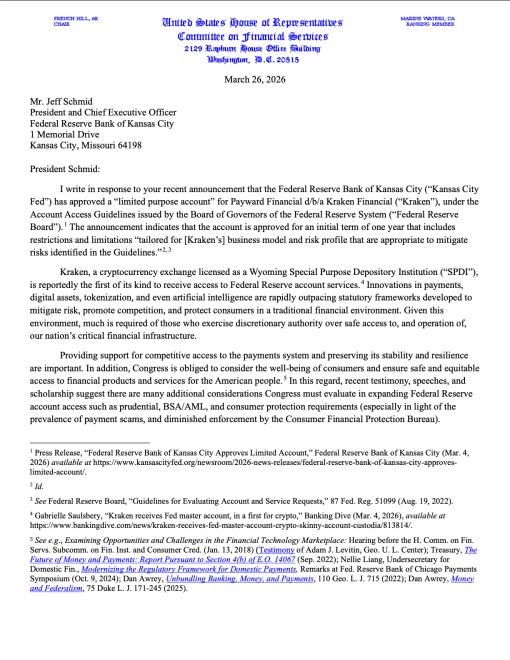
Rep. Waters' letter to Kansas City Fed's President Jeff Schmid. Source: House Financial Services Committee

Notably, Kraken Financial, Kraken’s banking arm, made history as the first crypto company to gain direct access to the Federal Reserve’s core payment system. This achievement was accomplished after Kraken secured approval from the Kansas City Fed for a Fed master account earlier this month.

As reported by Bitcoinist, the master account’s approval will enable Kraken Financial to expedite and streamline transactions for its large clients and professional traders. Additionally, it will grant Kraken’s banking unit direct access to Fedwire, a prominent interbank payment system that processes over $4 trillion in transfers daily.

The milestone represents a significant triumph for the crypto industry, which had been repeatedly denied access to the Federal Reserve system for years. Previously, the company had relied on intermediary banks to facilitate transfers to other firms.

The lawmaker highlighted that granting a cryptocurrency firm access to the Federal Reserve’s payment system for the first time raises policy, regulatory, and consumer protection concerns, arguing that it is particularly concerning given the rapid pace at which financial innovation is outpacing the rules and safeguards designed to ensure the safety of the financial system.

The Kansas City Fed’s announcement does not disclose specific information about Kraken’s access to the range of Federal Reserve financial services “due to the confidentiality of business information provided by applicants.” However, the announcement raises questions about the approval because neither statute nor the Federal Reserve Board’s Account Access Guidelines refer to a ‘limited purpose account’ type.

Crypto Access To Fed’s Payment Rails Faces Opposition

Representative Waters emphasized that access to the nation’s core payments infrastructure carries significant public responsibility and should not be extended without full transparency, clear legal grounding, and confidence that risks will be properly managed.

Therefore, she requested information no later than April 10, 2026, on the Federal Reserve services that Kraken can now access, the conditions or restrictions that apply, and the prudential, anti-money laundering (AML), and consumer protection considerations that were weighed before proceeding with the approval.

The lawmaker’s letter arrives as banking groups express significant concerns about granting crypto and fintech companies direct access to the Federal Reserve’s payment systems. Traditional banks have cautioned that even limited access could pose a substantial threat to the US payment system and overall financial stability.

For context, Kraken’s limited access to the master account is similar to the “skinny” master account concept initially proposed by the Federal Reserve Board of Governors in October 2025.

This type of restricted account would enable payment fintechs and crypto companies to access the Federal Reserve’s payment systems. However, it would exclude other advantages more closely associated with banks, such as the discount window lending facility.

In addition, the Office of the Comptroller of the Currency (OCC) approved conditional bank charters for Ripple, Circle, BitGo, Paxos, and Fidelity in December, raising concerns that it could blur the lines between banking activities and lead to regulatory arbitrage.

Last month, the American Bankers Association (ABA) urged the main banking regulator to postpone its approval of applications for crypto bank charters, suggesting that the agency should wait until the regulatory uncertainties are resolved.
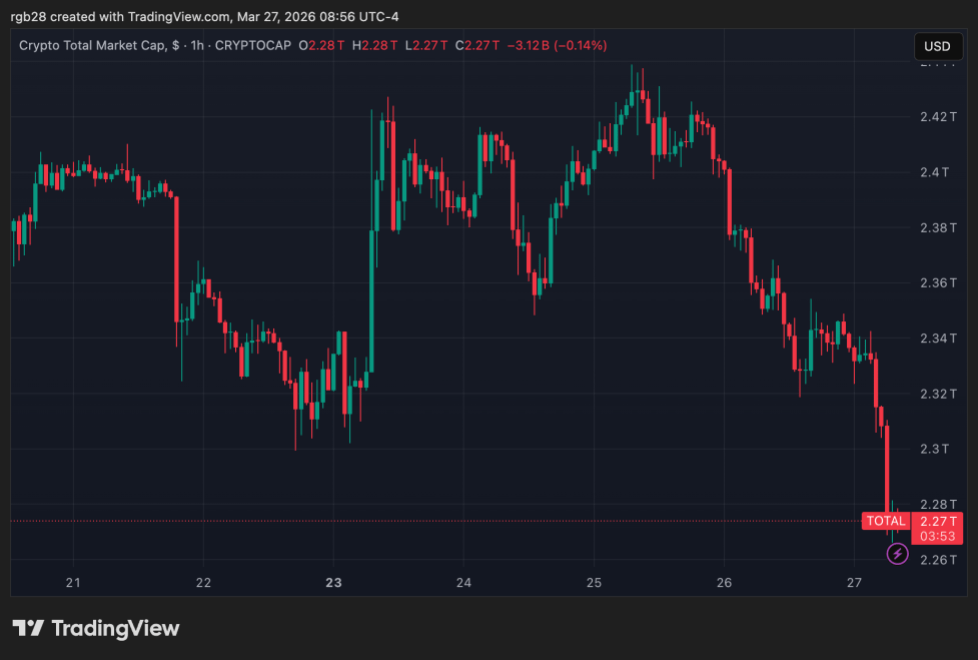
Total crypto market capitalization is at $2.27 trillion in the one-week chart. Source: TOTAL on TradingView


Пов'язані питання

QWhat is the main concern raised by Representative Maxine Waters regarding the Kansas City Fed's approval of a master account for Kraken?

ARepresentative Maxine Waters expressed concerns about the policy, regulatory, and consumer protection implications of granting a cryptocurrency firm direct access to the Federal Reserve's payment system for the first time, arguing that financial innovation is outpacing existing rules.

QWhat specific type of account did the Federal Reserve Bank of Kansas City approve for Kraken, and why is it notable?

AThe Kansas City Fed approved a 'limited purpose account' for Kraken. It is notable because it marks the first time a crypto company has gained direct access to the Federal Reserve's core payment system, a significant milestone for the industry.

QWhat practical benefits does the master account provide to Kraken Financial?

AThe master account enables Kraken Financial to expedite and streamline transactions for its large clients and professional traders and grants it direct access to Fedwire, a major interbank payment system that processes over $4 trillion daily.

QWhat information did Representative Waters request from the Kansas City Fed, and by when?

ARepresentative Waters requested information on the Federal Reserve services Kraken can access, the conditions or restrictions that apply, and the prudential, AML, and consumer protection considerations weighed before approval. This information was requested by April 10, 2026.

QWhy are traditional banking groups opposed to granting crypto companies access to the Fed's payment systems?

ATraditional banking groups, like the American Bankers Association, are concerned that even limited access for crypto and fintech companies could pose a substantial threat to the U.S. payment system and overall financial stability, potentially leading to regulatory arbitrage.

Пов'язані матеріали

The $290 Million Deficit: A Three-Way Game Between Aave, L0, and Kelp—Who Should Foot the Bill?

An incident involving the theft of 116,500 rsETH (worth approximately $290 million) from Kelp DAO’s cross-chain bridge contract has triggered a complex dispute over responsibility and compensation among Kelp DAO, LayerZero, and Aave. The attack occurred due to a compromised RPC provider used by LayerZero’s Decentralized Verifier Network (DVN). Since Kelp DAO’s bridge used a 1/1 DVN configuration—a single point of failure—the attacker successfully forged a cross-chain message, leading to the unauthorized release of rsETH tokens from the mainnet. These genuine tokens were then deposited into Aave and other lending platforms to borrow WETH, enabling the attacker to exit with the funds. Responsibility is attributed primarily to Kelp DAO for its risky 1/1 DVN setup. LayerZero bears secondary responsibility for permitting such a vulnerable configuration in its protocol layer. Aave also shares indirect blame for over-collateralizing rsETH and other Liquid Restaking Token (LRT) assets without adequate ongoing risk oversight. Kelp DAO lacks sufficient funds to cover the loss, shifting focus to the deeper-pocketed players: LayerZero, whose cross-chain ecosystem and reputation are at risk, and Aave, which faces massive bad loans and declining Total Value Locked (TVL). Aave has asserted that mainnet rsETH remains fully backed, implying it expects Kelp DAO to allow redemption of underlying ETH. This approach would preserve Aave’s mainnet positions but invalidate Layer2 rsETH, damaging LayerZero’s cross-chain credibility. Potential solutions include: - A universal 18.5% haircut on all rsETH holders, causing significant Aave bad debt. - Writing off Layer2 rsETH entirely, protecting Aave mainnet but harming LayerZero and Kelp DAO. - Negotiating a bounty with the hacker for partial fund return. - A joint bailout, possibly led by LayerZero’s ecosystem fund, given its long-term stake in the cross-chain ecosystem. The situation remains unresolved as the parties negotiate, but prolonged delay risks broader DeFi instability, including potential liquidity crises and loss of confidence in LRT and cross-chain infrastructures.

Odaily星球日报14 хв тому

The $290 Million Deficit: A Three-Way Game Between Aave, L0, and Kelp—Who Should Foot the Bill?

Odaily星球日报14 хв тому

Bitcoin's Bull-Bear Range Battle Continues, HYPE Faces Critical Test of Wave V Support | Exclusive Analysis

This market analysis covers Bitcoin (BTC) and HYPE, highlighting key levels and trading strategies for the week. HYPE is currently testing a critical support level at $40.17. A hold above this level could lead to consolidation between $40.17–$45.76, while a break below it may signal the end of its current V-wave uptrend from the April 2 low. The short-term strategy is to look for long entries near $40.17 if support holds, using 30% leverage and strict stop-loss discipline. Bitcoin is interpreted to be in a larger D-wave rebound from the February 6 low of $60,000, currently trading within a $73,500–$79,000 range. Key resistance lies at $79,000–$80,600 and $83,500–$84,500, with supports at $73,500, $69,500, and $65,000–$66,000. The medium-term strategy maintains a 60% short position from $89,000. Short-term tactics include selling into rallies near $76,500–$79,000 (Scenario A) or breaking below $73,500 (Scenario B), using 30% leverage. Last week, a 1x leveraged long trade in HYPE yielded a 6.80% gain, and the BTC short from $89,000 is currently up approximately 17.08%. Risk management is emphasized: set stop-losses at entry, move to breakeven at +1% profit, and trail stops to lock in gains thereafter. All views are based on technical analysis and are not investment advice. Traders are urged to exercise caution and adapt to market changes.

marsbit45 хв тому

Bitcoin's Bull-Bear Range Battle Continues, HYPE Faces Critical Test of Wave V Support | Exclusive Analysis

marsbit45 хв тому

Bitcoin's Bull-Bear Range Battle Continues, HYPE Faces Critical Test of Wave V Support | Invited Analysis

The market is experiencing directional uncertainty with both opportunities and risks. HYPE's daily V-wave structure is at a critical juncture, with the $40.17 support level being pivotal for its future trajectory. A break below this level, followed by an inability to surpass the recent high of $45.76, could signal the end of the current upward structure. The short-term strategy for HYPE is to "follow the trend and buy on dips," using a 30% position size and a 30/60-minute trading cycle, entering long upon confirmed support holds with model signals. Bitcoin's market structure is reinterpreted, with the rally from the $60,000 low now considered a larger D-wave rebound within a medium-term correction, facing a key test between $73,500 and $79,000. A break above the upper bound may lead to limited upside, while a drop below could see a decline toward $69,500. Core resistance lies at $79,000–$80,600 and $83,500–$84,500, with support at $73,500, $69,500, and $65,000–$66,000. The medium-term strategy maintains a 60% short position from $89,000, to be exited if price stabilizes above the multi-empty band. Short-term tactics involve 30% positions for "spread" opportunities, with two scenarios: selling on rallies near $76,500–$79,000 (Scheme A) or shorting on a breakdown below $73,500 (Scheme B), both with strict stop-losses. A复盘 of HYPE's recent short trade showed a 6.80% gain from a long entry at $41.59 (based on model buy signals) and exit at $44.42 (triggered by top signals). Key reminders include setting initial stops at entry, moving to breakeven at +1% profit, and trailing stops thereafter. All views are for reference only; market conditions change rapidly, and caution is advised.

Odaily星球日报52 хв тому

Bitcoin's Bull-Bear Range Battle Continues, HYPE Faces Critical Test of Wave V Support | Invited Analysis

Odaily星球日报52 хв тому

On the Same Day Aave Introduced rsETH, Why Did Spark Choose to Exit?

On April 18, Kelp DAO's cross-chain bridge was exploited, resulting in the malicious minting of 116,500 unbacked rsETH. The attacker deposited these into Aave and borrowed WETH, creating a potential bad debt of approximately $195 million. Aave’s Guardian quickly froze the market, but the protocol’s insurance could only cover about 25% of the loss. In contrast, SparkLend, a lending protocol in the MakerDAO ecosystem, suffered no direct losses. This was not due to superior foresight but rather a preemptive governance decision. On January 29, Spark executed a governance action to discontinue new rsETH supply, citing low usage and high concentration from a single wallet. The same day, Aave expanded its rsETH market by enabling E-Mode with a 93% LTV to attract more deposits. Spark’s risk management framework is designed to remove assets with low usage or poor risk-adjusted returns, regardless of external security concerns. Aave’s decision was growth-oriented, aiming to boost WETH utilization and attract capital. Spark also employs additional safeguards: rate-limited supply and borrow caps that would have limited the scale of such an attack, and a robust oracle system using the median of three price feeds. These mechanisms systemically contain the maximum exposure to any single risk event, demonstrating a fundamentally different approach to risk than Aave’s growth-first model.

marsbit52 хв тому

On the Same Day Aave Introduced rsETH, Why Did Spark Choose to Exit?

marsbit52 хв тому

Strategy's 'Money Printer': Is STRC Bitcoin's Savior or Destroyer?

Bitcoin's recent price movement is being heavily influenced by Michael Saylor and his company, MicroStrategy, through a new financial instrument: STRC (Variable Rate Series A Perpetual Stretch Preferred Stock). This Nasdaq-listed perpetual preferred stock offers an 11.5% annual dividend, attracting significant capital. Crucially, funds raised from STRC are used to purchase Bitcoin, with a 3x leverage effect—for every $1 from STRC, MicroStrategy adds $2 from MSTR equity to buy $3 worth of BTC. This creates a powerful "flywheel": more STRC sales fuel massive BTC buying, supporting its price and improving MicroStrategy's credit, which in turn makes STRC more attractive to investors. However, this mechanism introduces risks. A significant "ex-dividend arbitrage" pattern has emerged, where traders buy STRC before its monthly dividend, collect the payout, and quickly sell, causing price volatility and potentially driving up Bitcoin's cost basis for MicroStrategy. In response, Saylor has proposed shifting STRC to a semi-monthly dividend to smooth out these effects. Furthermore, STRC's high yield is being integrated into DeFi protocols like Apyx Protocol and Saturn Credit, offering new on-chain yield opportunities. The central concern remains: as MicroStrategy aggressively accumulates over 3.5% of all BTC, it challenges Bitcoin's foundational principle of decentralization, creating a system where a single public company significantly influences the market.

marsbit1 год тому

Strategy's 'Money Printer': Is STRC Bitcoin's Savior or Destroyer?

marsbit1 год тому

Торгівля

Спот
Ф'ючерси

Популярні статті

Як купити HOUSE

Ласкаво просимо до HTX.com! Ми зробили покупку Housecoin (HOUSE) простою та зручною. Дотримуйтесь нашої покрокової інструкції, щоб розпочати свою криптовалютну подорож.Крок 1: Створіть обліковий запис на HTXВикористовуйте свою електронну пошту або номер телефону, щоб зареєструвати обліковий запис на HTX безплатно. Пройдіть безпроблемну реєстрацію й отримайте доступ до всіх функцій.ЗареєструватисьКрок 2: Перейдіть до розділу Купити крипту і виберіть спосіб оплатиКредитна/дебетова картка: використовуйте вашу картку Visa або Mastercard, щоб миттєво купити Housecoin (HOUSE).Баланс: використовуйте кошти з балансу вашого рахунку HTX для безперешкодної торгівлі.Треті особи: ми додали популярні способи оплати, такі як Google Pay та Apple Pay, щоб підвищити зручність.P2P: Торгуйте безпосередньо з іншими користувачами на HTX.Позабіржова торгівля (OTC): ми пропонуємо індивідуальні послуги та конкурентні обмінні курси для трейдерів.Крок 3: Зберігайте свої Housecoin (HOUSE)Після придбання Housecoin (HOUSE) збережіть його у своєму обліковому записі на HTX. Крім того, ви можете відправити його в інше місце за допомогою блокчейн-переказу або використовувати його для торгівлі іншими криптовалютами.Крок 4: Торгівля Housecoin (HOUSE)Легко торгуйте Housecoin (HOUSE) на спотовому ринку HTX. Просто увійдіть до свого облікового запису, виберіть торгову пару, укладайте угоди та спостерігайте за ними в режимі реального часу. Ми пропонуємо зручний досвід як для початківців, так і для досвідчених трейдерів.

277 переглядів усьогоОпубліковано 2025.04.27Оновлено 2025.04.27

Як купити HOUSE

Обговорення

Ласкаво просимо до спільноти HTX. Тут ви можете бути в курсі останніх подій розвитку платформи та отримати доступ до професійної ринкової інформації. Нижче представлені думки користувачів щодо ціни HOUSE (HOUSE).

活动图片