A Hair Dryer Blows Open the World's Largest Nvidia Chip Smuggling Case

比推Опубліковано о 2026-03-20Востаннє оновлено о 2026-03-20

Анотація

A co-founder and senior executive of Supermicro, Wally Liaw, has been arrested in California for orchestrating the largest AI chip smuggling case in history, involving $2.5 billion worth of Nvidia GPUs destined for China. The scheme involved using a Southeast Asian shell company to purchase servers under the guise of legitimate use, then repackaging them for illegal shipment to China. To deceive auditors, the group created counterfeit servers with real serial numbers transferred using a hairdryer. Liaw, who faces up to 20 years in prison, accelerated operations ahead of new U.S. export restrictions in May 2025. The case highlights the persistent demand for Nvidia chips in China, where black market prices are 50% higher, and the evolving sophistication of smuggling networks, from individual couriers to corporate insiders.

Author: David, Shenchao TechFlow

Original Title: A Hair Dryer Blows Open the World's Largest Nvidia Chip Smuggling Case


Early this morning, Wally Liaw, co-founder of Supermicro, was arrested in California.

Supermicro is one of the world's largest AI server manufacturers and a core supply chain partner of Nvidia, having received $13 billion in orders for Nvidia Blackwell chips in just one quarter last year.

Liaw has been with the company since its founding in 1993 and currently serves as senior vice president and board member.

The charges against him are:

Smuggling $2.5 billion worth of Nvidia AI chip servers to China through shell companies in Southeast Asia. The maximum sentence is 20 years.

The U.S. Department of Justice has characterized this case as the largest AI chip smuggling case in history.

However, the details of this case are very much like a movie plot.

According to the indictment, Liaw and his accomplices arranged for a Southeast Asian company to act as a "white glove," purchasing large quantities of servers equipped with Nvidia GPUs from Supermicro under the guise of "self-use." Once the servers arrived in Southeast Asia, workers tore off the original packaging, placed them into unmarked boxes, and shipped them to China.

The real goods were shipped away, but Supermicro's compliance team and the U.S. Department of Commerce would regularly inspect the inventory and scan serial numbers at the warehouse. The warehouse couldn't be empty, could it?

So they built tens of thousands of fake servers.

The shells looked identical to the real ones, but they contained no chips and could not be powered on. They were specifically placed in the warehouse for auditors to see.

Having fake servers wasn't enough; the serial numbers on the packaging also had to match. Workers used a hair dryer to heat the serial number stickers on the real packaging, peeled them off completely, and then stuck them onto the boxes of the fake servers...
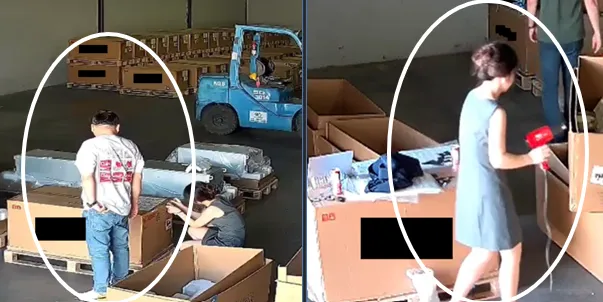
The auditors scanned the codes, and the system showed everything was normal.

Surveillance footage in the factory captured the hair dryer moment. But the real goods were already on their way to China.

Even more outrageous, on one occasion when Supermicro's own compliance team sent someone to inspect, accomplice Sun took photos and videos of the fake servers and sent them to the auditor as "proof" that the "goods were all there."

Another time, U.S. Department of Commerce export control officials came for an inspection. Someone on site directly impersonated a lawyer to receive them...

The main culprit, Liaw, is 71 years old and holds Supermicro stock worth $430 million. In theory, he doesn't need the money.

There's another detail in the indictment. A broker once forwarded a news link to Liaw about several Chinese nationals being arrested in the U.S. for smuggling AI chips.

Liaw's reply was a string of crying face emojis, and then he continued with the operation.

After the news was announced, Supermicro's stock fell 13% in after-hours trading. The company stated that Liaw has been suspended, the involved party Sun has been terminated, and sales manager Steven Chang from the Taiwan office is currently at large.

Supermicro was not named as a defendant. The company stated it has a "robust compliance system."

But this isn't the first time this company's compliance system has had problems.

$2.5 Billion Chip Smuggling Pipeline

This smuggling chain wasn't built overnight.

The indictment shows that Liaw was very proactive in managing the operation. He directly asked the person in charge of the Southeast Asian company via encrypted communication: How many can you take in January? February? March? April? Just give a rough estimate, and then we'll use this number to apply for a chip quota from Nvidia.

So the process was:

First, confirm the demand from Chinese buyers, then use that volume to negotiate a quota from Nvidia, citing "self-use" by the Southeast Asian company. Once Nvidia approved the quota, the servers were assembled in the U.S., shipped to Taiwan, then transferred to the Southeast Asian company, which removed the packaging and shipped them to China.
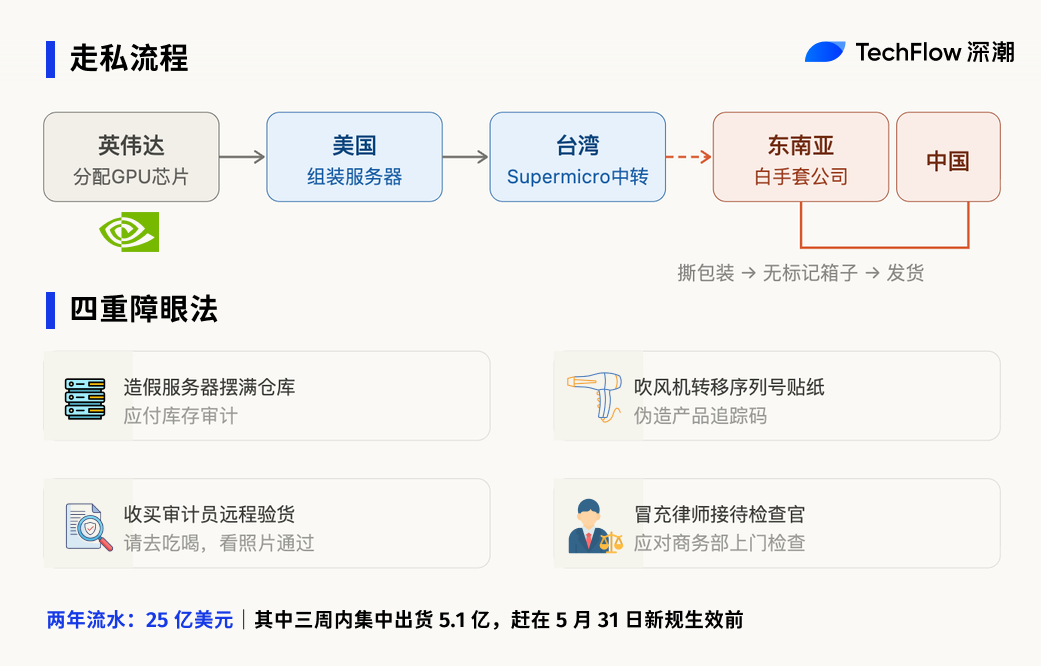
From clients to supply sources to logistics, Liaw single-handedly managed the entire chain. He wasn't a middleman; he was the co-founder and head of business development at Supermicro.

Using his own company's supply chain to smuggle his own company's products.

Between 2024 and 2025, servers worth $2.5 billion flowed out through this pipeline. The indictment says this scale gradually expanded, using the phrase:

Growing increasingly bold.

The boldest single transaction occurred from late April to mid-May 2025. In three weeks, $510 million worth of servers were transferred from the U.S. to China via Southeast Asia.

Why the sudden acceleration? Possibly because Liaw saw a White House statement.

In early 2025, the U.S. government announced a new set of export control rules for AI products, scheduled to take effect in mid-May, further tightening chip export reviews to regions like Southeast Asia. Liaw forwarded this news to the head of the Southeast Asian company, adding a note:

"We need to speed these up before May 13!"

May 13th was the effective date of the new rules. Before that, the existing loopholes could still be used. So the final three weeks became a race against time. The volume that usually took months to move was compressed into twenty days.

Meanwhile, Steven Chang from the Taiwan office was responsible for another task: ensuring no one conducted a real inspection.

The indictment says he prevented auditors from checking the actual areas where servers were stored in the Southeast Asian data center and specifically arranged for an auditor he called "friendly" to conduct this review.

All the forged documents, fake servers, and hair dryer label switching were meant to keep this pipeline running uninterrupted. And the speed of the pipeline peaked in the final three weeks.

But Supermicro isn't the only one in the chip smuggling business.

Over the past two years, the U.S. Department of Justice has dismantled several chip smuggling networks. The scale ranged from tens of millions to hundreds of millions of dollars, with methods becoming increasingly outrageous. And the profiles of the participants have also been escalating.

Stricter the Chip Ban, More Respectable the Smugglers

Supermicro isn't the first to be caught.

Looking back two years, the chip smuggling business has evolved through three generations. The identities of the participants have escalated, their methods have become more like legitimate business, and the scale has grown larger.

The first generation was "ant moving."

When the chip ban first came out in 2022, smuggling was still manual labor. International students, tourists, personal shoppers would carry one or two Nvidia GPUs at a time, hiding them in personal luggage to get through customs. If stopped, they would claim it was for personal use.

Some hid chips in boxes of live lobsters, some strapped them to their bodies and covered them with fake pregnant bellies.

In Shenzhen's Huaqiangbei, these chips had a complete after-sales industry chain. Specialized shops repaired broken cards and disassembled chips, handling over 500 per month, charging $1,400 to $2,800 per chip. After repair, they were sold to data centers and AI startups.

Smugglers at this stage had no companies, no documents; they relied on human effort and courage. The amount per transaction was small, but every little helps.
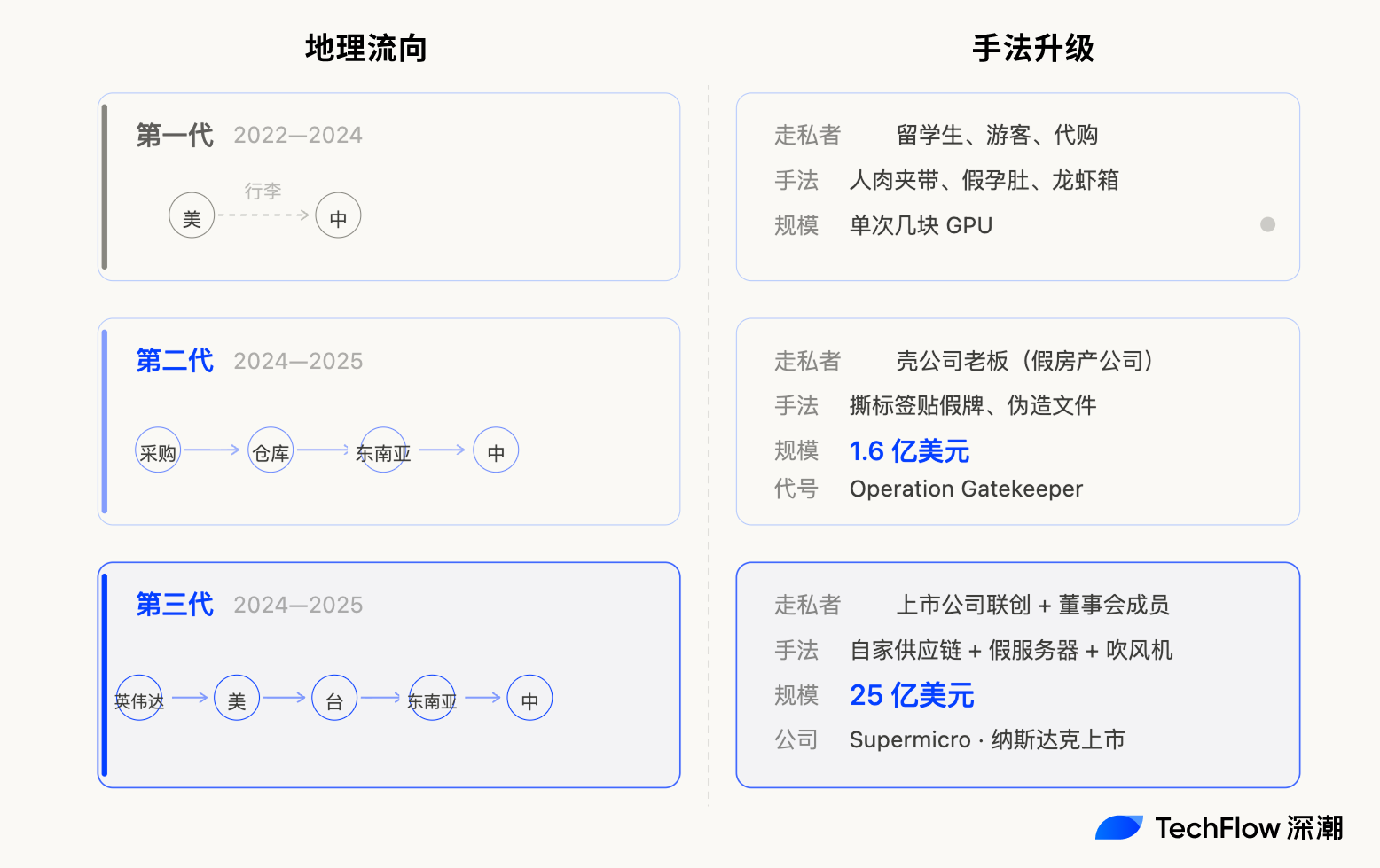
The second generation began using companies, "hanging sheep's head but selling dog meat."

In late 2025, the U.S. Department of Justice dismantled a smuggling network codenamed "Operation Gatekeeper." The main culprit was a man living in Houston named Alan Hsu, 43 years old. He used a company to purchase Nvidia chips in bulk from Lenovo and ship them to a warehouse in New Jersey.

This company was called Janford Realtor, registered as a real estate company.

It never conducted a single real estate transaction.

After the chips arrived at the warehouse, workers tore off Nvidia's original labels and stuck on the name of a fictional company—"SANDKYAN." They were then transshipped via Malaysia and Thailand, eventually entering China. The entire network moved over $160 million in goods in eight months.

The most dramatic moment in this case occurred during the takedown. FBI agents secretly infiltrated the New Jersey warehouse beforehand and quietly removed all the GPUs inside. The smugglers discovered the goods were missing, thought they had been stolen, and sent people to the warehouse to "redeem" them.

The ransom was negotiated to $1 million, and the person who came to make the exchange was caught red-handed by the FBI.

The third generation is the professionally involved, like Supermicro.

No longer fake companies, no longer middlemen, but the co-founder of a listed company personally managing the operation.

No need to buy chips from others; their own company is a core supplier to Nvidia. No need to forge buyer identities; using the company's own supply chain, its own customer relationships, its own quotas to apply for chips, and then internally bypassing its own company's compliance team.

From ant moving to fake real estate companies, to Silicon Valley listed company executives. The three generations of smugglers have only one thing in common:

The end buyers are all in China, and the chips are all Nvidia's.

The difference is, the person carrying a backpack through customs in 2022 was gambling with their freedom. The person sitting in a Silicon Valley office managing the operation in 2026 is gambling with a company worth tens of billions of dollars.

Every time the ban is upgraded, the profit from smuggling jumps a step, and the status of those willing to enter the game also jumps a step.

So how profitable is this business really?

The Black Market Price of a Chip

Why can't chip smuggling be stopped? The answer lies in the price.

According to multiple overseas media reports, the price of Nvidia's high-end GPUs on the Chinese black market is generally about 50% higher than the official channels in the U.S. The ban created a price difference, the price difference created profit, and the profit created smugglers.

Demand is rigid. Ray Wang, an analyst at semiconductor analysis firm SemiAnalysis, said in an interview with CNBC:

Over 60% of China's leading AI models currently still run on Nvidia hardware. Training a large model requires thousands of high-end GPUs; you can't start work even one short.

This means Chinese AI companies don't "want to buy" Nvidia chips; they "must buy" them.
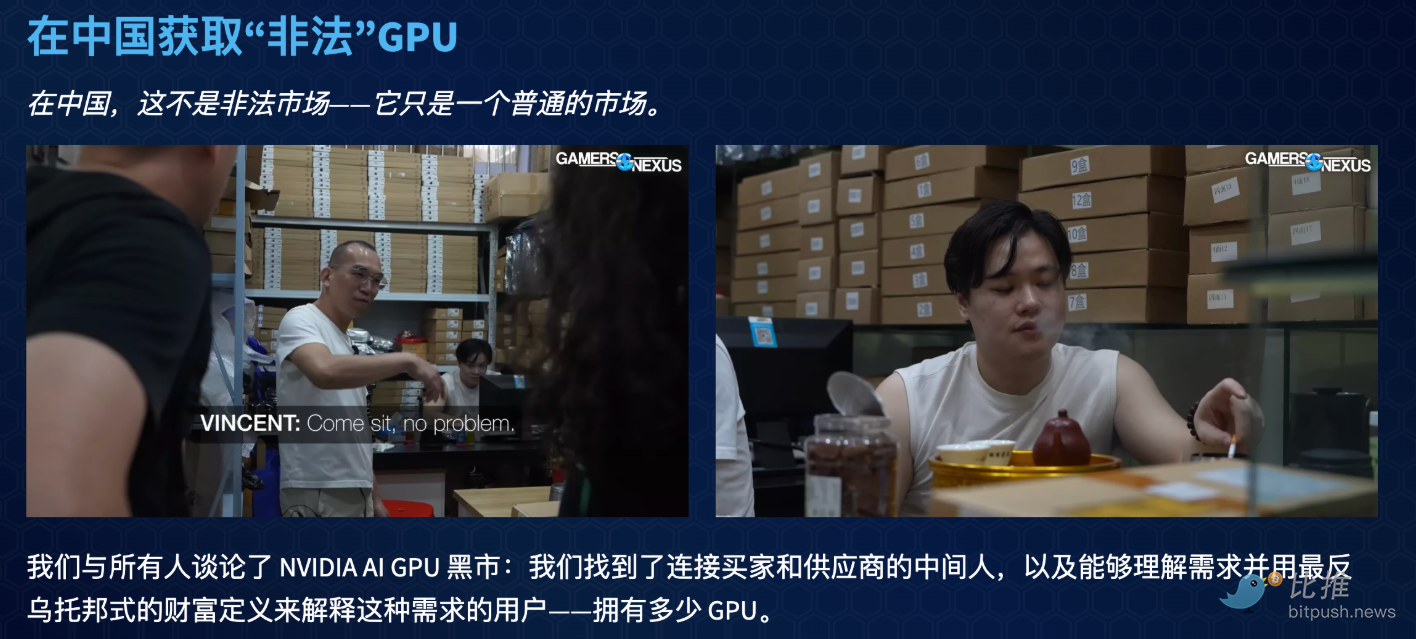
Image source: GamersNexus in-depth investigation of the Huaqiangbei chip market

What about the supply side?

After chips leave Nvidia's factory, they pass through distributors, system integrators, server manufacturers—every link is a potential entry point for smuggling. U.S. export controls mainly focus on the sales and shipping step, relying on buyers to self-declare the end user.

Once the chips leave the U.S., the subsequent steps basically rely on honesty.

A Financial Times report last year estimated that in just the three months after April 2025, over $1 billion worth of embargoed chips flowed into China through various channels. Industry insiders estimate the entire black market's monthly turnover could be on the order of $1 billion...

And ironically, the U.S. government's own policies have been wavering.

Last December, the Department of Justice high-profile announced the dismantling of the Operation Gatekeeper smuggling network, arresting several suspects. But on the same day, Trump announced on Truth Social: Allowing Nvidia to sell H200 chips to China.

Later, the U.S. government opened another loophole, allowing Nvidia to sell the less powerful H20 chips to China, on the condition that Nvidia pay 15% of the sales revenue to the U.S. government.

Cracking down on smuggling on one hand, selling themselves on the other, and even taking a cut. This makes the entire ban system very difficult to explain.

If you tell a chip broker that smuggling is illegal, he might reply: The government is selling them too, they just call it "conditional export."

The deeper paradox is that Nvidia is now the world's highest-valued company, with a market cap of $4.3 trillion. The more advanced its chips, the greater the demand, the higher the black market premium, and the more lucrative the smuggling.

A Hair Dryer Can't Blow Away Demand

What signal do people inside chip companies see when the government itself is both cracking down on smuggling and approving exports?

The protagonist of this article, Supermicro, also helped Musk build the Colossus AI computing cluster in 122 days and received $13 billion in Nvidia Blackwell orders last quarter.

The people who build the servers and the people who smuggle the servers are the same group.

A $2.5 billion smuggling case was finally brought down by a hair dryer. Surveillance footage captured workers using a hair dryer to peel off labels; it's now posted on the U.S. Department of Justice website for anyone to see.

The same week Liaw was arrested, Nvidia CEO Jensen Huang publicly stated that the company is facing a backlog of $1 trillion in chip orders.

A trillion dollars in demand is sitting there, and the black market premium is sitting there.

Perhaps the next person willing to pick up a hair dryer won't have to wait long.


Twitter:https://twitter.com/BitpushNewsCN

Bitpush TG Discussion Group:https://t.me/BitPushCommunity

Bitpush TG Subscription: https://t.me/bitpush

Original link:https://www.bitpush.news/articles/7621608

Пов'язані питання

QWhat was the role of Wally Liaw at Supermicro and what crime was he charged with?

AWally Liaw was a co-founder and senior vice president of Supermicro. He was charged with smuggling $2.5 billion worth of Nvidia AI chip servers to China through shell companies in Southeast Asia.

QWhat was the method used to deceive auditors and export control officials in the smuggling operation?

AThey created thousands of fake servers with identical exteriors but no chips inside. They used a hairdryer to heat and remove the serial number stickers from the real packaging and then applied them to the boxes of the fake servers to pass audits.

QWhy did the smuggling operation accelerate significantly in April and May 2025?

AThe operation accelerated because the U.S. government announced new AI product export control rules set to take effect in mid-May 2025. Liaw wanted to move as much inventory as possible before the stricter rules closed the existing loopholes.

QWhat is the estimated price premium for Nvidia's high-end GPUs on the Chinese black market according to the article?

ANvidia's high-end GPUs sell for approximately a 50% premium on the Chinese black market compared to official U.S. channels.

QWhat paradox does the article highlight regarding the U.S. government's policy on chip exports to China?

AThe article points out the paradox of the U.S. government cracking down on chip smuggling while simultaneously allowing Nvidia to sell certain chips to China under specific conditions, such as taking a 15% cut of the sales, which complicates the enforcement of the ban.

Пов'язані матеріали

Торгівля

Спот
Ф'ючерси

Популярні статті

Що таке $S$

Розуміння SPERO: Комплексний огляд Вступ до SPERO Оскільки ландшафт інновацій продовжує еволюціонувати, виникнення технологій web3 та криптовалютних проектів відіграє ключову роль у формуванні цифрового майбутнього. Один з проектів, який привернув увагу в цій динамічній сфері, — це SPERO, позначений як SPERO,$$s$. Ця стаття має на меті зібрати та представити детальну інформацію про SPERO, щоб допомогти ентузіастам та інвесторам зрозуміти його основи, цілі та інновації в рамках web3 та крипто-сектору. Що таке SPERO,$$s$? SPERO,$$s$ — це унікальний проект у криптопросторі, який прагне використати принципи децентралізації та технології блокчейн для створення екосистеми, що сприяє залученню, корисності та фінансовій інклюзії. Проект розроблений для полегшення взаємодії між користувачами новими способами, надаючи їм інноваційні фінансові рішення та послуги. У своїй основі SPERO,$$s$ прагне надати можливості індивідам, забезпечуючи інструменти та платформи, які покращують користувацький досвід у криптовалютному просторі. Це включає в себе можливість більш гнучких методів транзакцій, сприяння ініціативам, що підтримуються спільнотою, та створення шляхів для фінансових можливостей через децентралізовані додатки (dApps). Основна концепція SPERO,$$s$ обертається навколо інклюзивності, прагнучи зменшити розриви в традиційній фінансовій системі, використовуючи переваги технології блокчейн. Хто є творцем SPERO,$$s$? Особистість творця SPERO,$$s$ залишається дещо невідомою, оскільки є обмежені публічно доступні ресурси, що надають детальну інформацію про його засновників. Ця відсутність прозорості може бути наслідком зобов'язання проекту до децентралізації — етики, яку багато проектів web3 поділяють, ставлячи колективні внески вище за індивідуальне визнання. Зосереджуючи обговорення навколо спільноти та її колективних цілей, SPERO,$$s$ втілює суть наділення без виділення конкретних осіб. Таким чином, розуміння етики та місії SPERO є більш важливим, ніж ідентифікація єдиного творця. Хто є інвесторами SPERO,$$s$? SPERO,$$s$ підтримується різноманітними інвесторами, починаючи від венчурних капіталістів до ангельських інвесторів, які прагнуть сприяти інноваціям у крипто-секторі. Зосередження цих інвесторів зазвичай узгоджується з місією SPERO — пріоритет надається проектам, які обіцяють технологічний прогрес у суспільстві, фінансову інклюзію та децентралізоване управління. Ці інвесторські фонди зазвичай зацікавлені в проектах, які не лише пропонують інноваційні продукти, але й позитивно впливають на спільноту блокчейн та її екосистеми. Підтримка з боку цих інвесторів підкріплює SPERO,$$s$ як значного конкурента в швидко змінюваній сфері крипто-проектів. Як працює SPERO,$$s$? SPERO,$$s$ використовує багатогранну структуру, яка відрізняє його від традиційних криптовалютних проектів. Ось деякі ключові особливості, які підкреслюють його унікальність та інноваційність: Децентралізоване управління: SPERO,$$s$ інтегрує моделі децентралізованого управління, надаючи користувачам можливість активно брати участь у процесах прийняття рішень щодо майбутнього проекту. Цей підхід сприяє відчуттю власності та відповідальності серед членів спільноти. Корисність токена: SPERO,$$s$ використовує свій власний криптовалютний токен, розроблений для виконання різних функцій в екосистемі. Ці токени дозволяють здійснювати транзакції, отримувати винагороди та полегшувати послуги, що пропонуються на платформі, підвищуючи загальну залученість та корисність. Шарова архітектура: Технічна архітектура SPERO,$$s$ підтримує модульність та масштабованість, що дозволяє безперешкодно інтегрувати додаткові функції та додатки в міру розвитку проекту. Ця адаптивність є надзвичайно важливою для збереження актуальності в постійно змінюваному крипто-ландшафті. Залучення спільноти: Проект підкреслює ініціативи, що підтримуються спільнотою, використовуючи механізми, які стимулюють співпрацю та зворотний зв'язок. Підтримуючи сильну спільноту, SPERO,$$s$ може краще задовольняти потреби користувачів та адаптуватися до ринкових тенденцій. Фокус на інклюзію: Пропонуючи низькі комісії за транзакції та зручні інтерфейси, SPERO,$$s$ прагне залучити різноманітну базу користувачів, включаючи осіб, які раніше не брали участі в крипто-просторі. Це зобов'язання до інклюзії узгоджується з його загальною місією наділення через доступність. Хронологія SPERO,$$s$ Розуміння історії проекту надає важливі уявлення про його розвиток та етапи. Нижче наведено пропоновану хронологію, що відображає значні події в еволюції SPERO,$$s$: Етап концептуалізації та ідеації: Початкові ідеї, що стали основою SPERO,$$s$, були сформовані, тісно пов'язані з принципами децентралізації та фокусом на спільноті в індустрії блокчейн. Запуск білого паперу проекту: Після концептуального етапу був випущений комплексний білий папір, що детально описує бачення, цілі та технологічну інфраструктуру SPERO,$$s$, щоб залучити інтерес та зворотний зв'язок від спільноти. Створення спільноти та ранні залучення: Активні зусилля були спрямовані на створення спільноти ранніх прихильників та потенційних інвесторів, що полегшило обговорення цілей проекту та отримання підтримки. Подія генерації токенів: SPERO,$$s$ провів подію генерації токенів (TGE) для розподілу своїх рідних токенів серед ранніх прихильників та встановлення початкової ліквідності в екосистемі. Запуск початкового dApp: Перший децентралізований додаток (dApp), пов'язаний з SPERO,$$s$, став доступним, дозволяючи користувачам взаємодіяти з основними функціями платформи. Постійний розвиток та партнерства: Безперервні оновлення та вдосконалення пропозицій проекту, включаючи стратегічні партнерства з іншими учасниками блокчейн-простору, сформували SPERO,$$s$ у конкурентоспроможного та еволюціонуючого гравця на крипто-ринку. Висновок SPERO,$$s$ є свідченням потенціалу web3 та криптовалют для революціонізації фінансових систем та наділення індивідів. Завдяки зобов'язанню до децентралізованого управління, залучення спільноти та інноваційно спроектованих функцій, він прокладає шлях до більш інклюзивного фінансового ландшафту. Як і з будь-якими інвестиціями в швидко змінюваному крипто-просторі, потенційним інвесторам та користувачам рекомендується ретельно досліджувати та обдумано взаємодіяти з поточними подіями в SPERO,$$s$. Проект демонструє інноваційний дух крипто-індустрії, запрошуючи до подальшого дослідження його численних можливостей. Хоча подорож SPERO,$$s$ ще триває, його основні принципи можуть справді вплинути на майбутнє того, як ми взаємодіємо з технологією, фінансами та один з одним у взаємопов'язаних цифрових екосистемах.

73 переглядів усьогоОпубліковано 2024.12.17Оновлено 2024.12.17

Що таке $S$

Що таке AGENT S

Агент S: Майбутнє автономної взаємодії в Web3 Вступ У постійно змінюваному ландшафті Web3 та криптовалюти інновації постійно переосмислюють, як люди взаємодіють з цифровими платформами. Один з таких новаторських проектів, Агент S, обіцяє революціонізувати взаємодію людини з комп'ютером через свою відкриту агентну структуру. Прокладаючи шлях для автономних взаємодій, Агент S прагне спростити складні завдання, пропонуючи трансформаційні застосування в штучному інтелекті (ШІ). Це детальне дослідження заглиблюється в складності проекту, його унікальні особливості та наслідки для сфери криптовалюти. Що таке Агент S? Агент S є революційною відкритою агентною структурою, спеціально розробленою для вирішення трьох основних викликів в автоматизації комп'ютерних завдань: Набуття специфічних знань у галузі: Структура інтелектуально навчається з різних зовнішніх джерел знань та внутрішнього досвіду. Цей подвійний підхід дозволяє їй створити багатий репозиторій специфічних знань у галузі, покращуючи її продуктивність у виконанні завдань. Планування на довгих горизонтах завдань: Агент S використовує планування з підкріпленням досвіду, стратегічний підхід, який полегшує ефективний розподіл та виконання складних завдань. Ця функція значно підвищує її здатність ефективно та результативно управляти кількома підзавданнями. Обробка динамічних, неоднорідних інтерфейсів: Проект представляє Інтерфейс Агент-Комп'ютер (ACI), інноваційне рішення, яке покращує взаємодію між агентами та користувачами. Використовуючи багатомодальні великі мовні моделі (MLLMs), Агент S може безперешкодно орієнтуватися та маніпулювати різноманітними графічними інтерфейсами користувача. Завдяки цим новаторським функціям Агент S надає надійну структуру, яка вирішує складнощі, пов'язані з автоматизацією людської взаємодії з машинами, прокладаючи шлях для численних застосувань у ШІ та за його межами. Хто є творцем Агент S? Хоча концепція Агент S є фундаментально новаторською, конкретна інформація про його творця залишається невідомою. Творець наразі невідомий, що підкреслює або початкову стадію проекту, або стратегічний вибір зберегти засновників у таємниці. Незважаючи на анонімність, акцент залишається на можливостях та потенціалі структури. Хто є інвесторами Агент S? Оскільки Агент S є відносно новим у криптографічній екосистемі, детальна інформація про його інвесторів та фінансових спонсорів не задокументована. Відсутність публічно доступних відомостей про інвестиційні фонди або організації, що підтримують проект, викликає питання щодо його фінансової структури та дорожньої карти розвитку. Розуміння підтримки є критично важливим для оцінки стійкості проекту та потенційного впливу на ринок. Як працює Агент S? В основі Агент S лежить передова технологія, яка дозволяє йому ефективно функціонувати в різних умовах. Його операційна модель побудована навколо кількох ключових функцій: Взаємодія з комп'ютером, подібна до людської: Структура пропонує розширене планування ШІ, прагнучи зробити взаємодії з комп'ютерами більш інтуїтивними. Імітуючи людську поведінку при виконанні завдань, вона обіцяє підвищити досвід користувачів. Наративна пам'ять: Використовується для використання високорівневого досвіду, Агент S використовує наративну пам'ять для відстеження історій завдань, тим самим покращуючи свої процеси прийняття рішень. Епізодична пам'ять: Ця функція надає користувачам покрокові інструкції, дозволяючи структурі пропонувати контекстуальну підтримку в міру виконання завдань. Підтримка OpenACI: Завдяки можливості працювати локально, Агент S дозволяє користувачам зберігати контроль над своїми взаємодіями та робочими процесами, узгоджуючи з децентралізованою етикою Web3. Легка інтеграція з зовнішніми API: Його універсальність і сумісність з різними платформами ШІ забезпечують те, що Агент S може безперешкодно вписатися в існуючі технологічні екосистеми, роблячи його привабливим вибором для розробників та організацій. Ці функціональні можливості колективно сприяють унікальному положенню Агент S у крипто-просторі, оскільки він автоматизує складні, багатоступеневі завдання з мінімальним втручанням людини. У міру розвитку проекту його потенційні застосування в Web3 можуть переосмислити, як відбуваються цифрові взаємодії. Хронологія Агент S Розробка та етапи Агент S можуть бути узагальнені в хронології, яка підкреслює його значні події: 27 вересня 2024 року: Концепція Агент S була представлена в комплексній науковій статті під назвою “Відкрита агентна структура, яка використовує комп'ютери як людина”, що демонструє основи проекту. 10 жовтня 2024 року: Наукова стаття була опублікована на arXiv, пропонуючи детальне дослідження структури та її оцінки продуктивності на основі бенчмарку OSWorld. 12 жовтня 2024 року: Було випущено відеопрезентацію, що надає візуальне уявлення про можливості та особливості Агент S, ще більше залучаючи потенційних користувачів та інвесторів. Ці маркери в хронології не лише ілюструють прогрес Агент S, але й вказують на його прихильність до прозорості та залучення громади. Ключові моменти про Агент S У міру розвитку структури Агент S кілька ключових характеристик виділяються, підкреслюючи її новаторський характер та потенціал: Інноваційна структура: Розроблена для забезпечення інтуїтивного використання комп'ютерів, подібного до людської взаємодії, Агент S пропонує новий підхід до автоматизації завдань. Автономна взаємодія: Здатність автономно взаємодіяти з комп'ютерами через GUI означає стрибок до більш інтелектуальних та ефективних обчислювальних рішень. Автоматизація складних завдань: Завдяки своїй надійній методології він може автоматизувати складні, багатоступеневі завдання, роблячи процеси швидшими та менш схильними до помилок. Безперервне вдосконалення: Механізми навчання дозволяють Агенту S покращуватися на основі минулого досвіду, постійно підвищуючи свою продуктивність та ефективність. Універсальність: Його адаптивність до різних операційних середовищ, таких як OSWorld та WindowsAgentArena, забезпечує його здатність служити широкому спектру застосувань. Оскільки Агент S займає своє місце в ландшафті Web3 та криптовалюти, його потенціал покращити можливості взаємодії та автоматизувати процеси означає значний прогрес у технологіях ШІ. Завдяки своїй інноваційній структурі Агент S є прикладом майбутнього цифрових взаємодій, обіцяючи більш безперешкодний та ефективний досвід для користувачів у різних галузях. Висновок Агент S представляє собою сміливий крок вперед у поєднанні ШІ та Web3, з можливістю переосмислити, як ми взаємодіємо з технологією. Хоча проект все ще на ранніх стадіях, можливості для його застосування є величезними та переконливими. Завдяки своїй комплексній структурі, що вирішує критичні виклики, Агент S прагне вивести автономні взаємодії на передній план цифрового досвіду. У міру того, як ми заглиблюємося в сфери криптовалюти та децентралізації, проекти, подібні до Агент S, безсумнівно, відіграватимуть ключову роль у формуванні майбутнього технологій та співпраці людини з комп'ютером.

354 переглядів усьогоОпубліковано 2025.01.14Оновлено 2025.01.14

Що таке AGENT S

Як купити S

Ласкаво просимо до HTX.com! Ми зробили покупку Sonic (S) простою та зручною. Дотримуйтесь нашої покрокової інструкції, щоб розпочати свою криптовалютну подорож.Крок 1: Створіть обліковий запис на HTXВикористовуйте свою електронну пошту або номер телефону, щоб зареєструвати обліковий запис на HTX безплатно. Пройдіть безпроблемну реєстрацію й отримайте доступ до всіх функцій.ЗареєструватисьКрок 2: Перейдіть до розділу Купити крипту і виберіть спосіб оплатиКредитна/дебетова картка: використовуйте вашу картку Visa або Mastercard, щоб миттєво купити Sonic (S).Баланс: використовуйте кошти з балансу вашого рахунку HTX для безперешкодної торгівлі.Треті особи: ми додали популярні способи оплати, такі як Google Pay та Apple Pay, щоб підвищити зручність.P2P: Торгуйте безпосередньо з іншими користувачами на HTX.Позабіржова торгівля (OTC): ми пропонуємо індивідуальні послуги та конкурентні обмінні курси для трейдерів.Крок 3: Зберігайте свої Sonic (S)Після придбання Sonic (S) збережіть його у своєму обліковому записі на HTX. Крім того, ви можете відправити його в інше місце за допомогою блокчейн-переказу або використовувати його для торгівлі іншими криптовалютами.Крок 4: Торгівля Sonic (S)Легко торгуйте Sonic (S) на спотовому ринку HTX. Просто увійдіть до свого облікового запису, виберіть торгову пару, укладайте угоди та спостерігайте за ними в режимі реального часу. Ми пропонуємо зручний досвід як для початківців, так і для досвідчених трейдерів.

754 переглядів усьогоОпубліковано 2025.01.15Оновлено 2025.03.21

Як купити S

Обговорення

Ласкаво просимо до спільноти HTX. Тут ви можете бути в курсі останніх подій розвитку платформи та отримати доступ до професійної ринкової інформації. Нижче представлені думки користувачів щодо ціни S (S).

活动图片