HIP-4 Opens Permissionless Deployment: Can Hyperliquid Kill Polymarket?

Odaily星球日报Опубліковано о 2026-07-20Востаннє оновлено о 2026-07-20

Анотація

Hyperliquid recently announced that HIP-4 will soon support permissionless deployments, similar to its successful HIP-3 model for perpetual contracts. Deployers will need to stake 500,000 HYPE (locked for 6 months) and can earn up to 50% fee share from their created markets. This move aims to replicate the "decentralized" growth strategy that propelled Hyperliquid to leadership in tokenized stocks and commodities. However, HIP-4's initial performance in the prediction market sector has been weak, with only $216M in total volume over three months and a handful of active markets. This pales in comparison to leader Polymarket, which saw $4.587B in volume last month alone. The high staking requirement—valued at around $30 million—could exclude smaller teams, potentially limiting innovation and competition. The article questions whether this strategy can succeed, noting that Hyperliquid missed the crucial timing window of the recent World Cup, a major driver for prediction markets. While permissionless deployment could increase market variety and speed, the combination of high entry barriers and missed opportunities may hinder HIP-4's ability to challenge established players like Polymarket.

Original | Odaily Planet Daily (@OdailyChina)

Author | Golem (@web3_golem)
Just after the World Cup ended, Hyperliquid dropped a "nuclear bomb" into the prediction market sector.

On July 20th, Hyperliquid announced that HIP-4 will, in the future, support permissionless deployment just like HIP-3. The staking requirement for HIP-4 deployers is similarly 500,000 HYPE, which will be locked for 6 months. HIP-4 deployers will be able to set fee splits of up to 50% in the deployed markets. This feature will first be open on the testnet before going live on the mainnet.

Hyperliquid Announces HIP-4 Opens Permissionless Deployment

Although Hyperliquid's announcement is preliminary, and the specific time for HIP-4's permissionless deployment has not been determined, the market has already become excited upon hearing the news.

The reason Hyperliquid has become the world's largest stock token and on-chain commodity perpetual contract trading platform, even taking the lead over traditional financial markets in pricing corporate IPOs, is largely thanks to the launch of HIP-3 in October 2025 and the opening of third-party permissionless creation of perpetual contract markets.

Therefore, this time, investors believe Hyperliquid can once again rely on the power of "decentralization" to surpass all the leaders in the prediction market sector.

Who Will Be the Next Trade.xyz?

Hyperliquid launched the HIP-4 market on May 2, 2026, marking its official entry into the prediction market sector. Before the HIP-4 market launched, the market was generally optimistic that it would become Hyperliquid's next core narrative point. However, its performance over the nearly three months since launch can be described as poor.

According to official Hyperliquid data, the cumulative trading volume of the HIP-4 market over the past three months is only $216 million, with a daily average trading volume of just $10 million. Daily active users peaked at only 7,000, and total fee revenue is merely $442.38. In comparison, DeFiLlama data shows that Polymarket's trading volume in the past month alone reached $4.587 billion, with fees of $50 million.
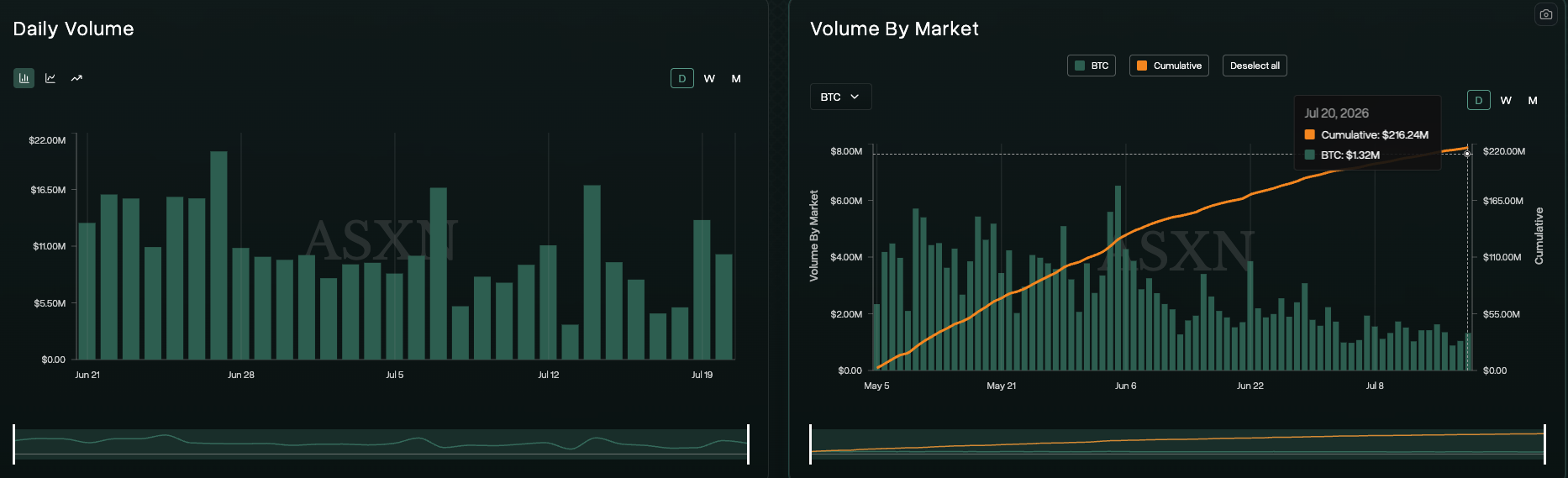
HIP-4 Average Daily and Total Trading Volume

Not only are users and trading volume low, but the number of tradable outcome events on HIP-4 is also very limited. Currently, the entire HIP-4 market has only 6 tradable prediction markets, which is a drop in the bucket compared to Polymarket in terms of both quantity and variety.
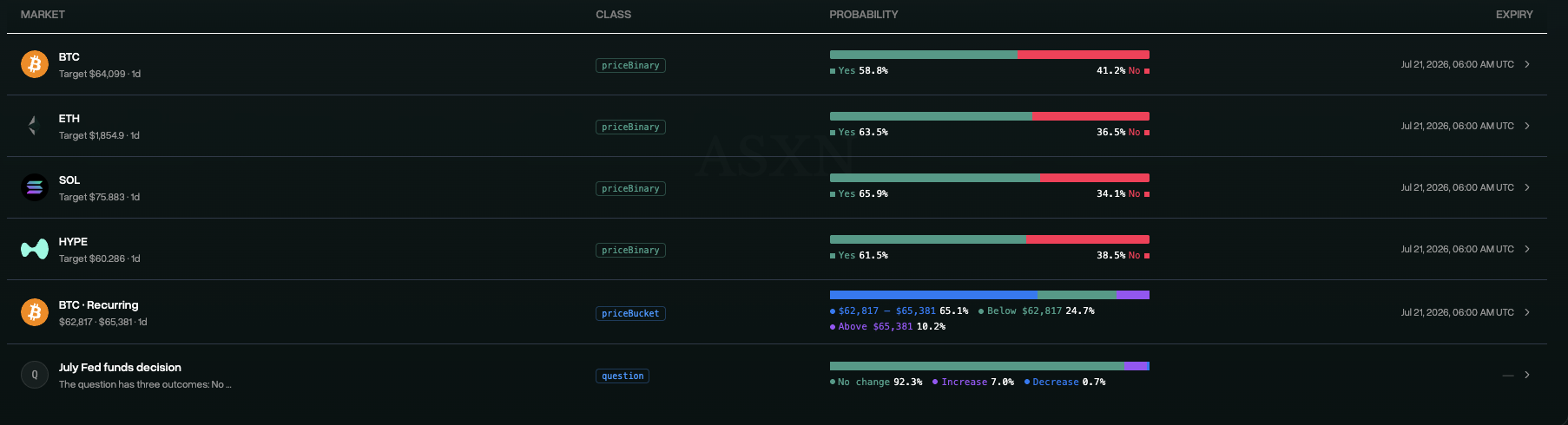
Currently Tradable Events on HIP-4

Faced with such a vast difference in scale, Hyperliquid chose the path of reliance, following the successful experience of HIP-3. Since it couldn't build momentum on its own, it would give the stage to the community to create another Trade.xyz within HIP-4.

Hyperliquid opening permissionless deployment for the HIP-4 market is equivalent to Polymarket allowing users to autonomously open prediction market events. Hyperliquid founder Jeff also stated that permissionless deployment is particularly important for the growth of outcome markets (HIP-4) because the scope for tradable outcomes is extremely broad. The number of independent events suitable for outcome trading far exceeds the number of underlying assets used for derivatives and real-world asset tokenization.

Moreover, having the community or third parties deploy prediction market events offers greater flexibility. The launch of existing prediction market contracts is mainly handled or reviewed by the team, which is not decentralized enough in process. Team members cannot possibly cover all areas of interest comprehensively, especially for hot events in the real world. This model slows down the time from market reaction to final execution and launch.

In the HIP-4 market, as long as a third party stakes enough HYPE tokens, they can launch prediction market events according to their own standards without needing review from the Hyperliquid team. Hyperliquid also stipulates that it will not restrict multiple deployers from simultaneously deploying identical events. This will incentivize healthy competition within the HIP-4 market. Only those providing users with more comprehensive events and deeper liquidity will succeed in the competition.

Hyperliquid's product philosophy has always adhered to a win-win strategy. The HIP-3 market has already nurtured the giant Trade.xyz, which accounts for over 90% of the HIP-3 market share, with the trading volume of its top 10 perpetual contract listings each exceeding $10 billion.

Perhaps many teams are now eager and ready. On the day Hyperliquid opens HIP-4 permissionless deployment on the mainnet, we may witness a lively "battle of the gods."

Can Hyperliquid Disrupt the Prediction Market Landscape?

But can Hyperliquid really "eat all day with one trick"?

First, Hyperliquid is no longer what it used to be. HYPE price has stabilized above $60, and the requirement for HIP-4 market deployers to stake 500,000 HYPE (approximately $30 million) effectively blocks small startup teams. A funding round for a crypto project today might not even reach $30 million, and prediction market projects capable of raising $30 million might prefer to develop their own prediction market platforms.

Therefore, the excessively high staking threshold for HIP-4 deployers may lead to a sharp decrease in third-party competitors. Ultimately, only "well-funded" prediction market projects might come to attract traffic. The number of tradable independent events would also be limited, severely hindering the entire HIP-4's innovation momentum.

Secondly, the timing of Hyperliquid's launch of HIP-4 permissionless deployment didn't even catch the last bus. One major reason 2026 became an opportune year for the development of the prediction market sector is the high density of sporting events in recent years, especially coinciding with the quadrennial World Cup. Various prediction markets have been focusing on World Cup matches. On Polymarket, the total trading volume for the July 20th Argentina vs. Spain match event alone reached $83.75 million.

But Hyperliquid completely missed the crucial time window of the World Cup, which is undoubtedly a huge strategic oversight. Even the success of the HIP-3 market combined various factors of right timing, advantageous location, and human harmony. The international crude oil price fluctuations caused by the US-Iran conflict in February this year served as a significant catalyst for the development of the HIP-3 market. On the first day of the conflict, which fell on a weekend when traditional markets were closed, traders urgently needing to adjust positions and hedge had to find new tradable markets. Hyperliquid's HIP-3 market became the first choice.

When Hyperliquid launched HIP-3, it did not emphasize it was built for stock tokenization and commodity tokenization, but it ultimately gave rise to Trade.xyz and Hyperliquid's current leading position in the tokenized trading market. If Hyperliquid had not seized the opportunity of the US-Iran conflict, perhaps Hyperliquid would not have a position in today's tokenized trading market.

Similarly, having missed the World Cup opportunity, how confident can Hyperliquid be now in disrupting the prediction market giants?


Трендові криптовалюти

Пов'язані питання

QWhat is HIP-4 and what major update did Hyperliquid announce regarding it?

AHIP-4 is Hyperliquid's prediction market feature. Hyperliquid announced that HIP-4 will support permissionless deployment, similar to HIP-3. This allows third parties to independently create and deploy their own prediction markets by staking HYPE tokens.

QAccording to the article, what are the key concerns about HIP-4's permissionless deployment model?

AThe article raises two main concerns. First, the high staking requirement (500,000 HYPE, worth around $30 million) may exclude smaller teams, reducing competition and innovation. Second, Hyperliquid missed the crucial timing window of the World Cup, a major driver for prediction market activity, which could hinder its ability to compete with established players like Polymarket.

QHow does the performance of Hyperliquid's HIP-4 market compare to Polymarket's, based on the data in the article?

AHIP-4's performance is significantly lower than Polymarket's. HIP-4 had a cumulative trading volume of $216 million over 3 months, while Polymarket achieved a trading volume of $4.587 billion in just the past month. HIP-4 also has far fewer active users and tradable markets compared to Polymarket.

QWhat was the strategy behind HIP-3's success that Hyperliquid is trying to replicate with HIP-4?

AThe success of HIP-3 was driven by its permissionless deployment model for perpetual contracts, which empowered third parties like Trade.xyz to create markets. This decentralized approach led to massive growth. Hyperliquid is applying the same 'decentralization' strategy to HIP-4, hoping community-driven event creation will fuel similar expansion in the prediction market sector.

QWhat incentive does Hyperliquid provide for HIP-4 market deployers?

AHyperliquid allows HIP-4 deployers to set up to a 50% fee share on the markets they create. This provides a direct financial incentive for third parties to build and maintain high-quality, liquid prediction markets on the platform.

Пов'язані матеріали

L2 'Recalibration': When L1 Becomes Its Own Rollup, What Is Ethereum's Endgame?

The article discusses the evolving relationship between Ethereum's Layer 1 (L1) and Layer 2 (L2) solutions, moving beyond the initial "L2 for scaling" model. As Ethereum L1 itself scales (increasing Gas Limit, statelessness, zkEVM), the unique value proposition of L2s shifts from merely providing cheap execution to offering differentiated features like application-specific optimization, privacy, and flexible governance. The piece explores three key themes: 1. **L2's New Role:** L2s are transitioning from a pure scaling technology to a spectrum of execution environments with varying degrees of security inheritance from Ethereum L1. 2. **Interoperability as State Trust:** Solving L2 fragmentation is less about cross-chain bridges and more about enabling faster, trust-minimized state verification between environments. This involves initiatives like faster L1 finality, intent-based architectures (Open Intents Framework), and native account abstraction. 3. **Blurring Layers:** With the potential integration of zk-proofs into L1 validation (making L1 akin to its own "Rollup") and the concept of "Native Rollups," the rigid boundary between L1 and L2 may fade. The future could be a unified system with multiple execution domains (for DeFi, gaming, privacy, etc.) sharing a common security, settlement, and state framework. In conclusion, Ethereum's goal is not to abandon L2s or re-centralize everything on L1, but to re-integrate the fragmented user experience—liquidity, accounts, applications—while preserving the scaling benefits of a multi-environment ecosystem. The endgame is a cohesive "one chain" feeling for users, powered by diverse but securely interconnected execution layers.

marsbit20 хв тому

L2 'Recalibration': When L1 Becomes Its Own Rollup, What Is Ethereum's Endgame?

marsbit20 хв тому

The Encryption Bill Clarity's Challenge: A Thorny Path of Bipartisan Compromise in the U.S.

U.S. lawmakers are attempting to advance the Clarity Act, a significant crypto market structure bill, but its path is fraught with partisan hurdles. The process has been rocky since January, when a prior bipartisan deal in the Senate Banking Committee was upended. A key compromise in May on "yield" issues allowed the bill to move forward in committee, but only with the conditional support of two Democratic senators, Angela Alsobrooks and Ruben Gallego. They emphasized that their final vote depends on reaching an agreement on ethics provisions for elected officials. Ultimately, the Senate Agriculture Committee passed its version along party lines without Democratic support. As Republicans push for a full Senate vote in July, the demand for strong ethics language has expanded beyond Democrats. Additional controversies surround provisions related to yields (aligning some Republicans with large banks) and developer protections (opposed by enforcement agencies). Core concerns about illicit finance and consumer protection remain central to the debate. Despite consensus on the need for legislation, achieving the necessary bipartisan compromise is proving difficult. While momentum exists—including recent meetings between senators and White House officials—a reconciled bill text faces skepticism. Senator Gallego has stated that without ethics terms acceptable to Democrats, they will not provide the needed votes. The immediate goals for the crypto community in Congress are unclear: a symbolic Senate vote before the August recess, eventual passage into law by 2026, or forging a final compromise framework. The arduous, vote-by-vote effort to build bipartisan support continues, mirroring the traditional legislative grind the industry must now navigate.

Foresight News1 год тому

The Encryption Bill Clarity's Challenge: A Thorny Path of Bipartisan Compromise in the U.S.

Foresight News1 год тому

Торгівля

Спот

Популярні статті

Як купити 4

Ласкаво просимо до HTX.com! Ми зробили покупку 4 (4) простою та зручною. Дотримуйтесь нашої покрокової інструкції, щоб розпочати свою криптовалютну подорож.Крок 1: Створіть обліковий запис на HTXВикористовуйте свою електронну пошту або номер телефону, щоб зареєструвати обліковий запис на HTX безплатно. Пройдіть безпроблемну реєстрацію й отримайте доступ до всіх функцій.ЗареєструватисьКрок 2: Перейдіть до розділу Купити крипту і виберіть спосіб оплатиКредитна/дебетова картка: використовуйте вашу картку Visa або Mastercard, щоб миттєво купити 4 (4).Баланс: використовуйте кошти з балансу вашого рахунку HTX для безперешкодної торгівлі.Треті особи: ми додали популярні способи оплати, такі як Google Pay та Apple Pay, щоб підвищити зручність.P2P: Торгуйте безпосередньо з іншими користувачами на HTX.Позабіржова торгівля (OTC): ми пропонуємо індивідуальні послуги та конкурентні обмінні курси для трейдерів.Крок 3: Зберігайте свої 4 (4)Після придбання 4 (4) збережіть його у своєму обліковому записі на HTX. Крім того, ви можете відправити його в інше місце за допомогою блокчейн-переказу або використовувати його для торгівлі іншими криптовалютами.Крок 4: Торгівля 4 (4)Легко торгуйте 4 (4) на спотовому ринку HTX. Просто увійдіть до свого облікового запису, виберіть торгову пару, укладайте угоди та спостерігайте за ними в режимі реального часу. Ми пропонуємо зручний досвід як для початківців, так і для досвідчених трейдерів.

475 переглядів усьогоОпубліковано 2025.10.20Оновлено 2026.06.02

Як купити 4

Обговорення

Ласкаво просимо до спільноти HTX. Тут ви можете бути в курсі останніх подій розвитку платформи та отримати доступ до професійної ринкової інформації. Нижче представлені думки користувачів щодо ціни 4 (4).

活动图片