The Largest Upgrade Since The Merge? How Glamsterdam Will Affect Ethereum?

marsbitОпубліковано о 2026-07-02Востаннє оновлено о 2026-07-02

Анотація

Ethereum's next major upgrade, Glamsterdam (combining consensus layer "Gloas" and execution layer "Amsterdam"), is scheduled for late 2026 and considered the most significant overhaul since The Merge. It aims to fundamentally enhance L1 performance and architecture to prepare for substantial capacity increases. The upgrade centers on three core changes: 1. **Enshrined PBS (ePBS - EIP-7732):** Integrates the Proposer-Builder Separation directly into the protocol, eliminating reliance on external relays. This extends the window for processing execution payloads, allowing nodes more time to handle larger blocks and more data, paving the way for a higher Gas Limit. 2. **Block-Level Access Lists (BALs - EIP-7928):** Provides a pre-declared "map" in the block header of all state data (accounts, storage) that transactions will access and modify. This enables potential parallel transaction processing and faster state synchronization for nodes. 3. **Gas Repricing (EIP-8037):** Overhauls the gas model to more accurately reflect the real resource costs for nodes. It separates computation costs from state storage costs, making operations that create permanent state data (like new accounts) more expensive, while computation-heavy operations become relatively cheaper. These changes work together to solve the trilemma of scaling: giving nodes more time to process larger blocks (ePBS), reducing execution bottlenecks (BALs), and controlling unsustainable state growth (Gas Repricing). The...

Ethereum's next major upgrade is now entering the final sprint.

According to the current official Ethereum roadmap, the Glamsterdam upgrade is planned for mainnet activation in the second half of 2026. As of the end of June, it has entered the final testing phase on developer networks. Centered around multi-client devnets, continuous testing is underway for core features like enshrined PBS, block-level access lists, and gas repricing, though the exact activation time has not been finalized.

Meanwhile, on various social media platforms, the most discussed aspect is undoubtedly the compelling performance narrative of "mainnet hitting 10,000 TPS" post-upgrade. However, beyond this, this upgrade represents a fundamental overhaul of Ethereum's block production pipeline and execution engine. The depth and breadth of its changes have led the developer community to widely acclaim it as "the largest-scale upgrade since The Merge."
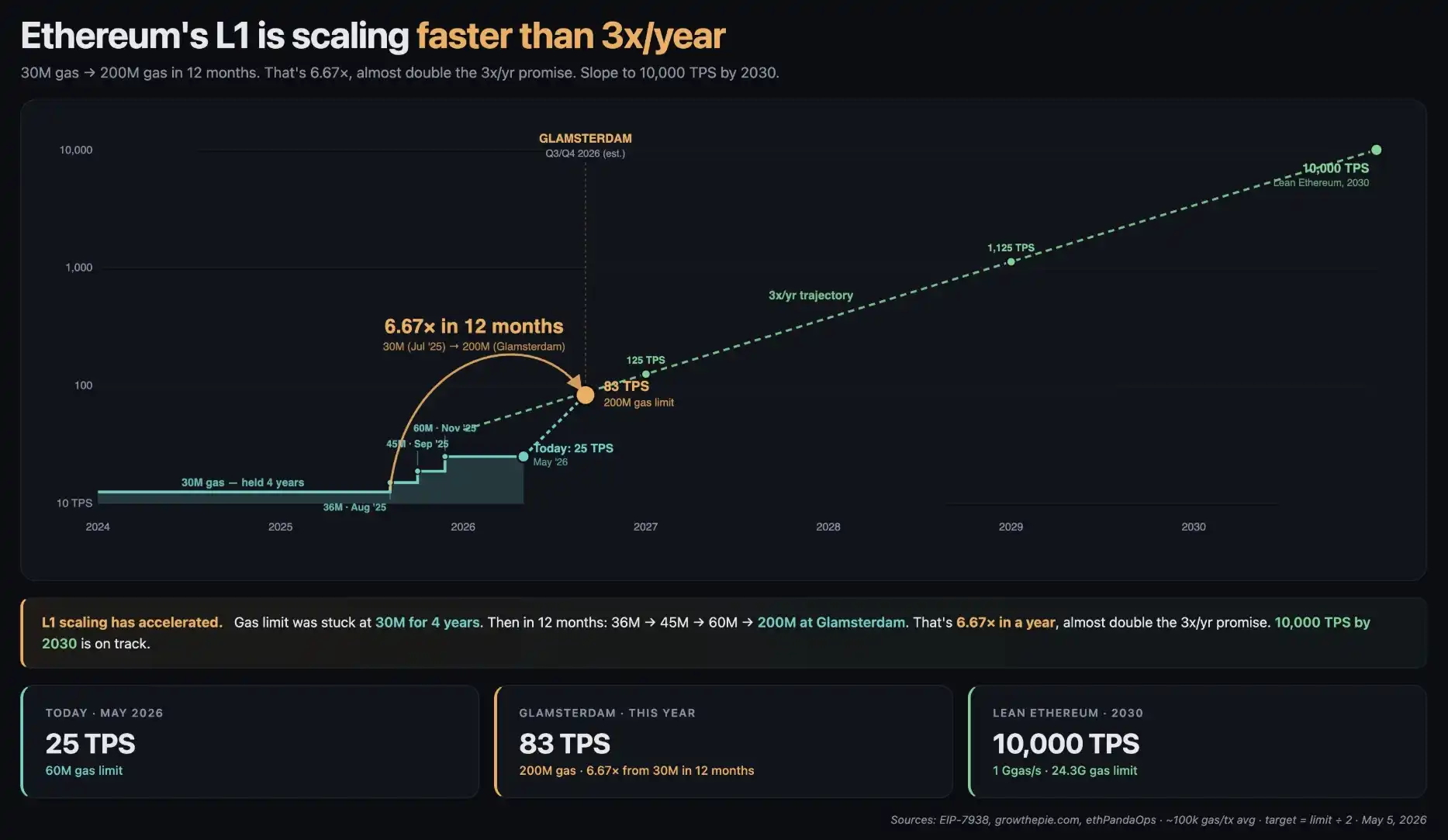
So, what exactly does this rather cool-sounding "Glamsterdam" (a combination of the consensus layer upgrade Gloas and the execution layer upgrade Amsterdam) change? How will it address past pain points, and what transformative changes will it bring to our daily on-chain experience?

I. Why is it the 'Largest Upgrade Since The Merge'?

If previous upgrades like Dencun and Fusaka primarily paved the way for L2 data availability (Blob), then Glamsterdam shifts the focus back to L1, initiating a major renovation of L1 performance and architecture.

This reflects the underlying ethos of Ethereum's current drive to "make L1 great again": how to enable L1 to process more transactions without simultaneously increasing node operation costs and network centralization risks.

However, for ordinary users, Ethereum upgrades are often simplified to one intuitive question: Will gas become cheaper? Will throughput increase? Frankly, the upcoming Glamsterdam is difficult to summarize simply with terms like "fee reduction" or "scaling."

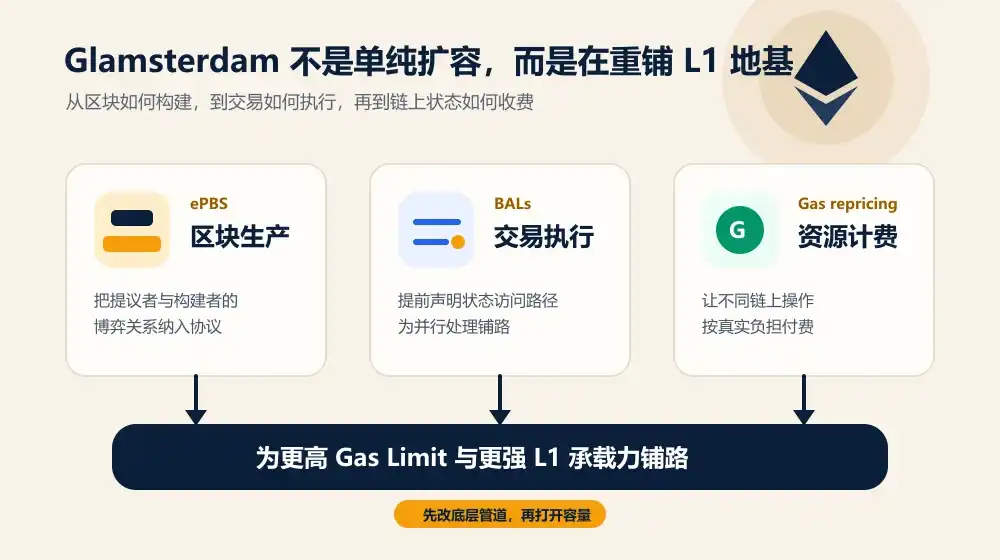
Overall, this upgrade touches multiple critical aspects of Ethereum's underlying infrastructure, including who builds blocks, how transactions are executed, how nodes read and synchronize state, and how much gas different on-chain operations should pay. It essentially redesigns the foundational paradigm for how Ethereum produces and processes blocks. According to the currently disclosed technical details, the most significant core changes focus on three main areas:

  • Enshrined PBS (ePBS): Restructures the game theory between block proposers and builders, eliminating reliance on external relays;
  • Block-Level Access Lists (BALs): Provides a pre-defined map for transaction execution, paving the way for parallel processing and faster node synchronization;
  • Gas Repricing: Introduces a more precise resource pricing model to control state bloat in high-throughput environments;
First, to understand enshrined PBS, one must know that blocks on Ethereum are not necessarily submitted directly by the Proposer. Especially under the current MEV-Boost architecture, most Proposers outsource the tasks of collecting transactions, ordering them, and searching for MEV opportunities to specialized block Builders. The Proposer is primarily responsible for selecting the candidate block with the highest bid to submit to the network.

This division of labor—"Builder assembles, Proposer submits"—is PBS (Proposer-Builder Separation).

The problem, however, is that this mechanism is not fully encoded into Ethereum's underlying protocol—Proposers and Builders must rely on off-protocol third-party software and MEV-Boost Relay services to complete block bidding, content delivery, and payment.

This means Relays must ensure Builders eventually publish the full block and prevent Proposers from "front-running" by peeking at the block content and refusing payment. Thus, they occupy a fragile and centralized role as a "trusted intermediary."

The ePBS (Enshrined PBS) proposed by EIP-7732 aims to solve this exact pain point. It plans to integrate this game theory directly into Ethereum's consensus protocol itself, eliminating third-party relays entirely. Builders become natively recognized participants in the protocol. They first submit a block commitment and bid, the protocol automatically locks the corresponding payment, and then a dedicated "Payload Timeliness Committee" judges whether the Builder publishes the execution payload on time.

This decouples the processing of the consensus block and the execution payload, extending the propagation and processing window for the execution payload from about 2 seconds to approximately 9 seconds. These few extra seconds, while seemingly small, are crucial for Ethereum scaling—it means nodes gain more time to receive and process larger blocks and more Blob data, thereby creating room to further increase the Gas Limit.

Second, another core breakthrough of Glamsterdam on the execution layer is Block-Level Access Lists (BALs) proposed by EIP-7928.

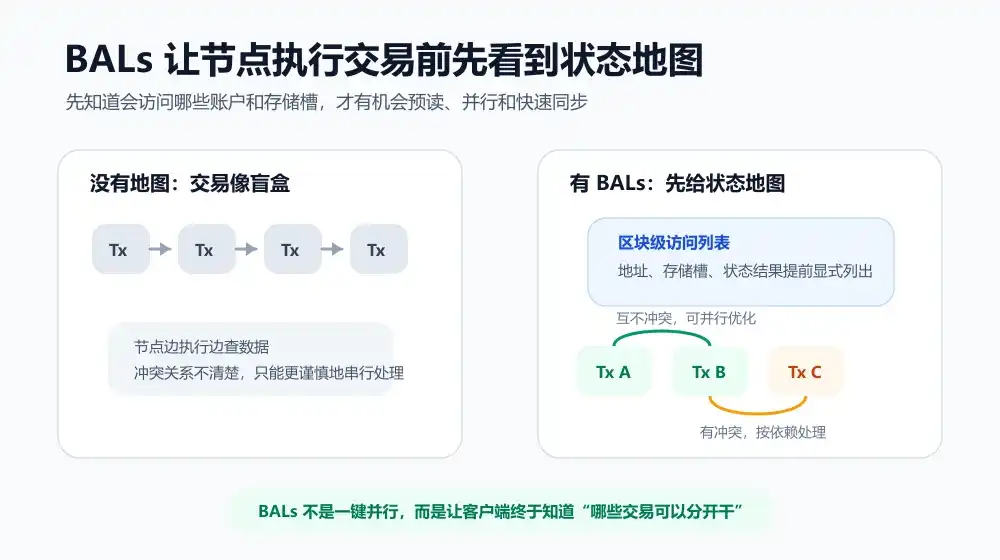
As is well known, currently, Ethereum nodes cannot directly learn from a block which accounts each transaction will read, which contract storage it will access, or which states it will modify. They typically discover these data dependencies only during the transaction execution process.

This is like entering a large warehouse to retrieve goods without a complete inventory list. Workers must search while processing. Therefore, to prevent two people from modifying the same inventory simultaneously, most work must be done strictly in a fixed order (single-threaded serial execution).

Block-Level Access Lists (BALs) are equivalent to attaching a complete "state access map" to each block. They declare in the block header in advance which addresses and storage slots the transaction set within that block will touch, as well as the resulting state after execution. With this map, nodes can immediately discern which transactions access the same data and which are conflict-free before execution:

For the conflict-free parts, nodes can prefetch related state from disk and perform parallel transaction validation and state root calculation, without needing to queue all work into a strictly serial pipeline. Furthermore, since BALs also record state changes after transaction execution, some nodes can use these results for state reconstruction during network synchronization and catch-up, without having to execute every transaction in the block from scratch in all scenarios (the author's personal interpretation sees a flavor of sharding concepts here), potentially making Ethereum a more parallel-executable blockchain.

Therefore, in the long run, this is also a key underlying element for Ethereum's mainnet to break through its performance ceiling.
Finally, there's Gas Repricing, which fundamentally recalibrates the gas pricing for various on-chain operations primarily through economic levers.

The reason is that Ethereum's current gas costs do not perfectly align with the actual resource consumption borne by nodes. For example, a pure, complex computation, once executed, typically doesn't leave nodes with much long-term burden. However, creating a new account, deploying a smart contract, or writing to a new storage slot generates data that needs to be permanently stored by all full nodes globally.

Historically, the fees for these state-creation behaviors have not fully reflected their permanent storage costs (state explosion). If Ethereum maintains its original pricing after increasing the Gas Limit, the additional block space could quickly translate into uncontrollable state data, ultimately overwhelming node hardware.

EIP-8037, which has been confirmed for inclusion in Glamsterdam, aims to completely restructure these rules. This includes separating computation and state accounting, recalculating costs based on the volume of new state data added, distinguishing between ordinary computation gas and state gas; and controlling state explosion, making operations that create numerous new accounts, deploy large redundant contracts, or frequently write new state potentially more expensive. Meanwhile, applications primarily consuming immediate computational resources without persistently increasing state will find their fee structure more attractive.

Ultimately, Glamsterdam's gas reform shouldn't be simplistically understood as "across-the-board fee reduction." Instead, it clarifies how much immediate computational resource a transaction consumes versus the long-term storage burden it leaves on the network, then makes different operations pay in a way that more closely reflects their true physical cost.

Overall, these three parts, while seemingly independent, collectively point towards the same ultimate goal: to renovate the underlying core infrastructure in advance, paving the way for Ethereum's mainnet to further and significantly increase its Gas Limit and processing capacity.

II. Why Not Simply Make Blocks Bigger?

Many might wonder: if it's too slow and expensive, why not simply increase the Gas Limit and double the block capacity directly?

This is a perennial question. Theoretically, the most direct way to increase mainnet capacity is indeed to raise the maximum gas allowed per block. A higher Gas Limit means a block can accommodate more transactions and computations.

However, the Gas Limit is not a number that can be increased infinitely. Blindly enlarging blocks triggers a domino effect: nodes must receive more data, execute more transactions, and compute new states within the same timeframe. If processing speed can't keep up, weaker nodes are more likely to fall behind, block propagation and validation may experience delays, ultimately increasing the risk of network forks and centralization.

Simultaneously, more transactions also mean more accounts, contracts, and storage data permanently written to Ethereum's database. This data doesn't disappear after the transaction ends but continuously accumulates in Ethereum's state database, leading to faster state bloat.

Therefore, Ethereum scaling is not a simple arithmetic problem; it needs to solve three challenges simultaneously:

  • First, how to give nodes more time to propagate and process larger blocks;
  • Second, how to reduce the performance bottlenecks caused by serial transaction execution;
  • Finally, how to prevent additional block space from rapidly translating into uncontrollable state inflation;

This is the core logic of Glamsterdam. Instead of scaling first and forcing nodes to bear the brunt, it first restructures the methods of block production, transaction execution, and resource pricing, clearing the underlying pipelines, and then naturally opening the door for increased mainnet capacity.

Among these, ePBS rearranges the block processing flow within a slot, giving nodes more time to propagate and validate larger blocks; BALs enhances client efficiency in reading, executing, and synchronizing by explicitly providing state access relationships; and Gas Repricing is responsible for limiting unsustainable state growth.

During the Glamsterdam collaboration test in April 2026, core developers conducted intensive stress testing around multi-client implementations and explicitly proposed a post-upgrade technical target of 200 million gas as a credible capacity floor. The underlying support for this target comes precisely from the combined foundation provided by ePBS, BALs, and state gas repricing.

Of course, 200 million gas is closer to the system's post-upgrade carrying capacity and a direction for future evolution. It does not mean the mainnet's Gas Limit will immediately jump to this level on the day Glamsterdam activates.

What truly matters is that Ethereum is shifting from a past approach of "cautious, incremental scaling" towards "preparing in advance for more substantial mainnet scaling through foundational structural overhaul."

III. How Will Ordinary Users and the Ethereum Ecosystem Be Affected?

From the perspective of ordinary users, the most concerning question about the Glamsterdam upgrade remains: will transaction fees decrease?

Overall, the answer leans more towards likely decreasing and becoming more stable, rather than all transactions becoming instantly cheaper.

Since ePBS and Block-Level Access Lists create conditions for a higher Gas Limit, it can be foreseen that the number of transactions each block can accommodate will definitely increase. With on-chain demand remaining constant, the increased supply of block space should naturally help alleviate congestion and reduce the probability of sudden Base Fee spikes.

However, the impact on individual transactions may vary depending on the operation. For example, simple ETH transfers may benefit from basic gas optimization; and because BALs inform about state paths in advance, wallets' accuracy in estimating gas fees will significantly improve. The poor experience of transaction failures and fees being deducted due to inaccurate wallet gas estimation during market volatility will become a thing of the past.

On the other hand, operations like deploying contracts, batch-creating accounts, or writing large amounts of new state might see increased costs due to state repricing. Therefore, Glamsterdam is more likely to result in lower costs for simple transactions, more stable fees during congestion periods, while simultaneously making state-intensive applications pay a more accurate price for the long-term network resources they occupy.
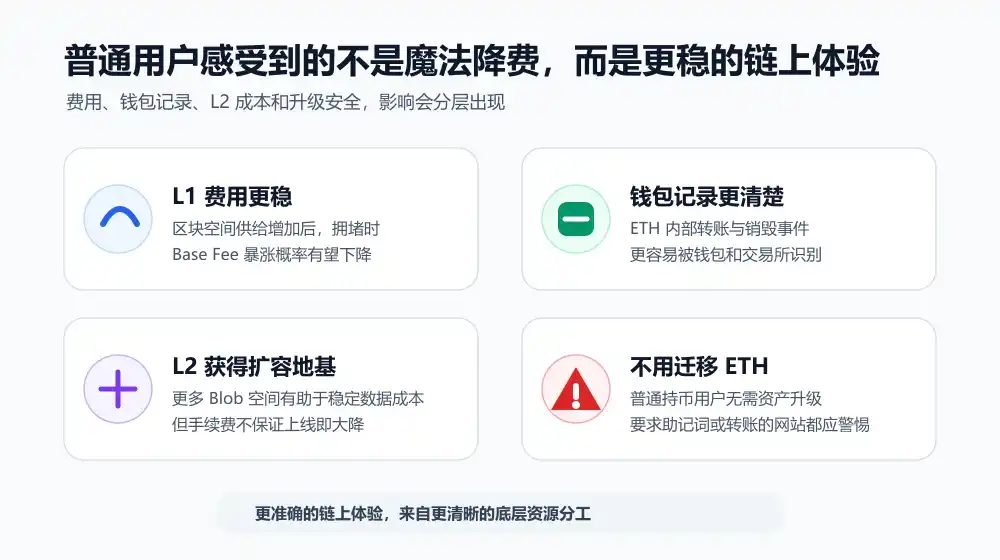
For users primarily on L2s, this upgrade is not irrelevant. By extending the data propagation window for execution payloads from about 2 seconds to about 9 seconds, ePBS not only supports larger mainnet blocks but also leaves room for Ethereum to handle more Blob data. With continued expansion of Blob capacity, Rollups will have more ample space to submit transaction data, which in the long run helps stabilize L2 data costs.

Additionally, a more user-perceptible change for wallets, exchanges, and cross-chain bridges might come from EIP-7708. Currently, ERC-20 token transfers typically generate standardized Transfer logs, but some native ETH transfers between smart contracts do not leave similarly clear event records. Wallets and trading platforms often need to rely on additional internal transaction tracing tools to identify these ETH movements.

EIP-7708 requires non-zero ETH transfers and ETH burn operations to generate standard logs, enabling wallets, exchanges, and bridges to more reliably identify deposits, withdrawals, and internal ETH movements within contracts. In the future, users may see more complete ETH asset records, and some internal transfers that previously required complex transaction tracing to display may be more easily recognized directly by wallets.

For node operators and stakers, the impact is more direct. Since Glamsterdam changes block processing methods on both the execution and consensus layers, nodes and validators need to upgrade to client versions supporting Glamsterdam before mainnet activation. Ordinary ETH holders do not need to migrate their ETH or perform any so-called "asset upgrades" or "token swaps."

Looking further ahead, what Glamsterdam truly impacts is how Ethereum rebalances the trade-off between scaling and decentralization. After all, if increased block capacity leads to a significant simultaneous rise in the hardware costs required to run a node, while mainnet throughput increases, the network might become increasingly reliant on large institutions.

The combination of ePBS, Block-Level Access Lists, and state gas repricing attempts to chart a different scaling path: not simply demanding nodes process more work in the same time, but rather reorganizing the block production flow, providing transaction dependency information in advance, and charging for different resources based on their actual burden.

This is the most fundamental difference between Glamsterdam and a simple Gas Limit increase. It doesn't attempt to solve all of Ethereum's problems with a single EIP, but simultaneously overhauls three interconnected mechanisms: block production, transaction execution, and state growth.

In Conclusion

In the long term, what Glamsterdam profoundly affects is the narrative direction of how Ethereum rebalances "high-performance scaling" with "absolute decentralization."

This also reflects Ethereum's increasingly familiar original intention or inherent tendency—in the face of competitive pressure from high-performance monolithic blockchains, instead of opting for a simple, brute-force increase in hardware requirements, it chooses a path that strives to maintain its decentralized ethos and possesses more fundamental resilience. Just like this time, through a combination of rewriting the block pipeline (ePBS), providing explicit transaction dependencies in advance (BALs), and making different resources pay precisely according to their physical burden (Gas Repricing), the aim is still to carve out greater mainnet capacity under the premise of ensuring ordinary people can run nodes and participate in validation.

From this perspective, every cost-effective gas fee we pay in the future, the more accurate and clear internal ETH transaction records in our wallets, and the broader space for L2 fee reductions will perhaps all deeply benefit from the foundational groundwork that Glamsterdam lays for Ethereum in the second half of 2026.

Трендові криптовалюти

Пов'язані питання

QWhat is the main goal of the Glamsterdam upgrade for Ethereum?

AThe main goal of the Glamsterdam upgrade is not simply to increase capacity or lower fees, but to fundamentally restructure Ethereum's core infrastructure. It aims to pave the way for a significant future increase in the mainnet's processing capacity (Gas Limit) by overhauling the block production pipeline, transaction execution engine, and resource pricing model, while better balancing performance with decentralization.

QWhat are the three core changes introduced by the Glamsterdam upgrade according to the article?

AThe three core changes are: 1. Enshrined PBS (ePBS): It embeds Proposer-Builder Separation directly into the consensus protocol, eliminating reliance on external relays and allowing more time for block propagation. 2. Block-Level Access Lists (BALs): They provide a 'map' of state data accessed by transactions in a block, enabling potential parallel processing and faster node synchronization. 3. Gas Repricing: It introduces a more precise resource billing model, separating computation cost from state storage cost to control state bloat.

QHow will the Glamsterdam upgrade potentially affect transaction fees for ordinary users?

AFees are expected to become more stable and potentially decrease for simple transactions. Increased block space from a higher possible Gas Limit could reduce congestion. However, fees will not uniformly drop; operations that create new state (like deploying contracts) may become more expensive due to the new Gas repricing model. Additionally, gas estimation by wallets will become more accurate.

QWhy can't Ethereum simply increase the Gas Limit to scale, as mentioned in the article?

ASimply increasing the Gas Limit to create larger blocks would cause a domino effect: nodes would struggle to process more data within the same timeframe, leading to propagation delays, increased risk of network forks, and greater centralization as weaker nodes fall behind. It would also accelerate 'state bloat,' the uncontrolled growth of permanent data all nodes must store. Glamsterdam addresses these underlying issues first to enable sustainable scaling.

QWhat positive impact does EIP-7708, part of Glamsterdam, have on user experience?

AEIP-7708 mandates that non-zero native ETH transfers and ETH burns generate standard log events. This will allow wallets, exchanges, and bridges to more reliably track ETH movements, including internal contract transactions. As a result, users will see more complete and accurate records of their ETH transactions in their wallet history.

Пов'язані матеріали

Solana Expands Validator Power With Launch of On-Chain Governance

Solana has formally launched its on-chain governance system, empowering token holders and validators with a more open and decentralized way to influence major protocol decisions. Governance debates and voting are now conducted entirely on-chain using the new Solana Governance Proposals (SGP) framework, supported by stake-weighted voting and cryptographic verification. Validators with at least 100,000 SOL in delegated stake can submit an SGP. To proceed to a formal vote, a proposal must first gain support from at least 15% of the network's total staked SOL, ensuring only ideas with significant backing move forward. SGPs serve a distinct purpose from the technical Solana Improvement Documents (SIMDs). While SIMDs focus on *how* to implement protocol upgrades, SGPs determine *whether* the broader ecosystem believes a proposal should proceed, via an on-chain, stake-weighted vote. This separation allows core developers to continue building effectively while reserving community-wide votes for impactful decisions. A key feature grants delegators greater control: they can now override their validator's governance vote. If a validator votes against a delegator's preference or abstains, the delegator can cast a vote directly using their own stake weight through Solana's governance portal. The voting process is secured using Merkle proofs to verify participant stakes against an on-chain consensus snapshot. With this implementation, Solana aims to broaden community participation in governance without hindering development, combining decentralized decision-making with efficient protocol evolution.

TheNewsCrypto24 хв тому

Solana Expands Validator Power With Launch of On-Chain Governance

TheNewsCrypto24 хв тому

Trillion-Won Bet on Semiconductors: Is South Korea Really Panicking This Time?

**Summary:** South Korea, traditionally adept at "counter-cyclical" investments during industry downturns, has launched an unprecedented trillion-dollar (approximately 6.4 trillion RMB) semiconductor investment plan during a current AI-driven boom. This shift signals deep strategic anxiety, driven by the rapid rise of China's memory chip challengers. The article traces this dynamic through the history of East Asian semiconductor competition. In the 1980s, Japan used a "national system + industrial capital" model to surpass the US in DRAM, only to be overtaken in the 1990s by South Korea employing the same aggressive, efficiency-focused tactics—most notably massive, loss-tolerant investments during downturns to crush competitors like Japan's Elpida. Now, China's memory giants, Yangtze Memory (YMTC) and ChangXin Memory Technologies (CXMT), are employing a strikingly similar playbook. Starting from near-zero a decade ago, they've used a combination of government-backed capital, strategic technology acquisition (e.g., CXMT leveraging Qimonda's legacy), and innovative architectural leaps (e.g., YMTC's Xtacking) to achieve rapid technological catch-up. Crucially, during the severe industry downturn of 2023, while Korean and US giants cut production, the Chinese firms expanded capacity and competed on price, rapidly gaining global market share (reaching ~11% in NAND and ~7.67% in DRAM by 2025). South Korea's current massive investment, therefore, is a defensive move born of fear. The historical pattern suggests that once a technological gap closes, scale and integrated supply chain advantages—areas where China holds significant potential—can determine the leader. Having used counter-cyclical strategies to become the incumbent, South Korea now faces the prospect of a formidable challenger using those very same tactics. This investment marks not just a bet on the AI cycle, but the opening chapter in a new battle for dominance in the memory industry.

marsbit34 хв тому

Trillion-Won Bet on Semiconductors: Is South Korea Really Panicking This Time?

marsbit34 хв тому

Торгівля

Спот

Популярні статті

Що таке ETH 2.0

ETH 2.0: Нова ера для Ethereum Вступ ETH 2.0, широко відомий як Ethereum 2.0, є величезним оновленням для блокчейну Ethereum. Ця трансформація не є лише косметичною зміною; вона має на меті фундаментально покращити масштабованість, безпеку та сталий розвиток мережі. З переходом від енергомісткого механізму консенсусу Proof of Work (PoW) до більш ефективного Proof of Stake (PoS), ETH 2.0 обіцяє трансформаційний підхід до екосистеми блокчейнів. Що таке ETH 2.0? ETH 2.0 — це збірка особливих, взаємопов’язаних оновлень, спрямованих на оптимізацію можливостей та продуктивності Ethereum. Це перетворення розроблене для вирішення критичних викликів, з якими стикалося існуюче механізм Ethereum, зокрема щодо швидкості транзакцій та заторів у мережі. Мета ETH 2.0 Основні цілі ETH 2.0 зосереджені на покращенні трьох ключових аспектів: Масштабованість: Мета — значно підвищити кількість транзакцій, які мережа може обробити за секунду; ETH 2.0 прагне вийти за межі поточного обмеження приблизно в 15 транзакцій на секунду, потенційно досягнувши тисяч. Безпека: Підвищені заходи безпеки є невід’ємною частиною ETH 2.0, зокрема через покращену стійкість до кібератак і збереження децентралізованої етики Ethereum. Сталий розвиток: Новий механізм PoS розроблений не тільки для підвищення ефективності, але й для різкого зменшення споживання енергії, що узгоджує операційну структуру Ethereum з екологічними міркуваннями. Хто є творцем ETH 2.0? Створення ETH 2.0 можна віднести до Ethereum Foundation. Ця неприбуткова організація, яка відіграє важливу роль у підтримці розвитку Ethereum, очолюється відомим співавтором Віталіком Бутеріним. Його бачення більш масштабованого та стійкого Ethereum стало рушійною силою цього оновлення, залучаючи внески зі всього світу від розробників і ентузіастів, які прагнуть покращити протокол. Хто є інвесторами ETH 2.0? Хоча подробиці про інвесторів ETH 2.0 не були оприлюднені, відомо, що Ethereum Foundation отримує підтримку від різних організацій та осіб у сфері блокчейну та технологій. Ці партнери включають венчурні капітальні компанії, технологічні компанії та філантропічні організації, які мають спільний інтерес у підтримці розвитку децентралізованих технологій та інфраструктури блокчейну. Як працює ETH 2.0? ETH 2.0 відзначається введенням низки ключових функцій, які відрізняють його від попередника. Proof of Stake (PoS) Перехід до механізму консенсусу PoS є одним із знакових змін ETH 2.0. На відміну від PoW, який покладається на енергомісткий видобуток для перевірки транзакцій, PoS дозволяє користувачам підтверджувати транзакції та створювати нові блоки відповідно до кількості ETH, яку вони ставлять у мережі. Це призводить до підвищення енергоефективності, зменшуючи споживання приблизно на 99,95%, завдяки чому Ethereum 2.0 стає значно більш екологічною альтернативою. Шардові ланцюги Шардові ланцюги є ще одним ключовим нововведенням ETH 2.0. Ці менші ланцюги працюють паралельно з основним ланцюгом Ethereum, що дозволяє обробляти кілька транзакцій одночасно. Це підходи покращує загальну ємність мережі, усуваючи проблеми масштабованості, які переслідували Ethereum. Beacon Chain У центрі ETH 2.0 знаходиться Beacon Chain, яка координує мережу і управляє протоколом PoS. Вона виконує роль організатора: контролює валідаторів, забезпечує з’єднання шард з мережею і моніторить загальний стан екосистеми блокчейнів. Хронологія ETH 2.0 Шлях ETH 2.0 характеризується кількома ключовими етапами, які відображають еволюцію цього значного оновлення: Грудень 2020: Запуск Beacon Chain ознаменував введення PoS, проклавши шлях до міграції на ETH 2.0. Вересень 2022: Завершення "Злиття" є знаковим моментом, коли мережа Ethereum успішно перейшла з PoW на PoS, відкриваючи нову еру для Ethereum. 2023: Очікуване розгортання шардових ланцюгів має на меті подальше покращення масштабованості мережі Ethereum, закріплюючи ETH 2.0 як надійну платформу для децентралізованих додатків і послуг. Ключові особливості та переваги Покращена масштабованість Однією з найзначніших переваг ETH 2.0 є його покращена масштабованість. Поєднання PoS та шардових ланцюгів дозволяє мережі розширити свою ємність, що дозволяє їй обробляти набагато більший обсяг транзакцій в порівнянні з класичною системою. Енергоефективність Запровадження PoS є величезним кроком до енергоефективності в технології блокчейн. Значно зменшуючи споживання енергії, ETH 2.0 не тільки знижує операційні витрати, але також ближче узгоджується з глобальними цілями сталого розвитку. Підвищена безпека Оновлені механізми ETH 2.0 сприяють підвищенню безпеки по всій мережі. Впровадження PoS, поряд з інноваційними контрольними заходами, встановленими через шардові ланцюги та Beacon Chain, забезпечує вищий рівень захисту від потенційних загроз. Зниження витрат для користувачів З покращенням масштабованості вплив на витрати на транзакції також стане очевидним. Збільшена ємність і зменшені затори, як очікується, призведуть до зниження зборів для користувачів, що зробить Ethereum більш доступним для повсякденних транзакцій. Висновок ETH 2.0 є значною еволюцією в екосистемі блокчейну Ethereum. Оскільки він вирішує важливі питання, такі як масштабованість, споживання енергії, ефективність транзакцій і загальна безпека, важливість цього оновлення не можна недооцінювати. Перехід до Proof of Stake, введення шардових ланцюгів і фундаментальна робота Beacon Chain свідчать про майбутнє, в якому Ethereum може задовольнити зростаючі вимоги децентралізованого ринку. В індустрії, що рухається вперед завдяки інноваціям та прогресу, ETH 2.0 є підтвердженням можливостей технології блокчейн у прокладенні шляху до більш сталого та ефективного цифрового економіки.

181 переглядів усьогоОпубліковано 2024.04.04Оновлено 2024.12.03

Що таке ETH 2.0

Що таке ETH 3.0

ETH3.0 та $eth 3.0: Глибоке дослідження майбутнього Ethereum Вступ У швидко змінюваному світі криптовалют та технології блокчейн, ETH3.0, часто позначуваний як $eth 3.0, став темою значного інтересу та спекуляцій. Цей термін охоплює два основні концепти, які потребують уточнення: Ethereum 3.0: Це потенційне майбутнє оновлення, яке має на меті покращення можливостей існуючого блокчейну Ethereum, зокрема, фокусуючись на поліпшенні масштабованості та продуктивності. ETH3.0 Мем Токен: Цей окремий криптовалютний проект прагне використовувати блокчейн Ethereum для створення екосистеми, орієнтованої на меми, сприяючи залученню до криптовалютної громади. Розуміння цих аспектів ETH3.0 є важливим не лише для криптоентузіастів, але й для тих, хто спостерігає за широкими технологічними тенденціями у цифровому просторі. Що таке ETH3.0? Ethereum 3.0 Ethereum 3.0 пропонується як оновлення вже існуючої мережі Ethereum, яка стала основою багатьох децентралізованих додатків (dApps) та смарт-контрактів з моменту свого виникнення. Передбачувані удосконалення зосереджені в основному на масштабованості — інтегруючи передові технології, такі як шардінг та нульові знання (zk-докази). Ці технологічні нововведення націлені на забезпечення безпрецедентної кількості транзакцій на секунду (TPS), потенційно досягаючи мільйонів, тим самим вирішуючи одну з найзначніших обмежень, з якими стикається сучасна технологія блокчейн. Покращення є не лише технічним, а й стратегічним; воно спрямоване на підготовку мережі Ethereum до широкого прийняття та корисності в майбутньому, позначеному збільшеним попитом на децентралізовані рішення. ETH3.0 Мем Токен На відміну від Ethereum 3.0, ETH3.0 Мем Токен пропонує легшу та грайливішу домену, поєднуючи культуру інтернет-мемів із динамікою криптовалют. Цей проект дозволяє користувачам купувати, продавати та обмінювати меми на блокчейні Ethereum, надаючи платформу, яка сприяє залученню громади через креативність та спільні інтереси. ETH3.0 Мем Токен має на меті продемонструвати, як технологія блокчейн може перетинатися з цифровою культурою, створюючи випадки використання, які є водночас розважальними та фінансово життєздатними. Хто є творцем ETH3.0? Ethereum 3.0 Ініціатива щодо Ethereum 3.0 переважно підтримується консорціумом розробників та дослідників у межах громади Ethereum, зокрема, до складу якого входить Джастін Дрейк. Відомий своїми думками та внеском у розвиток Ethereum, Дрейк є помітною особистістю в обговореннях щодо переходу Ethereum на новий рівень консенсусу, який називається «Beam Chain». Цей колабораційний підхід до розробки свідчить про те, що Ethereum 3.0 не є продуктом єдиного творця, а скоріше втіленням колективної винахідливості, спрямованої на просування технології блокчейн. ETH3.0 Мем Токен Деталі про творця ETH3.0 Мем Токена наразі не відстежуються. Природа мем-токенів часто призводить до більш децентралізованої та громартової структури, що може пояснити відсутність специфічної атрибуції. Це узгоджується з етикою ширшої крипто-спільноти, де інновації часто виникають з колективних, а не індивідуальних зусиль. Хто є інвесторами ETH3.0? Ethereum 3.0 Підтримка Ethereum 3.0 переважно надходить від Фонду Ethereum поряд з ентузіастичною спільнотою розробників та інвесторів. Це базове співробітництво надає значний градус легітимності та підвищує ймовірність успішної реалізації, оскільки воно використовує довіру та авторитет, накопичені за роки роботи мережі. У швидко змінюваному кліматі криптовалют підтримка громади займає важливу роль у розвитку та прийнятті, позиціонуючи Ethereum 3.0 як серйозного конкурента для майбутніх блокчейн-інновацій. ETH3.0 Мем Токен Хоча наразі доступні джерела не надають явної інформації щодо інвестиційних фондів або організацій, що підтримують ETH3.0 Мем Токен, це свідчить про типову модель фінансування для мем-токенів, яка часто спирається на підтримку знизу та залучення громади. Інвестори в такі проекти зазвичай складаються з осіб, які мотивовані потенціалом інновацій, що керуються спільнотою, та духом співпраці, притаманним крипто-спільноті. Як працює ETH3.0? Ethereum 3.0 Відмінні риси Ethereum 3.0 полягають у його запропонованій реалізації технології шардінгу та zk-proof. Шардінг — це метод розподілу блокчейну на менші, керовані частини чи «шарди», які можуть обробляти транзакції одночасно, а не послідовно. Це децентралізоване оброблення допомагає запобігти заторам та забезпечити оперативність мережі навіть під великим навантаженням. Технологія нульових доказів (zk-proof) надає ще один рівень складності, дозволяючи валідацію транзакцій без розкриття підпорядкованих даних. Цей аспект не лише підвищує конфіденційність, а й збільшує загальну ефективність мережі. Також обговорюється включення нульової Ефірної віртуальної машини (zkEVM) в це оновлення, що ще більше підвищить можливості та корисність мережі. ETH3.0 Мем Токен ETH3.0 Мем Токен виділяється завдяки використанню популярності культури мемів. Він створює ринок, на якому користувачі можуть брати участь у торгівлі мемами не лише для розваги, але й для потенційного економічного вигоди. Інтегруючи функції, такі як стейкінг, забезпечення ліквідності та механізми управління, проект сприяє створенню середовища, яке заохочує взаємодію та участь громади. Пропонуючи унікальне поєднання розваг та економічних можливостей, ETH3.0 Мем Токен прагне залучити різну аудиторію, яка охоплює від криптоентузіастів до casual-консумерів мемів. Хронологія ETH3.0 Ethereum 3.0 11 листопада 2024: Джастін Дрейк натякає на майбутнє оновлення ETH 3.0, яке зосереджене на поліпшеннях масштабованості. Це оголошення означає початок формальних обговорень щодо майбутньої архітектури Ethereum. 12 листопада 2024: Очікується, що запропоновану пропозицію для Ethereum 3.0 буде представлено на Devcon у Бангкоку, що готує ґрунт для більш широкого зворотного зв'язку від громади та потенційних наступних кроків у розвитку. ETH3.0 Мем Токен 21 березня 2024: ETH3.0 Мем Токен офіційно потрапляє у список на CoinMarketCap, що означає його дебют у публічному крипто-просторі та підвищує видимість для його меморієнтованої екосистеми. Ключові моменти На завершення, Ethereum 3.0 представляє значну еволюцію в межах мережі Ethereum, зосереджуючись на подоланні обмежень щодо масштабованості та продуктивності через передові технології. Його запропоновані оновлення відображають проактивний підхід до майбутніх вимог і корисності. Натомість ETH3.0 Мем Токен втілює суть культури, керованої громадою, у сфері криптовалют, використовуючи культуру мемів для створення привабливих платформ, які заохочують творчість і участь користувачів. Розуміння окремих цілей і функцій ETH3.0 та $eth 3.0 є надзвичайно важливим для кожного, хто цікавиться поточними подіями в крипто-просторі. З обома ініціативами, які прокладають унікальні шляхи, вони разом підкреслюють динамічну та багатогранну природу інновацій у блокчейн-технологіях.

173 переглядів усьогоОпубліковано 2024.04.04Оновлено 2024.12.03

Що таке ETH 3.0

Як купити ETH

Ласкаво просимо до HTX.com! Ми зробили покупку Ethereum (ETH) простою та зручною. Дотримуйтесь нашої покрокової інструкції, щоб розпочати свою криптовалютну подорож.Крок 1: Створіть обліковий запис на HTXВикористовуйте свою електронну пошту або номер телефону, щоб зареєструвати обліковий запис на HTX безплатно. Пройдіть безпроблемну реєстрацію й отримайте доступ до всіх функцій.ЗареєструватисьКрок 2: Перейдіть до розділу Купити крипту і виберіть спосіб оплатиКредитна/дебетова картка: використовуйте вашу картку Visa або Mastercard, щоб миттєво купити Ethereum (ETH).Баланс: використовуйте кошти з балансу вашого рахунку HTX для безперешкодної торгівлі.Треті особи: ми додали популярні способи оплати, такі як Google Pay та Apple Pay, щоб підвищити зручність.P2P: Торгуйте безпосередньо з іншими користувачами на HTX.Позабіржова торгівля (OTC): ми пропонуємо індивідуальні послуги та конкурентні обмінні курси для трейдерів.Крок 3: Зберігайте свої Ethereum (ETH)Після придбання Ethereum (ETH) збережіть його у своєму обліковому записі на HTX. Крім того, ви можете відправити його в інше місце за допомогою блокчейн-переказу або використовувати його для торгівлі іншими криптовалютами.Крок 4: Торгівля Ethereum (ETH)Легко торгуйте Ethereum (ETH) на спотовому ринку HTX. Просто увійдіть до свого облікового запису, виберіть торгову пару, укладайте угоди та спостерігайте за ними в режимі реального часу. Ми пропонуємо зручний досвід як для початківців, так і для досвідчених трейдерів.

3.2k переглядів усьогоОпубліковано 2024.12.10Оновлено 2026.06.02

Як купити ETH

Обговорення

Ласкаво просимо до спільноти HTX. Тут ви можете бути в курсі останніх подій розвитку платформи та отримати доступ до професійної ринкової інформації. Нижче представлені думки користувачів щодо ціни ETH (ETH).

活动图片