Claude Starts Independently Designing New Proteins, Efficiency Surpasses Human Experts by Dozens of Times

marsbitОпубліковано о 2026-08-19Востаннє оновлено о 2026-08-19

Анотація

Anthropic's Claude AI autonomously designed novel protein binders, achieving a 26.8% overall success rate (354 validated designs out of 1320) across 14 out of 15 target proteins—double to triple the industry average of 10-15%. Guided by a detailed 16k-word prompt but making all design decisions itself, Claude orchestrated existing tools like RFdiffusion and ProteinMPNN over 24-48 hours per target. Notably, it succeeded on challenging targets like TNFα (where expert teams had failed) and outperformed a public competition's results on RBX1. While promising for accelerating therapeutic discovery, Anthropic has restricted such capabilities in its public model due to dual-use concerns. The prompts, data, and all designs are publicly released.

Anthropic had Claude design proteins itself, hitting 14 out of 15 targets—a result that amazed researchers in the field.

On August 18, Anthropic released an experimental result: Claude (Mythos Preview and Opus 4.8) autonomously completed an entire protein design workflow.
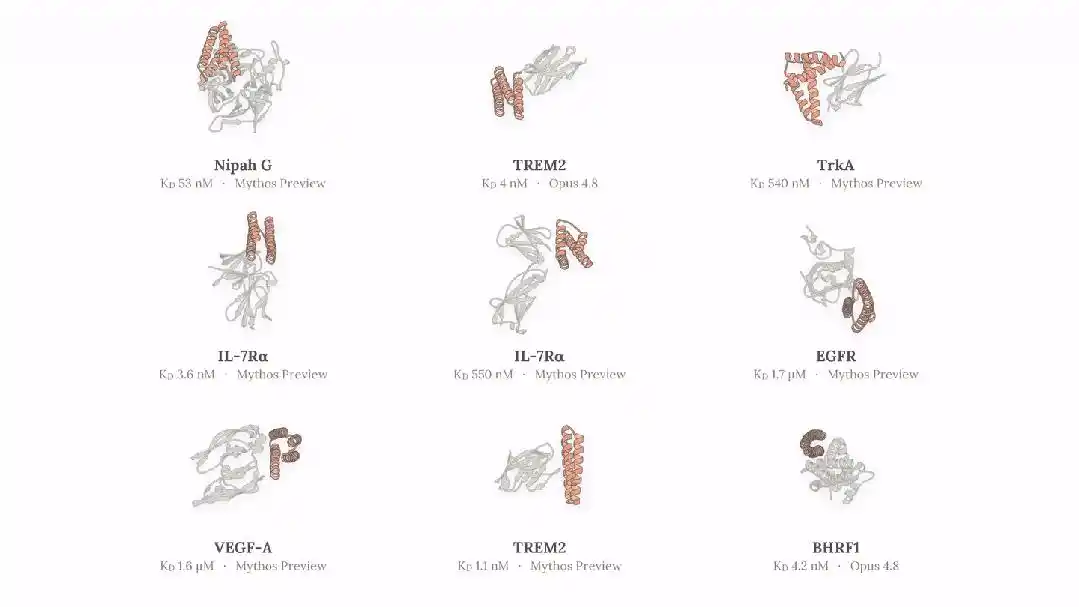
Given 15 protein targets, it was asked to independently design new proteins to bind to them, succeeding for 14 targets.

Out of 1320 designs, 354 were validated as effective by two independent labs, with an overall success rate of 26.8%.

The industry average in this field is 10%–15%.

Protein binders are the foundation for how many drugs work: first, design a molecule that can grab the target protein, then it might become a drug.

This design process typically requires protein engineers weeks of computation, optimization, and screening.

From AlphaFold to Claude: Predicting Proteins and Designing Proteins Are Two Different Things

What AlphaFold did in 2020: given a protein sequence, predict the shape it folds into.

The input is known, the output is a prediction.

It is a specially trained protein model, doing one thing extremely well.

What Claude did this time is different.

It was only given the name of a target protein, with the task of designing a brand new protein from scratch to bind to it.

The input is a name, the output is a new protein.

One is describing a picture, the other is writing an essay from a prompt.

The tools Claude used were all off-the-shelf—RFdiffusion, ProteinMPNN, ESMFold2. These open-source models for protein design and structure prediction already exist and can be downloaded by any lab.

Claude didn't invent new tools; what it did was orchestration: the research team wrote a prompt of approximately 16,000 words, encoding the working knowledge of protein engineers, including the stages of the experiment, the tools available at each stage, and screening criteria.

This prompt did not specify which face of the protein to target, which generation method to use, or preset any sequences.

It was given to Claude, along with a cloud server account, and left to run.

In multi-target mode, a single 48-hour Session handled 14 targets simultaneously; in single-target mode, each target took 24 hours.

Human operators only did three things: approved network access, monitored infrastructure, and sent the designs prioritized by Claude to two independent labs (Adaptyv Bio and Twist Bioscience) for synthesis and testing—no one intervened in any design decisions.

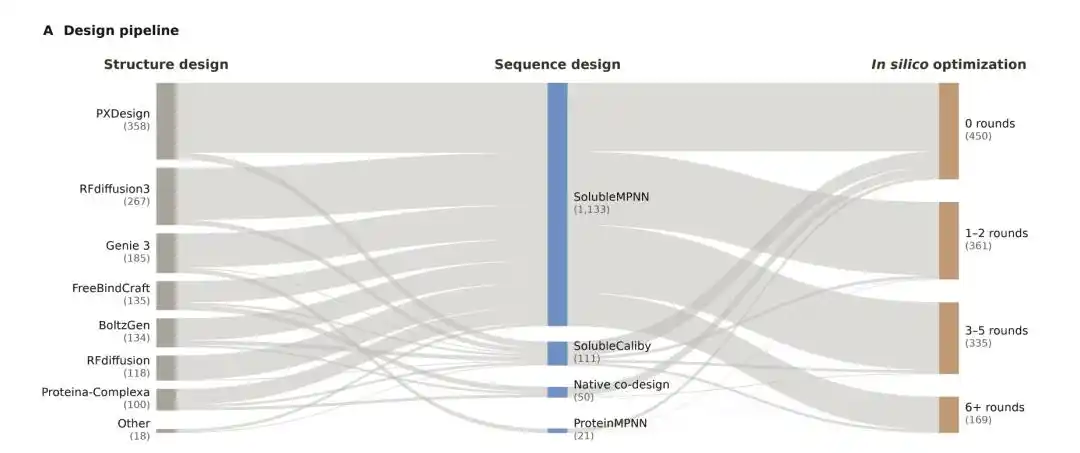
Claude autonomously selected targets, selected epitopes, installed tools, ran models, screened and optimized, prioritized deliverables, and ultimately utilized 10 different structure generation methods, combining them into 24 tool combinations.
Results

The current average success rate in the protein design field is 10%–15%.

Claude, in different modes, achieved 22%–35%, two to three times the industry average.
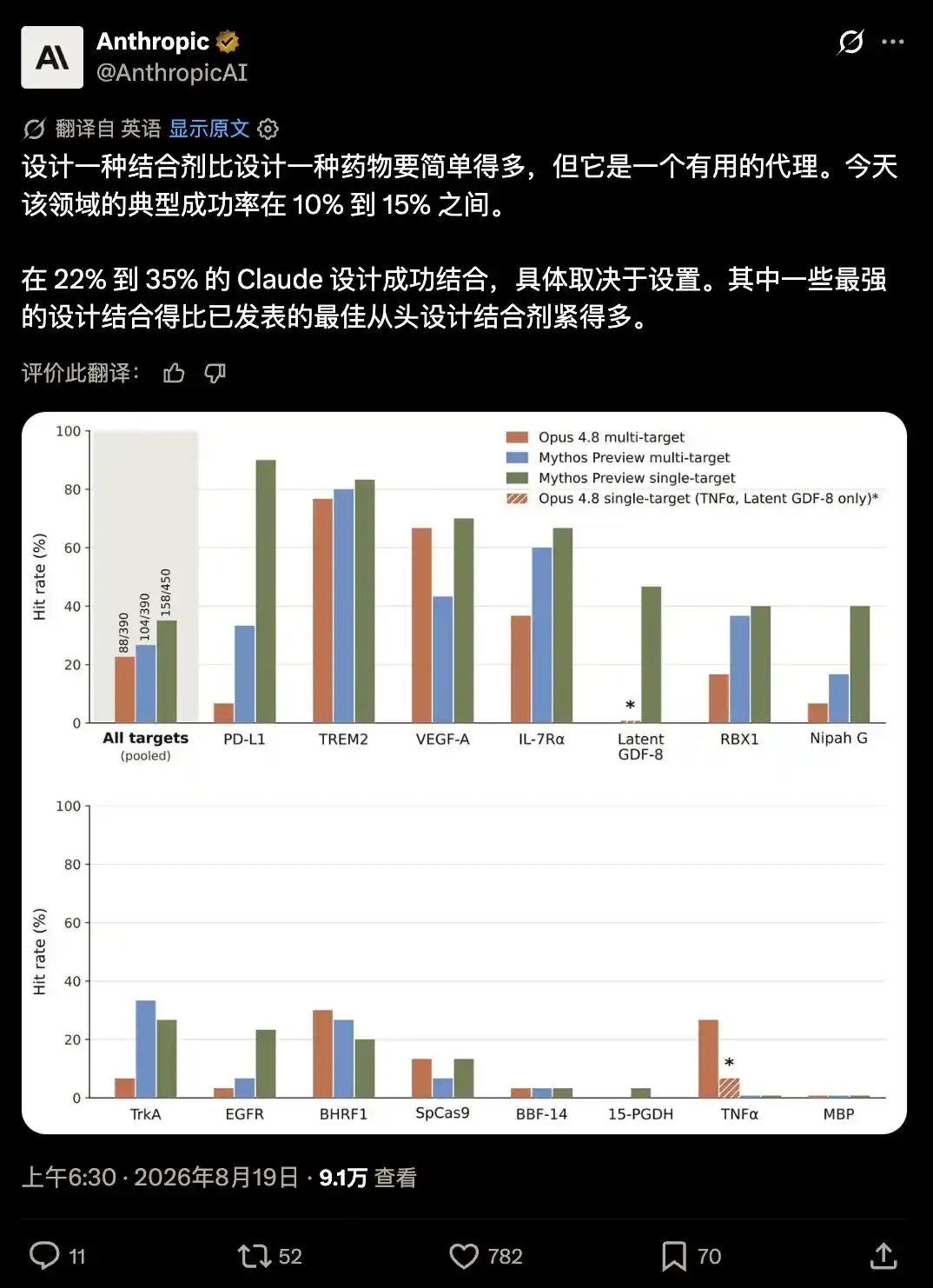
https://x.com/AnthropicAI/status/2089842389682954621

If we look only at Claude's own top-ranked design, the hit rate was 49%: for every two targets, the design ranked first was directly usable for one.

Results for several targets are worth mentioning separately.

Adaptyv Bio previously hosted an open design competition for a protein called RBX1; global participants submitted 245 designs, only 9 of which were successful.

Claude submitted 90 designs for the same target, with 28 successes; its best design bound the target ten times more tightly than the competition champion.

TNFα is an even harder target—Humira, one of the world's best-selling drugs, works by binding to this protein, but multiple expert teams had previously attempted *de novo* binder design, all failing.

Opus 4.8 produced 12 effective designs, some of which could even cross-species binding to human, monkey, and mouse TNFα simultaneously.

There were also failures: for a protein called MBP, all 90 designs failed.

Similar signals exist in analytical chemistry.

Given raw data from an NMR spectrometer and a one-sentence instruction, Claude Opus 5 produced results in 23 minutes, consistent with conclusions from a lab chemist's manual analysis taking half an hour to an hour.

The two experimental directions are different, but the signal is consistent: this generalist model, Claude, autonomously ran and produced lab-validated, expert-level results in 24 to 48 hours (48 hours in multi-target mode, 24 hours in single-target mode) for research tasks that would take experts weeks.

Just Six Years, A World Transformed

Binders are still far from being drugs, with steps like toxicology and clinical trials in between, each taking years.

All structures are computational predictions, not yet verified by experimental structural biology.

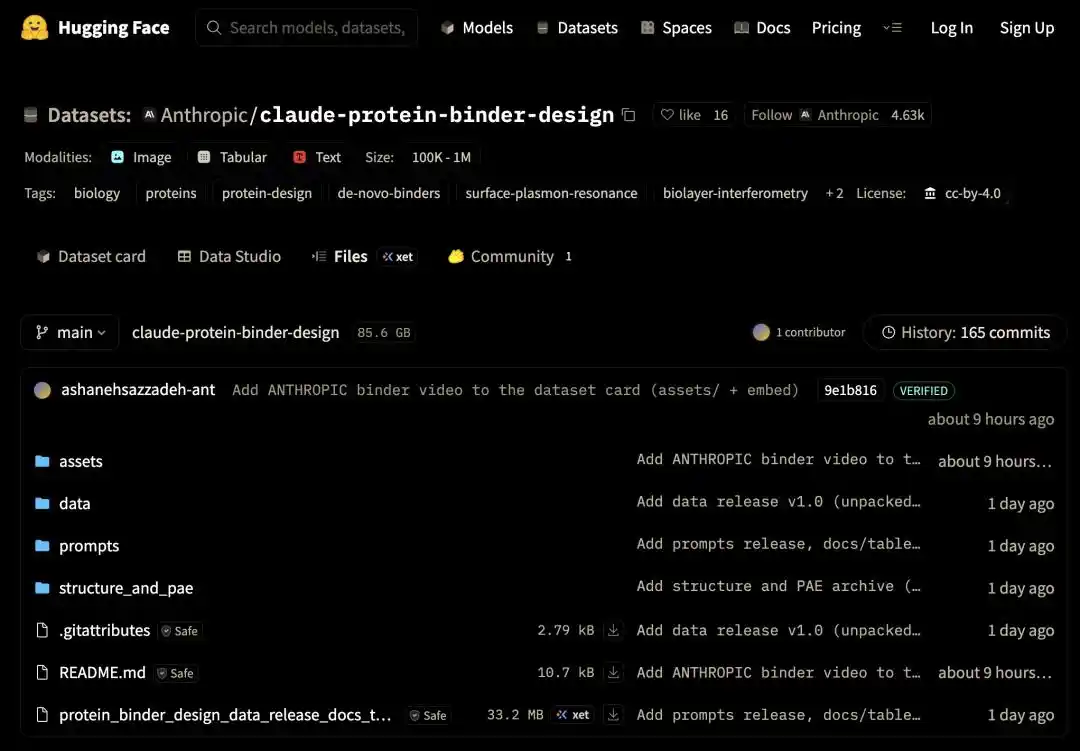
Claude used only open-source tools; Anthropic has open-sourced the prompt, data, and all 1440 design models on HuggingFace, allowing any lab to reproduce the work.
https://huggingface.co/datasets/Anthropic/claude-protein-binder-design/tree/main

Such autonomous research capabilities carry dual-use risks; Anthropic has blocked protein design and other biological capabilities in the public version of Claude.

Only six years have passed from AlphaFold predicting protein structures to Claude autonomously designing proteins.

References:

https://www.anthropic.com/research/Claude-accelerates-protein-design

https://www-cdn.anthropic.com/30bf50e22a01388bb29bf077ee3f244531594b7a.pdf

This article is from the WeChat public account "新智元" (New Wisdom), author: ASI启示录

Пов'язані питання

QWhat was Claude's overall success rate in designing novel proteins that could bind to given targets?

AClaude achieved an overall success rate of 26.8% (354 validated designs out of 1320), which is approximately two to three times the industry average of 10%–15%.

QHow did Claude's performance on the RBX1 target compare to a previous public competition?

AIn a previous public competition for the RBX1 target, global participants submitted 245 designs with only 9 successes. In contrast, Claude submitted 90 designs for the same target, achieving 28 successes. Its best design bound the target ten times more tightly than the competition winner.

QWhat key role did human operators play during Claude's autonomous protein design process?

AHuman operators performed only three tasks: approving network access, monitoring the computing infrastructure, and sending Claude's prioritized designs for synthesis and testing to two independent labs. No human intervened in any design decisions.

QWhat makes Claude's task different from what AlphaFold does, according to the article?

AAlphaFold predicts the 3D structure of a protein given its amino acid sequence (input known, output predicted). Claude's task was de novo protein design: starting only with a target protein's name, it had to design a completely new protein sequence capable of binding to that target (input is a name, output is a new protein).

QWhat was a notable challenge where Claude failed, and on which target?

AClaude failed completely on the MBP (Maltose-binding protein) target, where all 90 of its designed proteins did not work.

Пов'язані матеріали

Arca Chief Investment Officer: How Should Tokens Be Valued Once Protocols Start Earning Money?

Title: Arca CIO: How Should Tokens Be Valued When Protocols Start Making Money? Summary: For over a decade, Arca has argued that digital assets should be valued based on fundamentals and future cash flows, just like traditional investments. While tokens are not stocks, basic investment principles still apply. Many decentralized protocols (e.g., Hyperliquid, Aave) are now generating significant, real revenue with high margins. However, protocol revenue alone does not automatically translate to token value. Unlike equity holders who have a legal claim on company assets and future cash flows (via dividends, buybacks, or acquisitions), token holders often lack a clear, enforceable path to receive value from protocol profits. Therefore, the critical link between protocol economics and token economics is even more important. A credible mechanism must exist for value to eventually flow to token holders, with token buybacks being one clear, direct method. Capital allocation is now a key issue for profitable protocols. Like growing companies, protocols should reinvest profits when returns on investment are high. However, this reinvestment only delays value capture; it cannot replace it indefinitely. Investors must believe that eventually, surplus capital will be returned. For example, two protocols with identical revenues should not trade at the same valuation multiple if one has a credible buyback mechanism and the other does not. As the market increasingly accepts this valuation framework, a major opportunity exists. Protocols with strong fundamentals and value-capture mechanisms may see their valuation multiples expand significantly as the historical discount for token-based assets narrows. Crypto investment is finally maturing into fundamental analysis, focusing on revenue growth, margins, competitive advantages, reinvestment returns, and credible paths for profit distribution to token holders.

marsbit14 хв тому

Arca Chief Investment Officer: How Should Tokens Be Valued Once Protocols Start Earning Money?

marsbit14 хв тому

SEC Proposal a ‘Significant’ Step Forward From ‘Ill-Suited’ Crypto Rules: Commissioner Peirce

A U.S. Securities and Exchange Commission (SEC) commissioner, Hester M. Peirce, has called a new SEC proposal a significant improvement over what she termed a "misfit" set of crypto rules. Peirce stated that a whole generation has struggled due to the SEC's insistence on applying unsuitable regulations to cryptocurrencies, but the new proposal moves toward "clear, sensible, and enforceable rules for crypto offerings." SEC Chairman Paul S. Atkins also welcomed the initiative, noting in a separate statement that the agency's previous enforcement-heavy approach had driven investment overseas, limiting investor protections domestically. The proposal, announced on Tuesday, outlines new rules aimed at creating a clear and purposeful framework for certain investment contracts involving crypto assets, designed to allow organizations to raise capital while protecting investors. This move comes shortly after the U.S. Senate failed to advance the comprehensive Digital Asset Market Clarity (CLARITY) Act. Atkins had previously stated the SEC was prepared to develop rules for digital assets if the Senate could not pass the CLARITY Act. Meanwhile, Galaxy Digital has lowered its estimated odds of the CLARITY Act passing by 2026 to just 10%, citing numerous unresolved policy questions and the Senate's limited time—only about two to three weeks after reconvening on September 14—to pass it.

cryptonews.ru45 хв тому

SEC Proposal a ‘Significant’ Step Forward From ‘Ill-Suited’ Crypto Rules: Commissioner Peirce

cryptonews.ru45 хв тому

Торгівля

Спот
活动图片