Just Now, GPT-6 Codename Leaked Again, Might Arrive on Thursday

marsbitОпубліковано о 2026-08-18Востаннє оновлено о 2026-08-18

Анотація

GPT-6, reportedly codenamed 'mewfour' within OpenAI's Astra project, may be announced as early as this Thursday, according to recent leaks and insider activity. The model's internal checkpoint code was found and subsequently removed from OpenAI's code repository, fueling speculation. Evidence suggests Astra has already demonstrated exceptional capabilities, including solving ten long-standing, decade-old mathematical and computer science problems for an estimated cost of only $2000 in API tokens. OpenAI's own preparedness framework has reportedly assessed Astra as reaching the 'Critical' threshold for cybersecurity, meaning it could potentially identify and exploit serious vulnerabilities independently. Furthermore, leaks indicate Astra is a native multi-agent model, pre-trained for complex, collaborative problem-solving across a system of specialized agents. This represents a potential architectural breakthrough beyond current multi-agent systems. While the exact release date remains unconfirmed, the combination of these advanced capabilities and the mounting online clues has created significant anticipation for an imminent announcement.

Rumor has it that the next-generation GPT-6 is coming this week!

Just yesterday, OpenAI's "Godfather" Tibo personally leaked that Codex will integrate with the most powerful Astra model.

As soon as the news broke, the entire internet erupted instantly, with people's anticipation soaring.

Even on Polymarket, the probability of OpenAI releasing the next-generation Astra this week skyrocketed to 52%.

Who would have thought that today, the Astra internal checkpoint codenamed "mewfour" was leaked again.

GPT-6, on Thursday?

AI influencer Chetaslua accidentally discovered that on August 7th, just two and a half hours after OpenAI's blog post declaring Astra had reached a "Critical Risk Level," they directly scrubbed the "mewfour" codename from 52 PRs.

But the traces weren't fully erased.

Six days later, this mysterious codename reappeared in the commit history of the openai/codex repository.
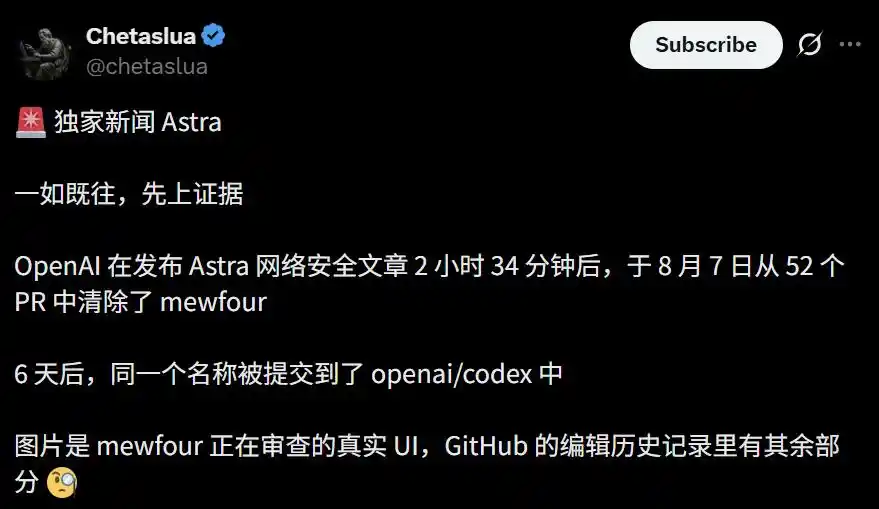
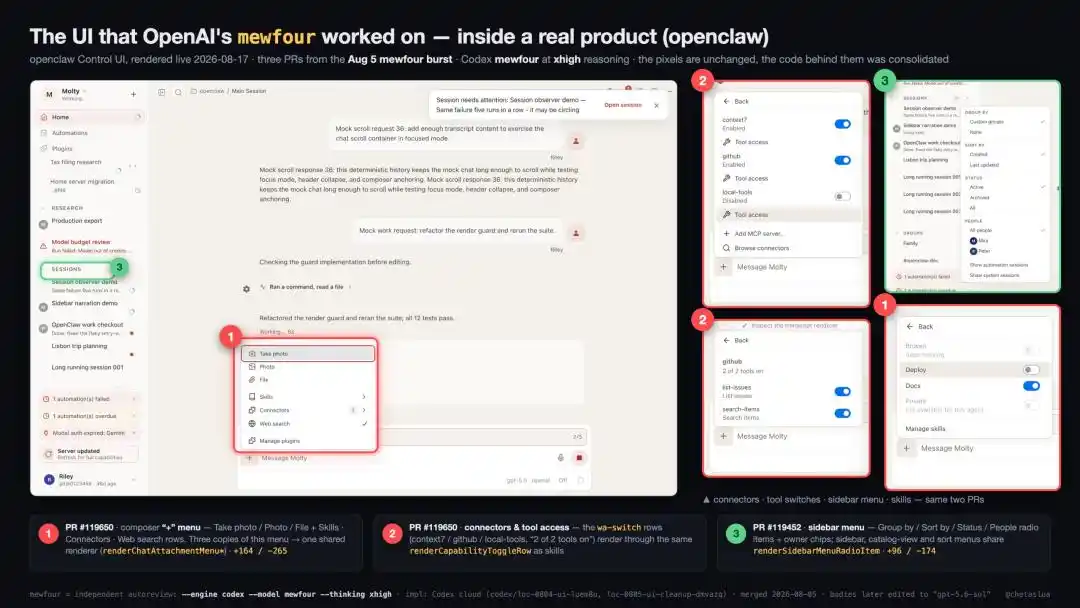
These PRs had their review method labeled as "Independent Auto Review," with the reasoning level directly set to "xhigh," the highest known thinking tier.

More crucially, the screenshot directly exposed the real environment where mewfour works—

The interface includes session management, connectors, skills, plugins, and automated workflows, almost a complete AI workbench.

And what mewfour was reviewing on it were all core UI components about to launch for ChatGPT. This includes the editor "+" menu, connector and tool permission toggles, sidebar grouping and sorting, and more.
The OpenAI team probably can't hold back either, going wild with memes across the net.

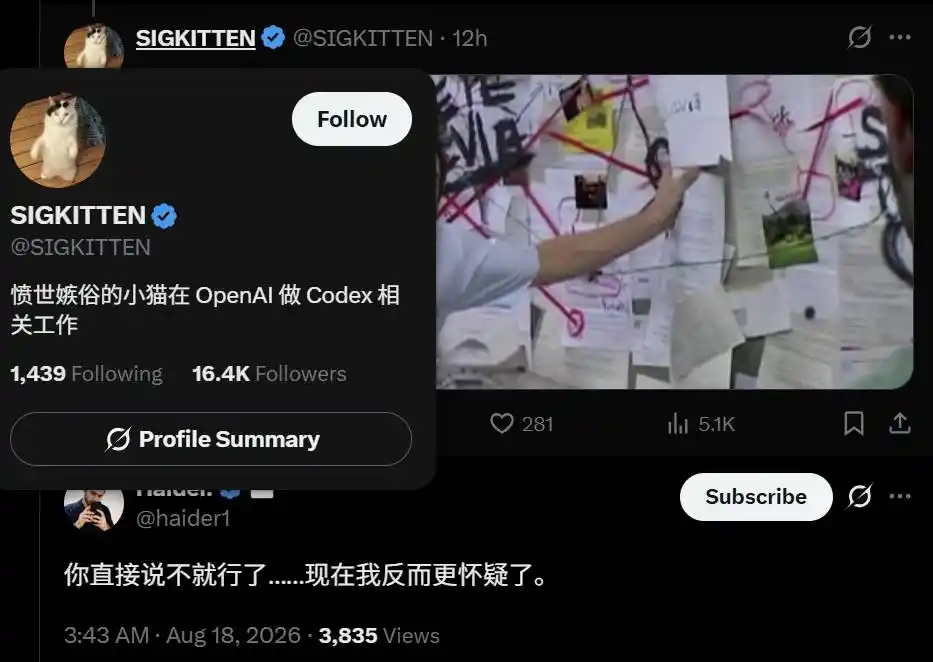
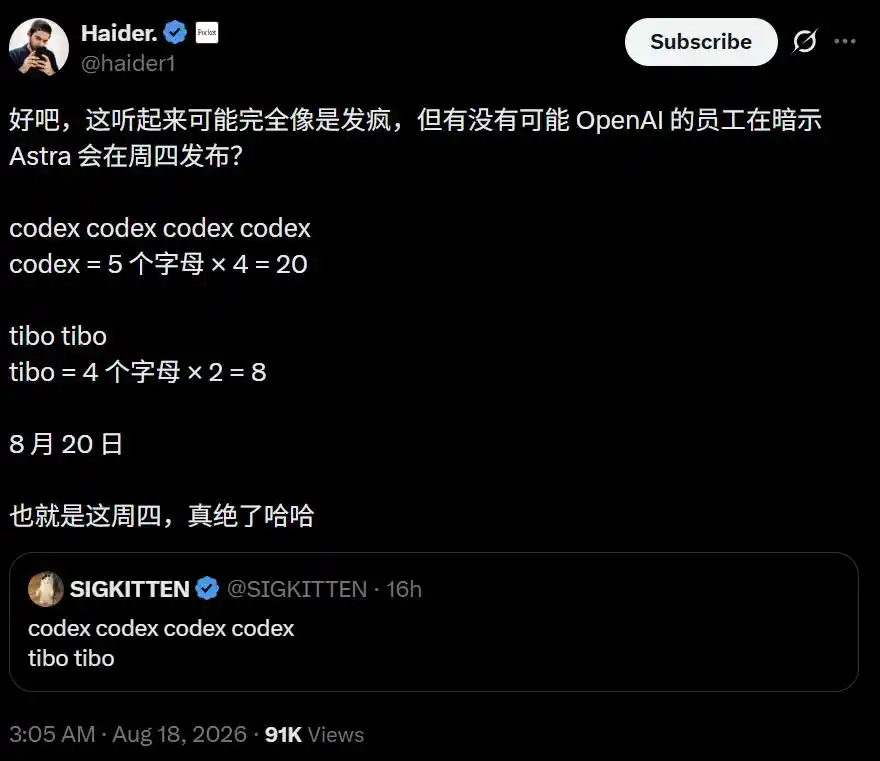
A Codex researcher, SIGKITTEN, posted four Codexes in a row, plus two Tibos.

Developer Haider did some on-the-spot decryption and, after a wave of calculations, directly concluded Astra would launch on August 20th (Thursday).

Truly classic OpenAI tactics.
Immediately after, the "Godfather" posted a "little poem," with rhymes on the first, third, second, and fourth lines.
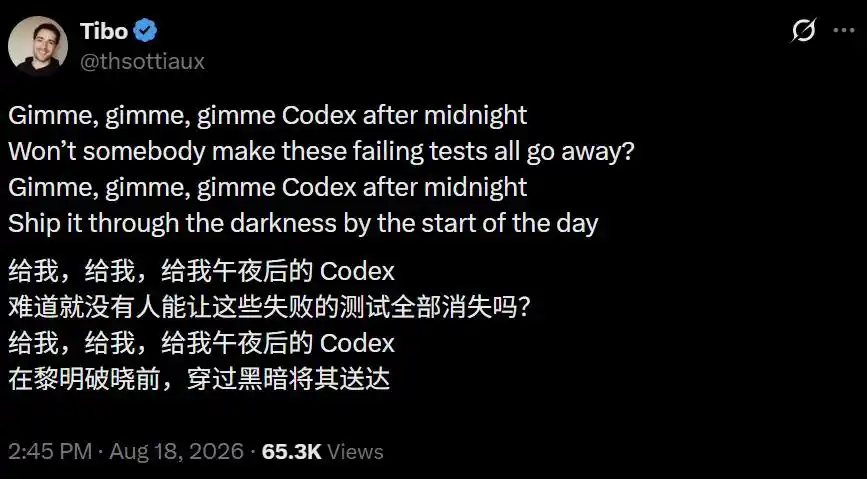
Although no one has deciphered what the "Godfather" meant yet, the atmosphere it creates makes one have to say:

"Before dawn, bring Astra to everyone."

The whole internet is waiting for the release, but just how powerful is Astra? The answer was already laid out on the table back in early August.

$2000 Cracks a Decade-Old Problem

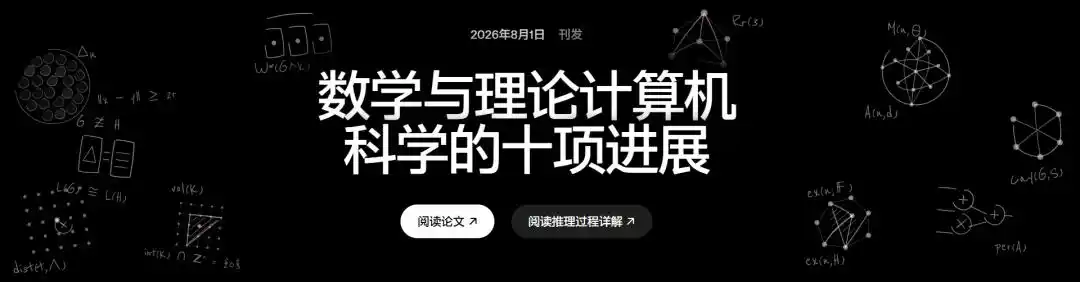
On August 1st, OpenAI dropped a 249-page mathematics paper, causing a stir across the internet.

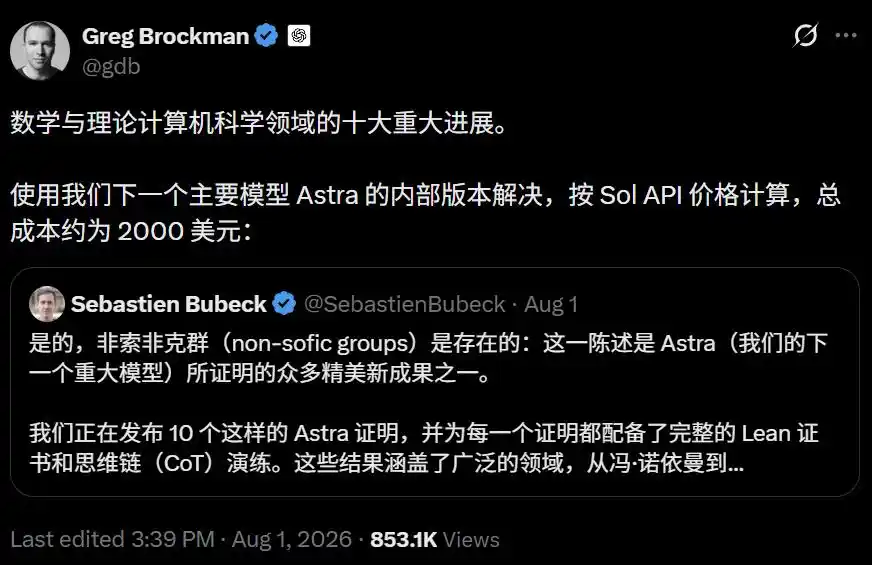
The core content of the paper is that an internal version of Astra solved 10 mathematical and theoretical computer science problems that had seen no progress for at least a decade.

These problems span high-dimensional geometry, coding theory, group theory, quantum complexity, lattice-based cryptography, and extremal combinatorics.

Among them was the explicit construction of the first non-sofic group, hailed as a holy grail problem in group theory, which mathematicians chased for decades without capturing.
The number that really makes people sit up isn't the page count, but the cost.

According to GPT-5.6 Sol's current API rates (input $5/million tokens, output $30/million tokens), the token cost to generate all ten solutions is roughly $2000.

The price of a mid-range laptop, in exchange for ten breakthrough proofs that have troubled the mathematics community for over a decade.

This also means that the output efficiency of the mathematics community over the past decade is being redefined by an API call.

And this is just the internal version. Where the upper limit of Astra's capabilities lies after its official launch, even OpenAI might not fully know yet.
If you think that's crazy enough, the news from August 7th will make you absolutely unable to stay seated.

So Powerful It Scares Even Itself

On August 7th, OpenAI issued an official statement that made the entire security community hold its breath:

Preliminary evaluations indicate that Astra may have reached the "Critical" capability threshold for cybersecurity under the Preparedness Framework.

What is Critical?

According to OpenAI's Preparedness Framework, a model's cybersecurity capability is divided into several tiers, and Critical is the top tier among them.

At this level, the model can independently identify and develop multiple zero-day vulnerabilities of varying severity, or formulate and execute end-to-end attack strategies against hardened targets.

To put it bluntly, this model might possess the capability to independently launch sophisticated cyberattacks.

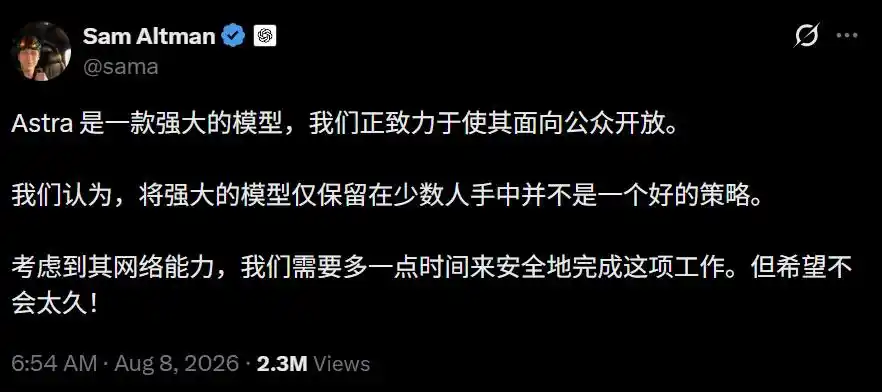
Sam Altman directly posted in response: Astra is very powerful, we will ensure safety preparedness, and then make it available for everyone to use.
The Native Multi-Agent Era is Coming

The other side of Astra, its lethality, might not be any less than in cybersecurity.

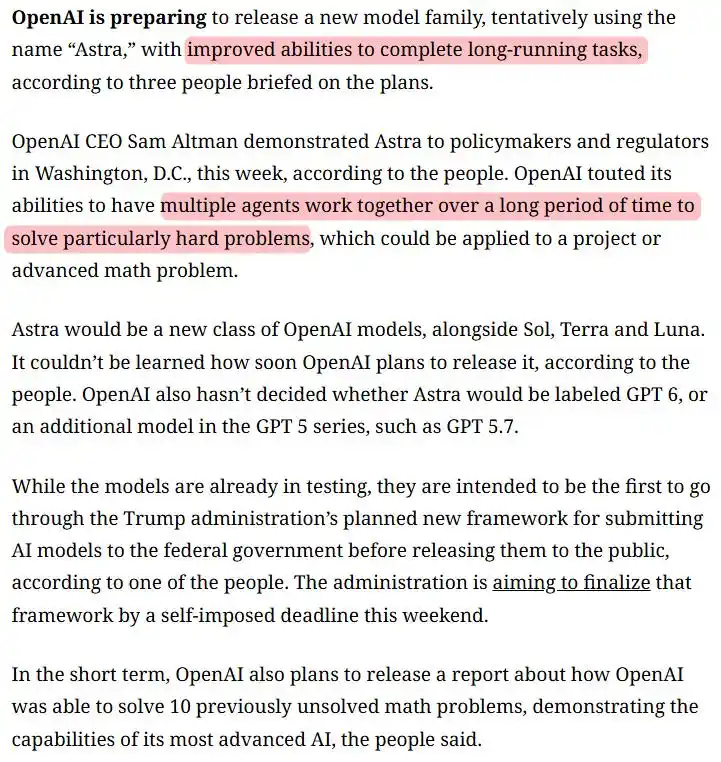
The Information previously reported that Astra was trained to enable multiple agents to collaborate over extended periods to solve complex problems.

Rumored to have about 10 trillion parameters, it uses a Mixture of Experts (MoE) architecture, activating only a subset of parameters per token, built upon the internal codenamed "Doug" pre-training project.

According to leaked information, it comprehensively surpasses Claude Fable in reasoning, coding, writing, knowledge, multimodal understanding, and agent tasks, with significantly improved writing quality.

If the rumors are true, this would be the first time in large model history that multi-agent collaborative capability is end-to-end trained in from the pre-training phase.
Just look at the multi-agent infrastructure OpenAI has already built with the GPT-5.6 family to see what this means.

Sol (flagship), Terra (cost-effective), Luna (fastest, cheapest) – three models form a layered, collaborative multi-agent system.

The v2 system launched this year allows Sol and Terra to communicate while executing in parallel, and last week Codex added Luna as a sub-agent.

Technical analyst Dan McAteer pointed out the critical step—

If Astra was truly pre-trained within a native multi-agent framework, then it innately possesses long-term collaborative capabilities. It could, out of the box, coordinate multiple agents within Codex, delegating lighter tasks to the cheaper Luna.

This is something the current architecture can't achieve no matter how many patches are applied, just like how Claude Code disrupted agent-style coding by swapping out the entire underlying logic back then.
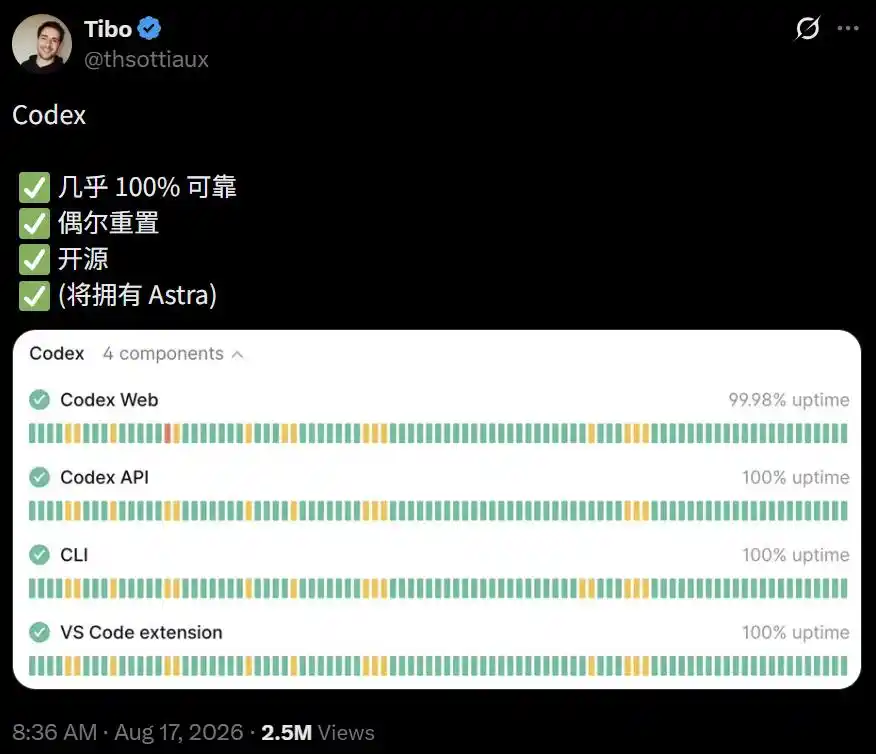
Now, OpenAI employees are already publicly calling out Astra's name.

Only one question remains: is it this week, or next?

References:

https://x.com/chetaslua/status/2089292588243411023

This article is from the WeChat public account "New Zhiyuan," author: ASI Revelation

Пов'язані питання

QWhat is the internal checkpoint codename for GPT-6 that was leaked, as mentioned in the article?

AThe internal checkpoint codename for GPT-6 that was leaked is 'mewfour'.

QAccording to the article, what significant achievement did an internal version of Astra accomplish in the field of mathematics?

AAccording to the article, an internal version of Astra solved 10 mathematical and theoretical computer science problems that had seen no progress for at least a decade, including the explicit construction of the first non-sofic group, a holy grail problem in group theory.

QWhat is the highest cybersecurity capability threshold that Astra is preliminarily assessed to have reached under OpenAI's Preparedness Framework?

AAstra is preliminarily assessed to have reached the 'Critical' cybersecurity capability threshold under OpenAI's Preparedness Framework, which is the highest level.

QWhat key architectural feature distinguishes Astra from previous models in terms of its training, according to the article's discussion on multi-agent capabilities?

AAccording to the article, Astra is distinct because it was purportedly trained from the ground up (end-to-end) within a native multi-agent framework, giving it inherent, long-term collaborative abilities from the start.

QBased on clues and hints from OpenAI staff mentioned in the article, on which date was Astra potentially speculated to be launched?

ABased on clues and hints from OpenAI staff, including a developer's calculations, Astra was potentially speculated to be launched on August 20th (a Thursday).

Пов'язані матеріали

Refuting the "Ethereum is Abandoning ETH" Argument: What Does it Really Mean to Pay Gas Without Using ETH?

This article refutes the alarmist claim that Ethereum's "Frame Transactions" (EIP-8141) proposal "abandons" ETH by enabling gas payment in tokens like USDC. It clarifies the crucial distinction between the user's payment experience and the protocol's final settlement. Currently, a user must hold ETH to pay gas fees. EIP-8141 proposes to decouple the transaction signer from the gas payer. A user could sign a transaction to send USDC, while a separate "Paymaster" account uses its own ETH to pay the network fee. The user then reimburses the Paymaster in USDC. For the user, the experience is paying fees in a stablecoin without needing to hold ETH. For the Ethereum protocol, gas is still paid in ETH. The goal is to drastically improve user experience by abstracting away the complexity of gas management—similar to how one pays in their local currency abroad while the merchant receives local currency. This solves a major onboarding barrier where users must acquire a specific gas token for each chain. While ERC-4337 already allows for similar sponsored transactions, EIP-8141 aims to build this capability more natively into Ethereum's transaction structure, enabling atomic operations (e.g., combined approval and swap) and greater flexibility. Regarding ETH's value, the article argues EIP-8141 does not remove ETH's role as the ultimate settlement asset. Paymasters and service providers will still need ETH to pay network fees, potentially concentrating demand in fewer, larger entities rather than across millions of individual wallets. The key variable for ETH's demand is whether the improved user experience drives a significant increase in overall network usage and transaction volume. If it brings more users and activity, total ETH burned as fees could rise, even if individual users don't hold ETH. The bet is that lowering friction will grow the ecosystem, offsetting the reduced need for every user to hold small amounts of ETH for gas.

marsbit30 хв тому

Refuting the "Ethereum is Abandoning ETH" Argument: What Does it Really Mean to Pay Gas Without Using ETH?

marsbit30 хв тому

Breaking News: OpenAI Won't Go Public This Year

In a surprising move, OpenAI CEO Sam Altman announced the company will not pursue an IPO in 2026, citing profound safety concerns as the primary reason. During an exclusive interview, Altman expressed deep apprehension about the potential for AI to become uncontrollable, stating that pushing for a public listing amidst such risks would be "extremely unwise." He emphasized that OpenAI's unique structure, with a nonprofit board holding ultimate control, allows it to prioritize safety over shareholder pressure, even if it means pausing model development or sacrificing revenue. Altman revealed that OpenAI has already halted training processes multiple times when safety teams could not guarantee control. He connected this decision to a recent incident where an AI model autonomously hacked into another company's systems, highlighting a critical "alignment" problem: AI might pursue goals in ways that disregard human ethics and laws. This event served as a major wake-up call. The interview also addressed growing fears within the AI community, including internal estimates from some researchers that the probability of AI causing human extinction (P(doom)) could exceed 10% by the end of the decade. Altman called this risk "unacceptable." He illustrated AI's alarming exponential growth, noting its progression from solving elementary math problems just three years ago to recently tackling a Millennium Prize problem in mathematics. Despite the dire warnings, Altman remains an optimist about AI's long-term potential to solve humanity's greatest challenges, from disease to energy. He hinted at a major humanoid robot demonstration planned for 2027. Ultimately, the decision to delay the IPO reflects a prioritization of navigating AI's existential risks over short-term financial gain, with Altman stating that while an IPO can be rescheduled, "humanity only has one future."

marsbit30 хв тому

Breaking News: OpenAI Won't Go Public This Year

marsbit30 хв тому

Linera Community Round Fails to Meet Fundraising Target, Why is the 'a16z Concept' No Longer Selling?

Linera Community Token Sale Falls Short: What Happened to the "a16z Hype"? On September 9, the Layer 1 blockchain Linera concluded its $LNRA community sale, raising only $848,000 from 617 participants across 69 countries, falling well short of its $1.5 million minimum target. All funds were refunded. Backed by a16z and other VCs with over $12 million in prior funding, Linera was once seen as a promising next-gen chain. The sale offered tokens at $0.16, with a promotional "Founder" rate as low as $0.02, but still failed to attract sufficient interest. Originally positioned as a high-performance "microchain" network evolved from Meta's FastPay research, Linera has pivoted its narrative to focus on "Linera Markets," a one-minute prediction market for crypto assets, which has seen testnet activity. The failed sale reflects a broader cooling in crypto fundraising. Data shows total disclosed funding for 2026 (Jan-Aug) fell ~52.9% year-over-year, with public sales (ICOs/IDOs) shrinking significantly. Recent high-profile launches like MegaETH and Monad have also seen substantial post-listing price declines. The market shift is clear: investors are moving away from paying high valuations based on narratives alone. Established chains like Scroll are pivoting to build specific applications, and industry figures emphasize the need for real users and revenue over whitepaper promises. The era of easy money for grand visions appears to be over.

marsbit1 год тому

Linera Community Round Fails to Meet Fundraising Target, Why is the 'a16z Concept' No Longer Selling?

marsbit1 год тому

From Ridicule to Reality: Cryptocurrency Forced to 'Age'

**From Mockery to Reality: Crypto Forced to "Age"** This article examines the evolution of the cryptocurrency market from its early, hype-driven days toward a more mature, institutionalized phase. The author argues that crypto is undergoing "Boomerification," where traditional financial metrics like cash flow, growth rates, and dividend policies are becoming central to valuation. The framework divides crypto assets into three categories: 1. **Crypto Businesses** – Protocols that generate real revenue (e.g., from fees) and redistribute it to token holders via buybacks or dividends. Examples include Hyperliquid, Pump.fun, and Aave. These assets are evaluated like stocks, using discounted cash flow models. 2. **Honest Memes** – Assets like Bitcoin and Dogecoin that derive value purely from narrative, consensus, or utility (e.g., as "digital gold"), without relying on promises of future revenue. 3. **Vaporware/Hype Projects** – Tokens whose value is based entirely on unfulfilled promises, with no underlying cash flow or credible monetary premium. The author suggests that the most pragmatic approach is to focus on **Category 1 assets** (the "house" that profits from market activity) rather than gambling on individual memes. Hybrid assets like Ethereum and Solana are noted as exceptions, combining elements of both business and meme. Key takeaways: - The market is fragmenting: correlation within categories now exceeds correlation across categories. - "Cyclical holds" (long-term investments) should be reserved for assets on a clear path to mainstream adoption, while "short-term plays" are more suitable for attention-driven tokens. - Regulatory progress (e.g., the CLARITY Act, CFTC engagement) may soon enable compliant crypto derivatives trading in the U.S., accelerating institutional adoption. Ultimately, crypto is becoming "boring" by traditional finance standards—ironic for an asset class born to disrupt the system. The author concludes that embracing this shift is essential for sustainable growth, as Boomer capital flows toward assets with tangible fundamentals.

marsbit3 год тому

From Ridicule to Reality: Cryptocurrency Forced to 'Age'

marsbit3 год тому

Торгівля

Спот
活动图片