Decentralization at risk as 100 wallets hold 80% of DeFi supply: Report

ambcryptoОпубліковано о 2026-03-29Востаннє оновлено о 2026-03-29

Анотація

DeFi's decentralization is under threat as new data reveals extreme concentration of governance power. A report from the ECB shows the top 100 wallets control over 80% of the token supply across major protocols, while just 10-20 voters hold up to 96% of delegated voting power in some cases. With participation rates as low as 4-12%, decision-making is effectively controlled by a small group of entities, including founders, treasuries, and centralized exchanges. This makes regulators' jobs easier, as they can now identify clear control points, increasing DeFi's regulatory exposure under frameworks like MiCA. Consequently, markets are repricing DAO tokens, with a growing premium placed on protocols that demonstrate broader participation and transparency, while those with concentrated control face valuation pressures.

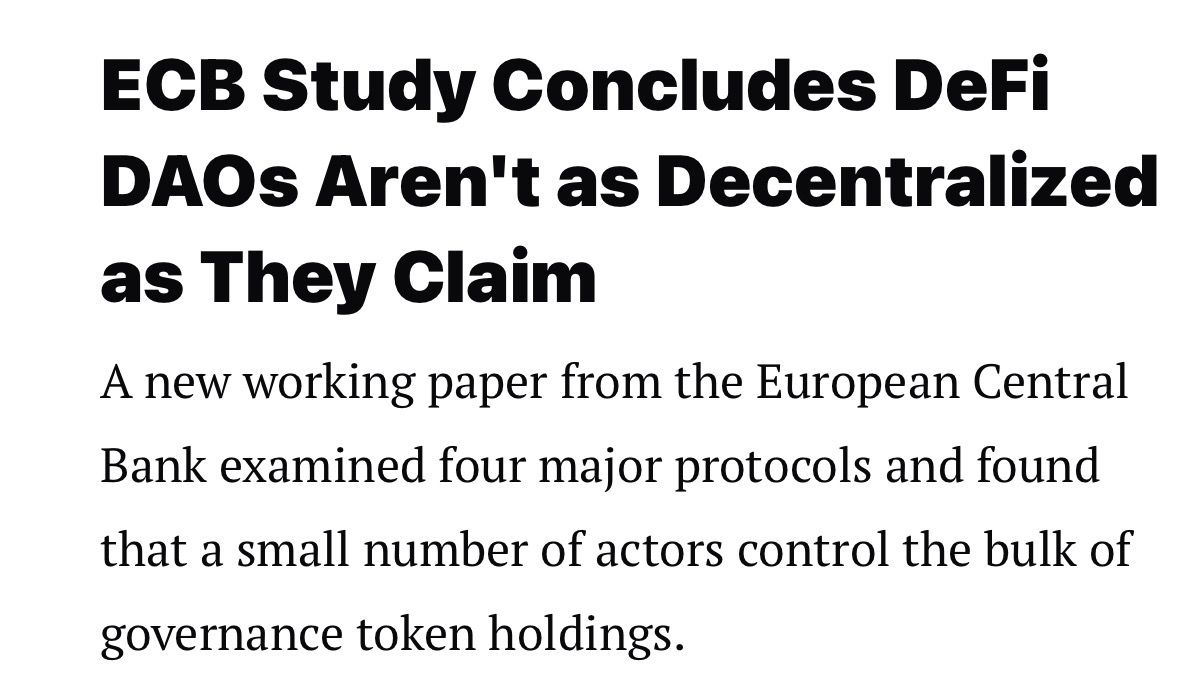
DeFi’s decentralization narrative is now being tested, as governance data reveals power is not widely distributed. The ECB’s March 2026 paper shows the top 100 holders control over 80% of tokens across major protocols, forming a clear concentration.

As this structure persists, decision-making shifts toward a small group, often including treasuries, founders, and centralized exchanges. Delegation intensifies this effect, as just 10–20 voters control up to 96% of delegated power.
Source: X

Participation remains low at 5–12%, which means most holders do not influence outcomes, leaving control in fewer hands. This imbalance matters because regulators can now identify who shapes protocol decisions.

As frameworks like MiCA tighten, these visible control points increase regulatory exposure. This shift suggests DeFi may face oversight similar to traditional finance structures.

DeFi governance narrows, but who is in control?

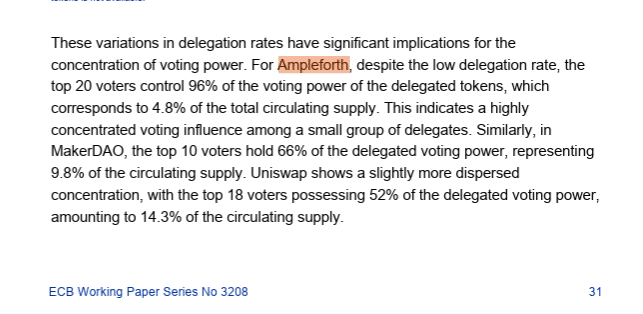
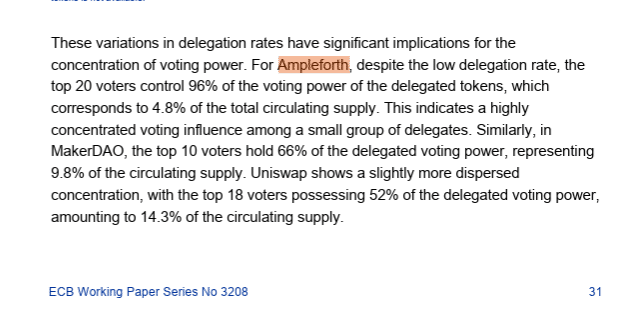
DeFi governance is shifting from broad ownership to concentrated control, as delegation hands decision power to a small group. The ECB’s March 2026 paper shows the trend clearly, with the top 20 voters in Ampleforth controlling 96.04% of delegated votes.
Source: ECB.Europa.eu

As this structure develops, the results rely more on a small number of active delegates than on the larger holder base. Influence clusters quickly, as seen by the fact that Uniswap’s top 18 hold 52% and MakerDAO’s top 10 control 66%.

Nevertheless, since one-third to almost 50% of the top voters cannot be identified, this focus does not translate into obvious accountability. Delegation separates traceable ownership from influence, which is why this occurs.

This creates a market where control is concentrated but partially hidden. As a result, DeFi’s decentralization weakens, while regulatory pressure rises without fully resolving enforceability.

DAO tokens reprice as decentralization weakens

Such a concentration of delegated voting power is now affecting DAO token prices, as markets reassess how decentralized these systems really are. Decision-making remains limited to a small group, with participation staying at 4–12%.

Due to the lack of widespread control, the decentralization premium decreases as the trend continues. Investors start to doubt the true worth of governance tokens, which makes this trend significant.

Perceived risk rises when regulators highlight distinct control groups, which puts further pressure on tokens with lax governance. At the same time, protocols that are more transparent and involve more people are becoming more popular.

This shift suggests DAO tokens will be priced based on governance quality, where broader participation supports value, while concentrated control leads to weaker performance.


Final Summary

  • DeFi governance shows concentrated control, weakening decentralization and increasing regulatory exposure.
  • DeFi governance concentration pressures DAO token valuations, as markets favor stronger transparency and broader participation.


Пов'язані питання

QWhat percentage of tokens across major DeFi protocols are controlled by the top 100 holders, according to the ECB's report?

AThe top 100 holders control over 80% of tokens across major DeFi protocols.

QHow does delegation intensify the concentration of power in DeFi governance?

ADelegation intensifies this effect, as just 10–20 voters control up to 96% of delegated power.

QWhat is the typical participation rate in DeFi governance, and what does this imply for decision-making?

AParticipation remains low at 5–12%, which means most holders do not influence outcomes, leaving control in fewer hands.

QHow is the market reassessing the value of DAO tokens in light of governance concentration?

AMarkets are reassessing how decentralized these systems really are, and the decentralization premium decreases. DAO tokens are being priced based on governance quality, where broader participation supports value, while concentrated control leads to weaker performance.

QWhat regulatory risk arises from the visible concentration of control in DeFi protocols?

AAs regulatory frameworks like MiCA tighten, these visible control points increase regulatory exposure, suggesting DeFi may face oversight similar to traditional finance structures.

Пов'язані матеріали

The Unchanging Foundation Through Bull and Bear Markets: On the Occasion of BitMart's 8th Anniversary

BitMart Celebrates 8 Years: A Journey of Compliance, Security, and Ecosystem Growth As the cryptocurrency industry matures, centralized exchanges (CEXs) face two major challenges: regulatory compliance and ecosystem development. BitMart, now celebrating its 8th anniversary, has established itself through a strong commitment to both. Founded in 2017 in the U.S., BitMart prioritized regulatory compliance from the start. By early 2026, it achieved full compliance across all 50 U.S. states and territories, becoming one of the few crypto exchanges operating legally nationwide. Security is another cornerstone. BitMart employs a multi-layered defense system: 99% of user assets are stored in cold wallets, MPC technology secures key management, and advanced protocols like WAF and XDR protect the platform. It also collaborates with institutional custodians and maintains a large blacklist database for AML monitoring. Ecosystem growth has been central to BitMart’s strategy. In 2025, it upgraded its trading systems, achieving ultra-low latency and high throughput. The platform listed 1,193 assets, nearly 50% of which were first listings, with 93 assets surging over 1,000%. BitMart expanded into PayFi with BitMart Card, travel bookings, P2P trading, and RWA-linked products. It also introduced AI tools like X Insight and Beacon Trading Assistant, and launched a Web3 wallet in 2026 to streamline on-chain transactions. By the end of 2025, BitMart had over 13 million users, 1,700+ trading pairs, and saw its native token BMX grow 445% in market cap. Rather than seeking shortcuts, BitMart has consistently chosen the path of long-term, sustainable growth—building trust through compliance, security, and innovation.

Odaily星球日报10 хв тому

The Unchanging Foundation Through Bull and Bear Markets: On the Occasion of BitMart's 8th Anniversary

Odaily星球日报10 хв тому

Торгівля

Спот
Ф'ючерси
活动图片