Written by: Liam 'Akiba' Wright
Compiled by: Saoirse, Foresight News
Vitalik Buterin's "Lean Ethereum" blog post on the X platform on July 4th set a clear timeline for Ethereum's development narrative targeting the institutional market: this public blockchain, seen as foundational financial infrastructure, now needs to complete its own reconstruction in the public eye.
In the X post released over the weekend, Vitalik defined "Lean Ethereum" as a set of upgrades expected to take three to four years, calling it the third major version iteration following Ethereum's Merge upgrade.
The accompanying Ethereum Foundation architectural diagram serves only as a draft reference for multi-party coordination, not a finalized plan. It outlines several core development goals: achieving second-level transaction finality, the mainnet handling 10 billion Gas per second, layer-two networks scaling to the trillion Gas level, achieving post-quantum security at the base layer, while also listing privacy features as a core development goal for the first layer.
This plan also makes the investment logic for ETH clearer for the market. Institutional investors need to determine: Can Ethereum maintain its stable and reliable position as financial infrastructure during this multi-year period of foundational reconstruction? Moreover, the settlement guarantee capability that originally attracted institutions to Ethereum must smoothly navigate this comprehensive upgrade and transformation.
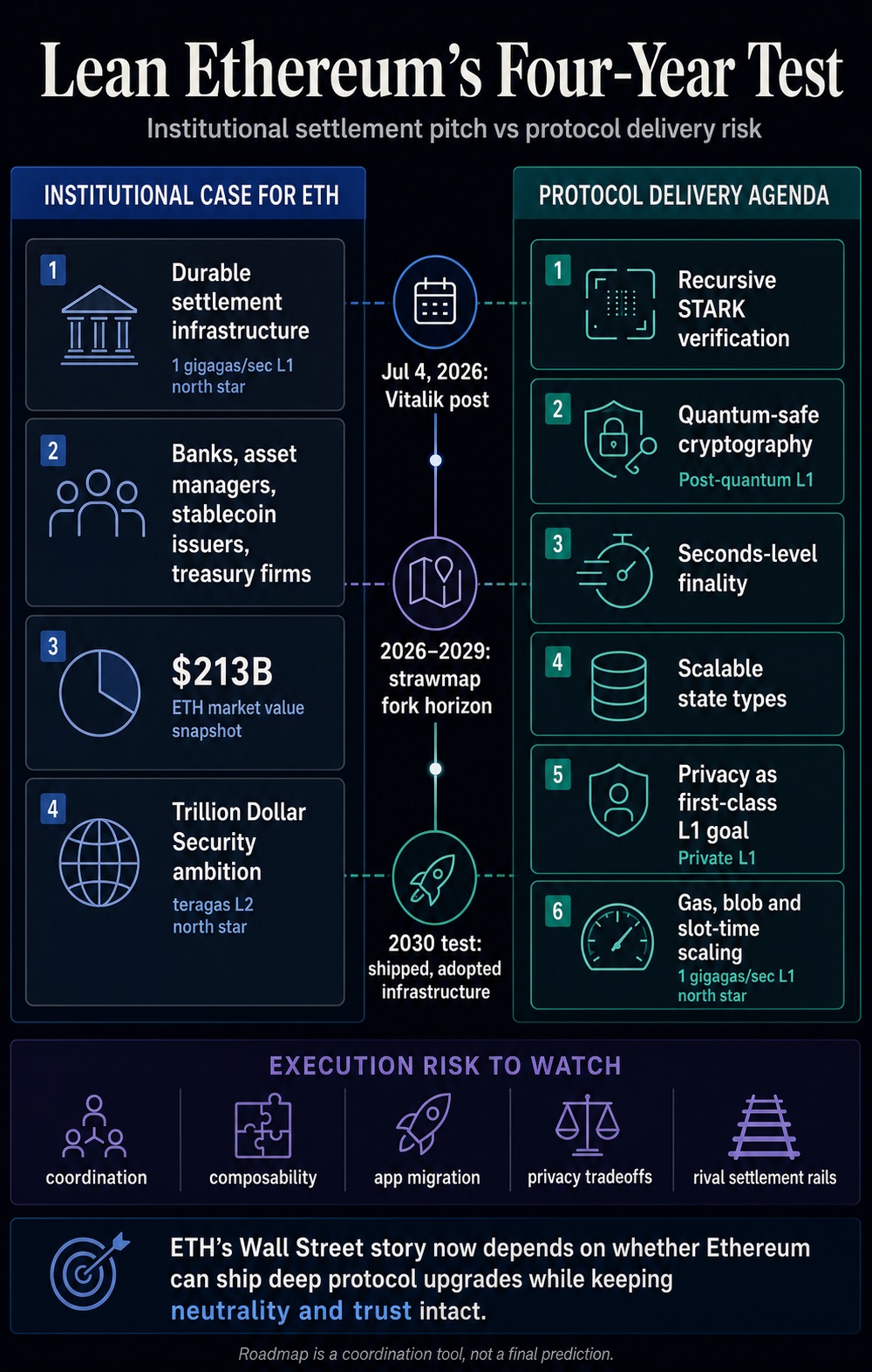
Vitalik's four-year "Lean Ethereum" upgrade plan released on July 4, 2026, presents Ethereum's value proposition to Wall Street institutions on one side and six major foundational technical upgrade tasks on the other. Simultaneously, it faces implementation risks such as multi-party coordination and compromised composability. Over the next four years, Ethereum must complete the full suite of foundational renovations while preserving the network's neutral and trustworthy attributes to fulfill the grand vision of becoming institutional-grade settlement infrastructure.
Institutional Financial Needs Meet Major Protocol Underlayer Changes
Ethereum's positioning for Wall Street has long extended beyond spot trading. Its current target clientele now covers banks, asset management companies, stablecoin issuers, asset tokenization business units, and publicly listed companies that hold ETH on their balance sheets and use Ethereum as a settlement layer.
The Ethereum Foundation's 2025 "Trillion-Dollar Safe Asset" plan plainly states this grand vision: Ethereum aims to build a sufficiently secure foundation upon which individuals, businesses, institutions, and even governments can custody massive assets on-chain.
The "Lean Ethereum" proposal is precisely the upgrade roadmap tailored to realize this institutional vision.
The Ethereum Foundation has specifically established the "Institutional Ethereum" section as an official interface for banks, asset managers, public companies, tokenization projects, and stablecoin entities. Simultaneously, Ethlabs was created, relying on treasury funds for R&D to support ETH's monetary value narrative. Bitmine, Sharplink, and Joe Lubin are deeply involved in the operation of these two sections, building the external supporting ecosystem for the institutional market, while the Ethereum Foundation maintains its protocol-neutral positioning.
This industry context means "Lean Ethereum" is far from a mere technical vision. If Ethereum is to be promoted externally as a stable and reliable settlement and collateral asset, this roadmap must reduce industry uncertainty, not add risk.
CryptoSlate market data from July 5th showed ETH trading at around $1,763, with a total market cap of approximately $213 billion. Ethereum's scale is already substantial enough for its protocol development direction to impact institutional capital, yet its volatility also means financial institutions are highly attentive to upgrade implementation risks.
For bank and corporate finance heads, due diligence on ETH is entirely different from ordinary crypto trading. They need to assess whether the new foundational network architecture can maintain the predictability of settlement while applications, wallets, clients, layer-two networks, and privacy-related tooling undergo synchronous adaptation.
Only a fully realized and implemented roadmap can build a credible path from the current Ethereum to a new, scaled, comprehensively secure, and neutral network. And "Lean Ethereum" stands at the critical juncture of this transformation path.
Why the Entire Upgrade Package is Crucial
The multiple core changes listed in Vitalik's post, if treated merely as technical jargon, can be easily overlooked; each directly impacts the institutional user experience:
Recursive STARK Proofs alter on-chain verification logic, no longer requiring repeated full execution of transactions, instead relying on proofs to drastically reduce chain verification costs and enhance scaling capabilities. For institutions, this directly relates to long-term system operational costs and the credibility of asset audits.
Post-Quantum Cryptography System This is a layout for the long-term future. Banks and asset managers need to custody assets lasting decades; the underlying signature and proof systems must be able to withstand future quantum computer attacks. This draft directly sets post-quantum security as a core development goal for the first layer, addressing it at the foundational protocol level.
Transaction Finality and Gas Limit Optimization Both directly affect daily institutional operations. Faster transaction final confirmation speeds shorten fund settlement waiting periods. Continuously raising the Gas limit, expanding Blob data, and shortening block intervals enhance Ethereum's capacity to handle transactions, preventing users and applications from migrating to other blockchains due to network congestion. The performance targets of 1 billion Gas for L1 and 1 trillion Gas for L2 in the plan are ambitious. The institutional interpretation is straightforward: if Ethereum wants to handle more large-scale settlement business, it must solve the pain point of network capacity shortage.
State Storage Restructuring (The Most Disruptive Change) This is the most transformative part of the entire package, directly altering application development logic. Vitalik proposes that the existing dynamic storage model will see only minor expansion, while simultaneously launching a new lightweight storage standard. For ERC-20 tokens, NFTs, and most DeFi applications, adapting to the new standard would significantly lower fees. However, complex shared contracts will still need to rely on traditional dynamic storage. This new storage architecture essentially guides developers to migrate through cost advantages. If the new standard can notably reduce on-chain costs for mainstream assets, developers will proactively adapt. But if it leads to fragmented liquidity, damages protocol composability, or breaks established developer habits, cost reduction may come with significant trade-offs. Precisely because of this, Ethereum's settlement narrative for institutions is not just a technical problem in cryptography but also a product design and on-chain governance challenge.
Native Privacy Features at the Base Layer Privacy features and storage architecture belong to the same category of core issues. Vitalik explicitly stated that privacy is already a core development goal, and the architectural diagram lists a native privacy system at layer one as a key direction.
Banks and asset managers conducting business inherently require transaction confidentiality, compliance control, and predictable settlement mechanisms. Yet Ethereum cannot abandon its core attributes of being publicly auditable and neutral. The privacy R&D in "Lean Ethereum" needs to find balance among multiple demands while ensuring the usability of the first layer network.
Core Risk: The Challenge of Multi-Party Coordination and Implementation
This architectural draft itself objectively states its own positioning: it's basically unrealistic to expect an officially finalized roadmap covering all Ethereum stakeholders. Final consensus can only be formed gradually, a process full of uncertainty.
The document also emphasizes that the proposal is for coordination and communication among parties only, not a precise prediction of future development. The planned timeline is for reference and should not be taken as fully credible.
And these supplementary statements precisely highlight the value of this roadmap. Ethereum's core advantage in attracting various competing financial institutions is precisely its independence from any single entity's control and its network neutrality. However, this neutral attribute also makes coordinating protocol upgrade implementation far more difficult than with private consortium chains.
Thus, the "Lean Ethereum" proposal conveys two contradictory signals:
Positive Aspect: Ethereum is comprehensively upgrading its foundation, adapting for high-value assets, large-scale proof verification, low-cost validation, layered storage, native privacy, while proactively preparing for quantum security risks.
Potential Pitfall: The network requires all users and institutions to bear various uncertainty risks during the lengthy cycle of large-scale foundational reconstruction.
The risks are not limited to hard fork timing; they span the entire industry chain: Can application developers fully grasp the new storage model? Can wallet and infrastructure service providers complete protocol adaptation synchronously? Can users maintain trust through multiple iterations? Can L1 and L2 network roadmaps stay aligned? Can on-chain governance prioritize high-difficulty upgrades, avoiding power struggles among major stakeholders?
Even if individual upgrades are all successfully implemented, the entire multi-fork plan might still fail to meet expectations due to lagging supporting infrastructure: network throughput increases, but application architecture isn't adapted synchronously; privacy features land, but compliant institutions still prefer permissioned chains; new storage standards reduce fees for ordinary tokens, yet complex contracts remain bound by the old system. Therefore, for institutions to judge Ethereum's transformation success, they cannot rely solely on the roadmap's release; they must also monitor on-chain usage data and developer migration progress.
From an institutional perspective, this test is especially rigorous: private settlement networks can offer clear, stable product delivery timelines, at the cost of losing openness; other public chain competitors promote simple, direct high throughput and low execution costs.
The solution Ethereum offers is: an open, neutral public chain foundation can also iterate rapidly and serve as large-scale financial infrastructure. And "Lean Ethereum" makes this proposition tangible and measurable.
The Next Four Years: Ethereum Undergoes Comprehensive Scrutiny
The market will subsequently judge the transformation's effectiveness through a series of implementation actions and developer feedback: Whether upgrades like Glamsterdam and Hegota launch on schedule, the progress of hard forks like I-star and subsequent ones, the smooth rollout of Gas and Blob capacity expansions, the progress of transaction finality R&D, and whether application teams embrace the new storage architecture or view it as a significant burden.
Optimistic Development Scenario
If Ethereum's upgrades are smoothly implemented, the "Lean Ethereum" plan will solidify ETH's investment thesis and significantly enhance Ethereum's credibility as a settlement layer. Faster transaction confirmation, cheaper on-chain verification costs, native privacy, proactive quantum security preparation, and layered, scalable storage will transform Ethereum from a mature public chain clinging to its existing ecosystem into financial infrastructure with sustained growth potential.
Pessimistic Development Scenario
If upgrade progress stalls or lags, this roadmap could instead become a liability for Ethereum. Institutional investors will not wait indefinitely for the public chain to complete speed improvements, privacy overhauls, fee reductions, and quantum security upgrades. Stablecoin issuers, tokenization platforms, and corporate treasury funds will directly shift to foundational networks with more stable implementation cycles, even if such networks lack Ethereum's neutral and open characteristics.
This is the fundamental change "Lean Ethereum" brings to ETH's Wall Street narrative: On one hand, it clearly argues the technical logic for Ethereum's continued role as a settlement layer for high-value digital assets for institutions. On the other hand, it compiles a comprehensive risk checklist for institutional investors.
Over the next four years, Ethereum must transform the paper roadmap into implemented, usable infrastructure while safeguarding the core advantage of neutral public chains that attract institutions. Both are indispensable.