13 Business Lines Surpass $100 Million in Annualized Revenue, Robinhood Moves Toward a 'Super Financial App'

Odaily星球日报Опубліковано о 2026-07-30Востаннє оновлено о 2026-07-30

Анотація

Robinhood Q2 2026 Earnings: Record Revenue and a Push Towards a "Super Financial App" Robinhood (HOOD) reported strong Q2 2026 results, with net revenue reaching $1.308 billion, up 32% year-over-year, and net income hitting $561 million, a 45% increase. The company now has 13 distinct business lines each generating over $100 million in annualized revenue. Key drivers included a 44% surge in transaction-based revenue to $776 million, led by a more than 10x growth in "event contracts" (prediction markets) and strong performance in stocks and options. User metrics also grew, with funded accounts rising to 28.4 million and total assets under custody reaching $369 billion. The Robinhood Gold subscription service hit a record 4.8 million users. The report highlights a strategic shift for Robinhood. Moving beyond its core as a zero-commission trading platform for retail investors, it is actively building a broader financial ecosystem. This includes expanding into wealth management (Robinhood Strategies), payments (Robinhood Credit Card), and next-generation infrastructure like AI-powered "Agentic Trading" and its own Ethereum Layer 2 blockchain, Robinhood Chain. The company's goal is to evolve from a trading app into a comprehensive "super financial app," offering a one-stop shop for investing, cash management, and future on-chain finance.

Original | Odaily Planet Daily (@OdailyChina)

Author | Azuma (@azuma_eth)

On July 30th, Eastern Time, US online broker Robinhood (HOOD) officially announced its Q2 2026 financial results.

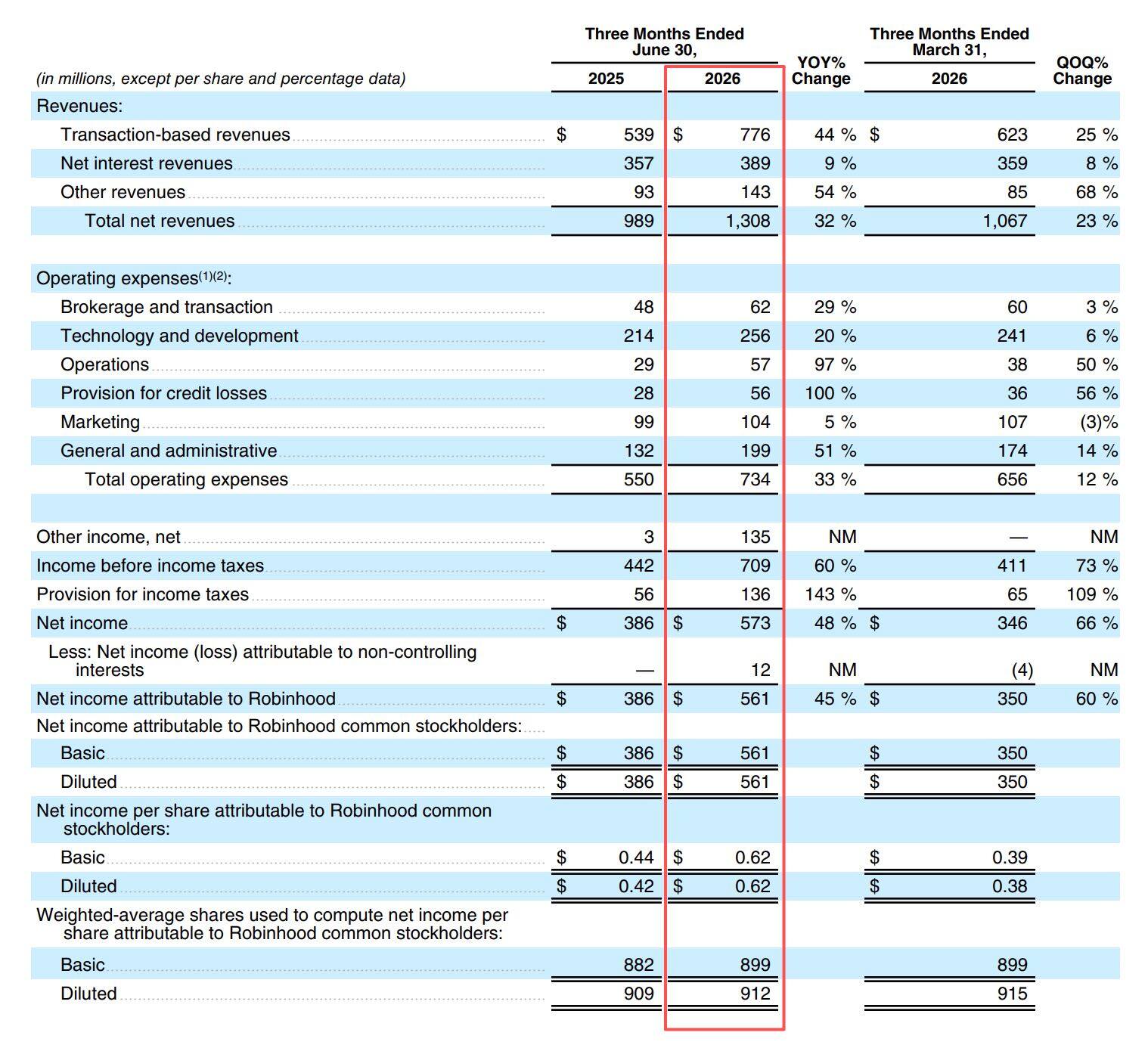
The report shows, Robinhood achieved Q2 net revenue of $1.308 billion, a 32% year-over-year increase, hitting a record high; Net income attributable to common stockholders reached $561 million, a 45% year-over-year increase; Diluted earnings per share (EPS) were $0.62, exceeding market expectations of $0.42.
Robinhood's growth this quarter was driven by trading business, user assets, and subscription services. Specifically:

  • Transaction-based revenue reached $776 million, up 44% YoY, with event contract revenue hitting $156 million, an increase of over 10 times; Options revenue reached $342 million, up 29% YoY; Equities revenue reached $129 million, up 95% YoY.
  • Net interest revenue reached $389 million, up 9% YoY; Other revenue reached $143 million, up 54% YoY, reflecting that Robinhood is expanding revenue streams through new services like the Trump Account and Gold subscriptions, gradually reducing reliance on a single transaction business.
  • User scale and deposited funds also continued to grow. Funded accounts reached 28.4 million, up 7% YoY; Robinhood Gold subscribers reached 4.8 million, up 39% YoY, a record high; Total assets under custody reached $369 billion, up 32% YoY; Net deposits for the quarter reached $21.7 billion, up 28% YoY.

Compared to the past model relying on commission-free trading and young retail investors for growth, the current Robinhood is attempting to transform from a "retail trading platform" into a one-stop financial ecosystem covering trading, wealth management, digital assets, and on-chain finance.

Explosive Growth in Trading Business, Prediction Markets Become a Major Growth Point

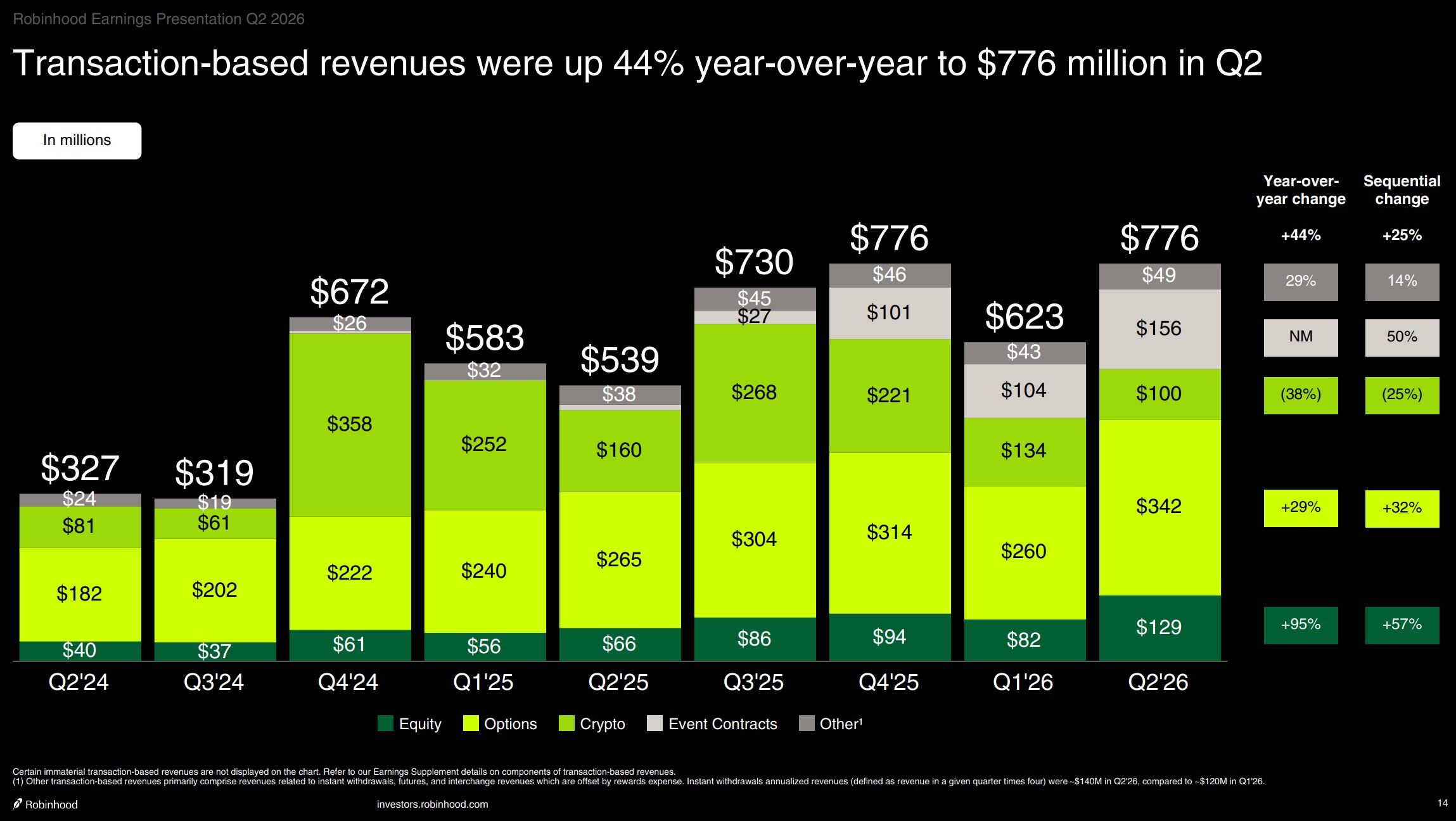
The most eye-catching performance for Robinhood this quarter came from the explosion of its trading business. Data shows, Q2 trading revenue for Robinhood reached $776 million, a 44% YoY increase, becoming the main driver of overall revenue growth.
Specifically, the revenue data and growth status of various trading services are as follows:

  • Equities trading revenue reached $129 million, up 95% YoY;
  • Options trading revenue reached $342 million, up 29% YoY;
  • Event contract (i.e., prediction market) revenue reached $156 million, an increase of over 10 times YoY;
  • Cryptocurrency trading revenue was approximately $100 million, down 38% YoY, the only declining category among mainstream trading services......

Benefiting from the favorable environment of the US stock market rally in Q2, the overall trading activity on the Robinhood platform also hit a new high. Q2 equities notional trading volume reached $956 billion, up 85% YoY; Options contract volume reached 774 million, up 50% YoY.

A key point worth noting in the earnings report is that prediction markets have now become a new direction Robinhood is heavily betting on, and also the biggest growth point this quarter's performance — for details, see "The First Prediction Market Concept Stock Has Emerged!".

This year, the popularity of prediction markets has continued to rise, experiencing a major surge during the World Cup cycle, while Robinhood has also accelerated its layout during the same period. In Q2, Robinhood launched its own prediction market platform, Rothera — a CFTC-licensed prediction market exchange and clearing house jointly established by Robinhood and Susquehanna International Group.

During the World Cup cycle, Robinhood redirected some orders originally destined for Kalshi to be executed on Rothera. Artemis data shows this move helped Rothera capture nearly 15% of the market share for World Cup-related event contracts.

Compared to traditional stock trading, prediction markets have stronger event-driven attributes and better suit the demand of young users for instant information and interactive trading. For Robinhood, this not only means new revenue sources but also signifies the company's attempt to broaden user trading scenarios.

Growth in User Asset Deposits, Robinhood Seeks a Second Growth Curve

If the trading business is the main driver of Robinhood's current performance growth, then deeper financial services centered on user assets are the key to further capturing long-term value.

In the past, Robinhood relied more on transaction fees and user activity for growth. However, as the platform scales, the company is attempting to increase user asset deposits and expand revenue sources through subscriptions, wealth management, credit cards, and other businesses.

  • As of the end of Q2, Robinhood's funded accounts reached 28.4 million, up 7% YoY; total assets under custody reached $369 billion, up 32% YoY; net deposits for the quarter reached $21.7 billion, with net deposits over the past 12 months reaching $75.7 billion.
  • At the same time, Robinhood Gold (paid subscription membership) continues to grow rapidly. Q2 Gold subscribers reached 4.8 million, up 39% YoY, a record high.
  • Additionally, new products launched around high-value users are also starting to scale. The Robinhood Credit Card business has achieved over $100 million in annualized revenue, with Gold Card users surpassing 1 million; Robinhood Strategies has attracted over 300,000 users, with assets under management approaching $2 billion.
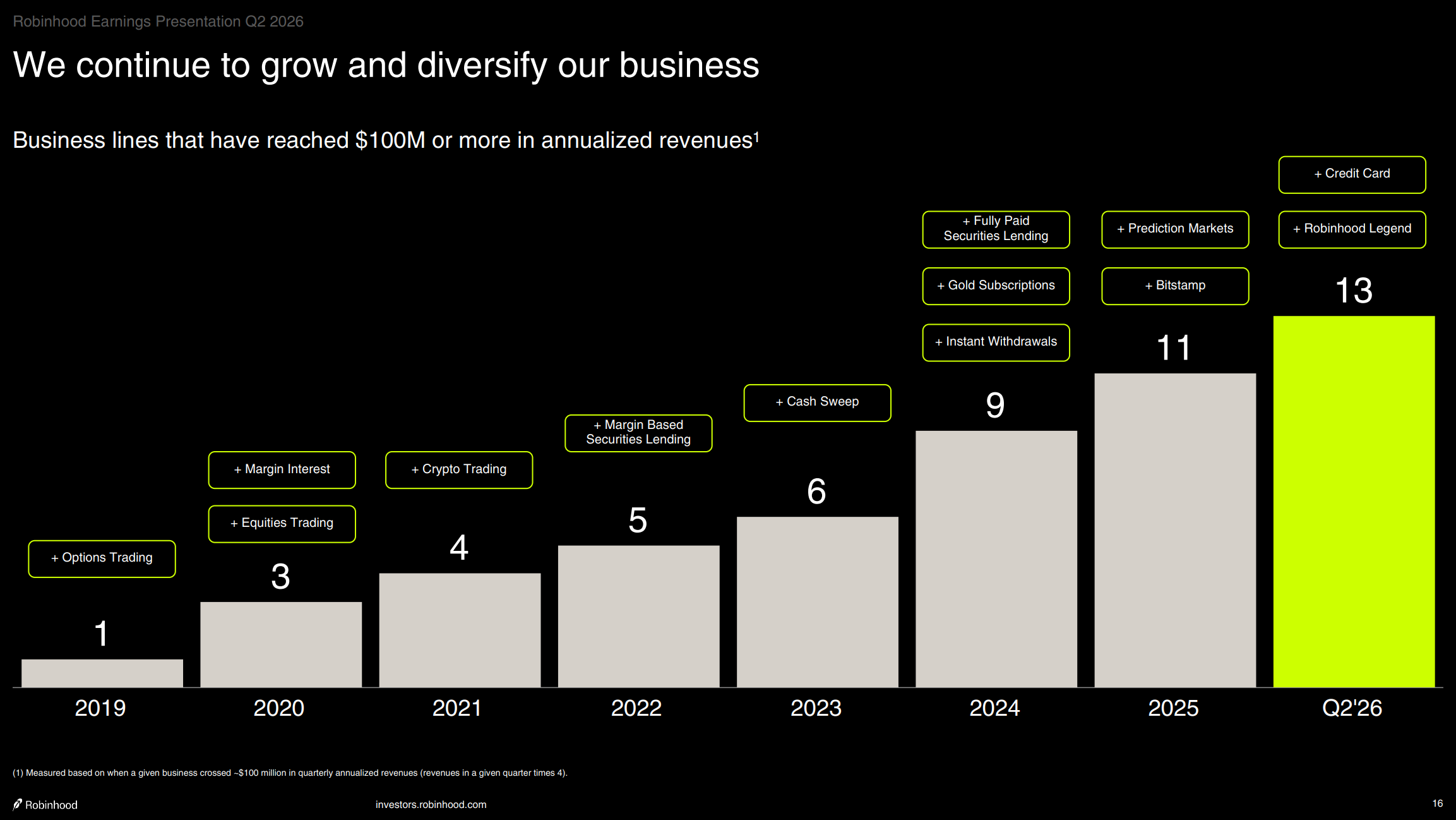
In the earnings presentation, Robinhood revealed that 13 business lines have now surpassed $100 million in annualized revenue, including equities trading, options trading, crypto trading, Gold subscriptions, prediction markets, credit cards, etc.

This means Robinhood is transitioning from a platform dependent on trading cycles to a comprehensive ecosystem covering trading, asset management, payments, and financial services.

AI and Blockchain: Robinhood Bets on Next-Generation Financial Infrastructure

Beyond traditional trading and wealth management businesses, Robinhood is also extending its reach into the fields of AI and blockchain, attempting to position itself early for the next generation of financial infrastructure.

In May this year, Robinhood announced the launch of the Agentic Trading feature, allowing users to trade stocks, options, and crypto assets through AI agents. As of the end of Q2, nearly 100,000 users had opened Agentic Trading accounts, with related asset holdings exceeding $100 million.

Different from merely providing trading tools, Robinhood aims to embed AI capabilities directly into the investment process, enhancing user engagement frequency through automated analysis and trading assistance. Currently, Agentic Trading is still in its early stages, but its growth rate indicates that AI is becoming an important direction for Robinhood to expand its product boundaries.

Simultaneously, Robinhood is also accelerating its blockchain push. In Q2, Robinhood launched the Robinhood Chain public mainnet, positioned as an Ethereum Layer 2 network for Real World Assets (RWA). Driven by the recent Meme coin rally, Robinhood Chain has now become one of the most active underlying ecosystems in the current Web3 market.

Next Stop: "Super Financial App"

Overall, the biggest change reflected in Robinhood's Q2 report is not just that revenue and profits continue to hit new highs, but that the company's growth logic is changing.

In the past, Robinhood attracted young investors with low-barrier trading and grew rapidly through stocks, options, and crypto trading. Now, the company is constantly expanding the boundaries of user demand through businesses like Gold subscriptions, credit cards, prediction markets, AI trading, and blockchain. In terms of long-term strategy, Robinhood is attempting to evolve from a simple "trading platform" into a "Super Financial App" covering investment, wealth management, digital assets, and more financial service scenarios.

The core of this goal is not merely to add more products, but to build a more complete financial ecosystem around the user lifecycle: users can complete trading, asset management, cash management, and even participate in future on-chain finance all on the same platform.

Of course, this path is still full of challenges. On one hand, new businesses are still in their early stages, and whether they can sustainably contribute to scaled revenue needs time to verify. On the other hand, the regulatory environment in areas like prediction markets, crypto assets, and on-chain finance could also affect Robinhood's future expansion pace.

But at least from the Q2 report, Robinhood is no longer content with being just an online broker serving retail traders; it is advancing towards becoming the next-generation financial gateway.


Пов'язані питання

QWhat was Robinhood's Q2 2026 net revenue and year-over-year growth?

ARobinhood's Q2 2026 net revenue was $1.308 billion, representing a 32% year-over-year increase and a new all-time high.

QWhat was the most significant growth driver in Robinhood's trading business during the quarter?

AThe Event Contracts (prediction market) business was the most significant growth driver in trading, with revenue reaching $156 million, a growth of over 10 times year-over-year.

QHow many business lines at Robinhood now generate over $100 million in annualized revenue?

ARobinhood currently has 13 business lines that each generate over $100 million in annualized revenue, including stock trading, options trading, crypto trading, Gold subscriptions, and prediction markets.

QWhat is the new strategic direction Robinhood is aiming for, as outlined in the article?

ARobinhood is aiming to evolve from a retail trading platform into a 'super financial app'—a comprehensive financial ecosystem covering investment, wealth management, digital assets, and future on-chain finance services.

QWhat two emerging technology areas is Robinhood investing in for future financial infrastructure?

ARobinhood is investing in AI and blockchain technology. It launched Agentic Trading (AI-powered trading) and the Robinhood Chain, a Layer 2 blockchain network focused on Real World Assets (RWA).

Пов'язані матеріали

AI is Killing 'Poor People's Entertainment'

AI Is Eliminating 'Entertainment for the Poor' This article discusses the rising cost of video gaming, arguing that AI is making digital entertainment increasingly expensive. It follows the example of a frugal gamer who, accustomed to waiting for discounts and buying second-hand games, now faces a new reality. Video game consoles like the PS5 Pro and Switch 2 are increasing in price post-launch, breaking the traditional pattern of降价 over time. Game prices are also rising, with major titles like GTA 6 launching at $80. Furthermore, the industry is moving towards eliminating physical media, exemplified by Sony's plan to stop PS disc production by 2028. This shift blocks the二手 market, a key cost-saving avenue for players. Even Valve's anticipated affordable Steam Machine launched with a high price and disappointing specs. Manufacturers cite inflation, supply chain issues, and rising development costs, but a core driver is the AI boom. AI data centers now consume semiconductor and memory resources once prioritized for consumer electronics like game consoles. This competition from a more profitable sector drives up hardware costs. Additionally, developing modern AAA games with massive teams over many years is astronomically expensive, pushing publishers towards digital-only distribution and subscription models to secure recurring revenue. The article suggests this trend extends beyond gaming. Video streaming, music platforms, cloud storage, and AI tools are increasingly locked behind complex subscription tiers. While AI promises future benefits, it is currently making digital entertainment and services more costly. The era of progressively cheaper, accessible online entertainment is ending, forcing consumers to pay more upfront for future technological promises.

marsbit22 хв тому

AI is Killing 'Poor People's Entertainment'

marsbit22 хв тому

The Demise of the Trillion-HKD ETF Myth: SK Hynix Plummets, Hong Kong Switches from 'Double Leverage' to 'Flexible Leverage', South Korea Restricts Leveraged ETF Investments

South Korea's AI-driven bull market has taken a sharp downturn, severely impacting SK Hynix's stock and prompting regulatory tightening in both Hong Kong and South Korea on single-stock leveraged products. The CSOP SK Hynix Daily Leveraged (2x) ETF, once the world's largest single-stock leveraged ETF with over HKD 130 billion in assets, saw its value plummet by over 80% as SK Hynix shares fell nearly 46% from their June peak, erasing more than HKD 100 billion. In response, Hong Kong's Securities and Futures Commission (SFC) revised its regulatory framework. Starting August 3rd, fixed 2x leverage for single-stock leveraged and inverse products will shift to a dynamic "flexible leverage" mechanism, where daily leverage can vary up to a maximum of 2x. This aims to balance market development with investor protection but has sparked debate about changes to the products' core features and potential reduced appeal for risk-seeking investors. Simultaneously, South Korean authorities announced plans to further restrict single-stock leveraged ETFs following two consecutive days of market circuit breakers. Proposed measures include capping individual investors' allocations to such products at 20% of their total financial investment assets, increasing trading costs, and enhancing suitability requirements. The Finance Minister publicly apologized, acknowledging insufficient initial risk assessment. Analysts note that while the long-term fundamentals for South Korean semiconductor firms like SK Hynix remain solid, short-term market volatility is heightened due to concentrated leveraged bets and shifting global risk sentiment. The regulatory moves in both markets signal a clear shift from encouraging innovation towards prioritizing risk control, reminding investors of the amplified risks inherent in leveraged products.

marsbit28 хв тому

The Demise of the Trillion-HKD ETF Myth: SK Hynix Plummets, Hong Kong Switches from 'Double Leverage' to 'Flexible Leverage', South Korea Restricts Leveraged ETF Investments

marsbit28 хв тому

After the Privatization of the Internet, Silicon Valley Begins Privatizing Human Civilization

"The Privatization of Human Civilization" The article critiques how AI companies like Anthropic are systematically acquiring and digitizing millions of books—sometimes by destroying physical copies—to build proprietary training datasets for models like Claude. While a lawsuit resulted in a settlement, the author argues the deeper issue transcends copyright: it is about the privatization and centralized control of human knowledge and civilization. This process coincides with a powerful Silicon Valley ideology, exemplified by Marc Andreessen's "Techno-Optimist Manifesto" and movements like e/acc (Effective Accelerationism). This worldview frames technological growth and speed as inherently moral, portraying caution, regulation, and public dissent as obstacles to progress. It often envisions intelligence itself, rather than human well-being, as the ultimate goal, potentially sidelining present human concerns. Figures like Peter Thiel and Curtis Yarvin express skepticism towards democratic processes as too slow, suggesting more centralized, founder-led governance is efficient. This logic extends to AI, where a small team within a company defines the model's "constitution"—its rules, values, and definitions of truth and safety—effectively governing how millions understand the world. Thus, the scanned books symbolize a new form of control. Knowledge isn't erased but is ingested into private, opaque systems. The original, decentralized, and contestable nature of books and public knowledge is replaced by a curated, company-controlled output. The public's access to their own cultural heritage becomes mediated by corporate AI, which remembers civilization only in the form its creators dictate. This is not book-burning but a subtler, potentially more complete privatization of human memory and understanding.

marsbit37 хв тому

After the Privatization of the Internet, Silicon Valley Begins Privatizing Human Civilization

marsbit37 хв тому

Торгівля

Спот
活动图片