Commerce Ministry's Latest Export Controls Target 10 US Companies: Three Market-Moving Threads Explained

marsbitОпубліковано о 2026-06-22Востаннє оновлено о 2026-06-22

Анотація

China's Ministry of Commerce placed 10 U.S. entities, including MP Materials, USA Rare Earth, Red Cat Holdings, and Teal Drones, on an export control list, banning the export of dual-use items. This move is seen as part of an ongoing countermeasure in the rare earth sector. The analysis suggests the primary impact is on U.S. companies within the **military, drone, and rare earth** sectors, aiming to restrict their access to critical Chinese materials and technology. For the Chinese market, the event is interpreted as reinforcing the **strategic value and pricing power** of domestic rare earth suppliers. However, the potential stock market reactions are nuanced: 1. **Chinese Rare Earth Upstream:** Companies like Northern Rare Earth are near yearly highs, indicating this event's "beneficiary" logic is largely priced in. It may confirm the trend but is unlikely to be a new major catalyst. 2. **Chinese Rare Earth Mid/Downstream & Drones:** Sectors like magnetic materials (e.g., Da Di Bear, Zhenghai Magnetic) and military drones (e.g., China Aerospace) are relatively undervalued. While the drone listing highlights sectoral competition, it doesn't directly translate to new orders for Chinese firms. 3. **Impact on Listed U.S. Companies:** The effect on stocks like MP Materials is ambiguous. While Chinese restrictions pose a challenge, these companies are also core to U.S. supply chain security efforts and may receive increased government support, potentially offsetting negative...

Author: David, Chao Xiang Research

On June 22nd, the Ministry of Commerce issued Announcement No. 23 of 2026, adding 10 U.S. entities including Ivex, Red Cat Holdings, and MP Materials to the export control list, prohibiting the export of dual-use items to them; on the same day, an additional 46 U.S. companies were added to the government procurement restriction list.

(Author's note: Dual-use items refer to goods, technologies, and services that have both civilian and military applications or can enhance military potential.)

This marks another round in the normalization of China's rare earth countermeasures since October 2025. The 10 targeted U.S. companies are primarily concentrated in three sectors: defense, drones, and rare earths.

The two most prominent names on the list are MP Materials and USA Rare Earth, both flagships of the U.S. rare earth industry. China's action against them prompted the market's initial reaction to favor the A-share rare earth sector: with competitors being restricted, domestic players gain greater scarcity and value.

The question is, the rare earth sector has been rising from last October until now, with leading upstream companies already near their year-to-date highs. Is it too late to react now?

If it is late, where might the money go?

The Commerce Ministry's control list involves more than just the rare earth thread. The fully appreciated rare earth sector might still have further catalysts ahead, and overlooked, less popular threads might still be under the radar.

We attempt to outline the potentially affected threads and place them on a price coordinate for reference.

Key Conclusions

1 The upstream A-share rare earth sector is fully priced-in; this control measure is not a new catalyst.

Northern Rare Earth's current price of 52.9 yuan is only about 20% away from its one-year high of 63.6 yuan; Guangdong Rising Nonferrous Metals at 115 yuan and Shenghe Resources at 33.6 yuan are both close to their one-year highs. These upstream resource stocks have been trending upward since October last year, and the logic of "benefiting from rare earth countermeasures" has largely been priced in. For the upstream rare earth industry, this control measure is more of a reconfirmation of the trend rather than a new starting point for a rally.

2 The relatively underpriced segments are the mid-to-downstream rare earth magnet materials and the drone industry chain.

Within the same rare earth chain, valuations in the midstream and downstream are significantly lower than upstream:

Magnet sector players like Earth-Panda (30.7 yuan) and Sinomag (13.7 yuan) are still near the lower end of their one-year ranges, their gains notably lagging behind upstream resource stocks. The drone sector corresponding to Red Cat and Teal Drones on the control list is even quieter, with Avic UAS near its one-year low and receiving limited market attention. The pricing progress of various segments is not uniform under the same event.

3 The targeted U.S. stocks do not necessarily constitute a one-sided negative; the open market needs to verify.

MP Materials and USA Rare Earth are core players in the U.S. domestic rare earth supply chain, with MP having background investment from the U.S. Department of Defense.

For such companies, China's export controls and U.S. policy support are two coexisting forces, and their impact directions may not align. All three mentioned stocks were not at low levels before the announcement. The announcement was made on Monday before U.S. markets opened, so their true pricing reaction awaits the market's verdict.

Investors holding related positions should pay close attention to the post-open price action.

Why Do Export Controls Benefit Domestic Rare Earths?

Many find it counterintuitive at first glance: banning exports means Chinese businesses do less trade, so how is that a positive?

The key lies in the direction of the control. This ban prevents China from selling rare earth-related items to those 10 U.S. companies, cutting off the supply sources for these American firms, not the raw material procurement for Chinese manufacturers.

China's rare earth industry, from mining, smelting, and separation to magnet manufacturing, is the world's most complete chain, self-sufficient and not reliant on sourcing from the U.S. In other words, this announcement does not affect Chinese suppliers' upstream operations; they can produce and export as usual.

It's the U.S. side that is truly pinched.

Companies like MP Materials and USA Rare Earth want to build a self-reliant supply chain bypassing China, yet they still depend on China for separation technology, equipment, and some intermediate materials. Restricting competitors' access conversely enhances the scarcity and bargaining power of Chinese companies within the global rare earth landscape, which is the real reason the market interprets this as positive for A-share rare earths.

Rare Earth Upstream is Fully Priced; Money Hasn't Flowed Downstream

First, clarify the chain. Rare earths are mined, then smelted and separated into materials like praseodymium-neodymium oxide; this is the upstream, handled by companies like Northern Rare Earth, Guangdong Rising Nonferrous Metals, and Shenghe Resources.

These raw materials are further processed into NdFeB permanent magnet materials and installed into various motors; this is the midstream and downstream, where JL Mag, Sinomag, and Earth-Panda operate.

The upstream sells raw materials; the downstream sells magnet materials.

In this round of market movement, money primarily surged into the upstream. Northern Rare Earth at 52.9 yuan, Guangdong Rising Nonferrous Metals at 115 yuan, and Shenghe Resources at 33.6 yuan are all near their one-year highs. The logic is straightforward: every time rare earths' strategic importance is emphasized, the first beneficiaries are the upstream players with mines and smelting capacity, whose scarcity is tangible.

In my view, this control event is a positive in the same direction for the upstream, but the price has already digested this expectation. Entering now is more like taking over at high levels, offering less favorable risk-reward.
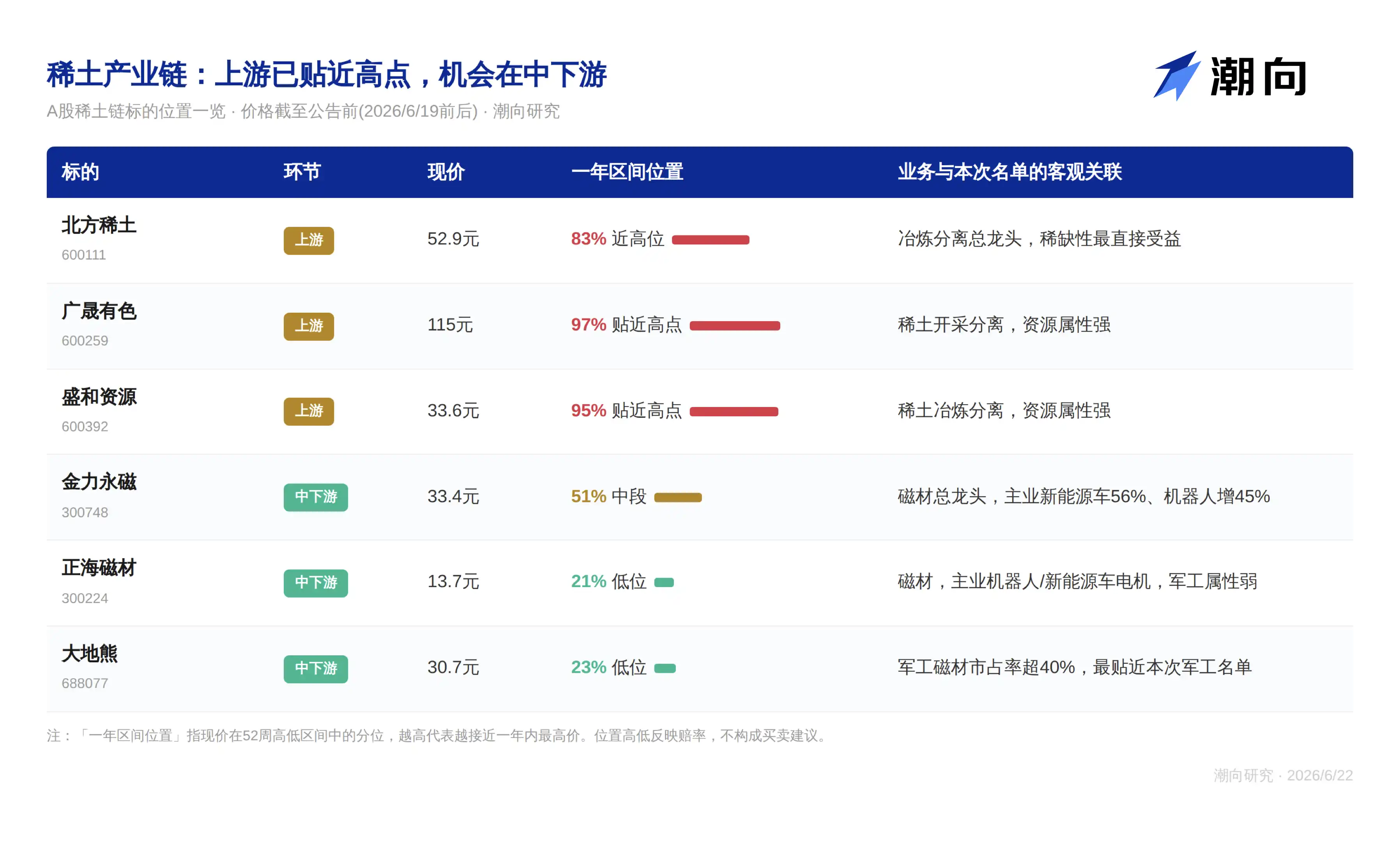
Moving downstream to magnet materials, the pricing progress is noticeably slower.

Among the three magnet leaders, JL Mag, with 7.7 billion yuan in revenue and doubled net profit, saw its 2025 stock price rise over 90%, placing it at a high level. However, Sinomag and Earth-Panda are still pressed near the lower end of their one-year price ranges, not catching up with the upstream gains.

There is a background detail easily overlooked:

Since the second half of 2025, China has opened up exports to U.S. magnet manufacturers. For instance, JL Mag's U.S. sales reached 500 million yuan for the full year, up 40%; Sinomag and Earth-Panda also obtained U.S. export licenses. China's addition of 10 companies to the control list this time is a precise move under the framework of "allowing ordinary commercial customers while cutting off specific defense entities," not a comprehensive embargo.

Therefore, the impact of this logic on magnet companies' financial statements is actually limited.

The 10 restricted U.S. companies were not among their major clients to begin with. The real revenue for JL Mag and Sinomag comes from new energy vehicle and robot motors, largely unrelated to defense exports to the U.S.

This control measure is more of a sentiment boost for the magnet stock sector, unlikely to translate into tangible orders. However, regarding the rare earth downstream, what's truly noteworthy might be which company's business aligns more closely with the defense theme of this list.
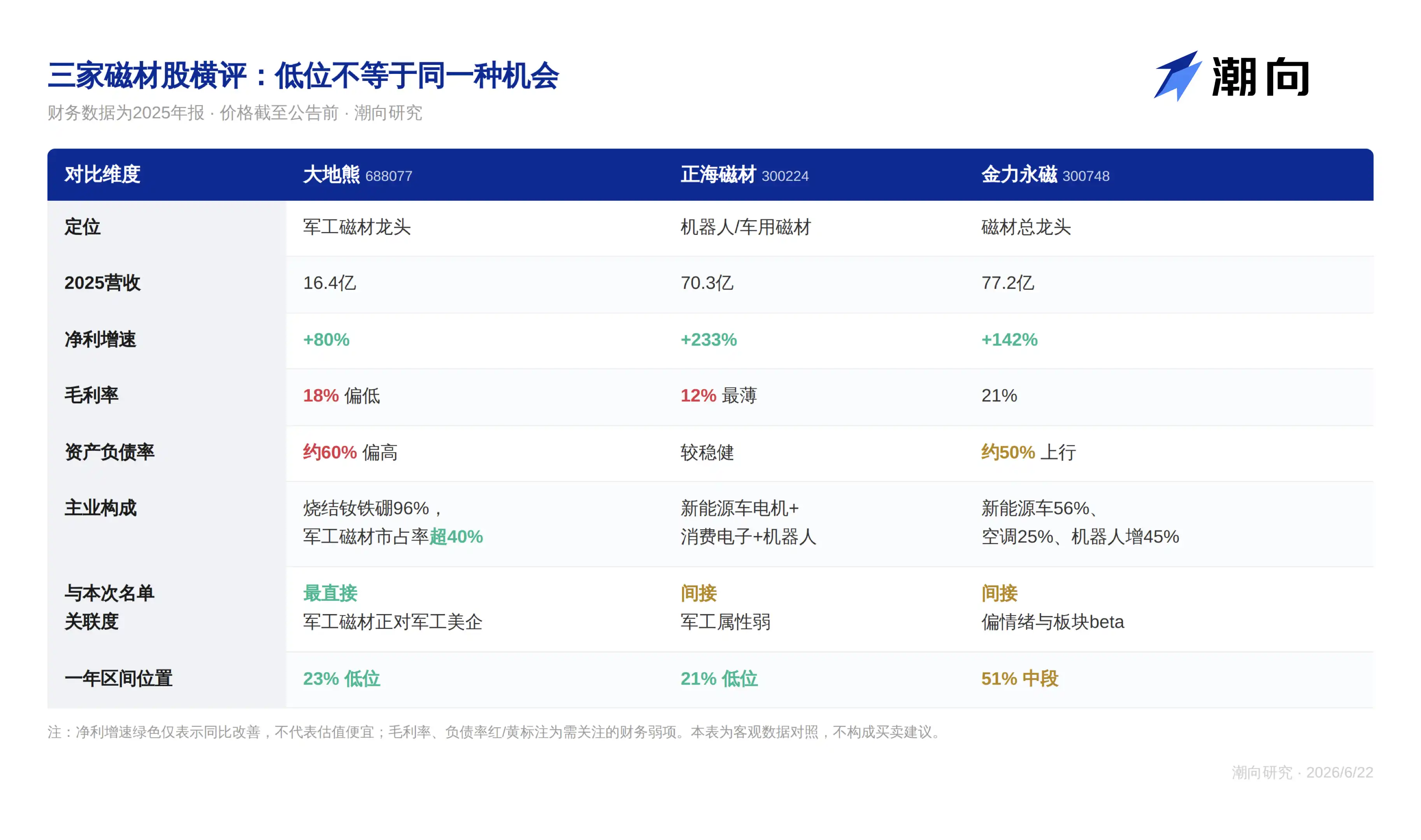
On this point, Earth-Panda aligns better than the other two.

Earth-Panda has a small market cap, with 2025 revenue of 1.6 billion yuan and net profit of 57.4 million yuan. However, it is a major domestic supplier of defense magnet materials, with publicly available data showing over 40% market share in this segment. Its products are used in equipment like aero engines and missiles, directly corresponding to the targeted defense and drone U.S. companies on the control list. This is its most direct narrative link to the event.

However, narrative alignment doesn't equal stability: financially, its gross margin is only 18%, and its debt ratio is nearing 60%, indicating weaker profitability and financial safety compared to peers. Combined with its small market cap, its stock price can bounce up quickly but also plummet sharply.

It suits those who can tolerate volatility and prioritize "purest theme," not as a cornerstone holding.

Sinomag represents another type. Its 2025 net profit more than tripled, a reversal much stronger than Earth-Panda's, but driven by humanoid robots and new energy vehicle motors, largely unrelated to this defense list. Its low price is more due to the robotics story not being fully priced in by the market yet.

Therefore, reading the rare earth thread reveals two different situations upstream and downstream.

Upstream holds resources with the most tangible scarcity, but prices have already reflected the positives; it's now a high-level handoff. Downstream magnet materials are still at low levels. Earth-Panda aligns more with the defense list, at the cost of a small market cap and weak finances. Sinomag is cheap but has weak relevance.

Drones: The List Points to This Thread, But No Direct Positive

Red Cat Holdings and its subsidiary Teal Drones on the control list produce military reconnaissance and strike drones in the U.S., exactly the type of military drone suppliers the U.S. aims to support to replace Chinese products.

The market naturally associates this with the A-share military drone sector, but the positive logic here is likely not the same as for rare earths. This won't directly bring orders to any specific Chinese drone company. It's more about bringing "Sino-U.S. competition in military drones" to the forefront, prompting the market to refocus on the strategic value and military export competitiveness of domestic military drones.

Following this thread to find corresponding A-share targets, the most business-aligned company is Avic UAS.

Avic UAS is a leader in large domestic military drones. Its core product is the Wing Loong series of reconnaissance-strike integrated drones, with drone systems accounting for over 90% of its main revenue. It primarily exports through military trade, being a main force in China's military drone exports.

In terms of business alignment, it indeed competes in the same arena as the targeted U.S. drone companies, making it the highest relevance play on this thread.

Its current price is 44 yuan, at the lower end of its one-year range. However, this position formed after a decline from highs, not from a lack of movement.

Its 2025 financial report shows significant performance growth with military trade orders, with revenue in the first three quarters more than tripling year-on-year, and the stock price once reached 48 yuan. The current pullback is more akin to cooling off after realization.

It's important to note that military trade revenue heavily depends on single large orders. Revenue fell nearly 70% year-on-year in 2024, turning to a loss, then rebounded strongly in 2025. This boom-bust characteristic means judging its cheapness based on price position is unreliable. The real variable is the signing and delivery rhythm of subsequent military trade orders. Valuation-wise, the company's P/E ratio has long been in the tens, not constituting undervaluation.

Export Restrictions Do Not Equate to Pure Negatives for Corresponding U.S. Stocks

This is the primary concern for holders of related U.S. stocks, and the answer might differ from intuition: not necessarily.

The most significant names on the export control list, MP Materials and USA Rare Earth, are core vehicles for the U.S. to reduce its reliance on Chinese rare earths. MP is the only vertically integrated rare earth producer of scale in the U.S., receiving investment from the U.S. Department of Defense in 2025, making it an object of national strategic support. This status determines its dual-sided situation:

China cuts off its access to Chinese dual-use items, but precisely due to supply chain security concerns, the U.S. government might instead provide it with more orders and subsidies.

Pre-announcement prices also support this view. MP, USA Rare Earth, and Red Cat Holdings were not at low levels before the control news emerged. The market did not sell off in advance due to "potential sanctions," indicating investors had not previously priced them simply as victims.

Of course, the final direction depends on the market opening. The announcement was made on Monday before U.S. markets opened. Whether sanctions are read as a material negative or offset by support expectations will be answered by post-open trading.
Note: This article is for information organization and viewpoint analysis. The mentioned stocks, ratings, and target prices are from public sources and are time-sensitive, constituting no investment advice. The market involves risks; decisions require independent judgment.


Трендові криптовалюти

Пов'язані питання

QAccording to the article, which A-share sectors are most impacted by China's new export controls on 10 US companies, and what is their current market pricing situation?

AThe export controls primarily impact three A-share sectors: 1) Rare Earth Upstream (e.g., Northern Rare Earth, Guang Sheng Nonferrous): These stocks are already trading near their yearly highs, meaning the 'benefit from export controls' logic is largely priced in. 2) Rare Earth Mid/Downstream (Magnet materials like Da Di Bear, Zhenghai Magnetic Material): These are still at the lower end of their yearly price range, with valuations significantly lagging behind upstream stocks. 3) Drone Sector (e.g., AVIC UAV): Specifically, military drones like AVIC UAV are mentioned as thematically related to the sanctioned US drone companies, but the stock is near its yearly low without a direct order boost from this event.

QWhy does the article suggest that the export controls could be a positive for China's rare earth sector, even though it restricts business?

AThe controls restrict Chinese companies from selling dual-use items *to* the 10 listed US firms, cutting off their supply sources. Since China's rare earth sector has a complete, self-sufficient supply chain and does not rely on raw materials from the US, its production is unaffected. By constraining key US competitors like MP Materials and USA Rare Earth (which still depend on some Chinese technology/inputs), the controls enhance the scarcity and bargaining power of Chinese rare earth suppliers in the global market, which is interpreted as a positive for the sector.

QAmong the rare earth magnet material (downstream) companies mentioned, which one is highlighted as having the most direct thematic link to the US entities on the sanctions list, and what are the associated risks?

ADa Di Bear (大地熊) is highlighted as having the most direct link because it is a major domestic supplier of rare earth magnets for military applications (e.g., aircraft engines, missiles), aligning with the sanctioned US defense and drone companies. The associated risks are its smaller market capitalization, weaker financials (lower gross margin, higher debt ratio), and higher stock price volatility, making it suitable only for investors who can tolerate high risk and prioritize thematic purity.

QWhat is the article's assessment of the potential impact on the US companies (like MP Materials) added to the export control list? Is it purely negative?

ANo, the impact is not necessarily purely negative. The article argues that for core US strategic companies like MP Materials (which has US Department of Defense investment), the situation is two-sided. While Chinese export controls cut off access to certain Chinese dual-use items, these companies are also central to US efforts to build domestic supply chains. This strategic importance may lead to increased US government orders, subsidies, and policy support, which could counteract the negative impact of the sanctions. The market's pre-announcement pricing (these stocks were not at lows) also suggested investors hadn't priced them as simple victims.

QRegarding the drone sector, which A-share company is considered the most thematically aligned with the sanctioned US drone firms, and what key factor drives its investment value according to the article?

AAVIC UAV (中无人机) is considered the most thematically aligned, as its core product, the Wing Loong series of military reconnaissance/strike drones, competes directly in the same military export market as the sanctioned US companies (Red Cat, Teal Drones). However, the article states the export controls do not directly translate into new orders for AVIC UAV. Its investment value is primarily driven by the rhythm of subsequent military export order signings and deliveries, not its current stock price level. The company's revenue is characterized by significant year-to-year fluctuations based on large individual contracts.

Пов'язані матеріали

Report Interpretation: J.P. Morgan Details Micron's Pre-Earnings Sentiment, Current Hardware Sector Dynamics

Morgan Stanley analyst Joshua Meyers' report (June 21, 2026) highlights key trends in the hardware and semiconductor sector ahead of Micron's earnings. The core takeaways are: 1. **Micron & Memory:** Memory remains a high-conviction long theme, driven by strong AI demand and rising ASPs. However, investor focus is shifting to the sustainability of Micron's >80% gross margins and the specifics of potential new long-term supply agreements (SCAs). 2. **Hardware Supply Chain:** AI-related demand for servers, networking, and storage remains robust, but company performance is diverging. Celestica (CLS) shows improved margin confidence, Western Digital and Seagate benefit from pricing, Fabrinet (FN) sees predictable AI optics growth, and Teradyne (TER) anticipates a new Google customer. 3. **AI Capex & WFE Forecasts:** JPMorgan increased its Wafer Fab Equipment (WFE) market growth forecasts to 28% in 2026 and 29% in 2027. AI infrastructure financing is evolving, with higher project-level debt reducing constraints on capex expansion. The report signals that while the AI-driven hardware cycle is strong, the market is entering a phase focused on execution verification (e.g., Micron's SCA details, Fabrinet's ramp with Amazon) and valuation sustainability. Key near-term signals include Micron's guidance, Arista Networks' outlook, and the pace of demand normalization post potential tariff-related pull-ins.

marsbit3 год тому

Report Interpretation: J.P. Morgan Details Micron's Pre-Earnings Sentiment, Current Hardware Sector Dynamics

marsbit3 год тому

Research Report Analysis: The Fed's New Chair's Debut – New Leader, But Same Script?

Report Analysis: Federal Reserve's New Chair Debut – A New Captain, But the Same Script? Morgan Stanley's chief global economist Seth B. Carpenter analyzes the first FOMC meeting under new Fed Chair Kevin Warsh in a June 21 report. Warsh deliberately avoided providing forward guidance on interest rates, aligning with his philosophy. However, market expectations for a rate hike this year were reinforced. Key signals lie elsewhere: inflation may fall more than expected, and quantitative tightening (QT) could be more aggressive than anticipated. The FOMC's "dot plot" suggests only one rate hike in 2026. Carpenter argues that if inflation undershoots forecasts, the logic for even a single hike weakens, especially as projections indicate potential rate cuts in 2027. On QT, Warsh's stance is clear. Carpenter notes that measures like halving the Treasury's account balance could shrink the Fed's balance sheet by around $500 billion with minimal market impact. Combined with adjustments to reserve interest and liquidity rules, the ultimate QT scale may exceed expectations, though its market effect might be less disruptive unless the Fed actively sells Mortgage-Backed Securities (MBS). While Warsh initiated a review of the Fed's policy framework, the 2% inflation target remains intact for now. The report concludes that the market may be overestimating the significance of reduced forward guidance and the near-term rate hike risk, while potentially underestimating the scope and manageable nature of the coming balance sheet reduction. The key debates will hinge on upcoming core PCE data, the specifics of the QT path, and the framework review's findings.

marsbit3 год тому

Research Report Analysis: The Fed's New Chair's Debut – New Leader, But Same Script?

marsbit3 год тому

Critical Game Week: BTC Retracement Confirmation vs. HYPE Support Battle | Guest Analysis

This weekly analysis outlines a critical juncture for BTC and HYPE markets, focusing on key price level confirmations. **BTC Analysis:** BTC is at a pivotal point after a five-wave rally from the June 5th low of $59,100. The price has broken below a short-term rising channel's lower boundary, with the current move seen as a pullback to test this breakdown. Failure to reclaim this level could lead to a retest of the $59,000-$60,000 support zone. The core scenario hinges on this channel retest outcome. * **Key Levels:** Resistance at $64,500-$65,000 (channel boundary) and $69,500-$70,500. Support at $59,000-$60,000 and $55,000. * **Strategy:** A core bearish stance is maintained (20% short from last week), with short-term plans for tactical trades. Three detailed contingency plans (A/B/C) are provided for short positions on resistance tests or breakdowns, emphasizing strict stop-loss discipline. **HYPE Analysis:** HYPE shows strong momentum but is currently in a corrective phase after hitting a new high of $76.94. The price is retesting the crucial $64-$66 support area. * **Key Levels:** Resistance near $77 and $80-$82. Support at $64-$66 and $52-$54. * **Strategy:** The short-term approach is "buy on dips, avoid chasing rallies." A long position is considered only if clear stabilization signals appear at the $64-$66 or deeper $52-$54 support zones, with tight risk controls. **General Risk Management:** A standardized trailing stop-loss protocol is emphasized: set initial stop, breakeven at +1% profit, then trail stops upward to lock in gains. *Disclaimer: All analysis is presented as a personal trading framework, not investment advice. Market conditions are complex and require dynamic adjustment.*

marsbit3 год тому

Critical Game Week: BTC Retracement Confirmation vs. HYPE Support Battle | Guest Analysis

marsbit3 год тому

Research Report Interpretation: Citi Attends AWS Summit, Bullish on Cloud Business Acceleration but Data Governance Remains Key Variable

Citi analyst Tyler Radke's team attended the AWS New York Summit (June 17-18), engaging with over 10 clients and partners. In a June 19 report, they highlighted the summit's focus on scaling agent AI for enterprise deployment. Citi maintains a "Buy" rating on Amazon, forecasting AWS revenue growth to accelerate to 37% in FY27 from 30% in FY26, noting this estimate may be conservative. Key takeaways: 1. **AWS Strategy Shift:** AWS is moving from proof-of-concepts to scalable deployment. New offerings like AWS Context (building enterprise knowledge graphs), Amazon Quick (cross-application AI assistant), and security tool Continuum address core enterprise pain points for AI adoption. 2. **Data Infrastructure Beneficiaries:** Data infrastructure companies like Snowflake, Elastic, Oracle, and ClickHouse are seen as direct beneficiaries of scaling AI workloads, as evidenced by strong growth and use cases presented. 3. **Critical Role of Data Governance:** As AI agents scale from hundreds to thousands, effective data governance becomes the key variable for deploying AI in core business processes. AWS Context represents AWS's strategic extension from providing compute/models to offering a data governance infrastructure layer. The report emphasizes that without solving data governance, AI will remain confined to pilot projects. The investment thesis focuses on AWS revenue acceleration and data infrastructure vendors' growth, while monitoring signals like AWS's quarterly revenue growth, Bedrock AgentCore task volume, and pricing impacts on companies like Elastic.

marsbit3 год тому

Research Report Interpretation: Citi Attends AWS Summit, Bullish on Cloud Business Acceleration but Data Governance Remains Key Variable

marsbit3 год тому

Торгівля

Спот
Ф'ючерси

Популярні статті

Що таке $S$

Розуміння SPERO: Комплексний огляд Вступ до SPERO Оскільки ландшафт інновацій продовжує еволюціонувати, виникнення технологій web3 та криптовалютних проектів відіграє ключову роль у формуванні цифрового майбутнього. Один з проектів, який привернув увагу в цій динамічній сфері, — це SPERO, позначений як SPERO,$$s$. Ця стаття має на меті зібрати та представити детальну інформацію про SPERO, щоб допомогти ентузіастам та інвесторам зрозуміти його основи, цілі та інновації в рамках web3 та крипто-сектору. Що таке SPERO,$$s$? SPERO,$$s$ — це унікальний проект у криптопросторі, який прагне використати принципи децентралізації та технології блокчейн для створення екосистеми, що сприяє залученню, корисності та фінансовій інклюзії. Проект розроблений для полегшення взаємодії між користувачами новими способами, надаючи їм інноваційні фінансові рішення та послуги. У своїй основі SPERO,$$s$ прагне надати можливості індивідам, забезпечуючи інструменти та платформи, які покращують користувацький досвід у криптовалютному просторі. Це включає в себе можливість більш гнучких методів транзакцій, сприяння ініціативам, що підтримуються спільнотою, та створення шляхів для фінансових можливостей через децентралізовані додатки (dApps). Основна концепція SPERO,$$s$ обертається навколо інклюзивності, прагнучи зменшити розриви в традиційній фінансовій системі, використовуючи переваги технології блокчейн. Хто є творцем SPERO,$$s$? Особистість творця SPERO,$$s$ залишається дещо невідомою, оскільки є обмежені публічно доступні ресурси, що надають детальну інформацію про його засновників. Ця відсутність прозорості може бути наслідком зобов'язання проекту до децентралізації — етики, яку багато проектів web3 поділяють, ставлячи колективні внески вище за індивідуальне визнання. Зосереджуючи обговорення навколо спільноти та її колективних цілей, SPERO,$$s$ втілює суть наділення без виділення конкретних осіб. Таким чином, розуміння етики та місії SPERO є більш важливим, ніж ідентифікація єдиного творця. Хто є інвесторами SPERO,$$s$? SPERO,$$s$ підтримується різноманітними інвесторами, починаючи від венчурних капіталістів до ангельських інвесторів, які прагнуть сприяти інноваціям у крипто-секторі. Зосередження цих інвесторів зазвичай узгоджується з місією SPERO — пріоритет надається проектам, які обіцяють технологічний прогрес у суспільстві, фінансову інклюзію та децентралізоване управління. Ці інвесторські фонди зазвичай зацікавлені в проектах, які не лише пропонують інноваційні продукти, але й позитивно впливають на спільноту блокчейн та її екосистеми. Підтримка з боку цих інвесторів підкріплює SPERO,$$s$ як значного конкурента в швидко змінюваній сфері крипто-проектів. Як працює SPERO,$$s$? SPERO,$$s$ використовує багатогранну структуру, яка відрізняє його від традиційних криптовалютних проектів. Ось деякі ключові особливості, які підкреслюють його унікальність та інноваційність: Децентралізоване управління: SPERO,$$s$ інтегрує моделі децентралізованого управління, надаючи користувачам можливість активно брати участь у процесах прийняття рішень щодо майбутнього проекту. Цей підхід сприяє відчуттю власності та відповідальності серед членів спільноти. Корисність токена: SPERO,$$s$ використовує свій власний криптовалютний токен, розроблений для виконання різних функцій в екосистемі. Ці токени дозволяють здійснювати транзакції, отримувати винагороди та полегшувати послуги, що пропонуються на платформі, підвищуючи загальну залученість та корисність. Шарова архітектура: Технічна архітектура SPERO,$$s$ підтримує модульність та масштабованість, що дозволяє безперешкодно інтегрувати додаткові функції та додатки в міру розвитку проекту. Ця адаптивність є надзвичайно важливою для збереження актуальності в постійно змінюваному крипто-ландшафті. Залучення спільноти: Проект підкреслює ініціативи, що підтримуються спільнотою, використовуючи механізми, які стимулюють співпрацю та зворотний зв'язок. Підтримуючи сильну спільноту, SPERO,$$s$ може краще задовольняти потреби користувачів та адаптуватися до ринкових тенденцій. Фокус на інклюзію: Пропонуючи низькі комісії за транзакції та зручні інтерфейси, SPERO,$$s$ прагне залучити різноманітну базу користувачів, включаючи осіб, які раніше не брали участі в крипто-просторі. Це зобов'язання до інклюзії узгоджується з його загальною місією наділення через доступність. Хронологія SPERO,$$s$ Розуміння історії проекту надає важливі уявлення про його розвиток та етапи. Нижче наведено пропоновану хронологію, що відображає значні події в еволюції SPERO,$$s$: Етап концептуалізації та ідеації: Початкові ідеї, що стали основою SPERO,$$s$, були сформовані, тісно пов'язані з принципами децентралізації та фокусом на спільноті в індустрії блокчейн. Запуск білого паперу проекту: Після концептуального етапу був випущений комплексний білий папір, що детально описує бачення, цілі та технологічну інфраструктуру SPERO,$$s$, щоб залучити інтерес та зворотний зв'язок від спільноти. Створення спільноти та ранні залучення: Активні зусилля були спрямовані на створення спільноти ранніх прихильників та потенційних інвесторів, що полегшило обговорення цілей проекту та отримання підтримки. Подія генерації токенів: SPERO,$$s$ провів подію генерації токенів (TGE) для розподілу своїх рідних токенів серед ранніх прихильників та встановлення початкової ліквідності в екосистемі. Запуск початкового dApp: Перший децентралізований додаток (dApp), пов'язаний з SPERO,$$s$, став доступним, дозволяючи користувачам взаємодіяти з основними функціями платформи. Постійний розвиток та партнерства: Безперервні оновлення та вдосконалення пропозицій проекту, включаючи стратегічні партнерства з іншими учасниками блокчейн-простору, сформували SPERO,$$s$ у конкурентоспроможного та еволюціонуючого гравця на крипто-ринку. Висновок SPERO,$$s$ є свідченням потенціалу web3 та криптовалют для революціонізації фінансових систем та наділення індивідів. Завдяки зобов'язанню до децентралізованого управління, залучення спільноти та інноваційно спроектованих функцій, він прокладає шлях до більш інклюзивного фінансового ландшафту. Як і з будь-якими інвестиціями в швидко змінюваному крипто-просторі, потенційним інвесторам та користувачам рекомендується ретельно досліджувати та обдумано взаємодіяти з поточними подіями в SPERO,$$s$. Проект демонструє інноваційний дух крипто-індустрії, запрошуючи до подальшого дослідження його численних можливостей. Хоча подорож SPERO,$$s$ ще триває, його основні принципи можуть справді вплинути на майбутнє того, як ми взаємодіємо з технологією, фінансами та один з одним у взаємопов'язаних цифрових екосистемах.

81 переглядів усьогоОпубліковано 2024.12.17Оновлено 2024.12.17

Що таке $S$

Що таке AGENT S

Агент S: Майбутнє автономної взаємодії в Web3 Вступ У постійно змінюваному ландшафті Web3 та криптовалюти інновації постійно переосмислюють, як люди взаємодіють з цифровими платформами. Один з таких новаторських проектів, Агент S, обіцяє революціонізувати взаємодію людини з комп'ютером через свою відкриту агентну структуру. Прокладаючи шлях для автономних взаємодій, Агент S прагне спростити складні завдання, пропонуючи трансформаційні застосування в штучному інтелекті (ШІ). Це детальне дослідження заглиблюється в складності проекту, його унікальні особливості та наслідки для сфери криптовалюти. Що таке Агент S? Агент S є революційною відкритою агентною структурою, спеціально розробленою для вирішення трьох основних викликів в автоматизації комп'ютерних завдань: Набуття специфічних знань у галузі: Структура інтелектуально навчається з різних зовнішніх джерел знань та внутрішнього досвіду. Цей подвійний підхід дозволяє їй створити багатий репозиторій специфічних знань у галузі, покращуючи її продуктивність у виконанні завдань. Планування на довгих горизонтах завдань: Агент S використовує планування з підкріпленням досвіду, стратегічний підхід, який полегшує ефективний розподіл та виконання складних завдань. Ця функція значно підвищує її здатність ефективно та результативно управляти кількома підзавданнями. Обробка динамічних, неоднорідних інтерфейсів: Проект представляє Інтерфейс Агент-Комп'ютер (ACI), інноваційне рішення, яке покращує взаємодію між агентами та користувачами. Використовуючи багатомодальні великі мовні моделі (MLLMs), Агент S може безперешкодно орієнтуватися та маніпулювати різноманітними графічними інтерфейсами користувача. Завдяки цим новаторським функціям Агент S надає надійну структуру, яка вирішує складнощі, пов'язані з автоматизацією людської взаємодії з машинами, прокладаючи шлях для численних застосувань у ШІ та за його межами. Хто є творцем Агент S? Хоча концепція Агент S є фундаментально новаторською, конкретна інформація про його творця залишається невідомою. Творець наразі невідомий, що підкреслює або початкову стадію проекту, або стратегічний вибір зберегти засновників у таємниці. Незважаючи на анонімність, акцент залишається на можливостях та потенціалі структури. Хто є інвесторами Агент S? Оскільки Агент S є відносно новим у криптографічній екосистемі, детальна інформація про його інвесторів та фінансових спонсорів не задокументована. Відсутність публічно доступних відомостей про інвестиційні фонди або організації, що підтримують проект, викликає питання щодо його фінансової структури та дорожньої карти розвитку. Розуміння підтримки є критично важливим для оцінки стійкості проекту та потенційного впливу на ринок. Як працює Агент S? В основі Агент S лежить передова технологія, яка дозволяє йому ефективно функціонувати в різних умовах. Його операційна модель побудована навколо кількох ключових функцій: Взаємодія з комп'ютером, подібна до людської: Структура пропонує розширене планування ШІ, прагнучи зробити взаємодії з комп'ютерами більш інтуїтивними. Імітуючи людську поведінку при виконанні завдань, вона обіцяє підвищити досвід користувачів. Наративна пам'ять: Використовується для використання високорівневого досвіду, Агент S використовує наративну пам'ять для відстеження історій завдань, тим самим покращуючи свої процеси прийняття рішень. Епізодична пам'ять: Ця функція надає користувачам покрокові інструкції, дозволяючи структурі пропонувати контекстуальну підтримку в міру виконання завдань. Підтримка OpenACI: Завдяки можливості працювати локально, Агент S дозволяє користувачам зберігати контроль над своїми взаємодіями та робочими процесами, узгоджуючи з децентралізованою етикою Web3. Легка інтеграція з зовнішніми API: Його універсальність і сумісність з різними платформами ШІ забезпечують те, що Агент S може безперешкодно вписатися в існуючі технологічні екосистеми, роблячи його привабливим вибором для розробників та організацій. Ці функціональні можливості колективно сприяють унікальному положенню Агент S у крипто-просторі, оскільки він автоматизує складні, багатоступеневі завдання з мінімальним втручанням людини. У міру розвитку проекту його потенційні застосування в Web3 можуть переосмислити, як відбуваються цифрові взаємодії. Хронологія Агент S Розробка та етапи Агент S можуть бути узагальнені в хронології, яка підкреслює його значні події: 27 вересня 2024 року: Концепція Агент S була представлена в комплексній науковій статті під назвою “Відкрита агентна структура, яка використовує комп'ютери як людина”, що демонструє основи проекту. 10 жовтня 2024 року: Наукова стаття була опублікована на arXiv, пропонуючи детальне дослідження структури та її оцінки продуктивності на основі бенчмарку OSWorld. 12 жовтня 2024 року: Було випущено відеопрезентацію, що надає візуальне уявлення про можливості та особливості Агент S, ще більше залучаючи потенційних користувачів та інвесторів. Ці маркери в хронології не лише ілюструють прогрес Агент S, але й вказують на його прихильність до прозорості та залучення громади. Ключові моменти про Агент S У міру розвитку структури Агент S кілька ключових характеристик виділяються, підкреслюючи її новаторський характер та потенціал: Інноваційна структура: Розроблена для забезпечення інтуїтивного використання комп'ютерів, подібного до людської взаємодії, Агент S пропонує новий підхід до автоматизації завдань. Автономна взаємодія: Здатність автономно взаємодіяти з комп'ютерами через GUI означає стрибок до більш інтелектуальних та ефективних обчислювальних рішень. Автоматизація складних завдань: Завдяки своїй надійній методології він може автоматизувати складні, багатоступеневі завдання, роблячи процеси швидшими та менш схильними до помилок. Безперервне вдосконалення: Механізми навчання дозволяють Агенту S покращуватися на основі минулого досвіду, постійно підвищуючи свою продуктивність та ефективність. Універсальність: Його адаптивність до різних операційних середовищ, таких як OSWorld та WindowsAgentArena, забезпечує його здатність служити широкому спектру застосувань. Оскільки Агент S займає своє місце в ландшафті Web3 та криптовалюти, його потенціал покращити можливості взаємодії та автоматизувати процеси означає значний прогрес у технологіях ШІ. Завдяки своїй інноваційній структурі Агент S є прикладом майбутнього цифрових взаємодій, обіцяючи більш безперешкодний та ефективний досвід для користувачів у різних галузях. Висновок Агент S представляє собою сміливий крок вперед у поєднанні ШІ та Web3, з можливістю переосмислити, як ми взаємодіємо з технологією. Хоча проект все ще на ранніх стадіях, можливості для його застосування є величезними та переконливими. Завдяки своїй комплексній структурі, що вирішує критичні виклики, Агент S прагне вивести автономні взаємодії на передній план цифрового досвіду. У міру того, як ми заглиблюємося в сфери криптовалюти та децентралізації, проекти, подібні до Агент S, безсумнівно, відіграватимуть ключову роль у формуванні майбутнього технологій та співпраці людини з комп'ютером.

706 переглядів усьогоОпубліковано 2025.01.14Оновлено 2025.01.14

Що таке AGENT S

Як купити S

Ласкаво просимо до HTX.com! Ми зробили покупку Sonic (S) простою та зручною. Дотримуйтесь нашої покрокової інструкції, щоб розпочати свою криптовалютну подорож.Крок 1: Створіть обліковий запис на HTXВикористовуйте свою електронну пошту або номер телефону, щоб зареєструвати обліковий запис на HTX безплатно. Пройдіть безпроблемну реєстрацію й отримайте доступ до всіх функцій.ЗареєструватисьКрок 2: Перейдіть до розділу Купити крипту і виберіть спосіб оплатиКредитна/дебетова картка: використовуйте вашу картку Visa або Mastercard, щоб миттєво купити Sonic (S).Баланс: використовуйте кошти з балансу вашого рахунку HTX для безперешкодної торгівлі.Треті особи: ми додали популярні способи оплати, такі як Google Pay та Apple Pay, щоб підвищити зручність.P2P: Торгуйте безпосередньо з іншими користувачами на HTX.Позабіржова торгівля (OTC): ми пропонуємо індивідуальні послуги та конкурентні обмінні курси для трейдерів.Крок 3: Зберігайте свої Sonic (S)Після придбання Sonic (S) збережіть його у своєму обліковому записі на HTX. Крім того, ви можете відправити його в інше місце за допомогою блокчейн-переказу або використовувати його для торгівлі іншими криптовалютами.Крок 4: Торгівля Sonic (S)Легко торгуйте Sonic (S) на спотовому ринку HTX. Просто увійдіть до свого облікового запису, виберіть торгову пару, укладайте угоди та спостерігайте за ними в режимі реального часу. Ми пропонуємо зручний досвід як для початківців, так і для досвідчених трейдерів.

1.6k переглядів усьогоОпубліковано 2025.01.15Оновлено 2026.06.02

Як купити S

Обговорення

Ласкаво просимо до спільноти HTX. Тут ви можете бути в курсі останніх подій розвитку платформи та отримати доступ до професійної ринкової інформації. Нижче представлені думки користувачів щодо ціни S (S).

活动图片