Altman Returns to Stanford and Admits Mistake: Outsourcing Thinking to AI, a Generation's Brains Are Atrophying

marsbitОпубліковано о 2026-07-16Востаннє оновлено о 2026-07-16

Анотація

Sam Altman returned to Stanford University and admitted he was wrong about AI's impact on education. He predicted that after an initial phase of student cheating with ChatGPT, the education system would rapidly reform itself to teach more critical thinking. However, three and a half years later, while AI has advanced dramatically, teaching and assessment methods remain largely unchanged—still focused on memorization, standardized answers, and closed-book exams. Altman expressed deep concern that this disconnect is causing a "cognitive atrophy," where outsourcing thinking to AI erodes students' critical reasoning skills. Research supports this: grades have dropped in high-stakes exams after ChatGPT's introduction, and while assignment scores in writing and coding have inflated due to AI use, exam performance hasn't improved, indicating "outsourcing" rather than learning. He argues the problem lies in institutional inertia. The education system, built on the premise that tasks are time-consuming, hasn't adapted to a world where AI makes shortcuts effortless. Students are being evaluated by outdated standards, risking a generational gap in essential cognitive skills. Altman proposes a shift: education should move from testing memorization to fostering judgment, creativity, and the ability to ask better questions. Core practices like writing and programming remain vital not for their outputs, which AI can generate, but for the thinking process they train. The urgent need is to...

Everyone thought schools would be forced to drastically transform by AI.

But three and a half years after ChatGPT's debut, education has barely changed.

In May of this year, Sam Altman returned to his alma mater, Stanford University, took the stage in the CS153 class, and admitted his mistake:

This was one of my prediction errors.

He also issued a stern warning: if we don't change, human thinking capacity will atrophy.

Not long ago, on the CS153 stage at Stanford, OpenAI CEO Sam Altman was asked: What do you think about education?

He paused: "I'm very worried. I thought it would have changed by now."
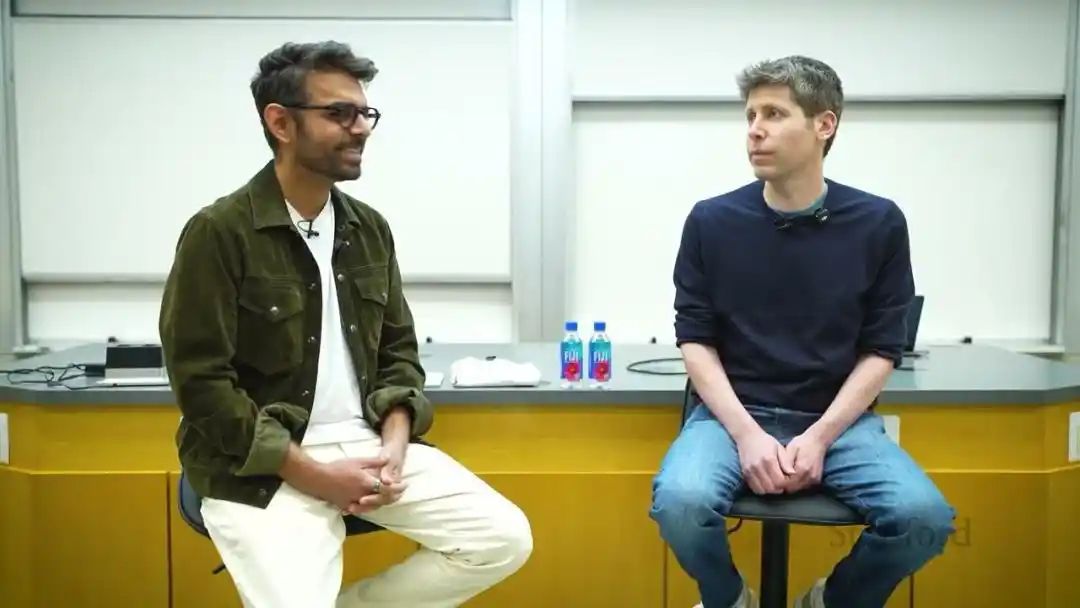
Altman appears at Stanford CS153 class discussing education in the AI era, admitting he underestimated the speed of the education system's transformation. (Source: Stanford Online)

Three and a half years ago, right after ChatGPT launched, Altman predicted that students would cheat for a year, then the entire education system would be forced to restructure itself, teaching people to think better than before.

However, three and a half years later, the script didn't unfold as Altman imagined.

On the AI side, it evolved from GPT-3.5, which could only write copy, to models that can disprove mathematical conjectures that stumped mathematicians for decades.

On the school side, they're still testing students with the same old things: rote memorization, standard answers, closed-book exams.

Homework, exams, theses... everything remains the same. Scouring the entire education system, he couldn't find a single significant structural change.

A man who bet correctly on the "Scaling Law" turned out to be mistaken about education.

He said this was one of his biggest prediction mistakes in recent years.

A person who constantly talks about Artificial General Intelligence (AGI) is actually anxious about the classroom.

What exactly is he afraid of?

He Thought Schools Should Have Changed Already

Rewind to November 2022, just after ChatGPT's release.

Back then, Altman's assessment was still optimistic:

The first year, students would use it to cheat and learn little; then the education system would reinvent itself, teaching courses much better than before.

According to his vision, teachers would assign projects that necessitated using AI, forcing students to use their brains more and come up with new ideas.

In 2024, he publicly expressed optimism: superintelligence would bring a personal tutor for everyone, education would shift from rote memorization to problem-solving, to critical thinking.

The result? AI advanced by leaps and bounds year after year, while education remained stagnant.

AI Outsourcing Is Hollowing Out Critical Thinking

This disconnect is what Altman is truly worried about.

He says if we continue to teach and evaluate students using the methods of the "pre-AGI world," it will not only render these methods ineffective but also cause people to "fail to learn how to think," leading to the gradual atrophy of critical thinking.

Outsourcing thinking to AI starts as just a shortcut.

But use it or lose it—the mental muscle responsible for independent thinking, like an unused arm, will subtly shrink and weaken, or as Altman puts it—muscle atrophy.

Is this just Altman's concern, or is it already a reality?

Some research shows that after ChatGPT entered the classroom, monthly test scores dropped by about 20% within six months; for high-stakes entrance exams that truly determine one's future, scores fell by 18% and 24% respectively, and this deficit takes up to two years to gradually become apparent.

More telling is an analysis from the University of California, Berkeley (UC Berkeley).

Among over 500,000 grade samples, grades in subjects like writing and programming noticeably shifted upward after ChatGPT, but the increase was entirely in homework scores, while exam scores remained unchanged.
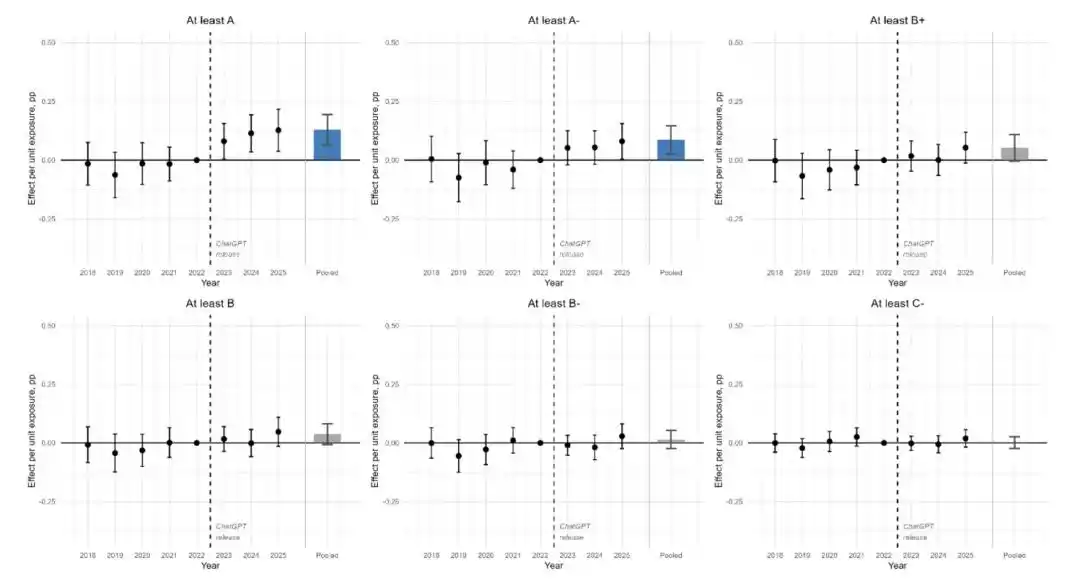
UC Berkeley analysis of over 500,000 grades: After ChatGPT's release, the proportion of A and A- grades in writing and programming courses significantly increased (blue significantly positive), while B+ and below barely moved. (Source: Chirikov/CSHE)

Why? This is "outsourcing," not "learning."

Another study spanning ten years and covering millions of US math interactions points to the same conclusion: with the arrival of chatbots, problems are solved faster, but less is learned.

Homework submissions are getting more polished, but minds are getting emptier.

Where Is the Promised Renaissance in Education?

Altman isn't the only one puzzled.
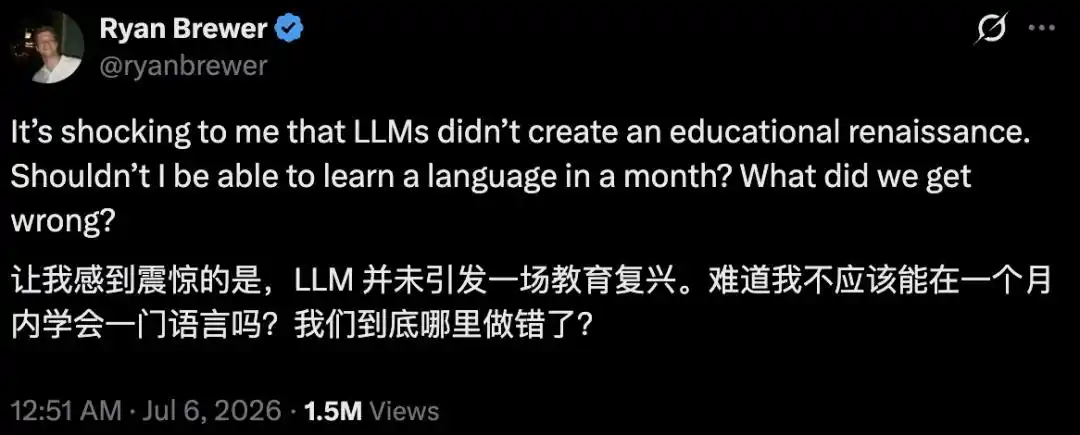
OpenAI technical team member Ryan Brewer posted, saying it's shocking that large language models haven't sparked an educational renaissance:

Shouldn't I be able to learn a language in a month? Where did we go wrong?

Similar doubts spread rapidly on X: With the most powerful learning tool in history in hand, why haven't AI tutors entered every household? Why is the education revolution so delayed?

The answer lies not in technology, but in institutional inertia.

The university's evaluation system—exams, theses, homework—has been built over centuries on an implicit premise: these tasks are too time-consuming for anyone to take shortcuts.

AI has changed that premise.

But schools are still using pre-AGI standards to measure a new generation raised with AI, even as the first generation of ChatGPT natives have already graduated.

Tools update with a version number; systems update over a generation: the technology is already here, but the rules remain in the previous era.

A 24/7, tireless, personalized, almost-free AI tutor could theoretically be given to every child today.

But it hasn't arrived, and the real reason is the pace at which the education system restructures itself.

In the same speech, Altman offered another prediction:

It's been three and a half years since ChatGPT appeared. Even if AI merely progresses along the same curve for another three and a half years, what human society can do will be on a completely different scale than today.

As technology races ahead exponentially, the gap between it and education will only widen, ultimately to be filled by the students currently sitting in old exams, old homework, and old evaluation systems.

The skills they learn may be taken over by AI the moment they leave school; the judgment they fail to develop may be difficult to recover in a lifetime.

The debt incurred is a generation's "cognitive deficit."

If Machines Can Write, Why Must Humans Still Learn?

So what should we still teach?

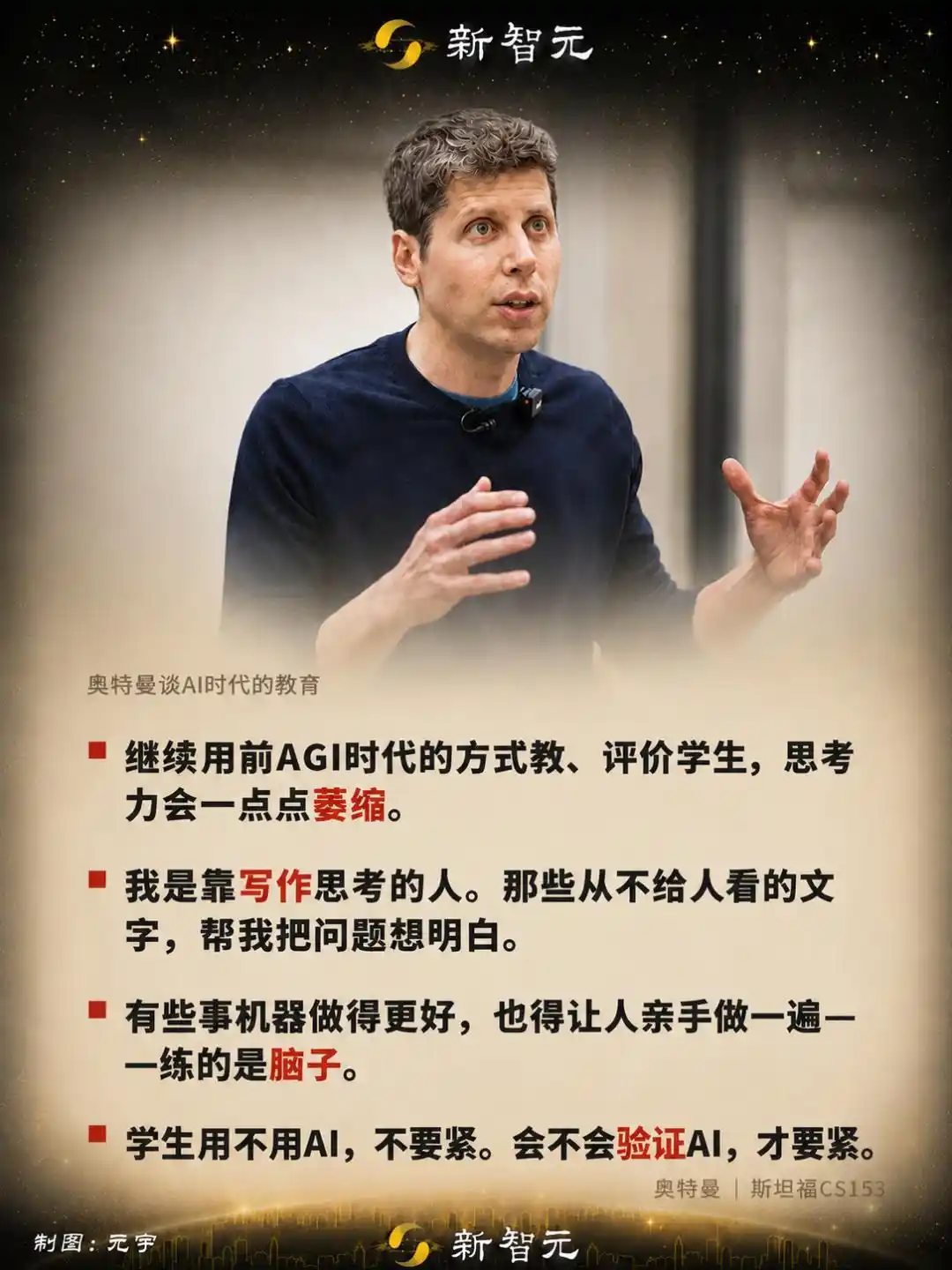
Altman's answer is somewhat counterintuitive: Some things, even though machines can do them better, humans must still do them by hand.

He gave his own example.

He said he's the kind of person who "thinks by writing," producing a lot of text never meant for anyone else, just to clarify a problem, and he's grateful he learned to write.

Programming is the same; AI can generate code in a second, but the process of building logic by hand trains the brain.

In essence, writing and programming are like math proofs in the calculator era: the machine already knows the answer, but we still have students derive it themselves. The goal isn't the answer behind the problem, but the meta-skills of "thinking" and "learning," and writing and programming are the tools to train them.

Following this logic, Altman advocates shifting the goal of education from "remembering more knowledge" to "asking better questions"; from testing memory to testing judgment, creativity, and genuine interdisciplinary skills.
And the root of the problem lies precisely in the evaluation system.

What do today's exams still test?

Memory, standard answers, completing tasks alone and closed-book. These three things are exactly what AI is best at and can most easily do for you.

When schools still evaluate students by "who remembers more, who answers more accurately," AI has turned "remembering more, answering accurately" into a zero-cost commodity.

How much meaning remains in numbers measured by a ruler that AI can easily pass, when used to gauge the abilities of the next generation?

This is what truly worries Altman: It's not most crucial whether students use AI; what's crucial is whether they can *verify* AI.

More concerning than over-reliance on AI is using AI without knowing how to verify it, accepting the machine's output at face value.

If this inertia persists for another three and a half years, a generation will gradually lose the training ground for independent thought, only to realize too late: they've almost forgotten how to think for themselves.

References:

https://www.youtube.com/watch?v=F_7M4Hc-usM

https://x.com/hesamation/status/2073884828861071557

https://x.com/ryanbrewer/status/2073812031988535760

This article is from the WeChat public account "Xin Zhi Yuan", author: ASI Revelations

Трендові криптовалюти

Пов'язані питання

QWhat was Sam Altman's original prediction about the impact of ChatGPT on education, and how did reality differ from his expectation?

ASam Altman initially predicted that after a year of students using ChatGPT to cheat, the education system would be forced to fundamentally restructure itself to teach people how to think better. However, three and a half years later, he admitted this was a major prediction error, as education has seen almost no significant structural change while AI has advanced rapidly.

QAccording to Sam Altman, what is the primary danger of continuing to use pre-AGI teaching and assessment methods in an AI era?

AThe primary danger is the atrophy of critical thinking skills. If students outsource their thinking to AI and education systems continue to rely on methods that value memorization and standardized answers over genuine understanding, the 'muscle' for independent thought will weaken and shrink due to lack of use.

QWhat evidence from UC Berkeley's grade analysis suggests students are 'outsourcing' rather than 'learning' with AI?

AAn analysis of over 500,000 grades at UC Berkeley showed that in courses like writing and programming, the proportion of students receiving A and A- grades increased significantly after ChatGPT's release, but grades for exams (B+ and below) remained virtually unchanged. This indicates AI is helping improve homework scores without corresponding gains in exam performance, pointing to outsourcing of work rather than deeper learning.

QWhy does Sam Altman believe that activities like writing and programming remain essential to learn, even though AI can do them well?

AHe believes the process of doing these activities trains the 'meta-skills' of thinking and learning. Just as students still work through math proofs in the calculator era, writing and programming are tools to structure logic and clarify thought. The value is not in the final product but in the cognitive exercise the process provides for the brain.

QWhat does Sam Altman suggest should be the new focus of education in the age of AI, and what is the main obstacle to achieving this shift?

AHe suggests shifting the focus from memorizing knowledge to asking better questions, and from testing memory to assessing judgment, creativity, and interdisciplinary skills. The main obstacle is the inertia of the current evaluation system, which still relies on assessing memorization, standardized answers, and closed-book tasks—precisely the areas where AI excels, making such assessments increasingly meaningless.

Пов'язані матеріали

Top 11 NFT games to play in July 2026

NFT games provide players with true ownership of in-game assets through blockchain technology, unlike traditional games. Here are the top 11 NFT games for July 2026: 1. **RavenQuest:** A free-to-play MMORPG with player-driven economy, housing NFTs, and guild wars. 2. **Decentraland:** A user-owned Ethereum-based virtual world for socializing, gaming, and buying digital real estate (LAND NFTs). 3. **Axie Infinity:** A pioneering play-to-earn game where players collect, breed, and battle NFT creatures called Axies. 4. **Pixels:** A free-to-play Ronin-based game focused on farming, crafting, and managing Pixelmon avatars in a player-driven economy. 5. **Gods Unchained:** A free-to-play strategy card game where every card is an NFT, built on Ethereum with Immutable X. 6. **My DeFi Pet:** Combines pet collection, breeding, and battling with DeFi mechanics, using the DPET token. 7. **Alien Worlds:** A fast-paced, decentralized metaverse game where players (explorers) mine resources and compete for the TLM token. 8. **The Sandbox:** A blockchain metaverse where users buy LAND NFTs and create, own, and monetize gaming experiences. 9. **Wreck League:** A mech fighting game with customizable NFT parts, featuring a hybrid Web2/Web3 model and strategic combat. 10. **Undeads Game:** A zombie apocalypse-themed game where players choose to be humans or zombies, with all assets as tradable NFTs. 11. **Shrapnel:** A first-person shooter set in 2043 where players battle for a resource called Sigma, with weapons and gear as NFTs. NFT games offer innovative formats and true digital ownership, but players should research each game before committing.

ambcrypto1 год тому

Top 11 NFT games to play in July 2026

ambcrypto1 год тому

Bitcoin Consolidation Underway: Selling Pressure from Long-Term Holders Eases, ETF Outflows Slow

Bitcoin is in the process of bottoming out, with key dynamics shifting. Long-term holder capitulation has cooled from its peak, and profit-taking has largely subsided. The sell-off at the June lows was absorbed by broad-based buying. The price is now recovering and testing towards key overhead resistance around the short-term holder cost basis near $69,000, where significant supply pressure is expected. Macro drivers are evolving: Bitcoin is increasingly reacting inversely to the US dollar and showing a more positive response to favorable economic data like soft inflation reports, while its correlation with equities has weakened. On-chain data shows that long-term holders are now mainly selling at a loss, a classic late-cycle signal. This primary source of sell-side pressure is no longer expanding. ETF outflows have slowed but haven't reversed, indicating institutional selling has paused but not turned into buying. In derivatives markets, bearish bets are being unwound as seen in falling put/call ratios and reduced crash protection costs, though this positioning adjustment hasn't yet translated into strong spot market buying. Volatility has compressed to yearly lows, a potential calm before the next decisive move. While the foundation for a recovery is being laid with seller exhaustion and demand absorption at lows, confirmation is still missing. A sustainable uptrend requires spot-driven buying to decisively break and hold above the short-term holder cost basis. Failure to do so, or a reacceleration of long-term holder losses, would signal a return to range-bound trading.

marsbit1 год тому

Bitcoin Consolidation Underway: Selling Pressure from Long-Term Holders Eases, ETF Outflows Slow

marsbit1 год тому

Торгівля

Спот

Популярні статті

Що таке $S$

Розуміння SPERO: Комплексний огляд Вступ до SPERO Оскільки ландшафт інновацій продовжує еволюціонувати, виникнення технологій web3 та криптовалютних проектів відіграє ключову роль у формуванні цифрового майбутнього. Один з проектів, який привернув увагу в цій динамічній сфері, — це SPERO, позначений як SPERO,$$s$. Ця стаття має на меті зібрати та представити детальну інформацію про SPERO, щоб допомогти ентузіастам та інвесторам зрозуміти його основи, цілі та інновації в рамках web3 та крипто-сектору. Що таке SPERO,$$s$? SPERO,$$s$ — це унікальний проект у криптопросторі, який прагне використати принципи децентралізації та технології блокчейн для створення екосистеми, що сприяє залученню, корисності та фінансовій інклюзії. Проект розроблений для полегшення взаємодії між користувачами новими способами, надаючи їм інноваційні фінансові рішення та послуги. У своїй основі SPERO,$$s$ прагне надати можливості індивідам, забезпечуючи інструменти та платформи, які покращують користувацький досвід у криптовалютному просторі. Це включає в себе можливість більш гнучких методів транзакцій, сприяння ініціативам, що підтримуються спільнотою, та створення шляхів для фінансових можливостей через децентралізовані додатки (dApps). Основна концепція SPERO,$$s$ обертається навколо інклюзивності, прагнучи зменшити розриви в традиційній фінансовій системі, використовуючи переваги технології блокчейн. Хто є творцем SPERO,$$s$? Особистість творця SPERO,$$s$ залишається дещо невідомою, оскільки є обмежені публічно доступні ресурси, що надають детальну інформацію про його засновників. Ця відсутність прозорості може бути наслідком зобов'язання проекту до децентралізації — етики, яку багато проектів web3 поділяють, ставлячи колективні внески вище за індивідуальне визнання. Зосереджуючи обговорення навколо спільноти та її колективних цілей, SPERO,$$s$ втілює суть наділення без виділення конкретних осіб. Таким чином, розуміння етики та місії SPERO є більш важливим, ніж ідентифікація єдиного творця. Хто є інвесторами SPERO,$$s$? SPERO,$$s$ підтримується різноманітними інвесторами, починаючи від венчурних капіталістів до ангельських інвесторів, які прагнуть сприяти інноваціям у крипто-секторі. Зосередження цих інвесторів зазвичай узгоджується з місією SPERO — пріоритет надається проектам, які обіцяють технологічний прогрес у суспільстві, фінансову інклюзію та децентралізоване управління. Ці інвесторські фонди зазвичай зацікавлені в проектах, які не лише пропонують інноваційні продукти, але й позитивно впливають на спільноту блокчейн та її екосистеми. Підтримка з боку цих інвесторів підкріплює SPERO,$$s$ як значного конкурента в швидко змінюваній сфері крипто-проектів. Як працює SPERO,$$s$? SPERO,$$s$ використовує багатогранну структуру, яка відрізняє його від традиційних криптовалютних проектів. Ось деякі ключові особливості, які підкреслюють його унікальність та інноваційність: Децентралізоване управління: SPERO,$$s$ інтегрує моделі децентралізованого управління, надаючи користувачам можливість активно брати участь у процесах прийняття рішень щодо майбутнього проекту. Цей підхід сприяє відчуттю власності та відповідальності серед членів спільноти. Корисність токена: SPERO,$$s$ використовує свій власний криптовалютний токен, розроблений для виконання різних функцій в екосистемі. Ці токени дозволяють здійснювати транзакції, отримувати винагороди та полегшувати послуги, що пропонуються на платформі, підвищуючи загальну залученість та корисність. Шарова архітектура: Технічна архітектура SPERO,$$s$ підтримує модульність та масштабованість, що дозволяє безперешкодно інтегрувати додаткові функції та додатки в міру розвитку проекту. Ця адаптивність є надзвичайно важливою для збереження актуальності в постійно змінюваному крипто-ландшафті. Залучення спільноти: Проект підкреслює ініціативи, що підтримуються спільнотою, використовуючи механізми, які стимулюють співпрацю та зворотний зв'язок. Підтримуючи сильну спільноту, SPERO,$$s$ може краще задовольняти потреби користувачів та адаптуватися до ринкових тенденцій. Фокус на інклюзію: Пропонуючи низькі комісії за транзакції та зручні інтерфейси, SPERO,$$s$ прагне залучити різноманітну базу користувачів, включаючи осіб, які раніше не брали участі в крипто-просторі. Це зобов'язання до інклюзії узгоджується з його загальною місією наділення через доступність. Хронологія SPERO,$$s$ Розуміння історії проекту надає важливі уявлення про його розвиток та етапи. Нижче наведено пропоновану хронологію, що відображає значні події в еволюції SPERO,$$s$: Етап концептуалізації та ідеації: Початкові ідеї, що стали основою SPERO,$$s$, були сформовані, тісно пов'язані з принципами децентралізації та фокусом на спільноті в індустрії блокчейн. Запуск білого паперу проекту: Після концептуального етапу був випущений комплексний білий папір, що детально описує бачення, цілі та технологічну інфраструктуру SPERO,$$s$, щоб залучити інтерес та зворотний зв'язок від спільноти. Створення спільноти та ранні залучення: Активні зусилля були спрямовані на створення спільноти ранніх прихильників та потенційних інвесторів, що полегшило обговорення цілей проекту та отримання підтримки. Подія генерації токенів: SPERO,$$s$ провів подію генерації токенів (TGE) для розподілу своїх рідних токенів серед ранніх прихильників та встановлення початкової ліквідності в екосистемі. Запуск початкового dApp: Перший децентралізований додаток (dApp), пов'язаний з SPERO,$$s$, став доступним, дозволяючи користувачам взаємодіяти з основними функціями платформи. Постійний розвиток та партнерства: Безперервні оновлення та вдосконалення пропозицій проекту, включаючи стратегічні партнерства з іншими учасниками блокчейн-простору, сформували SPERO,$$s$ у конкурентоспроможного та еволюціонуючого гравця на крипто-ринку. Висновок SPERO,$$s$ є свідченням потенціалу web3 та криптовалют для революціонізації фінансових систем та наділення індивідів. Завдяки зобов'язанню до децентралізованого управління, залучення спільноти та інноваційно спроектованих функцій, він прокладає шлях до більш інклюзивного фінансового ландшафту. Як і з будь-якими інвестиціями в швидко змінюваному крипто-просторі, потенційним інвесторам та користувачам рекомендується ретельно досліджувати та обдумано взаємодіяти з поточними подіями в SPERO,$$s$. Проект демонструє інноваційний дух крипто-індустрії, запрошуючи до подальшого дослідження його численних можливостей. Хоча подорож SPERO,$$s$ ще триває, його основні принципи можуть справді вплинути на майбутнє того, як ми взаємодіємо з технологією, фінансами та один з одним у взаємопов'язаних цифрових екосистемах.

131 переглядів усьогоОпубліковано 2024.12.17Оновлено 2024.12.17

Що таке $S$

Що таке AGENT S

Агент S: Майбутнє автономної взаємодії в Web3 Вступ У постійно змінюваному ландшафті Web3 та криптовалюти інновації постійно переосмислюють, як люди взаємодіють з цифровими платформами. Один з таких новаторських проектів, Агент S, обіцяє революціонізувати взаємодію людини з комп'ютером через свою відкриту агентну структуру. Прокладаючи шлях для автономних взаємодій, Агент S прагне спростити складні завдання, пропонуючи трансформаційні застосування в штучному інтелекті (ШІ). Це детальне дослідження заглиблюється в складності проекту, його унікальні особливості та наслідки для сфери криптовалюти. Що таке Агент S? Агент S є революційною відкритою агентною структурою, спеціально розробленою для вирішення трьох основних викликів в автоматизації комп'ютерних завдань: Набуття специфічних знань у галузі: Структура інтелектуально навчається з різних зовнішніх джерел знань та внутрішнього досвіду. Цей подвійний підхід дозволяє їй створити багатий репозиторій специфічних знань у галузі, покращуючи її продуктивність у виконанні завдань. Планування на довгих горизонтах завдань: Агент S використовує планування з підкріпленням досвіду, стратегічний підхід, який полегшує ефективний розподіл та виконання складних завдань. Ця функція значно підвищує її здатність ефективно та результативно управляти кількома підзавданнями. Обробка динамічних, неоднорідних інтерфейсів: Проект представляє Інтерфейс Агент-Комп'ютер (ACI), інноваційне рішення, яке покращує взаємодію між агентами та користувачами. Використовуючи багатомодальні великі мовні моделі (MLLMs), Агент S може безперешкодно орієнтуватися та маніпулювати різноманітними графічними інтерфейсами користувача. Завдяки цим новаторським функціям Агент S надає надійну структуру, яка вирішує складнощі, пов'язані з автоматизацією людської взаємодії з машинами, прокладаючи шлях для численних застосувань у ШІ та за його межами. Хто є творцем Агент S? Хоча концепція Агент S є фундаментально новаторською, конкретна інформація про його творця залишається невідомою. Творець наразі невідомий, що підкреслює або початкову стадію проекту, або стратегічний вибір зберегти засновників у таємниці. Незважаючи на анонімність, акцент залишається на можливостях та потенціалі структури. Хто є інвесторами Агент S? Оскільки Агент S є відносно новим у криптографічній екосистемі, детальна інформація про його інвесторів та фінансових спонсорів не задокументована. Відсутність публічно доступних відомостей про інвестиційні фонди або організації, що підтримують проект, викликає питання щодо його фінансової структури та дорожньої карти розвитку. Розуміння підтримки є критично важливим для оцінки стійкості проекту та потенційного впливу на ринок. Як працює Агент S? В основі Агент S лежить передова технологія, яка дозволяє йому ефективно функціонувати в різних умовах. Його операційна модель побудована навколо кількох ключових функцій: Взаємодія з комп'ютером, подібна до людської: Структура пропонує розширене планування ШІ, прагнучи зробити взаємодії з комп'ютерами більш інтуїтивними. Імітуючи людську поведінку при виконанні завдань, вона обіцяє підвищити досвід користувачів. Наративна пам'ять: Використовується для використання високорівневого досвіду, Агент S використовує наративну пам'ять для відстеження історій завдань, тим самим покращуючи свої процеси прийняття рішень. Епізодична пам'ять: Ця функція надає користувачам покрокові інструкції, дозволяючи структурі пропонувати контекстуальну підтримку в міру виконання завдань. Підтримка OpenACI: Завдяки можливості працювати локально, Агент S дозволяє користувачам зберігати контроль над своїми взаємодіями та робочими процесами, узгоджуючи з децентралізованою етикою Web3. Легка інтеграція з зовнішніми API: Його універсальність і сумісність з різними платформами ШІ забезпечують те, що Агент S може безперешкодно вписатися в існуючі технологічні екосистеми, роблячи його привабливим вибором для розробників та організацій. Ці функціональні можливості колективно сприяють унікальному положенню Агент S у крипто-просторі, оскільки він автоматизує складні, багатоступеневі завдання з мінімальним втручанням людини. У міру розвитку проекту його потенційні застосування в Web3 можуть переосмислити, як відбуваються цифрові взаємодії. Хронологія Агент S Розробка та етапи Агент S можуть бути узагальнені в хронології, яка підкреслює його значні події: 27 вересня 2024 року: Концепція Агент S була представлена в комплексній науковій статті під назвою “Відкрита агентна структура, яка використовує комп'ютери як людина”, що демонструє основи проекту. 10 жовтня 2024 року: Наукова стаття була опублікована на arXiv, пропонуючи детальне дослідження структури та її оцінки продуктивності на основі бенчмарку OSWorld. 12 жовтня 2024 року: Було випущено відеопрезентацію, що надає візуальне уявлення про можливості та особливості Агент S, ще більше залучаючи потенційних користувачів та інвесторів. Ці маркери в хронології не лише ілюструють прогрес Агент S, але й вказують на його прихильність до прозорості та залучення громади. Ключові моменти про Агент S У міру розвитку структури Агент S кілька ключових характеристик виділяються, підкреслюючи її новаторський характер та потенціал: Інноваційна структура: Розроблена для забезпечення інтуїтивного використання комп'ютерів, подібного до людської взаємодії, Агент S пропонує новий підхід до автоматизації завдань. Автономна взаємодія: Здатність автономно взаємодіяти з комп'ютерами через GUI означає стрибок до більш інтелектуальних та ефективних обчислювальних рішень. Автоматизація складних завдань: Завдяки своїй надійній методології він може автоматизувати складні, багатоступеневі завдання, роблячи процеси швидшими та менш схильними до помилок. Безперервне вдосконалення: Механізми навчання дозволяють Агенту S покращуватися на основі минулого досвіду, постійно підвищуючи свою продуктивність та ефективність. Універсальність: Його адаптивність до різних операційних середовищ, таких як OSWorld та WindowsAgentArena, забезпечує його здатність служити широкому спектру застосувань. Оскільки Агент S займає своє місце в ландшафті Web3 та криптовалюти, його потенціал покращити можливості взаємодії та автоматизувати процеси означає значний прогрес у технологіях ШІ. Завдяки своїй інноваційній структурі Агент S є прикладом майбутнього цифрових взаємодій, обіцяючи більш безперешкодний та ефективний досвід для користувачів у різних галузях. Висновок Агент S представляє собою сміливий крок вперед у поєднанні ШІ та Web3, з можливістю переосмислити, як ми взаємодіємо з технологією. Хоча проект все ще на ранніх стадіях, можливості для його застосування є величезними та переконливими. Завдяки своїй комплексній структурі, що вирішує критичні виклики, Агент S прагне вивести автономні взаємодії на передній план цифрового досвіду. У міру того, як ми заглиблюємося в сфери криптовалюти та децентралізації, проекти, подібні до Агент S, безсумнівно, відіграватимуть ключову роль у формуванні майбутнього технологій та співпраці людини з комп'ютером.

753 переглядів усьогоОпубліковано 2025.01.14Оновлено 2025.01.14

Що таке AGENT S

Як купити S

Ласкаво просимо до HTX.com! Ми зробили покупку Sonic (S) простою та зручною. Дотримуйтесь нашої покрокової інструкції, щоб розпочати свою криптовалютну подорож.Крок 1: Створіть обліковий запис на HTXВикористовуйте свою електронну пошту або номер телефону, щоб зареєструвати обліковий запис на HTX безплатно. Пройдіть безпроблемну реєстрацію й отримайте доступ до всіх функцій.ЗареєструватисьКрок 2: Перейдіть до розділу Купити крипту і виберіть спосіб оплатиКредитна/дебетова картка: використовуйте вашу картку Visa або Mastercard, щоб миттєво купити Sonic (S).Баланс: використовуйте кошти з балансу вашого рахунку HTX для безперешкодної торгівлі.Треті особи: ми додали популярні способи оплати, такі як Google Pay та Apple Pay, щоб підвищити зручність.P2P: Торгуйте безпосередньо з іншими користувачами на HTX.Позабіржова торгівля (OTC): ми пропонуємо індивідуальні послуги та конкурентні обмінні курси для трейдерів.Крок 3: Зберігайте свої Sonic (S)Після придбання Sonic (S) збережіть його у своєму обліковому записі на HTX. Крім того, ви можете відправити його в інше місце за допомогою блокчейн-переказу або використовувати його для торгівлі іншими криптовалютами.Крок 4: Торгівля Sonic (S)Легко торгуйте Sonic (S) на спотовому ринку HTX. Просто увійдіть до свого облікового запису, виберіть торгову пару, укладайте угоди та спостерігайте за ними в режимі реального часу. Ми пропонуємо зручний досвід як для початківців, так і для досвідчених трейдерів.

1.6k переглядів усьогоОпубліковано 2025.01.15Оновлено 2026.06.02

Як купити S

Обговорення

Ласкаво просимо до спільноти HTX. Тут ви можете бути в курсі останніх подій розвитку платформи та отримати доступ до професійної ринкової інформації. Нижче представлені думки користувачів щодо ціни S (S).

活动图片