Firestorm erupts in Aave governance forum over CoW Swap fees

cointelegraphОпубліковано о 2025-12-14Востаннє оновлено о 2025-12-14

Анотація

A dispute has erupted in the Aave governance forum regarding fee distribution from the protocol’s recent integration with CoW Swap. Aave DAO member EzR3aL raised concerns that swap fees—estimated at $200,000 weekly in ETH—are being sent to a private address controlled by Aave Labs rather than to the DAO treasury. They argue the DAO should receive this revenue, estimated at $10 million annually. Aave Labs responded that front-end components have always been under its control, while protocol-level changes remain under DAO oversight. It also claimed it funded the development of the integration adapters. However, several community members, including Aave-Chan Initiative founder Marc Zeller, criticized the move, arguing that the DAO funded the original adapter technology and that redirecting fees away from the treasury is unacceptable. The conflict underscores ongoing challenges in DAO governance and revenue distribution.

A dispute between the Aave decentralized autonomous organization (DAO), which governs the Aave decentralized finance (DeFi) protocol, and Aave Labs, the main development company for Aave products, over fees from the recently announced integration with decentralized exchange aggregator CoW Swap, continues to flare up.

The issue was raised by pseudonymous Aave DAO member EzR3aL, who said that the fees generated by crypto asset swaps using CoW Swap were going to a different onchain address, not the treasury of the Aave decentralized autonomous organization.

Instead, the fees are going to a private address controlled by Aave Labs. EzR3aL raised several questions, including why the DAO was not consulted before the fees were routed, and argued that the fees belong to the DAO.
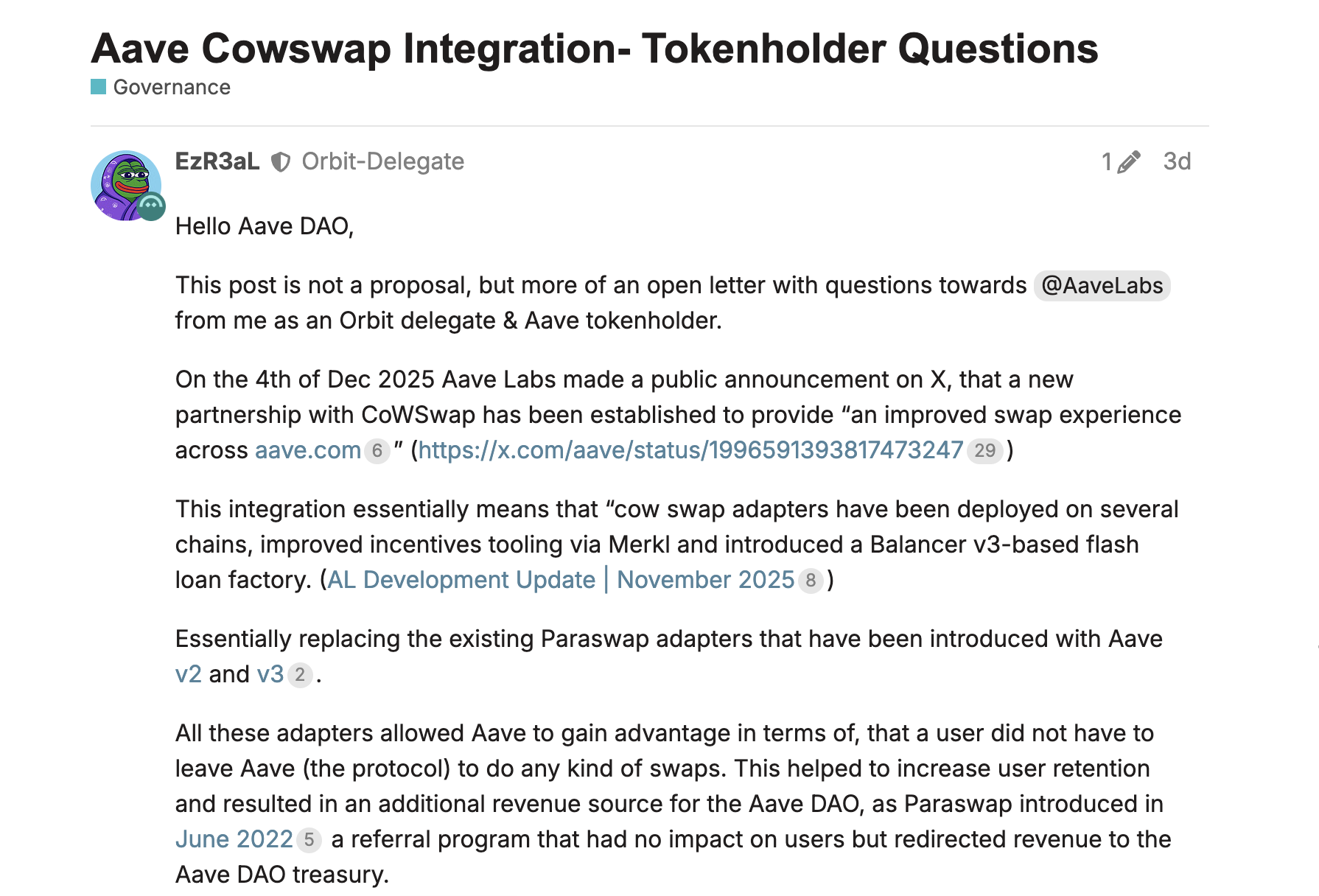
The governance forum post that sparked the debate. Source: Aave Governance

“Another entity, rather than the Aave DAO, is receiving at least $200,000 per week worth of Ether,” EzR3aL said, adding that this amounts to $10 million of potential annual revenue kept from the DAO.

Aave Labs responded that the front-end components for the website and application interfaces have always been the rightful purview of Aave Labs.

Related: Aave launches retail savings app with up to 9% APY to compete with banks

Protocol-level changes, like interest rate policies and approving changes to smart contract code, have always been subject to the DAO’s stewardship, Aave Labs said.

Aave Labs also claimed that it was the entity that funded the development of the “adapters,” the lines of code that allow swaps and other integrations to work.
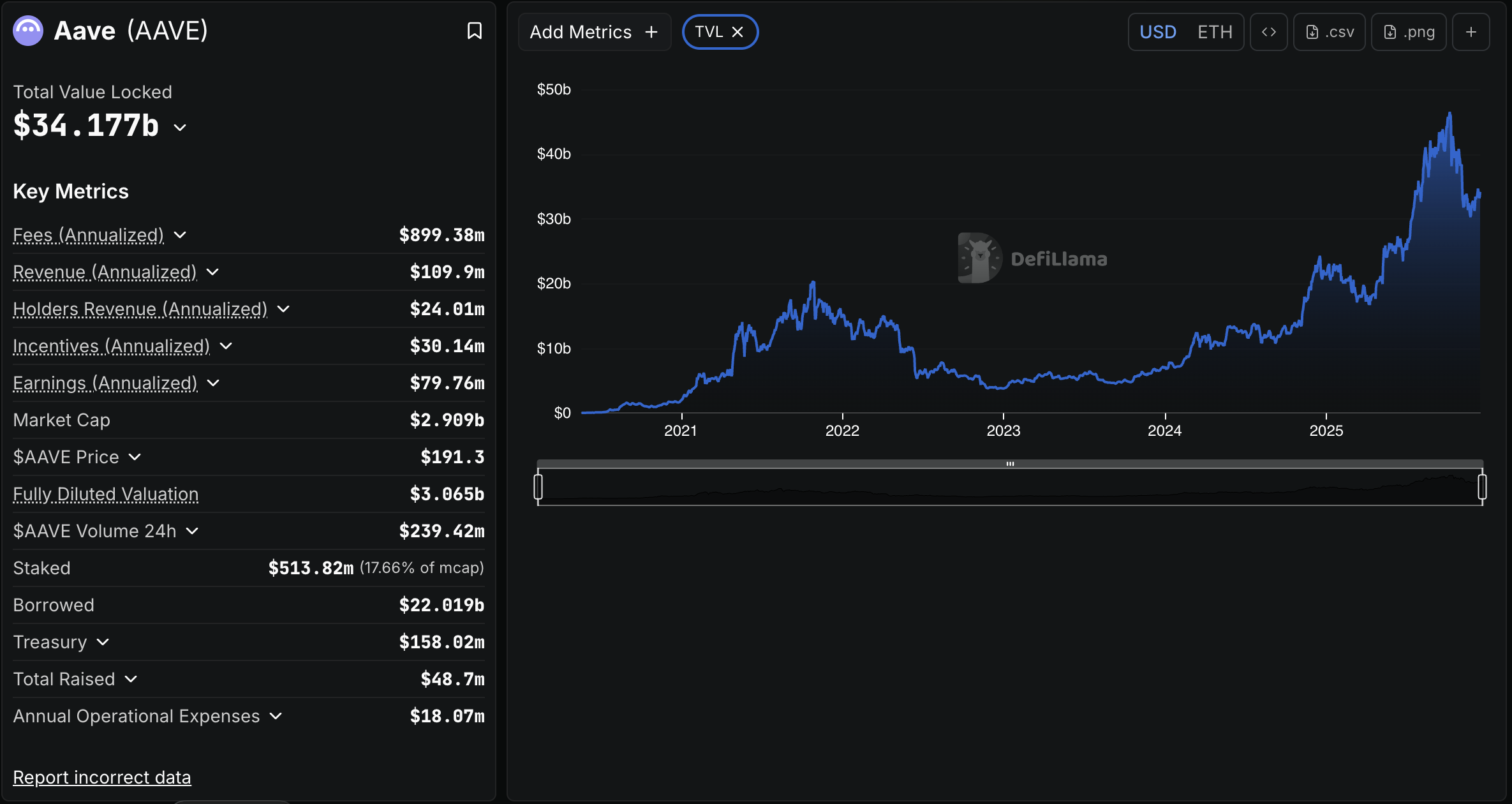
The total value locked in the Aave protocol and a financial overview of the DeFi platform. Source: DeFiLlama

However, the response did little to curb the tension, with several DAO members saying that the Aave DAO funded the development of the original adapter technology; therefore, the revenue from the integration should flow back to the DAO.

Marc Zeller, the founder of the Aave-Chan Initiative, a delegate platform serving the Aave governance community, said the decision to route the fees exclusively to Aave Labs is “extremely concerning.”

“Aave Labs, in the pursuit of their own monetization, redirected Aave user volume towards competition. This is unacceptable,” Zeller said.

Cointelegraph reached out to Aave Labs but did not obtain an immediate response by the time of publication.

The conflict highlights the complexities of running a DAO, which is a novel form of governance and organization that has benefits over traditional business structures but also brings its own unique challenges.

Magazine: The one thing these 6 global crypto hubs all have in common...
Пов'язані матеріали

Nvidia's Wednesday Earnings Night: The Battle That Decides the Fate of the AI Bull Market is Here

NVIDIA is set to report its quarterly earnings after the U.S. market closes on Wednesday, May 20. This event is widely seen as a crucial test for the current AI-driven bull market. The semiconductor sector is exhibiting severe technical overbought conditions, with the Philadelphia Semiconductor Index (SOX) trading approximately 60% above its 200-day moving average—the most extreme deviation since the dot-com bubble peak of 1999/2000. Market sentiment is highly concentrated on a few AI-related stocks, raising concerns about overall market breadth. Analysts highlight a key contradiction: while fundamentals for AI and semiconductors remain strong, significant technical pressures are building. Option market activity reflects this tension. Positions are heavily skewed towards bullish calls, yet there is also notable hedging activity through put options on broad indices and sector ETFs, signaling preparation for potential downside volatility. An unusual pattern of rising stock prices alongside rising implied volatility further underscores the market's expectation for a major move. For NVIDIA specifically, the market's primary focus will be on its forward guidance for the next quarter, which is deemed more critical than the immediate earnings results. Despite a recent seven-day rally adding roughly $1.7 trillion in market cap, historical data shows NVIDIA's stock has often declined the day after its past five earnings reports. The outcome of this report is expected to have a significant ripple effect across the broader technology and semiconductor markets, given NVIDIA's pivotal role.

marsbit10 хв тому

Nvidia's Wednesday Earnings Night: The Battle That Decides the Fate of the AI Bull Market is Here

marsbit10 хв тому

Harvard University May Have Lost $150 Million in Cryptocurrency Trading! Has Liquidated Ethereum and Significantly Reduced Bitcoin ETF Positions

Harvard University's endowment fund, managed by Harvard Management Company (HMC), recently disclosed significant reductions in its cryptocurrency holdings. According to its latest 13F filing, HMC sold its entire position in the BlackRock Ethereum Spot ETF (ETHA) and reduced its stake in the BlackRock Bitcoin Spot ETF (IBIT) by 43% in Q1 2026. This marks a sharp reversal from its peak holdings of $443 million in crypto assets just two quarters prior, bringing the current value to approximately $117 million. Analysis suggests these sales likely resulted in substantial losses. Estimates indicate HMC's Bitcoin ETF trades incurred a roughly 28% loss (over $100 million), while its brief Ethereum position fell about 35% (over $30 million), totaling potential losses exceeding $150 million. The timing of HMC's trades—aggressively adding to Bitcoin near its all-time high in late 2025 and buying Ethereum just before a market downturn—has drawn criticism as potential "buying high and selling low." However, the context points to broader pressures. Harvard faced a $113 million operating deficit in FY2025 due to cuts in federal research funding and a significant tax increase on endowment income. With much of its portfolio locked in illiquid private equity and hedge funds, the highly liquid crypto ETFs presented the most straightforward assets to sell for liquidity and risk management. Furthermore, HMC's Bitcoin ETF holding had grown to 20% of its public portfolio by Q3 2025, prompting necessary rebalancing. The move contrasts with other institutions like Mubadala (increasing Bitcoin ETF holdings) and Dartmouth College (maintaining and diversifying crypto exposure). Ultimately, Harvard's actions appear driven by a confluence of fiscal stress, liquidity needs, and portfolio risk control rather than a simple market-timing strategy, highlighting how traditional institutional risk calculus applies even to volatile crypto assets.

marsbit22 хв тому

Harvard University May Have Lost $150 Million in Cryptocurrency Trading! Has Liquidated Ethereum and Significantly Reduced Bitcoin ETF Positions

marsbit22 хв тому

Harvard University May Have Lost $150 Million in Cryptocurrency Trading! Has Liquidated Ethereum and Significantly Reduced Bitcoin ETF Holdings

Harvard University's endowment fund, Harvard Management Company (HMC), significantly reduced its cryptocurrency holdings in Q1 2026, reportedly incurring substantial losses. According to its latest 13F filing, HMC completely sold off its position in the BlackRock Ethereum ETF (ETHA) and cut its BlackRock Bitcoin ETF (IBIT) holdings by 43%, leaving a position worth approximately $117 million. This marks a sharp decline from a peak public crypto allocation of $443 million just two quarters prior. Analysis suggests these trades resulted in estimated losses exceeding $150 million, with Bitcoin positions sold at an average loss of around 28% and Ethereum positions at roughly 35%. The moves have sparked debate on whether HMC engaged in counterproductive "buy high, sell low" behavior. The article contextualizes HMC's crypto journey, beginning with its initial disclosed investment in IBIT and gold ETF GLD in Q2 2025 as an "inflation hedge." Aggressive buying in Q3 2025 made IBIT its largest single public holding at 20% of the portfolio, coinciding with Bitcoin nearing all-time highs. Subsequent trimming began in Q4 2025, with an initial foray into ETHA. Explanations for the recent drastic cuts extend beyond market timing. Harvard faces significant financial pressure, including an annual operating deficit and a major increase in endowment tax rates. With illiquid assets like private equity dominating the portfolio, the highly liquid crypto ETFs became the most practical source for necessary portfolio rebalancing and liquidity. Furthermore, the impending retirement of HMC's CEO adds a layer of reputational risk to holding volatile assets. The article contrasts Harvard's retreat with other institutions, such as Mubadala's continued accumulation of Bitcoin ETFs and Dartmouth's expansion into staking-oriented crypto products. It concludes that HMC's actions reflect a complex interplay of fiscal needs, risk management, and institutional constraints rather than simple speculative trading, highlighting how traditional finance logic applies to crypto within large endowment portfolios.

链捕手28 хв тому

Harvard University May Have Lost $150 Million in Cryptocurrency Trading! Has Liquidated Ethereum and Significantly Reduced Bitcoin ETF Holdings

链捕手28 хв тому

WSJ: Unveiling the Secret Jury That Controls Disputes on Polymarket

Last month, Garrick Wilhelm lost a $567 bet on the Polymarket prediction platform about whether a ceasefire would be reached with Hezbollah. When a truce was announced, some traders argued it counted, but Wilhelm disagreed. The dispute was settled not by Polymarket, but by a decentralized group of UMA token holders who vote on such disagreements. As trading surges, resolving ambiguous outcomes is a growing challenge for prediction markets. Unlike competitors like Kalshi that decide internally, Polymarket outsources dispute resolution to UMA. Its token holders, mostly anonymous and with voting power weighted by holdings, arbitrate cases. Critics argue this system is prone to manipulation, as voters can also bet on the same markets they judge. A Wall Street Journal analysis found that over the past year, at least 60% of active UMA voters had corresponding Polymarket accounts and held positions in disputes they voted on. Voting power is also concentrated among a few large holders. Polymarket says only 0.2% of bets go to UMA and that the system disperses authority. Its founder has acknowledged flaws and promised fixes. UMA's backers deny any proven manipulation, dismissing critics as sore losers. The platform penalizes voters in the minority to incentivize "correct" outcomes. Disputes are rising, covering topics from a streamer's pregnancy announcement to Iran. This model also helps Polymarket argue it's an offshore platform outside U.S. regulation, a shift made after a 2022 settlement with the CFTC. Some losing traders have formed groups to protest, targeting entities like UMA.rocks, which aggregates votes. Its founder says traders often blame UMA for their own mistakes. A recently ousted committee member, Scout, admitted to both betting and voting but argued involved voters research more thoroughly. He highlighted the dilemma: "Either you have conflicted traders deciding, or you have uninformed outsiders voting. There is no perfect answer right now."

marsbit1 год тому

WSJ: Unveiling the Secret Jury That Controls Disputes on Polymarket

marsbit1 год тому

Торгівля

Спот
Ф'ючерси

Популярні статті

Як купити AAVE

Ласкаво просимо до HTX.com! Ми зробили покупку Aave Protocol (AAVE) простою та зручною. Дотримуйтесь нашої покрокової інструкції, щоб розпочати свою криптовалютну подорож.Крок 1: Створіть обліковий запис на HTXВикористовуйте свою електронну пошту або номер телефону, щоб зареєструвати обліковий запис на HTX безплатно. Пройдіть безпроблемну реєстрацію й отримайте доступ до всіх функцій.ЗареєструватисьКрок 2: Перейдіть до розділу Купити крипту і виберіть спосіб оплатиКредитна/дебетова картка: використовуйте вашу картку Visa або Mastercard, щоб миттєво купити Aave Protocol (AAVE).Баланс: використовуйте кошти з балансу вашого рахунку HTX для безперешкодної торгівлі.Треті особи: ми додали популярні способи оплати, такі як Google Pay та Apple Pay, щоб підвищити зручність.P2P: Торгуйте безпосередньо з іншими користувачами на HTX.Позабіржова торгівля (OTC): ми пропонуємо індивідуальні послуги та конкурентні обмінні курси для трейдерів.Крок 3: Зберігайте свої Aave Protocol (AAVE)Після придбання Aave Protocol (AAVE) збережіть його у своєму обліковому записі на HTX. Крім того, ви можете відправити його в інше місце за допомогою блокчейн-переказу або використовувати його для торгівлі іншими криптовалютами.Крок 4: Торгівля Aave Protocol (AAVE)Легко торгуйте Aave Protocol (AAVE) на спотовому ринку HTX. Просто увійдіть до свого облікового запису, виберіть торгову пару, укладайте угоди та спостерігайте за ними в режимі реального часу. Ми пропонуємо зручний досвід як для початківців, так і для досвідчених трейдерів.

299 переглядів усьогоОпубліковано 2024.12.11Оновлено 2025.03.21

Як купити AAVE

Обговорення

Ласкаво просимо до спільноти HTX. Тут ви можете бути в курсі останніх подій розвитку платформи та отримати доступ до професійної ринкової інформації. Нижче представлені думки користувачів щодо ціни AAVE (AAVE).

活动图片