When Transfers Become Truly Frictionless: How Sui Uses 'Zero Gas' to Become the Underlying Infrastructure for Stablecoin Payments

marsbitОпубліковано о 2026-06-22Востаннє оновлено о 2026-06-22

Анотація

Title: Sui Launches Zero-Gas Stablecoin Transfers to Become the Foundation for Stablecoin Payments Sui has introduced a zero-gas fee feature for peer-to-peer stablecoin transfers, eliminating the need for users or businesses to hold separate SUI tokens to pay transaction costs. This innovation, built on a new underlying account architecture called Address Balances, significantly reduces validator processing costs for eligible transactions. Currently, the feature applies to a whitelist of stablecoins for transfers meeting a minimum amount, effectively preventing spam. This development aims to unlock mainstream payment use cases for stablecoins—such as everyday purchases, remittances, and subscriptions—by removing cost and complexity barriers. It is also positioned to benefit high-frequency micro-payments for AI agents and institutional B2B payments, reducing operational friction. Major custody provider Fireblocks has already announced support. The move follows Sui processing over $1 trillion in stablecoin transfer volume since August 2025. Looking ahead, Sui plans to enhance this infrastructure with protocol-level confidential transactions later in 2026, aiming to provide scalable, free, and privacy-preserving payments. Together, these advancements strengthen Sui's goal of becoming the default settlement layer for stablecoin payments.

Author: Deep Tide TechFlow

If you go to an ATM to transfer money, and the ATM tells you that you must first buy "ATM usage coupons," you would probably think the ATM has gone crazy.

But this has been the operating rule for blockchain for over a decade: to make a transfer, first prepare the Gas.

As stablecoins play an increasingly critical role in the payment field, the cost of this threshold becomes clearer: new users are blocked outside, and payment scenarios are difficult to implement.

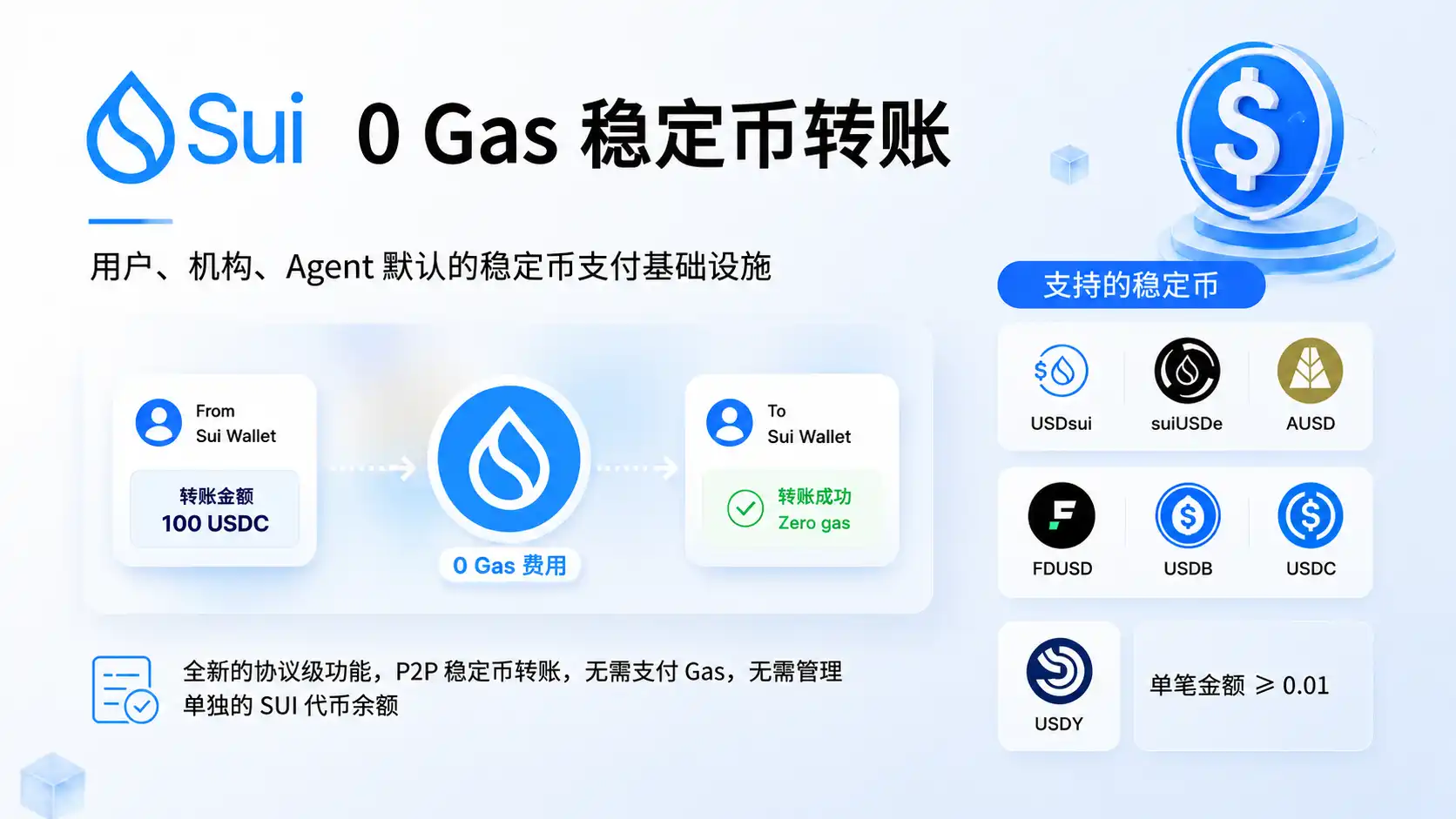
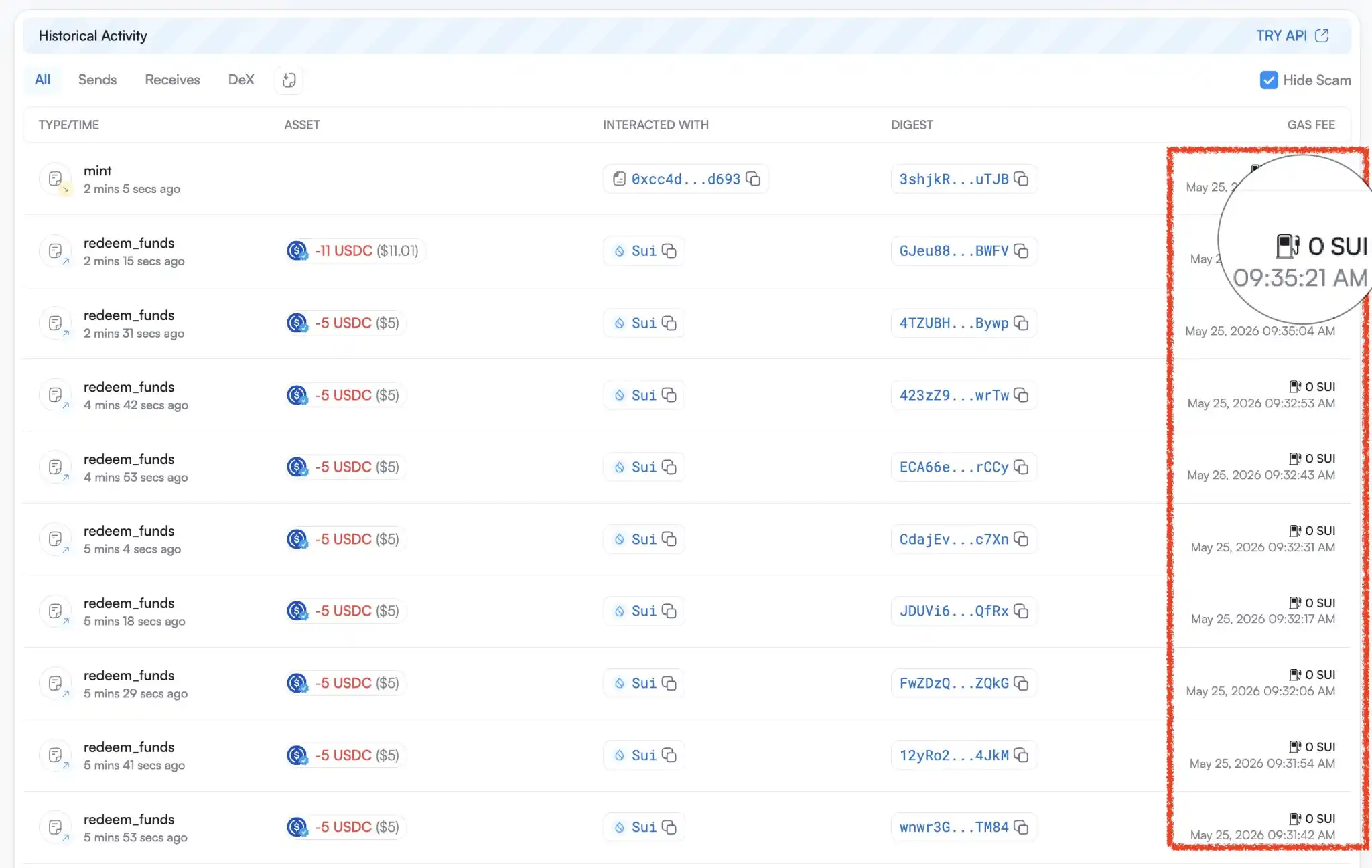
As a key initiative in building the "underlying infrastructure for stablecoin payments," on May 20, 2026, Sui announced the launch of a zero Gas stablecoin transfer feature, allowing users and enterprises to send stablecoins peer-to-peer without paying Gas fees, and without needing to manage a separate SUI token balance.

Although currently, this feature only supports P2P transfers of whitelisted stablecoins, stablecoins now have a real chance to transform from "crypto assets" into "payment infrastructure." The entity achieving this also further strengthens its position as a strong contender for the role of the "default foundation for stablecoin payments."
A New Kind of "Zero Gas": No One Is Paying for You in the Background

When mentioning zero Gas, most users' first reaction might be: Who paid the Gas for me?

This habitual thinking stems from past incomplete attempts at "zero Gas": either through subsidies or relays. The Gas never disappeared; someone was just quietly settling the bill in the background, a superficial solution that doesn't address the root cause.

Sui's "Zero Gas Stablecoin Transfer" targets the fundamental root.

It is built upon a new underlying account architecture called Address Balances. When tokens are sent using specific Move functions, they are automatically consolidated into the single balance of the recipient's address, eliminating the need to create or manage Coin objects. This saves the overhead of object creation, splitting, merging, and version tracking. The processing cost for validators is extremely low, low enough that they can refrain from charging users fees.

Costs are reduced, and boundaries must also be clearly defined: Under the highly restricted PTB mechanism, only P2P transfers of whitelisted stablecoins, with amounts no less than 0.01, are judged as zero Gas. This supports payment scenarios while isolating malicious transactions.
What Can This Infrastructure Run?

Firstly, it opens the door to daily payments. When the experience is frictionless and the cost is zero, those payment scenarios we once pinned high hopes on for stablecoins—including consumption, tipping, subscriptions, cross-border remittances, etc.—gain the potential for rapid penetration. Stablecoin payments, for the first time, possess the basic conditions to compete head-on with traditional payment tools, potentially even faster and better.

Of course, for high-frequency micro-payment scenarios, many will think of the Agent economy. In the past, actions like AI autonomous transactions and arbitrage required additional Gas management. The zero Gas stablecoin transfer will become the lowest-cost, least-resistance choice for Agents. Combined with Sui's high-performance advantages, it will further support the large-scale deployment of autonomous payment flows.

Another keyword is: Institutions. This is a group Sui officials specifically emphasize. Whether it's cross-border B2B payments, supplier settlements, or platform profit sharing, institutions often face higher payment friction. The protocol-level zero Gas mechanism transforms stablecoins into a payment tool that institutions can directly utilize.

Worth mentioning is that when the zero Gas feature was launched, Fireblocks had already announced support for address balances, and soon after, it supported Gas-free stablecoin transfers, further enhancing the accessibility of Sui's payment infrastructure for institutions. At the same time, several institutional-grade custody platforms and wallets have announced they will support zero Gas transactions.

Zero Gas: The First Half; Privacy: The Second Half

Since August 2025, stablecoin transfer volume on the Sui network has exceeded $1 trillion. This figure is sufficient to show that the underlying logic for stablecoin payments in the Sui ecosystem is already working. The launch of zero Gas stablecoin transfers will undoubtedly accelerate the construction of Sui's role as the "default foundation for stablecoin payments."

But this is only the first half of Sui's 2026 payment narrative.

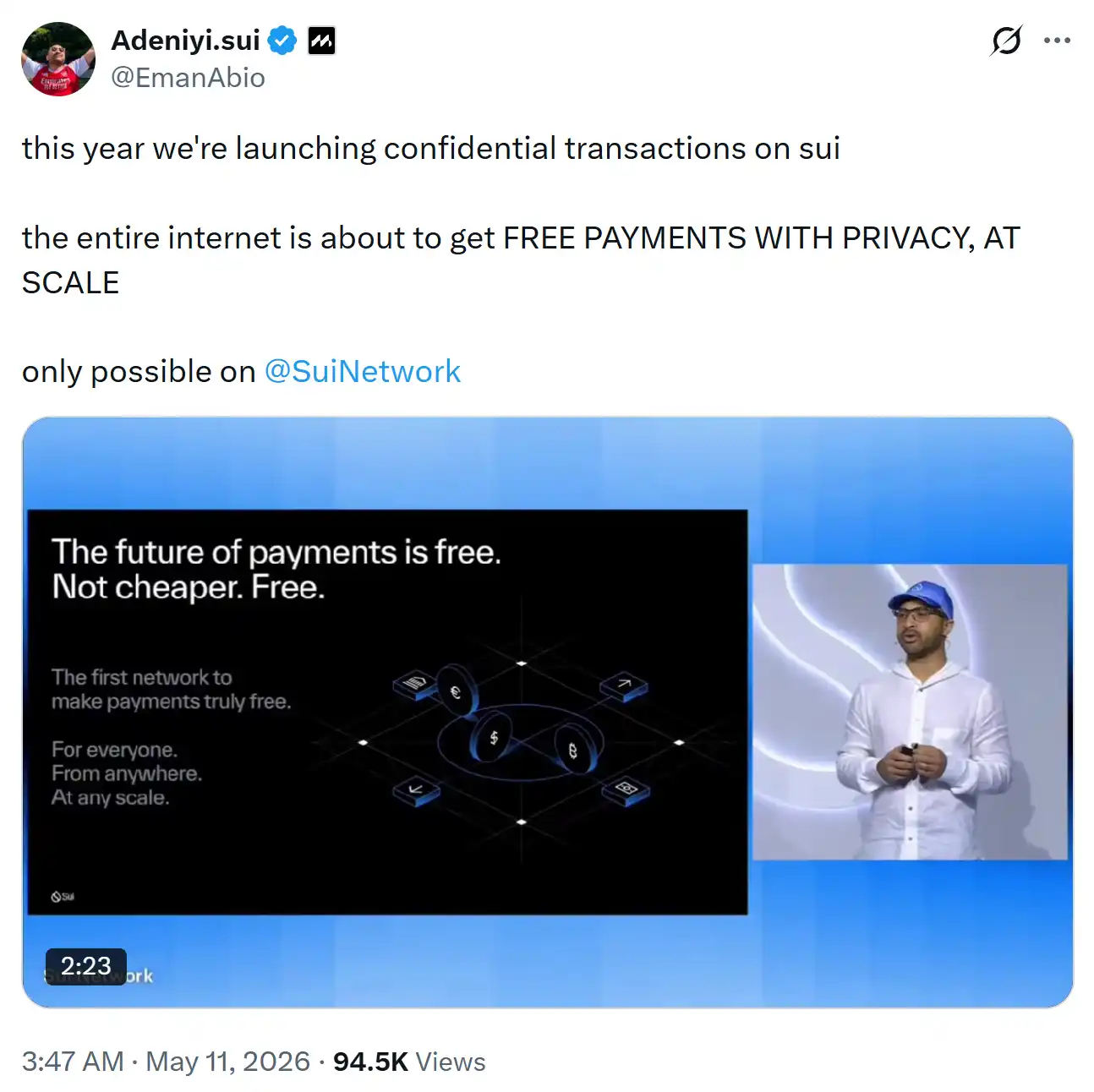
Regarding the second half, the Mysten Labs product team has hinted multiple times: Protocol-level confidential transaction functionality will be launched within 2026, aiming to achieve large-scale, free payments with privacy protection.

Transfers will not only be cost-free but will also be able to hide transaction amounts and certain details, while retaining necessary audit and compliance capabilities.

This combination is crucial for adoption, especially for institutions. The higher the compliance requirements, the greater the value of confidential transactions.
Let Money Flow Like Information.

This can be considered a phrase that runs through all of Sui's technological and ecosystem initiatives.

And now, from payments to Agents to institutions, the fuse that will decide large-scale adoption might just be lit by zero Gas stablecoin transfers.

Трендові криптовалюти

Пов'язані питання

QWhat is the main announcement made by Sui regarding stablecoin transfers, and when was it announced?

ASui announced a zero Gas stablecoin transfer function on May 20, 2026. This feature allows users and businesses to send stablecoins peer-to-peer without paying Gas fees and without needing to manage a separate SUI token balance.

QHow does Sui's 'zero Gas' mechanism for stablecoin transfers fundamentally differ from previous attempts at eliminating Gas fees?

AUnlike previous methods that relied on subsidies or relayers where someone else ultimately pays the Gas, Sui's approach targets the underlying architecture. It is built on the new Address Balances system, where tokens are sent using specific Move functions and automatically merged into the recipient's single balance. This eliminates the overhead of creating, splitting, merging, and tracking Coin objects, reducing validator processing costs so low that fees can be waived for the user.

QAccording to the article, what are some of the key use cases or scenarios enabled by zero Gas stablecoin transfers on Sui?

AThe key use cases include: 1) Everyday payments like consumption, tipping, subscriptions, and cross-border remittances. 2) High-frequency micropayments for the Agent/AI economy, enabling autonomous transactions with minimal cost. 3) Institutional payments such as cross-border B2B payments, supplier settlements, and platform revenue sharing, where reducing friction is crucial.

QWhat is the 'second half' or next major development in Sui's 2026 payment narrative mentioned in the article?

AThe 'second half' of Sui's 2026 payment narrative is the planned launch of a protocol-level confidential transaction feature within the year. The goal is to enable large-scale, free (zero Gas), and privacy-preserving payments that can hide transaction amounts and certain details while retaining necessary audit and compliance capabilities.

QWhat underlying technical principle allows Sui to offer zero Gas fees for eligible stablecoin transfers?

AIt is enabled by the new Address Balances account architecture. When tokens are sent using specific Move functions, they are automatically merged into the recipient's address balance without creating individual Coin objects. This drastically reduces the computational overhead (like object creation, splitting, merging, and version tracking) for validators, making the cost so low that fees are not charged to users for qualifying transactions.

Пов'язані матеріали

Which Crypto Sectors Have Been "Eaten" by AI Agents?

The article examines which crypto sectors have been increasingly dominated by AI Agents and which remain human-centric. In certain high-speed, efficiency-driven areas, AI Agents have taken clear control. This includes derivatives/perpetuals trading, where bots outperform humans significantly (e.g., a contest showed 0% of AI Agents were liquidated vs. 43% of humans), arbitrage/MEV extraction, and yield optimization (with ~68% of new DeFi protocols in Q1 2026 featuring autonomous AI Agents). Spot trading and portfolio optimization are also seeing heavy Agent adoption. However, the shift is not universal. In "battleground" sectors, both Agents and humans coexist. In prediction markets, Agents dominate short-term arbitrage, but humans still outperform in long-term, nuanced judgment calls. In DeFi lending, while liquidation is automated, core deposit/borrow decisions remain largely human-driven. Sectors still firmly led by human activity include stablecoin payments and card-based spending (driven by real-world economic activity and remittances) and wallets, which serve as the crucial human-verification and approval layer. The rise of Agents increases the need for robust human-Agent verification layers. Projects like World/AgentKit, t54, Self Protocol, and Kite AI are building infrastructure to create trust, security, and accountability by binding Agents to verified human identities. In conclusion, while AI Agents have decisively "eaten" speed and optimization-focused crypto sectors, human judgment, trust, and real-world context remain dominant in areas that create broad economic value, such as payments and identity. The future likely involves a symbiotic relationship where Agents require human verification and oversight to operate effectively.

Foresight News9 хв тому

Which Crypto Sectors Have Been "Eaten" by AI Agents?

Foresight News9 хв тому

After Rising 11 Times in a Year, Micron's Earnings Report Becomes a Stress Test for the AI Memory Market

**Micron's Upcoming Earnings: A Crucial Test for the AI Memory Rally** Investors in AI memory stocks face a critical moment on June 24th, when Micron Technology reports quarterly earnings. The stock, having surged approximately 11-fold from $103 to $1,134 over the past year, carries immense market expectations. Wall Street consensus forecasts a staggering ~932% year-over-year jump in EPS to around $19.72 and ~270% revenue growth to ~$345 billion, largely driven by sold-out HBM (High Bandwidth Memory) capacity through 2026. Analysts have aggressively revised estimates upward over the last 90 days, with EPS expectations rising 68%. This creates a high bar: even strong results risk a sell-off if they fail to meet these elevated projections. Notably, price forecasts from institutions like Citi (predicting ~200% DRAM price increases in 2026) are already among the most bullish on Wall Street, not conservative. The key metric to watch is gross margin, guided to a record ~81%. Such peak profitability raises questions about sustainability in the historically cyclical memory sector. While management has signaled continued strength, the stock's direction post-earnings will likely hinge more on forward guidance for the next quarter and details on HBM capacity expansion for 2027, rather than the already-anticipated stellar past results. The report represents a major pressure test for the high-flying AI memory trade.

marsbit13 хв тому

After Rising 11 Times in a Year, Micron's Earnings Report Becomes a Stress Test for the AI Memory Market

marsbit13 хв тому

Торгівля

Спот
Ф'ючерси

Популярні статті

Як купити GAS

Ласкаво просимо до HTX.com! Ми зробили покупку GAS (GAS) простою та зручною. Дотримуйтесь нашої покрокової інструкції, щоб розпочати свою криптовалютну подорож.Крок 1: Створіть обліковий запис на HTXВикористовуйте свою електронну пошту або номер телефону, щоб зареєструвати обліковий запис на HTX безплатно. Пройдіть безпроблемну реєстрацію й отримайте доступ до всіх функцій.ЗареєструватисьКрок 2: Перейдіть до розділу Купити крипту і виберіть спосіб оплатиКредитна/дебетова картка: використовуйте вашу картку Visa або Mastercard, щоб миттєво купити GAS (GAS).Баланс: використовуйте кошти з балансу вашого рахунку HTX для безперешкодної торгівлі.Треті особи: ми додали популярні способи оплати, такі як Google Pay та Apple Pay, щоб підвищити зручність.P2P: Торгуйте безпосередньо з іншими користувачами на HTX.Позабіржова торгівля (OTC): ми пропонуємо індивідуальні послуги та конкурентні обмінні курси для трейдерів.Крок 3: Зберігайте свої GAS (GAS)Після придбання GAS (GAS) збережіть його у своєму обліковому записі на HTX. Крім того, ви можете відправити його в інше місце за допомогою блокчейн-переказу або використовувати його для торгівлі іншими криптовалютами.Крок 4: Торгівля GAS (GAS)Легко торгуйте GAS (GAS) на спотовому ринку HTX. Просто увійдіть до свого облікового запису, виберіть торгову пару, укладайте угоди та спостерігайте за ними в режимі реального часу. Ми пропонуємо зручний досвід як для початківців, так і для досвідчених трейдерів.

193 переглядів усьогоОпубліковано 2024.12.12Оновлено 2026.06.02

Як купити GAS

Обговорення

Ласкаво просимо до спільноти HTX. Тут ви можете бути в курсі останніх подій розвитку платформи та отримати доступ до професійної ринкової інформації. Нижче представлені думки користувачів щодо ціни GAS (GAS).

活动图片