From Speculation to Risk Management: Predictive Markets Are Filling the Gap in Commercial Insurance

marsbitОпубліковано о 2026-08-17Востаннє оновлено о 2026-08-17

Анотація

From Speculation to Risk Management: Predictive Markets Filling the Commercial Insurance Gap The emergence of AI risk management tools like Blanket is exploring the potential of predictive markets as a genuine insurance tool for businesses. These markets, with their simple contract structure—paying $1 if an event occurs, $0 if not—allow the real-time market price to reflect collective probability assessments. Businesses can use them to hedge against operational risks (e.g., abnormal weather, energy price fluctuations) that are often not covered by traditional business interruption insurance, which typically requires physical damage. A key question is whether these markets are genuinely used for hedging or remain primarily speculative. Analysis of Kalshi markets from August 2025 to August 2026 compared weather contracts (a potential hedge instrument) against sports contracts (largely speculative) and traditional CME grain futures. Three behavioral metrics were examined: 1. **Daily Turnover Rate:** Weather contracts showed the lowest rate (0.210), lower than corn futures (0.266) and significantly lower than sports contracts (0.315), suggesting longer holding periods. 2. **Hold-to-Expiry Ratio:** Weather contracts had a much higher ratio (over 0.5) compared to near-zero ratios for sports contracts, indicating a stronger tendency to hold positions until settlement, consistent with hedging behavior. 3. **Position Buildup Timing:** Weather market positions reached 50% of their...

Written by: G_Gyeomm

Compiled by: AIdidiaoJP, Foresight News

I. A New Type of Insurance Directly Priced by the Market

The recently launched AI risk management tool Blanket is attempting to turn predictive markets into a genuine insurance tool usable by businesses. The logic is straightforward: a business inputs its operational information, the system automatically diagnoses its main risk exposures, and then recommends corresponding Kalshi event contracts to help the business hedge against these risks.

The hedging mechanism itself is not complex. The contract structure of a predictive market is extremely clear — it pays $1 if an event occurs and $0 if it doesn't. The contract's real-time price represents the market's collective judgment on the probability of that event occurring.

It is precisely this simple structure that gives predictive markets the potential to become real hedging tools. Businesses can preemptively purchase contracts for events that could impact their operations, such as abnormal weather, energy price volatility, or tariff policy changes. If these risks materialize, the contract payouts can partially or fully offset the operational losses.

A specific example: an ice cream shop that would lose about $20,000 in revenue if the summer is unusually cool.

The hedging operation is as follows: buy 20,000 temperature contracts at $0.30 each. If the average summer temperature falls below a preset threshold, each contract pays out $1. The total cost is $6,000.

There are only two possible outcomes:

  • Cool Summer: The temperature is below the threshold, revenue is down $20,000, but the contracts pay out $20,000 in total. The net loss is locked at $6,000 — exactly the initial cost of buying the contracts.
  • Hot Summer: The temperature is above the threshold, revenue is unaffected, but the contracts expire worthless, and the $6,000 cost is completely lost.

Regardless of the outcome, the final loss is firmly locked at $6,000. This $6,000 is essentially the insurance premium. And the rate for this premium is not set by an insurance company's actuary or any traditional underwriting institution, but by the market itself — the price quoted in real-time by countless buyers and sellers with real money.

II. Is the Hedging Market Really Functioning?

Predictive markets have already accumulated enough speculative demand. They first gained fame through election predictions, then smoothly expanded into the sports arena, largely solving the volume problem. The industry generally believes the next growth space lies in expanding more practical use cases, with hedging needs repeatedly mentioned as one of the most promising directions.

In principle, its value is indeed significant. The gaps not covered by existing hedging tools are quite broad. Traditional business interruption insurance in commercial insurance typically requires physical damage as a precondition. A ski shop losing revenue because there was hardly any snow all winter — this kind of pure "operational risk" — is almost impossible to find suitable insurance products to cover on the market.

There are mature hedging tools in the futures market, but the barriers are high: requiring an ISDA agreement, opening a specialized futures account, posting margin, and minimum contract size limits. These are not issues for large institutions, but are almost unattainable for ordinary small and medium-sized enterprises. Goldman Sachs can maintain a professional derivatives trading team, but the cafe on the corner obviously cannot.

The problem is, there has always been a clear chasm between theoretical rationality and actual use. Predictive markets have long carried the label of "gambling," and whether they can truly operate as an independent hedging market — rather than just a speculative tool — has never been systematically verified.

The real question that needs answering is: Are predictive markets actually being used for hedging? Does real hedging demand exist? Trading behavior itself can provide clues. We selected three sets of data for comparison.

The first set is CME grain futures — a typical traditional hedging market, primarily used to mitigate losses from price fluctuations in agricultural and livestock products.

The second set is the Kalshi sports market — where hedging demand is extremely limited, and trading is almost entirely driven by speculation.

The third set is the Kalshi weather market — it handles weather risk in a manner similar to CME weather futures, while sharing the exact same event contract structure and trading environment with the Kalshi sports market. This makes it an excellent test sample — to see which side its trading behavior is closer to.

Hedging and speculation typically exhibit different trading characteristics. Hedgers tend to establish positions well before the actual risk window arrives and hold them until expiration; speculators move in and out more frequently, chasing prices, with noticeably higher turnover rates.

If the Kalshi weather market's turnover rate and holding behavior are closer to traditional hedging markets than to the sports market, then hedging demand is real.

Conversely, if it's not much different from the sports market, then actual usage is closer to pure speculation. In that case, tools like Blanket might be responding to a nice industry hypothesis, not a real demand confirmed by data.

The dataset for this analysis covers 1,265 Kalshi markets settled between August 2025 and August 2026. The screening criteria were: cumulative trading volume of at least 500 contracts, and trading lasting at least three days.

III. Data Point 1: Average Daily Turnover Rate

First, look at how frequently positions are traded in each market. Turnover rate is defined as daily trading volume divided by open interest (OI) for that day. We calculated the daily turnover rate for each contract in each market and then took the median for the entire trading cycle.

The results are clear: Kalshi weather contracts have the lowest turnover rate, only 0.210. The traditional hedging product corn futures is 0.266, and Kalshi sports contracts are the highest at 0.315.
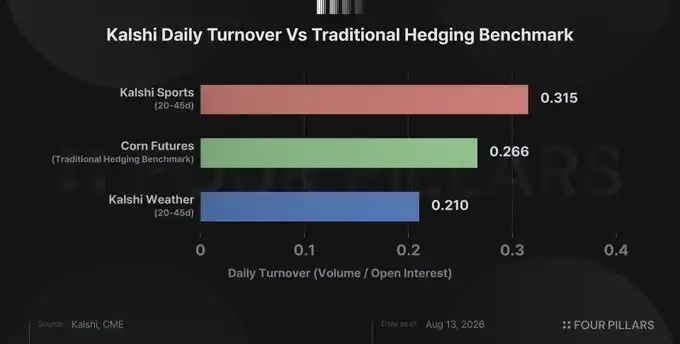
Sports contracts turn over about 1.5 times faster than weather contracts. This indicates a relatively longer holding tendency for weather contracts, initially suggesting the possible existence of real hedging demand.

However, a caveat: Corn futures' turnover rate sits in the middle, and the differences among the three data sets are not particularly stark. Based on turnover rate alone, we cannot fully confirm the existence of hedging demand in the weather market. What this data can definitively tell us so far is only that weather contract turnover is significantly lower than sports contract turnover.

IV. Data Point 2: Hold-to-Expiration Ratio

The second key metric is the hold-to-expiration ratio — measuring how many positions remain untouched in the market at settlement. It is calculated as the final open interest for each contract divided by the cumulative trading volume. A higher value indicates more positions were firmly held until the expiration date.
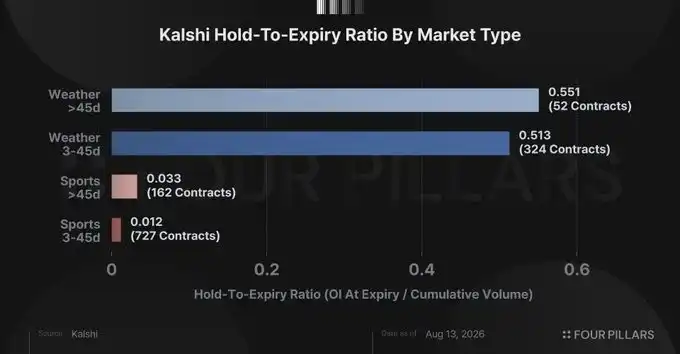
The difference in results is very striking: regardless of trading duration, the hold-to-expiration ratio for weather contracts exceeds 0.5. In contrast, sports contracts are only 0.012 and 0.033 respectively. In the 3 to 45-day trading interval, weather is 42.8 times that of sports; in the over 45-day interval, the gap is still 16.7 times.

This clearly shows: Weather contracts are far more inclined to "buy and hold" than sports contracts. Hedgers hold contracts to receive payouts if the risk materializes, not to chase price differences. Therefore, a high hold-to-expiration ratio strongly supports the judgment that there is real hedging demand in the weather market.

Of course, this cannot be directly interpreted as the entire weather market being used for hedging. This data does not track the identities of individual position buyers and sellers, so it cannot be simply equated with the proportion of original buyers holding to expiration. What can be confirmed at present is that the holding behavior of weather contracts is distinctly different from that of sports contracts.

V. Data Point 3: When Were Positions Established?

The final question is: When were these positions established? We divided the daily open interest for each contract by that contract's peak open interest, converted the time from launch to expiration into a progress bar from 0% to 100%, and then plotted the median curve.

The criterion for judgment is the point at which half of the peak open interest is reached. If half is reached when there is still more time until expiration, it means positions were built earlier — which is more in line with the behavior pattern of hedgers.
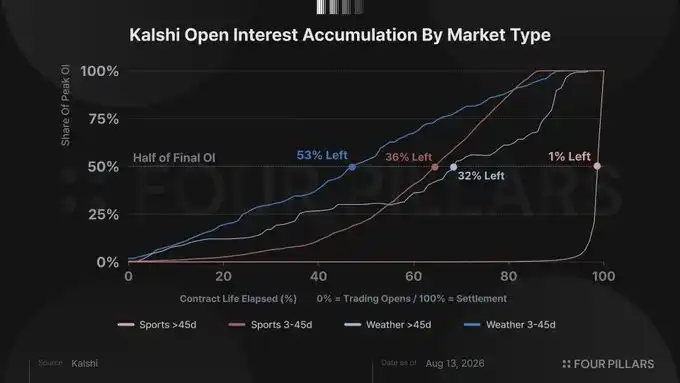
For weather contracts trading for 3 to 45 days, they had already reached half their peak open interest when their lifecycle was at 47%, leaving 53% of the time until expiration. Sports contracts in the same interval didn't reach half until 65%, with only 36% of the time remaining.

For contracts over 45 days, the difference is even more astonishing. Weather contracts reached half when there was still 32% until expiration, while sports contracts had only 1.3% left. Regardless of the interval, weather positions were established much earlier than sports positions.
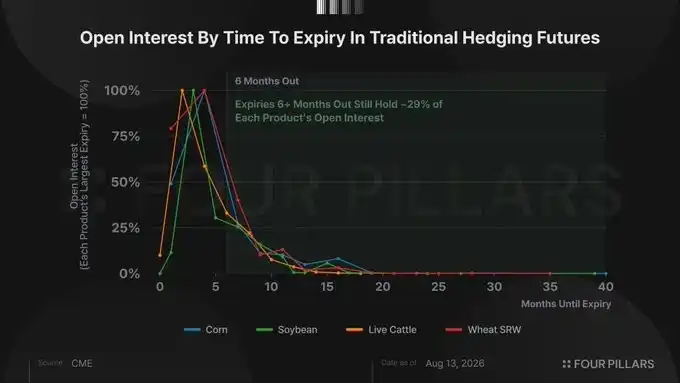
This behavior of "early positioning" is precisely a typical characteristic of traditional hedging markets. As of August 11, 2026, CME grain and livestock futures contracts expiring in six months had already accumulated massive open interest. Corn futures even held 65,127 positions on contracts expiring 16 months later.

This reflects the tendency to act well before the risk actually materializes. And the behavioral pattern of Kalshi weather contracts is clearly closer to traditional hedging markets than to sports markets.

VI. Hedging Relies on Liquidity Built by Speculation

Conclusion first: The Kalshi weather market is neither a purely hedging market nor a purely speculative one like sports. Speculative demand still contributes a significant portion of the liquidity, but on top of that, hedging demand has also emerged relatively clearly.

The three indicators point in the same direction: weather contracts trade less frequently, retain more positions at settlement, and positions are established earlier. No single indicator can confirm trading intent with 100% certainty, but the high consistency of these behaviors collectively supports a judgment — there indeed exists a holding demand in the Kalshi weather market distinct from sports, and a considerable part of it is likely real hedging demand.

More importantly, speculative demand is not so much a weakness of predictive markets as it is a prerequisite for the hedging function to exist. A market with only hedgers and no speculators would struggle to find sufficient counterparties and continuous liquidity.

In predictive markets, speculators are responsible for pricing and providing liquidity, while hedgers transfer the risks they do not wish to bear on this foundation. The risk is no longer directly underwritten by an insurance company but is naturally dispersed among market participants through trading.

Therefore, the next phase of growth for predictive markets is not about "squeezing out" speculation and shifting entirely to hedging. What truly matters is: How much real corporate hedging demand can be layered on top of the liquidity base already built by speculation? This is the core variable that determines whether it can upgrade from an "interesting speculative tool" to a "usable risk management infrastructure."


Трендові криптовалюти

Пов'язані питання

QWhat is the main difference between using a prediction market and traditional insurance for business risk management?

AThe main difference is that in prediction markets, the insurance premium (price of the contract) is determined collectively by market participants based on their assessment of the event's probability, whereas in traditional insurance, the premium is calculated by the insurer's actuaries.

QWhat are the three data points used to analyze whether the Kalshi weather market is used for hedging?

AThe three data points are: 1) Average daily turnover rate, 2) Hold-to-expiration ratio, and 3) The timing of when positions are established (measured by the time it takes to reach 50% of peak open interest).

QAccording to the analysis, how does the trading behavior of Kalshi weather contracts compare to its sports contracts?

AThe analysis shows that Kalshi weather contracts have a lower turnover rate, a significantly higher hold-to-expiration ratio, and positions are established much earlier compared to Kalshi sports contracts. This suggests behavior more consistent with hedging.

QWhat is the primary role of speculators in a prediction market that aims to serve hedging purposes?

ASpeculators provide the necessary liquidity and price discovery in the prediction market, which creates a functional trading environment that allows hedgers to enter and exit positions to transfer their risks.

QWhat example is given to illustrate how a business could use a prediction market contract to hedge against operational risk?

AThe example given is an ice cream shop that could hedge against a cool summer. It could buy 20,000 temperature contracts at $0.30 each (total cost $6,000). If the summer is cool and average temperature falls below a threshold, each contract pays $1, offsetting the estimated $20,000 revenue loss, thereby locking the net loss at the initial $6,000 cost. If the summer is hot, the contracts expire worthless, and the shop loses the $6,000 premium but enjoys full revenue.

Пов'язані матеріали

'The Idea of Catching the Absolute Bottom Is Wrong': Experts on a New Phase of Bitcoin Capitulation

Analysts from CryptoQuant advise investors against trying to pinpoint the exact bottom of Bitcoin's price. Their data shows the percentage of the Bitcoin supply in profit has fallen to 51.4%, a level historically associated with capitulation phases followed by accumulation. This means approximately 48.6% of circulating coins are held at an unrealized loss. The metric, based on UTXO analysis comparing a coin's last moved price to its current market value, last neared this level in early 2023 when Bitcoin traded between $16,000 and $20,000. CryptoQuant states that the idea of catching the "absolute bottom" is flawed. The decline in the average cost basis during a bear market reflects coins transferring from weak hands to stronger, long-term holders. While some investors realize losses, others may use the decline for gradual accumulation. The accumulation window may last longer than many expect, even as fear drives some participants away. Historically, a supply in profit below 55% has been linked to re-accumulation periods. Separately, Swan Bitcoin CEO Cory Klippsten offered a forecast, suggesting Bitcoin could form a bottom in October 2026, followed by a recovery towards approximately $130,000 ahead of the 2028 halving. This aligns with the historical pattern of local lows forming about 12 months after bull market peaks; Bitcoin hit its all-time high above $126,000 in early October 2025. However, Klippsten cautioned against over-relying on past cycles due to limited historical data.

cryptonews.ru14 хв тому

'The Idea of Catching the Absolute Bottom Is Wrong': Experts on a New Phase of Bitcoin Capitulation

cryptonews.ru14 хв тому

How Does FalconX Bring Institutional Lending On-Chain? Deep Dive into the FALX Operational Mechanism

FALX is a structured credit facility that brings institutional prime brokerage loans on-chain as fixed-income assets. It works by having FalconX originate overcollateralized loans to institutional clients (e.g., quant funds, market makers). These loan exposures enter a bankruptcy-remote SPV. The Pareto protocol provides the on-chain credit vault infrastructure, while M11 Credit acts as the credit curator, administrative agent, and collateral agent. Platforms like Plume, Ethereum, and Solana serve as distribution channels for investors. Investors deposit USDC into the vault, receiving an estimated ~7.4% net yield (after a 10% performance fee). This yield represents a premium over low-risk on-chain alternatives (like tokenized Treasuries at ~4%) to compensate for risks including FalconX operational risk, collateral liquidation risk, SPV legal risk, M11's execution risk, a 31-day redemption notice period, and potential contagion from DeFi re-collateralization. The structure incorporates multiple risk mitigations: overcollateralized underlying loans, a first-loss capital contribution from FalconX, and independent oversight by M11. However, challenges remain, such as scaling investor demand (current AUM is ~$148M against a ~$1B potential capacity), managing redemption liquidity, and addressing new risks from the vault token's use as collateral in DeFi lending protocols like Morpho. FALX demonstrates a pragmatic path for on-chain credit by leveraging existing institutional loan origination and combining it with legal structures, external curation, and blockchain-based distribution.

marsbit15 хв тому

How Does FalconX Bring Institutional Lending On-Chain? Deep Dive into the FALX Operational Mechanism

marsbit15 хв тому

Торгівля

Спот

Популярні статті

Що таке G$

Розуміння GoodDollar ($G$): План для децентралізованого універсального базового доходу Вступ У постійно змінному ландшафті криптовалют та технології блокчейн ініціативи, що прагнуть вирішити нагальні соціальні проблеми, привертають все більше уваги. Одним із таких проектів є GoodDollar ($G$), рішення для універсального базового доходу (UBI) на базі Web3. GoodDollar намагається подолати нерівність і скоротити розрив у багатстві, створюючи та розподіляючи доступні економічні ресурси тим, хто найбільше цього потребує. Завдяки інноваційному використанню децентралізованих фінансів (DeFi) GoodDollar представляє унікальну модель, яка може суттєво змінити сприйняття та надання фінансової допомоги у всьому світі. Що таке GoodDollar ($G$)? GoodDollar - це криптовалютний протокол, який полегшує випуск і розподіл цифрових токенів, що називаються $G$, своїм зареєстрованим користувачам на щоденній основі. Ці токени функціонують як форма універсального базового доходу, сприяючи фінансовій підтримці людей з різних культур, особливо тих, хто традиційно виключений із фінансової системи. Функціонуючи на блокчейні, GoodDollar використовує кілька мереж, включаючи Ethereum, Celo та Fuse, забезпечуючи широкий доступ і зручність. Основною метою GoodDollar є зробити криптовалюту доступною та вигідною для всіх, незалежно від їх економічного старту. Творець GoodDollar ($G$) Деталі щодо творця GoodDollar залишаються дещо неясними. Однак варто зазначити, що проект має сильну підтримку від eToro, широко визнаної інвестиційної платформи, яка надала початкове фінансування та основну підтримку для розвитку GoodDollar. Візія проекту не є виключно прибутковою, а більше схиляється до соціального підприємництва, прагнучи до системних змін у економічній доступності. Інвестори GoodDollar ($G$) GoodDollar користується фінансовою підтримкою та оперативною підтримкою eToro. Це партнерство зіграло значну роль у запуску протоколу та його подальшому розвитку. Хоча eToro відігравала важливу роль у встановленні основ проекту, GoodDollar прагне перейти до моделі, що фінансується її спільнотою в довгостроковій перспективі. Цей перехід до фінансування спільнотою відповідає зобов'язанням GoodDollar щодо децентралізації, що дає можливість її користувачам мати прямий інтерес у майбутньому проекту. Як працює GoodDollar ($G$)? Операційна структура GoodDollar значною мірою базується на принципах DeFi для генерації процентів від застрахованих криптовалют. Цей механізм дозволяє проекту карбувати та розподіляти токени $G$ як цифровий базовий дохід для користувачів у всьому світі. Декілька ключових характеристик роблять GoodDollar унікальним і інноваційним: Універсальний базовий дохід (UBI): Щодня зареєстровані користувачі отримують безкоштовні токени, що встановлює автоматичний потік доходу, призначений для полегшення фінансового тиску. Стійка економічна модель: Токеноміка проекту націлена на балансування попиту та пропозиції токенів $G$, щоб забезпечити стабільність їхньої вартості з часом. Токени з резервами: Кожен токен $G$ забезпечується резервом криптовалют, що надає йому вбудовану цінність і надійність, що є критично важливим для підтримки довіри користувачів. Децентралізоване управління: GoodDollar впроваджує демократичний підхід до прийняття рішень через управління на основі токенів. Це дозволяє членам спільноти активно брати участь у формуванні траєкторії проекту, роблячи його дійсно орієнтованим на спільноту. Глобальна доступність: GoodDollar створив значний слід у спільноті, з понад 640 000 членами в 181 країні. Такий широкий охват є інструментом у полегшенні UBI на глобальному рівні. Хронологія GoodDollar ($G$) Еволюція GoodDollar позначена кількома значними етапами в його історії: 2019: Запуск гаманця GoodDollar став першим кроком до реалізації його бачення надання UBI через криптовалюту. 2020: Після успішного впровадження гаманця, протокол GoodDollar офіційно дебютував. Це ознаменувало критичну фазу в його місії надання щоденних розподільних доходів. 2021: Проект далі прогресував із запровадженням свого Децентралізованого автономного органу (DAO), що сприяло більшій залученості спільноти та управлінню. 2022: GoodDollar представив свою дружню до DeFi версію 2 (V2), прагнучи до підвищення залученості користувачів та ефективності роботи. Того ж року також відбувся перехід до децентралізованої структури управління через GoodDAO. 2022: Була концептуалізована нова дорожня карта, зосереджена на ініціативах, таких як грантова програма, спрямована на просування підприємницьких проектів, пов'язаних з $G$, і оновленого ринку GoodDollar. Ключові особливості GoodDollar ($G$) Проект GoodDollar вводить численні важливі особливості, спрямовані на переосмислення ландшафту базового доходу: Універсальний базовий дохід: Щоденна доставка безкоштовних токенів своїм користувачам основополагає його місію з усунення економічної нестабільності. Багатоканальна операція: Використання кількох блокчейн-мереж підвищує доступність і масштабованість, забезпечуючи ширшу участь. Взаємодія з децентралізованими фінансами: Використання DeFi дозволяє забезпечити сталість фінансування моделі UBI, зміцнюючи її життєздатність як економічного рішення. Залучення спільноти та управління: GoodDollar передбачає модель, в якій спільнота впливає на операції через демократичну участь, що сприяє прозорості та підзвітності. Глобальна спільнота: Наявність різноманітної глобальної спільноти дозволяє проекту реалізовувати рішення UBI, адаптовані до різних культурних та економічних контекстів. Висновок GoodDollar представляє собою трансформаційний крок до впровадження принципів універсального базового доходу через інноваційний погляд на технологію блокчейн. Використовуючи децентралізовані фінанси, проект не лише пропонує рішення для фінансової нерівності, але й активно залучає користувачів до його управління та операцій. Зростаюча спільнота та еволюційна дорожня карта роблять GoodDollar значущим гравцем на перетині криптовалюти та соціального добра, прокладаючи шлях до більш справедливого фінансового майбутнього. Як він продовжує еволюціонувати, шлях GoodDollar може в кінцевому підсумку надихнути інші ініціативи розглянути подібні моделі, просуваючи справу економічного розширення можливостей для всіх.

202 переглядів усьогоОпубліковано 2024.04.05Оновлено 2024.12.03

Що таке G$

Як купити G

Ласкаво просимо до HTX.com! Ми зробили покупку Gravity (G) простою та зручною. Дотримуйтесь нашої покрокової інструкції, щоб розпочати свою криптовалютну подорож.Крок 1: Створіть обліковий запис на HTXВикористовуйте свою електронну пошту або номер телефону, щоб зареєструвати обліковий запис на HTX безплатно. Пройдіть безпроблемну реєстрацію й отримайте доступ до всіх функцій.ЗареєструватисьКрок 2: Перейдіть до розділу Купити крипту і виберіть спосіб оплатиКредитна/дебетова картка: використовуйте вашу картку Visa або Mastercard, щоб миттєво купити Gravity (G).Баланс: використовуйте кошти з балансу вашого рахунку HTX для безперешкодної торгівлі.Треті особи: ми додали популярні способи оплати, такі як Google Pay та Apple Pay, щоб підвищити зручність.P2P: Торгуйте безпосередньо з іншими користувачами на HTX.Позабіржова торгівля (OTC): ми пропонуємо індивідуальні послуги та конкурентні обмінні курси для трейдерів.Крок 3: Зберігайте свої Gravity (G)Після придбання Gravity (G) збережіть його у своєму обліковому записі на HTX. Крім того, ви можете відправити його в інше місце за допомогою блокчейн-переказу або використовувати його для торгівлі іншими криптовалютами.Крок 4: Торгівля Gravity (G)Легко торгуйте Gravity (G) на спотовому ринку HTX. Просто увійдіть до свого облікового запису, виберіть торгову пару, укладайте угоди та спостерігайте за ними в режимі реального часу. Ми пропонуємо зручний досвід як для початківців, так і для досвідчених трейдерів.

555 переглядів усьогоОпубліковано 2024.12.10Оновлено 2026.06.02

Як купити G

Що таке @G

Graphite Network, $@G: Міст між традиційними фінансами та Web3 Вступ до Graphite Network, $@G У яскравому світі криптовалют та проектів web3 Graphite Network виступає як маяк інновацій. З його рідним токеном, $@G, цей блокчейн Layer-1, що працює на основі Proof-of-Authority (PoA), призначений для подолання розриву між традиційними фінансами (TradFi) та швидко розвиваючою екосистемою Web3. Оскільки цифрові валюти набирають популярності, Graphite Network прагне запропонувати блокчейн-платформу, яка пріоритетно ставить безпеку, відповідність та швидкість, представляючи себе як посередника довіри та підзвітності. Що таке Graphite Network, $@G? Graphite Network не просто ще один блокчейн-проект; він має на меті переосмислити, як децентралізація, безпека та підзвітність користувачів сприймаються у сфері цифрових фінансів. Проект має ряд відмінних характеристик: Блокчейн на основі репутації: У своїй основі Graphite Network реалізує політику один користувач, один рахунок, підкріплену інтегрованою перевіркою Know Your Customer (KYC) та механізмами оцінки. Цей дизайн забезпечує баланс між конфіденційністю користувачів та прозорістю — критично важливий аспект фінансових операцій у сучасному цифровому світі. Дохід від вузлів входу: Мережа стимулює користувачів налаштовувати вузли входу, що дозволяє операторам отримувати винагороди від транзакцій у мережі. Ця модель генерації доходу не лише підвищує залученість користувачів, але й зміцнює здоров'я мережі та децентралізацію. Сумісність з EVM: Завдяки віртуальній машині (VM), сумісній з Ethereum, Graphite Network забезпечує безшовну інтеграцію існуючих децентралізованих додатків (dApps) на Solidity та смарт-контрактів, запрошуючи розробників використовувати її можливості без значних модифікацій. Інтеграція KYC: В епоху, коли відповідність є надзвичайно важливою, інтегрована структура KYC з кількома рівнями перевірки підвищує контроль над фінансовими операціями без обов'язкової участі, встановлюючи прецедент для автономії користувачів. Хто є творцем Graphite Network, $@G? Graphite Network виник внаслідок зусиль Graphite Foundation, неприбуткової організації, що займається розвитком, підтримкою та еволюцією Graphite Network. Зобов'язання фонду підкреслює бачення проекту створити безпечне та стійке блокчейн-середовище, зосереджене на справжньому залученні користувачів та відповідності. Хто є інвесторами Graphite Network, $@G? На даний момент є обмежена інформація про конкретних інвесторів, які підтримують ініціативу Graphite Network. Засновницька організація, Graphite Foundation, функціонує незалежно, сприяючи зростанню проекту, одночасно шукаючи партнерства, які резонують з її баченням відповідальної та доступної блокчейн-платформи. Як працює Graphite Network, $@G? Операція Graphite Network ґрунтується на його унікальному механізмі консенсусу Proof-of-Authority, який досягає вражаючого балансу між високою пропускною здатністю та децентралізацією. Давайте розглянемо різні компоненти, які визначають його роботу: Транспортні вузли: Служачи вузлами входу, вони є критично важливими для екосистеми. Оператори можуть отримувати дохід від транзакцій, які проходять через мережу, що не лише надає можливості окремим користувачам, але й зміцнює децентралізацію мережі. Авторизовані вузли: У центрі Graphite Network знаходяться основні валідатори, які проходять суворі тести на відповідність, що включають надійну перевірку KYC разом з технічними оцінками. Цей рівень довіри є важливим для забезпечення високого рівня цілісності транзакцій у мережі. Система тікерів: Graphite Network використовує унікальну систему тікерів для своїх обгорнених токенів, позначених як @G. Ця функція підвищує ясність інтеграції активів, роблячи транзакції користувачів зрозумілими та простими. Інноваційний підхід Graphite Network відображає значний крок у вирішенні критичних питань цифрових фінансів, позиціонуючи себе вигідно для майбутнього, оскільки все більше користувачів переходять від традиційних форм фінансів до світу децентралізованих додатків. Хронологія Graphite Network, $@G Щоб зрозуміти прогрес і етапи Graphite Network, корисно переглянути ключові події в його хронології: 2021: Заснування Graphite Network Graphite Foundation знаменує початок нової ери в розвитку блокчейнів, зосереджуючись на відповідності та розширенні можливостей користувачів. Ключові події: Після запуску впровадження доходу від вузлів входу, встановлення моделі на основі репутації, інтегрована перевірка KYC та забезпечення сумісності з EVM представляють значні досягнення в проекті. Останні події: Постійний розвиток та зусилля Graphite Foundation зосереджені на покращенні функцій мережі, одночасно сприяючи зростанню екосистеми, демонструючи довгострокове зобов'язання до стійкості та інновацій. Додаткові ключові моменти Окрім своїх основних компонентів, Graphite Network охоплює кілька інструментів та функцій, які підвищують його зручність: Гаманець Graphite: Зручне розширення для Chrome, яке полегшує доступ до різних функцій та додатків мережі на сумісних з Ethereum ланцюгах, підвищуючи зручність для користувачів. Міст Graphite: Цей інструмент дозволяє безшовні передачі активів Graphite через різні мережі, сприяючи інтегрованій та взаємодійній екосистемі. Explorer Graphite: Служачи важливим інструментом у межах екосистеми, ця функція дозволяє користувачам переглядати та перевіряти вихідний код смарт-контрактів, відстежувати транзакції та досліджувати іншу важливу інформацію в реальному часі. Тестова мережа Graphite: Проект забезпечує надійне тестове середовище для розробників, дозволяючи їм забезпечити стабільність та масштабованість перед розгортанням у основній мережі. Ця ініціатива не лише надає можливості розробникам, але й підвищує надійність усієї мережі. Висновок Graphite Network з його рідним токеном $@G представляє значний крок до подолання розриву між традиційними фінансами та передовими блокчейн-технологіями. Зосереджуючись на безпеці, відповідності та децентралізації, ця інноваційна платформа готова очолити перехід у еру Web3. Оскільки залучення користувачів зростає, а все більше проектів використовують її можливості, Graphite Network має всі шанси зробити тривалі внески в швидко змінюваний цифровий ландшафт. На завершення, Graphite Network є свідченням того, що можна досягти, коли інноваційне мислення зустрічається з зростаючими вимогами сучасних фінансів та технологій. Оскільки світ досліджує потенціал децентралізованих фінансів, Graphite Network, безумовно, залишиться помітним гравцем у цій сфері.

88 переглядів усьогоОпубліковано 2025.01.06Оновлено 2025.01.06

Що таке @G

Обговорення

Ласкаво просимо до спільноти HTX. Тут ви можете бути в курсі останніх подій розвитку платформи та отримати доступ до професійної ринкової інформації. Нижче представлені думки користувачів щодо ціни G (G).

活动图片