Robinhood Chain Goes Viral in One Week: Memes Bring Traffic, Stablecoins Boost TVL

marsbitОпубліковано о 2026-07-10Востаннє оновлено о 2026-07-10

Анотація

Robinhood Chain, a new Arbitrum-based Layer 2 blockchain, has seen explosive growth in its first week. This surge was driven by a combination of viral memecoin trading and a major stablecoin deposit, though the latter contributes the most to its Total Value Locked (TVL). Active addresses soared from near zero to nearly 200,000, with daily DEX volume peaking at nearly $400 million. The integration of the Solana-based launchpad Pump.fun significantly lowered the barrier for memecoin trading, fueling activity with tokens like CASHCAT, which saw a 1320% price surge. Contrary to the public focus on memes, the primary driver of the chain's TVL, which reached approximately $234 million, was a ~$50 million deposit of Ethena's USDG stablecoin into the Morpho lending protocol. This single event caused a 160% TVL increase. Morpho underpins Robinhood's Earn product, offering yield on stablecoins. While the chain was originally launched with a focus on tokenized Real-World Assets (RWAs), this segment remains a minor part of the ecosystem at around $12.8 million. The initial growth is thus characterized by speculative memecoin trading and yield-seeking stablecoin deposits, while its core RWA narrative is still in early development.

Written By: The Defiant Team

Compiled By: Saoirse, Foresight News

This week, a combination of Memecoin hype, integration with the Pump.fun platform, and an application announcing its migration from Solana to this new, just-week-old blockchain have collectively driven a surge in on-chain activity for Robinhood Chain. Notably, however, the largest single inflow of funds on the chain came from stablecoin staking, not Memecoin trading.

According to a network dashboard data published by Entropy Advisors on Dune Analytics: this Layer-2 network built on Arbitrum has seen its cumulative address count approach 200,000, with a total protocol value locked (TVL) of approximately $234 million.

The public chain officially opened mainnet access to the public on July 1st, meaning nearly all of this growth has occurred within its first week of operation, and on-chain activity has continued to accelerate in recent days.
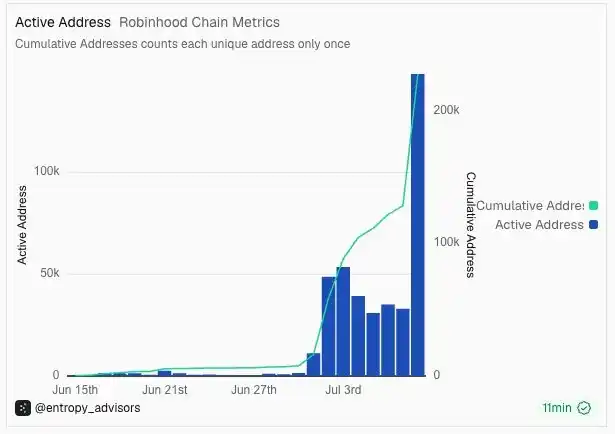
Robinhood Active Address Count. Data Source: Dune Analytics

CEO Makes a Complete 180-Degree Turn in Official Stance

The strategic shift began at the highest level of management. On the evening of July 7th, CEO Vlad Tenev posted on platform X: 'We built Robinhood Chain to be the best public chain for real-world assets (RWA)... But this chain is also great for memecoins.'

This statement overturned his view from just days earlier. On July 2nd, the day the mainnet launched, he stated in a CNBC interview that memecoins were largely a dead end. In his view, tokens lacking practical application value struggle to sustain long-term, and tokenized real-world assets represent a more sustainable path for the crypto industry.

When Robinhood formally launched the mainnet at its London keynote presentation 'Robinhood Presents: The World is Flat,' it consistently positioned the chain as infrastructure for tokenized stocks and various real-world assets; integrations with Uniswap, Chainlink, Alchemy, and BitGo were completed on launch day.

Pump.fun Channels a Large Number of Traders

On July 8th, the token launch platform Pump.fun, born in the Solana ecosystem, announced support for trading Robinhood Chain tokens, significantly lowering the barrier for traders to participate in the chain's Memecoins.

The platform's official account posted on platform X: 'You can now trade Robinhood Chain tokens on the Pump.fun app! No cross-chain bridge needed, seamless trading with SOL, the platform supports all popular Robinhood chain tokens.'

Pump.fun co-founder Alon Cohen stated that this update was merely an extension of the platform's existing multi-chain trading tools, not an independent new business line. He posted: 'Pump.fun is not just for launching platform-native tokens, it supports all cross-chain trading. You can trade Robinhood tokens now, zero fees via the Solana route.'

World Project Migrates Out of Solana Ecosystem

Robinhood Chain successfully lured project resources from the Solana ecosystem. The on-chain prediction market World launched on Solana on July 1st, usable directly within the Phantom wallet. Now, the project's official team has announced a full migration to this new public chain.

The project team announced on platform X on July 8th: 'World has decided to migrate from Solana to Robinhood Chain.' The team stated this strategic adjustment was made after careful evaluation over the past 24 hours and expressed gratitude to the Solana Foundation and community.

CASHCAT Ignites Memecoin Rally

The hottest token currently is CASHCAT, named after Robinhood's early stock trading-era mascot 'Cash Cat,' with the token trading on Uniswap V3 deployed on Robinhood Chain.

CoinGecko data shows that on July 8th, CASHCAT traded around $0.1373, marking a 24-hour surge of 1320%, with a market cap approaching $137 million and a 24-hour trading volume of approximately $194 million; the price fluctuated between $0.0089 and $0.1475 during the day.

User Base Expands Rapidly from Zero

Setting aside the Memecoin rally, on-chain monitoring data shows growth across all fronts of the ecosystem. Active addresses during the June testnet phase were nearly zero, but daily active addresses surged to tens of thousands in early July, with cumulative unique addresses nearing 200,000.

Decentralized exchange trading volume has performed impressively, with the single-day peak on July 7th approaching $400 million, with the vast majority of trades executed via Uniswap V3, V4, and PancakeSwap V3. Simultaneously, on-chain fees remain low, with Gas prices around 0.021 Gwei and an average transaction fee of just $0.005.
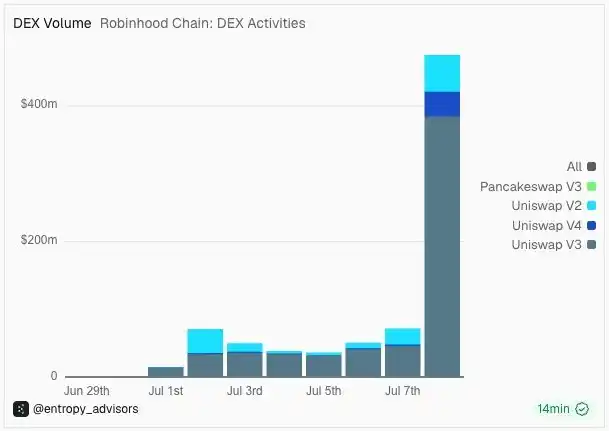
Robinhood Chain DEX Trading Volume. Data Source: Dune Analytics

Core Driver of TVL Surge is Ethena Stablecoin, Not Memecoins

Although market attention is focused on Memecoin speculation, the most critical factor driving the surge in Robinhood Chain's total value locked (TVL) was a deposit of stablecoin funds. Ethena injected approximately $50 million into the USDG pool managed by Steakhouse Financial within the lending protocol Morpho. Morpho is the underlying protocol for Robinhood's on-chain savings product, Robinhood Earn, which can offer an annualized yield of about 7% for USDG.

DefiLlama data shows this capital inflow directly propelled the protocol's TVL to a single-day increase of over 160%. Morpho hosts the vast majority of statistically trackable DeFi liquidity on the chain, with stablecoins (primarily USDG) constituting the bulk of on-chain asset value.
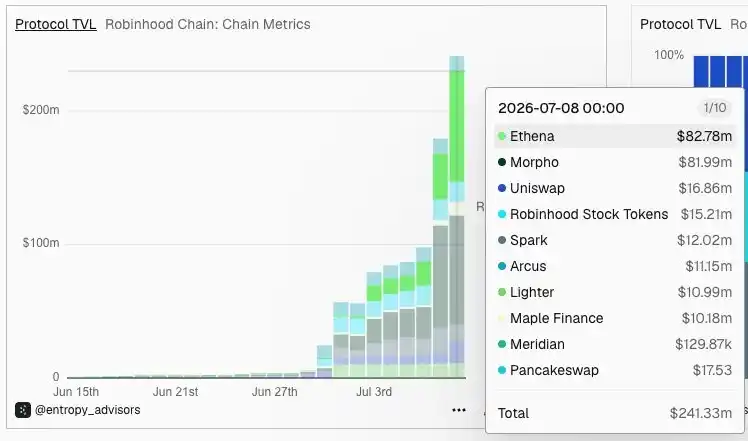
Robinhood Chain Total Value Locked. Data Source: Dune Analytics

The data reflects two parallel development paths for the public chain: institutional stablecoin capital and lending business solidify the underlying capital base; the retail Memecoin frenzy fueled by Pump.fun continues to drive up transaction counts and active users. Confusing the relationship between the two would severely overstate the contribution of Meme trading to the total value locked metric.

RWA Business Remains a Minimal Proportion

Despite Robinhood Chain's emphasis on the RWA narrative, the current scale of its tokenized real-world asset business is extremely low. The total value of tokenized assets like U.S. Treasuries, stocks, ETFs, and commodities is only about $12.8 million, far less than the TVL supported by stablecoins and lending funds.

The stock tokens launched by Robinhood are tokenized debt certificates that track the price of U.S. stocks and ETFs but do not grant holders shareholder voting rights. The products are available in over 120 countries globally and are not offered to users within the United States.

This gap summarizes the state of Robinhood Chain in its first week: speculative trading and stablecoin deposits seeking yield provide the initial liquidity and on-chain activity, while the chain's initially planned core sector—tokenized securities business—remains in a slow starting phase.


Трендові криптовалюти

Пов'язані питання

QWhat are the key factors driving the rapid increase in activity on Robinhood Chain within a week of its launch?

AThe key factors are the Meme coin trading frenzy, integration with the Pump.fun platform, and the migration of the World project from Solana. Additionally, a significant inflow of stablecoin capital into the Morpho lending protocol provided a major boost to Total Value Locked (TVL).

QHow did CEO Vlad Tenev's public stance on Meme coins change after the launch of Robinhood Chain?

AInitially, shortly after the mainnet launch on July 2nd, Vlad Tenev stated on CNBC that Meme coins were 'basically dead' and emphasized tokenized real-world assets (RWA) as a more sustainable path. However, by July 7th, he reversed this stance on X, declaring that Robinhood Chain was also 'really good for Meme coins.'

QWhat is the significance of the integration with Pump.fun for the Robinhood Chain ecosystem?

AThe integration with Pump.fun significantly lowered the barrier for traders to participate in Meme coin trading on Robinhood Chain. It allows users to trade Robinhood Chain tokens directly on Pump.fun without needing a cross-chain bridge, using SOL with zero transaction fees through Solana channels.

QAccording to the data, what is the primary driver behind the surge in Robinhood Chain's Total Value Locked (TVL), and why is this distinction important?

AThe primary driver of the TVL surge was a large stablecoin deposit, specifically around $50 million from Ethena into the USDG pool on the Morpho lending protocol. This is important because it highlights that the foundational capital and scale of the chain come from institutional stablecoin and lending activity, not from the more visible Meme coin trading frenzy, which would otherwise exaggerate the contribution of speculation to the TVL metric.

QWhat does the current data reveal about the state of Robinhood Chain's originally intended core business of Real World Assets (RWA) compared to its current activity?

AThe data shows that the tokenized real-world asset (RWA) business, such as tokenized US treasuries, stocks, and ETFs, is currently minimal, with a total value of only about $12.8 million. This is vastly overshadowed by the capital from stablecoin deposits and lending. The article concludes that while speculative trading and yield-seeking stablecoins are driving initial liquidity and activity, the chain's core RWA narrative is still in its very early stages.

Пов'язані матеріали

With Revenue 3.8 Billion Lower Than CXMT, Net Profit Is 8.6 Billion Higher: What Secrets Are Hidden in YMTC's IPO?

Chinese NAND flash giant Changcun Holdings has submitted its IPO prospectus to the Shanghai Stock Exchange. In Q1 2026, the company reported revenue of 47.042 billion yuan and a net profit attributable to parent company shareholders of 33.379 billion yuan. This presents a striking contrast with its competitor Changxin Technology, which had higher revenue (50.8 billion yuan) but a significantly lower net profit of 24.762 billion yuan. The key to this discrepancy lies in their ownership structures of core assets. Changcun Holdings fully owns its main operating entity, Yangtze Memory Technologies Co., Ltd., allowing nearly all group profits to flow to the parent company. In contrast, Changxin Technology controls but does not fully own its key production subsidiaries, meaning a substantial portion of its consolidated profits (approximately 8.25 billion yuan in Q1 2026) belongs to minority shareholders, reducing its reported net profit. Despite Changcun's higher net profit, its pre-IPO valuation is estimated lower than Changxin's. Analysts attribute this to differing market expectations: Changxin, focused on DRAM and the high-growth HBM market for AI servers, is seen as having greater long-term growth potential. Changcun, while dominant in NAND flash, operates in a market with inherent size constraints, making its future valuation more dependent on successfully upgrading its product mix toward higher-value segments like enterprise SSDs.

marsbit5 хв тому

With Revenue 3.8 Billion Lower Than CXMT, Net Profit Is 8.6 Billion Higher: What Secrets Are Hidden in YMTC's IPO?

marsbit5 хв тому

Perpetual Contract Liquidation Wave Resurges, Bitcoin $62k - $67k May Become the 'Disaster Zone'

A wave of liquidations has hit the crypto perpetual futures market, with analysts warning of continued volatility. Following Bitcoin's drop below $76,000 and subsequent rebound, over $84 million in long positions were liquidated in one hour, demonstrating the amplified impact of leverage. The U.S. CFTC's recent approval of a spot Bitcoin perpetual contract on the Kalshi exchange has opened this "previously closed" asset class to American institutions, with the platform reporting $5.5 billion in volume in its first two weeks. However, critics like Better Markets warn that perpetuals are "among the most dangerous crypto products" for retail investors due to a lack of enhanced protections. Recent price action saw a massive $529 million in hourly liquidations, predominantly longs. Analysts note that while a $3.3 billion short squeeze cleared liquidity above $80,000, a significant pool of long liquidations now sits between $62,000 and $67,000, posing a downside risk if key resistance holds. Experts caution new traders against using leverage or options, which can expire worthless, without proper experience and risk management. Despite the dangers, the demand for leveraged products persists, with some institutional players preferring on-chain platforms for their transparency and self-custody. As Kalshi expands its perpetual offerings beyond crypto, the core warning remains: leverage can lead to sudden, severe losses for unprepared investors.

marsbit6 хв тому

Perpetual Contract Liquidation Wave Resurges, Bitcoin $62k - $67k May Become the 'Disaster Zone'

marsbit6 хв тому

Japanese Interest Rates Return to 1996 Levels: Can Bitcoin's 'Decoupling Narrative' Withstand the September Rate Hike?

Japan's borrowing costs have hit their highest level since 1996, with 30-year and 10-year government bond yields rising significantly. This marks a major shift for a country long reliant on negative rates. Meanwhile, Bitcoin surged 22% in a week, topping $80,000. The core question is whether crypto's apparent decoupling from traditional market turbulence can withstand potential interest rate hikes by the Bank of Japan (BOJ) in September. For years, the yen carry trade—borrowing cheap yen to invest in higher-yielding assets—has fueled global risk assets. This leverage, estimated at up to $500 billion, relies on near-zero Japanese rates. The BOJ raised its policy rate to 1.0% in June, a 31-year high, with a further hike expected in September. A rapid yen appreciation could quickly wipe out carry trade profits and trigger deleveraging, as seen in August 2024 when Bitcoin and Japanese stocks fell sharply. Currently, however, the yen is weakening, which could temporarily support the carry trade and risk assets. Japan faces a debt dilemma. Its national debt has soared to a record ¥1,346 trillion. Raising rates could stabilize the yen but drastically increase debt servicing costs. The BOJ has signaled a slower pace of policy normalization to ensure market stability. Japan's large-scale selling of US Treasuries to fund currency intervention has also contributed to rising global yields. Bitcoin's recent resilience challenges traditional risk-asset logic. A pessimistic view holds that significant BOJ tightening and a stronger yen would force global deleveraging, pulling Bitcoin down. Higher yields also make interest-bearing assets relatively more attractive than Bitcoin. An optimistic scenario suggests that continued yen weakness could make Bitcoin an appealing hedge for Japanese investors. Japanese institutional interest is growing, with regulatory progress potentially paving the way for spot crypto ETFs by 2027. The key event is the BOJ's September 17-18 meeting. Market focus will be less on the expected rate hike to 1.25% and more on the future policy guidance. A hawkish signal aiming for higher rates could strengthen the yen and unwind carry trades. A dovish stance, constrained by debt concerns, could further weaken the yen, potentially benefiting Bitcoin via a weaker dollar and local demand. The current market prices in a slow evolution of Japan's debt issues. While Bitcoin may be trading on yen weakness and institutional adoption, the 30-year yield near 4% is a significant risk signal. The correlation between the yen's direction and Bitcoin remains crucial and could reverse swiftly if the BOJ alters market expectations in September.

marsbit11 хв тому

Japanese Interest Rates Return to 1996 Levels: Can Bitcoin's 'Decoupling Narrative' Withstand the September Rate Hike?

marsbit11 хв тому

Торгівля

Спот

Популярні статті

Як купити ONE

Ласкаво просимо до HTX.com! Ми зробили покупку Harmony (ONE) простою та зручною. Дотримуйтесь нашої покрокової інструкції, щоб розпочати свою криптовалютну подорож.Крок 1: Створіть обліковий запис на HTXВикористовуйте свою електронну пошту або номер телефону, щоб зареєструвати обліковий запис на HTX безплатно. Пройдіть безпроблемну реєстрацію й отримайте доступ до всіх функцій.ЗареєструватисьКрок 2: Перейдіть до розділу Купити крипту і виберіть спосіб оплатиКредитна/дебетова картка: використовуйте вашу картку Visa або Mastercard, щоб миттєво купити Harmony (ONE).Баланс: використовуйте кошти з балансу вашого рахунку HTX для безперешкодної торгівлі.Треті особи: ми додали популярні способи оплати, такі як Google Pay та Apple Pay, щоб підвищити зручність.P2P: Торгуйте безпосередньо з іншими користувачами на HTX.Позабіржова торгівля (OTC): ми пропонуємо індивідуальні послуги та конкурентні обмінні курси для трейдерів.Крок 3: Зберігайте свої Harmony (ONE)Після придбання Harmony (ONE) збережіть його у своєму обліковому записі на HTX. Крім того, ви можете відправити його в інше місце за допомогою блокчейн-переказу або використовувати його для торгівлі іншими криптовалютами.Крок 4: Торгівля Harmony (ONE)Легко торгуйте Harmony (ONE) на спотовому ринку HTX. Просто увійдіть до свого облікового запису, виберіть торгову пару, укладайте угоди та спостерігайте за ними в режимі реального часу. Ми пропонуємо зручний досвід як для початківців, так і для досвідчених трейдерів.

635 переглядів усьогоОпубліковано 2024.12.12Оновлено 2026.06.02

Як купити ONE

Обговорення

Ласкаво просимо до спільноти HTX. Тут ви можете бути в курсі останніх подій розвитку платформи та отримати доступ до професійної ринкової інформації. Нижче представлені думки користувачів щодо ціни ONE (ONE).

活动图片