Robinhood, the First Stock in the Predictive Market Concept

marsbitОпубліковано о 2026-06-16Востаннє оновлено о 2026-06-16

Анотація

The online brokerage Robinhood, which previously partnered with prediction market platform Kalshi to offer event contract trading to its users, is now becoming a direct competitor. This shift began after Robinhood, through a joint venture, acquired and rebranded a CFTC-regulated exchange (now Rothera Exchange). Robinhood's motivation stems from the rapid growth of prediction markets on its platform, which significantly boosted its "other transaction revenue." Recognizing that its vast retail user base is the most critical asset, Robinhood aims to capture more value by routing orders to its own exchange instead of sharing fees with Kalshi. It strategically launched its Rothera platform during the high-traffic 2026 FIFA World Cup, successfully processing tens of millions of contracts in its initial days. This move signals a pivotal power shift in the prediction market industry: control over user distribution and access is emerging as a more decisive advantage than the underlying market infrastructure itself. The future competition may increasingly revolve around which platforms control the major user gateways.

Author: Azuma, Odaily Planet Daily

The battle of the World Cup has begun, and the total trading volume of the predictive market continues to hit new highs. However, as the industry leader, Kalshi might not be in the best mood right now.

The reason is not due to fluctuations in Kalshi's own business data, but because Kalshi now "suddenly" faces another formidable rival besides Polymarket, and this opponent was once its most important ally.
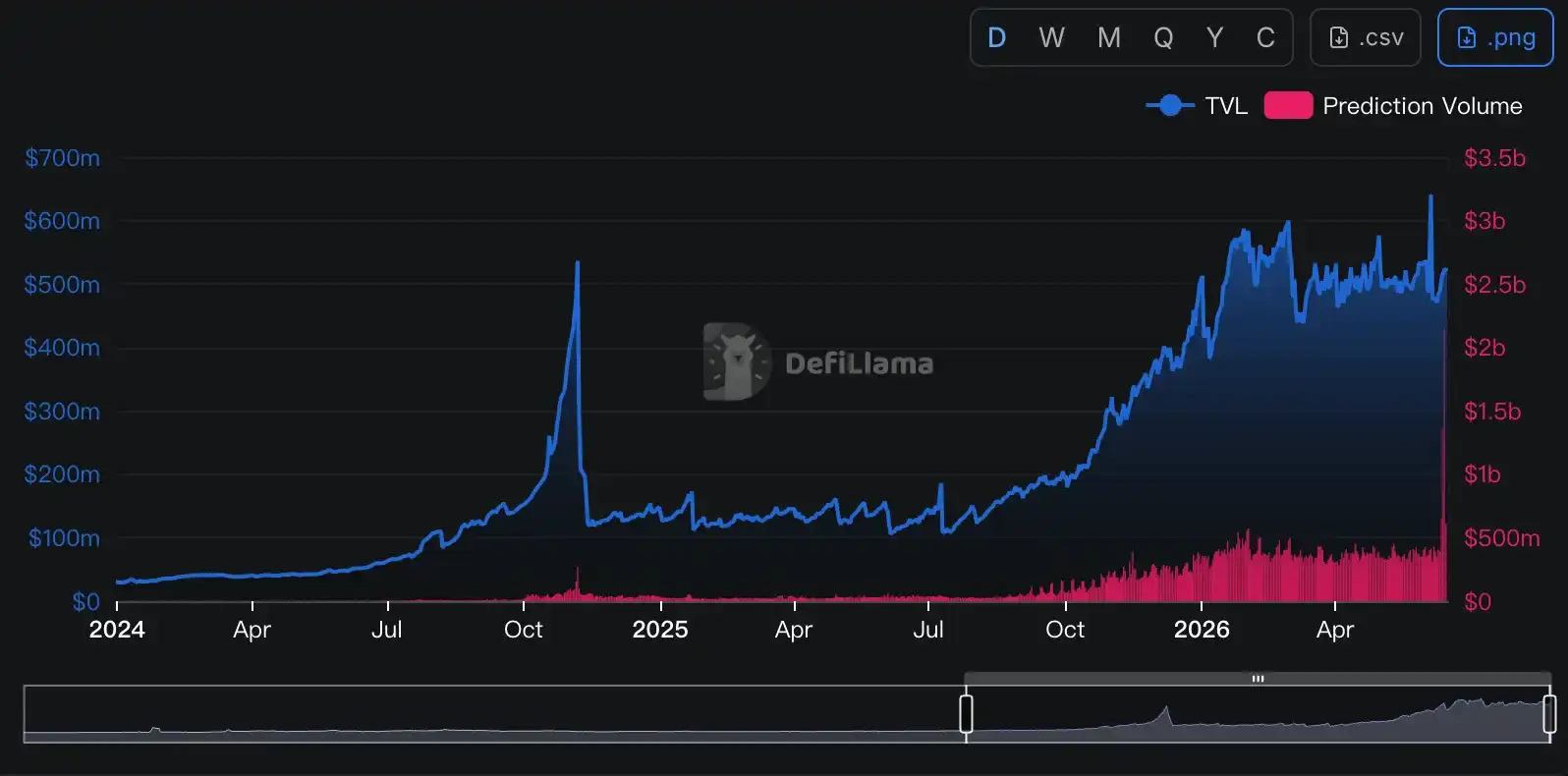
  • Odaily Note: Data sourced from Defillama.

Kalshi's Most Important Traffic Channel — Robinhood

Rewind to March 2025. At that time, Kalshi announced a partnership with the US online broker Robinhood, where the latter would use Kalshi's services to offer its users predictive market trading, allowing them to place bets on events like politics, economics, and sports.

From a business model perspective, this was a typical case of "mutual benefit" — Robinhood, responsible for user access and transaction distribution, could directly use Kalshi's mature product; Kalshi, responsible for the underlying market, matching, clearing, and regulatory compliance systems, could reach Robinhood's massive retail user pool.

The subsequent story proved the "win-win" outcome of this partnership. Through Robinhood's channel distribution, Kalshi indirectly gained massive users and transaction volume. Piper Sandler analysts once estimated that "trading volume completed through Robinhood's channel accounted for about 25%-35% of Kalshi's total trading volume." These orders ultimately translated into revenue for both parties — Robinhood would independently charge for all Kalshi event contracts traded through its channel, a fixed fee of $0.01 per contract per direction, and then share the revenue with Kalshi (the specific proportion was not disclosed).
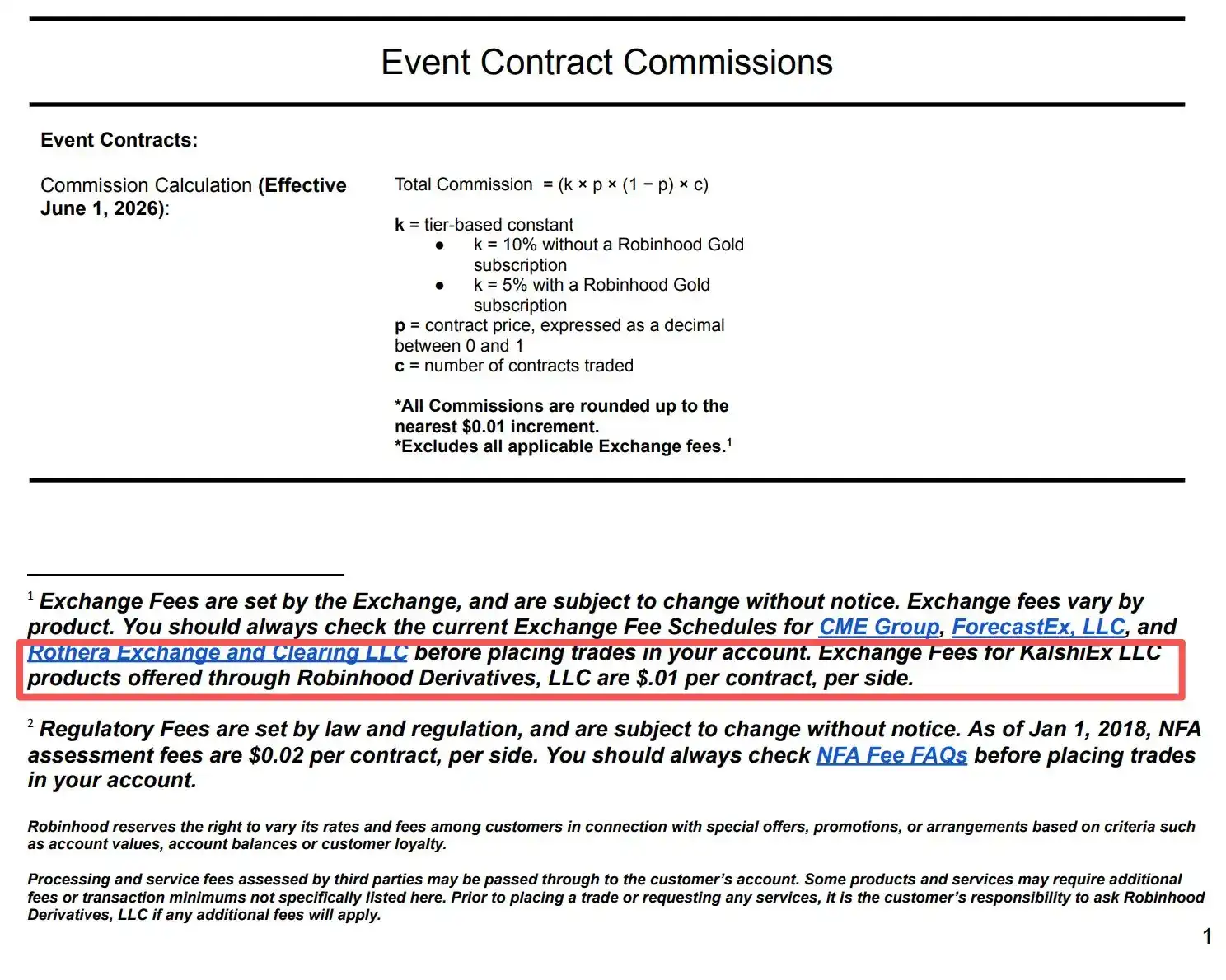
The Q1 financial report disclosed at the end of April showed that Robinhood facilitated the trading of 8.8 billion event contracts in Q1, driving "other trading revenue" to grow by 320% year-on-year, reaching $147 million. The predictive market has become the brightest new growth engine in Robinhood's product line.

However, recently, this relationship has undergone some subtle changes.

Robinhood's Ambition: Taking Back the Cake Shared with Kalshi

As internet history has proven countless times, when a channel gains enough leverage, it is no longer content with being just a channel. Robinhood is no exception.

Although the partnership with Kalshi also brought substantial revenue to Robinhood, as the predictive market became one of the fastest-growing new businesses on the platform, Robinhood was no longer satisfied with the current revenue-sharing arrangement.

In their cooperation model, Kalshi was responsible for providing the market and infrastructure, while Robinhood was responsible for providing users and order flow. However, as the partnership deepened, Robinhood gradually realized that what is truly scarce might not be the market itself, but the user access it firmly controls. After all, for most Robinhood users, they don't care whether their orders are ultimately executed on Kalshi or another platform — users only see a trading entry within the Robinhood app, not the underlying infrastructure provider.

In other words, Robinhood always held one of the most critical resources for the predictive market — distribution power. If the users belong to Robinhood, why should the order flow go to someone else?

In fact, just as Robinhood was quickly validating the demand for predictive markets through Kalshi, a Plan B was quietly launched shortly thereafter.

In November 2025, Robinhood announced the formation of a joint venture with Wall Street quantitative trading giant Susquehanna and planned to acquire the CFTC-regulated derivatives exchange MIAXdx. According to the official statement, this joint venture would operate an independent futures and derivatives exchange and clearing organization in the future, with predictive markets being one of its key focus areas. At the time, the outside world largely viewed it as an infrastructure investment. However, as more information was disclosed later, people gradually realized Robinhood's goal was far beyond just finding a new partner for predictive markets.

In January 2026, the transaction was completed. Robinhood and Susquehanna gained 90% control of MIAXdx, simultaneously acquiring a complete CFTC regulatory framework, including Designated Contract Market (DCM) and Derivatives Clearing Organization (DCO) licenses. Subsequently, MIAXdx was renamed Rothera Exchange, and its clearing organization was renamed Rothera Clearing.

At this point, Robinhood possessed the core elements needed to independently operate a predictive market, lacking only a mature product comparable to Kalshi. However, for Robinhood, with its rich experience in internet product development, this was evidently not a difficult task.

Rothera's Opportunity: The World Cup

In June 2026, after about half a year of accelerated development, the Rothera product gradually took shape, and Robinhood finally made the move that was almost destined to happen — gradually shifting the orders that originally flowed to Kalshi into its own controlled system.

Robinhood specifically chose an ideal launch battleground for Rothera — the World Cup. For predictive markets, the World Cup is undoubtedly one of the most high-traffic trading themes. Whether it's match outcomes, advancement results, or champion predictions, related markets can attract a large number of new users to trade in a short period. For the newly launched Rothera platform, there is no better scenario for a cold start than the World Cup.

According to Robinhood's official disclosure, during this World Cup with a total of 104 matches, some event contracts will be directed to Rothera for matching and clearing, including markets for single World Cup match results, the ultimate World Cup champion, total goals in a single match, and others. Compared to the previous model that relied entirely on Kalshi, this marks the first time Robinhood has introduced predictive market orders into its own trading system on a large scale.
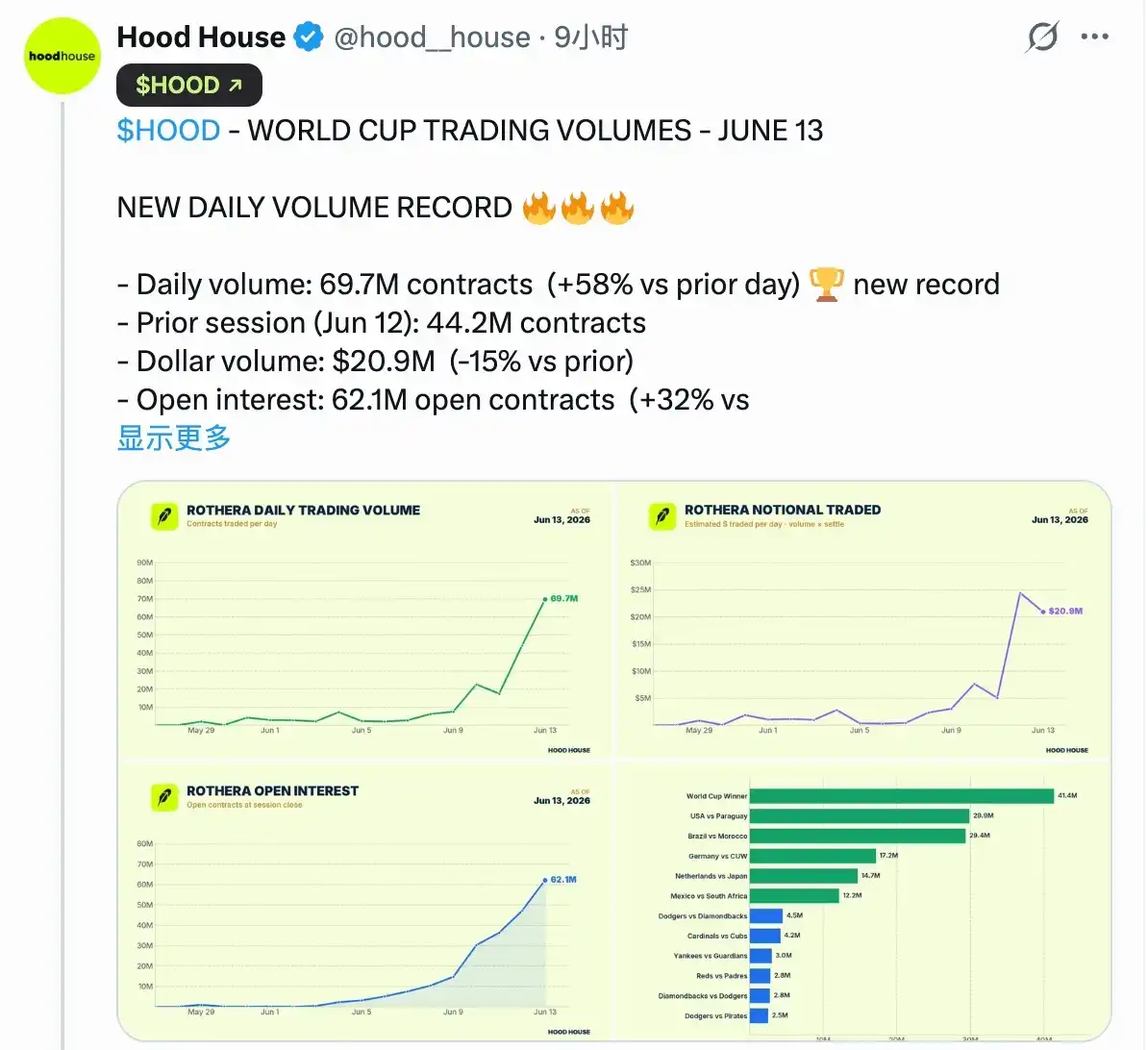
Judging by the results, Rothera clearly seized this opportunity. According to data disclosed by Hood House, an investment research media tracking Robinhood's activities, on June 12, Rothera completed 44.2 million contract trades, corresponding to a dollar trading volume of approximately $24.4 million; on June 13, Rothera completed 69.7 million contract trades, corresponding to a dollar trading volume of approximately $20.9 million... Although these figures still lag behind Kalshi's popular markets, which often involve hundreds of millions of dollars, considering that Rothera has literally just launched a few days ago, this performance is sufficiently successful.

For both Robinhood and Kalshi, this signifies that the balance of their cooperation has begun to tilt. From Robinhood's perspective, the transaction fee revenue that previously had to be shared with Kalshi can now be kept more within its own ecosystem. From Kalshi's perspective, this means that one of its most important growth engines has begun to show signs of weakening.

And the World Cup is clearly just the beginning of Rothera's encroachment on Kalshi. Looking further into the future, Robinhood will inevitably expand Rothera's coverage to more sporting events, as well as economic and political themes. Those orders that originally flowed to Kalshi will be intercepted one by one by Rothera.

Since Robinhood and Kalshi have never publicly disclosed their revenue-sharing ratio (some reports say 50%:50%, but no official information is available), we cannot know the exact monetary value of this interception. However, considering that Robinhood alone generated $147 million in predictive market-related revenue in Q1, and the Q2 World Cup and the more distant mid-term elections will likely bring even larger-scale trading activities, calculated on an annual basis, the value of this interception could reach several billion dollars.

Who Controls Distribution, Controls Everything

The drama of Robinhood and Kalshi moving from allies to opponents once again illustrates a logic repeatedly proven in the internet market — products are easy to build, but traffic is hard to find; whoever controls distribution controls everything.

Over the past few years, the market generally believed that Kalshi's core moat came from regulatory licenses, exchange qualifications, and clearing capabilities. Therefore, whether it was brokers like Robinhood or various media, communities, and traffic platforms, they were essentially just Kalshi's channel partners and traffic inlets. However, the emergence of Rothera proves one thing: in today's landscape of severe product homogenization, the product itself might not be the most critical element. What is truly scarce is always the user.

Where the users are, the liquidity is; where the liquidity is, the market will be. When Robinhood controls the access to tens of millions of retail users, it has the full capability to direct these users to any trading venue. For users, they don't care whether their orders are ultimately executed on Kalshi or Rothera. As long as the experience doesn't significantly differ, it doesn't matter who is matching or clearing behind the scenes.

If the theme of the predictive market industry in the past few years was the market battle between Polymarket and Kalshi, then the theme for the coming years might become a channel war. Robinhood incubating Rothera is essentially a reverse integration initiated by the channel side towards the market layer. As more and more platforms with traffic inlets begin to realize the strategic value of predictive markets, similar stories are highly likely to continue occurring. Whether it's exchanges, brokers, social platforms, or media platforms, they could all become new predictive market entry points.

And when inlets start to control the market, and channels begin to have pricing power, the ultimate winner in the predictive market industry might no longer be the platform responsible for order matching, but the one closest to the user and most capable of controlling distribution.

This was true in the internet era and the mobile internet era. This time, there's no exception either.


Пов'язані питання

QAccording to the article, why did Robinhood partner with Kalshi initially?

ARobinhood partnered with Kalshi in March 2025 to leverage Kalshi's established product and regulatory infrastructure to offer prediction market trading services to its users. This allowed Robinhood to enter the prediction market quickly while Kalshi gained access to Robinhood's large retail user base.

QWhat is the core reason Robinhood decided to develop its own prediction market platform, Rothera Exchange?

AThe core reason is that Robinhood realized it controlled the most critical resource: the user distribution channel. Since users only interacted through the Robinhood app and didn't care about the backend infrastructure, Robinhood saw an opportunity to capture more revenue by diverting orders from Kalshi to its own controlled platform, thereby keeping more of the transaction fees.

QWhat event did Robinhood choose to launch Rothera Exchange, and why was it strategic?

ARobinhood strategically chose the 2026 FIFA World Cup to launch Rothera Exchange. The World Cup is a major event that generates high trading volume and attracts many new users to prediction markets, making it an ideal scenario for the platform's initial growth and market penetration.

QHow significant was the volume of prediction market trades for Robinhood in Q1 of 2026 according to the article?

AAccording to the article, Robinhood's Q1 2026 earnings report showed it facilitated 8.8 billion event contracts, driving a 320% year-over-year growth in 'other transaction revenue' to $147 million. This made prediction markets the fastest-growing new business line for Robinhood at the time.

QWhat broader industry shift does the article suggest is occurring with the rise of Rothera and similar moves by other platforms?

AThe article suggests the industry is shifting from a market-centric competition (like between Polymarket and Kalshi) to a 'channel war' or 'distribution war.' Platforms with large user bases and distribution power (like Robinhood, brokerages, social media) are recognizing the value of prediction markets and may integrate or build their own, challenging the dominance of pure infrastructure providers.

Пов'язані матеріали

Ethereum Reaches the Milestone of One Million Developers, Sharplink CEO Delves Deep into Ethereum's Future Possibilities

Ethereum Surpasses One Million Developers Milestone: A Look at Its Unshakeable Dominance and Future Joseph Chalom, CEO of Sharplink, reflects on his recent Asia trip where he engaged deeply with Ethereum developers and ecosystem leaders. The most striking takeaway was not just the industry's vibrancy, but the rigorous, long-term vision of local builders. This context brings to life a pivotal statistic: Ethereum has now surpassed one million cumulative developers (1,012,824), with approximately 232,000 remaining active in the past year—a talent pool unmatched by any other crypto ecosystem. The critical question isn't which blockchain is fastest, but where top developers choose to build long-term. Ethereum's answer is unequivocal. Its decade-long lead stems from a unique convergence of technology, institutional culture, economic systems, and composability, cementing its role as the foundational operating system for programmable finance. This massive developer base is tackling the industry's hardest problems, continuously strengthening Ethereum's moat. Key initiatives include: * **The Glamsterdam Upgrade (planned 2026):** Introducing ePBS and Block-level Access Lists for parallel execution and higher throughput while preserving core values like credible neutrality and fair MEV distribution. * **Synchronous Composability:** Projects are working to enable atomic transactions across dozens of Rollups, making them function as one unified chain and eliminating ecosystem fragmentation. * **Post-Quantum Security:** Ethereum is far ahead in preparing for quantum computing threats, with a dedicated foundation working group and testnets targeting a full migration by ~2029—a crucial factor for institutional adoption. Beyond developers, Ethereum's core network effects are its unparalleled composability and unified standards (like EVM and Solidity), which create a powerful flywheel: more developers → better tools → greater liquidity → more institutional participation. Its other decisive advantages include credible neutrality (over 900k validators), a secure modular architecture with interconnected Rollups, and a deeply entrenched culture shaped by top-tier researchers. Ultimately, there's a vast difference between generating short-term activity and becoming the trusted, long-term coordination layer for global native finance. Major institutions prioritize security, trust, and liquidity—areas where Ethereum holds dominant mindshare. The industry's trajectory shows resources consolidating around unified standards, deep liquidity, and developer consensus. After meeting the builders in Seoul and Hong Kong, Chalom is more convinced than ever: Ethereum's unshakeable future is being built right now.

Foresight News11 хв тому

Ethereum Reaches the Milestone of One Million Developers, Sharplink CEO Delves Deep into Ethereum's Future Possibilities

Foresight News11 хв тому

Saylor's Latest Long Read: Bitcoin is Not Money, It's Digital Capital, and Money is Built Upon It

Michael Saylor presents his "Digital Asset Stack" theory, positioning Bitcoin as the foundational layer of digital capital. He argues Bitcoin itself should remain unchanged—no staking, inflation, or protocol alterations. Instead, a five-layer financial architecture should be built atop it: Digital Capital (BTC), Digital Credit (e.g., yield instruments like STRC), Digital Currency (stable, yield-bearing instruments pegged to fiat), Digital Yield (leveraged/structured products), and Digital Equity (e.g., MSTR stock, absorbing residual volatility). Saylor asserts this stack transforms Bitcoin's high-volatility, high-energy capital into tailored products: stable currencies for payments/savings, yield instruments for income seekers, and equity for growth investors. This approach meets diverse needs—corporate treasuries, banks, retirees, emerging market users—without compromising Bitcoin's core properties (scarcity, decentralization). The "killer use case" is rebuilding global money, credit, and capital markets on Bitcoin, bridging the fiat world with a superior digital asset foundation. The system leverages traditional finance principles (risk layering, structured products) while using Bitcoin as the ultimate collateral. This expands Bitcoin's utility, drives adoption, and offers a better monetary experience: digital, yield-bearing, stable-value tools for everyday use.

marsbit24 хв тому

Saylor's Latest Long Read: Bitcoin is Not Money, It's Digital Capital, and Money is Built Upon It

marsbit24 хв тому

Can SK Hynix's Stock Double Again in This Rally?

The article discusses the highly optimistic price target of approximately $3,500 for SK Hynix stock, set by Aletheia Capital. This target is significantly above the consensus range of $2,000-$2,520 from major brokerages. The core debate is whether SK Hynix deserves a fundamental re-rating beyond its traditional cyclical discount, based on the long-term impact of AI-driven demand. The $3,500 target hinges on three key assumptions holding simultaneously until at least 2027: 1) Continued shortage and high pricing for HBM (High Bandwidth Memory), a critical component for AI chips; 2) Sustained high prices for standard DRAM, as HBM production consumes capacity and constrains general supply; and 3) Strong AI server demand generating substantial, above-expectation free cash flow. SK Hynix's leading ~58% market share in HBM and its early certification with key clients like Nvidia provide a competitive advantage, allowing it to capture significant supply chain premiums. The HBM shortage is seen not just as a niche growth driver but as a catalyst that amplifies profitability across the entire memory business by tightening overall DRAM supply. However, the article cautions that this target represents an optimistic "tail scenario." Key risks include potential supply increases from competitors (Samsung, Micron) by 2027, a possible slowdown in HBM price growth, and high capital expenditures that could erode the projected free cash flow. The divergence in analyst targets reflects the market's uncertainty over whether the current AI-driven boom will temporarily elevate earnings or permanently raise the memory industry's profit baseline.

marsbit27 хв тому

Can SK Hynix's Stock Double Again in This Rally?

marsbit27 хв тому

Has the Cryptocurrency Market Hit Bottom? Here's What Institutions Think

"Has the crypto market bottomed out? Major institutions are divided on the outlook, according to a recent analysis by Matt Hougan, Chief Investment Officer of Bitwise. Three prominent research firms published in-depth reports on the topic with differing conclusions. Galaxy Digital argues Bitcoin has not yet found its bottom, pointing to only 4 out of 13 historical bottoming indicators being met. Their analysis suggests a potential bottom range of $30,000 to $54,000. NYDIG adopts a more cautious stance, noting that while metrics are close to historical bear market lows, a classic panic-selling capitulation event is missing. They acknowledge the possibility of a bottom but consider it unlikely, citing structural changes from institutional adoption. In contrast, Standard Chartered Bank asserts the bottom is already in at around $59,000. Their revised bullish view, predicting a year-end target of $100,000, hinges on anticipated reductions in ETF selling pressure linked to events like a potential SpaceX IPO. Despite the surface-level disagreement on the exact price floor, the reports share significant common ground crucial for long-term investors. All three institutions agree that a market bottom will likely form within the current year, that current prices are closer to the bottom than to previous cycle highs, and that Bitcoin is poised for another major bull cycle in the future. The core takeaway is that while the precise bottom level remains debated, the long-term value proposition for Bitcoin remains strong and may even be strengthening. Key supportive trends include rising global debt, persistent inflation, declining trust in traditional institutions, accelerating digitization, and improving market infrastructure. Therefore, for investors with a long-term horizon, the focus should shift from pinpointing the exact bottom to recognizing that the cycle's peak is likely still ahead, making current levels an attractive entry point for substantial potential upside."

Foresight News48 хв тому

Has the Cryptocurrency Market Hit Bottom? Here's What Institutions Think

Foresight News48 хв тому

Торгівля

Спот
Ф'ючерси

Популярні статті

Як купити T

Ласкаво просимо до HTX.com! Ми зробили покупку Threshold Network Token (T) простою та зручною. Дотримуйтесь нашої покрокової інструкції, щоб розпочати свою криптовалютну подорож.Крок 1: Створіть обліковий запис на HTXВикористовуйте свою електронну пошту або номер телефону, щоб зареєструвати обліковий запис на HTX безплатно. Пройдіть безпроблемну реєстрацію й отримайте доступ до всіх функцій.ЗареєструватисьКрок 2: Перейдіть до розділу Купити крипту і виберіть спосіб оплатиКредитна/дебетова картка: використовуйте вашу картку Visa або Mastercard, щоб миттєво купити Threshold Network Token (T).Баланс: використовуйте кошти з балансу вашого рахунку HTX для безперешкодної торгівлі.Треті особи: ми додали популярні способи оплати, такі як Google Pay та Apple Pay, щоб підвищити зручність.P2P: Торгуйте безпосередньо з іншими користувачами на HTX.Позабіржова торгівля (OTC): ми пропонуємо індивідуальні послуги та конкурентні обмінні курси для трейдерів.Крок 3: Зберігайте свої Threshold Network Token (T)Після придбання Threshold Network Token (T) збережіть його у своєму обліковому записі на HTX. Крім того, ви можете відправити його в інше місце за допомогою блокчейн-переказу або використовувати його для торгівлі іншими криптовалютами.Крок 4: Торгівля Threshold Network Token (T)Легко торгуйте Threshold Network Token (T) на спотовому ринку HTX. Просто увійдіть до свого облікового запису, виберіть торгову пару, укладайте угоди та спостерігайте за ними в режимі реального часу. Ми пропонуємо зручний досвід як для початківців, так і для досвідчених трейдерів.

455 переглядів усьогоОпубліковано 2024.12.10Оновлено 2026.06.02

Як купити T

Обговорення

Ласкаво просимо до спільноти HTX. Тут ви можете бути в курсі останніх подій розвитку платформи та отримати доступ до професійної ринкової інформації. Нижче представлені думки користувачів щодо ціни T (T).

活动图片