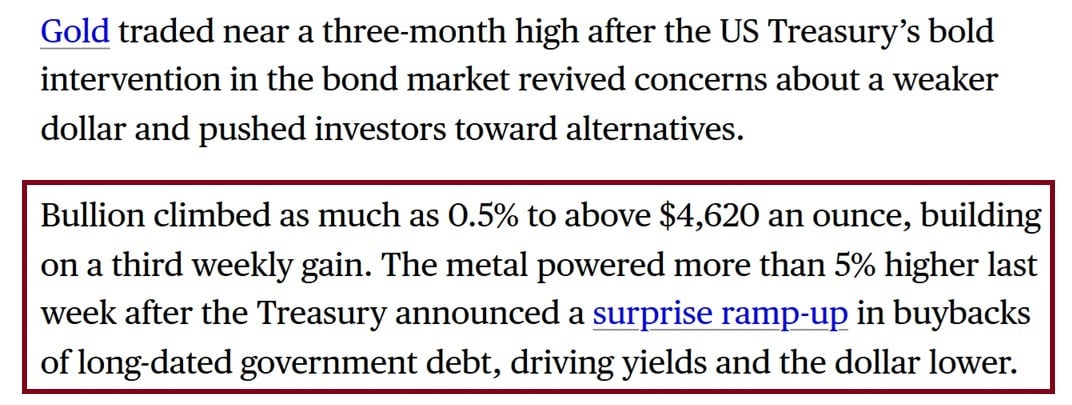
Analysts at Bloomberg noted that gold rose to a three-month high above $4,620 per ounce as Treasury Department intervention in the bond market revived concerns about dollar weakness. Throughout the week, spot gold traded in the range of $4,580 to $4,600, while futures broke towards the $4,650 mark.
Saxo Bank's Commodity Strategist Ole Hansen stated that gold "continues its confident climb, adding 1.8% for the day and 5.1% for the week," calling the break above the 200-day moving average a technical trigger for new purchases in an uptrend and identifying a level above $4,770 as the next resistance mark.
Some traders view a breakout above this level as confirmation that the rally has potential for further gains and talk about a price of $5,000 per ounce if the dollar continues to fall. This rise has been more significant than most analysts expected, and in its June-published semi-annual forecast, the World Gold Council considered reaching the $4,500 mark as an optimistic scenario requiring a "strong and clear signal" from policymakers.
The Treasury Department's buyback decision appears to have been that signal, as gold is now trading significantly above the level the Council outlined as the optimistic scenario for 2026.
Treasury's Buyback Bet – The Reason for the Rise
The catalyst was the U.S. Treasury Department's announcement on August 19th that it would double the volume of long-term bond buyback operations from September 9th to November 4th. This announcement came just days after the yield on 30-year Treasury bonds surged to a 19-year high of 5.337% – a sell-off that rattled the bond markets and spurred officials into action.
The buyback plan lowered yields to 5.198% but hit the dollar: the dollar index fell to 98.723 – its lowest level since May 14th. Analysts, including ING's Global Markets Head Chris Turner and Capital Economics economist Ariane Curtis, pointed to the expansion of the buyback program as the trigger, noting that this move effectively reorients government borrowing towards short-term bills (a compromise that markets view as negative for the dollar, even though it stabilizes long-term debt).
The buyback of its own bonds allows the Treasury to retire old, less liquid bonds, purchasing them with proceeds from the sale of new bonds – a tool it has repeatedly used this year to prevent a spiral in long-term borrowing costs after a yield spike shook auctions.
Robert Kiyosaki, author of "Rich Dad Poor Dad," went even further, calling the expansion of the bond buyback program a form of quantitative easing and urging his followers to invest in Bitcoin, gold, silver, and select real estate assets. This comparison is not entirely accurate, given that the Treasury finances the buyback of its own bonds from debt issuance proceeds, not by injecting new central bank money, unlike true quantitative easing. Nonetheless, the market's reaction to the dollar this week looked practically the same in both cases.
Bitcoin "Picks Up" the Same Devaluation Trend
As reported by Bitcoin.com News, when the Treasury Department's buyback program expansion first hit the markets, Bitcoin jumped about 20% in the days after the announcement, continuing a recovery that has become closely linked to the same narrative of dollar weakness driving gold prices. Economist Mohamed El-Erian noted that Bitcoin's rise to the $79,000 mark alongside gold's price rise above $4,600 were stark examples of the same trade succeeding, but not everyone seems convinced that Bitcoin should be in that basket.
Robin Brooks, former chief currency strategist at Goldman Sachs who first popularized the "devaluation trade" theory, stated that he "would stay away from Bitcoin," arguing that markets do not perceive it the same way as gold and silver.
end-content