Valuation $1 Billion, Nvidia Doubles Down! Is Prime Intellect Washing Off Its Web3 Label?

Foresight NewsОпубліковано о 2026-07-13Востаннє оновлено о 2026-07-13

Анотація

Prime Intellect, a decentralized AI infrastructure company founded in 2024, recently announced a $130 million Series A funding round at a $1 billion valuation, with investments from NVIDIA, Intel, and Dell's venture arms. The company claims its annualized recurring revenue (ARR) has exceeded $100 million within a year, serving over 6,000 enterprise clients. Initially rooted in Web3 and decentralized science (DeSci), Prime Intellect has evolved into a full-stack AI training and deployment platform. Its core technology enables distributed training of large language models across globally dispersed, heterogeneous GPU clusters. Key milestones include releasing open-source models like INTELLECT-1 and INTELLECT-3, and launching Prime Intellect Lab, a platform allowing users to train and optimize agentic models without managing their own GPU infrastructure. The company's deep collaboration with hardware giants, particularly NVIDIA, extends beyond investment to joint optimization of software (e.g., integrating NVIDIA Dynamo) and hardware systems. A notable commercial case involves fintech company Ramp using Prime Lab to train a specialized agent, demonstrating the platform's applied value. While achieving rapid commercial growth, Prime Intellect has systematically downplayed its earlier Web3 and token-based incentives from its official documentation, repositioning itself as a mainstream AI infrastructure provider focused on enterprise adoption and potential IPO.


Written by: KarenZ, Foresight News


An AI infrastructure company founded just over two years ago, on one hand announces support from investment arms of Nvidia, Intel, and Dell, and on the other claims its annualized revenue has already exceeded $100 million—these two figures combined are enough to make Prime Intellect one of the most noteworthy AI projects to re-examine recently.


July 8, 2026, the decentralized AI infrastructure network Prime Intellect announced the completion of a $130 million Series A funding round at a $1 billion valuation, led by AI-focused venture capital firm Radical Ventures, with rare joint participation from investment arms of Nvidia, Intel, and Dell, bringing its total funding raised to over $150 million.


While disclosing the massive funding, Prime Intellect officially announced that in less than a year, its annualized revenue (ARR) has rapidly jumped to over $100 million, and the platform serves more than 6,000 enterprise and startup clients.


What's the Background?


As mentioned in "OpenAI Founding Member Steps In! Quick Read on Decentralized AI Dark Horse Project Prime Intellect" in March 2025, Prime Intellect was founded in January 2024 by co-founders Vincent Weisser and Johannes Hagemann.


  • CEO Vincent Weisser was previously long involved in the intersection of decentralized science (DeSci) and AI, having co-initiated projects like Bio Protocol, VitaDAO, and CryoDAO, and served as the Ecosystem and AI Lead at the DeSci platform Molecule.
  • CTO Johannes Hagemann focused on distributed AI and semi-automated engineering, brain-computer interfaces, and previously worked as an AI Research Engineer at the German AI company Aleph Alpha.


Additionally, in October 2025, venture capitalist Ash Arora joined Prime Intellect as Head of Applied Go-to-Market (Applied GTM), responsible for product strategy, commercialization, revenue, and applied AI products in post-training processing and reinforcement learning. Ash Arora recently pointed out that Prime Intellect's full-time team size has now reached 40 people.


In terms of funding, Prime Intellect has raised over $150 million cumulatively. A $5.5 million seed round in April 2024 was co-led by Distributed Global and CoinFund, with angel investors including Hugging Face CEO Clem Delangue.


Less than a year later, in March 2025, Prime Intellect completed another $15 million funding round led by Peter Thiel's Founders Fund, with investors including OpenAI founding member and former Tesla AI Director Andrej Karpathy, Together.AI Chief Scientist Tri Dao, Stability AI co-founder Emad Mostaque, and other heavyweight figures in the AI field.


The latest round is different in nature. In the $130 million Series A round, NVIDIA Ventures, Intel Capital, and Dell Technologies Capital are not just financial investors; their parent companies hold key positions in GPU, CPU, server, and data center infrastructure respectively.
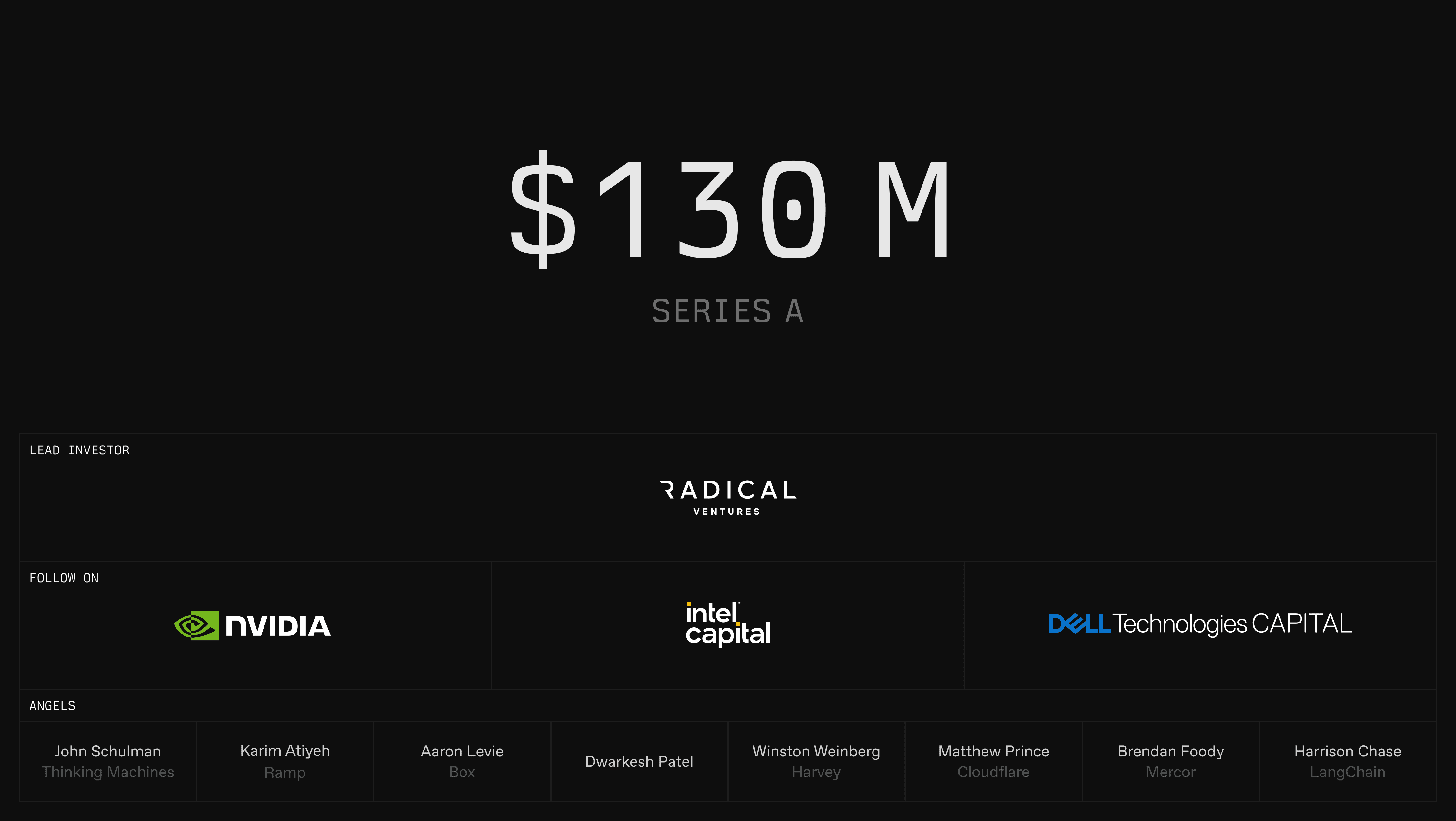


Intel Capital's explanation of this investment also indicates: The reason hardware giants are buying in is that Prime Intellect is attempting to bring underlying computation, training environments, evaluation, reinforcement learning post-training, and upstream inference together on a unified control plane.


What Are the Substantive Developments?


An early notable achievement of Prime Intellect was proving that long-distance, heterogeneous GPUs could also collaborate on training. Following its technical iterations over the past two years, one can see how the platform gradually transformed research experiments into commercial product lines.


In late November 2024, Prime Intellect released the 10-billion parameter model INTELLECT-1, with training nodes spanning five countries and three continents. The company claimed it achieved an overall compute utilization of 83% across continents at that time, and when training using only nodes distributed across the United States, compute utilization reached 96%.


Less than half a year later, Prime Intellect released INTELLECT-2, advancing the goal to globally distributed reinforcement learning with 32 billion parameters. To achieve this, the team developed the asynchronous reinforcement learning framework PRIME-RL, SHARDCAST for propagating model weights, and TOPLOC to verify if inference nodes are "working honestly."


A more critical change occurred with INTELLECT-3. In November 2025, Prime Intellect released a 106-billion parameter MoE model based on Zhipu GLM-4.5-Air, fine-tuned with supervision and reinforcement learning. The model was trained for about two months on 64 nodes with 512 NVIDIA H200 GPUs; model weights, training framework, data, RL environments, and evaluation methods were all open-sourced. The significance here is not just releasing another model, but the company validated an entire production system with its own research project: PRIME-RL handles asynchronous training, Verifiers and Environments Hub provide unified tools and a community ecosystem to build and host RL environments and evaluations, Prime Sandboxes isolate execution of agent-generated code, and the compute orchestration layer manages clusters, storage, and monitoring.


In February of this year, Prime Intellect launched a full-stack AI training platform called Prime Intellect Lab, specifically designed to help individuals, engineers, and AI companies train and optimize their own models (especially agentic models) without needing to build expensive GPU clusters themselves. On May 7th, Lab ended its beta and officially opened fully.


In June, Prime Intellect released prime-rl version 0.6.0, claiming to push the engineering limit to trillion-parameter scale MoE (Mixture of Experts) models. Prime Intellect disclosed that on GLM-5 series software engineering tasks, it could process sequences up to 131,000 tokens using 28 H200 nodes, with single-step training time under 5 minutes.


The key behind this is not a single algorithm, but the joint optimization of training and inference systems: the inference side uses FP8 low-precision computation and components like DeepEP and DeepGEMM to increase throughput; pre-filling and decoding are separated to avoid long tool outputs slowing down generation; KV Cache hierarchical offloading improves concurrency. The training side also adopts block-scaled FP8 and reduces routing discrepancies between MoE model training and inference via Router Replay, combined with FSDP, expert parallelism, and context parallelism. These optimizations ultimately impact GPU utilization, training time, and customer costs.


In July this year, prime-rl added a unified algorithm layer, built-in with six types of training methods: GRPO, MaxRL, On-Policy Distillation, self-distillation, SFT Distillation, and ECHO, and allows selecting different algorithms for different environments within the same training run. Simply put, the same agent can use one learning method for math tasks and another for terminal operation tasks without rewriting the underlying trainer. This moves Prime Intellect from "running training for clients" closer to a scalable RL operating system.


Hardware-Software Synergy: Nvidia is More Than Just an Investor


Looking at the Series A investor lineup, the binding between hardware giants and Prime Intellect goes beyond capital, extending deep into hardware-software architecture co-construction.


The collaboration between Prime Intellect and Nvidia spans both hardware and software layers. On the hardware side, its training and serving workloads already use NVIDIA Blackwell, Blackwell Ultra, and NVL72 rack-scale systems, which the company claims are more efficient than previous Hopper clusters.


On the software side, NVIDIA Dynamo is used for global inference orchestration, auto-scaling, request routing, and KV Cache offloading, and is integrated with Prime Intellect's large-scale LoRA (Low-Rank Adaptation, a fine-tuning technique for large language models) deployments.


Nvidia's own technical blog also confirms that Prime Intellect has deployed the NVIDIA Dynamo inference framework in its production workflows and participated in co-designing and integrating LoRA Adapter support.


Prime Intellect stated in March this year that it would test RL sandbox workloads around the NVIDIA Vera CPU and plans to migrate some sandboxes and provide GPU sandboxes on Vera Rubin systems once Vera is publicly available. The company's self-tests claim each Vera CPU socket can stably run 176 VMs in parallel; in its defined RL sandbox workloads, with multi-threading enabled, throughput is on average about 30% higher than the baseline of AMD Zen 5 with only physical cores enabled on AWS.


These numbers show potential cost advantages, but they currently come from collaborative testing between the parties, and the comparison environments are not identical, so they cannot be taken as independent general performance conclusions. References to Vera Rubin and GPU sandboxes should be stated as "planned adoption," not already large-scale commercial deployment.


Along with product maturity, real commercial monetization is occurring. According to Prime Intellect's disclosure, fintech company Ramp uses Prime Intellect Lab to train the retrieval sub-agent FastAsk for Ramp Labs: Ramp turned its AI spreadsheet editor Ramp Sheets into a trainable RL environment, then performed reinforcement learning training based on the Qwen3.5-35B-A3B foundational model.


Results published by Prime Intellect show FastAsk's accuracy at 66.25%, higher than Claude Opus 4.6's 61.88%, with average response time about 27% lower.


Since the test set and evaluation were defined by the collaborating parties, this does not mean this 35B model outperforms Opus in general capabilities, but it proves a narrower yet more commercially valuable proposition: enterprises can train smaller models to become experts in specific workflows.


Is the $100 Million 'ARR' Real?


It must be clarified that Prime Intellect's official statement uses the phrase "over $100 million in annualized revenue," not "has earned $100 million in revenue in the past year."


Annualized revenue is typically extrapolated from recent monthly or quarterly revenue speed to a full year; if the business is growing rapidly, it may be significantly higher than the actual revenue over the past twelve months. For GPU, training, and inference businesses charging based on usage, this metric also does not represent clients signing automatically renewable annual contracts of equivalent value.


From Prime Intellect's announcements and launched paid products, the company's commercialization mainly covers four categories: first, the compute marketplace, including GPU instances billed per usage hour, multi-node clusters, and reserved clusters; second, Lab hosted training, charging based on model input, output, and training tokens; third, inference and hosted evaluation, also related to model call volume; fourth, Sandboxes, charging based on CPU, memory, disk, and runtime.


The growth drivers of this revenue structure are not hard to understand. First, GPU clusters themselves are high-price-per-client, continuously consumed resources billed hourly, allowing revenue scale to climb faster than pure software subscriptions. Second, Prime Intellect is extending the customer consumption path from "renting GPUs" to "building environments—running inference—conducting evaluations—reinforcement learning training—deployment," allowing the same client to generate usage across multiple stages. Third, agent reinforcement learning inherently requires extensive parallel rollouts, long-context inference, and isolated sandboxes, naturally consuming more compute power than ordinary API Q&A.


Prime Intellect's disclosed over 6,000 clients and the Ramp case at least indicate the platform is no longer just a research demo. However, when scrutinizing the $100 million figure, several boundaries remain. Prime Intellect is a private company; currently, there are no publicly audited financial reports, the monthly or quarterly revenue basis for calculating annualized revenue, customer payment rates, revenue breakdown, or customer concentration. Whether compute marketplace revenue is recognized based on total client expenditure or platform net revenue has also not been clarified by the company.


Furthermore, Prime Intellect's compute marketplace currently does not offer formal Service Level Agreements (SLAs), with the company stating the reason is the underlying infrastructure comes from multiple suppliers. The official suggestion is for users with higher stability requirements to choose Secure Cloud; if supplier-side failures occur, refunds or platform credits may be provided.


Compared to a single financial number, more easily verifiable progress is that Prime Intellect has turned originally scattered distributed collaborative training into a true full-stack infrastructure "with proprietary models, an open-source ecosystem, backing from hardware giants, and actual enterprise billing for implementation."


Token Cues Erased from Documentation


One detail that cannot be ignored is that as Prime Intellect now steps into the $1 billion valuation club and loudly announces $100 million ARR, the author discovered: The once highly Web3-colored statements in the official documentation—"contracts deployed on Base Sepolia testnet," "future migration to a proprietary chain," and "distributing token rewards to compute pools based on active time via the RewardsDistributor contract"—have been completely erased.


This deletion at the documentation level was foreshadowed as early as March 2025 in that initial official tweet.


At that time, Prime Intellect announced the completion of a $15 million funding round led by Silicon Valley powerhouse Founders Fund, with a core investor roster even featuring top figures like Andrej Karpathy (OpenAI co-founder), Clem Delangue (Hugging Face CEO), and Balaji Srinivasan. It was from this moment that the project's underlying logic was deconstructed.


The previously grassroots-flavored narrative of "issuing tokens, pooling retail computing power, airdrop incentives" immediately became a red-line compliance risk zone for traditional venture capital. To receive ammunition from mainstream capital markets, Prime Intellect had to superficially complete a thorough cleansing from "Crypto-first" to "AI-first."


However, its distributed model training still retains the P2P network topology kernel, but decentralization is no longer a token narrative aimed at retail speculation; instead, it has become an invisible pipeline for B2B enterprises to "schedule idle global compute at low cost."


Now, Prime Intellect more closely resembles a pure AI SaaS company, with its endgame likely being an IPO or a high-premium acquisition by traditional hardware giants.


Трендові криптовалюти

Пов'язані питання

QWhat significant achievements and milestones has Prime Intellect announced regarding its growth and partnerships?

APrime Intellect announced a $1.3 billion Series A funding round at a $10 billion valuation, co-led by NVIDIA Ventures, Intel Capital, and Dell Technologies Capital. It also reported achieving over $100 million in annualized recurring revenue (ARR) and serving more than 6,000 enterprise clients within a year.

QHow has Prime Intellect evolved its technological offerings from its early stages to its current commercial platform?

APrime Intellect evolved from demonstrating cross-continent, heterogeneous GPU training with models like INTELLECT-1 and INTELLECT-2, to launching Prime Intellect Lab—a full-stack AI training platform. It now provides a unified control plane for compute, training, evaluation, reinforcement learning post-training, and inference, with optimizations like FP8 precision and integrated algorithms in prime-rl.

QWhat is the nature and significance of the partnerships between Prime Intellect and hardware giants like NVIDIA and Intel?

AThe partnerships with NVIDIA and Intel are strategic and extend beyond financial investment. They involve deep hardware and software integration. For example, Prime Intellect uses NVIDIA Blackwell systems and Dynamo inference framework, and collaborates on LoRA adapter support. It also tests RL workloads on Intel's Vera CPU, aiming for cost-efficient performance scaling.

QWhat are the main components of Prime Intellect's business model and revenue streams?

APrime Intellect's commercial model includes four main product lines: 1) A compute marketplace with GPU instances and clusters, 2) The Lab platform for managed training (charged per token), 3) Inference and hosted evaluation services, and 4) Sandboxes billed for CPU, memory, disk, and runtime usage. Revenue is driven by high-value GPU consumption and extending customer usage across the AI development lifecycle.

QHow has Prime Intellect's public narrative and documentation changed regarding its Web3 and token-related origins?

APrime Intellect has systematically removed all Web3 and crypto-native language from its official documentation. References to 'contracts deployed on Base Sepolia testnet,' 'future migration to a proprietary chain,' and 'token rewards via RewardsDistributor' have been erased. This shift aligns with its transition to an 'AI-first' narrative to attract traditional venture capital and enterprise clients, moving away from a 'Crypto-first' and retail-focused token model.

Пов'язані матеріали

The Signal That Has Appeared Before Every BTC Bottom Since 2014, It Was Close This Time

A valuation model tracking Bitcoin for 12 years has been updated. The new model shows a current score of 24.3, placing BTC in the historical bottom 20% range. However, analysis reveals that since 2014, every Bitcoin bear market bottom has seen this score drop *below 20* for a sustained period before turning around. The current cycle's low so far was 21.5 on July 1st. The author explains the model was rebuilt to address a flaw in its historical baseline, making it a more accurate "map" of current value. Two interpretations are offered: either the historically definitive washout has not yet occurred, or this cycle's bottom will be shallower, as each cycle has been less volatile than the last. The author's action plan involves automated buying triggered at specific score levels. A purchase was made at the cycle's cheapest reading (21.5), with more capital allocated for a potential drop below 20. The strategy emphasizes following a pre-written plan over emotion. Additional market context is provided: Bitcoin reclaimed its 200-week moving average, the BTC/Gold ratio is at a 3-year low showing capital preference for gold, and Bitcoin dominance remains high at 59%, indicating no "altcoin season." The summary concludes by noting the model's inconvenient implication—the market looks less like a bottom now—and poses a question to readers: at what score would they deploy their final capital?

marsbit14 хв тому

The Signal That Has Appeared Before Every BTC Bottom Since 2014, It Was Close This Time

marsbit14 хв тому

Qingyan Jingzhun Raises Hundreds of Millions in Funding, with Investment from National Equipment Manufacturing Giants

Qingyan Precision, a provider of physical AI infrastructure, has secured billions of RMB in Series B financing. The investment round, led by prominent automotive industry funds and notably featuring the state-owned China National Machinery Industry Corp. (Sinomach) fund, underscores a strategic shift in the capital market towards companies with proven industrial application capabilities. The company positions itself as the "engineering foundation for physical AI," specializing in enabling embodied intelligence (like humanoid robots) to operate in complex, real-world industrial environments. Its core offering is the "TsingLoop" multi-modal data engineering pipeline, which captures and standardizes data from physical workspaces (like visual, force, and process parameters) to create reusable data assets. This system supports a "Robot-in-the-Loop" testing framework that validates robotic performance in digital twin simulations and real-world conditions before deployment. Qingyan Precision leverages over eight years of experience and a network of 2000+ industrial sensor nodes across sectors like automotive and mining. This provides a crucial "training ground" for embodied AI models. The founding team combines academic pedigree from Tsinghua University and Stanford with deep industry experience from leading robotics firms. The company's vision is to build "one foundation, one brain, and hundreds of vertical applications," using its data platform and industrial world model to deploy scalable physical intelligence across various industrial tasks.

marsbit22 хв тому

Qingyan Jingzhun Raises Hundreds of Millions in Funding, with Investment from National Equipment Manufacturing Giants

marsbit22 хв тому

Making a Fortune of $10.32 Million: The World Cup Money-Printing Tactic of a Polymarket Whale

**Earning $10.32 Million: A Polymarket Whale's World Cup Profit Strategy** While teams battle for the World Cup trophy, a hidden whale nicknamed "swisstony" has been quietly making a fortune on the prediction market Polymarket. This account, created around July 2025, boasts total profits of $18.62 million, with $10.33 million earned in the past month alone. With a 52.9% win rate, it has placed over 139,600 predictions, averaging about 380 trades per day—indicating it is likely a high-frequency quantitative bot. The account's signature "trash panda" aptly describes its strategy: sifting through vast market data and tiny price discrepancies to build wealth. Its current holdings are heavily concentrated on the France vs. Spain semi-final, including a roughly $160,000 bet against France. Analysis shows two core tactics driving its success: 1. **High-Volume "Anti-Favorite" Bets:** Placing large wagers (often $400k-$1M) against overvalued favorites like Germany or England, buying "No" shares at favorable prices when market-implied win probability is 46%-64%. It has recorded over 17 individual profits exceeding $1 million using this method. 2. **"Lottery-Ticket" Bets on Extreme Long Shots:** Allocating small amounts (thousands of dollars) to buy shares priced as low as 0.2¢-1.2¢ on outcomes deemed nearly impossible. While most of these bets lose, the occasional win—like those with payouts over 100x—generates significant profits (over $100,000 per hit) that boost overall returns without risking much capital. This dual approach combines consistent, large-scale profit from correcting major market mispricings with opportunistic, high-reward bets on extreme underdogs. The account exemplifies how systematic, high-frequency execution can amplify a small statistical edge into millions in profits on prediction markets.

Foresight News49 хв тому

Making a Fortune of $10.32 Million: The World Cup Money-Printing Tactic of a Polymarket Whale

Foresight News49 хв тому

AI Token Factory Explosion: Tsinghua University Team Raises 10 Billion in Half a Year

Qijing Tech, a company founded by a Tsinghua University team of faculty and students, has rapidly become a significant player in China's AI infrastructure sector, focusing on high-quality AI token production. Over the past six months, the startup has secured over 1 billion RMB in funding. The company specializes in AI inference—the efficient use of AI models—positioning itself as a "high-quality AI token factory." Unlike many competitors initially focused on model training, Qijing Tech believes inference is where real economic value is generated. Its core technology optimizes the entire AI token production chain through innovations like "full-system heterogeneous collaboration," aiming for stable, efficient, and low-cost output suitable for enterprise use. This strategy has attracted significant investor interest. Major funding rounds have been led by institutions such as Henan Investment Group Huirong Fund, with continued backing from existing investors. The company's "less models, deeper optimization" approach, concentrating resources on key models and high-value scenarios, is resonating in a market where a few top models dominate token usage. The results are promising. Since early 2026, Qijing Tech reports a threefold increase in token production efficiency per unit of computing power and a thirtyfold increase in total high-quality token output. Monthly revenue for June 2026 alone surpassed its entire 2025 revenue. Operating on a "Token as a Service" (TaaS) model, Qijing Tech engages in both direct token sales and collaborative operations, helping partners like state-owned enterprises transition from traditional computing power leasing to high-value token production. As AI token usage in China surges, Qijing Tech aims to be a key enabler in the emerging AI token economy, building the essential infrastructure for the AI era.

marsbit1 год тому

AI Token Factory Explosion: Tsinghua University Team Raises 10 Billion in Half a Year

marsbit1 год тому

Financing Weekly Report | SBI Makes Consecutive Moves, Bets $125 Million on Gauntlet; Crypto Capital Continues to Flow to Trading and Infrastructure

Weekly crypto financing highlights show capital continues to flow into trading, compliance, and digital asset infrastructure, with traditional financial institutions like Japan's SBI Holdings playing a larger role. SBI made two major investments: a $125M exclusive investment in DeFi risk management and asset allocation platform Gauntlet, and leading a $76M Series C round for crypto exchange EDX Markets. Other notable crypto deals included: QIZ Security ($17M seed) for post-quantum cryptography management; TrueDAO ($10M strategic) for AI-powered DeFi infrastructure; KOR Protocol ($7.5M Series A) for an on-chain creative asset clearing platform; Tether's $20M strategic investment in Brazil's Mercado Bitcoin; and M1X Global ($5.5M seed) for sovereign financial infrastructure. The AI sector saw larger individual rounds. Prime Intellect raised $130M Series A for its decentralized AI protocol stack. AI legal services firm Norm raised $120M, reaching a $1.2B valuation. Voice AI company Gradium's total funding surpassed $100M. The report also notes a shift towards business models focused on specific enterprise-level AI infrastructure and application scenarios. Overall, the crypto primary market remains subdued, with nine deals totaling over $261M last week, centered on centralized finance, DeFi, and infrastructure.

marsbit1 год тому

Financing Weekly Report | SBI Makes Consecutive Moves, Bets $125 Million on Gauntlet; Crypto Capital Continues to Flow to Trading and Infrastructure

marsbit1 год тому

Торгівля

Спот

Популярні статті

Що таке GROK AI

Grok AI: Революція в розмовних технологіях ери Web3 Вступ У швидко змінюваному ландшафті штучного інтелекту Grok AI вирізняється як помітний проєкт, що поєднує сфери передових технологій та взаємодії з користувачами. Розроблений компанією xAI, яку очолює відомий підприємець Ілон Маск, Grok AI прагне переосмислити, як ми взаємодіємо зі штучним інтелектом. Оскільки рух Web3 продовжує процвітати, Grok AI має на меті використати потужність розмовного ШІ для відповіді на складні запитання, надаючи користувачам досвід, який є не лише інформативним, але й розважальним. Що таке Grok AI? Grok AI — це складний розмовний чат-бот, розроблений для динамічної взаємодії з користувачами. На відміну від багатьох традиційних систем ШІ, Grok AI охоплює ширший спектр запитів, включаючи ті, які зазвичай вважаються недоречними або виходять за межі стандартних відповідей. Основні цілі проєкту включають: Надійне міркування: Grok AI акцентує увагу на здоровому глузді, щоб надавати логічні відповіді на основі контекстуального розуміння. Масштабоване управління: Інтеграція допоміжних інструментів забезпечує моніторинг та оптимізацію взаємодій користувачів для покращення якості. Формальна верифікація: Безпека є пріоритетом; Grok AI впроваджує методи формальної верифікації для підвищення надійності своїх результатів. Розуміння довгого контексту: Модель ШІ відзначається здатністю зберігати та згадувати обширну історію розмов, що сприяє змістовним та контекстуально обізнаним дискусіям. Стійкість до атак: Зосереджуючись на покращенні своїх захистів від маніпульованих або зловмисних вхідних даних, Grok AI прагне зберегти цілісність взаємодій з користувачами. По суті, Grok AI — це не просто пристрій для отримання інформації; це занурюючий розмовний партнер, який заохочує динамічний діалог. Творець Grok AI Геній, що стоїть за Grok AI, — це ніхто інший, як Ілон Маск, особа, яка стала синонімом інновацій у різних сферах, включаючи автомобільну промисловість, космічні подорожі та технології. Під егідою xAI, компанії, що зосереджена на розвитку технологій ШІ на користь суспільства, бачення Маска прагне переосмислити розуміння взаємодій з ШІ. Лідерство та основоположна етика глибоко впливають на прагнення Маска розширити технологічні межі. Інвестори Grok AI Хоча конкретні деталі щодо інвесторів, які підтримують Grok AI, залишаються обмеженими, загальновідомо, що xAI, інкубатор проєкту, заснований і підтримується переважно самим Ілоном Маском. Попередні підприємства та активи Маска забезпечують надійну підтримку, що додатково зміцнює довіру до Grok AI та потенціал для зростання. Однак наразі інформація про додаткові інвестиційні фонди або організації, що підтримують Grok AI, не є доступною, що позначає область для потенційного майбутнього дослідження. Як працює Grok AI? Операційна механіка Grok AI є такою ж інноваційною, як і його концептуальна структура. Проєкт інтегрує кілька передових технологій, які сприяють його унікальним функціональним можливостям: Надійна інфраструктура: Grok AI побудований з використанням Kubernetes для оркестрації контейнерів, Rust для продуктивності та безпеки, і JAX для високопродуктивних числових обчислень. Ця трійка забезпечує ефективну роботу чат-бота, його масштабованість та швидке обслуговування користувачів. Доступ до знань у реальному часі: Однією з відмінних рис Grok AI є його здатність отримувати дані в реальному часі через платформу X — раніше відому як Twitter. Ця можливість надає ШІ доступ до останньої інформації, що дозволяє надавати своєчасні відповіді та рекомендації, які можуть бути пропущені іншими моделями ШІ. Два режими взаємодії: Grok AI пропонує користувачам вибір між “Розважальним режимом” та “Звичайним режимом”. Розважальний режим дозволяє більш ігровий та гумористичний стиль взаємодії, тоді як Звичайний режим зосереджується на наданні точних і правильних відповідей. Ця універсальність забезпечує індивідуальний досвід, що відповідає різним уподобанням користувачів. По суті, Grok AI поєднує продуктивність із залученням, створюючи досвід, який є одночасно збагачуючим і розважальним. Хронологія Grok AI Шлях Grok AI відзначений важливими етапами, які відображають його розвиток та етапи впровадження: Початковий розвиток: Фундаментальна фаза Grok AI тривала приблизно два місяці, протягом яких проводилося початкове навчання та налаштування моделі. Випуск бета-версії Grok-2: У значному досягненні була оголошена бета-версія Grok-2. Цей випуск представив дві версії чат-бота — Grok-2 та Grok-2 mini — кожна з яких оснащена можливостями для спілкування, кодування та міркування. Публічний доступ: Після бета-розробки Grok AI став доступним для користувачів платформи X. Ті, хто має акаунти, підтверджені номером телефону та активні принаймні сім днів, можуть отримати доступ до обмеженої версії, що робить технологію доступною для ширшої аудиторії. Ця хронологія відображає систематичний розвиток Grok AI від початку до публічної взаємодії, підкреслюючи його прагнення до постійного вдосконалення та взаємодії з користувачами. Ключові особливості Grok AI Grok AI охоплює кілька ключових особливостей, які сприяють його інноваційній ідентичності: Інтеграція знань у реальному часі: Доступ до актуальної та релевантної інформації відрізняє Grok AI від багатьох статичних моделей, забезпечуючи захоплюючий та точний досвід для користувачів. Універсальні стилі взаємодії: Пропонуючи різні режими взаємодії, Grok AI задовольняє різноманітні уподобання користувачів, запрошуючи до творчості та персоналізації у спілкуванні з ШІ. Передова технологічна основа: Використання Kubernetes, Rust та JAX надає проєкту надійну основу для забезпечення надійності та оптимальної продуктивності. Етичні міркування в дискурсі: Включення функції генерації зображень демонструє інноваційний дух проєкту. Однак це також піднімає етичні питання, пов'язані з авторським правом та поважним зображенням впізнаваних фігур — триваюча дискусія в спільноті ШІ. Висновок Як піонер у сфері розмовного ШІ, Grok AI втілює потенціал трансформаційних користувацьких досвідів в цифрову епоху. Розроблений компанією xAI та керований візією Ілона Маска, Grok AI інтегрує знання в реальному часі з передовими можливостями взаємодії. Він прагне розширити межі того, що може досягти штучний інтелект, зберігаючи при цьому акцент на етичних міркуваннях та безпеці користувачів. Grok AI не лише втілює технологічний прогрес, але й представляє нову парадигму спілкування в ландшафті Web3, обіцяючи залучити користувачів як глибокими знаннями, так і ігровою взаємодією. Оскільки проєкт продовжує розвиватися, він слугує свідченням того, що може досягти перетин технологій, творчості та людської взаємодії.

483 переглядів усьогоОпубліковано 2024.12.26Оновлено 2024.12.26

Що таке GROK AI

Що таке ERC AI

Euruka Tech: Огляд $erc ai та його амбіцій у Web3 Вступ У швидко змінюваному ландшафті технології блокчейн та децентралізованих додатків нові проекти з'являються часто, кожен з унікальними цілями та методологіями. Одним з таких проектів є Euruka Tech, який працює у широкій сфері криптовалют та Web3. Основна увага Euruka Tech, зокрема його токена $erc ai, зосереджена на представленні інноваційних рішень, розроблених для використання зростаючих можливостей децентралізованих технологій. Ця стаття має на меті надати всебічний огляд Euruka Tech, дослідження його цілей, функціональності, ідентичності його творця, потенційних інвесторів та його значення в ширшому контексті Web3. Що таке Euruka Tech, $erc ai? Euruka Tech характеризується як проект, який використовує інструменти та функціональність, що пропонуються середовищем Web3, зосереджуючи увагу на інтеграції штучного інтелекту у своїй діяльності. Хоча конкретні деталі про структуру проекту дещо неясні, він розроблений для покращення залучення користувачів та автоматизації процесів у крипто-просторі. Проект має на меті створити децентралізовану екосистему, яка не лише полегшує транзакції, але й включає прогностичні функції через штучний інтелект, звідси і назва його токена, $erc ai. Мета полягає в тому, щоб надати інтуїтивно зрозумілу платформу, яка сприяє розумнішим взаємодіям та ефективній обробці транзакцій у зростаючій сфері Web3. Хто є творцем Euruka Tech, $erc ai? На даний момент інформація про творця або засновницьку команду Euruka Tech залишається невизначеною та дещо непрозорою. Ця відсутність даних викликає занепокоєння, оскільки знання про бекграунд команди часто є важливим для встановлення довіри в секторі блокчейн. Тому ми класифікували цю інформацію як невідому, поки конкретні деталі не стануть доступними в публічному домені. Хто є інвесторами Euruka Tech, $erc ai? Аналогічно, ідентифікація інвесторів або організацій, які підтримують проект Euruka Tech, не надається через доступні дослідження. Аспект, який є критично важливим для потенційних зацікавлених сторін або користувачів, які розглядають можливість співпраці з Euruka Tech, - це впевненість, що походить від встановлених фінансових партнерств або підтримки від авторитетних інвестиційних компаній. Без розкриття інформації про інвестиційні зв'язки важко зробити всебічні висновки про фінансову безпеку або довговічність проекту. Відповідно до знайденої інформації, цей розділ також має статус невідомий. Як працює Euruka Tech, $erc ai? Незважаючи на відсутність детальних технічних специфікацій для Euruka Tech, важливо враховувати його інноваційні амбіції. Проект прагне використовувати обчислювальну потужність штучного інтелекту для автоматизації та покращення досвіду користувачів у середовищі криптовалют. Інтегруючи ШІ з технологією блокчейн, Euruka Tech має на меті надати такі функції, як автоматизовані угоди, оцінка ризиків та персоналізовані інтерфейси користувачів. Інноваційна суть Euruka Tech полягає в його меті створити безшовний зв'язок між користувачами та величезними можливостями, які пропонують децентралізовані мережі. Завдяки використанню алгоритмів машинного навчання та ШІ, він має на меті мінімізувати труднощі для нових користувачів і спростити транзакційні досвіди в рамках Web3. Ця симбіоз між ШІ та блокчейном підкреслює значення токена $erc ai, який виступає як міст між традиційними інтерфейсами користувачів та розвиненими можливостями децентралізованих технологій. Хронологія Euruka Tech, $erc ai На жаль, через обмежену інформацію про Euruka Tech ми не можемо представити детальну хронологію основних подій або досягнень у подорожі проекту. Ця хронологія, яка зазвичай є безцінною для відстеження еволюції проекту та розуміння його траєкторії зростання, наразі недоступна. Як тільки інформація про значні події, партнерства або функціональні доповнення стане очевидною, оновлення, безумовно, підвищать видимість Euruka Tech у крипто-сфері. Роз'яснення щодо інших проектів “Eureka” Варто зазначити, що кілька проектів та компаній мають схожу назву з “Eureka”. Дослідження виявило ініціативи, такі як AI-агент від NVIDIA Research, який зосереджується на навчанні роботів складним завданням за допомогою генеративних методів, а також Eureka Labs та Eureka AI, які покращують користувацький досвід в освіті та аналітиці обслуговування клієнтів відповідно. Однак ці проекти відрізняються від Euruka Tech і не повинні бути змішані з його цілями чи функціональністю. Висновок Euruka Tech, разом із його токеном $erc ai, представляє обіцяючого, але наразі невідомого гравця в ландшафті Web3. Хоча деталі про його творця та інвесторів залишаються невідомими, основна амбіція поєднання штучного інтелекту з технологією блокчейн є центром інтересу. Унікальні підходи проекту до сприяння залученню користувачів через передову автоматизацію можуть виділити його на фоні прогресу екосистеми Web3. Оскільки крипто-ринок продовжує еволюціонувати, зацікавлені сторони повинні уважно стежити за новинами, пов'язаними з Euruka Tech, оскільки розвиток задокументованих інновацій, партнерств або визначеного дорожньої карти може представити значні можливості в найближчому майбутньому. На даний момент ми чекаємо на більш суттєві інсайти, які можуть розкрити потенціал Euruka Tech та його позицію в конкурентному крипто-ландшафті.

459 переглядів усьогоОпубліковано 2025.01.02Оновлено 2025.01.02

Що таке ERC AI

Що таке DUOLINGO AI

DUOLINGO AI: Інтеграція вивчення мов з Web3 та інноваціями штучного інтелекту В епоху, коли технології змінюють освіту, інтеграція штучного інтелекту (ШІ) та блокчейн-мереж відкриває нові горизонти для вивчення мов. З'являється DUOLINGO AI та його асоційована криптовалюта, $DUOLINGO AI. Цей проект прагне об'єднати освітні можливості провідних платформ для вивчення мов з перевагами децентралізованих технологій Web3. У цій статті розглядаються ключові аспекти DUOLINGO AI, його цілі, технологічна структура, історичний розвиток та майбутній потенціал, зберігаючи чіткість між оригінальним освітнім ресурсом та цією незалежною криптовалютною ініціативою. Огляд DUOLINGO AI В основі DUOLINGO AI лежить прагнення створити децентралізоване середовище, де учні можуть отримувати криптографічні винагороди за досягнення освітніх етапів у мовній компетенції. Застосовуючи смарт-контракти, проект має на меті автоматизувати процеси перевірки навичок та розподілу токенів, дотримуючись принципів Web3, які підкреслюють прозорість та власність користувачів. Модель відрізняється від традиційних підходів до вивчення мов, акцентуючи увагу на структурі управління, що базується на спільноті, що дозволяє власникам токенів пропонувати поліпшення змісту курсів та розподілу винагород. Деякі з помітних цілей DUOLINGO AI включають: Гейміфіковане навчання: Проект інтегрує досягнення на блокчейні та невзаємозамінні токени (NFT), щоб представляти рівні мовної компетенції, сприяючи мотивації через захоплюючі цифрові винагороди. Децентралізоване створення контенту: Це відкриває можливості для викладачів та мовних ентузіастів вносити свої курси, сприяючи моделі розподілу доходів, яка вигідна всім учасникам. Персоналізація на основі ШІ: Використовуючи сучасні моделі машинного навчання, DUOLINGO AI персоналізує уроки, щоб адаптуватися до індивідуального прогресу навчання, подібно до адаптивних функцій, що є в усталених платформах. Творці проекту та управління Станом на квітень 2025 року команда, що стоїть за $DUOLINGO AI, залишається псевдонімною, що є поширеною практикою в децентралізованому криптовалютному середовищі. Ця анонімність має на меті сприяти колективному розвитку та залученню зацікавлених сторін, а не зосереджуватися на окремих розробниках. Смарт-контракт, розгорнутий на блокчейні Solana, зазначає адресу гаманця розробника, що свідчить про зобов'язання до прозорості щодо транзакцій, незважаючи на те, що особи творців залишаються невідомими. Згідно з його дорожньою картою, DUOLINGO AI прагне перетворитися на Децентралізовану Автономну Організацію (DAO). Ця структура управління дозволяє власникам токенів голосувати з важливих питань, таких як реалізація функцій та розподіл скарбниці. Ця модель узгоджується з етикою розширення прав і можливостей спільноти, що спостерігається в різних децентралізованих додатках, підкреслюючи важливість колективного прийняття рішень. Інвестори та стратегічні партнерства На даний момент немає публічно відомих інституційних інвесторів або венчурних капіталістів, пов'язаних з $DUOLINGO AI. Натомість ліквідність проекту в основному походить з децентралізованих бірж (DEX), що є різким контрастом до стратегій фінансування традиційних компаній у сфері освітніх технологій. Ця модель знизу вгору вказує на підхід, орієнтований на спільноту, що відображає зобов'язання проекту до децентралізації. У своєму білому документі DUOLINGO AI згадує про формування співпраці з неуточненими “блокчейн-освітніми платформами”, спрямованими на збагачення своїх курсів. Хоча конкретні партнерства ще не були розкриті, ці спільні зусилля натякають на стратегію поєднання інновацій блокчейну з освітніми ініціативами, розширюючи доступ та залучення користувачів у різноманітні навчальні напрямки. Технологічна архітектура Інтеграція ШІ DUOLINGO AI включає два основні компоненти на основі ШІ для покращення своїх освітніх пропозицій: Адаптивний навчальний двигун: Цей складний двигун навчається на основі взаємодій користувачів, подібно до власних моделей великих освітніх платформ. Він динамічно регулює складність уроків, щоб вирішувати конкретні проблеми учнів, зміцнюючи слабкі місця через цілеспрямовані вправи. Розмовні агенти: Використовуючи чат-боти на базі GPT-4, DUOLINGO AI надає платформу для користувачів, щоб брати участь у симульованих розмовах, сприяючи більш інтерактивному та практичному досвіду вивчення мови. Інфраструктура блокчейну Побудований на блокчейні Solana, $DUOLINGO AI використовує комплексну технологічну структуру, яка включає: Смарт-контракти для перевірки навичок: Ця функція автоматично нагороджує токенами користувачів, які успішно проходять тести на компетентність, підкріплюючи структуру стимулів для справжніх навчальних результатів. NFT значки: Ці цифрові токени позначають різні етапи, яких досягають учні, такі як завершення розділу курсу або оволодіння конкретними навичками, що дозволяє їм обмінюватися або демонструвати свої досягнення в цифровому форматі. Управління DAO: Члени спільноти, наділені токенами, можуть брати участь в управлінні, голосуючи за ключові пропозиції, що сприяє культурі участі, яка заохочує інновації в курсах та функціях платформи. Історичний хронологічний графік 2022–2023: Концептуалізація Основи DUOLINGO AI закладаються з створення білого документа, що підкреслює синергію між досягненнями ШІ у вивченні мов та децентралізованим потенціалом блокчейн-технологій. 2024: Бета-реліз Обмежений бета-реліз представляє пропозиції з популярних мов, винагороджуючи ранніх користувачів токенами в рамках стратегії залучення спільноти проекту. 2025: Перехід до DAO У квітні відбувається повний запуск основної мережі з обігом токенів, що спонукає обговорення в спільноті щодо можливих розширень на азійські мови та інші розробки курсів. Виклики та майбутні напрямки Технічні труднощі Незважаючи на свої амбітні цілі, DUOLINGO AI стикається з суттєвими викликами. Масштабованість залишається постійною проблемою, особливо в балансуванні витрат, пов'язаних із обробкою ШІ, та підтриманням чутливої, децентралізованої мережі. Крім того, забезпечення якості створення контенту та модерації в умовах децентралізованої пропозиції створює складнощі у підтримці освітніх стандартів. Стратегічні можливості Дивлячись у майбутнє, DUOLINGO AI має потенціал використовувати партнерства з мікрокреденційними академічними установами, надаючи блокчейн-верифіковані підтвердження мовних навичок. Крім того, розширення через різні блокчейни може дозволити проекту залучити ширші бази користувачів та додаткові екосистеми блокчейну, покращуючи його взаємодію та охоплення. Висновок DUOLINGO AI представляє інноваційне злиття штучного інтелекту та блокчейн-технологій, пропонуючи альтернативу, орієнтовану на спільноту, традиційним системам вивчення мов. Хоча його псевдонімна розробка та нова економічна модель несуть певні ризики, зобов'язання проекту до гейміфікованого навчання, персоналізованої освіти та децентралізованого управління освітлює шлях вперед для освітніх технологій у сфері Web3. Оскільки ШІ продовжує розвиватися, а екосистема блокчейну еволюціонує, ініціативи на кшталт DUOLINGO AI можуть переосмислити, як користувачі взаємодіють з мовною освітою, наділяючи спільноти та винагороджуючи залучення через інноваційні механізми навчання.

495 переглядів усьогоОпубліковано 2025.04.11Оновлено 2025.04.11

Що таке DUOLINGO AI

Обговорення

Ласкаво просимо до спільноти HTX. Тут ви можете бути в курсі останніх подій розвитку платформи та отримати доступ до професійної ринкової інформації. Нижче представлені думки користувачів щодо ціни AI (AI).

活动图片