Fidelity Assesses the Limits of AI's Influence on the Crypto Market

cryptonews.ruОпубліковано о 2026-08-20Востаннє оновлено о 2026-08-20

Анотація

Fidelity Analysts Assess the Limits of AI's Impact on the Crypto Market Fidelity Digital Assets senior analyst Max Waddington notes that AI agents could become a new source of activity in the digital asset sector, from payments to trading and lending. However, the benefits will likely be distributed unevenly. Fidelity's study of over 100,000 GitHub developers shows AI coding assistants increased commit counts by up to 180% and releases by 30%. These tools enable smaller teams to build blockchain applications faster, though critical financial software still requires manual code review. In the crypto industry itself, developer counts fell in 2026 amid lower prices, but commits per developer continued to rise. Waddington cautions that more applications don't guarantee success; user adoption, liquidity, compliance, and trust remain key. Autonomous AI agents, capable of payments, trading, liquidity provision, and lending, are emerging as another driver. Blockchains are suitable due to 24/7 operation and programmable settlements. According to Keyrock, AI agents had already conducted over 176 million transactions worth more than $73 million by May, predominantly using USDC. Infrastructure is developing, with Coinbase launching tools like the x402 protocol and 'Coinbase for Agents'. However, Fidelity expects agents to use multiple platforms (both public blockchains and traditional finance systems) based on cost and convenience. A surge in AI-driven transactions may not proportion...

AI agents could become a new source of activity for the digital asset sector—from payments to trading and lending. The benefits from this will be distributed unevenly among market participants, believes Max Waddington, Senior Analyst at Fidelity Digital Assets.

Developers Are Using AI More Frequently

Fidelity studied data from over 100,000 GitHub developers. The use of digital programming assistants increased the number of commits by up to 180% and the number of releases by 30%.
Source: Fidelity.

Waddington noted that such tools will allow small teams to build and launch blockchain applications faster. However, in financial and other critical software, code still requires manual review.

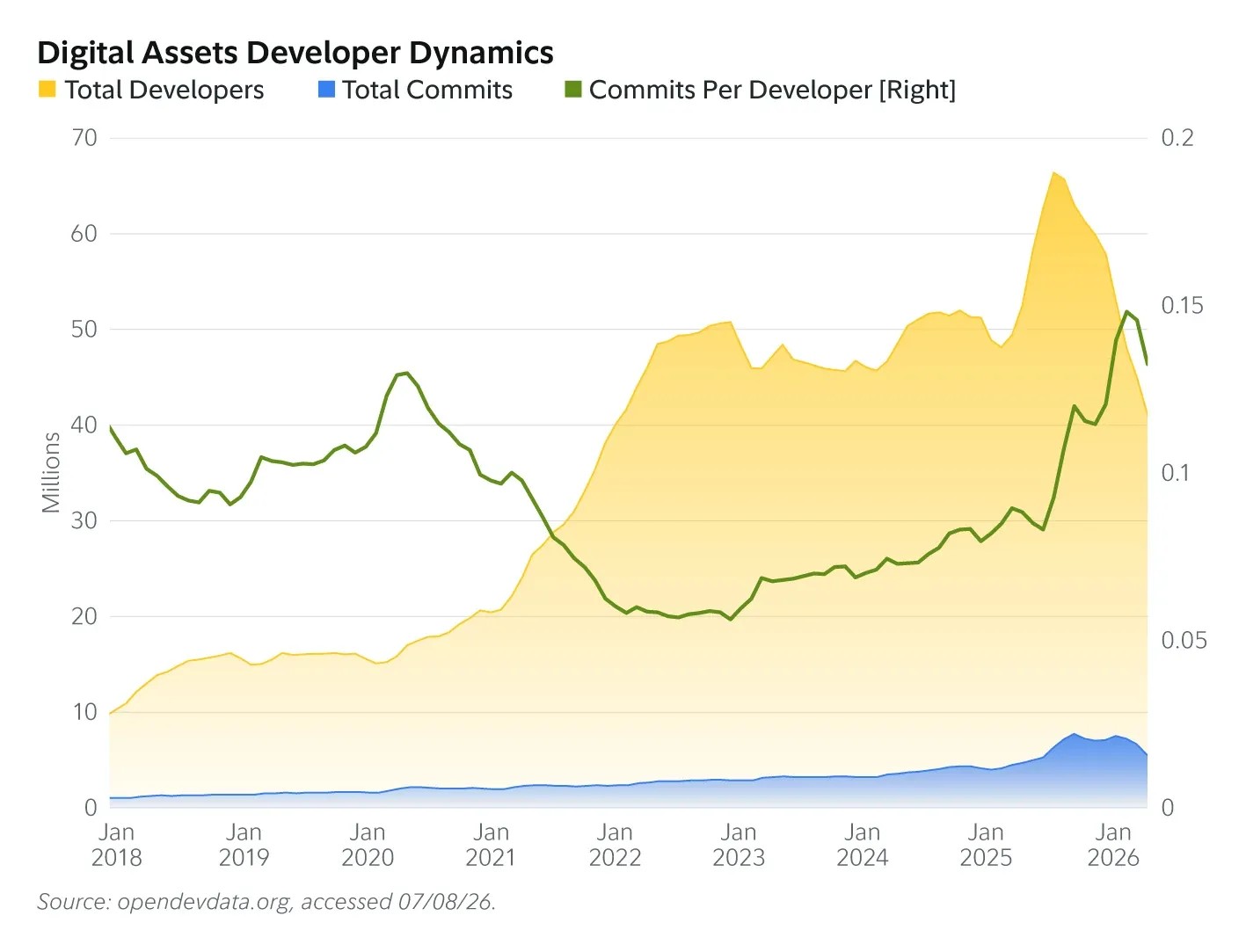
A similar trend was observed within the crypto industry itself. In 2026, against the backdrop of declining digital asset prices, both the number of developers and the volume of commits decreased, with the latter indicator falling more slowly. As a result, the average number of changes per developer continued to grow.

At the same time, an increase in the number of applications alone does not guarantee their success. Projects still need users, liquidity, regulatory compliance, and trust. According to Waddington, as development becomes cheaper, these factors will come to the forefront.

AI Agents Will Go On-Chain

Autonomous AI agents could become an additional driver of activity in the sector. They are capable of independently making payments, trading assets, providing liquidity, as well as issuing and taking loans.

Blockchains are suitable for such operations due to 24/7 operation, programmable settlements, and the ability to conduct microtransactions without human involvement.

This market is already taking shape. According to Keyrock, by May, AI agents had conducted over 176 million transactions worth more than $73 million. About 98.6% of the operations involved the USDC stablecoin.

Infrastructure for such scenarios is also developing. One of the most active players here is the exchange Coinbase, which previously launched the x402 protocol for automatic internet payments and later introduced Coinbase for Agents—a set of tools for trading and settlements using AI.

Nevertheless, Fidelity does not expect all agent operations to migrate to public blockchains. Banks, fintech companies, and traditional players are developing their own solutions, possessing an established customer base, infrastructure, and access to credit products.

In the view of analysts, AI agents will most likely work with multiple platforms simultaneously, choosing between them based on cost and convenience.

What are AI agent payments (agentic payments)?

Transaction Growth Does Not Guarantee Revenue Growth

Even if AI attracts millions of new operations to blockchains, this will not necessarily lead to a proportional increase in revenue for the networks themselves.

As an example, experts cited payments: their number can grow rapidly, but the fee per transaction remains low. Such transactions can also be batched, conducted off the main network, or moved to cheaper L2 solutions.

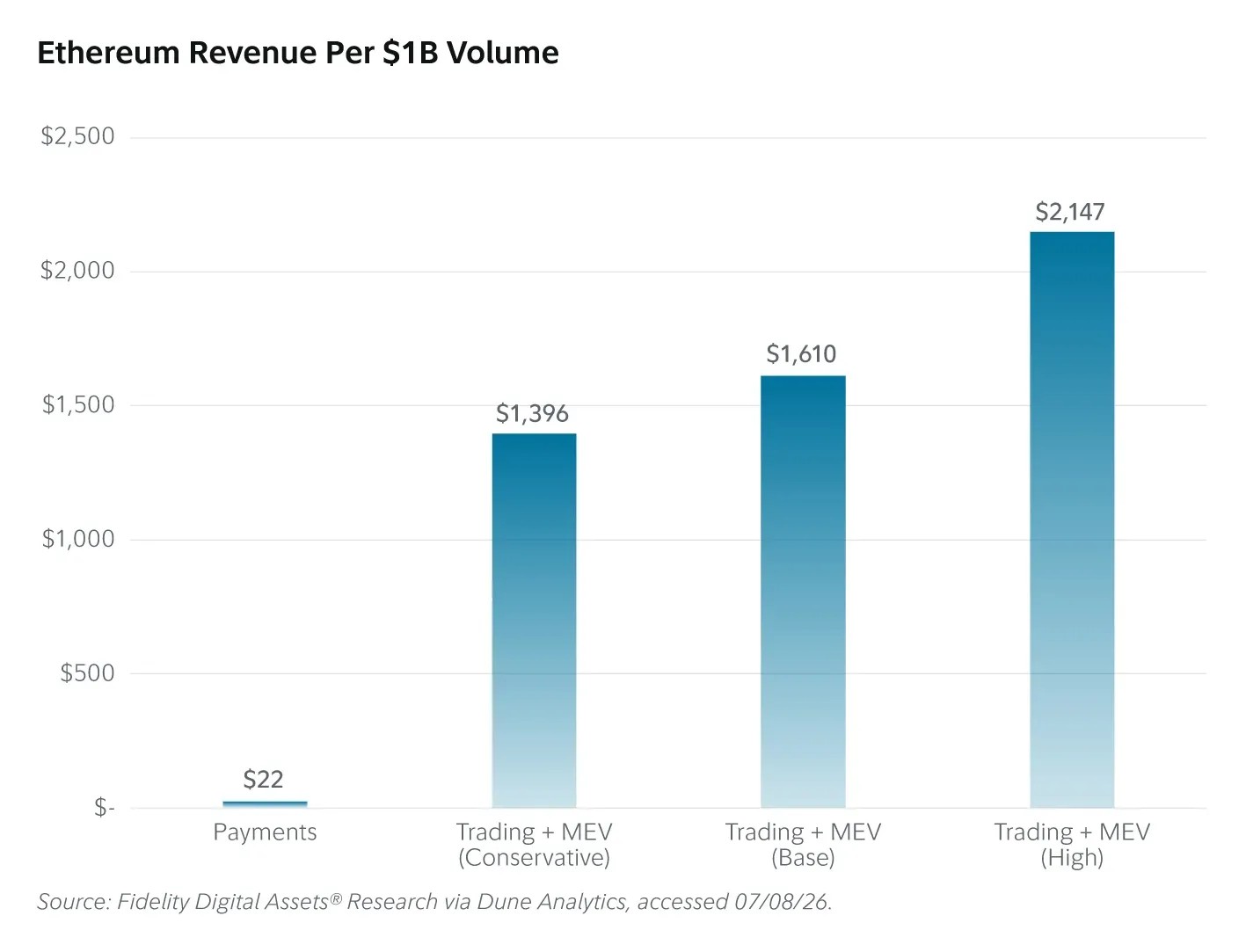
Operations with capital generate much more significant revenue. According to Fidelity's calculations, over the last 180 days, trading brought the base layer of Ethereum 49 times more revenue per dollar of volume than payments. Additional revenue is also created through MEV.
Source: Fidelity.

This is why analysts see greater potential in AI agents that will trade, lend, borrow, and provide liquidity. In the case of mass adoption of automatic payments, the main beneficiaries may be stablecoin issuers and infrastructure providers, rather than the native tokens of blockchains.

Recall that in March, specialists at Bernstein named digital assistants as the future of stablecoins. Later, Franklin Templeton noted that AI agents could become a driver of crypto payments.

end-content

Пов'язані питання

QAccording to the Fidelity analysis mentioned in the article, what are the two main areas of crypto market activity that AI agents could significantly impact?

AAccording to the Fidelity analysis, AI agents could significantly impact two main areas: 1) Development of blockchain applications by increasing developer productivity, and 2) On-chain activity through autonomous operations like payments, trading, lending, and providing liquidity.

QWhat key finding about developer productivity using AI assistants did Fidelity's study of GitHub data reveal?

AThe study of over 100,000 GitHub developers revealed that the use of AI coding assistants increased the number of code commits by up to 180% and boosted the number of software releases by 30%.

QWhy does the article suggest that a surge in AI-driven transactions might not proportionally increase blockchain networks' revenue?

AThe article suggests this because many AI-driven activities, like payments, generate low fees per transaction. Furthermore, these transactions can be batched, processed off-chain, or moved to cheaper Layer-2 solutions, limiting revenue for the base layer. Revenue from capital-based activities like trading is much more significant.

QWhat is the primary type of cryptocurrency used by AI agents for their on-chain transactions, according to data from Keyrock cited in the article?

AAccording to data from Keyrock cited in the article, approximately 98.6% of transactions conducted by AI agents used the stablecoin USDC.

QWhat does the article identify as a major challenge for new blockchain projects, which will become even more critical as AI lowers development costs?

AThe article identifies that attracting users, ensuring liquidity, complying with regulatory requirements, and building trust are the major challenges for new projects. As AI makes development cheaper, these factors will become the primary focus for success, rather than just the ability to create an application.

Пов'язані матеріали

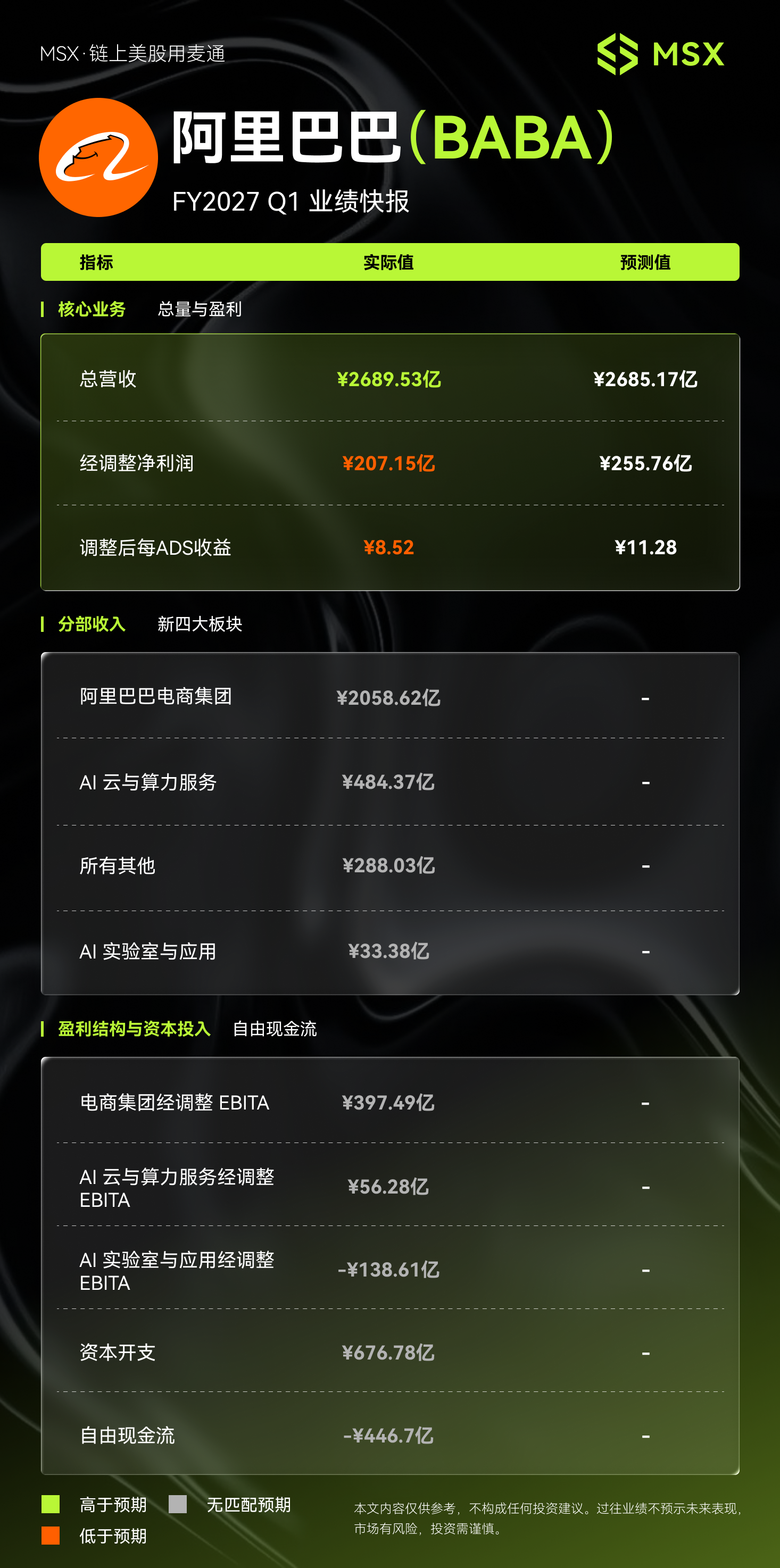
MSX US Stock Daily Observation: Alibaba FY2027 Q1 Earnings: AI Cloud Revenue Growth Hits Record High, AI Cloud Achieves Profitable Closed Loop

**MSX Daily US Stock Watch: Alibaba FY2027 Q1 Earnings – AI Cloud Revenue Hits Record Growth, Achieves Profitability Milestone** Alibaba's Q1 FY2027 revenue slightly exceeded expectations at 268.9B yuan (+9% YoY). However, adjusted net profit of 20.7B yuan (-38% YoY) and adjusted EPS missed consensus significantly. This shortfall was primarily driven by increased AI investments and two one-time items: a 5.5B euro provision for an EU Digital Services Act fine and 4.46B yuan in goodwill impairment. The restructured business segments showed clear divergence. The standout performer was the AI Cloud & Computing Services unit, with revenue surging 45% YoY to 48.44B yuan. Crucially, its adjusted EBITA jumped 133% YoY to 5.63B yuan, with margins expanding to 12%, signaling a profitable commercial loop for AI infrastructure. Within the Commerce Group, revenue growth was mixed: China Local Services (instant retail) grew 45% to 53.3B yuan, largely offsetting an 8% decline in Traditional China Commerce (110.9B yuan). International commerce revenue fell 1%. Despite this, the Commerce Group's adjusted EBITA dipped only 1% YoY to 39.75B yuan. A key area to watch is cash flow. Capital expenditures soared 75% YoY to 67.68B yuan, turning free cash flow to a net outflow of 44.67B yuan. However, operating cash flow remained positive and grew 11% YoY to 22.95B yuan, indicating the cash burn is a strategic choice for AI capacity build-out rather than operational weakness. In summary, while headline profits were pressured by heavy AI spending and one-off charges, the core takeaway is the emerging profitability of the AI Cloud business. The success of Alibaba's current investment cycle hinges on whether the profit improvement in AI Cloud can outpace the depreciation costs of its massive computing infrastructure expansion.

Odaily星球日报23 хв тому

MSX US Stock Daily Observation: Alibaba FY2027 Q1 Earnings: AI Cloud Revenue Growth Hits Record High, AI Cloud Achieves Profitable Closed Loop

Odaily星球日报23 хв тому

Торгівля

Спот
活动图片