Restoring Crypto Privacy: ZCASH (ZEC) Makes A Move After 50% Crash

bitcoinistОпубліковано о 2026-06-11Востаннє оновлено о 2026-06-11

Анотація

Following a severe price crash of over 50% triggered by the discovery of a critical counterfeiting vulnerability in its Orchard privacy pool, Zcash (ZEC) is taking steps to restore confidence. The bug, found by a security researcher using AI, could have allowed undetected creation of fake ZEC tokens. Developers from the Zcash Open Development Lab (ZODL) and others quickly patched the flaw, helping the price rebound over 70%. However, Orchard's privacy features make it impossible to verify if any counterfeit tokens were actually created before the fix. To address this, key ecosystem groups including Shielded Labs and The Zcash Foundation have proposed a new system called Ironwood. Its primary goal is to restore users' ability to independently verify Zcash's total circulating supply. Once activated, node operators could confirm the supply hasn't been tampered with. The Ironwood proposal would also block any new coin minting in the Orchard pool and restrict fund movement through a controlled mechanism. This system could provide evidence on whether the vulnerability was ever exploited. If no excess ZEC attempts to leave the pool, it suggests no counterfeiting occurred. Any attempted exit of fake coins would be blocked and destroyed, publicly revealing any attack while protecting the legitimate supply.

Zcash (ZEC) is making a push to restore confidence in its privacy-focused network after a major exploit scare triggered a sharp market selloff. Following a more than 50% price crash in ZEC, developers moved quickly to patch the network vulnerability. They are now proposing a new system designed to help users independently verify the cryptocurrency’s circulating supply and solidify the network’s security protocols.

Zcash Price Rebounds After Exploit Scare and Iron Wood Proposal

Last week, Zcash suffered a steep decline of more than 50%, falling to $250 after reports of a dangerous counterfeiting bug in its Orchard zero-knowledge proof circuit spread across the market. The incident rattled investors and contributed to $116 million in liquidations across the market.

Notably, the flaw was discovered by Taylor Hornby, a security researcher, using an AI auditing framework powered by Claude Opus 4.8. Developers said the vulnerability could have allowed an attacker to create fake ZEC tokens within the Orchard pool without detection.

Despite the sharp selloff and price crash that followed the news, ZEC’s price recovered some of its losses after developers released an emergency fix. CoinMarketCap data shows that the cryptocurrency rebounded by more than 70% to $433 after the Orchard vulnerability was quickly patched through a coordinated effort involving the Zcash Open Development Lab (ZODL) and other ecosystem participants.
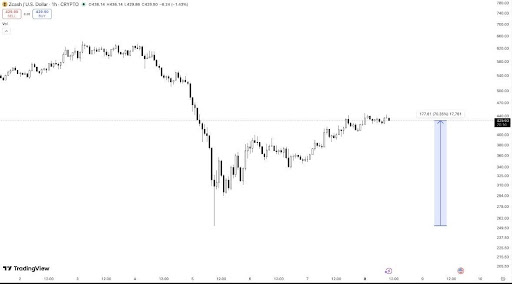
Source: Chart from Simon Dedic on X

While the team successfully fixed the flaw, it remains unclear whether counterfeit ZEC was created before the patch. This concern is more unsettling because the bug had existed within the Zcash network without being detected until recently. Although developers believe exploitation was unlikely, they also noted that Orchard’s privacy features make it impossible for users to verify whether any fake tokens were minted.

To address that issue, Shielded Labs, a non-profit supporting Zcash, is working alongside The Zcash Foundation, Tachyon Group, Valar Group, and the ZODL on a proposal known as Ironwood. The initiative aims to restore users’ ability to verify the soundness of Zcash’s circulating supply without relying on assumptions about other participants or waiting for funds to migrate out of the Orchard pool.

Ironwood Proposal To Restore Zcash Supply Verification

The new proposal was announced in an X post on June 6, in a report authored by the founder and former CEO of Zcash, Jason McGee, founder of Shielded Labs, and Hornby.

The primary goal of Ironwood is to give each user the ability to independently verify Zcash’s supply. Developers said that once activated, users running a node would be able to confirm that the circulating supply has not been tampered with.

The proposal also blocks any transaction that tries to mint a new coin in the Orchard pool. As a result, ZEC would no longer freely circulate within that pool, and funds would only move out through a turnstile mechanism.

The report said Ironwood could also provide evidence about whether the vulnerability was ever exploited during last week’s incident. As users move funds into a new pool, any potential counterfeiter would face a difficult choice: either try to transfer fake coins, risking exposure, or leave the coins behind.

If no extra ZEC tries to leave the Orchard pool, the report noted that it would strongly suggest the flaw was never exploited. If excess funds actually try to exit, they would be blocked and effectively destroyed, preserving the current circulating supply while publicly showing that counterfeiting had occurred.

ZEC trading at $426 on the 1D chart | Source: ZECUSDT on Tradingview.com

Пов'язані питання

QWhat caused Zcash (ZEC) to experience a sharp price crash of over 50% last week?

AThe price crash was triggered by reports of a dangerous counterfeiting bug in its Orchard zero-knowledge proof circuit, which could have allowed an attacker to create fake ZEC tokens without detection.

QWho discovered the vulnerability in Zcash's Orchard circuit and how was it found?

AThe flaw was discovered by security researcher Taylor Hornby using an AI auditing framework powered by Claude Opus 4.8.

QWhat is the main purpose of the proposed Ironwood system for Zcash?

AThe primary goal of the Ironwood proposal is to give each user the ability to independently verify Zcash's circulating supply, confirming it has not been tampered with, without relying on assumptions about other participants.

QHow would the Ironwood proposal potentially reveal if the Orchard vulnerability was ever exploited?

AAs users move funds out of the Orchard pool through a new turnstile mechanism, any attempt to transfer counterfeit coins would be blocked and exposed. If no extra ZEC tries to leave, it suggests the flaw was never used. If excess funds try to exit, they are blocked and destroyed, publicly showing counterfeiting occurred.

QWhich organizations are collaborating on the Ironwood proposal for Zcash?

AThe organizations involved are Shielded Labs, The Zcash Foundation, Tachyon Group, Valar Group, and the Zcash Open Development Lab (ZODL).

Пов'язані матеріали

Korean Youth, Making a 'Last Stand' in an Epic Bull Market

South Korea is experiencing an unprecedented stock market boom in the first half of 2026, with the KOSPI index doubling in six months, driven primarily by tech giants Samsung Electronics and SK Hynix. This "epic bull run," tied to the semiconductor cycle, has sparked a nationwide frenzy for stock trading. The country, with a population of just over 50 million, now has over 105 million securities accounts. The article, from the perspective of a Chinese national living in Seoul, explores how this speculative fever reflects deeper societal anxieties among Korean youth. Facing stagnant wages, high costs of living, housing pressures, and rigid social stratification, many young people see the volatile market as a "last chance" to alter their predetermined life trajectories and escape financial precarity. Stories include a young office worker investing her meager savings, a couple delaying marriage due to financial pressures, and a seasoned trader navigating exclusive social circles where market information is currency. However, the boom also exposes and exacerbates existing inequalities. While some achieve windfalls, others face devastating losses, with borrowing to invest reaching record highs. The narrative contrasts the illusion of equal opportunity with the harsh reality that the ability to absorb risk is unevenly distributed. Ultimately, the market frenzy is portrayed not as a solution, but as a symptom of a generation's struggle against a system offering limited upward mobility, where daily life is a precarious balance of bills, debts, and societal expectations.

marsbit12 хв тому

Korean Youth, Making a 'Last Stand' in an Epic Bull Market

marsbit12 хв тому

Young South Koreans, Making a 'Last-Ditch Effort' in an Epic Bull Market

This article explores how an unprecedented stock market boom in South Korea during the first half of 2026, driven by the semiconductor industry, is transforming the lives of ordinary people, particularly the youth. The KOSPI index doubled in six months, fueled by giants Samsung and SK Hynix, leading to a frenzy of retail investing. With over 105 million stock accounts in a population of just over 50 million, a sense of "FOMO" (fear of missing out) is pervasive. Through the perspective of Li Yuning, a Chinese woman living in Seoul, the piece follows several young Koreans who see the market as a last chance to escape stifling economic pressures, high housing costs, and narrow social mobility. Individuals like Minji, a low-paid office worker, and Junho, saving for marriage, invest their limited savings, while experienced traders like Suhu navigate exclusive social circles. The narrative reveals that this speculative fever stems less from greed and more from deep-seated anxiety about being left behind in a society with growing wealth inequality and rigid class structures. However, the boom also exposes stark social divides. It exacerbates wealth gaps, as those with family support or existing capital fare better. The pressure to succeed is immense, with stories of devastating losses leading to personal tragedy. Ultimately, the article suggests the牛市 acts as a pressure valve and a temporary illusion of opportunity in a system where traditional paths to advancement seem increasingly closed, leaving young people to gamble on the market as a final, desperate bid for a better future.

链捕手18 хв тому

Young South Koreans, Making a 'Last-Ditch Effort' in an Epic Bull Market

链捕手18 хв тому

Doubao Charges More than GPT, While DeepSeek Slashes Prices Dramatically: Who Will Win?

The article discusses the divergent pricing strategies of two major Chinese AI companies. In May, Doubao (by ByteDance) began testing fees, with its professional tier priced higher than ChatGPT Plus. Meanwhile, DeepSeek permanently cut prices for its V4-Pro API to a quarter of the original, setting new global lows. Doubao, with high user traffic from ByteDance apps like TikTok, leads in monthly active users but faces massive compute costs from its free model. Its move to a freemium model targets heavy users, aiming to balance scale and monetization amid substantial investments. DeepSeek's price cut is attributed to architectural innovations that slash inference costs, adaptation to domestic hardware reducing dependency, and engineering optimizations. It focuses on the enterprise (B2B) market, aiming to become a leading model base. Both companies are currently unprofitable. The article contrasts their approaches with Anthropic, which is profitable by primarily serving enterprises with high-value use cases like coding and agents. It argues that sustainable AI business models require integrating AI into real workflows to deliver tangible ROI, rather than just offering chat services. DeepSeek's recent $7 billion funding round, including investments from Tencent, is noted to bolster its B2B position. The ultimate winner will be the player that successfully transforms AI into measurable returns, whether through consumer productivity ecosystems or enterprise platforms.

marsbit27 хв тому

Doubao Charges More than GPT, While DeepSeek Slashes Prices Dramatically: Who Will Win?

marsbit27 хв тому

Promised Year of Crypto IPOs? Only One Went Public in Six Months, Down 70%

The much-anticipated wave of crypto IPOs in 2026 has failed to materialize, with market conditions worsening dramatically. While SpaceX prepares for the largest IPO in history, raising $75 billion at a $1.75 trillion valuation, the crypto sector faces a frozen pipeline. The sole crypto IPO success this year, BitGo, serves as a cautionary tale. After launching on the NYSE in January at $18, its stock has plummeted approximately 70%. Other major contenders have stalled or delayed. Kraken, which secretly filed in late 2025, has put its plans on ice, seeing its valuation drop 33% to $13.3 billion. Consensys has postponed its filing until autumn at the earliest, and Bitpanda is poised to miss its self-imposed H1 deadline for a Frankfurt listing. This widespread retreat is driven by a severe liquidity crunch. Bitcoin has fallen below $60,000, with capital being diverted to AI stocks and the massive SpaceX offering. The poor performance of earlier crypto listings like Gemini and the stagnant price of Coinbase further dampen investor appetite. A key underlying pressure is the impending US midterm elections in November, which could alter the currently favorable regulatory landscape. Companies had hoped to go public during this window of policy certainty, but challenging market dynamics have overridden those plans. The transparency that comes with being a public company is now seen as a potential liability rather than a benefit in a down market. The industry's fate now hinges on a few critical watchpoints: whether Kraken restarts its process in H2, if Consensys files in the fall, and if SpaceX's debut can revitalize market liquidity. Otherwise, the promised "crypto IPO year" will likely be pushed beyond the election.

marsbit42 хв тому

Promised Year of Crypto IPOs? Only One Went Public in Six Months, Down 70%

marsbit42 хв тому

Торгівля

Спот
Ф'ючерси

Популярні статті

Як купити ZEC

Ласкаво просимо до HTX.com! Ми зробили покупку Zcash (ZEC) простою та зручною. Дотримуйтесь нашої покрокової інструкції, щоб розпочати свою криптовалютну подорож.Крок 1: Створіть обліковий запис на HTXВикористовуйте свою електронну пошту або номер телефону, щоб зареєструвати обліковий запис на HTX безплатно. Пройдіть безпроблемну реєстрацію й отримайте доступ до всіх функцій.ЗареєструватисьКрок 2: Перейдіть до розділу Купити крипту і виберіть спосіб оплатиКредитна/дебетова картка: використовуйте вашу картку Visa або Mastercard, щоб миттєво купити Zcash (ZEC).Баланс: використовуйте кошти з балансу вашого рахунку HTX для безперешкодної торгівлі.Треті особи: ми додали популярні способи оплати, такі як Google Pay та Apple Pay, щоб підвищити зручність.P2P: Торгуйте безпосередньо з іншими користувачами на HTX.Позабіржова торгівля (OTC): ми пропонуємо індивідуальні послуги та конкурентні обмінні курси для трейдерів.Крок 3: Зберігайте свої Zcash (ZEC)Після придбання Zcash (ZEC) збережіть його у своєму обліковому записі на HTX. Крім того, ви можете відправити його в інше місце за допомогою блокчейн-переказу або використовувати його для торгівлі іншими криптовалютами.Крок 4: Торгівля Zcash (ZEC)Легко торгуйте Zcash (ZEC) на спотовому ринку HTX. Просто увійдіть до свого облікового запису, виберіть торгову пару, укладайте угоди та спостерігайте за ними в режимі реального часу. Ми пропонуємо зручний досвід як для початківців, так і для досвідчених трейдерів.

555 переглядів усьогоОпубліковано 2024.12.12Оновлено 2026.06.02

Як купити ZEC

Обговорення

Ласкаво просимо до спільноти HTX. Тут ви можете бути в курсі останніх подій розвитку платформи та отримати доступ до професійної ринкової інформації. Нижче представлені думки користувачів щодо ціни ZEC (ZEC).

活动图片