POLY's Appearance Hints Keep Coming, How Far Is the Airdrop?

marsbitОпубліковано о 2026-05-19Востаннє оновлено о 2026-05-19

Анотація

The article discusses growing speculation around the potential launch and airdrop of the POLY token by prediction market platform Polymarket. It outlines a timeline of official hints, starting from CEO Shayne Coplan mentioning POLY alongside major cryptocurrencies in October 2025 to confirmations from other team members about a future token and airdrop. Recent developments include the appearance of POLY preview pages on CoinGecko and CoinMarketCap in April, and further product-related hints from the team in May about staking and airdrop criteria. Market prediction data suggests a 56% probability of a token launch before year-end, with significant potential market capitalization. The author's personal view is that Polymarket is unlikely to issue the token before the World Cup, prioritizing platform stability and infrastructure development for the high-traffic event instead. The article advises strategies like hedging trades and engaging on social media to potentially qualify for a future airdrop.

Recently, due to constant hints from Polymarket officials regarding POLY token-related content, various airdrop-farming communities have been analyzing the timing and scale of the POLY airdrop from different angles.

According to predict.fun data, the probability of the event "Polymarket will launch its official token before the end of this year" is currently 56%; there is even a 7% probability that "Polymarket will launch its official token before Q2 of this year."
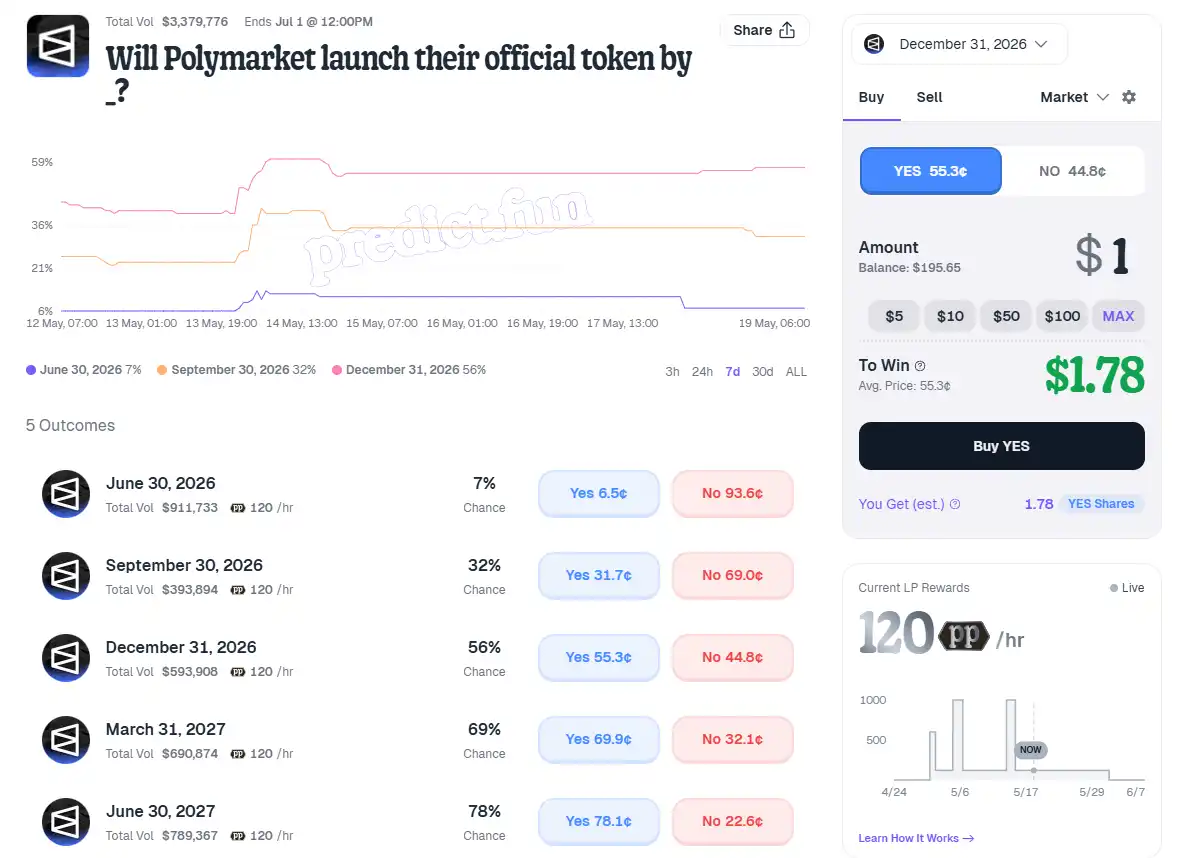
Additionally, regarding market cap, the probability for the event "Polymarket's FDV exceeds $6 billion one day after listing" is currently 51%; there is a 34% probability for "Polymarket's FDV exceeds $10 billion one day after listing."
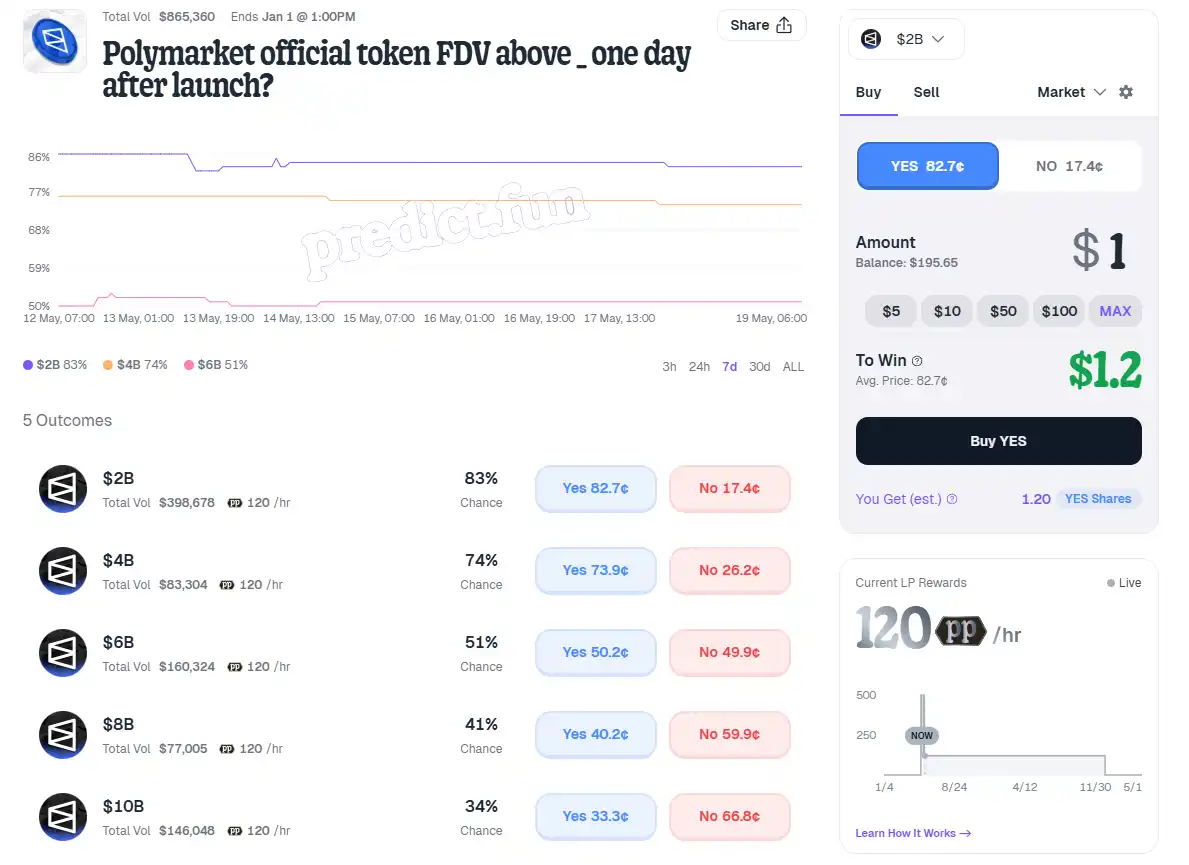
Timeline of Official Polymarket Token Hints

October 2025: Initial Hints and Official Confirmation of the POLY Token

Official signals surrounding the POLY token from Polymarket can be traced back to last October.

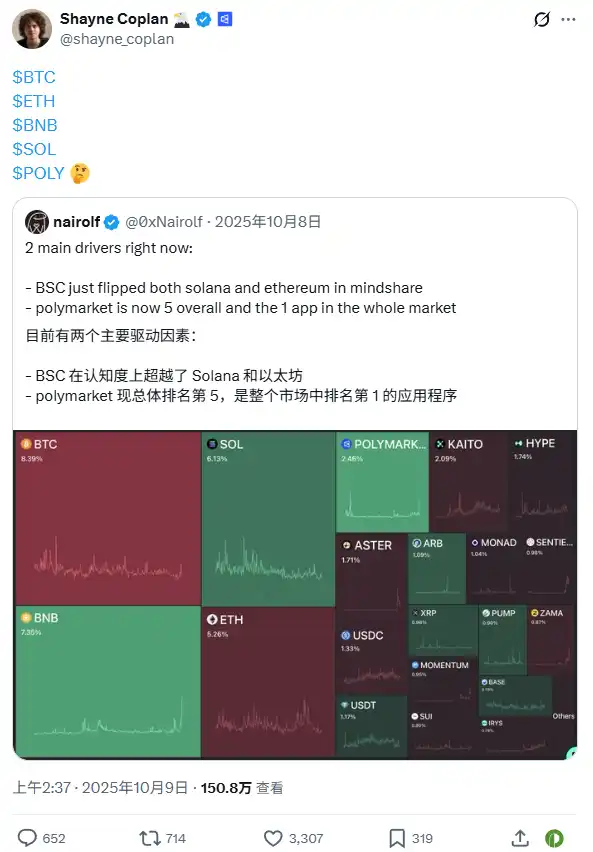
On October 8, 2025, Polymarket CEO Shayne Coplan posted on X, listing POLY alongside BTC, ETH, BNB, and SOL, sparking community speculation about a Polymarket token launch.

Although this was not an official token announcement, for the market, the founder personally writing $POLY was sensitive enough. Since then, community discussion about a Polymarket token launch has noticeably heated up.
The airdrop expectation was further brought into public discussion by official team members. On October 23, 2025, Polymarket Growth Lead William LeGate mentioned "prospective airdrop farmers" in a podcast or related discussion. While not a formal rule explanation, this essentially acknowledged the existence of user behavior and expectations around a Polymarket airdrop in the market.

The expectation for the POLY token was further solidified on October 24, 2025. Polymarket CMO Matthew Modabber explicitly stated in a podcast, "Polymarket will have a token, and it will have an airdrop." This statement became a key turning point for Polymarket's token expectation, shifting from community speculation to official confirmation.

Entering November, the focus of official discussion began to shift from whether there would be an airdrop to what kind of behavior would *not* qualify for an airdrop. On November 11, 2025, William LeGate, responding to Sybil farming, clearly stated, "I can confidently tell you these sybil-farmed accounts are not going to result in any airdrop allocations, they're just wasting their time."

April of This Year: Major Price Tracking Platforms Launch POLY Preview Pages

Entering April of this year, POLY token expectations have extended to major crypto price-tracking websites.

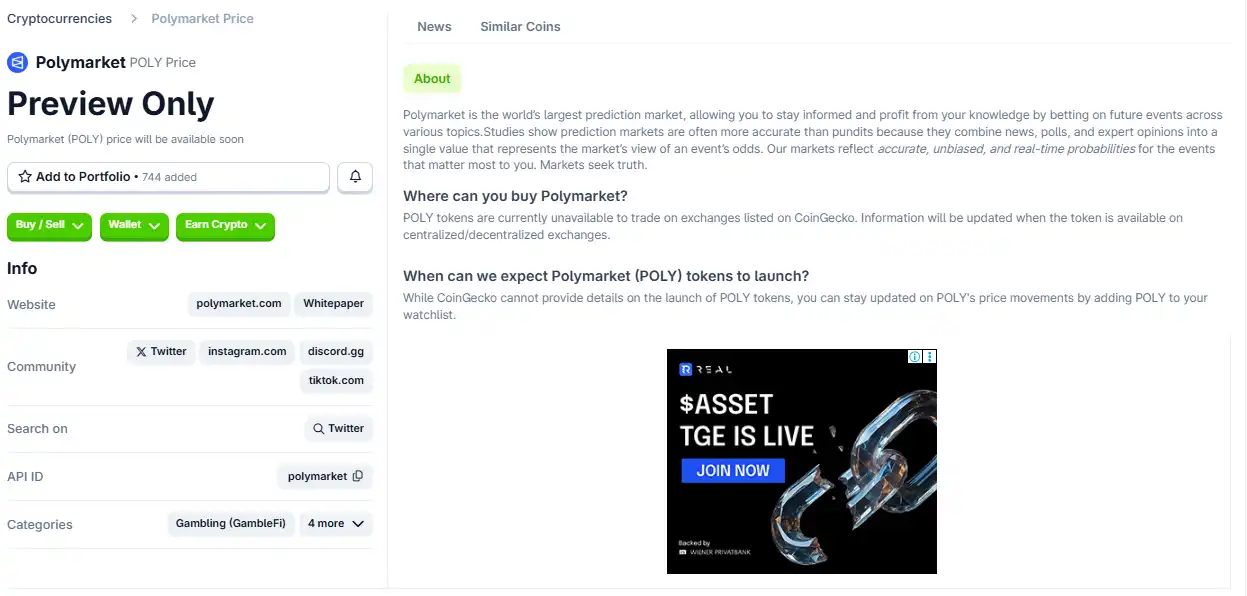
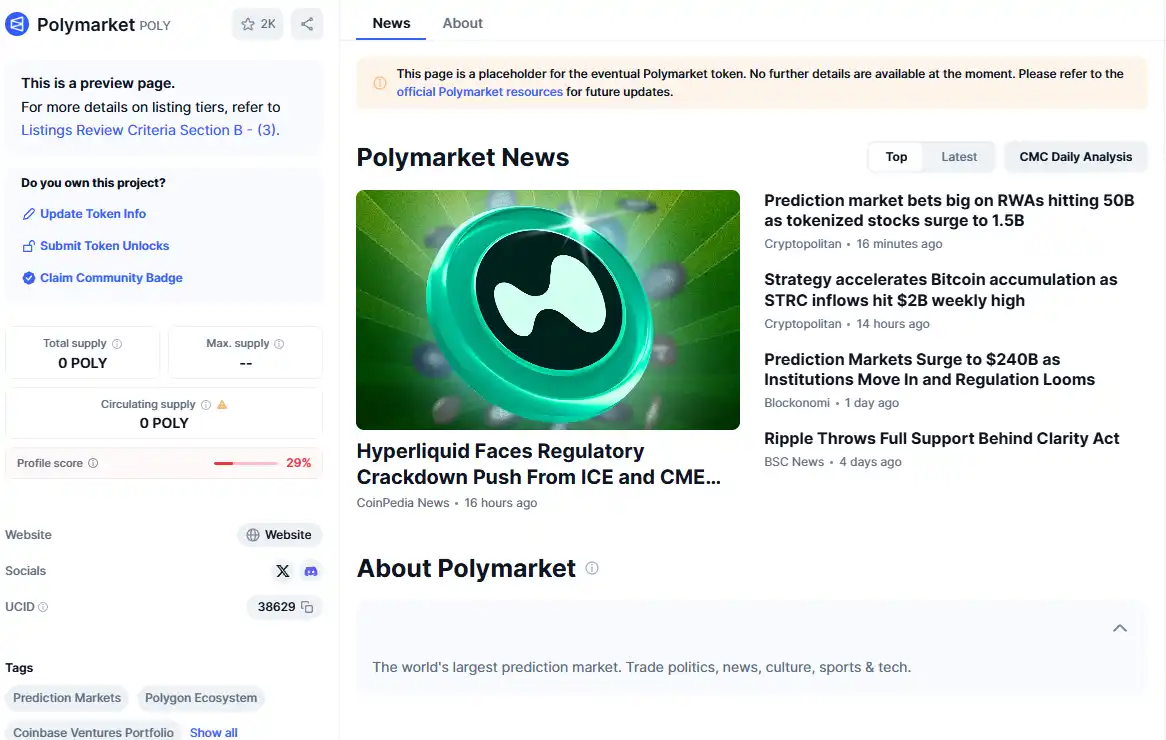
Currently, preview pages for Polymarket (POLY) have appeared on both CoinGecko and CoinMarketCap. While these pages are not equivalent to the official token launch nor do they represent Polymarket announcing a TGE timeline, the fact that external platforms are reserving pages for $POLY further strengthens the community's expectation of a Polymarket token launch.
May of This Year: POLY Token Moves from Airdrop Expectation to Product Hints

Entering May, the discussion around the POLY token has moved further towards specific functions and airdrop qualifications.

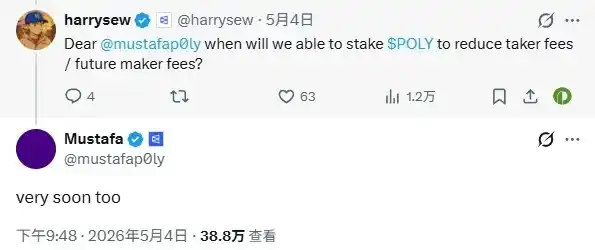
On the evening of May 4th, Polymarket official team member Mustafa responded to questions about the POLY token in a community interaction. A user asked when they could stake POLY to reduce taker fees, or potentially future maker fees.

Mustafa's reply was: "Soon." The community quickly interpreted this official response as Polymarket preparing for the token launch.
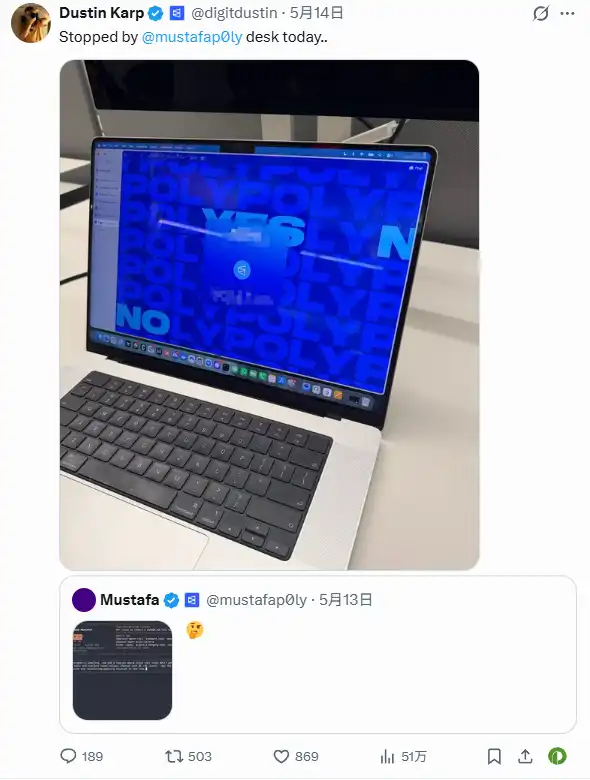
On May 13th, clues surrounding the POLY token continued to increase.

Polymarket Product Lead Dustin Karp posted a photo of his workstation, saying he passed by Mustafa's desk. The photo appeared to show an internal page related to the POLY token airdrop. The community zoomed in and found an "Airdrop" tab visible, further heightening expectations for a POLY token airdrop.
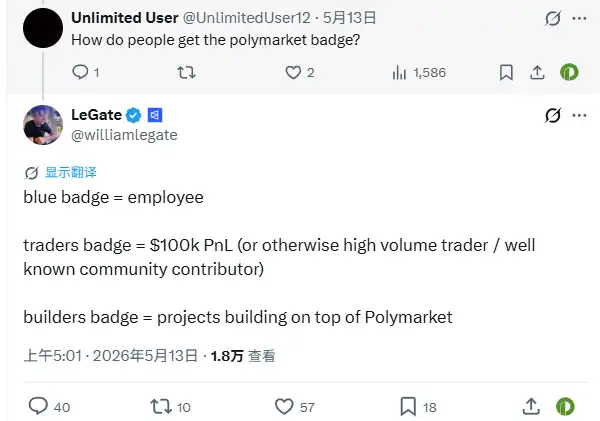
Subsequently, Polymarket Growth Lead LeGate also responded to questions about official badges in community discussions.

LeGate replied that the blue badge represents Polymarket employees; the "Traders" badge is primarily for traders with cumulative profits reaching $100,000, or other high-volume users (in other tweets, he mentioned a trading volume exceeding $10 million and said if users are active on Polymarket, the profit and volume thresholds can be slightly adjusted), and notable community contributors; the "Builders" badge is for projects building and developing based on the Polymarket ecosystem.
Badges might not be the only criteria for receiving an airdrop. The community inquired whether content contributions on X would be rewarded with POLY tokens. LeGate replied that linking your X account to your Polymarket account is only one-third of the conditions.

In addition, users should probably also put their Polymarket profile link in their X bio, actively share their trades, profit records, and market views on X, and maintain interaction with the community.
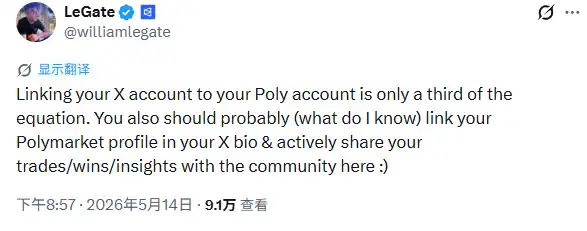
Although this reply did not explicitly confirm whether "shitposting" ("zui lu") could genuinely earn an airdrop, various communities were relatively optimistic and actively posted Polymarket-related content on X to seek potential token airdrops.

Personal Strategy

For someone who has been deeply involved in prediction markets throughout the first half of this year, I am still leaning towards the belief that Polymarket will not launch its token before the World Cup.

The reason is simple. Polymarket's more important task right now may not be to launch a token immediately, but to first refine the trading experience and infrastructure. Whether it's the continuous optimization of V2 or even a chain migration, it's essentially to prepare for high-traffic, high-frequency trading scenarios like the World Cup.

For Polymarket, if the platform experience is unstable during the World Cup, launching a token in advance would hardly help truly onboard new users and trading volume.

Therefore, recent trading has primarily been focused on hedging, placing orders on predict.fun to farm points, and then hedging positions received on Polymarket. At the same time, participating in various events on Polymarket with profitability as the goal.

Additionally, I am also linking my personal X account information on Polymarket and posting Polymarket-related content on X, hoping that when the token is launched in the future, a portion of the airdrop will also be allocated to "shitposting users" ("zui lu users").

Пов'язані питання

QWhat is the main subject of the article and what community activity does it discuss?

AThe main subject is the potential launch and airdrop of the POLY token by Polymarket. The article discusses extensive analysis and speculation within crypto 'airdrop farming' communities regarding the timing and scale of the airdrop.

QAccording to prediction market data, what is the estimated probability for Polymarket launching its official token before the end of this year?

AAccording to data from predict.fun, the probability of the event 'Polymarket will launch its official token before the end of this year' is currently reported at 56%.

QWhen did the first significant official hint about the POLY token occur, and who was involved?

AThe first significant hint occurred on October 8, 2025, when Polymarket CEO Shayne Coplan listed '$POLY' alongside major cryptocurrencies like BTC and ETH on X, sparking community speculation about a token launch.

QWhat two types of user badges did Polymarket's Growth Head, William LeGate, mention, and what are their general criteria?

AWilliam LeGate mentioned 'Traders' badges for users with over $100,000 in cumulative profit or high trading volume (over $10 million), and 'Builders' badges for projects developing on the Polymarket ecosystem.

QWhat is the author's personal prediction for the POLY token launch timeline and the primary reason behind it?

AThe author personally predicts that Polymarket will not launch the token before the FIFA World Cup. The primary reason is that the platform's priority is likely to optimize trading experience and infrastructure to handle the high traffic expected during the World Cup event.

Пов'язані матеріали

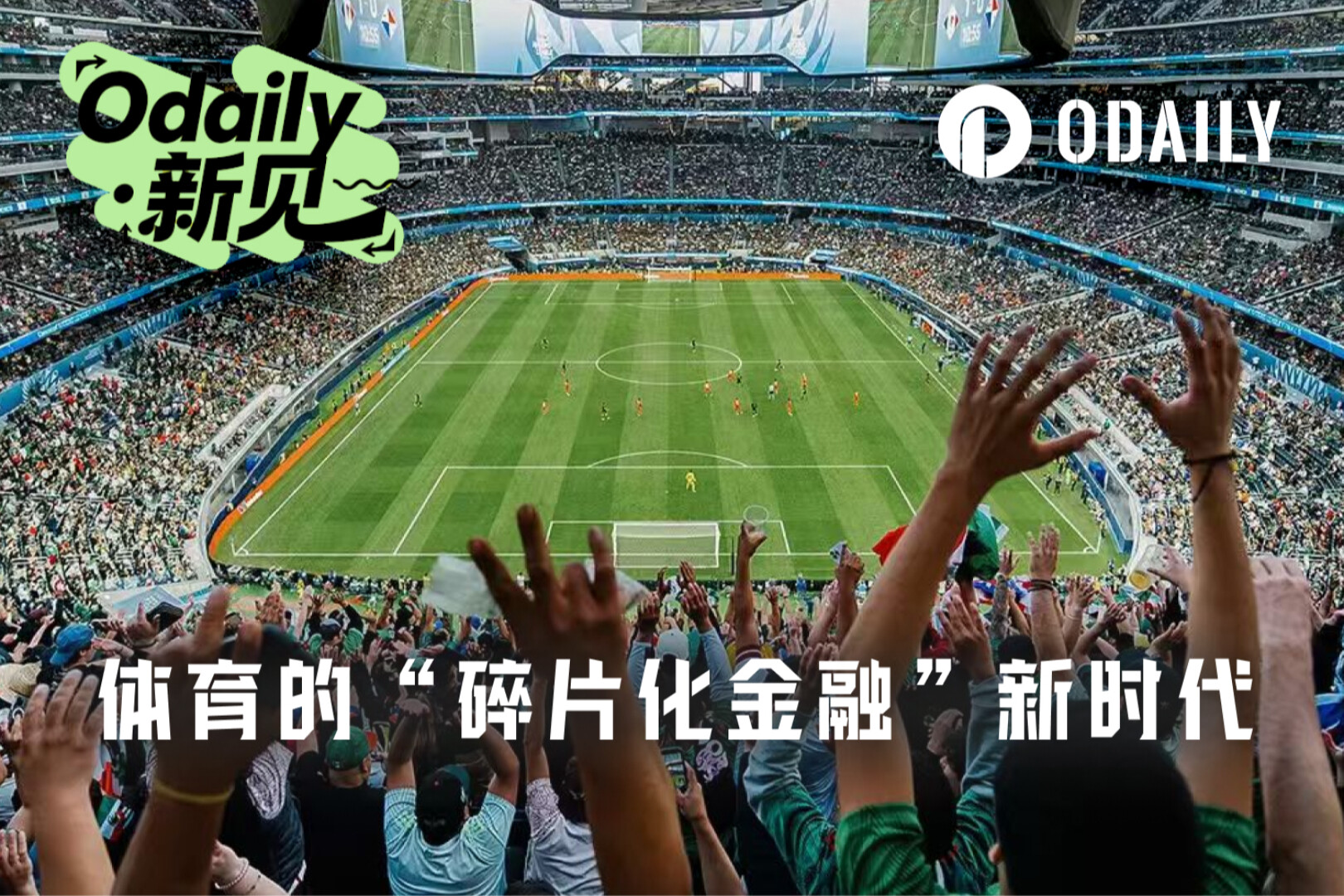
The World Cup is Approaching: Sports Entering the Era of 'Fragmented Finance'

With the approaching World Cup, sports are entering an era of "fragmented finance." This shift is exemplified by FIFA's new rule requiring debutant players to wear a special "World Cup debut patch." Post-tournament, these patches will be authenticated, cut, and embedded into collectible cards, potentially transforming into high-value assets. The global sports trading card market, valued at over $11.5 billion, represents a sophisticated alternative asset class with deep secondary markets and distinct bull/bear cycles. While football has a massive fanbase, its card market has historically lacked the liquidity and unified narrative of the NBA's system. The NBA's success stems from its centralized, star-driven storytelling—from draft nights to championships—which perfectly fuels financialization. The World Cup patch initiative is FIFA's attempt to create similar "financial raw material" for football. The NBA card market, evolving over 70 years, has matured into a financial ecosystem. After a 1990s crash due to overproduction, the industry rebounded by embracing scarcity: limited editions, autographs, game-worn memorabilia (patches), and serial numbering. Today, it features professional grading (e.g., PSA, BGS), auction platforms, live "break" streams, and dedicated marketplaces, mirroring aspects of cryptocurrency markets with their volatility, speculation, and community-driven trading. The core driver is narrative. A card's value is tied to a specific historic moment or player potential—like Stephen Curry's 1/1 card commemorating his Olympic game-winning shot selling for $518,500. This trade in "ownership of history" or "future greatness" parallels prediction markets, both monetizing collective emotion. Unlike many NFT projects that struggle to generate sustained narratives, sports are a perpetual emotion-generating machine. Leagues like the NBA and UFC constantly produce real-world drama—rivalries, comebacks, and triumphs—that fuels ongoing interest and investment. For younger audiences consuming sports via highlights and social media clips, trading cards become a direct financial instrument for engaging with these narratives. Thus, traditional sports leagues are leading the charge in assetization, leveraging their unique advantages: real events, global fan consensus, and endless storytelling. They are becoming platforms for issuing financial assets, turning fragments of history—a patch, a signature, a moment—into tradable commodities.

Odaily星球日报40 хв тому

The World Cup is Approaching: Sports Entering the Era of 'Fragmented Finance'

Odaily星球日报40 хв тому

Vitalik's Latest Long Read: In the AI Era, How Can Code Become More Secure?

Vitalik Buterin explores the role of formal verification as a critical tool for software security, especially in the AI era and for blockchain systems. He defines formal verification as using machine-checkable mathematical proofs to verify that code meets specified properties, moving beyond manual auditing. The article highlights that while AI can generate code and find vulnerabilities rapidly, it also makes formal verification more accessible by assisting in writing proofs. This is crucial for Ethereum's complex components like STARKs, ZK-EVMs, consensus algorithms, and high-performance EVM implementations, where bugs can lead to irreversible losses. Vitalik argues that formal verification enables a powerful "separation of concerns": AI can write highly optimized (e.g., assembly) code for efficiency, while a separate, human-readable specification defines correctness. A machine-checked proof then verifies their equivalence. This paradigm can create a more secure "trusted core" of software. However, he cautions that formal verification is not a panacea. "Proven correctness" depends on the accuracy of the specifications and proofs themselves, which can be wrong or incomplete. Risks include unverified code sections, hardware-level side-channel attacks, and overlooked assumptions. The true goal is not absolute proof but increased confidence through redundant expressions of intent—using code, tests, types, and formal proofs—and automatically checking their consistency. The article concludes that AI and formal verification are complementary: AI enables scale, while verification ensures accuracy. For critical systems, this combination offers a path toward stronger security in a future with powerful AI adversaries, helping to maintain the defensive advantage essential for a decentralized internet.

marsbit1 год тому

Vitalik's Latest Long Read: In the AI Era, How Can Code Become More Secure?

marsbit1 год тому

Торгівля

Спот
Ф'ючерси
活动图片