Author: Zen, PANews
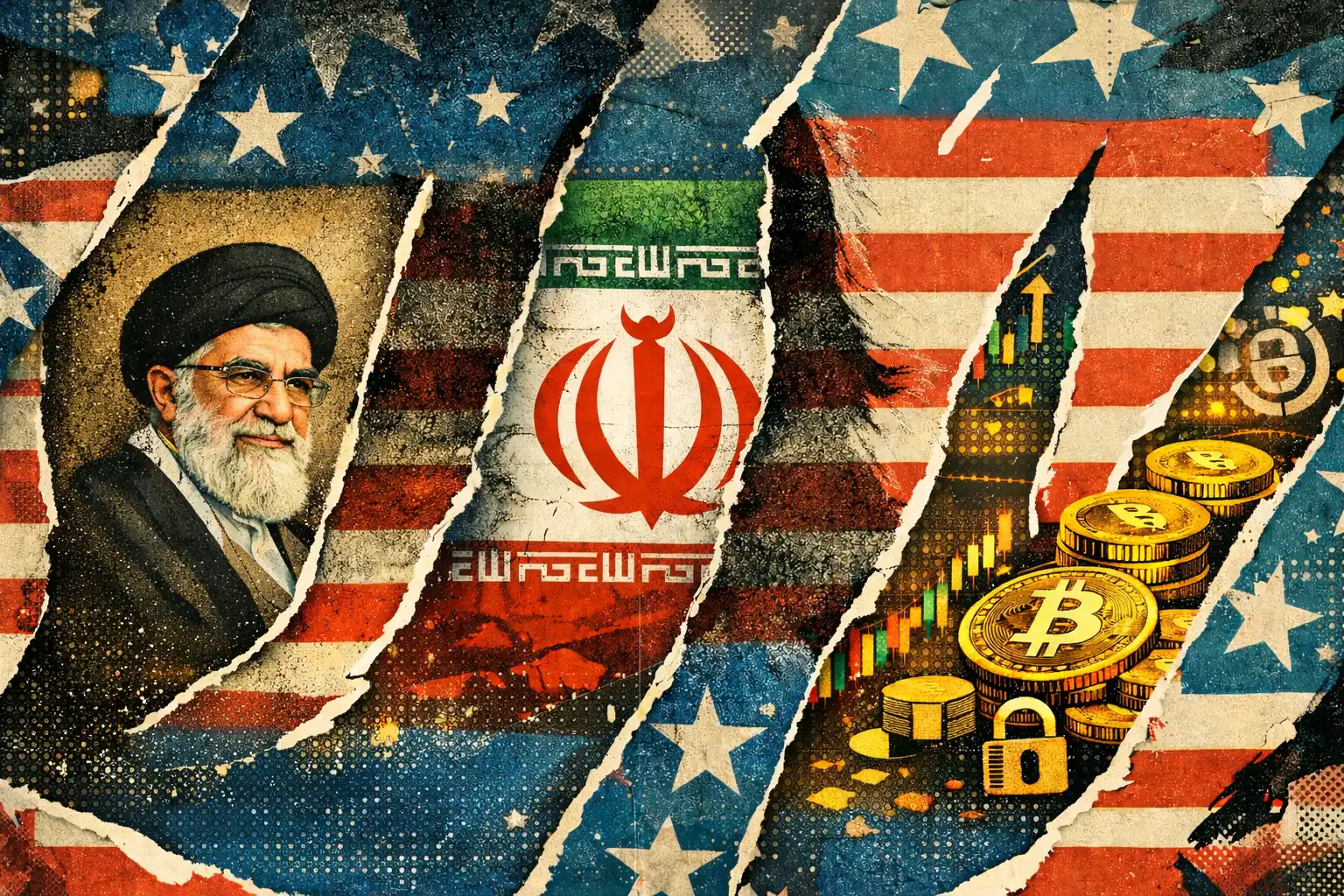
The world's spotlight is on Iran and the Persian Gulf. When the outside world discusses Iran, the narratives often revolve around military and regime risks, and the impact on energy and shipping. The immediate reports from mainstream media focus on military actions, oil and gas facilities, the Strait of Hormuz, and the sharp fluctuations in financial markets.
But beneath these grand narratives, if you zoom in on the specific ordinary individuals in cities like Tehran, Mashhad, and Ahvaz, you will find that in times of high tension, the most important things are the safety of life and the hedging of assets.
After the US and Israel launched their attacks, the outflow of assets from Iran's largest cryptocurrency exchange, Nobitex, surged, increasing by about 700% in just a few minutes. A report from Chainalysis also confirmed that within hours of the attack, the hourly trading volume of crypto assets within Iran rapidly increased.
Over the four days leading up to March 2nd, crypto assets worth over ten million US dollars had accelerated their outflow from Iran. The funds of the Iranian people are finding a safer passage through cryptocurrency.
Iran's Economy Under the "Dominance" of the US Dollar
For Iran, any escalation of the situation can quickly transmit to its two fragile nerves: the exchange rate and the financial system. Cryptocurrency has unexpectedly become an important medium.
Over the past few years, the Iranian economy has sunk deeper into a cycle of external sanctions, internal imbalances, and currency depreciation. The continuous weakening of the rial is no longer just a price change but has become a societal panic.
In 2015, after the JCPOA (Iran nuclear deal) was reached, the market once expected sanctions to ease: the free market rate was roughly 32,000 rials to 1 US dollar. However, after the US withdrew from the JCPOA in 2018 and announced the phased restoration of sanctions, the rial quickly moved from tens of thousands into the "hundred thousand rial era." Subsequently, the long-term sanctions, combined with inflation, tight foreign exchange supply, and geopolitical conflicts, caused it to break the one million rial mark in the first half of last year. During the surge of protests at the beginning of this year, it even hit a historical low of 1.5 million rials.
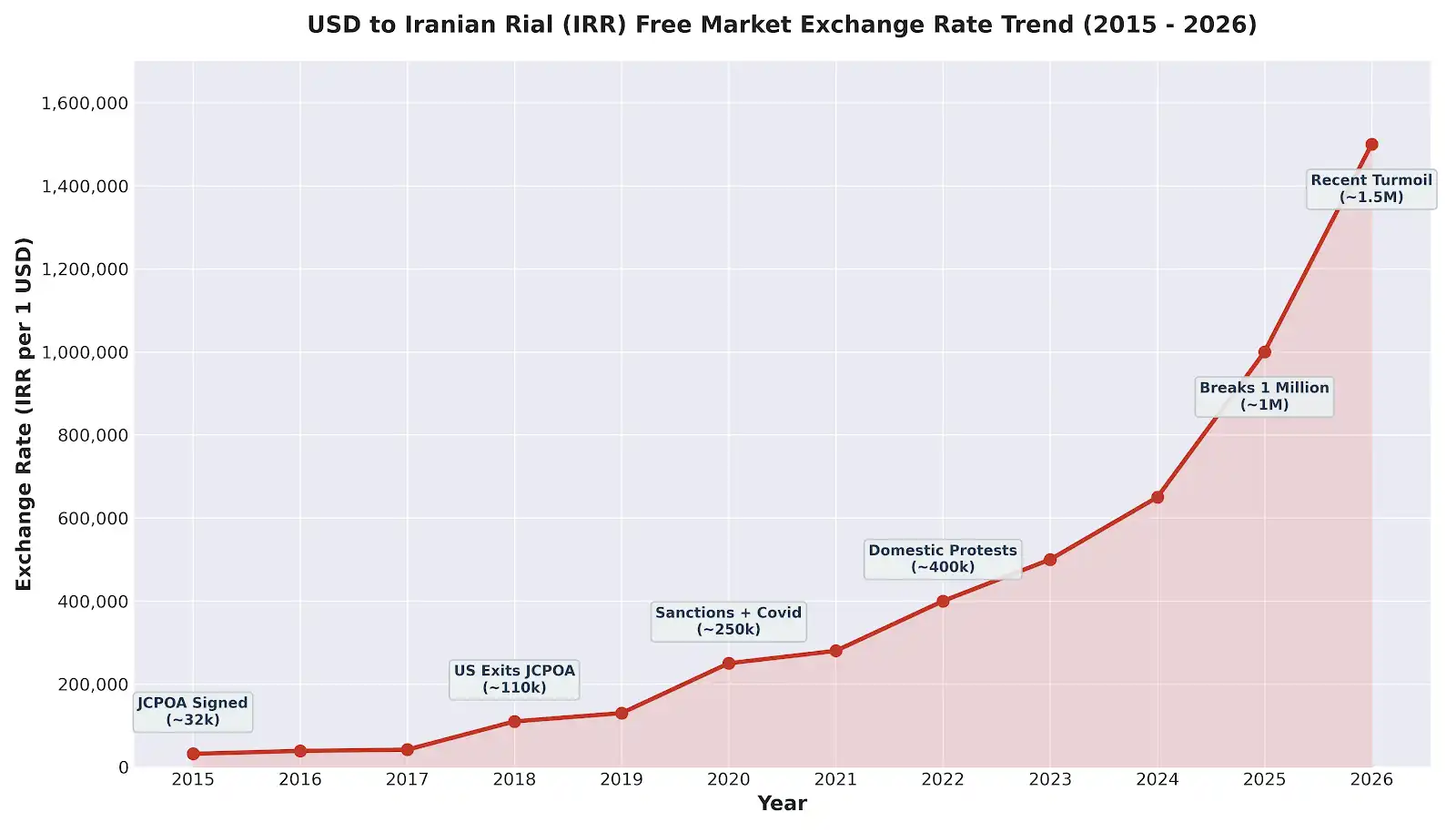
In a global financial structure centered on the US dollar, Iran, strangled by sanctions, has to face a situation dominated by the dollar and continuous depreciation of the rial.
The US dollar, as the "hub currency" for global foreign exchange transactions, can complete cross-border transactions for imports, debt, insurance, shipping, and key component procurement stably and with low friction. Even if Iran's printing presses roar and issue more rials domestically, they cannot replace this critical capability.
In many pricing systems for bulk commodities and supply chains, the US dollar remains the natural pricing anchor; in a sanctions environment, it is even harder for Iran to obtain US dollar clearing services through normal banking channels, making the entry point for hard currency scarce and expensive.
Therefore, many people's expectation for the future is to quickly convert their rials into something more reliable—US dollar cash, gold, and cryptocurrencies, mainly Bitcoin and stablecoins like USDT.
As an Islamic country, financial activities must also comply with the norms of Sharia law. Islamic doctrine strictly prohibits all forms of usury (Riba) and gambling (Gharar), and cryptocurrency trading, due to its high fluctuations and speculative nature, is viewed with caution.
However, Iran's former Supreme Leader Khamenei held a relatively open attitude towards crypto and called for keeping the law与时俱进 (evolving with the times). Khamenei's statement, in essence, was more like a realist compromise when the economy was facing a desperate situation.
From Government to Public, Iran Needs Cryptocurrency
Due to long-term sanctions and high inflation, both the Iranian government and its people are chasing hard currency substitutes in their own ways. This is why crypto assets, represented by Bitcoin and dollar stablecoins, have gradually transformed from "speculative instruments" into a nearly essential tool of value in Iran. It is both a financial safety valve for citizens and a "cyber money house" for the state apparatus to evade sanctions.
The Iranian government's attitude towards cryptocurrency can be described as "love-hate, utilizing and suppressing in parallel."
At the state level, when crypto activities help provide alternative channels for import settlement, foreign exchange acquisition, or fund transfers, regulators tolerate or even absorb them within a certain range, such as initially allowing Bitcoin mining domestically. Cryptocurrency is also an important means in the "shadow financial network" of the Iranian government and military for transferring funds and evading supervision.
According to TRM Labs, the company identified over 5,000 addresses marked as related to the Islamic Revolutionary Guard Corps (IRGC) and estimated that since 2023, the organization has transferred $3 billion worth of cryptocurrency. British blockchain research company Elliptic stated that the Central Bank of Iran acquired at least $507 million worth of the stablecoin USDT in 2025.
However, when cryptocurrency is seen as accelerating the depreciation of the rial, strengthening expectations of capital flight, or forming hard-to-regulate private financial networks, the Iranian government quickly turns to tightening controls.
In early 2025, the Central Bank of Iran (CBI) "suddenly stopped all rial payment channels for crypto exchanges," leaving over 10 million crypto users unable to use rials to purchase crypto assets like Bitcoin; reports indicated that one of the main goals was to prevent further depreciation of the rial and avoid the rapid conversion of the local currency into foreign currency or stablecoins through exchanges.
This method of cutting off the fiat currency entry point essentially uses administrative means to sever the most convenient channel for the public to convert rials into value. But this does not mean Iranian society no longer needs crypto; instead, it squeezes demand into grayer, more decentralized paths, including over-the-counter (OTC) trading, alternative payment accounts, or more covert on-chain transfers.
And when the state repeatedly uses this governance method during currency crises, the public's preference for "assets outside the system" is further reinforced. Because every sudden restriction reminds them that financial rules can change at any time, and assets are not entirely under their control.
At the citizen level, crypto demand is mainly driven by three forces: value preservation, transferability, and speculation. According to TRM Labs estimates, 95% of fund flows related to Iran come from retail investors. Iran's largest cryptocurrency exchange, Nobitex, disclosed that it has 11 million customers, with most trading activity coming from retail and small investors. The exchange stated: "For many users, cryptocurrency primarily serves as a store of value to cope with the continuous depreciation of the local currency."
Even more surreal, in mid-2024, Telegram "Tap-to-Earn" crypto mini-games like "Hamster Kombat" and "Notcoin" triggered a national frenzy in Iran. On the Tehran subway and streets, countless Iranians frantically tapped their phone screens, trying to use free "crypto airdrops" to fight soaring prices. Reports indicated that nearly a quarter of Iran's population participated in such games at the time. When the national currency loses credibility, even the hope of clicking the screen for meager virtual coins becomes a glimmer of light in the darkness.
Therefore, in Iran, we see a paradox: on the one hand, the authorities worry that crypto accelerates the depreciation of the rial and weakens capital controls, so they cut off rial payment channels at critical moments; on the other hand, in the long-term structure of sanctions and foreign exchange scarcity, cryptocurrency is constantly proving its utility. And for ordinary Iranians, this utility is extremely important, becoming an emergency exit in a life of crisis.
The Covert Battle for Power and the Increasing "Black Miners"
Unlike the frontal confrontation of hot weapons on the front lines, a silent covert battle over power resources has been ongoing within Iran for years.
In a country like Iran with "scarce social resources," electricity is no longer just a necessity of life but is redefined as a strategic resource that can be arbitraged. But the cost of this arbitrage is ultimately borne by ordinary residents, causing severe power difficulties.
Although Iran is a typical energy-rich country, it has long been trapped in a cycle of power shortages and rolling blackouts. The main reasons are insufficient infrastructure investment, aging power generation and transmission systems, and price subsidies leading to excessively rapid demand growth.
In a public account during the summer of 2025, Iran's power company Tavanir stated that crypto mining consumed nearly 2000MW of electricity, roughly equivalent to the output of two Bushehr nuclear power plants. More critically, mining accounted for about 5% of total electricity consumption but might account for 15%–20% of the current power shortage.
Tavanir claimed that during an internet outage related to the conflict with Israel, national electricity consumption dropped by about 2400MW; Tavanir partly attributed this to a large number of illegal mining machines going offline, claiming the shutdown involved 900,000 illegal devices, which indirectly confirms the scale of underground mining.
The CEO of Tehran Province Power Distribution Company also stated that Iran has become the world's fourth-largest cryptocurrency mining center, with over 95% of active mining machines operating without licenses, indicating an extremely high degree of illegality, making it a "paradise for illegal miners." This statement shifts responsibility from the government to ordinary Iranians.
The Iranian authorities have ostensibly been cracking down on illegal mining in recent years, but the problem has only grown. This means that so-called illegal mining has transformed from a marginal phenomenon into a structural industry. Behind it lies not only electricity price套利 (arbitrage) but also gray protection, enforcement rent-seeking, and complex local interest networks, marked deeply by privilege.
Mosques and industrial zones controlled by the military even enjoy the benefits of free mining.
"Ordinary people and even private companies cannot obtain the electricity needed to run and cool such a large number of mining machines." Professionals in the cryptocurrency mining field believe that only industrial-scale production could cause such huge power consumption.
According to revelations from multiple media and investigative agencies, the privileged class in Iran absolutely dominates this power盛宴 (feast). In Iran, religious sites like mosques legally enjoy extremely cheap or even free electricity supply, leading many mosques to become roaring "underground mines."
At the same time, large-scale mining farms are often hidden within heavy industrial parks controlled by the military and some保密 (confidential) facilities exempt from blackout quotas. While the privileged class uses free "national electricity" to疯狂套取 (frantically arbitrage) Bitcoin, ordinary residents burdened by high inflation can't even奢望 (dare to hope for) enough power to run a fan on a summer night.
In the final analysis, Iran's power crisis and illegal mining are not simple law and order issues but a battle for electricity围绕 (revolving around) subsidized resources, currency depreciation, and survival pressure. And the pain of blackouts will continue to linger in the summer nights of ordinary families.
And now, amidst endless geopolitical conflicts and political uncertainty, Iran's economic future is once again cast in shadow.