From 'Little Brain' to 'Big Brain': Unitree Robotics Raises 60 Billion Yuan in IPO, Focusing Efforts on Robot AI Models

Опубліковано о 2026-08-19Востаннє оновлено о 2026-08-19

Анотація

Unitree Robotics plans to allocate approximately half of the funds raised from its IPO to the research and development of AI models for robots. AI will function similarly to the human cerebrum (perceiving surroundings and making decisions) and cerebellum (controlling complex movements and maintaining balance).

Chinese robotics startup Unitree Robotics (Unitree Robotics) was listed on the Shanghai Stock Exchange on August 19. Its stock price surged approximately six-fold after opening and remained at a high level during the trading session. Unitree Robotics' products are renowned for their outstanding motion performance. The funds raised will be used to strengthen the "brain"—the artificial intelligence (AI) model—that enables robots to act autonomously.

It listed on the Science and Technology Innovation Board (STAR Market), which is aimed at high-tech innovative enterprises. This initial public offering (IPO) is the first for a humanoid robotics concept stock in the domestic Chinese market. Retail investor oversubscription for the new shares exceeded 8,000 times, indicating high expectations.

Unitree Robotics was founded in August 2016 by Chairman and General Manager Wang Xingxing, who was researching robotic dogs while studying in a graduate master's program at the time. Its headquarters are located in Hangzhou, Zhejiang Province, the same location as tech giant Alibaba Group and AI development company DeepSeek.

Recently, quadruped walking robotic dogs have contributed about 40% of its operating revenue. However, Unitree Robotics gained widespread attention after releasing its humanoid robot "H1" in the summer of 2023. During a Spring Festival holiday television program, it showcased movements like dancing and backflips, demonstrating its excellent motion capabilities and development potential.

In February 2025, it became a "national-level" innovative enterprise. Wang Xingxing of Unitree Robotics, founded less than ten years ago, was invited to attend a symposium for private enterprises held by Chinese President Xi Jinping in Beijing.

A key feature of Unitree Robotics is its independent R&D and production of core components such as AI models, motion control systems, as well as sensors and motors. This not only speeds up new product launches but also effectively reduces costs.

The starting price for its representative model "G1" is $13,500, making it affordable at the price of an average car.
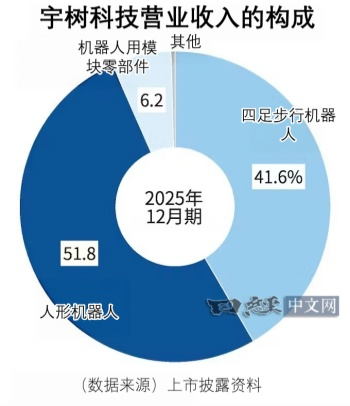
Compared to American companies like Tesla, its biggest advantage is that it has already begun mass production. The cumulative shipment volume of its humanoid robots had reached about 18,000 units by July. Taiwanese research firm TrendForce predicts that in terms of production volume in 2026, it will surpass competitors like AGIBOT and rank first.

Unitree Robotics plans to use about half of the funds obtained from the IPO for R&D of AI models for robotics. The AI will perform functions analogous to the human brain (perceiving the surrounding situation and making decisions) and the cerebellum (controlling complex movements and maintaining balance).

It is reported that future development will especially focus on the "big brain" (the brain). Li Zhihui of Nomura Research Institute, who is familiar with China's tech industry, pointed out, "In the mid-2010s when Unitree was founded, foundational AI models for robotics were still in the development stage. Wang Xingxing previously focused first on developing the 'little brain' (the cerebellum)."

Пов'язані матеріали

Analysis of 13F Holdings of Seven Major Funds: What Are Buffett, Duan Yongping, Li Lu, and Dan Bin Thinking?

A summary of Q2 2026 13F filings from seven major funds (Berkshire Hathaway, Duquesne Family Office, H&H International Investment, Himalaya Capital, ARK Investment, Oriental Harbor Investment Master Fund, Situational Awareness LP) reveals AI remains the central investment theme, with significant capital reallocation within the sector. Berkshire Hathaway, under Greg Abel, made its largest net stock purchases in years, heavily increasing its stake in Alphabet, signaling a strategic tilt towards tech while maintaining core holdings in consumer and financial stocks. Duquesne Family Office (Stanley Druckenmiller) rotated within semiconductors, selling Micron, Broadcom, and Intel but adding to positions in TSMC, STMicroelectronics, and AMD, while also reinvesting in cloud giants Alphabet and Amazon and cautiously re-entering Chinese tech via Baidu. H&H International Investment (Duan Yongping) and Himalaya Capital (Li Lu) both significantly increased their stakes in PDD, with Li Lu also concentrating his portfolio by selling out of several financial and energy holdings to focus on core positions like Alphabet and Berkshire. H&H also took profits from high-flying AI/tech names like Nvidia and Google, viewing the moves as valuation adjustments rather than a loss of conviction. ARK Investment (Cathie Wood) aggressively bought SpaceX upon its IPO and continued hunting for disruptive innovation across AI, energy, and biotech, while reducing its Tesla holding. Oriental Harbor Investment Master Fund (Dan Bin) executed a dramatic shift towards AI hardware, launching major new positions in Intel, SanDisk, AMD, and others while selling down software/platform holdings like Google and clearing out consumer names Apple and Tesla. Situational Awareness LP's filing, reflecting pre-liquidation positions, showed a story of missed hedging opportunities leading to significant losses. The consensus is that AI growth is continuing, but capital is actively rotating to identify the next profit centers within the value chain—from semiconductors and infrastructure to eventual commercialization. The filings, while lagging, offer a snapshot of how sophisticated investors are positioning for AI's next phase.

Odaily星球日报11 хв тому

Analysis of 13F Holdings of Seven Major Funds: What Are Buffett, Duan Yongping, Li Lu, and Dan Bin Thinking?

Odaily星球日报11 хв тому

Arthur Hayes Makes a High-Profile Comeback, Flop Labs Aims to Become the "Fuel" for the Agent Economy

Arthur Hayes, co-founder of BitMEX, has announced his return as head of a new project called Flop Labs, declaring "FLOP is food for your AI agent." This marks his first high-profile return to a leadership role since stepping back from BitMEX. Flop Labs aims to be a native monetary network and verifiable computation settlement layer for the AI Agent economy, distinguishing itself from existing AI Agent projects. Its core concept is "Proof-of-Useful-Inference," which seeks to integrate useful AI inference tasks into the blockchain consensus mechanism, allowing FLOP tokens to serve as the native currency for Agents to purchase computing resources and store memory. The ecosystem involves four key roles: Miners (provide GPU compute), Validators (verify services), Agents (consume services), and KOLs/Partners (community growth). The project promises a 100% fair launch with no presale or VC involvement. A large airdrop is planned for Q4 2026, with the genesis block targeted for Q1 2027. While the announcement has generated community excitement, particularly around the airdrop, the project is in an early conceptual stage. It currently lacks a published whitepaper, detailed tokenomics, technical specifics on its consensus mechanism, or smart contract audits. Arthur Hayes has defended the venture, separating his belief in the potential of the Agentic Economy from concerns about an AI stock bubble. The success of Flop Labs will hinge on its ability to deliver substantive technical progress and ecosystem development in the coming months.

Odaily星球日报26 хв тому

Arthur Hayes Makes a High-Profile Comeback, Flop Labs Aims to Become the "Fuel" for the Agent Economy

Odaily星球日报26 хв тому

World Chain Launches EIP-7928 Block Access Lists on Mainnet

World Chain has launched EIP-7928 block access lists on its Mainnet, becoming the first production layer-2 network to implement this standard. This deployment aims to significantly increase blockchain throughput without substantially raising the hardware requirements for validators. By providing access list data incrementally every 200 milliseconds through its flashblock architecture, World Chain enables validators to verify transactions in parallel and begin validation while a block is still being built, eliminating the need for sequential re-execution. Implemented via a runtime flag rather than a hard fork, this approach is an extension of the EIP-7928 standard, which Ethereum may incorporate in a future update. Internal benchmarks on World Chain test networks showed validation latency remained stable as throughput scaled up to one gigabit per second on standard cloud infrastructure, suggesting the potential for increased throughput without a proportional increase in computational resources for validators. This mainnet launch represents the first production use of streaming EIP-7928 block access lists and contributes to Ethereum's broader scaling strategy by expanding verification capacity while remaining accessible to independent validators. Built on the OP Stack and secured by Ethereum, World Chain is designed for scalability within the Superchain ecosystem. It focuses on applications like stablecoin finance, international remittances, and trading, utilizing World ID's proof-of-human system. The network aims to make blockchain technology widely accessible, starting with discovery and use through compatible wallets like World App.

TheNewsCrypto32 хв тому

World Chain Launches EIP-7928 Block Access Lists on Mainnet

TheNewsCrypto32 хв тому

Торгівля

Спот
活动图片