When 500 Million People Abandon ChatGPT

marsbitОпубліковано о 2026-06-22Востаннє оновлено о 2026-06-22

Анотація

ChatGPT's Global AI Assistant Market Share Drops Below 50% Three and a half years after its groundbreaking launch, ChatGPT faces a pivotal moment. While it remains the largest AI assistant globally, its market share has fallen below 50% for the first time, reaching 46.4% as of May, according to Sensor Tower's 2026 AI landscape report. Google's Gemini (27.7%) and Anthropic's Claude (10.3%) are now its main competitors, with Grok, Perplexity, and others also gaining ground. The market has evolved from awe and initial adoption into a phase of product comparison, ecosystem integration, and commercialization. User behavior has matured significantly. Loyalty is low; users readily switch between assistants for specific tasks. Gemini benefits from deep integration within Google's ecosystem (Search, Gmail, Android), while Claude has carved a niche among productivity-focused users with strong retention, nearly matching ChatGPT's. User choice is now influenced by a complex mix of capability, ecosystem, price, use case, and even brand trust. Commercialization is accelerating. AI app downloads continue but growth is slowing, while user spending is rising. Over $4.2 billion was spent in-app during H1 2026. Claude leads in premium subscription conversion rates (13%). OpenAI is expanding its revenue streams, testing ads shown to 17% of ChatGPT users daily by May. This shift highlights the immense financial pressure of model training and inference costs. Despite revenue growth, OpenAI's c...

It has been three and a half years since ChatGPT burst onto the scene.

Back then, many people realized for the first time that a dialog box might become the next-generation internet portal. Today, it has long since become the fastest application in human history to reach 1 billion monthly active users. Yet, at the same time, it has reached a symbolic turning point:

ChatGPT's global market share has dropped below 50% for the first time.
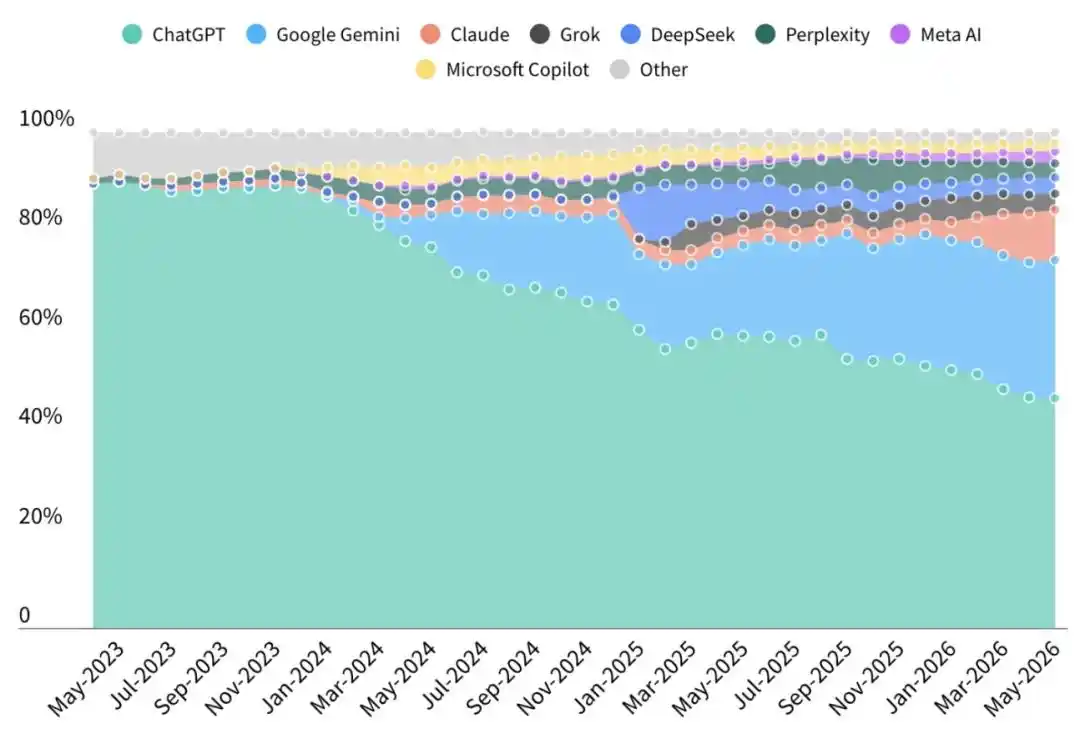
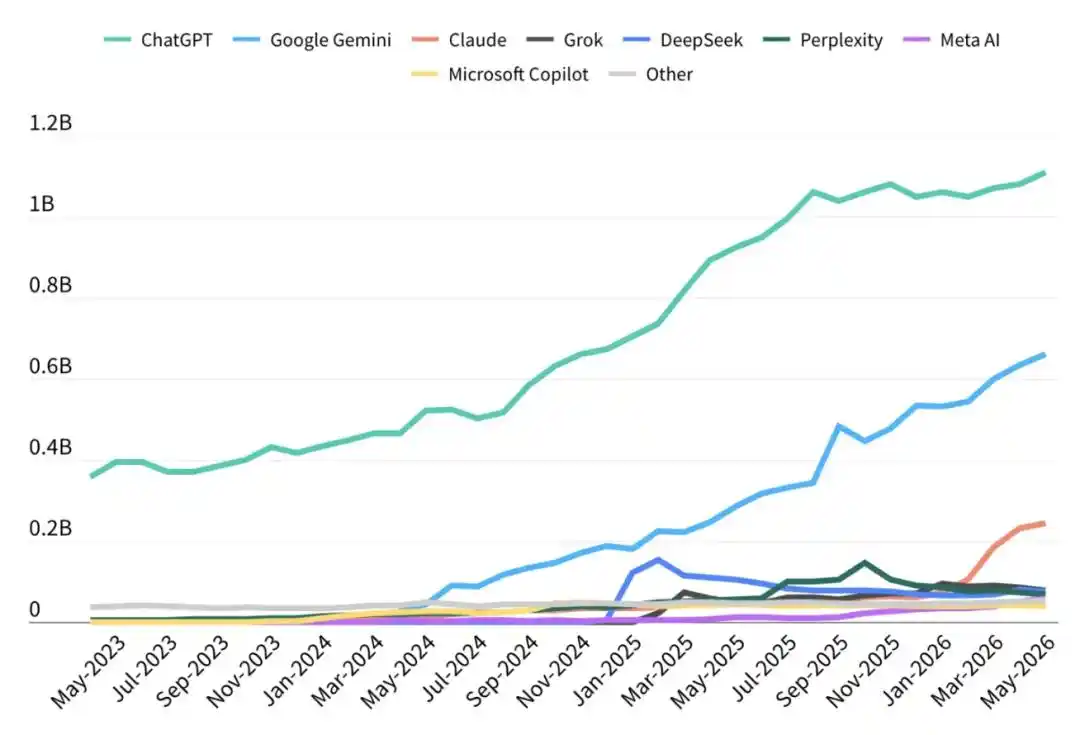
According to the analytics firm Sensor Tower in its "State of AI 2026 Report," as of the end of May this year, ChatGPT's share of the global AI assistant market fell to 46.4%. Prior to January this year, this figure was still above 50%.

ChatGPT remains the world's largest AI assistant. But leading no longer equals monopoly. The AI assistant boom ignited by OpenAI has moved from wonder, trial, and awe into the stage of product comparison, ecosystem lock-in, paid conversion, and commercialization.

Loyalty is a False Promise; Users are 'Players'

In 2023, having a ChatGPT account still carried a certain identity as an AI trendsetter. By 2026, AI assistants are increasingly becoming infrastructure in internet life, much like search, email, and office suites.

The most noteworthy change in Sensor Tower's report is not just that ChatGPT still ranks first. More importantly, users are becoming more willing to migrate. As long as another assistant is more convenient in a specific scenario, users will immediately allocate their time to that other product.

The main rivals pulling ChatGPT's share below 50% are Gemini and Claude.

As of the end of May, Gemini's global share reached 27.7%, and Claude reached 10.3%. Products like Grok, Perplexity, DeepSeek, and Meta AI each remain below 5%, but they are also continuously squeezing the remaining market.
Gemini's growth is not hard to understand.

It stands on the foundation of Google's complete ecosystem. Search, Gmail, Docs, Calendar, and Android are all natural entry points. When AI is embedded into tools users must use daily, many ordinary users don't need to specifically open another webpage to summon ChatGPT.

Especially after the release of Gemini 3.0, Google also achieved its first real major victory, officially joining the AI game table and entering the view of more mainstream users.

Claude's path is more like a victory for productivity tools.

It doesn't have a distribution system like Google's, but it has built a strong reputation in scenarios such as writing, coding, long-text processing, and complex task collaboration. Sensor Tower states that Claude is approaching ChatGPT's user retention levels. For heavy users, AI assistants have shed their toy-like attributes and are starting to genuinely impact work efficiency.
A more subtle change is that users are no longer judging AI products solely based on model capability.

As AI assistants increasingly take on personalized interactive characteristics, users are also beginning to discuss work, emotions, judgments, and decisions with them. Brand trust, value orientation, and institutional relationships may all become part of user choice.

And the slightest bit of negative publicity can trigger a wave of massive uninstalls. This is something OpenAI CEO Sam Altman has likely felt deeply over the past year.

AI companies used to believe that as long as the model was stronger, users would stay. The reality of 2026 is much more complex. Capability, ecosystem, price, scenario, and brand trust are now collectively determining whether an assistant will be used continuously.

The Free Lunch is Over; AI Apps are Starting to Talk Money

Beyond market share, another set of data from Sensor Tower's report better illustrates the stage change in the industry: AI apps are still growing, but the growth logic has changed.

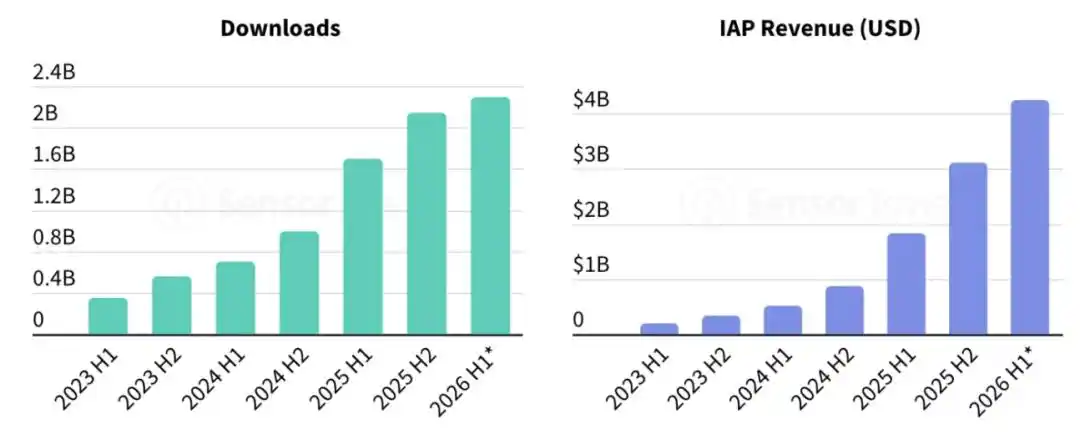
Sensor Tower estimates that in the first half of 2026, global AI app downloads will approach 2.3 billion, and in-app spending will exceed $4.2 billion. In comparison, AI app in-app spending in the first half of 2025 was $1.83 billion.

Users are still downloading AI apps and are willing to pay for AI.

But the growth rates for both downloads and spending have slowed. Meanwhile, the industry has moved from a period of rapid expansion into a more realistic competitive phase. Companies can no longer just talk about user growth; they must also prove they can turn traffic into revenue.

Regional differences are also beginning to show.

Asia remains the highest market for AI app downloads, but in Q1 2026, it saw its first-ever download decline, dropping by 3.3%, mainly influenced by markets like India.
In contrast, North America and Europe are stronger in in-app consumption. For AI companies, what truly determines the business model is often the ability to pay; installation scale can only solve part of the problem.

The trend in the US market is even more pronounced.

Users are increasingly using AI assistants for productivity tasks and are more willing to pay for advanced features. Claude performs well here. Sensor Tower states that Anthropic has 13% of its users subscribing to paid plans, with a conversion rate among the highest in the industry.

A 13% subscription conversion rate explains why Claude can continue to expand its presence amidst the squeeze from giants. As long as AI helps users save time, write code, organize documents, and handle complex tasks, a subscription fee of twenty or even two hundred dollars per month is actually within an acceptable range.

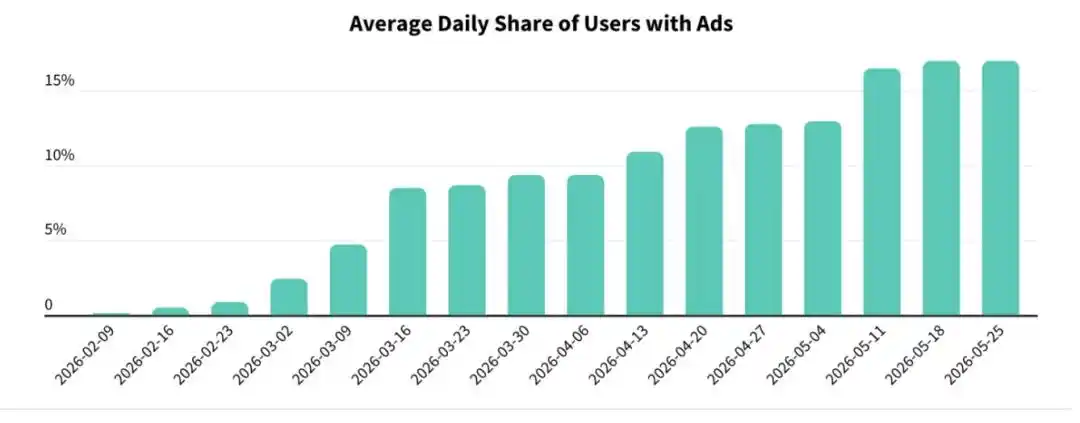
ChatGPT's commercialization path is more diverse and also more controversial. Sensor Tower states that OpenAI began testing ads in ChatGPT starting in February this year, gradually expanding ad display scale and user coverage.

By May, an average of 17% of users saw ads daily. Software and shopping are currently the largest advertiser categories, followed by media & entertainment, and food & beverage.
From subscriptions to ads, ChatGPT is moving towards a more typical internet business model. Early users were familiar with a clean dialog box, a portal imbued with the dream of Artificial General Intelligence (AGI).

Unfortunately, even the smartest AI on the planet ultimately can't escape the fate of becoming a shopping guide. For OpenAI, advertising and shopping have become experiments that must be pursued. Now, this portal is also beginning to carry ads, shopping guides, recommendations, and transaction conversions.

Model inference, training, and compute expenditures are extremely expensive; relying solely on subscription revenue can hardly cover long-term investment. Advertising and shopping are becoming the next pieces of the puzzle for ChatGPT's commercialization.

As AI begins to penetrate core scenarios like shopping, office work, and search, the imagination of AI becoming a unified super portal is also encountering increasingly realistic platform boundaries.

Sensor Tower estimates that in the first half of 2026, global AI app usage time will grow from 17.2 billion hours in the same period last year to approximately 36 billion hours. Among these, the top three AI assistants account for 89% of the total usage time of AI assistant apps.

There is still opportunity for later players, but it exists more in fragmented scenarios, such as AI companions, AI content generation, and vertical industry tools. The main battlefield for general assistants has largely been occupied by ChatGPT, Gemini, and Claude.

Farewell to the Altar; AI Moves Towards the Everyday

The decline in ChatGPT's share occurs at a somewhat paradoxical point in time: OpenAI's revenue is still growing rapidly, its user base is still expanding, and its capital reserves far exceed those of most startups.

According to a report by The Information based on documents disclosed by OpenAI to shareholders, OpenAI's cash consumption reached $3.7 billion in the first quarter, exceeding half of its $5.7 billion revenue. Both cash consumption and revenue roughly tripled year-over-year.

This is also a common challenge facing the current AI industry. Users and revenue continue to grow, yet massive capital investment is required to maintain model training, inference services, and infrastructure construction.
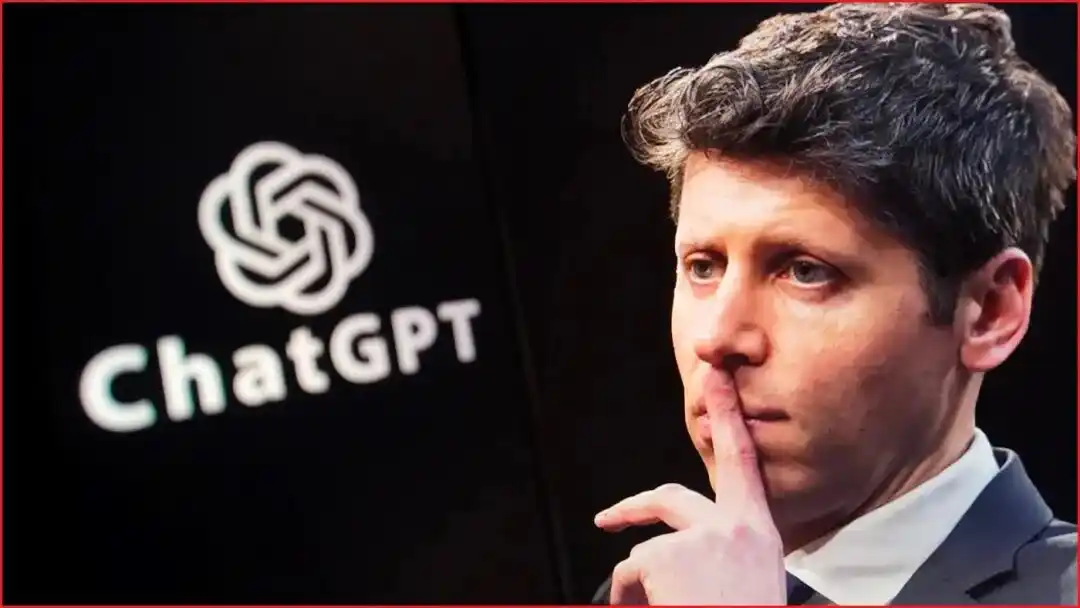
Furthermore, OpenAI expects its cash consumption in 2026 could reach $25 billion, rising further to $57 billion in 2027. Even though OpenAI has secretly submitted IPO filing documents, the listing timing may still be adjusted based on market conditions.

In other words, as one of the world's strongest AI brands, OpenAI still needs to answer a question: when models are getting more expensive, competition is getting fiercer, and users are becoming more willing to migrate, how high a profit margin can ChatGPT's business model ultimately generate.

However, even though ChatGPT's share has fallen below 50%, it remains the world's largest AI assistant and is still the most frequently mentioned name when people talk about AI. But this milestone is symbolic.

The AI assistant market has moved past the era where a single product defined the industry. In the past, ChatGPT was responsible for making the masses believe AI could change the internet. Now, Gemini, Claude, Grok, DeepSeek, and various vertical AI assistants are collectively dividing user time, usage scenarios, and commercial revenue.
User demands are also subtly changing.

By now, you probably are no longer satisfied with just asking AI to write a poem or tell a lame joke. Instead, you're starting to demand it writes code with fewer errors, processes documents more accurately, facilitates office collaboration more conveniently, and offers more reasonable subscription prices.

When a technology no longer elicits repeated amazement but instead begins to be scrutinized, compared, and replaced, it has truly begun to enter mainstream life.

ChatGPT has lost its dominant half of the market, but AI has truly begun to win the world. It's just that in this new world, there are no eternal kings, only us, forever ready to migrate for the sake of a more useful tool.

This article is from the WeChat public account "ifanr," author: ifanr, discovering tomorrow's products.


Трендові криптовалюти

Пов'язані питання

QAccording to the article, what is the key symbolic change in the global AI assistant market share as of May 2026?

AThe key symbolic change is that ChatGPT's global market share has dropped below 50% for the first time, to 46.4%.

QWhich two main competitors are primarily responsible for reducing ChatGPT's market share below 50%?

AGemini (27.7% share) and Claude (10.3% share) are the two main competitors responsible for this reduction.

QWhat are the two main business model paths highlighted for ChatGPT's monetization beyond subscriptions?

AThe two main paths are integrating advertising and e-commerce/shopping features into the ChatGPT platform.

QWhat does the 13% subscription conversion rate for Claude's users indicate, according to the report?

AIt indicates that users are willing to pay for AI assistants that demonstrably improve productivity, such as by saving time or handling complex tasks, making Claude's premium subscription model successful.

QWhat broader industry shift does the article suggest is represented by ChatGPT's market share decline?

AIt represents a shift from a period of awe and trial with a single dominant product to a mature, competitive phase where user choice is driven by specific features, ecosystem integration, pricing, and trust, integrating AI into everyday life.

Пов'язані матеріали

Critical Game Week: BTC Retracement Confirmation vs. HYPE Support Battle | Guest Analysis

This weekly analysis outlines a critical juncture for BTC and HYPE markets, focusing on key price level confirmations. **BTC Analysis:** BTC is at a pivotal point after a five-wave rally from the June 5th low of $59,100. The price has broken below a short-term rising channel's lower boundary, with the current move seen as a pullback to test this breakdown. Failure to reclaim this level could lead to a retest of the $59,000-$60,000 support zone. The core scenario hinges on this channel retest outcome. * **Key Levels:** Resistance at $64,500-$65,000 (channel boundary) and $69,500-$70,500. Support at $59,000-$60,000 and $55,000. * **Strategy:** A core bearish stance is maintained (20% short from last week), with short-term plans for tactical trades. Three detailed contingency plans (A/B/C) are provided for short positions on resistance tests or breakdowns, emphasizing strict stop-loss discipline. **HYPE Analysis:** HYPE shows strong momentum but is currently in a corrective phase after hitting a new high of $76.94. The price is retesting the crucial $64-$66 support area. * **Key Levels:** Resistance near $77 and $80-$82. Support at $64-$66 and $52-$54. * **Strategy:** The short-term approach is "buy on dips, avoid chasing rallies." A long position is considered only if clear stabilization signals appear at the $64-$66 or deeper $52-$54 support zones, with tight risk controls. **General Risk Management:** A standardized trailing stop-loss protocol is emphasized: set initial stop, breakeven at +1% profit, then trail stops upward to lock in gains. *Disclaimer: All analysis is presented as a personal trading framework, not investment advice. Market conditions are complex and require dynamic adjustment.*

marsbit4 хв тому

Critical Game Week: BTC Retracement Confirmation vs. HYPE Support Battle | Guest Analysis

marsbit4 хв тому

Research Report Interpretation: Citi Attends AWS Summit, Bullish on Cloud Business Acceleration but Data Governance Remains Key Variable

Citi analyst Tyler Radke's team attended the AWS New York Summit (June 17-18), engaging with over 10 clients and partners. In a June 19 report, they highlighted the summit's focus on scaling agent AI for enterprise deployment. Citi maintains a "Buy" rating on Amazon, forecasting AWS revenue growth to accelerate to 37% in FY27 from 30% in FY26, noting this estimate may be conservative. Key takeaways: 1. **AWS Strategy Shift:** AWS is moving from proof-of-concepts to scalable deployment. New offerings like AWS Context (building enterprise knowledge graphs), Amazon Quick (cross-application AI assistant), and security tool Continuum address core enterprise pain points for AI adoption. 2. **Data Infrastructure Beneficiaries:** Data infrastructure companies like Snowflake, Elastic, Oracle, and ClickHouse are seen as direct beneficiaries of scaling AI workloads, as evidenced by strong growth and use cases presented. 3. **Critical Role of Data Governance:** As AI agents scale from hundreds to thousands, effective data governance becomes the key variable for deploying AI in core business processes. AWS Context represents AWS's strategic extension from providing compute/models to offering a data governance infrastructure layer. The report emphasizes that without solving data governance, AI will remain confined to pilot projects. The investment thesis focuses on AWS revenue acceleration and data infrastructure vendors' growth, while monitoring signals like AWS's quarterly revenue growth, Bedrock AgentCore task volume, and pricing impacts on companies like Elastic.

marsbit10 хв тому

Research Report Interpretation: Citi Attends AWS Summit, Bullish on Cloud Business Acceleration but Data Governance Remains Key Variable

marsbit10 хв тому

Crucial Week of Contention: BTC Tests Support and HYPE's Key Level Battle | Special Analysis

**Market Enters Critical Week: Bitcoin Pullback Test and HYPE Support Battle** The market enters a crucial phase of contention this week. The marginal shifts in Federal Reserve policy expectations continue to dictate the pricing rhythm for risk assets. Meanwhile, in the crypto market, following a period of sideways consolidation, the divergence between bulls and bears is becoming concentrated at key price levels. **Bitcoin (BTC) Analysis & Strategy** * **Technical View:** The 4-hour chart suggests BTC is in a five-wave structure since the June 5th low near $59,100. Price action shows a short-term rising channel. The recent drop below this channel's lower boundary is now being followed by a pullback attempt (wave 40-41). The outcome of this retest is critical. * **This Week's Outlook:** The core focus is whether BTC can reclaim and hold above the channel's lower boundary. * **Bullish Scenario:** A successful hold could lead to a continued rebound, potentially challenging the $69,500 - $70,500 resistance zone. * **Bearish Scenario:** Failure to hold may trigger a renewed test of the $59,000 - $60,000 core support area, with $55,000 as a deeper support level. * **Operational Strategy:** The author maintains a 20% mid-term short position initiated last week near $64,500, based on a model signaling a shift to a bearish structure. Short-term tactics involve using 30% capital for potential "spread" trades, with three contingency plans (A, B, C) outlined for reacting to resistance tests, breakouts, or support breakdowns. **HYPE Analysis & Strategy** * **Technical View:** On the 4-hour chart, HYPE shows strong momentum, having recently broken to a new high since January. The current pullback presents a clear three-wave correction structure, bringing the price back to the critical $64 - $66 support zone. * **This Week's Outlook:** The focus is on the battle for the $64 - $66 support area. * **Bullish Scenario:** Holding this support could signal a continuation of the uptrend from the June 10th low, leading to new highs. * **Bearish Scenario:** A breakdown could extend the correction, potentially testing the deeper $52 - $54 support band. * **Operational Strategy:** The recommended short-term approach is "buy on dips, avoid chasing rallies." A light long position (under 30% capital) could be considered if HYPE shows stabilization signals at the $64-$66 or $52-$54 support zones, confirmed by model signals. Strict stop-loss discipline is emphasized. **General Risk Management:** A strict trailing stop-loss protocol is advised: set an initial stop; move to breakeven at +1% profit; lock in profits progressively thereafter. *Disclaimer: All analysis is presented as the author's personal technical perspective and trading log, not as investment advice. Markets are complex and dynamic; risk control is paramount.*

Odaily星球日报11 хв тому

Crucial Week of Contention: BTC Tests Support and HYPE's Key Level Battle | Special Analysis

Odaily星球日报11 хв тому

AI Agents Also Need 'Credit Checks': ERC-8126 is Filling the Gap in On-chain Trust

The article discusses ERC-8126, a proposed standard designed to address the lack of trust and verification for AI Agents operating on-chain. While ERC-8004 provides AI Agents with a basic on-chain identity (answering "Who are you?"), it does not guarantee trustworthiness. ERC-8126 aims to fill this gap by establishing a verification layer (answering "Are you reliable?"). It standardizes how independent verification providers can assess an agent's associated risks across five key areas: Token/Contract Verification (ETV), Media Content Verification (MCV), Solidity Code Verification (SCV), Web Application Verification (WAV), and Wallet Verification (WV). These providers generate a standardized risk score (0-100) and proofs based on their checks, without acting as a single authoritative certifier. This allows wallets, marketplaces, dApps, and other agents to consume these risk signals—for example, to display warnings, filter listings, or make interaction decisions. The standard also incorporates concepts like Private Data Verification (PDV) and Zero-Knowledge Proofs (ZKP) to allow verification without exposing sensitive underlying data. Positioned alongside ERC-8004 (Identity) and ERC-8183 (Commerce for agents), ERC-8126 represents a step toward building a verifiable and accountable infrastructure for the emerging on-chain AI Agent economy, shifting trust assessment from purely user-based judgment to standardized, consumable signals.

marsbit29 хв тому

AI Agents Also Need 'Credit Checks': ERC-8126 is Filling the Gap in On-chain Trust

marsbit29 хв тому

Rented Conviction: How Much Real Money Is Behind the Bitcoin ETF Flows

Borrowed Belief: How much of Bitcoin ETF flows are real money? Weekly Bitcoin ETF flows, often interpreted as a measure of institutional conviction, are heavily influenced by a hidden arbitrage trade rather than genuine directional buying. A cash-and-carry arbitrage, where traders buy the ETF while simultaneously shorting Bitcoin futures on the CME to lock in a basis spread (the price difference between futures and spot), drives roughly half of the week-to-week flow volatility. This delta-neutral activity appears as ETF inflows but is unrelated to price views. Data shows a strong correlation (0.70) between weekly ETF inflows and increases in hedge fund short positions on CME futures, while Bitcoin’s weekly price returns have almost no explanatory power. However, this arbitrage activity dominates short-term *fluctuations*, not the cumulative *stock* of investments. Of the total ~$55 billion in net ETF inflows since launch, only about $1 billion currently represents net arbitrage exposure. The vast majority consists of steady, directional buying averaging around $400 million per week. The arbitrage trade has been unwinding for two years, with hedge fund short positions peaking near $14 billion in late 2024 and declining to ~$4.5 billion. Recent ETF outflows partly reflect this ongoing unwind as the basis compresses, not a loss of faith in Bitcoin. Thus, ETF flows overstate the *volatility* of belief, not its *level*. The headline number is more a gauge of arbitrage desk activity than conviction. For accurate interpretation, monitor the CME basis relative to Treasury yields and hedge fund net shorts—these reveal how much of the reported “demand” is truly directional.

marsbit31 хв тому

Rented Conviction: How Much Real Money Is Behind the Bitcoin ETF Flows

marsbit31 хв тому

Торгівля

Спот
Ф'ючерси

Популярні статті

Як купити PEOPLE

Ласкаво просимо до HTX.com! Ми зробили покупку ConstitutionDAO (PEOPLE) простою та зручною. Дотримуйтесь нашої покрокової інструкції, щоб розпочати свою криптовалютну подорож.Крок 1: Створіть обліковий запис на HTXВикористовуйте свою електронну пошту або номер телефону, щоб зареєструвати обліковий запис на HTX безплатно. Пройдіть безпроблемну реєстрацію й отримайте доступ до всіх функцій.ЗареєструватисьКрок 2: Перейдіть до розділу Купити крипту і виберіть спосіб оплатиКредитна/дебетова картка: використовуйте вашу картку Visa або Mastercard, щоб миттєво купити ConstitutionDAO (PEOPLE).Баланс: використовуйте кошти з балансу вашого рахунку HTX для безперешкодної торгівлі.Треті особи: ми додали популярні способи оплати, такі як Google Pay та Apple Pay, щоб підвищити зручність.P2P: Торгуйте безпосередньо з іншими користувачами на HTX.Позабіржова торгівля (OTC): ми пропонуємо індивідуальні послуги та конкурентні обмінні курси для трейдерів.Крок 3: Зберігайте свої ConstitutionDAO (PEOPLE)Після придбання ConstitutionDAO (PEOPLE) збережіть його у своєму обліковому записі на HTX. Крім того, ви можете відправити його в інше місце за допомогою блокчейн-переказу або використовувати його для торгівлі іншими криптовалютами.Крок 4: Торгівля ConstitutionDAO (PEOPLE)Легко торгуйте ConstitutionDAO (PEOPLE) на спотовому ринку HTX. Просто увійдіть до свого облікового запису, виберіть торгову пару, укладайте угоди та спостерігайте за ними в режимі реального часу. Ми пропонуємо зручний досвід як для початківців, так і для досвідчених трейдерів.

493 переглядів усьогоОпубліковано 2024.12.12Оновлено 2026.06.02

Як купити PEOPLE

Обговорення

Ласкаво просимо до спільноти HTX. Тут ви можете бути в курсі останніх подій розвитку платформи та отримати доступ до професійної ринкової інформації. Нижче представлені думки користувачів щодо ціни PEOPLE (PEOPLE).

活动图片