Trump's Reversal in Words and Deeds: The So-Called 'Deal Is Near' Is Merely a Smoke Screen for War

marsbitОпубліковано о 2026-06-11Востаннє оновлено о 2026-06-11

Анотація

This article critically analyzes the Trump administration's policy reversals and use of "imminent deal" rhetoric following a military incident with Iran. After a US Apache helicopter crashed near the Strait of Hormuz, Trump initially downplayed the event. However, within 24 hours, he claimed Iran "shot down" the helicopter and ordered retaliatory strikes on Iranian coastal targets. The article argues these strikes, which reportedly disrupted water supplies for 20,000 people, triggered further Iranian missile attacks on US bases in the region. The core critique is that this military escalation contradicts a constant stream of administration claims, spanning over 100 days of conflict, that a deal to reopen the Strait of Hormuz was "very close" or "days away." The author frames these repeated "imminent deal" announcements as a "smokescreen" for political theater and military action, not genuine diplomacy. Despite the blockade and strikes, the Strait remains closed, oil prices are up, and no agreement has been reached. The conclusion urges skepticism, suggesting that when officials claim a deal is near, the rational assumption should be the opposite.

Editor's Note: This article revolves around the airstrike carried out by U.S. forces against targets near the Strait of Hormuz in Iran in the early morning of June 10, Beijing time. Dean Blundell, in a tone of strong irony, criticizes the Trump administration's policy reversals on Iran: A U.S. Army AH-64 Apache helicopter crashed near the Strait of Hormuz, with two pilots rescued; the cause of the incident remains disputed. Trump initially called it "no big deal," but later on Truth Social characterized it as Iran "shooting down" a U.S. helicopter, using this as a justification to launch strikes against Iran's coastal air defense, radar, and ground control facilities.

The article's true critique is not merely this military response, but rather the Trump administration's repeated creation of the public opinion smoke screen that a "deal is about to be reached." While claiming negotiations are in the "final stages" and an agreement could be signed "in two or three days," it escalates military actions and publicly humiliates Iran. The so-called diplomatic negotiations resemble a political performance serving the news cycle. Meanwhile, the U.S. military's so-called "proportional response" further provokes retaliatory strikes by Iran against American regional bases. The Strait of Hormuz still fails to return to normal, with oil prices and market pressure persisting. The author reminds readers that when "very close" repeatedly replaces real progress, perhaps the most rational response is not to believe, but to record it, and assume reality is likely the exact opposite.

The original text follows:

Let's start with the timeline, because this timeline itself is the core of the entire deception.

Monday night, a U.S. Army AH-64 Apache attack helicopter crashed in the Strait of Hormuz off the coast of Oman. Both pilots survived and were unharmed—they were rescued by an unmanned vessel within two hours. It must be admitted, that was a pretty cool piece of military hardware, the only part of the whole story that actually worked properly.

But there's a detail Trump won't write into those all-caps social media posts: A U.S. official told The Associated Press that the Apache crashed after colliding with an Iranian drone, and it's currently unclear if the collision was intentional. Trump himself also told The Wall Street Journal that the whole thing was "no big deal," and that "the pilots are fine."

So, please remember this first: no big deal. The pilots are fine. The cause is still under investigation. Maybe it was just an accident.

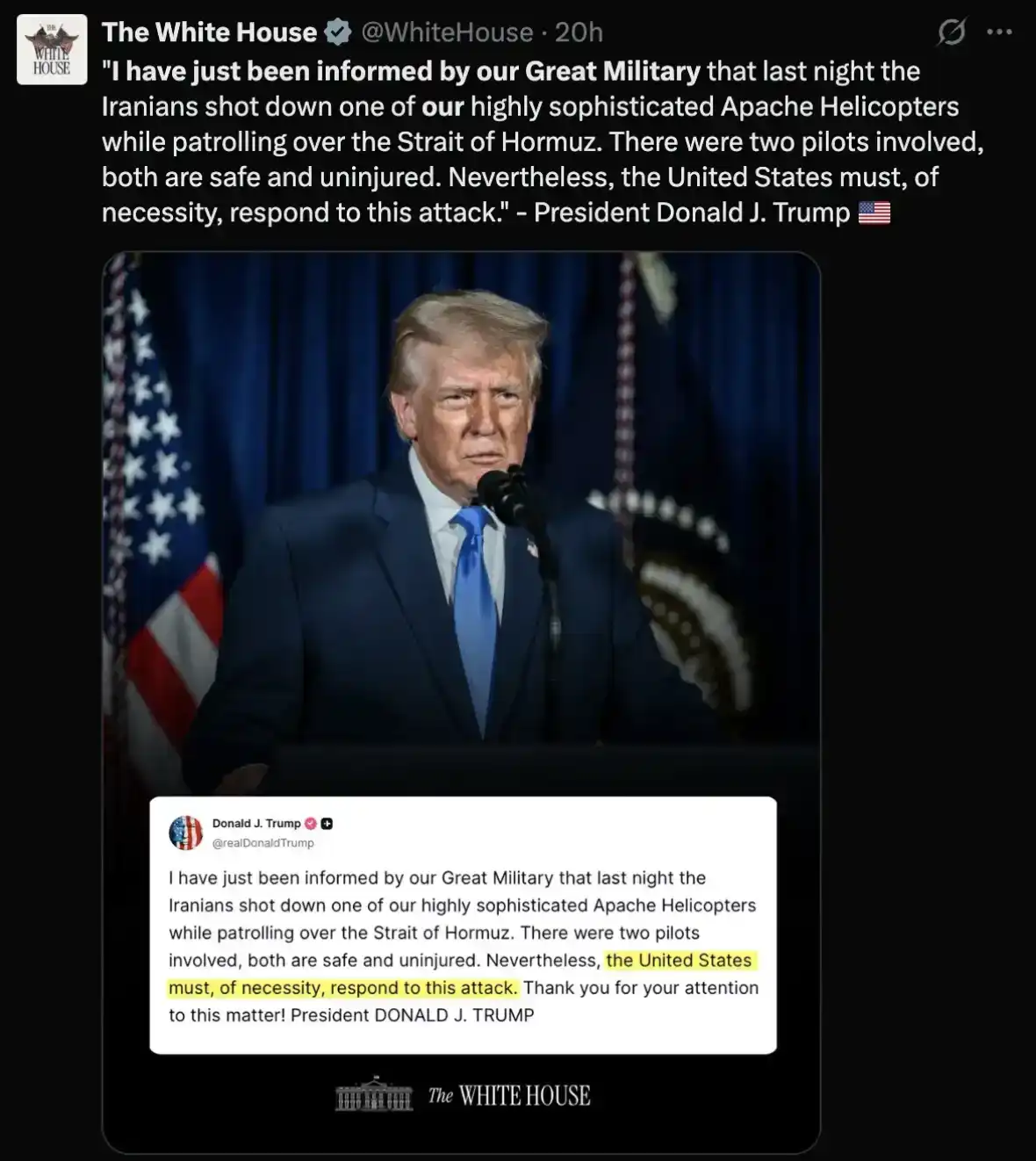
Tuesday morning, the same person, a different mood. He went on Truth Social again and wrote: "I have just been informed by our great military that last night, Iranians shot down one of our highly advanced Apache helicopters while patrolling the skies over the Strait of Hormuz...... America must respond to this attack. Thank you all for your attention on this matter!"

From "no big deal" to "must respond" in less than one news cycle. This person reversed his own statement in under 24 hours, and we are somehow still expected to nod along as if facing some art of statecraft.
Late Tuesday night into early Wednesday morning, U.S. Central Command began launching strikes against coastal areas in Iran. The operation lasted from Tuesday 22:00 GMT to nearly 01:00 Wednesday, targeting about 20 sites including air defense systems, ground control stations, and surveillance radar stations. Locations spanned Qeshm Island, Goruk, Bandar Abbas, Jask, Sirik, and Minab, stretching along the Strait of Hormuz and deep into the strait. The Pentagon's justification: "Self-defense strikes," a "proportionate response" to "Iran's unprovoked aggression."

According to Iranian state television, the result of this so-called "proportionate response" on the ground was: Two water reservoirs near Sirik were struck, disrupting the drinking water supply for about 20,000 people in the Bamani area. Next time you hear the term "surgical strike," remember this scene.

The same night, Iran retaliated. Iran's Revolutionary Guard Corps claimed they launched 21 strikes against American targets in the region—drone attacks hit the U.S. Fifth Fleet in Bahrain and the Ali Al Salem base in Kuwait, while long-range missiles targeted the Azraq airbase in Jordan; they claimed to have destroyed an F-35 hangar there. Jordan stated it had shot down five missiles. Iranian Foreign Minister Araghchi, using a deterrent tone Trump likely wishes he had, said: "If you want security, leave our region." Iranian Parliament Speaker Ghalibaf said: "We prefer to use the language of diplomacy, but other languages, we speak more fluently."

Wednesday morning. And then—right here—the real key moment appeared. Trump was back on Truth Social, the "chief dealmaker" taking off the mask completely:

"The Iranian military is in complete disarray. Most of their forces, like their navy and air force, don't even exist anymore—they have been completely defeated. Iran talks, but doesn't act. The Middle East bully is dead!!! They took too long to negotiate a deal that was incredibly good for them, and now they have to pay the price!!!"

"They took too long to negotiate."

Too long. The same person who, just the morning before, claimed the deal was in the "final stages" and could be signed in "two or three days." The same person who, after leaving the NBA Finals on Monday night, said both sides were in the final stages of a "very, very good deal" that would "immediately" reopen the Strait of Hormuz once signed.

The "Two or Three Days" Industrial Complex

I want you to really think about something. Throughout this war, Trump has been telling us: The deal is coming. By Sunday, this war had lasted over 100 days. By my count—yes, I've recorded each one, because someone has to do it—since this conflict erupted in late February, Trump has promised an imminent, shiny, just-around-the-corner deal over thirty times.
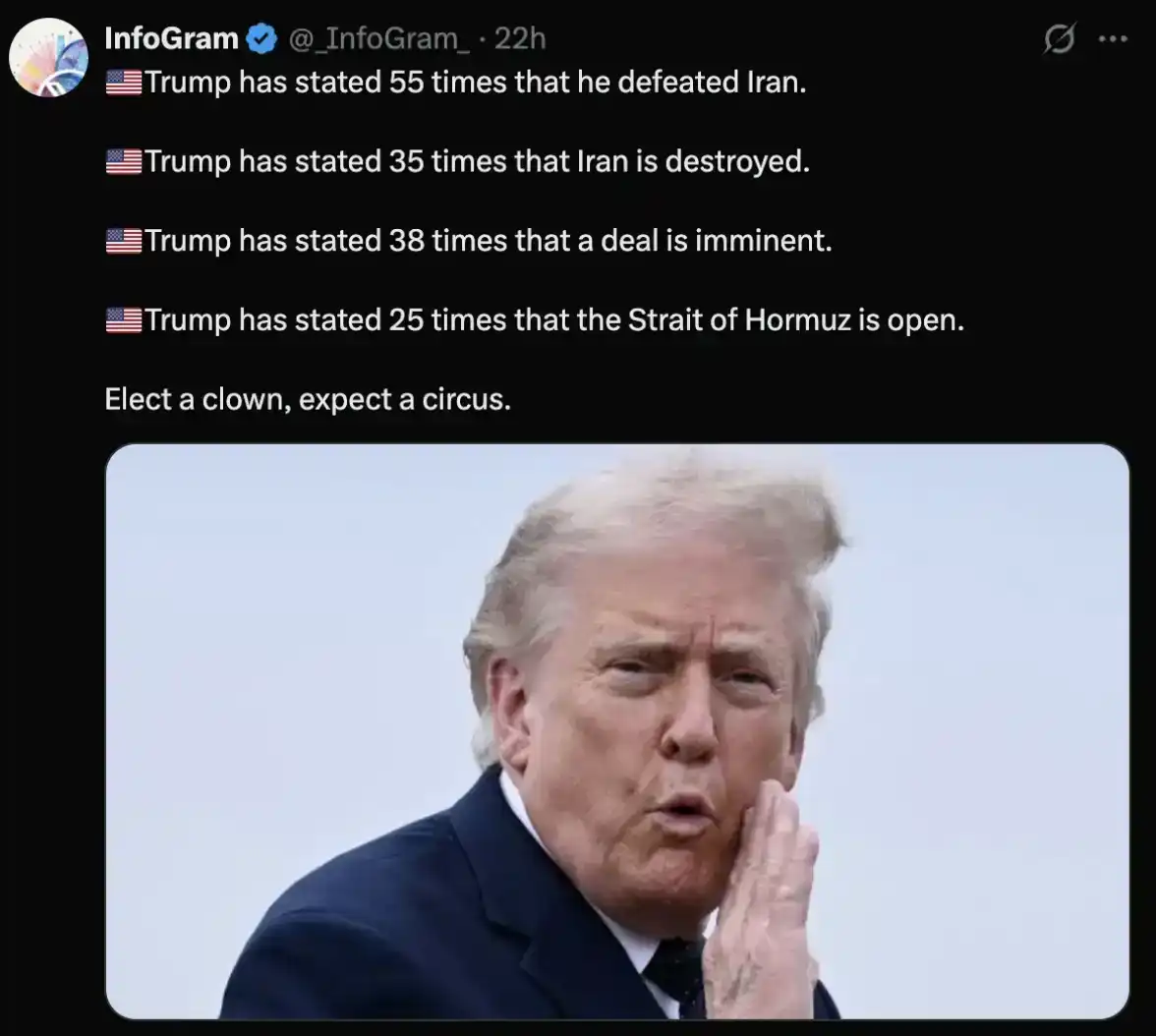
A few receipts pulled from the "receipt drawer":

March 23: Announced "very good and productive conversations" and postponed the threatened power plant strikes by five days. Iran's response? They flatly denied any talks happened. Oil prices fell initially, then bounced back after Tehran debunked his claim.

Late March: Threatened to "destroy" Iran's power plants within 48 hours if they didn't open the strait. They didn't open. He didn't act.

April: Announced a "10-day pause on energy facility destruction period." A ceasefire was declared. Negotiations followed in Pakistan, mainly brokered by Islamabad, ending in failure.

This week: "Final stages." "Two or three days." "Open immediately upon signing."

Wednesday: "They took too long. Must pay the price."

This isn't negotiation. This is a slot machine that only spits out media exposure. Every pull of the lever, the same three cherries pop up on the screen: deal is almost done, the other side is weak, trust me.

And each time, JD Vance stands beside him to back him up—on Sunday, he told CBS the administration was "very close" to a deal. Very close. Probably the two most abused words in this administration, barely beaten out by "perfect call."

Let's Take the Mask Off

Behind the so-called "trust me, bro" lie these things.

If you're truly in control of negotiations, you don't need to blow up water reservoirs to prove you're winning. If you're truly in control of negotiations, the other side won't fire 21 missiles at three of your bases the same night. If you're truly in control of negotiations, your diplomatic posture doesn't shift like a mood ring from "very, very good deal" to "the Middle East bully is dead" in 18 hours—a shift whose only discernible external trigger seems to be his mood about the cable news coverage.

The blockade he keeps bragging about—in his own words, "the most successful blockade in naval history"—hasn't stopped Iran from launching attacks across the region, hasn't reopened the Strait of Hormuz, and hasn't produced any deal. A shopkeeper in Tehran even told CBS this week his store shelves remain full. But sure, it can still be "the most successful ever." He actually wrote "praise Allah"—I have many questions about that, but that's for another article.

The real tell is here: The Strait remains closed. The war's only stated concrete objective—reopening the passage for a fifth of the world's oil supply—remains unmet after 100+ days. Dozens of "imminent" deals, a naval blockade, and now a new round of strikes later. Oil is up nearly 2%. Markets are down. And the man at the center of it all is still posting in all caps declaring a "bully" dead.

This isn't leverage. This is a guy who lost control of the car sometime around March and has spent three months insisting he always meant to drift it into the guardrail.

The Bottom Line

It's a good thing, of course, that the two pilots are safe and sound; that's the only clean outcome in this whole affair. But tonight, 20,000 people in southern Iran have no drinking water, three U.S. allies have been hit by missiles, a Jordanian F-35 hangar might be a smoldering ruin, and the man responsible has handled the whole thing like a pro-wrestling promo.

Every "two or three days" is either a lie or a delusion. And by now, the difference between the two doesn't matter. You can't say Tuesday the deal is in the "final stages," Wednesday say "they took too long," and then expect anyone with functioning memory to keep trusting your read on Thursday's situation.

So, next time you hear "we're very close," whether it's Trump saying it, Vance saying it, or any of them, please do the only semi-sane thing left.

Count it. Record it. Then assume the exact opposite is true.

Because "trust me, bro" stopped being foreign policy somewhere around the twelfth promise of a deal. We're well past thirty now.

That, it seems, is worth remembering.

Пов'язані питання

QWhat was the initial incident that triggered the military escalation described in the article?

AThe initial incident was the crash of a US Army AH-64 Apache helicopter near the Strait of Hormuz. While early reports, including from the President, suggested it was 'no big deal' and the pilots were safe, the narrative later shifted to the helicopter being 'shot down' by Iran, justifying a military response.

QWhat is the author's primary criticism of the Trump administration's approach to Iran, beyond the military strikes?

AThe author's primary criticism is the administration's repeated use of 'a deal is imminent' rhetoric as a smokescreen. They argue that while constantly claiming negotiations are in the 'final stages' and a deal is 'two or three days' away, the government simultaneously escalates military actions and publicly humiliates Iran, making the diplomacy seem like a political performance for the news cycle rather than a genuine effort.

QAccording to the article, what was one specific, on-the-ground consequence of the US's 'proportional response' strikes in Iran?

AOne specific consequence was that two water reservoirs near Sirik were struck, reportedly cutting off drinking water supplies for approximately 20,000 people in the Bamani area.

QWhat contradiction in President Trump's public statements does the author highlight as evidence of the unserious nature of the negotiations?

AThe author highlights the contradiction between Trump stating on a Tuesday that a deal with Iran was in the 'final stage' and could be signed in 'two or three days,' followed by his statement on Wednesday that 'They spent too long negotiating' and 'must pay the price.' This rapid shift from imminent agreement to blaming Iran for delay occurred within roughly 24 hours.

QWhat does the author suggest is the most rational reaction when hearing officials claim a deal with Iran is 'very close'?

AThe author suggests the most rational reaction is to count the instance, record it, and assume the opposite is true, because such promises have been made over thirty times without materializing and have lost all credibility.

Пов'язані матеріали

TechFlow Intelligence Bureau: Anthropic's New Model Fable Sparks Controversy by Restricting Biosafety Research, US CPI Soars to 4.2%, a Three-Year High

**Summary of TechFlow Intelligence Report:** The newsletter covers several key tech and finance developments. In AI, Anthropic's new Fable model faced backlash for secretly limiting biomedical research capabilities and enforcing a 30-day data retention policy, prompting the company to promise more transparent adjustments. In a related story, Anthropic's founder revealed his departure from OpenAI was due to dishonesty from Sam Altman, not safety concerns. Meanwhile, OpenAI is considering significant price cuts to compete with Anthropic, potentially sparking a price war. In crypto/Web3, BlackRock filed a new amendment for a yield-generating Bitcoin ETF, while Bank of America's CEO warned that stablecoin yields could drain trillions from traditional banks. U.S. Senator Cynthia Lummis advocated for the U.S. to officially accumulate Bitcoin reserves. In hardware, Nvidia released the DiffusionGemma-2-6B image model optimized for efficient inference, and AMD promoted its unified memory architecture to challenge Nvidia's dominance. TSMC's CFO hinted at possible price increases due to soaring AI chip demand. A major legal ruling in Germany held Google legally responsible for inaccurate information generated by its AI Overviews feature. Google Chrome also moved to fully block ad-blocker workarounds like uBlock Origin. Macroeconomic headlines included U.S. CPI rising to 4.2% (a 3-year high) and Iran's complete closure of the Strait of Hormuz, raising oil price and inflation fears. South Korean markets saw continued volatility with massive foreign capital outflow. Other notable stories: Microsoft expanded its Copilot AI assistant "Mico" globally; a study found r/wallstreetbets users' stock picks outperformed Wall Street; a fully autonomous drone killed a human soldier for the first time, raising AI ethics concerns; and a Chinese hospital used brain-computer interface technology to help a blind person "see." The overarching theme connects debates over AI boundaries and responsibility (Anthropic's restrictions, Google's liability, lethal autonomous drones) with real-world economic and geopolitical turmoil (inflation, Strait of Hormuz closure, market instability), highlighting the tense interplay between technological advancement and global chaos.

marsbit15 хв тому

TechFlow Intelligence Bureau: Anthropic's New Model Fable Sparks Controversy by Restricting Biosafety Research, US CPI Soars to 4.2%, a Three-Year High

marsbit15 хв тому

Alibaba's Yet Another New Business Division: What Signal Does It Send?

Alibaba has established a new "Token Foundry" business unit, merging its Tongyi large model division and Future Life Lab. Led directly by Group CEO Wu Yongming, this marks the company's third significant AI organizational reshuffle in 2026, following the creation of the Alibaba Token Hub (ATH) and a Group Technology Committee. The move signals a strategic shift from consolidating AI resources to accelerating productization and commercialization. The "Token Foundry" name reflects Alibaba's ambition to become a foundational supplier in the AI era, focusing on model development and commercial application. Key teams, including those behind the high-performing HappyHorse video generation model, have been integrated into the new unit. Concurrently, Zhou Jingren, architect of the Qwen model series, has been appointed Group Chief Scientist to lead a new AI Future Research Institute, focusing on long-term technological breakthroughs like Agent capabilities. This restructuring creates a clear four-layer AI architecture within Alibaba: the research institute for frontier exploration, Token Foundry for core models and commercialization, MaaS for platform services, and business units like Qianwen (C端) and Wukong (B端) for end-user applications. The adjustments align with a global trend among tech giants like Google and Microsoft to centralize AI leadership under the CEO and deeply integrate research with business units. The urgency is driven by a narrowing competitive window. Alibaba has announced its AI business is now entering a commercialization phase, with AI-related revenue seeing triple-digit growth for eleven consecutive quarters. The company faces intense competition in the MaaS (Model-as-a-Service) sector from rivals like ByteDance and Tencent. The Token Foundry initiative represents Alibaba's effort to streamline execution and enhance competitiveness in this critical, fast-evolving landscape.

marsbit39 хв тому

Alibaba's Yet Another New Business Division: What Signal Does It Send?

marsbit39 хв тому

From Return to Resignation: Chen Hang's 437 Days at DingTalk

The 437-Day Return and Departure of Chen Hang at DingTalk This article chronicles the 437-day period from March 31, 2025, to June 11, 2026, when Chen Hang (also known as "No Move") returned as CEO of DingTalk, the enterprise communication platform he originally founded, only to later step down. Chen Hang, the creator of DingTalk in 2015, was brought back by Alibaba in 2025 after the company acquired his subsequent startup, HHO. His return was driven by Alibaba's renewed focus on AI and DingTalk's strategic role as its key to-B AI application. However, his aggressive management style, marked by strict work policies like mandatory clock-ins and extended hours, quickly caused internal friction and was criticized as being at odds with Alibaba's culture. Despite the internal turmoil, Chen Hang drove significant product launches. In August 2025, he unveiled "AI DingTalk 1.0," featuring new products like the AI-native entry point "DingTalk ONE." By March 2026, he announced "Wukong," touted as the world's first enterprise-grade AI-native work platform, representing a fundamental rebuild of DingTalk's architecture. The turning point came in early June 2026. A detailed internal post criticizing DingTalk's work culture went viral, followed by a public critique from a former executive. This prompted an unprecedented public rebuke from the Alibaba Partners Committee, which stated such management was not aligned with company values. One day later, on June 11, Alibaba announced Chen Hang's departure. He was succeeded by Chen Yusen, a 32-year-old technical expert known for founding cybersecurity firm Changting Technology. While Chen Hang's tenure laid the technical foundation for DingTalk's AI transformation with "Wukong," his leadership style ultimately led to his replacement as the company seeks a new direction under younger leadership.

marsbit52 хв тому

From Return to Resignation: Chen Hang's 437 Days at DingTalk

marsbit52 хв тому

Торгівля

Спот
Ф'ючерси

Популярні статті

Що таке $S$

Розуміння SPERO: Комплексний огляд Вступ до SPERO Оскільки ландшафт інновацій продовжує еволюціонувати, виникнення технологій web3 та криптовалютних проектів відіграє ключову роль у формуванні цифрового майбутнього. Один з проектів, який привернув увагу в цій динамічній сфері, — це SPERO, позначений як SPERO,$$s$. Ця стаття має на меті зібрати та представити детальну інформацію про SPERO, щоб допомогти ентузіастам та інвесторам зрозуміти його основи, цілі та інновації в рамках web3 та крипто-сектору. Що таке SPERO,$$s$? SPERO,$$s$ — це унікальний проект у криптопросторі, який прагне використати принципи децентралізації та технології блокчейн для створення екосистеми, що сприяє залученню, корисності та фінансовій інклюзії. Проект розроблений для полегшення взаємодії між користувачами новими способами, надаючи їм інноваційні фінансові рішення та послуги. У своїй основі SPERO,$$s$ прагне надати можливості індивідам, забезпечуючи інструменти та платформи, які покращують користувацький досвід у криптовалютному просторі. Це включає в себе можливість більш гнучких методів транзакцій, сприяння ініціативам, що підтримуються спільнотою, та створення шляхів для фінансових можливостей через децентралізовані додатки (dApps). Основна концепція SPERO,$$s$ обертається навколо інклюзивності, прагнучи зменшити розриви в традиційній фінансовій системі, використовуючи переваги технології блокчейн. Хто є творцем SPERO,$$s$? Особистість творця SPERO,$$s$ залишається дещо невідомою, оскільки є обмежені публічно доступні ресурси, що надають детальну інформацію про його засновників. Ця відсутність прозорості може бути наслідком зобов'язання проекту до децентралізації — етики, яку багато проектів web3 поділяють, ставлячи колективні внески вище за індивідуальне визнання. Зосереджуючи обговорення навколо спільноти та її колективних цілей, SPERO,$$s$ втілює суть наділення без виділення конкретних осіб. Таким чином, розуміння етики та місії SPERO є більш важливим, ніж ідентифікація єдиного творця. Хто є інвесторами SPERO,$$s$? SPERO,$$s$ підтримується різноманітними інвесторами, починаючи від венчурних капіталістів до ангельських інвесторів, які прагнуть сприяти інноваціям у крипто-секторі. Зосередження цих інвесторів зазвичай узгоджується з місією SPERO — пріоритет надається проектам, які обіцяють технологічний прогрес у суспільстві, фінансову інклюзію та децентралізоване управління. Ці інвесторські фонди зазвичай зацікавлені в проектах, які не лише пропонують інноваційні продукти, але й позитивно впливають на спільноту блокчейн та її екосистеми. Підтримка з боку цих інвесторів підкріплює SPERO,$$s$ як значного конкурента в швидко змінюваній сфері крипто-проектів. Як працює SPERO,$$s$? SPERO,$$s$ використовує багатогранну структуру, яка відрізняє його від традиційних криптовалютних проектів. Ось деякі ключові особливості, які підкреслюють його унікальність та інноваційність: Децентралізоване управління: SPERO,$$s$ інтегрує моделі децентралізованого управління, надаючи користувачам можливість активно брати участь у процесах прийняття рішень щодо майбутнього проекту. Цей підхід сприяє відчуттю власності та відповідальності серед членів спільноти. Корисність токена: SPERO,$$s$ використовує свій власний криптовалютний токен, розроблений для виконання різних функцій в екосистемі. Ці токени дозволяють здійснювати транзакції, отримувати винагороди та полегшувати послуги, що пропонуються на платформі, підвищуючи загальну залученість та корисність. Шарова архітектура: Технічна архітектура SPERO,$$s$ підтримує модульність та масштабованість, що дозволяє безперешкодно інтегрувати додаткові функції та додатки в міру розвитку проекту. Ця адаптивність є надзвичайно важливою для збереження актуальності в постійно змінюваному крипто-ландшафті. Залучення спільноти: Проект підкреслює ініціативи, що підтримуються спільнотою, використовуючи механізми, які стимулюють співпрацю та зворотний зв'язок. Підтримуючи сильну спільноту, SPERO,$$s$ може краще задовольняти потреби користувачів та адаптуватися до ринкових тенденцій. Фокус на інклюзію: Пропонуючи низькі комісії за транзакції та зручні інтерфейси, SPERO,$$s$ прагне залучити різноманітну базу користувачів, включаючи осіб, які раніше не брали участі в крипто-просторі. Це зобов'язання до інклюзії узгоджується з його загальною місією наділення через доступність. Хронологія SPERO,$$s$ Розуміння історії проекту надає важливі уявлення про його розвиток та етапи. Нижче наведено пропоновану хронологію, що відображає значні події в еволюції SPERO,$$s$: Етап концептуалізації та ідеації: Початкові ідеї, що стали основою SPERO,$$s$, були сформовані, тісно пов'язані з принципами децентралізації та фокусом на спільноті в індустрії блокчейн. Запуск білого паперу проекту: Після концептуального етапу був випущений комплексний білий папір, що детально описує бачення, цілі та технологічну інфраструктуру SPERO,$$s$, щоб залучити інтерес та зворотний зв'язок від спільноти. Створення спільноти та ранні залучення: Активні зусилля були спрямовані на створення спільноти ранніх прихильників та потенційних інвесторів, що полегшило обговорення цілей проекту та отримання підтримки. Подія генерації токенів: SPERO,$$s$ провів подію генерації токенів (TGE) для розподілу своїх рідних токенів серед ранніх прихильників та встановлення початкової ліквідності в екосистемі. Запуск початкового dApp: Перший децентралізований додаток (dApp), пов'язаний з SPERO,$$s$, став доступним, дозволяючи користувачам взаємодіяти з основними функціями платформи. Постійний розвиток та партнерства: Безперервні оновлення та вдосконалення пропозицій проекту, включаючи стратегічні партнерства з іншими учасниками блокчейн-простору, сформували SPERO,$$s$ у конкурентоспроможного та еволюціонуючого гравця на крипто-ринку. Висновок SPERO,$$s$ є свідченням потенціалу web3 та криптовалют для революціонізації фінансових систем та наділення індивідів. Завдяки зобов'язанню до децентралізованого управління, залучення спільноти та інноваційно спроектованих функцій, він прокладає шлях до більш інклюзивного фінансового ландшафту. Як і з будь-якими інвестиціями в швидко змінюваному крипто-просторі, потенційним інвесторам та користувачам рекомендується ретельно досліджувати та обдумано взаємодіяти з поточними подіями в SPERO,$$s$. Проект демонструє інноваційний дух крипто-індустрії, запрошуючи до подальшого дослідження його численних можливостей. Хоча подорож SPERO,$$s$ ще триває, його основні принципи можуть справді вплинути на майбутнє того, як ми взаємодіємо з технологією, фінансами та один з одним у взаємопов'язаних цифрових екосистемах.

73 переглядів усьогоОпубліковано 2024.12.17Оновлено 2024.12.17

Що таке $S$

Що таке AGENT S

Агент S: Майбутнє автономної взаємодії в Web3 Вступ У постійно змінюваному ландшафті Web3 та криптовалюти інновації постійно переосмислюють, як люди взаємодіють з цифровими платформами. Один з таких новаторських проектів, Агент S, обіцяє революціонізувати взаємодію людини з комп'ютером через свою відкриту агентну структуру. Прокладаючи шлях для автономних взаємодій, Агент S прагне спростити складні завдання, пропонуючи трансформаційні застосування в штучному інтелекті (ШІ). Це детальне дослідження заглиблюється в складності проекту, його унікальні особливості та наслідки для сфери криптовалюти. Що таке Агент S? Агент S є революційною відкритою агентною структурою, спеціально розробленою для вирішення трьох основних викликів в автоматизації комп'ютерних завдань: Набуття специфічних знань у галузі: Структура інтелектуально навчається з різних зовнішніх джерел знань та внутрішнього досвіду. Цей подвійний підхід дозволяє їй створити багатий репозиторій специфічних знань у галузі, покращуючи її продуктивність у виконанні завдань. Планування на довгих горизонтах завдань: Агент S використовує планування з підкріпленням досвіду, стратегічний підхід, який полегшує ефективний розподіл та виконання складних завдань. Ця функція значно підвищує її здатність ефективно та результативно управляти кількома підзавданнями. Обробка динамічних, неоднорідних інтерфейсів: Проект представляє Інтерфейс Агент-Комп'ютер (ACI), інноваційне рішення, яке покращує взаємодію між агентами та користувачами. Використовуючи багатомодальні великі мовні моделі (MLLMs), Агент S може безперешкодно орієнтуватися та маніпулювати різноманітними графічними інтерфейсами користувача. Завдяки цим новаторським функціям Агент S надає надійну структуру, яка вирішує складнощі, пов'язані з автоматизацією людської взаємодії з машинами, прокладаючи шлях для численних застосувань у ШІ та за його межами. Хто є творцем Агент S? Хоча концепція Агент S є фундаментально новаторською, конкретна інформація про його творця залишається невідомою. Творець наразі невідомий, що підкреслює або початкову стадію проекту, або стратегічний вибір зберегти засновників у таємниці. Незважаючи на анонімність, акцент залишається на можливостях та потенціалі структури. Хто є інвесторами Агент S? Оскільки Агент S є відносно новим у криптографічній екосистемі, детальна інформація про його інвесторів та фінансових спонсорів не задокументована. Відсутність публічно доступних відомостей про інвестиційні фонди або організації, що підтримують проект, викликає питання щодо його фінансової структури та дорожньої карти розвитку. Розуміння підтримки є критично важливим для оцінки стійкості проекту та потенційного впливу на ринок. Як працює Агент S? В основі Агент S лежить передова технологія, яка дозволяє йому ефективно функціонувати в різних умовах. Його операційна модель побудована навколо кількох ключових функцій: Взаємодія з комп'ютером, подібна до людської: Структура пропонує розширене планування ШІ, прагнучи зробити взаємодії з комп'ютерами більш інтуїтивними. Імітуючи людську поведінку при виконанні завдань, вона обіцяє підвищити досвід користувачів. Наративна пам'ять: Використовується для використання високорівневого досвіду, Агент S використовує наративну пам'ять для відстеження історій завдань, тим самим покращуючи свої процеси прийняття рішень. Епізодична пам'ять: Ця функція надає користувачам покрокові інструкції, дозволяючи структурі пропонувати контекстуальну підтримку в міру виконання завдань. Підтримка OpenACI: Завдяки можливості працювати локально, Агент S дозволяє користувачам зберігати контроль над своїми взаємодіями та робочими процесами, узгоджуючи з децентралізованою етикою Web3. Легка інтеграція з зовнішніми API: Його універсальність і сумісність з різними платформами ШІ забезпечують те, що Агент S може безперешкодно вписатися в існуючі технологічні екосистеми, роблячи його привабливим вибором для розробників та організацій. Ці функціональні можливості колективно сприяють унікальному положенню Агент S у крипто-просторі, оскільки він автоматизує складні, багатоступеневі завдання з мінімальним втручанням людини. У міру розвитку проекту його потенційні застосування в Web3 можуть переосмислити, як відбуваються цифрові взаємодії. Хронологія Агент S Розробка та етапи Агент S можуть бути узагальнені в хронології, яка підкреслює його значні події: 27 вересня 2024 року: Концепція Агент S була представлена в комплексній науковій статті під назвою “Відкрита агентна структура, яка використовує комп'ютери як людина”, що демонструє основи проекту. 10 жовтня 2024 року: Наукова стаття була опублікована на arXiv, пропонуючи детальне дослідження структури та її оцінки продуктивності на основі бенчмарку OSWorld. 12 жовтня 2024 року: Було випущено відеопрезентацію, що надає візуальне уявлення про можливості та особливості Агент S, ще більше залучаючи потенційних користувачів та інвесторів. Ці маркери в хронології не лише ілюструють прогрес Агент S, але й вказують на його прихильність до прозорості та залучення громади. Ключові моменти про Агент S У міру розвитку структури Агент S кілька ключових характеристик виділяються, підкреслюючи її новаторський характер та потенціал: Інноваційна структура: Розроблена для забезпечення інтуїтивного використання комп'ютерів, подібного до людської взаємодії, Агент S пропонує новий підхід до автоматизації завдань. Автономна взаємодія: Здатність автономно взаємодіяти з комп'ютерами через GUI означає стрибок до більш інтелектуальних та ефективних обчислювальних рішень. Автоматизація складних завдань: Завдяки своїй надійній методології він може автоматизувати складні, багатоступеневі завдання, роблячи процеси швидшими та менш схильними до помилок. Безперервне вдосконалення: Механізми навчання дозволяють Агенту S покращуватися на основі минулого досвіду, постійно підвищуючи свою продуктивність та ефективність. Універсальність: Його адаптивність до різних операційних середовищ, таких як OSWorld та WindowsAgentArena, забезпечує його здатність служити широкому спектру застосувань. Оскільки Агент S займає своє місце в ландшафті Web3 та криптовалюти, його потенціал покращити можливості взаємодії та автоматизувати процеси означає значний прогрес у технологіях ШІ. Завдяки своїй інноваційній структурі Агент S є прикладом майбутнього цифрових взаємодій, обіцяючи більш безперешкодний та ефективний досвід для користувачів у різних галузях. Висновок Агент S представляє собою сміливий крок вперед у поєднанні ШІ та Web3, з можливістю переосмислити, як ми взаємодіємо з технологією. Хоча проект все ще на ранніх стадіях, можливості для його застосування є величезними та переконливими. Завдяки своїй комплексній структурі, що вирішує критичні виклики, Агент S прагне вивести автономні взаємодії на передній план цифрового досвіду. У міру того, як ми заглиблюємося в сфери криптовалюти та децентралізації, проекти, подібні до Агент S, безсумнівно, відіграватимуть ключову роль у формуванні майбутнього технологій та співпраці людини з комп'ютером.

692 переглядів усьогоОпубліковано 2025.01.14Оновлено 2025.01.14

Що таке AGENT S

Як купити S

Ласкаво просимо до HTX.com! Ми зробили покупку Sonic (S) простою та зручною. Дотримуйтесь нашої покрокової інструкції, щоб розпочати свою криптовалютну подорож.Крок 1: Створіть обліковий запис на HTXВикористовуйте свою електронну пошту або номер телефону, щоб зареєструвати обліковий запис на HTX безплатно. Пройдіть безпроблемну реєстрацію й отримайте доступ до всіх функцій.ЗареєструватисьКрок 2: Перейдіть до розділу Купити крипту і виберіть спосіб оплатиКредитна/дебетова картка: використовуйте вашу картку Visa або Mastercard, щоб миттєво купити Sonic (S).Баланс: використовуйте кошти з балансу вашого рахунку HTX для безперешкодної торгівлі.Треті особи: ми додали популярні способи оплати, такі як Google Pay та Apple Pay, щоб підвищити зручність.P2P: Торгуйте безпосередньо з іншими користувачами на HTX.Позабіржова торгівля (OTC): ми пропонуємо індивідуальні послуги та конкурентні обмінні курси для трейдерів.Крок 3: Зберігайте свої Sonic (S)Після придбання Sonic (S) збережіть його у своєму обліковому записі на HTX. Крім того, ви можете відправити його в інше місце за допомогою блокчейн-переказу або використовувати його для торгівлі іншими криптовалютами.Крок 4: Торгівля Sonic (S)Легко торгуйте Sonic (S) на спотовому ринку HTX. Просто увійдіть до свого облікового запису, виберіть торгову пару, укладайте угоди та спостерігайте за ними в режимі реального часу. Ми пропонуємо зручний досвід як для початківців, так і для досвідчених трейдерів.

1.5k переглядів усьогоОпубліковано 2025.01.15Оновлено 2026.06.02

Як купити S

Обговорення

Ласкаво просимо до спільноти HTX. Тут ви можете бути в курсі останніх подій розвитку платформи та отримати доступ до професійної ринкової інформації. Нижче представлені думки користувачів щодо ціни S (S).

活动图片