Behind ZEC's Over 30% Plunge: An 'Unlimited Minting' Vulnerability with No Way to Prove if It Was Ever Exploited

marsbitОпубліковано о 2026-06-05Востаннє оновлено о 2026-06-05

Анотація

A critical vulnerability was discovered in Zcash's Orchard privacy pool, allowing for the theoretical creation of undetectable counterfeit ZEC. Researcher Taylor Hornby found the flaw on May 29th, 2024, within the Orchard circuit's cryptographic constraints, which could let an attacker bypass asset conservation rules. Although a rapid emergency fix was deployed within days via a coordinated soft and hard fork, a core uncertainty remains: due to Orchard's privacy features, it is impossible to cryptographically prove whether this "unlimited mint" flaw was exploited in the nearly four years since the pool's 2022 launch. This uncertainty, rather than the patched flaw itself, triggered a market panic, causing ZEC's price to drop over 30%. While the Zcash Foundation stated no evidence of exploitation was found, independent entity Shielded Labs emphasized the impossibility of definitively proving no counterfeit ZEC was ever created. The incident highlights the unique trust challenge in privacy systems. To address this, developers are proposing a new network upgrade with enhanced auditing to allow verifiable proof of supply integrity. Notably, the researcher utilized the newly released AI model Claude Opus 4.8 as a tool during the security review, signaling the growing role of advanced AI in uncovering complex cryptographic vulnerabilities.

On June 5th, Zcash founder Zooko Wilcox published a rare, detailed security retrospective.

The article disclosed that security researcher Taylor Hornby discovered a severe forging vulnerability in Orchard, Zcash's latest generation privacy pool, on May 29th. An attacker could construct a transaction that should not have passed validation, generating unlimited and undetectable counterfeit ZEC within Orchard.

This was not merely a theoretical risk. Taylor had already written a complete exploit program in a local test environment, successfully generating counterfeit ZEC. If the same program were deployed on the mainnet, an attacker could theoretically generate an unlimited quantity of counterfeit assets in their own mainnet wallet.

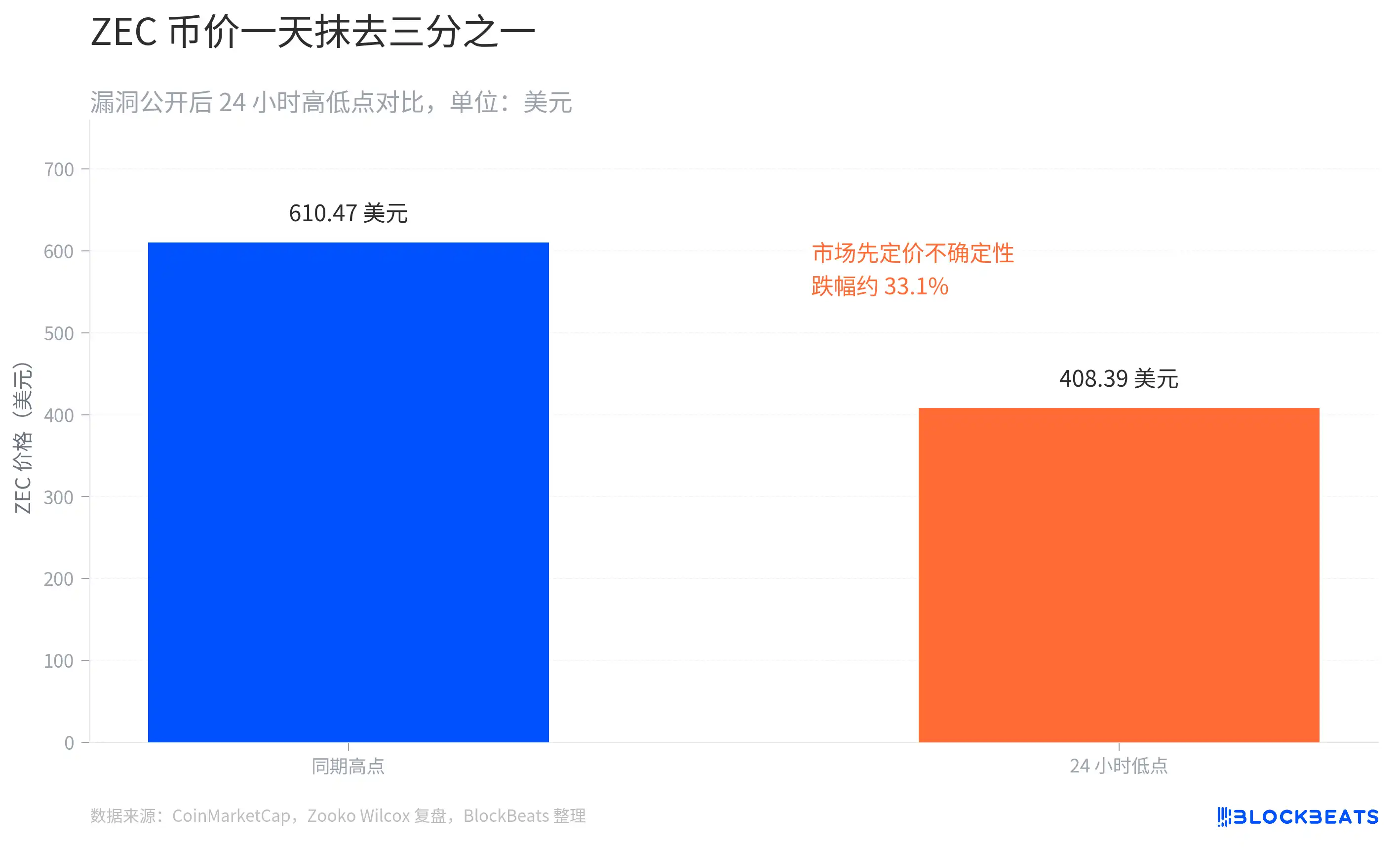
After the news became public, ZEC plunged by over 30%. Data from CoinMarketCap shows ZEC hit a 24-hour low of $408.39, down about one-third from its recent high of $610.47. Unfortunately, this was one of the few assets in the crypto space with excellent wealth effects recently, boasting a promising narrative favored by numerous industry leaders, now shattered by this vulnerability.
If one only looks at the outcome, this seems like another familiar crypto security incident: a vulnerability is discovered, developers rush to patch it, and the market panics.

However, the truly thorny aspect of the Orchard incident is that, while the vulnerability has been patched, the Zcash community cannot directly answer another, more sensitive question:

Has anyone exploited this vulnerability in the past four years?

Four-Day Emergency Patch, Orchard Briefly Suspended

Orchard is Zcash's next-generation privacy payment protocol launched in 2022 and one of the primary privacy pools currently used by Zcash. Users can hide balances, transaction amounts, and fund flows, while proving to the network via zero-knowledge proofs that transactions comply with the rules.

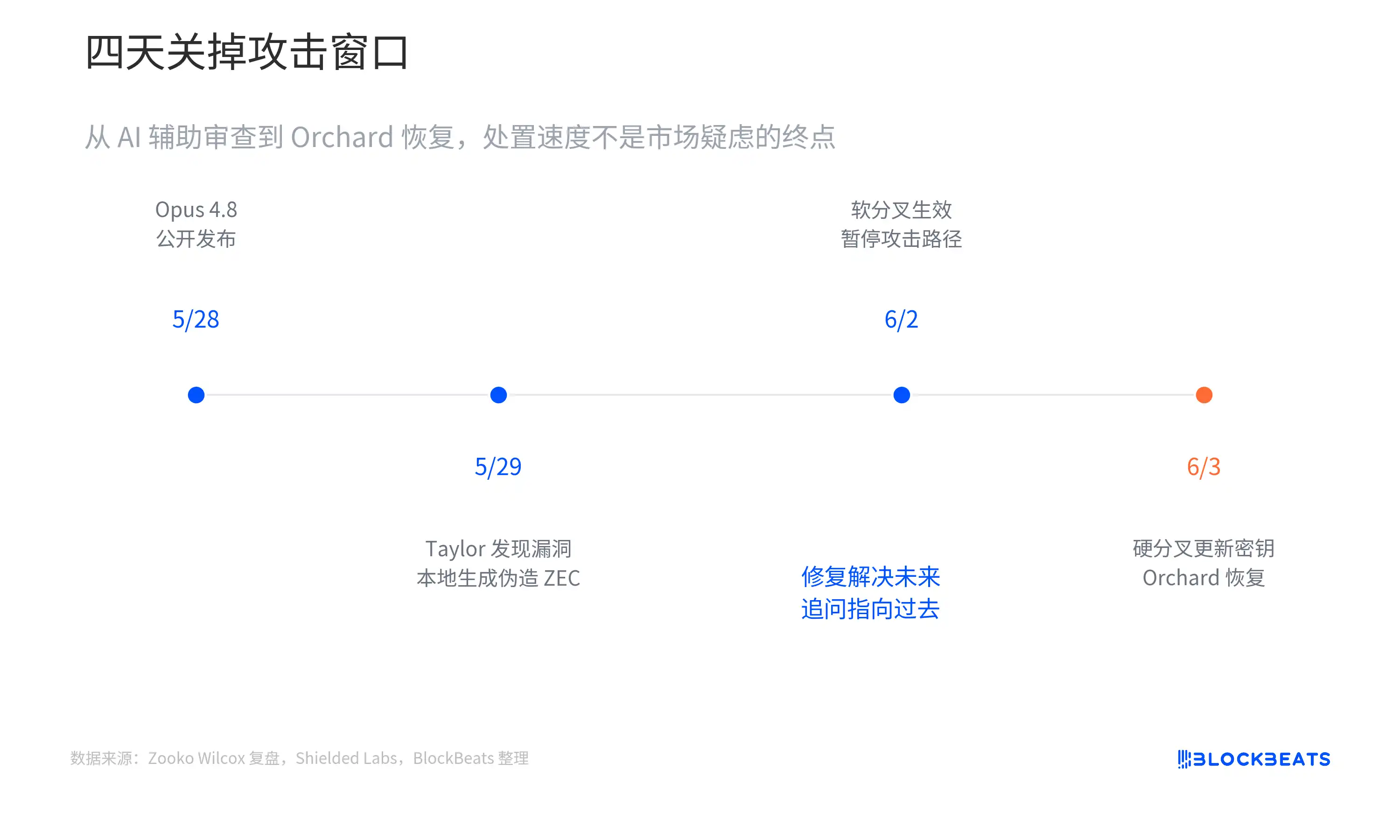
According to the timeline disclosed by Zooko, Shielded Labs, and the Zcash community, Taylor discovered anomalies during a targeted security audit of the Orchard circuit on May 29th and immediately privately disclosed the vulnerability to the Zcash Open Development Lab (ZODL). Shielded Labs is an independent, donation-funded Zcash ecosystem support organization based in Switzerland, long involved in Zcash's protocol development, security, and network sustainability efforts, and is not affiliated with the Zcash Foundation or ZODL.

ZODL engineers confirmed the issue was genuine within hours of receiving the report and began seeking a fix. To avoid exposing the vulnerability's details by directly releasing a code patch, the team first chose to temporarily shut down Orchard: prohibiting the creation of new Orchard outputs and the spending of funds already within Orchard.

After coordinating upgrades among developers, miners, node operators, exchanges, and infrastructure providers, an emergency soft fork took effect on June 2nd. Subsequently, Zcash performed a hard fork upgrade to update the verification key for the Orchard circuit and restored Orchard functionality on June 3rd. Transparent addresses and the Sapling privacy pool continued to operate during this period.

The entire process, from disclosure to remediation, took only a few days. In terms of emergency response speed, this was a remarkably successful handling.

But the market did not calm down because the vulnerability was fixed, as the fix addresses the future, not the past.
The Market Fears Not a Future Attack, But That an Attack May Have Already Happened

Ordinary security incidents usually have a relatively clear scale of loss. For a hacked smart contract, on-chain tracking can reveal how much the attacker moved; a cross-chain bridge vulnerability allows for tracking fund flows and affected addresses.

The Orchard incident is different.

According to Shielded Labs' explanation, this vulnerability could be used to generate unlimited and undetectable counterfeit ZEC within Orchard. Due to Orchard's inherent privacy properties, it is impossible for outsiders to cryptographically prove definitively whether this attack vector was exploited before the fix.

This means the market is not facing a determined loss figure but a kind of unquantifiable uncertainty:

If someone indeed found and exploited the vulnerability in the past, does counterfeit ZEC already exist within Orchard? If it exists, what is the scale? Do these assets remain in the privacy pool? Have they gradually leaked out through normal transactions?

More importantly, this risk window did not just open on May 29th. Shielded Labs stated that the vulnerability had existed since Orchard's launch in May 2022, until the emergency fix was completed in June 2026. In other words, the problem lay dormant for nearly four years.

What the market truly fears is not what happened between May 29th and June 2nd, but whether undetectable anomalies occurred during those past four years.

This is also the core reason behind ZEC's plunge of over 30%.

The market is selling off not just a vulnerability, but a repricing of the credibility of the supply.

How a Missing Mathematical Constraint Evolved into an 'Unlimited Minting' Risk

Seeing the words 'unlimited minting vulnerability,' our first thought might be that hackers gained admin privileges or some kind of protocol backdoor.

The reality is more fundamental.

Orchard's security relies on a zero-knowledge proof circuit (Orchard circuit). Users can hide specific transaction details but must prove to the network that their transaction satisfies protocol rules. One of the most important rules is asset conservation: a transaction cannot create new value out of thin air.

Simply put, users don't have to reveal how much ZEC they have or how much they send to whom, but the network must be able to confirm that:

The assets spent indeed come from legitimate inputs.
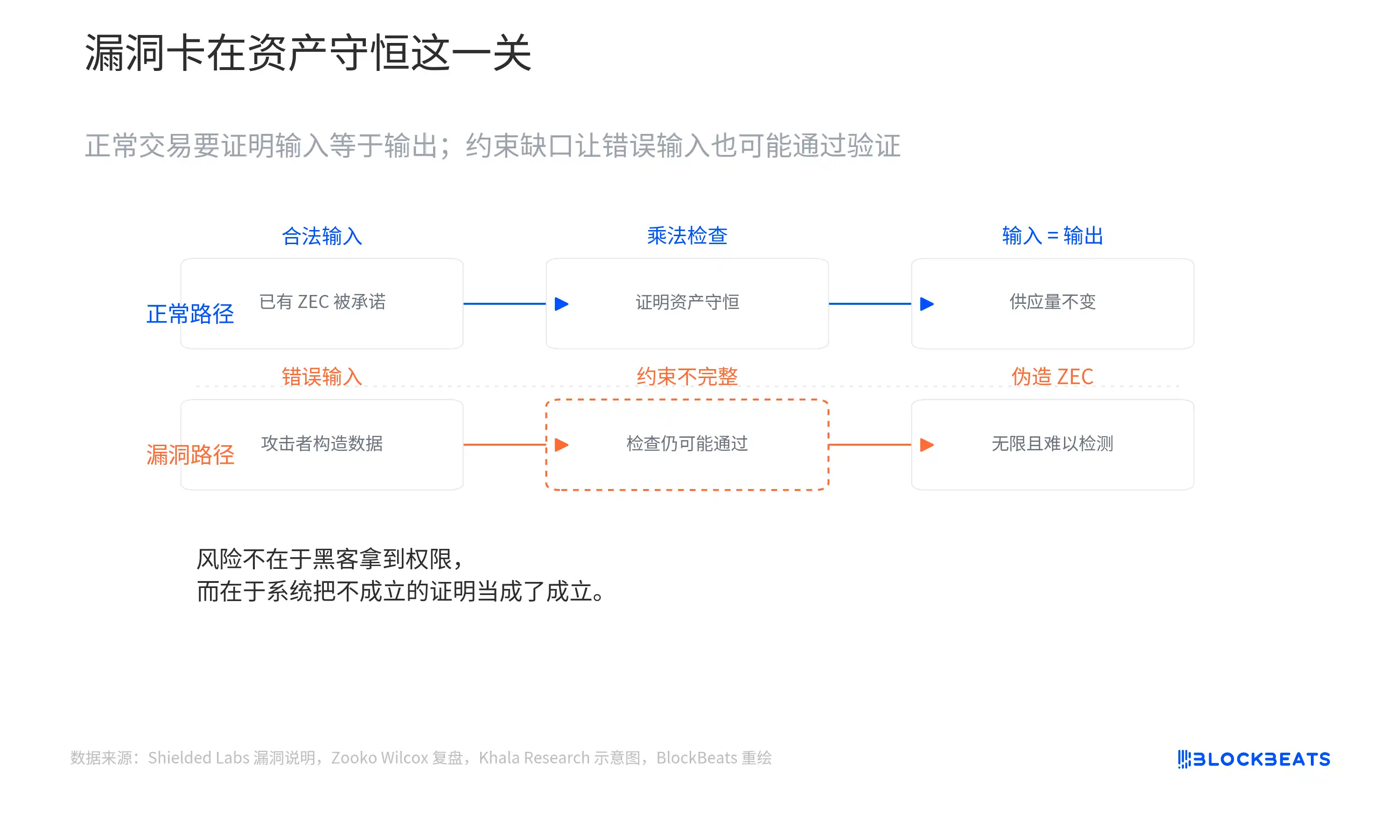
The problem Taylor discovered lies in an elliptic curve multiplication check within the Orchard circuit.

Shielded Labs describes it as an 'under-constrained element,' meaning a circuit element with incomplete constraints. Because the relevant mathematical relationship was not fully constrained, an attacker could input arbitrary erroneous data into the elliptic curve multiplication process, yet the verification process might still return a pass.

In other words, the attacker doesn't need to crack cryptographic algorithms or control network nodes.

They only need to construct a set of data that should not hold, tricking the system into erroneously believing the transaction still satisfies asset conservation.

Once this false proof is accepted by the network, the non-existent ZEC can be treated as legitimate assets, remaining within Orchard.

This is why Shielded Labs used extremely severe wording:

unlimited, undetectable counterfeit ZEC

The truly dangerous part is not just 'unlimited,' but 'undetectable.'

An Important Distinction Lies Between Two Statements

In its post-upgrade announcement, the Zcash Foundation stated that there is currently no evidence the vulnerability was exploited, no detection of unauthorized value creation, and user funds and privacy remain unaffected. The announcement also emphasized that Zcash's existing Turnstile Accounting mechanism can track value flows between different pools and protect the 21 million ZEC total supply cap.

Meanwhile, Shielded Labs clearly stated that it is impossible to cryptographically prove that counterfeit ZEC never appeared in Orchard's history.

These two statements may seem contradictory but actually address two different levels of the problem.

Zcash's original Turnstile Accounting can be understood as a 'gate' between different asset pools. The system can count how much legitimate asset entered Orchard and limit the scale of assets that can flow out of Orchard.

Suppose Orchard originally contained only 1 million legitimate ZEC; even if an attacker counterfeited more assets inside, the system would not allow assets exceeding the legitimate scale to flow out entirely. This helps prevent the total Zcash network supply cap from being easily breached.

But this mechanism cannot directly prove that counterfeit coins never appeared inside Orchard.

If counterfeit assets remain within Orchard, or gradually replace real assets within the legal outflow quota, the original statistical mechanism may not provide a definitive historical conclusion.

Regarding this arguably one of the oldest crypto privacy projects, all we know is that there is currently no evidence of abnormal minting, but the community still cannot directly prove that counterfeit assets never existed within Orchard.

This is precisely the type of risk the market finds hardest to handle.

The problem is not how many counterfeit coins have been discovered, but that no one can definitively confirm they never existed.

How Can Zcash Prove There Are No Counterfeit Coins in Orchard?

Patching the vulnerability is only the first step.

Shielded Labs has stated it is working with other Zcash developers on a new network upgrade proposal. The plan includes deploying a new privacy pool and enforcing Turnstile Accounting for all assets migrating out of Orchard.

This is akin to setting up a new migration gate for Orchard.

Assets in the old Orchard wishing to enter the new privacy pool would need to complete migration according to verifiable rules. The system could re-count the scale of legitimate assets flowing out and determine if there are any extra ZEC that cannot be migrated normally.
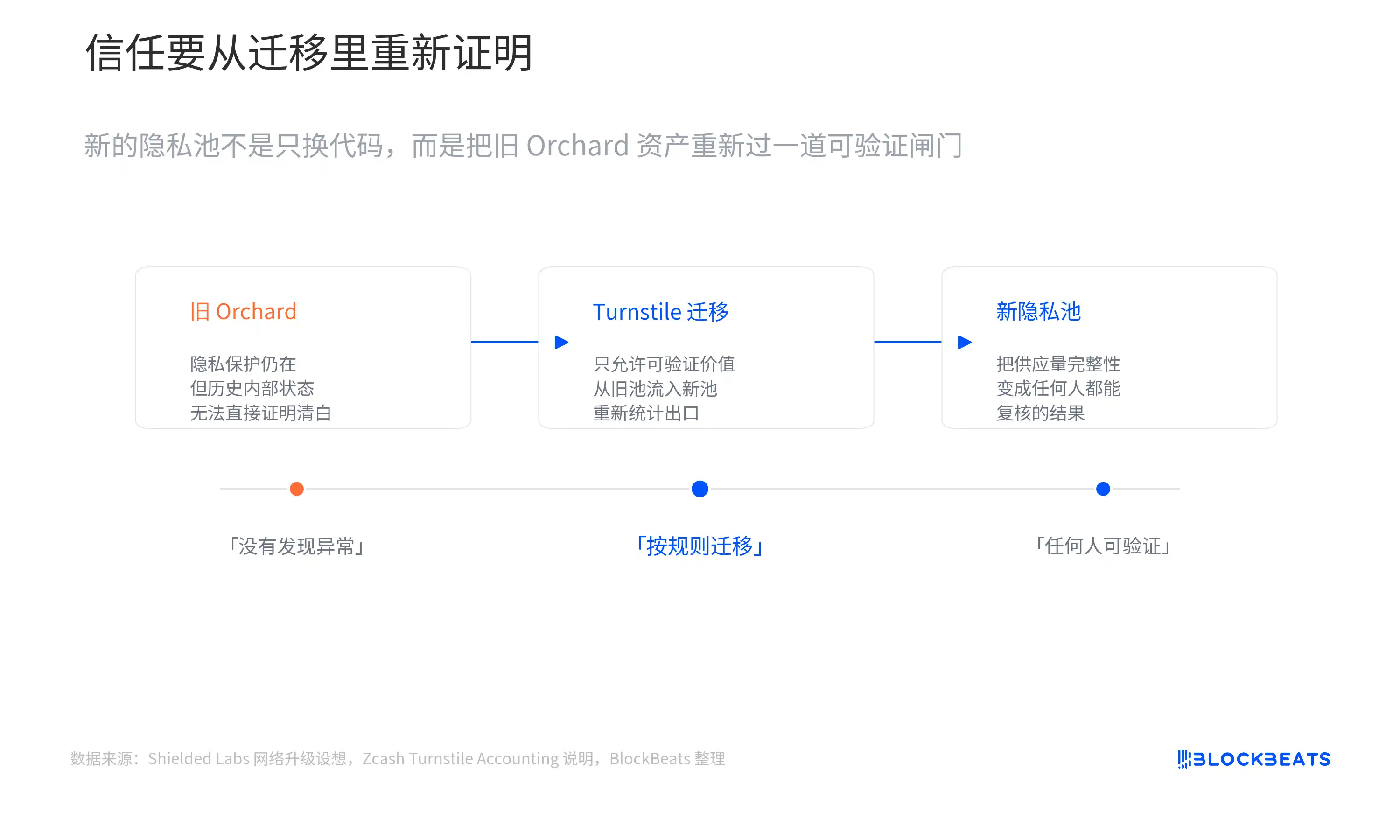
If the upgrade proceeds smoothly, anyone could verify Zcash's supply integrity and further prove no counterfeit assets exist in Orchard.

The significance of this plan is not just fixing code, but rebuilding market trust in Orchard.

Because in a privacy system, trust should not come from 'we think an attack didn't happen,' but from 'anyone can verify an attack didn't happen.'

Shielded Labs itself acknowledges the probability of prior malicious exploitation is low. The vulnerability was hidden for years and extremely difficult to discover; Taylor was actively searching for such issues in a dedicated security research project; after disclosure, the ecosystem quickly shut the attack window within days.

But Shielded Labs also emphasizes that users should not rely solely on the development team's subjective judgment.

The market needs proof.

Why Was a Four-Year-Old Vulnerability Discovered Now?

The Orchard incident has another detail easily overlooked by the market.

On May 28th, Anthropic released Claude Opus 4.8.

One day later, Taylor discovered the Orchard vulnerability.

According to the retrospective by Zooko and Shielded Labs, shortly after Opus 4.8's release, Taylor used it for a highly targeted audit of the Orchard circuit and discovered the issue on May 29th. Subsequently, with the assistance of Opus 4.8, he wrote a complete exploit program, generating unlimited, undetectable counterfeit ZEC in a local environment.

This detail is noteworthy not because AI can independently conduct cryptographic audits.

Public information does not support such an exaggerated conclusion.

Taylor himself is an experienced security researcher. Shielded Labs also mentioned he used a combination of traditional security research methods, a customized AI tool framework, and specifically designed prompts. Opus 4.8 was a crucial tool in the audit process, but not the only factor.

What is truly notable is that Taylor used not Anthropic's restricted-access, cybersecurity-focused model Claude Mythos Preview, but the newly publicly released general-purpose model Opus 4.8.

Anthropic positions Mythos Preview as an advanced model with significant vulnerability discovery and exploitation capabilities. Due to potential misuse risks, Anthropic did not release this model directly to the public but provides access to vetted partners via Project Glasswing.

In contrast, Opus 4.8 is a general-purpose model accessible to ordinary developers. Anthropic emphasized in its release notes its improvements in code analysis, complex task execution, and identifying code defects.

This makes the Orchard incident send an even more significant signal:

The capability to discover high-value vulnerabilities is diffusing from a few specialized security models to general-purpose models.

A general-purpose model released publicly for just one day, guided by a professional researcher, was able to participate in auditing a complex zero-knowledge proof circuit and help discover a critical vulnerability hidden for nearly four years.

This does not mean cryptography experts are no longer important.

On the contrary, Taylor's experience, choice of audit target, and ability to validate the model's output remain the core of the entire process.

But the combination of experts and AI is significantly lowering the cost of discovering complex vulnerabilities.

The Vulnerability is Closed, But the Market Still Awaits Answers

For Zcash, the most urgent attack window is closed.

Orchard functionality is restored, the verification circuit is updated, and there is currently no evidence the vulnerability was maliciously exploited.

But ZEC's plunge of over 30% indicates the market cares about more than just whether the code is fixed.

The market is still waiting for a more definitive answer:

In the past nearly four years, did counterfeit ZEC ever appear inside Orchard?

If the new privacy pool and Turnstile Accounting upgrade can be successfully implemented, the community will finally have a chance to prove supply integrity and rebuild market trust.

But until that proof is completed, the Orchard incident retains an unavoidable suspense:

Did those theoretically unlimited counterfeit ZEC never exist, or were they once hidden where no one could directly see?


Пов'язані питання

QWhat is the primary reason the ZEC price dropped over 30% despite the Orchard vulnerability being quickly patched?

AThe primary reason for the price drop was not the vulnerability itself or the risk of future attacks, but the market's inability to determine whether the vulnerability had already been exploited in the past. The vulnerability existed for nearly four years, and due to Orchard's privacy features, there is no way to cryptographically prove whether undetectable counterfeit ZEC was created during that time. This created profound uncertainty about the true supply integrity of ZEC.

QWhat specific aspect of the Orchard circuit was flawed, and what did it allow an attacker to do?

AThe flaw was an "under-constrained element" in an elliptic curve multiplication check within the Orchard zero-knowledge proof circuit. This incomplete mathematical constraint allowed an attacker to input incorrect data. The verification process could incorrectly pass, making the system believe a transaction obeyed the conservation of assets (no new value creation) when it did not. This enabled the creation of unlimited, undetectable counterfeit ZEC within the Orchard pool.

QWhat is the key difference between the statements from Zcash Foundation and Shielded Labs regarding the historical exploitation of the vulnerability?

AThe Zcash Foundation stated there is no evidence the vulnerability was exploited and that the overall 21 million ZEC supply cap remains protected by the Turnstile Accounting mechanism. Shielded Labs, however, clarified that while the supply cap is protected, it is cryptographically impossible to prove that no counterfeit ZEC was *ever* created inside Orchard in the past. Their statements address different levels: one is about the lack of observed evidence and the outer supply limit, while the other is about the fundamental impossibility of proving a negative within the private pool.

QWhat role did Anthropic's Claude Opus 4.8 play in the discovery of the Orchard vulnerability?

AAnthropic's Claude Opus 4.8, a publicly released general-purpose AI model, was used as a key tool by security researcher Taylor Hornby. The day after its release, Hornby used it to assist in a targeted security review of the Orchard circuit, which led to the discovery of the vulnerability. He then used Opus 4.8 to help write the complete exploit program. This highlights how vulnerability discovery capabilities are diffusing from specialized, restricted security models to publicly available general AI models when guided by expert researchers.

QWhat is the proposed next step by Shielded Labs to rebuild trust in Zcash's supply integrity after the patch?

AShielded Labs is working on a proposal for a new network upgrade. This involves deploying a new privacy pool and enforcing Turnstile Accounting on all assets migrating out of the old Orchard pool. This creates a new 'gate' for migration. By verifying the rules during this process, the network can effectively audit the assets leaving Orchard. If successful, this would allow anyone to verify that no extra, illegitimate ZEC existed in Orchard, moving trust from subjective assurance to objective, verifiable proof.

Пов'язані матеріали

Bitcoin's 'Rally Ends,' Officially Entering the Later Stage of a Bear Market?

Bitcoin prices declined 13% this week, reversing the recent rebound and signaling a likely transition into the later stages of a bear market. Key on-chain metrics deteriorated, with the short-term holder cost basis falling below the Realized Price—a pattern last seen in early 2022, characteristic of bear market maturity. The rally to ~$82k proved to be a bear market bounce, as evidenced by the 90-day realized profit/loss ratio failing to sustain above the bullish threshold of 2. Daily realized losses surged to $1.35B, including significant selling from long-term holders who accumulated near cycle tops, indicating ongoing supply redistribution. Price was rejected almost precisely at the aggregate US spot ETF cost basis of ~$83k, turning that level into resistance and leaving the average ETF investor underwater again. Spot market selling pressure intensified, with the 7-day volume delta turning significantly negative to its weakest level since February. While a major long liquidation event cleared over $400M in leverage, spot demand has not yet stepped in to absorb the resulting supply. Options markets continue pricing in higher future volatility (elevated volatility risk premium) and maintain a skew toward put options, reflecting persistent demand for downside protection, though not yet panic. Overall, market structure remains fragile. Sustained recovery likely requires a reclaim of the ETF cost basis, a shift back to positive spot demand, and a slowdown in realized loss-taking. Until then, the market risks further downside or extended consolidation within the broader bear trend.

Foresight News1 год тому

Bitcoin's 'Rally Ends,' Officially Entering the Later Stage of a Bear Market?

Foresight News1 год тому

How Risky is the "Death Spiral" of MSTR and STRC?

Summary: This article explores the perceived "death spiral" risk between MicroStrategy (MSTR), its Bitcoin holdings, and its perpetual preferred stock (STRC), drawing comparisons to the LUNA-UST collapse. While both systems feature price anchors, high yields for holders, and potential feedback loops, their core mechanisms differ fundamentally. The MSTR-STRC structure relies on continuous financing to sustain its high dividend payouts, primarily through stock ATM offerings. A negative feedback cycle could occur: falling MSTR stock price makes raising equity capital harder, increasing pressure to sell Bitcoin, which undermines STRC confidence and further depresses MSTR. However, unlike LUNA-UST's automated, direct linkage, the MSTR-STRC loop is weaker and has brakes: STRC dividends can be deferred or rates lowered, and STRC holders have a $100/share liquidation preference in bankruptcy, providing a price floor. The company's sustainability hinges on its ability to continue financing. Its current ~$900 million USD reserves cover only about 6.3 months of its ~$1.71 billion annual interest/dividend burden. The next six months are critical, aligning with both the potential bottom in Bitcoin's four-year cycle and the depletion timeline of its reserves. While a LUNA-style catastrophic collapse is deemed highly unlikely due to structural differences, the key question is whether MicroStrategy can navigate this period through healthy deleveraging to restart its capital engine.

Foresight News1 год тому

How Risky is the "Death Spiral" of MSTR and STRC?

Foresight News1 год тому

Торгівля

Спот
Ф'ючерси

Популярні статті

Що таке $S$

Розуміння SPERO: Комплексний огляд Вступ до SPERO Оскільки ландшафт інновацій продовжує еволюціонувати, виникнення технологій web3 та криптовалютних проектів відіграє ключову роль у формуванні цифрового майбутнього. Один з проектів, який привернув увагу в цій динамічній сфері, — це SPERO, позначений як SPERO,$$s$. Ця стаття має на меті зібрати та представити детальну інформацію про SPERO, щоб допомогти ентузіастам та інвесторам зрозуміти його основи, цілі та інновації в рамках web3 та крипто-сектору. Що таке SPERO,$$s$? SPERO,$$s$ — це унікальний проект у криптопросторі, який прагне використати принципи децентралізації та технології блокчейн для створення екосистеми, що сприяє залученню, корисності та фінансовій інклюзії. Проект розроблений для полегшення взаємодії між користувачами новими способами, надаючи їм інноваційні фінансові рішення та послуги. У своїй основі SPERO,$$s$ прагне надати можливості індивідам, забезпечуючи інструменти та платформи, які покращують користувацький досвід у криптовалютному просторі. Це включає в себе можливість більш гнучких методів транзакцій, сприяння ініціативам, що підтримуються спільнотою, та створення шляхів для фінансових можливостей через децентралізовані додатки (dApps). Основна концепція SPERO,$$s$ обертається навколо інклюзивності, прагнучи зменшити розриви в традиційній фінансовій системі, використовуючи переваги технології блокчейн. Хто є творцем SPERO,$$s$? Особистість творця SPERO,$$s$ залишається дещо невідомою, оскільки є обмежені публічно доступні ресурси, що надають детальну інформацію про його засновників. Ця відсутність прозорості може бути наслідком зобов'язання проекту до децентралізації — етики, яку багато проектів web3 поділяють, ставлячи колективні внески вище за індивідуальне визнання. Зосереджуючи обговорення навколо спільноти та її колективних цілей, SPERO,$$s$ втілює суть наділення без виділення конкретних осіб. Таким чином, розуміння етики та місії SPERO є більш важливим, ніж ідентифікація єдиного творця. Хто є інвесторами SPERO,$$s$? SPERO,$$s$ підтримується різноманітними інвесторами, починаючи від венчурних капіталістів до ангельських інвесторів, які прагнуть сприяти інноваціям у крипто-секторі. Зосередження цих інвесторів зазвичай узгоджується з місією SPERO — пріоритет надається проектам, які обіцяють технологічний прогрес у суспільстві, фінансову інклюзію та децентралізоване управління. Ці інвесторські фонди зазвичай зацікавлені в проектах, які не лише пропонують інноваційні продукти, але й позитивно впливають на спільноту блокчейн та її екосистеми. Підтримка з боку цих інвесторів підкріплює SPERO,$$s$ як значного конкурента в швидко змінюваній сфері крипто-проектів. Як працює SPERO,$$s$? SPERO,$$s$ використовує багатогранну структуру, яка відрізняє його від традиційних криптовалютних проектів. Ось деякі ключові особливості, які підкреслюють його унікальність та інноваційність: Децентралізоване управління: SPERO,$$s$ інтегрує моделі децентралізованого управління, надаючи користувачам можливість активно брати участь у процесах прийняття рішень щодо майбутнього проекту. Цей підхід сприяє відчуттю власності та відповідальності серед членів спільноти. Корисність токена: SPERO,$$s$ використовує свій власний криптовалютний токен, розроблений для виконання різних функцій в екосистемі. Ці токени дозволяють здійснювати транзакції, отримувати винагороди та полегшувати послуги, що пропонуються на платформі, підвищуючи загальну залученість та корисність. Шарова архітектура: Технічна архітектура SPERO,$$s$ підтримує модульність та масштабованість, що дозволяє безперешкодно інтегрувати додаткові функції та додатки в міру розвитку проекту. Ця адаптивність є надзвичайно важливою для збереження актуальності в постійно змінюваному крипто-ландшафті. Залучення спільноти: Проект підкреслює ініціативи, що підтримуються спільнотою, використовуючи механізми, які стимулюють співпрацю та зворотний зв'язок. Підтримуючи сильну спільноту, SPERO,$$s$ може краще задовольняти потреби користувачів та адаптуватися до ринкових тенденцій. Фокус на інклюзію: Пропонуючи низькі комісії за транзакції та зручні інтерфейси, SPERO,$$s$ прагне залучити різноманітну базу користувачів, включаючи осіб, які раніше не брали участі в крипто-просторі. Це зобов'язання до інклюзії узгоджується з його загальною місією наділення через доступність. Хронологія SPERO,$$s$ Розуміння історії проекту надає важливі уявлення про його розвиток та етапи. Нижче наведено пропоновану хронологію, що відображає значні події в еволюції SPERO,$$s$: Етап концептуалізації та ідеації: Початкові ідеї, що стали основою SPERO,$$s$, були сформовані, тісно пов'язані з принципами децентралізації та фокусом на спільноті в індустрії блокчейн. Запуск білого паперу проекту: Після концептуального етапу був випущений комплексний білий папір, що детально описує бачення, цілі та технологічну інфраструктуру SPERO,$$s$, щоб залучити інтерес та зворотний зв'язок від спільноти. Створення спільноти та ранні залучення: Активні зусилля були спрямовані на створення спільноти ранніх прихильників та потенційних інвесторів, що полегшило обговорення цілей проекту та отримання підтримки. Подія генерації токенів: SPERO,$$s$ провів подію генерації токенів (TGE) для розподілу своїх рідних токенів серед ранніх прихильників та встановлення початкової ліквідності в екосистемі. Запуск початкового dApp: Перший децентралізований додаток (dApp), пов'язаний з SPERO,$$s$, став доступним, дозволяючи користувачам взаємодіяти з основними функціями платформи. Постійний розвиток та партнерства: Безперервні оновлення та вдосконалення пропозицій проекту, включаючи стратегічні партнерства з іншими учасниками блокчейн-простору, сформували SPERO,$$s$ у конкурентоспроможного та еволюціонуючого гравця на крипто-ринку. Висновок SPERO,$$s$ є свідченням потенціалу web3 та криптовалют для революціонізації фінансових систем та наділення індивідів. Завдяки зобов'язанню до децентралізованого управління, залучення спільноти та інноваційно спроектованих функцій, він прокладає шлях до більш інклюзивного фінансового ландшафту. Як і з будь-якими інвестиціями в швидко змінюваному крипто-просторі, потенційним інвесторам та користувачам рекомендується ретельно досліджувати та обдумано взаємодіяти з поточними подіями в SPERO,$$s$. Проект демонструє інноваційний дух крипто-індустрії, запрошуючи до подальшого дослідження його численних можливостей. Хоча подорож SPERO,$$s$ ще триває, його основні принципи можуть справді вплинути на майбутнє того, як ми взаємодіємо з технологією, фінансами та один з одним у взаємопов'язаних цифрових екосистемах.

73 переглядів усьогоОпубліковано 2024.12.17Оновлено 2024.12.17

Що таке $S$

Що таке AGENT S

Агент S: Майбутнє автономної взаємодії в Web3 Вступ У постійно змінюваному ландшафті Web3 та криптовалюти інновації постійно переосмислюють, як люди взаємодіють з цифровими платформами. Один з таких новаторських проектів, Агент S, обіцяє революціонізувати взаємодію людини з комп'ютером через свою відкриту агентну структуру. Прокладаючи шлях для автономних взаємодій, Агент S прагне спростити складні завдання, пропонуючи трансформаційні застосування в штучному інтелекті (ШІ). Це детальне дослідження заглиблюється в складності проекту, його унікальні особливості та наслідки для сфери криптовалюти. Що таке Агент S? Агент S є революційною відкритою агентною структурою, спеціально розробленою для вирішення трьох основних викликів в автоматизації комп'ютерних завдань: Набуття специфічних знань у галузі: Структура інтелектуально навчається з різних зовнішніх джерел знань та внутрішнього досвіду. Цей подвійний підхід дозволяє їй створити багатий репозиторій специфічних знань у галузі, покращуючи її продуктивність у виконанні завдань. Планування на довгих горизонтах завдань: Агент S використовує планування з підкріпленням досвіду, стратегічний підхід, який полегшує ефективний розподіл та виконання складних завдань. Ця функція значно підвищує її здатність ефективно та результативно управляти кількома підзавданнями. Обробка динамічних, неоднорідних інтерфейсів: Проект представляє Інтерфейс Агент-Комп'ютер (ACI), інноваційне рішення, яке покращує взаємодію між агентами та користувачами. Використовуючи багатомодальні великі мовні моделі (MLLMs), Агент S може безперешкодно орієнтуватися та маніпулювати різноманітними графічними інтерфейсами користувача. Завдяки цим новаторським функціям Агент S надає надійну структуру, яка вирішує складнощі, пов'язані з автоматизацією людської взаємодії з машинами, прокладаючи шлях для численних застосувань у ШІ та за його межами. Хто є творцем Агент S? Хоча концепція Агент S є фундаментально новаторською, конкретна інформація про його творця залишається невідомою. Творець наразі невідомий, що підкреслює або початкову стадію проекту, або стратегічний вибір зберегти засновників у таємниці. Незважаючи на анонімність, акцент залишається на можливостях та потенціалі структури. Хто є інвесторами Агент S? Оскільки Агент S є відносно новим у криптографічній екосистемі, детальна інформація про його інвесторів та фінансових спонсорів не задокументована. Відсутність публічно доступних відомостей про інвестиційні фонди або організації, що підтримують проект, викликає питання щодо його фінансової структури та дорожньої карти розвитку. Розуміння підтримки є критично важливим для оцінки стійкості проекту та потенційного впливу на ринок. Як працює Агент S? В основі Агент S лежить передова технологія, яка дозволяє йому ефективно функціонувати в різних умовах. Його операційна модель побудована навколо кількох ключових функцій: Взаємодія з комп'ютером, подібна до людської: Структура пропонує розширене планування ШІ, прагнучи зробити взаємодії з комп'ютерами більш інтуїтивними. Імітуючи людську поведінку при виконанні завдань, вона обіцяє підвищити досвід користувачів. Наративна пам'ять: Використовується для використання високорівневого досвіду, Агент S використовує наративну пам'ять для відстеження історій завдань, тим самим покращуючи свої процеси прийняття рішень. Епізодична пам'ять: Ця функція надає користувачам покрокові інструкції, дозволяючи структурі пропонувати контекстуальну підтримку в міру виконання завдань. Підтримка OpenACI: Завдяки можливості працювати локально, Агент S дозволяє користувачам зберігати контроль над своїми взаємодіями та робочими процесами, узгоджуючи з децентралізованою етикою Web3. Легка інтеграція з зовнішніми API: Його універсальність і сумісність з різними платформами ШІ забезпечують те, що Агент S може безперешкодно вписатися в існуючі технологічні екосистеми, роблячи його привабливим вибором для розробників та організацій. Ці функціональні можливості колективно сприяють унікальному положенню Агент S у крипто-просторі, оскільки він автоматизує складні, багатоступеневі завдання з мінімальним втручанням людини. У міру розвитку проекту його потенційні застосування в Web3 можуть переосмислити, як відбуваються цифрові взаємодії. Хронологія Агент S Розробка та етапи Агент S можуть бути узагальнені в хронології, яка підкреслює його значні події: 27 вересня 2024 року: Концепція Агент S була представлена в комплексній науковій статті під назвою “Відкрита агентна структура, яка використовує комп'ютери як людина”, що демонструє основи проекту. 10 жовтня 2024 року: Наукова стаття була опублікована на arXiv, пропонуючи детальне дослідження структури та її оцінки продуктивності на основі бенчмарку OSWorld. 12 жовтня 2024 року: Було випущено відеопрезентацію, що надає візуальне уявлення про можливості та особливості Агент S, ще більше залучаючи потенційних користувачів та інвесторів. Ці маркери в хронології не лише ілюструють прогрес Агент S, але й вказують на його прихильність до прозорості та залучення громади. Ключові моменти про Агент S У міру розвитку структури Агент S кілька ключових характеристик виділяються, підкреслюючи її новаторський характер та потенціал: Інноваційна структура: Розроблена для забезпечення інтуїтивного використання комп'ютерів, подібного до людської взаємодії, Агент S пропонує новий підхід до автоматизації завдань. Автономна взаємодія: Здатність автономно взаємодіяти з комп'ютерами через GUI означає стрибок до більш інтелектуальних та ефективних обчислювальних рішень. Автоматизація складних завдань: Завдяки своїй надійній методології він може автоматизувати складні, багатоступеневі завдання, роблячи процеси швидшими та менш схильними до помилок. Безперервне вдосконалення: Механізми навчання дозволяють Агенту S покращуватися на основі минулого досвіду, постійно підвищуючи свою продуктивність та ефективність. Універсальність: Його адаптивність до різних операційних середовищ, таких як OSWorld та WindowsAgentArena, забезпечує його здатність служити широкому спектру застосувань. Оскільки Агент S займає своє місце в ландшафті Web3 та криптовалюти, його потенціал покращити можливості взаємодії та автоматизувати процеси означає значний прогрес у технологіях ШІ. Завдяки своїй інноваційній структурі Агент S є прикладом майбутнього цифрових взаємодій, обіцяючи більш безперешкодний та ефективний досвід для користувачів у різних галузях. Висновок Агент S представляє собою сміливий крок вперед у поєднанні ШІ та Web3, з можливістю переосмислити, як ми взаємодіємо з технологією. Хоча проект все ще на ранніх стадіях, можливості для його застосування є величезними та переконливими. Завдяки своїй комплексній структурі, що вирішує критичні виклики, Агент S прагне вивести автономні взаємодії на передній план цифрового досвіду. У міру того, як ми заглиблюємося в сфери криптовалюти та децентралізації, проекти, подібні до Агент S, безсумнівно, відіграватимуть ключову роль у формуванні майбутнього технологій та співпраці людини з комп'ютером.

685 переглядів усьогоОпубліковано 2025.01.14Оновлено 2025.01.14

Що таке AGENT S

Як купити S

Ласкаво просимо до HTX.com! Ми зробили покупку Sonic (S) простою та зручною. Дотримуйтесь нашої покрокової інструкції, щоб розпочати свою криптовалютну подорож.Крок 1: Створіть обліковий запис на HTXВикористовуйте свою електронну пошту або номер телефону, щоб зареєструвати обліковий запис на HTX безплатно. Пройдіть безпроблемну реєстрацію й отримайте доступ до всіх функцій.ЗареєструватисьКрок 2: Перейдіть до розділу Купити крипту і виберіть спосіб оплатиКредитна/дебетова картка: використовуйте вашу картку Visa або Mastercard, щоб миттєво купити Sonic (S).Баланс: використовуйте кошти з балансу вашого рахунку HTX для безперешкодної торгівлі.Треті особи: ми додали популярні способи оплати, такі як Google Pay та Apple Pay, щоб підвищити зручність.P2P: Торгуйте безпосередньо з іншими користувачами на HTX.Позабіржова торгівля (OTC): ми пропонуємо індивідуальні послуги та конкурентні обмінні курси для трейдерів.Крок 3: Зберігайте свої Sonic (S)Після придбання Sonic (S) збережіть його у своєму обліковому записі на HTX. Крім того, ви можете відправити його в інше місце за допомогою блокчейн-переказу або використовувати його для торгівлі іншими криптовалютами.Крок 4: Торгівля Sonic (S)Легко торгуйте Sonic (S) на спотовому ринку HTX. Просто увійдіть до свого облікового запису, виберіть торгову пару, укладайте угоди та спостерігайте за ними в режимі реального часу. Ми пропонуємо зручний досвід як для початківців, так і для досвідчених трейдерів.

1.5k переглядів усьогоОпубліковано 2025.01.15Оновлено 2026.06.02

Як купити S

Обговорення

Ласкаво просимо до спільноти HTX. Тут ви можете бути в курсі останніх подій розвитку платформи та отримати доступ до професійної ринкової інформації. Нижче представлені думки користувачів щодо ціни S (S).

活动图片