Anthropic CEO's In-depth Interview: After AI Becomes a Super Weapon, How to Balance Between Business and Security?

marsbitОпубліковано о 2026-06-24Востаннє оновлено о 2026-06-24

Анотація

Anthropic CEO Dario Amodei discusses his company's approach to AI development, emphasizing the need to balance rapid commercial progress with safety and ethical considerations. He explains Anthropic's focus on enterprise applications, which aligns with their long-term, trust-based values, and details the intense competition in the AI field. Amodei defends his previous warnings about AI-driven job displacement, clarifying his intent was to spur proactive solutions, not predict doom. He addresses Anthropic's work with government defense agencies, stating it's a necessary response to global threats but is conducted with strict ethical boundaries, such as prohibiting autonomous weapons. A significant portion of the interview focuses on the decision not to publicly release the powerful "Mythos" model due to its advanced, potentially dangerous capabilities in cybersecurity, a move he argues is responsible despite criticism. Amodei concludes by advocating for a measured, incremental approach to AI advancement, supported by both corporate governance structures and sensible government regulation to manage existential risks.

Source: Bloomberg

Compiled by: Felix, PANews

Bloomberg recently conducted an interview with Anthropic CEO Dario Amodei, discussing his entrepreneurial journey in San Francisco, competition with OpenAI, and the ultimate goals of AI.

PANews has compiled the highlights of the interview.
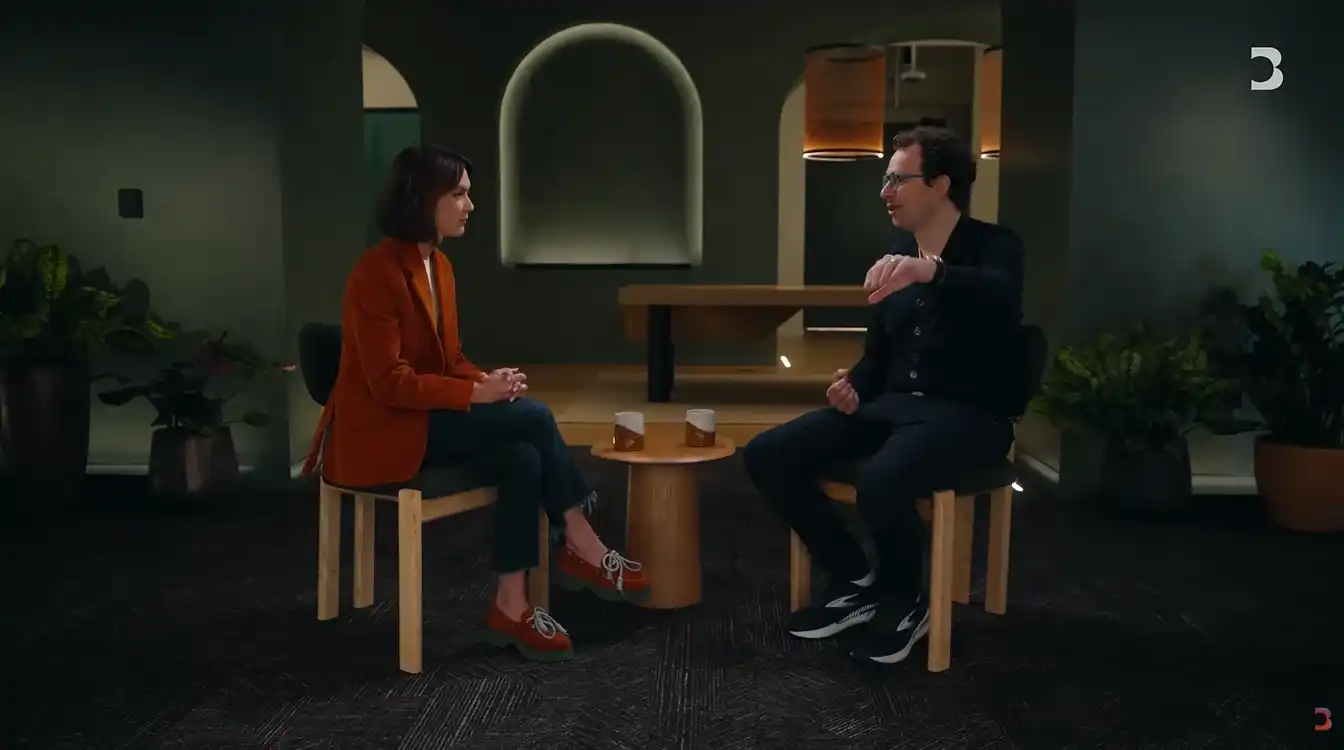
Host: You are currently at the center of the AI universe. How does that feel?

Dario:Throughout my career, especially during my time at Anthropic, what I've experienced is a smooth exponential curve. The feeling of this smooth exponential curve is: nothing happens, nothing happens, a small thing happens, and then 'whoosh'—explosive growth. This is the world's experience, and also the company's scale experience relative to other companies and the world. I looked at this chart for a long time, I used to say 'we'll probably become the AI company with the highest revenue and valuation around this time,' and it indeed happened. So on one hand, I'm not surprised because it's just a smooth line on the chart; but on the other hand, when things actually happen, you see more details and colors, which is absolutely surprising. We always need to keep in mind the most fundamental questions: How to train good models? How to put them into good products? How to ensure safety? How to help people while managing the social risks brought by technology? They are all the same questions, just examined under a larger microscope.

Host: You grew up in San Francisco, what were you like as a child? I know your father was a leather craftsman and your mother worked in a library. How did that influence you?

Dario:The first internet revolution was happening around me at the time, but I had zero interest in it. I was only interested in doing math problems, doodling, understanding the universe, and science fiction. That was my overall environment back then, and I was filled with curiosity about the world.

Host: You grew up in this hub city of technology, and now it's also the center of AI. Has anything about this city influenced your worldview?

Dario:The general spirit of non-conformity, individualism, and 'it's okay to be crazy' here has indeed influenced me. If you go to Europe or even other parts of this country, you'll find that thinking differently or having crazy ideas is not encouraged and is even considered strange. Although I have many criticisms of Silicon Valley, I think one thing it does well is: It's okay even if all the experts are against you. If you have a coherent vision for the world, you should pursue it. Maybe it completely doesn't work, but if it succeeds, it creates a long-tail effect, and you might find huge gold veins in certain ore deposits. I think this spirit is very important.

Host: Your decision to leave OpenAI has become Silicon Valley lore. What actually happened? Besides the rumors, what were the real issues? Where did the disagreements lie?

Dario:Let me put it simply. When developing powerful technology, you face many difficult problems, and Anthropic also faces these dilemmas daily where we don't know if our decisions are right or wrong. So there are many reasonable disagreements on safety issues, and we did have some of those with them, but that alone wasn't enough reason to leave. Even within Anthropic, people have disagreements with me and with each other. However, when you feel you can't trust someone, when you feel their values are not as they claim, when you feel they are dishonest, not acting from the motives they profess, when you see disturbing patterns of deceptive behavior, it's hard to continue working with and trusting that company. Ultimately, if you and others have different visions and don't trust each other, why argue? The solution is to go your separate ways. I am perfectly at peace with us doing things our way, and them doing things theirs. See who wins in the market, who wins in public opinion. That is more telling than any dramatic gossip about who left whom. We are demonstrating an example of how to deploy this technology responsibly. If they disagree, they can present their arguments. I think that's all there is to say.

Host: At the AI summit in India, you and Sam Altman seemed to refuse to hold hands on stage. What happened there?

Dario:The truth is that summit was extremely disorganized. We all went on stage at the last minute, they changed our order on the spot, took a photo, and then suddenly ordered all of us to hold hands. If you've been to these international summits with heads of state, you know they tend to be super chaotic (and I'm not singling out India).

Host: But everyone else held hands.

Dario:I don't know how to explain it to you. Narendra Modi just suddenly called for everyone to hold hands on stage.

Host: Okay. Sam and Elon are suing each other. You don't like Sam. If the people building the world's most important technology can't hold hands on stage, how can we trust you'll collaborate on risks that threaten human existence?

Dario:What I want to tell you is that there are huge differences in the quality and trustworthiness of the people building this technology. That 'nobody trusts anybody' narrative is not correct. I've known Demis Hassabis, who developed the Gemini models, for 15 years; they are competitors to the Claude models, but we've collaborated on many issues. We buy compute from Google, and we often exchange ideas about safety. So I think, first, some actors are indeed more trustworthy than others; second, there are actors outside Anthropic that I trust. What I think needs to happen is for the trustworthy actors to band together, putting the untrustworthy actors in a position where they have no choice but to adopt the same standards. In my experience, some people won't do the right thing on their own, but if most people in the industry are doing the right thing, others don't have much choice. This has two aspects: The positive side is mutual inspiration (i.e., racing to the top), like Demis doing AlphaFold inspired us, we do biological research, and our interpretability research inspires them—it's not zero-sum competition. This is the positive 'carrot' side of the race; and the 'stick' side is that you'll look terrible if you don't do the right thing. They might reluctantly do the right thing while pretending to do something else, even thinking we have some sinister hidden agenda—that's to be expected, but that's precisely how industries align and cooperate.

Host: Early on, others focused on fun, flashy consumer applications, while you bet on coding and the enterprise side. Claude Code and Claude Cowork have been very successful. Why did you make that bet? Was it a values decision or a business decision?

Dario:When we founded Anthropic, the most basic thing was we wanted to do things the right way. But to fund the extremely expensive model creation, it needed a business model. If the business model fundamentally conflicts with your values, you're in a bind: either betray your values or become irrelevant. It's much better to choose a business model compatible with your values. We looked at social media and the consumer world, which often incentivize user engagement and even addiction (like the AI video model mess we see), just to maximize user screen time for ad revenue. In contrast, on the enterprise side, we hope to use AI to cure previously incurable diseases (collaborating with biotech, pharma, and academia), make energy cheaper and more efficient, help education and nonprofits, and promote economic growth. These are inherently enterprise applications. Another factor is that enterprises highly value trust and long-term relationships. The consumer side can sometimes be gimmicky, while the enterprise side requires you to build trust over many years and deliver what you promise. This is very synergistic with our goal of deploying models in a positive, safe manner.

Host: A developer can switch from Claude to ChatGPT or Gemini in an afternoon. Is it really possible to maintain a long-term lead in this industry? How long would it take for a strong competitor to replicate what you've built?

Dario:Model quality is the most important thing. We are far ahead in model quality right now. While there is some switching inertia, I (and Anthropic) have never relied on product 'stickiness' to keep people from switching. You need to have a better model, a better product. We see the growth rate hasn't even turned downwards. At least at the time of this interview recording, if anything, it's still rising. So I tend to think model quality is the most important thing.

Host: Soon after the launch of Claude Cowork, $285 billion in market cap evaporated overnight, with traders calling it 'SaaSpocalypse.' If AI continues to advance at this pace, how much traditional software will be replaced, and how fast?

Dario: It's hard to predict this accurately ahead of time. All traditional software companies have their own moats. Some of those moats will disappear, but others will remain. 'Quickly writing complex software' as a moat will definitely disappear; you can no longer rely on that for defense. But customer relationships, knowledge of how industries work, and unique domain expertise will still matter. My advice to these companies: Don't be complacent. List all your moats, see which ones will disappear, which ones will strengthen, because new moats will also emerge. Those who are flexible will do well, and those who deceive themselves and rest on past laurels will have a hard time. Overall, I think the software industry will get bigger, not smaller, though there will certainly be some big losers.

Host: Explain that.

Dario:Because the 'pie' is getting bigger. If AI raises the industry ceiling by 10x, existing businesses could easily grow 1.5x, even if their relative share of the total pie becomes smaller. But for those who don't adapt, who bury their heads in the sand, they will face tough times or even go out of business.

Host: Your biggest backers are companies like Amazon, Google, Microsoft, and Nvidia. They all have their own agendas, being both partners and competitors. Your huge business milestones are tied to funding rounds. Who is really in charge?

Dario:In many cases, we've been very upfront about what we truly think. We're all adults; we can agree to disagree, collaborate on one thing while disagreeing on another.

Host: There are reports that your valuation is higher than OpenAI's. For a five-year-old startup, a valuation nearing a trillion dollars. How do you make sense of that number? If you're more disciplined on compute and have a faster path to profitability, why do you need that much money?

Dario:The demand for compute is growing incredibly fast. Business fundamentals are good, but you might need three or four times more compute within a year; growth is extremely fast. We fully expect revenue growth to match or even exceed that compute growth. Raising money is to buffer the impact of that uncertainty; it's very rational and results in very little dilution of company equity. It absolutely does not indicate problems with the business fundamentals.

Host: Does it feel good to surpass your main competitor?

Dario:We have many difficult challenges ahead. We are promoting the 'race to the top' idea, trying to pull other companies forward alongside us. Sometimes they don't acknowledge it, sometimes they attack us while copying us, but that pulling effect is incredibly valuable. The value of being the leading company is not merely about beating opponents, but about having the ability to drive the entire ecosystem.

Host: But winning must feel a bit better.

Dario:We certainly always strive to succeed and don't want to fail. I don't think we should shut down this technology; we compete in a free enterprise system and just need to mitigate model risks. We are always seeking balance between the two poles.

Host: Your product development speed is astonishing. How do you do it?

Dario:Two reasons: First, we have a unified culture and organizational efficiency; everyone is aligned. Second, it's Claude itself. We are now using Claude to help develop our models and products, making the process more efficient. This generates a massive and increasingly reliable acceleration effect.

Host: What's the craziest thing you've seen AI do?

Dario:It's all about biology and medicine. I've seen several instances where Claude diagnosed medical issues that senior doctors missed. In biology, models are becoming astonishingly good at drug design or computational chemistry. As a former biologist, I know that requires an extremely high level of specialized training. This is the huge positive side of AI; it will greatly enhance human quality of life. Imagine the scientific progress from 1900 to now over a century, and then imagine if we had another century of progress. If we navigate the current challenges successfully, we'll have a much better world.

Host: I know you love writing. Do you use Claude to help you write?

Dario:Yes, but I haven't had it write full texts for me yet because I'm a bit particular about specific styles. I mainly use Claude for brainstorming, organizing themes, or providing references. It currently plays a supporting role. While it's still some distance from writing better than me, that will come sooner or later.

Host: Writing helps clarify thoughts, involving a lot of critical thinking. If we let Claude do it, do we lose that thinking ability?

Dario:I am somewhat concerned about that, indeed. I insist on writing myself, half for the reader, but equally to clarify my own thoughts. If you just tell it 'write an article about AI risks,' not only will it not produce what I truly want to express, but I also lose that benefit of thinking. In the future, as models get better, we may need to find subtle ways of using them more directly while still retaining the benefits of thinking.

Host: You've been outspoken about job loss, predicting AI might eliminate half of junior white-collar jobs within 1 to 5 years. That was a year ago. Is that proportion 50% now, or higher?

Dario:If you look at the original full video, my actual statement was: I don't know what will happen, but this represents an order of magnitude for how crazy things could get. However, psychology always leans towards clipping out those three seconds of 'doom is coming,' while ignoring all the solutions I simultaneously discussed (like token tax, corporate adjustments, macroeconomic policies, etc.). My message was never 'doom is coming,' but that we need to see it coming, focus on it, and proactively manage it. In the short term, AI will make people more efficient, but this is just a transitional phase. As we've seen in the history of automation, AI may eventually take over those tasks. Take Anthropic's software engineers as an example: right now, AI helps them write most code, making them more efficient, but we're also starting to see cases where it's simply better to let AI directly perform specific tasks. On the other hand, this also creates new demands, like 'applied AI solution architects (frontline deployment engineers)' who combine technical and customer communication skills. Job destruction and job adjustment will happen simultaneously.

Host: You released a chart showing potential job disruption, which ones will disappear, which will be created?

Dario:It's hard to predict precisely, like predicting the stock market. But overall, junior white-collar positions (in banking, finance, etc.) are highly likely to be replaced by AI. In our conversations with enterprise customers, we see them facing a choice: lay off to cut costs, or use the same resources to do more new things? We always try to push them towards a 'positive-sum game': use efficiency gains to do more, not to lay people off. As the 'pie' expands, people might find new places to go; it's a question of matching speed. The scale of disruption will be large, which is why I tried to warn people.

Host: If there's unemployment at that high a scale, wouldn't that be a cause for revolution?

Dario: That is absolutely an outcome we want to avoid. I think several areas will retain opportunities: one is the physical world (because robotics development lags behind AI information processing speed; manufacturing and construction will still require a lot of human labor); another is all human-centric work. Even if AI is more accurate than doctors or better at customer service, people still want and need to talk to other humans and build connections on important matters. Humans will also retain the role of guiding AI values and intent.

Host: Many people have pushed back on your views, like Jensen Huang saying you confuse 'tasks' with 'jobs,' and others calling it 'doom marketing' that benefits Anthropic.

Dario:I want to rebut this clearly. In our reports and papers, we spent five whole pages detailing the distinction between tasks and jobs, explaining why this time is different, and proposed six solutions covering both private and government sectors. But I've found a sickness in Silicon Valley and social media is laziness; people just watch a three-second clip from a year ago and irresponsibly comment. Calling serious intellectual work 'cheap marketing' is itself a cheap marketing tactic and an incredibly lazy refusal to engage in serious discussion.

Host: As a globally leading AI company, you are deeply involved in many areas of US national security. You've had a long-standing anti-war stance since Caltech, but you were among the first AI companies to sign a classified cyber operations contract with the Department of Defense. Please explain.

Dario:The reason is the world is changing. When I see Russia invading Ukraine, I worry about the resurgence of authoritarian blocs. We need to defend ourselves. We absolutely do not want adversaries using AI to analyze intelligence, attack Ukraine, while we are unable to defend. So we are providing support across government departments. By the way, we do this absolutely not for money; running on government networks is actually a big hassle and yields little profit. Precisely because we do it out of 'caring,' there must be clear limits and red lines on the use of the technology, namely: no mass surveillance and no development of fully autonomous weapons. If we abandon our democratic values just to win a competition, that's not worth it. This is the balance and stance we uphold.

Host: You started partnering with Palantir in 2024; their tech is used by US Immigration and Customs Enforcement (ICE), police departments, and even in Gaza. Is Claude being used for surveillance?

Dario:We do not work with ICE and CBP, either directly or through Palantir. To my knowledge, we also do not operate in Gaza. We are very careful to limit our involvement to areas aligned with our values.

Host: So you drew red lines, the President banned some of your federal authorizations, the Pentagon labeled you a supply chain risk, and OpenAI stepped in and signed contracts you wouldn't. What does winning that fight actually look like?

Dario:I don't think of it as a fight to 'win or lose'; it's a societal debate about how governments should properly use AI. We are trying to establish usage precedents concerning worrisome scenarios and have drawn attention to the issue. We see bipartisan efforts in Congress attempting to ban high-risk applications and set up guardrails. If there's a win, it's getting our nation to think more carefully about the appropriate boundaries for using new technology; that's the victory.

Host: Some describe you as an ideological lunatic who shouldn't have this much power, or a left-wing zealot. Does that bother you?

Dario:I get called names often, and much worse than that. People can call me and Anthropic whatever they want. I only care about two things: the company succeeding, and us sticking to our values. It actually makes my life very simple; I've always known where I stand.

Host: Is an AI war more likely to prevent World War III or more likely to cause it?

Dario: Overall, more likely to prevent it. But without usage restrictions, it could cause one. Without proper regulation, both sides could easily erupt into conflict due to misunderstanding. If we have overwhelming superiority in intelligence gathering and response capability, adversaries will think twice before acting. Superior intelligence can effectively deter conflict.

Host: Anthropic is in the headlines almost weekly, recently about the Mythos model. You said Mythos is too powerful to release to the public. What surprised you most about it?

Dario:What surprised me most is that it not only finds vulnerabilities but can also turn them into substantive attack tools; there's been a huge leap in that capability. Some early companies testing it even asked us not to release it, calling it a 'super weapon' that should require a gun license to use. Our decision not to release it publicly isn't about locking it away forever; it's that current cyber defense mechanisms are still too easily 'jailbroken' or bypassed. We need to wait until defense mechanisms are confident enough to handle it before releasing it alongside robust safeguards.

Host: But there's been a lot of pushback: researchers claim cheaper open-source models can replicate it, and others say it's all grand PR and marketing. How do you respond?

Dario:The claim that it can be replicated with open-source models is utterly absurd. The Mythos model discovered 271 new vulnerabilities in the Firefox browser and thousands of new vulnerabilities in many private companies we can't disclose, which previous models simply couldn't find. That person on Twitter who claimed they could replicate it with an open-source model just re-located that specific line of code after we pointed out which line it was. That's not the same thing at all.

As for the 'marketing' claim, not releasing this super-powerful model is a huge commercial loss for us; it could have massively accelerated internal and external R&D. If it helps defenders, it helps attackers equally. So our current strategy is to first give it to defenders to patch system vulnerabilities. Once all the vulnerability 'holes' are plugged, the future internet ecosystem will become extremely secure. Those sniping and doing contrarian takes on X (including certain competitors) fail to take the societal risk trade-offs seriously, showing extreme immaturity.

Host: Have you already made trade-offs you're not entirely comfortable with?

Dario:The entire history of Anthropic is full of trade-offs. In an ideal world, you might spend years studying every pitfall of a chatbot before releasing it. While we did delay the initial version of Claude by a few months, everything is still a trade-off. Now that we are in a leading commercial position, Daniela and I are doing everything we can to nudge the needle further towards 'proceeding cautiously.' That's the intention behind restricting Mythos's release. If you're not a leading player, you can hardly make that decision.

Host: Since this technology is so powerful, why doesn't the government just take you over?

Dario:This is a very serious concern. Throughout history, all unprecedentedly powerful technologies (nuclear weapons, the internet, GPS, cell phones) were initially born in government and federal labs. AI is the first one built entirely in the private sector with the government arriving late, a situation that is actually dangerous and unstable. But the danger of the government not doing it now is arguably greater than the danger of the private sector doing it. So we need checks and balances: we set up the 'Long-Term Benefit Trust,' which has the power to remove the majority of the board and even fire me, introducing an element of public governance.

At the government level, we need the legislative and judicial branches to enforce mandatory pre-release testing and red-line regulation. I fear both a corporate monopoly over it and a government monopoly over it; they must check each other. It's quite ridiculous that there's a group within Silicon Valley who, from being extremely opposed to any regulation or even transparency requirements (saying it kills innovation), upon seeing the first real danger, immediately swing to declaring 'the government should nationalize it.' This reaction of swinging wildly between extreme poles is very immature; what we need is rational middle ground.

Host: Your field always talks about the moment AI gets good enough for 'self-improvement.' Your researchers think it's getting close. How far away specifically?

Dario:I think it's not a specific 'moment' but a continuously accelerating exponential process. We already see AI starting to assist in proposing the architecture for the next generation of AI. A year ago, AI improved total factor productivity by 10-15%; now it might be 20-30%. It won't suddenly go out of control at one moment; instead, on this smooth exponential curve, we need to assess at each node whether we should slow down and apply more control. The sane response is to smoothly escalate our countermeasures as the technology's power grows, not to panic.

Host: You've said there's a 10-25% chance of human civilization collapsing. That's not trivial. Could there be a scenario where something Anthropic builds causes that collapse?

Dario:I certainly hope not. That risk probability stems from the inherent unpredictability of the technology and the complexity of world dynamics. All the measures we take are precisely to reduce, not increase, that collapse probability. It's like the aviation industry: even if you build an airplane ten times safer than others, you can't absolutely guarantee to others it 'will never crash.'

Related reading: OpenAI and Anthropic Collective Change Tune: Is the AI Jobs Apocalypse Narrative No Longer in Vogue?


Трендові криптовалюти

Пов'язані питання

QWhat were the main reasons Dario Amodei gave for leaving OpenAI and founding Anthropic?

ADario Amodei cited fundamental differences in trust, values, and vision as the primary reasons for leaving OpenAI. He stated that while disagreements on safety issues alone were not enough to leave, a pattern of concerning deceptive behavior and a lack of trust in their stated motives made collaboration impossible. He felt he could not trust the leadership and that their actions did not align with their proclaimed values.

QHow does Anthropic balance the tension between pursuing commercial success and adhering to its safety and ethical values?

AAnthropic balances commercial success with safety and ethics by focusing on an enterprise-focused business model that it believes is inherently more aligned with its values. This model involves long-term trust relationships with businesses in areas like biotech, education, and energy, which aim to create positive societal impact. The company also consciously makes trade-offs, such as delaying the release of powerful models like 'Mythos' to develop adequate safeguards, even at commercial cost, to prioritize safety and responsible deployment.

QAccording to Dario Amodei, what is the most surprising and concerning capability of the unreleased 'Mythos' model?

AThe most surprising and concerning capability of the 'Mythos' model is its significant leap in not just discovering software vulnerabilities but in autonomously transforming those discoveries into practical, functioning attack tools. This ability is so advanced that some early testers described it as a 'superweapon' and suggested it should require a license to use, prompting Anthropic to withhold its public release until defense mechanisms are robust enough to counter it.

QWhat is Dario Amodei's perspective on the potential for AI to cause large-scale job displacement, and how does he propose society should respond?

ADario Amodei believes AI will likely lead to significant displacement of junior white-collar jobs, using the 50% figure as an illustrative magnitude of potential change, not a definitive prediction. He emphasizes this is not a 'doomsday' scenario but a warning that requires proactive management. His proposed solutions include a focus on a 'positive-sum' approach where companies use AI-driven efficiency gains to create new opportunities, policies like a 'token tax' for redistribution, macroeconomic adjustments, and recognizing that human-centric roles and physical-world jobs will remain crucial. He criticizes those who dismiss his warnings as 'marketing' for not engaging with the detailed solutions he has proposed.

QHow does Dario Amodei view the role of competition and collaboration among leading AI companies, especially regarding safety?

ADario Amodei views competition and collaboration as a mechanism for 'racing to the top.' He believes trustworthy companies should collaborate on safety ideas to set high standards, creating a positive 'carrot' effect through mutual inspiration. Simultaneously, this creates a 'stick' effect where less trustworthy actors are pressured to adopt similar standards to avoid appearing irresponsible. He distinguishes between companies he trusts (like Google DeepMind, with whom Anthropic collaborates) and those he does not, advocating for a coalition of trustworthy players to elevate the entire industry's safety practices.

Пов'язані матеріали

Interview with Strategy CEO: Can STRC Recover After Selling Bitcoin?

Interview with Strategy CEO Phong Le on the recent sale of 32 Bitcoin and its impact. He clarifies the move was a small, strategic action to demonstrate liquidity to debt holders, test internal processes, and prove operational discipline—not a response to fears of a "death spiral" from DeFi protocols leveraging STRC (Strategy's preferred stock product), which he notes holds less than 10% of STRC. Le emphasizes Strategy’s long-term focus as the largest corporate Bitcoin holder, using the adage that markets are a "voting machine" short-term but a "weighing machine" long-term. Decision-making is data-driven, involving the board, complex modeling, and multiple stakeholder considerations, moving beyond a founder-centric model. He outlines various capital options but stresses the strategic importance of "doing nothing" as a valid choice, citing resilience built during the 2022 bear market. Le expresses unwavering belief in Bitcoin's foundational value for global sovereignty and its future role in an AI-driven economy with trillions of autonomous agents. Addressing STRC's current price below its $100 face value, Le explains recent pressure was due to using dollar reserves for bond buybacks. He expects STRC to return to par as reserves are replenished and its semi-monthly dividend payments begin, noting the product is heavily over-collateralized. Finally, Le confirms the company sold Bitcoin the week prior to May 31st, as disclosed in an 8-K filing, leaving prediction market interpretations to others. The overarching philosophy remains "Spread Bitcoin with love," embracing all methods of gaining Bitcoin exposure.

marsbit11 хв тому

Interview with Strategy CEO: Can STRC Recover After Selling Bitcoin?

marsbit11 хв тому

IOSG Founder: Ethereum Doesn't Need Another Leap of Technical Faith, It Needs a Musk-style Compromise

Jocy, founder of IOSG Ventures, argues that Ethereum does not need renewed technological faith but a "Musk-like compromise." The recent formation of ETHLabs—funded by major ETH holders like BitMine and Lubin—highlights a market-driven move to fill a gap left by the Ethereum Foundation (EF), signaling a loss of confidence in its decentralized, hands-off approach. The core critique contrasts Vitalik Buterin's (V) idealistic, technology-first vision with Elon Musk's pragmatic, business-driven execution. The author asserts Ethereum's current shortage is not another technical roadmap but a clear, real-world application narrative and a leader willing to engage directly with commercial realities—like Musk. Internal issues are emphasized, citing EF's management problems and talent drain. While the new decentralized model with independent nodes like ETHLabs addresses the single foundation's limitations, it risks fragmentation without cohesive direction. True cohesion, the author suggests, must come from a shared, compelling narrative around ETH's value, not just from aligned financial interests. Independence claims for new entities are seen as aspirational, needing years of transparency to build trust. The ultimate threat is not competitors like Solana, but the broader shift of attention and talent toward AI. Ethereum has a limited window—12 to 18 months—to recapture focus by delivering tangible, real-world applications. The conclusion urges V to shift from abstract ideals to grounded, pragmatic leadership. The time for this crucial pivot is running out.

marsbit1 год тому

IOSG Founder: Ethereum Doesn't Need Another Leap of Technical Faith, It Needs a Musk-style Compromise

marsbit1 год тому

Google Starts Selling TPUs, Big Tech Aims to Produce "Low-Cost Tokens" with AI Chips

Google has begun selling its proprietary TPU chips and AI computing hardware directly to third-party data centers and clients, marking a strategic shift. Previously only accessible via cloud rentals, TPUs are specialized processors designed for the matrix and tensor operations central to AI models. By combining thousands into supercomputing clusters managed by CPUs, Google achieves high-efficiency AI processing. This move enables Google’s Gemini AI to offer competitive token pricing, challenging rivals like OpenAI. It also signals a broader industry trend where AI compute is becoming a commoditized resource like electricity. While NVIDIA remains dominant with its CUDA ecosystem and high-performance GPUs, the focus is shifting from raw power to cost efficiency and system integration. Google’s approach mirrors NVIDIA’s by selling an entire ecosystem—hardware, software, and data center expertise—rather than just chips. This threatens NVIDIA’s grip on the mid-range inference market, where lower-cost, efficient solutions are increasingly demanded. Similarly, cloud providers like Huawei Cloud and Alibaba Cloud in China are developing their own AI chip ecosystems (e.g., Ascend, Zhenwu), packaging chips, clusters, and tools into full-stack solutions. They aim to reduce token costs and capture market share through integrated systems. In summary, the AI infrastructure race is evolving from a competition for the strongest chips to a contest for the most efficient and cost-effective systems. Google’s TPU sales highlight this transition, emphasizing that future success lies in delivering affordable, scalable AI compute as a foundational service.

marsbit1 год тому

Google Starts Selling TPUs, Big Tech Aims to Produce "Low-Cost Tokens" with AI Chips

marsbit1 год тому

Торгівля

Спот
Ф'ючерси

Популярні статті

Що таке $S$

Розуміння SPERO: Комплексний огляд Вступ до SPERO Оскільки ландшафт інновацій продовжує еволюціонувати, виникнення технологій web3 та криптовалютних проектів відіграє ключову роль у формуванні цифрового майбутнього. Один з проектів, який привернув увагу в цій динамічній сфері, — це SPERO, позначений як SPERO,$$s$. Ця стаття має на меті зібрати та представити детальну інформацію про SPERO, щоб допомогти ентузіастам та інвесторам зрозуміти його основи, цілі та інновації в рамках web3 та крипто-сектору. Що таке SPERO,$$s$? SPERO,$$s$ — це унікальний проект у криптопросторі, який прагне використати принципи децентралізації та технології блокчейн для створення екосистеми, що сприяє залученню, корисності та фінансовій інклюзії. Проект розроблений для полегшення взаємодії між користувачами новими способами, надаючи їм інноваційні фінансові рішення та послуги. У своїй основі SPERO,$$s$ прагне надати можливості індивідам, забезпечуючи інструменти та платформи, які покращують користувацький досвід у криптовалютному просторі. Це включає в себе можливість більш гнучких методів транзакцій, сприяння ініціативам, що підтримуються спільнотою, та створення шляхів для фінансових можливостей через децентралізовані додатки (dApps). Основна концепція SPERO,$$s$ обертається навколо інклюзивності, прагнучи зменшити розриви в традиційній фінансовій системі, використовуючи переваги технології блокчейн. Хто є творцем SPERO,$$s$? Особистість творця SPERO,$$s$ залишається дещо невідомою, оскільки є обмежені публічно доступні ресурси, що надають детальну інформацію про його засновників. Ця відсутність прозорості може бути наслідком зобов'язання проекту до децентралізації — етики, яку багато проектів web3 поділяють, ставлячи колективні внески вище за індивідуальне визнання. Зосереджуючи обговорення навколо спільноти та її колективних цілей, SPERO,$$s$ втілює суть наділення без виділення конкретних осіб. Таким чином, розуміння етики та місії SPERO є більш важливим, ніж ідентифікація єдиного творця. Хто є інвесторами SPERO,$$s$? SPERO,$$s$ підтримується різноманітними інвесторами, починаючи від венчурних капіталістів до ангельських інвесторів, які прагнуть сприяти інноваціям у крипто-секторі. Зосередження цих інвесторів зазвичай узгоджується з місією SPERO — пріоритет надається проектам, які обіцяють технологічний прогрес у суспільстві, фінансову інклюзію та децентралізоване управління. Ці інвесторські фонди зазвичай зацікавлені в проектах, які не лише пропонують інноваційні продукти, але й позитивно впливають на спільноту блокчейн та її екосистеми. Підтримка з боку цих інвесторів підкріплює SPERO,$$s$ як значного конкурента в швидко змінюваній сфері крипто-проектів. Як працює SPERO,$$s$? SPERO,$$s$ використовує багатогранну структуру, яка відрізняє його від традиційних криптовалютних проектів. Ось деякі ключові особливості, які підкреслюють його унікальність та інноваційність: Децентралізоване управління: SPERO,$$s$ інтегрує моделі децентралізованого управління, надаючи користувачам можливість активно брати участь у процесах прийняття рішень щодо майбутнього проекту. Цей підхід сприяє відчуттю власності та відповідальності серед членів спільноти. Корисність токена: SPERO,$$s$ використовує свій власний криптовалютний токен, розроблений для виконання різних функцій в екосистемі. Ці токени дозволяють здійснювати транзакції, отримувати винагороди та полегшувати послуги, що пропонуються на платформі, підвищуючи загальну залученість та корисність. Шарова архітектура: Технічна архітектура SPERO,$$s$ підтримує модульність та масштабованість, що дозволяє безперешкодно інтегрувати додаткові функції та додатки в міру розвитку проекту. Ця адаптивність є надзвичайно важливою для збереження актуальності в постійно змінюваному крипто-ландшафті. Залучення спільноти: Проект підкреслює ініціативи, що підтримуються спільнотою, використовуючи механізми, які стимулюють співпрацю та зворотний зв'язок. Підтримуючи сильну спільноту, SPERO,$$s$ може краще задовольняти потреби користувачів та адаптуватися до ринкових тенденцій. Фокус на інклюзію: Пропонуючи низькі комісії за транзакції та зручні інтерфейси, SPERO,$$s$ прагне залучити різноманітну базу користувачів, включаючи осіб, які раніше не брали участі в крипто-просторі. Це зобов'язання до інклюзії узгоджується з його загальною місією наділення через доступність. Хронологія SPERO,$$s$ Розуміння історії проекту надає важливі уявлення про його розвиток та етапи. Нижче наведено пропоновану хронологію, що відображає значні події в еволюції SPERO,$$s$: Етап концептуалізації та ідеації: Початкові ідеї, що стали основою SPERO,$$s$, були сформовані, тісно пов'язані з принципами децентралізації та фокусом на спільноті в індустрії блокчейн. Запуск білого паперу проекту: Після концептуального етапу був випущений комплексний білий папір, що детально описує бачення, цілі та технологічну інфраструктуру SPERO,$$s$, щоб залучити інтерес та зворотний зв'язок від спільноти. Створення спільноти та ранні залучення: Активні зусилля були спрямовані на створення спільноти ранніх прихильників та потенційних інвесторів, що полегшило обговорення цілей проекту та отримання підтримки. Подія генерації токенів: SPERO,$$s$ провів подію генерації токенів (TGE) для розподілу своїх рідних токенів серед ранніх прихильників та встановлення початкової ліквідності в екосистемі. Запуск початкового dApp: Перший децентралізований додаток (dApp), пов'язаний з SPERO,$$s$, став доступним, дозволяючи користувачам взаємодіяти з основними функціями платформи. Постійний розвиток та партнерства: Безперервні оновлення та вдосконалення пропозицій проекту, включаючи стратегічні партнерства з іншими учасниками блокчейн-простору, сформували SPERO,$$s$ у конкурентоспроможного та еволюціонуючого гравця на крипто-ринку. Висновок SPERO,$$s$ є свідченням потенціалу web3 та криптовалют для революціонізації фінансових систем та наділення індивідів. Завдяки зобов'язанню до децентралізованого управління, залучення спільноти та інноваційно спроектованих функцій, він прокладає шлях до більш інклюзивного фінансового ландшафту. Як і з будь-якими інвестиціями в швидко змінюваному крипто-просторі, потенційним інвесторам та користувачам рекомендується ретельно досліджувати та обдумано взаємодіяти з поточними подіями в SPERO,$$s$. Проект демонструє інноваційний дух крипто-індустрії, запрошуючи до подальшого дослідження його численних можливостей. Хоча подорож SPERO,$$s$ ще триває, його основні принципи можуть справді вплинути на майбутнє того, як ми взаємодіємо з технологією, фінансами та один з одним у взаємопов'язаних цифрових екосистемах.

81 переглядів усьогоОпубліковано 2024.12.17Оновлено 2024.12.17

Що таке $S$

Що таке AGENT S

Агент S: Майбутнє автономної взаємодії в Web3 Вступ У постійно змінюваному ландшафті Web3 та криптовалюти інновації постійно переосмислюють, як люди взаємодіють з цифровими платформами. Один з таких новаторських проектів, Агент S, обіцяє революціонізувати взаємодію людини з комп'ютером через свою відкриту агентну структуру. Прокладаючи шлях для автономних взаємодій, Агент S прагне спростити складні завдання, пропонуючи трансформаційні застосування в штучному інтелекті (ШІ). Це детальне дослідження заглиблюється в складності проекту, його унікальні особливості та наслідки для сфери криптовалюти. Що таке Агент S? Агент S є революційною відкритою агентною структурою, спеціально розробленою для вирішення трьох основних викликів в автоматизації комп'ютерних завдань: Набуття специфічних знань у галузі: Структура інтелектуально навчається з різних зовнішніх джерел знань та внутрішнього досвіду. Цей подвійний підхід дозволяє їй створити багатий репозиторій специфічних знань у галузі, покращуючи її продуктивність у виконанні завдань. Планування на довгих горизонтах завдань: Агент S використовує планування з підкріпленням досвіду, стратегічний підхід, який полегшує ефективний розподіл та виконання складних завдань. Ця функція значно підвищує її здатність ефективно та результативно управляти кількома підзавданнями. Обробка динамічних, неоднорідних інтерфейсів: Проект представляє Інтерфейс Агент-Комп'ютер (ACI), інноваційне рішення, яке покращує взаємодію між агентами та користувачами. Використовуючи багатомодальні великі мовні моделі (MLLMs), Агент S може безперешкодно орієнтуватися та маніпулювати різноманітними графічними інтерфейсами користувача. Завдяки цим новаторським функціям Агент S надає надійну структуру, яка вирішує складнощі, пов'язані з автоматизацією людської взаємодії з машинами, прокладаючи шлях для численних застосувань у ШІ та за його межами. Хто є творцем Агент S? Хоча концепція Агент S є фундаментально новаторською, конкретна інформація про його творця залишається невідомою. Творець наразі невідомий, що підкреслює або початкову стадію проекту, або стратегічний вибір зберегти засновників у таємниці. Незважаючи на анонімність, акцент залишається на можливостях та потенціалі структури. Хто є інвесторами Агент S? Оскільки Агент S є відносно новим у криптографічній екосистемі, детальна інформація про його інвесторів та фінансових спонсорів не задокументована. Відсутність публічно доступних відомостей про інвестиційні фонди або організації, що підтримують проект, викликає питання щодо його фінансової структури та дорожньої карти розвитку. Розуміння підтримки є критично важливим для оцінки стійкості проекту та потенційного впливу на ринок. Як працює Агент S? В основі Агент S лежить передова технологія, яка дозволяє йому ефективно функціонувати в різних умовах. Його операційна модель побудована навколо кількох ключових функцій: Взаємодія з комп'ютером, подібна до людської: Структура пропонує розширене планування ШІ, прагнучи зробити взаємодії з комп'ютерами більш інтуїтивними. Імітуючи людську поведінку при виконанні завдань, вона обіцяє підвищити досвід користувачів. Наративна пам'ять: Використовується для використання високорівневого досвіду, Агент S використовує наративну пам'ять для відстеження історій завдань, тим самим покращуючи свої процеси прийняття рішень. Епізодична пам'ять: Ця функція надає користувачам покрокові інструкції, дозволяючи структурі пропонувати контекстуальну підтримку в міру виконання завдань. Підтримка OpenACI: Завдяки можливості працювати локально, Агент S дозволяє користувачам зберігати контроль над своїми взаємодіями та робочими процесами, узгоджуючи з децентралізованою етикою Web3. Легка інтеграція з зовнішніми API: Його універсальність і сумісність з різними платформами ШІ забезпечують те, що Агент S може безперешкодно вписатися в існуючі технологічні екосистеми, роблячи його привабливим вибором для розробників та організацій. Ці функціональні можливості колективно сприяють унікальному положенню Агент S у крипто-просторі, оскільки він автоматизує складні, багатоступеневі завдання з мінімальним втручанням людини. У міру розвитку проекту його потенційні застосування в Web3 можуть переосмислити, як відбуваються цифрові взаємодії. Хронологія Агент S Розробка та етапи Агент S можуть бути узагальнені в хронології, яка підкреслює його значні події: 27 вересня 2024 року: Концепція Агент S була представлена в комплексній науковій статті під назвою “Відкрита агентна структура, яка використовує комп'ютери як людина”, що демонструє основи проекту. 10 жовтня 2024 року: Наукова стаття була опублікована на arXiv, пропонуючи детальне дослідження структури та її оцінки продуктивності на основі бенчмарку OSWorld. 12 жовтня 2024 року: Було випущено відеопрезентацію, що надає візуальне уявлення про можливості та особливості Агент S, ще більше залучаючи потенційних користувачів та інвесторів. Ці маркери в хронології не лише ілюструють прогрес Агент S, але й вказують на його прихильність до прозорості та залучення громади. Ключові моменти про Агент S У міру розвитку структури Агент S кілька ключових характеристик виділяються, підкреслюючи її новаторський характер та потенціал: Інноваційна структура: Розроблена для забезпечення інтуїтивного використання комп'ютерів, подібного до людської взаємодії, Агент S пропонує новий підхід до автоматизації завдань. Автономна взаємодія: Здатність автономно взаємодіяти з комп'ютерами через GUI означає стрибок до більш інтелектуальних та ефективних обчислювальних рішень. Автоматизація складних завдань: Завдяки своїй надійній методології він може автоматизувати складні, багатоступеневі завдання, роблячи процеси швидшими та менш схильними до помилок. Безперервне вдосконалення: Механізми навчання дозволяють Агенту S покращуватися на основі минулого досвіду, постійно підвищуючи свою продуктивність та ефективність. Універсальність: Його адаптивність до різних операційних середовищ, таких як OSWorld та WindowsAgentArena, забезпечує його здатність служити широкому спектру застосувань. Оскільки Агент S займає своє місце в ландшафті Web3 та криптовалюти, його потенціал покращити можливості взаємодії та автоматизувати процеси означає значний прогрес у технологіях ШІ. Завдяки своїй інноваційній структурі Агент S є прикладом майбутнього цифрових взаємодій, обіцяючи більш безперешкодний та ефективний досвід для користувачів у різних галузях. Висновок Агент S представляє собою сміливий крок вперед у поєднанні ШІ та Web3, з можливістю переосмислити, як ми взаємодіємо з технологією. Хоча проект все ще на ранніх стадіях, можливості для його застосування є величезними та переконливими. Завдяки своїй комплексній структурі, що вирішує критичні виклики, Агент S прагне вивести автономні взаємодії на передній план цифрового досвіду. У міру того, як ми заглиблюємося в сфери криптовалюти та децентралізації, проекти, подібні до Агент S, безсумнівно, відіграватимуть ключову роль у формуванні майбутнього технологій та співпраці людини з комп'ютером.

706 переглядів усьогоОпубліковано 2025.01.14Оновлено 2025.01.14

Що таке AGENT S

Як купити S

Ласкаво просимо до HTX.com! Ми зробили покупку Sonic (S) простою та зручною. Дотримуйтесь нашої покрокової інструкції, щоб розпочати свою криптовалютну подорож.Крок 1: Створіть обліковий запис на HTXВикористовуйте свою електронну пошту або номер телефону, щоб зареєструвати обліковий запис на HTX безплатно. Пройдіть безпроблемну реєстрацію й отримайте доступ до всіх функцій.ЗареєструватисьКрок 2: Перейдіть до розділу Купити крипту і виберіть спосіб оплатиКредитна/дебетова картка: використовуйте вашу картку Visa або Mastercard, щоб миттєво купити Sonic (S).Баланс: використовуйте кошти з балансу вашого рахунку HTX для безперешкодної торгівлі.Треті особи: ми додали популярні способи оплати, такі як Google Pay та Apple Pay, щоб підвищити зручність.P2P: Торгуйте безпосередньо з іншими користувачами на HTX.Позабіржова торгівля (OTC): ми пропонуємо індивідуальні послуги та конкурентні обмінні курси для трейдерів.Крок 3: Зберігайте свої Sonic (S)Після придбання Sonic (S) збережіть його у своєму обліковому записі на HTX. Крім того, ви можете відправити його в інше місце за допомогою блокчейн-переказу або використовувати його для торгівлі іншими криптовалютами.Крок 4: Торгівля Sonic (S)Легко торгуйте Sonic (S) на спотовому ринку HTX. Просто увійдіть до свого облікового запису, виберіть торгову пару, укладайте угоди та спостерігайте за ними в режимі реального часу. Ми пропонуємо зручний досвід як для початківців, так і для досвідчених трейдерів.

1.6k переглядів усьогоОпубліковано 2025.01.15Оновлено 2026.06.02

Як купити S

Обговорення

Ласкаво просимо до спільноти HTX. Тут ви можете бути в курсі останніх подій розвитку платформи та отримати доступ до професійної ринкової інформації. Нижче представлені думки користувачів щодо ціни S (S).

活动图片