Jito Seizes User Traffic with JTX, Why Is It Still Undervalued by the Market?

marsbitОпубліковано о 2026-07-28Востаннє оновлено о 2026-07-28

Анотація

Jito, a Solana infrastructure provider, has launched a new product called JTX, which is shifting its business model from being a price-taker on Solana block space to becoming a price-setter for user transaction flow. Despite this strategic shift aimed at capturing and monetizing user traffic, the market continues to undervalue its native token, JTO. Analysts present a valuation case for JTO, arguing the market still prices it as backend infrastructure. Their base case scenario assumes JTX captures 15% of Solana DEX volume by Q2 2027, generating significant annualized revenue. Applying a conservative 30x P/S multiple to this revenue implies a JTO price of $1.18, representing ~57% upside from current levels (~$0.75). A probability-weighted target, including bullish (40% probability, 25% market share) and bearish (10% probability, 5% share) scenarios, points to a target of $2.75, suggesting ~267% potential upside. The thesis hinges on JTX's early positive performance data and its potential to benefit from the expected growth of on-chain trading, particularly from tokenized stocks and real-world assets. Furthermore, an estimated 80% of JTX's net revenue is slated for JTO buybacks, creating a potential value-accrual flywheel. The report concludes that Jito's transformation via JTX is not yet reflected in its valuation.

Authors: Jake Koch-Gallup & Sam Schubert

Compiled by: AididiaoJP, Foresight News

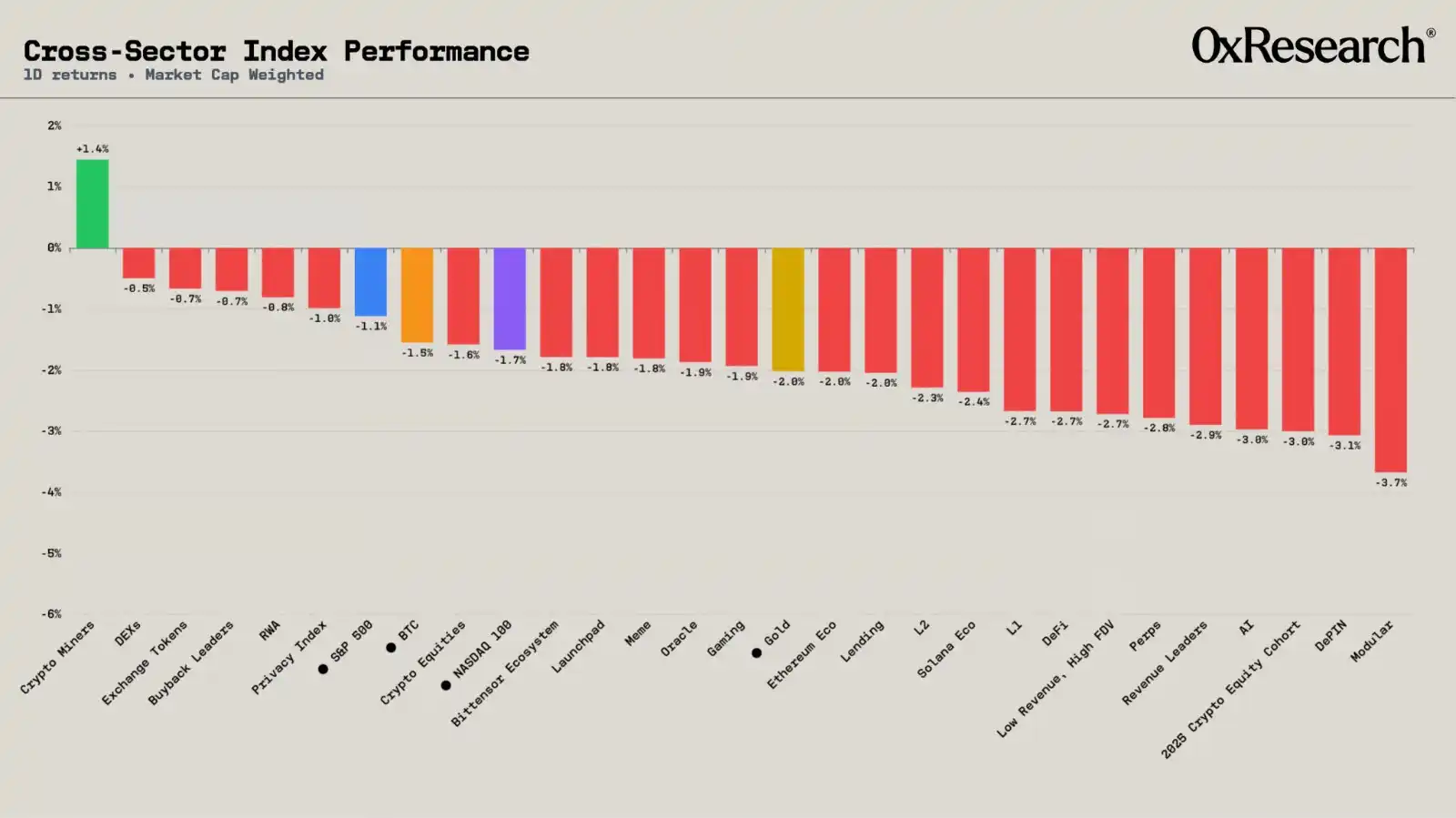
Following JTX's launch on July 14, how should we value JTO? This product is reshaping Jito's business model: it's no longer just a price-taker on Solana block space, but has begun pricing user traffic. Our base case implies 57% upside, while our probability-weighted target points to a potential gain of 267%. Meanwhile, the broader crypto market has pulled back, with only the crypto miner sector closing in the green, driven by a wave of AI data center trades.

Zooming out, one trend remains prominent: over the past week, the crypto miner sector surged 27.0%, significantly outperforming all other crypto sectors. It was followed by DEX (+4.6%), Bittensor Ecosystem (+4.3%), and Ethereum Ecosystem (+3.9%). The broader equity market was almost flat over the same period.
This rally has been fueled by a series of AI infrastructure announcements, indicating a shift in how investors value Bitcoin mining companies. On July 20, Hut 8 announced another 15-year, $9.8 billion lease for its Beacon Point campus, covering 352 megawatts. This deal doubles its contracted capacity to 704 MW, bringing the total base contract value to $19.6 billion. On the same day, IREN secured another $2.8 billion in AI cloud contracts, raising its year-end run-rate target from $3.7 billion to over $4.0 billion, with about 85% of its capacity already contracted to clients like Microsoft, NVIDIA, and Perplexity.
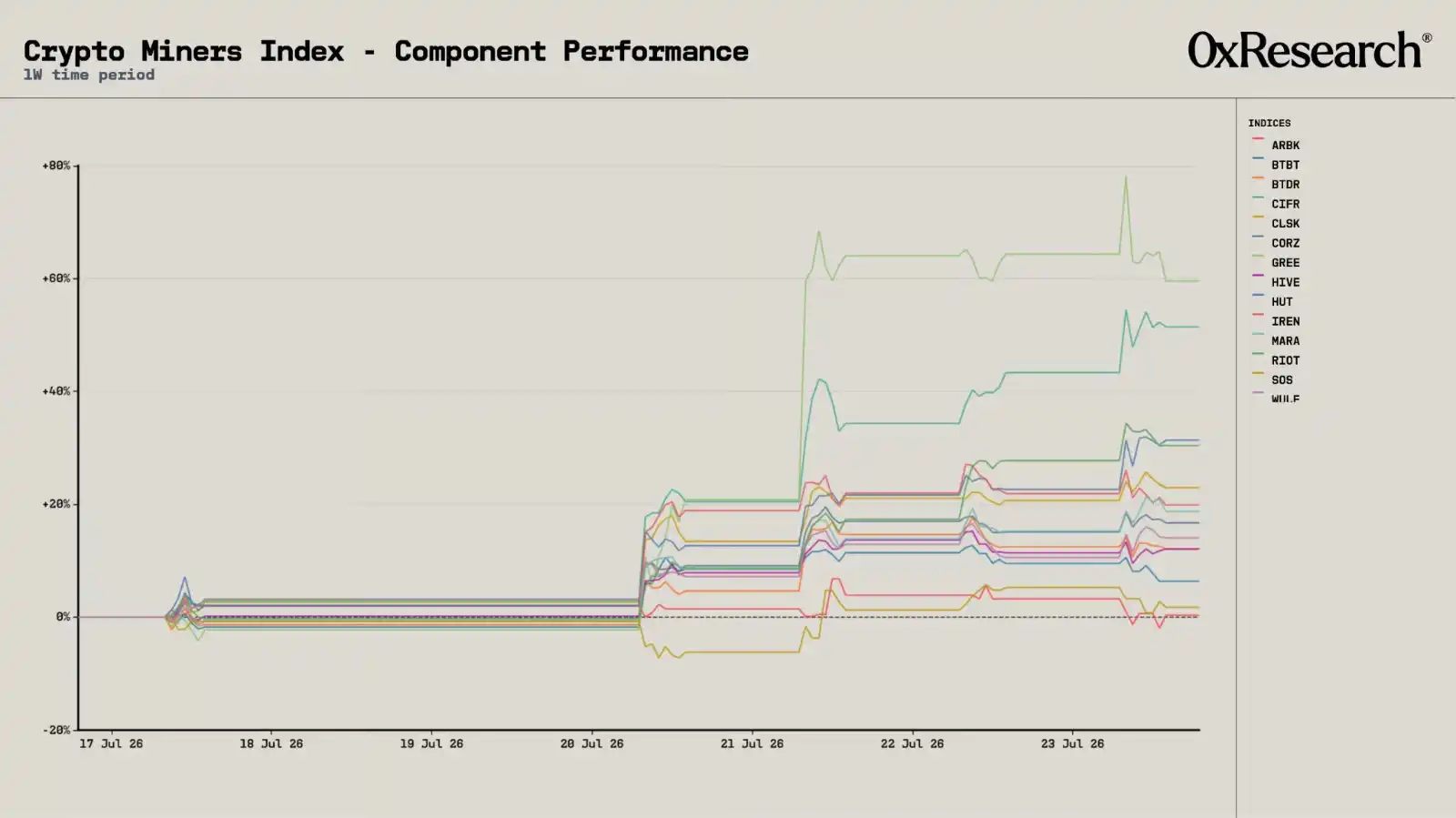
The market reacted swiftly. Over the past week, Greenidge gained 59.6%, followed by Cipher (+51.4%), Hut 8 (+31.4%), Riot (+30.4%), and CleanSpark (+22.9%). The common thread is that investors are increasingly viewing these companies as owners of scarce power and data center infrastructure, not just Bitcoin miners. As long as demand for AI compute continues to outpace supply, this narrative is likely to remain a primary catalyst for the sector, even as Bitcoin itself trades sideways.

Valuing Jito's JTX

Today, we dig deeper into valuing JTO. JTX's progress is redefining what the company is. The market still prices it as Solana backend infrastructure—a price-taker dependent on block space activity—whereas JTX (launched July 14) has effectively turned it into a price-setter for user traffic. Our buy thesis hinges on Jito's ability to truly capture this traffic, not a rebound in its traditional business.

While still early, JTX's execution data shows positive signs. Among the over 77,000 trades since launch, the median execution price deviated from the oracle mid-price by just 5.5 basis points, with 77.6% of trades within 25 bps and 29.1% even beating the oracle quote. Execution quality correlates strongly with liquidity: SOL had a median deviation of 3.9 bps, JitoSOL only 0.5 bps, while illiquid long-tail assets showed wider spreads. BAM's advantage is not yet pronounced: 4.6 bps in BAM-dominated blocks vs. 4.8 bps in others.

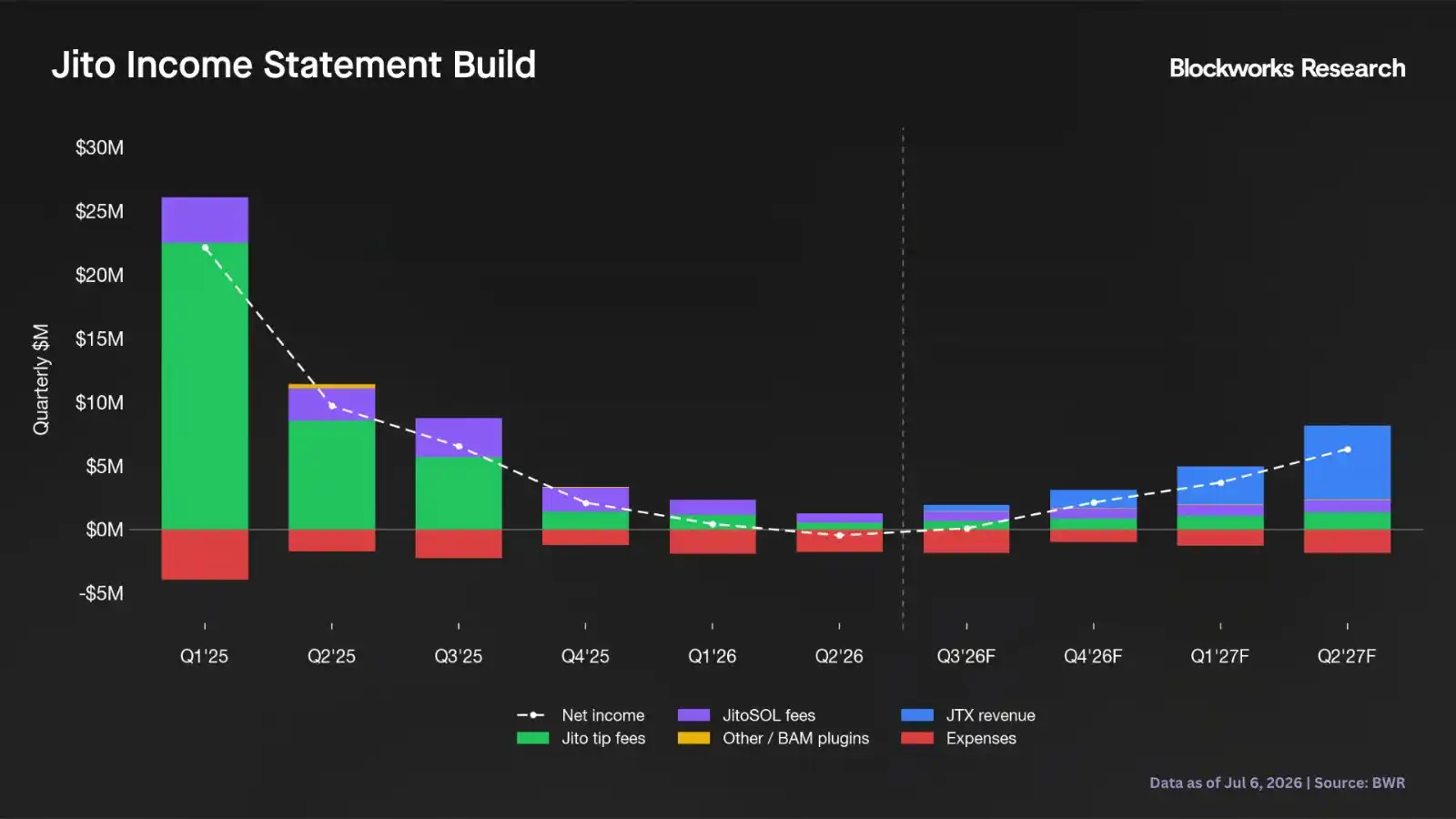
This structure exists because Jito deliberately sacrificed short-term revenue for long-term optimization of Solana's market structure—it shut down predatory MEV traffic and prioritized BAM, directly cutting into the high-margin Jito tip revenue that once contributed significantly.

Our model remains conservative on the legacy business: no assumption of tip revenue returning to peak levels, no assumption of JitoSOL LST recovery, and no assumption of BAM being fully monetized. The base case instead assumes JTX captures 15% of Solana DEX volume by Q2 2027, generating quarterly net revenue of $5.8 million and total revenue of $8.2 million, annualizing to about $32.7 million, with JTX accounting for roughly 72%. This implies a treasury-adjusted price-to-sales ratio of less than 15x based on Q2 2027 annualized revenue.
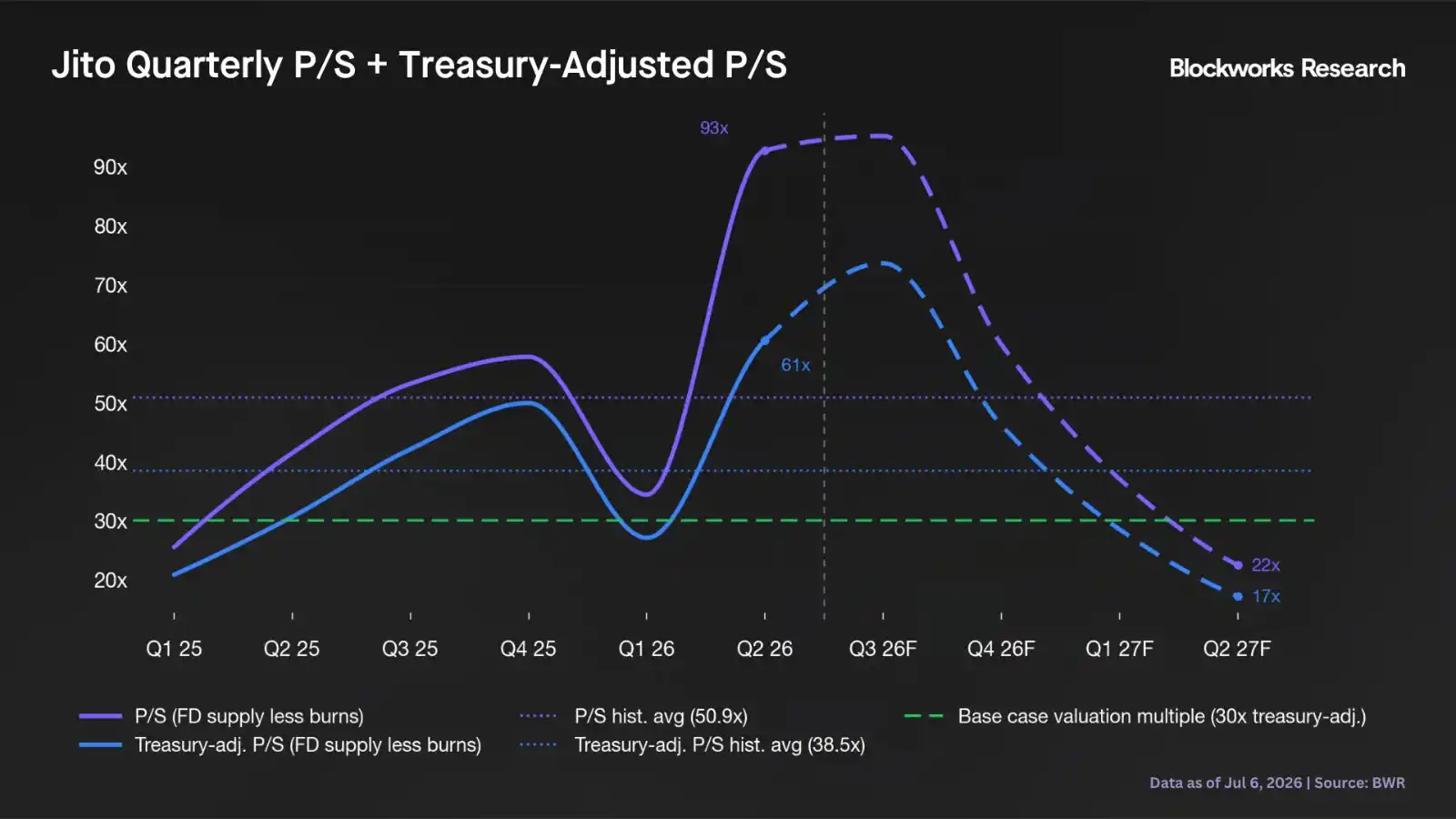
Historical context suggests this is cheap: even with declining revenue, the backend infrastructure business has traded at an average P/S of about 38x since early 2025. Applying a conservative 30x multiple to the base case annualized revenue yields a JTO price of $1.18, implying about 57% upside. A 30x multiple is not unreasonable for a growing business with a superior front-end economic model, especially compared to a shrinking business trading at 38x.
The scenario range is wide. The bull case (40% probability) assumes a 25% JTX market share and a 45x multiple, leading to a price of $5.31, a 600% gain. The bear case (10% probability) assumes market share stagnates at 5% and the P/S compresses to a commoditized 15x, leading to a price of $0.36, a 52% decline. The probability-weighted price target across the three scenarios is $2.75, implying about 267% upside from the current ~$0.75. The valuation is highly sensitive to Solana DEX volume, and our weighting leans optimistic because we believe tokenized stocks and real-world assets will scale on-chain, simultaneously boosting trading volume and JTX's market share.

JTX also makes JTO's value capture clearer: an estimated 80% of its revenue is earmarked for buybacks. The base case implies ~$8.6 million in buybacks over the next 12 months, retiring ~1.5% of the treasury-adjusted supply (bull case: ~5.7%). While the flywheel remains small today, it will scale directly with JTX's success.

Пов'язані питання

QWhat is JTX, and how is it changing Jito's business model?

AJTX is a new product launched by Jito on July 14. It is shifting Jito's business model from being a price taker dependent on Solana block space activity to becoming a price setter for user traffic. It allows Jito to capture and monetize this traffic directly.

QWhat is the market's recent trend regarding the crypto miner sector?

AOver the past week, the crypto miner sector has surged 27.0%, significantly outperforming all other crypto sectors. This rally is largely driven by announcements related to AI infrastructure, leading investors to value these companies more as owners of scarce electricity and data center infrastructure rather than just Bitcoin miners.

QAccording to the analysis, what is the potential upside for JTO based on the base case scenario?

AAccording to the base case scenario analysis, applying a conservative 30x P/S multiple to Jito's projected annualized revenue gives a target price of $1.18 for JTO, implying an approximate 57% upside from the current price.

QWhat is the probability-weighted target price for JTO and the implied potential upside?

AThe probability-weighted target price for JTO is $2.75, which implies a potential upside of approximately 267% from the current price of around $0.75. This target is derived from a weighted average of optimistic, base, and pessimistic scenarios.

QHow does JTX plan to create value for JTO token holders?

AJTX is expected to direct approximately 80% of its revenue towards buybacks of the JTO token. In the base case scenario, this would amount to about $8.6 million in buybacks over the next 12 months, potentially retiring around 1.5% of the treasury-adjusted token supply.

Пов'язані матеріали

Luno Cuts 20% of Global Workforce as Cryptocurrency Exchange Shifts Priorities Towards Automation

Luno, a global cryptocurrency exchange owned by Digital Currency Group, is reducing its global workforce by 20% as part of a major operational restructuring driven by a downturn in retail crypto activity and increased automation. CEO James Lanigan announced the layoffs on July 28, stating it was a difficult but necessary decision to build a more sustainable structure for the long term. The company did not disclose the total number of affected employees, though South African staff are among those impacted, with formal consultations initiated there in line with local labor laws. This marks the second major round of layoffs in three and a half years, following a 35% staff reduction in January 2023. The company cites cyclical declines in retail user activity and ongoing investment in automated tools as key factors behind the restructuring, which has fundamentally changed the firm's resource needs. Concurrently, Luno is reorganizing into three unified divisions built on a single core platform: 1) a consolidated consumer and API platform serving over 16 million users in Africa and Asia-Pacific, 2) a stablecoin solutions unit focused on the zar-backed 'Zaru' stablecoin launched in February 2026, and 3) an institutional arm offering OTC services and cross-border settlement networks. This restructuring follows recent market withdrawals, with Luno discontinuing services in certain markets from September 1, 2026.

cryptonews.ru2 хв тому

Luno Cuts 20% of Global Workforce as Cryptocurrency Exchange Shifts Priorities Towards Automation

cryptonews.ru2 хв тому

Turkey blocked 47,493 illegal betting sites amid expanded measures targeting cryptocurrency accounts

Turkey has blocked access to 47,493 illegal betting websites since January 1st as part of a nationwide crackdown on online gambling operators and their payment networks. Police and gendarmerie conducted 680 operations, detaining 5,629 suspects, with 3,231 placed in pre-trial detention and 1,515 placed under judicial supervision. Cybercrime units are conducting 24/7 monitoring of illegal betting sites, social media ads, and digital payment channels. Investigators are tracking bank accounts, e-money services, and crypto asset wallets suspected of facilitating betting operations or laundering criminal proceeds. The actions follow earlier raids in May targeting over 670 suspects, with one investigation in Adana uncovering cryptocurrency platforms used for laundering betting revenues. Authorities highlighted a specific case involving a network allegedly coordinated by a suspect with initials İ.Ö.Ö., which reportedly generated revenue from illegal betting and match-fixing. Prosecutors identified seven overseas crypto wallets that received transfers from this network, estimating total transaction volume at $4 billion. All related bank and crypto accounts were frozen. The network allegedly recruited individuals to act as "common accounts" for processing bets in exchange for a 1% commission. In separate operations, authorities blocked 4,742 bank accounts and six crypto accounts in Adana, and identified transactional activity worth approximately $104 million across 47 suspects. Assets including companies, vehicles, and properties were seized. The crackdown includes real-time disruption. During the 2022 World Cup final, prosecutors identified and ordered the freezing of 6,314 bank accounts used for illegal betting, aided by an AI analysis system called AVCI. They project illegal betting volume for the 2026 World Cup could reach $50 billion. Justice Minister Yılmaz Tunç stated that 19 offshore "financial companies" managing panel systems for illegal betting sites were identified, with legal proceedings initiated against 23 suspects. He emphasized a strategic shift towards "draining the swamp" through coordinated asset seizures and digital evidence collection, rather than relying on individual prosecutions.

cryptonews.ru8 хв тому

Turkey blocked 47,493 illegal betting sites amid expanded measures targeting cryptocurrency accounts

cryptonews.ru8 хв тому

Торгівля

Спот
活动图片