HYPE Cools Down, RWA Heats Up: Is Hyperliquid's Counter-Cyclical Expansion Just Beginning?

marsbitОпубліковано о 2026-08-04Востаннє оновлено о 2026-08-04

Анотація

As the price of HYPE has retreated from its peak about two months ago, Hyperliquid's ecosystem continues to expand, driven by growing RWA (Real World Assets) trading demand from HIP-3. The platform's share of the global perpetual contracts market has increased. While Trade.xyz maintains a dominant position as the primary gateway to the HIP-3 ecosystem, new entrants like Paragon are entering the competition by acquiring popular tickers and employing differentiated strategies, focusing on assets with strong narratives. The entry barrier for HIP-3 deployers is also lowering through capital partnerships. Despite the ecosystem growth, the HYPE token price has corrected significantly, influenced by cooling ETF inflows and large-scale unstaking by institutional whales, though some actions are attributed to wallet management rather than direct selling. Team token unlocks have not caused major selling pressure, as the protocol's assistance fund has been repurchasing tokens at a faster rate. The expansion of HIP-3 assets and infrastructure is poised to potentially enhance Hyperliquid's network effects and HYPE's value capture in the long term.

Author: Nancy, PANews

Since reaching a local high about two months ago, the price of HYPE has been in a sustained correction, but Hyperliquid's ecosystem expansion has not stalled. With HIP-3 driving growth in RWA trading demand, the platform's share of the global perpetual contracts market continues to increase.

At the same time, competition around the HIP-3 ecosystem entry points is heating up. Trade.xyz dominates due to its first-mover advantage, while multiple deployers are attempting to capture a share of the market by snatching up popular tickers and introducing capital support.

RWA Overtakes Crypto as Core Growth Sector, Trade.xyz Faces Siege from Newcomers "Grabbing Tickets"

The bear market has not hindered Hyperliquid's rapid expansion. However, what is fueling its growth now is not trading in crypto assets like Bitcoin and Ethereum, but the increasingly hot RWA sector.

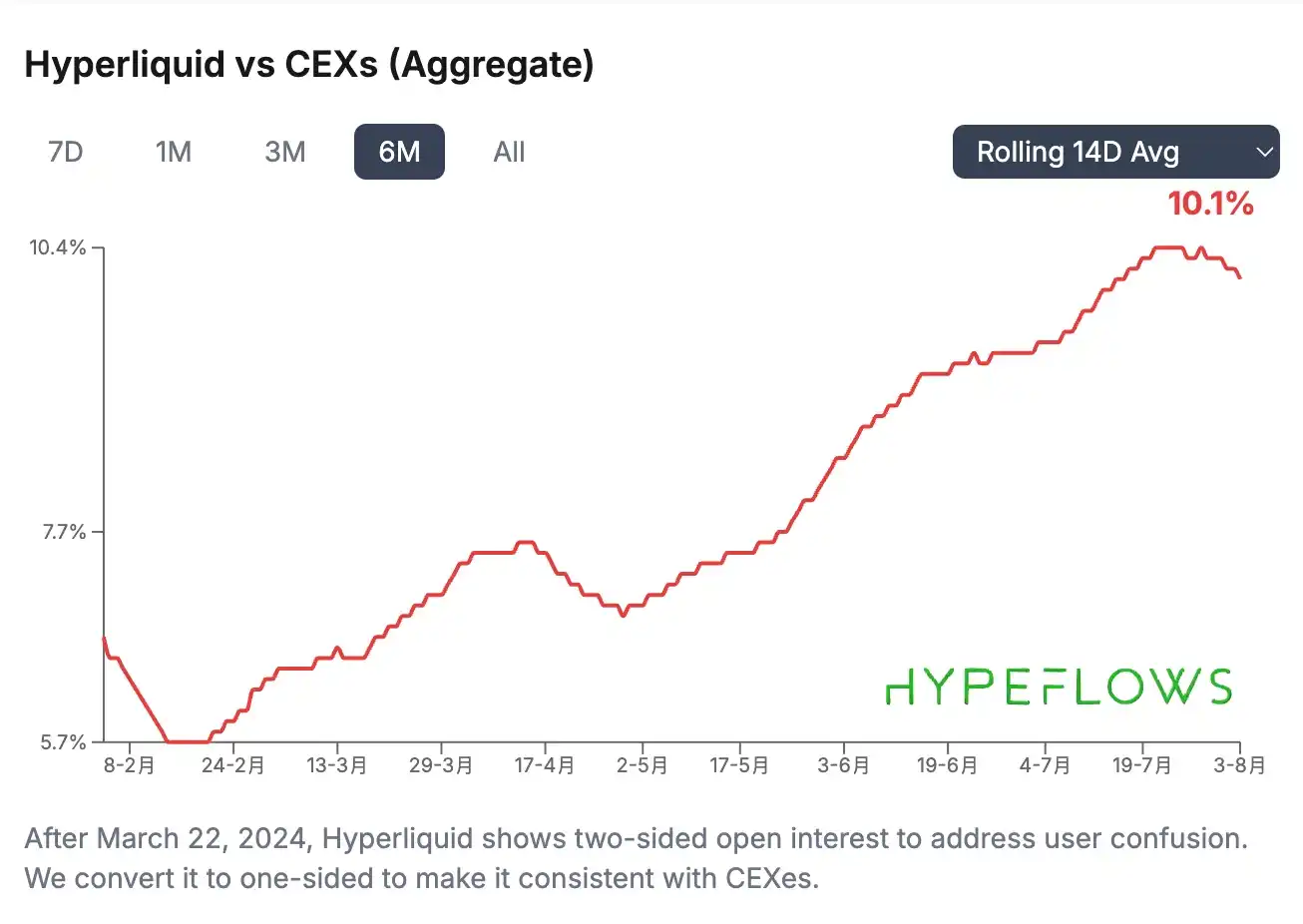
Currently, Hyperliquid is accelerating its rise in the global perpetual contracts market. Hypeflow data shows that as of August 3rd, based on the 14-day rolling average calculated by Open Interest (OI) size, Hyperliquid already holds a 10.1% share of the global perpetual contracts market, up from just 7.1% half a year ago.
The core driver of Hyperliquid's growth comes from the RWA trading demand brought by HIP-3.

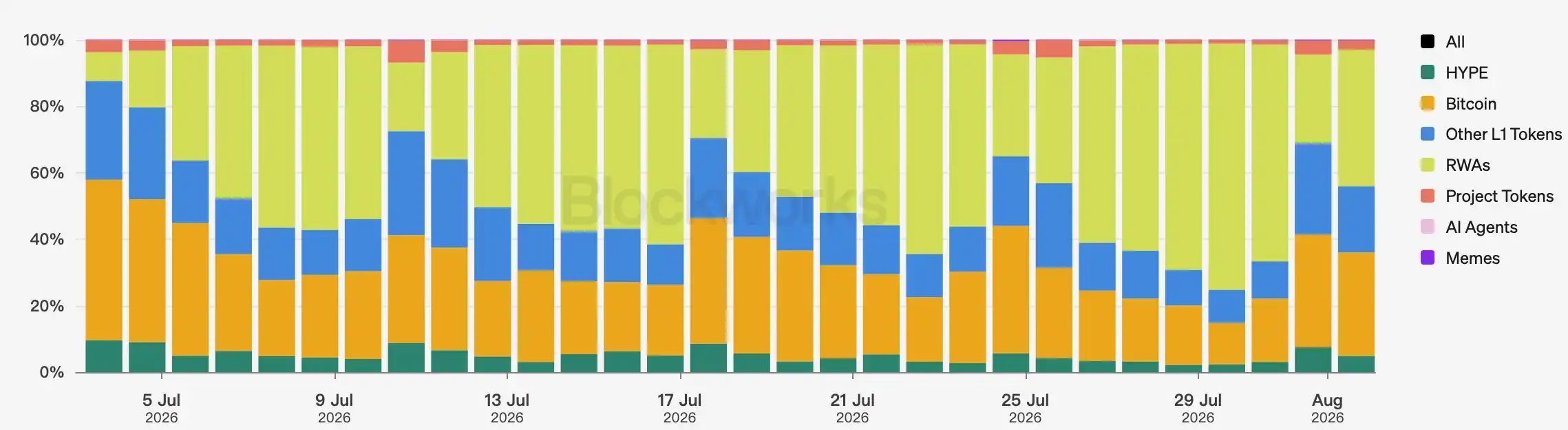
Blockworks data shows that as of August 1st, HIP-3-related RWA assets accounted for 41% of Hyperliquid's perpetual contract trading volume, recently rising to as high as 74%. At the same time, the trading share of traditional crypto assets like Bitcoin has been declining, indicating that Hyperliquid's current growth logic has shifted from crypto-native asset trading to an on-chain perpetual trading market covering stocks, commodities, and more real-world asset targets.
As the HIP-3 ecosystem continues to expand, more and more deployers are entering the competition.

Currently, Trade.xyz holds a leading market position thanks to its first-mover advantage, with various trading data repeatedly setting new records. According to official disclosures, Trade.xyz's cumulative trading volume has reached $408.4 billion, with weekend cumulative turnover exceeding $26 billion and a peak of over 60,000 unique traders in a single day.

However, competitors of Trade.xyz are accelerating their entry into the HIP-3 market using differentiated strategies and lower participation barriers.

For example, Paragon is laying out in the HIP-3 ecosystem by buying up tickers. hl.eco data shows that since July 15th, Paragon has successively acquired 13 tickers, spending a total of approximately 6,328 HYPE, valued at around $333,000. Prior to this, ticker auctions within the HIP-3 ecosystem were almost monopolized by Trade.xyz.
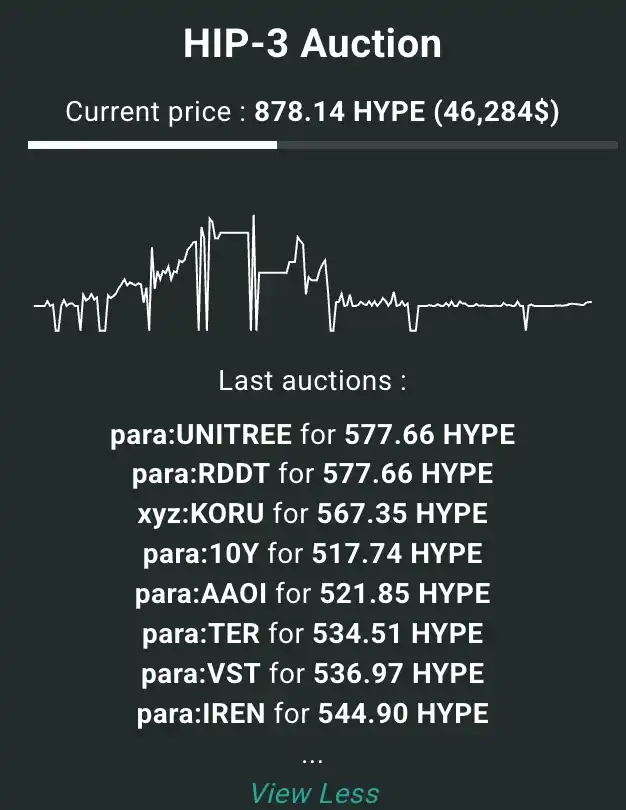
In terms of asset selection, Paragon has adopted a differentiated entry strategy. Its recently acquired tickers cover multiple segments of the AI industry chain, including fiber optics & optical modules (GLW, CRDO, AAOI, CIEN), semiconductor equipment (LRCX, TER), storage (STX), computing power & energy supporting infrastructure (IREN, VST, NET), as well as recently auctioned hot narrative targets like the humanoid robot company Unitree (UNITREE) and the social platform Reddit (RDDT).

Compared to Trade.xyz's focus on mainstream large-cap stocks, Paragon pays more attention to assets with relatively weaker liquidity in traditional markets but strong narrative appeal, which are suitable for on-chain perpetual trading. The community believes this strategy essentially secures positions in high-growth sectors at a lower cost in advance.

However, in terms of current scale, Paragon still lags significantly behind Trade.xyz. ASXN data shows Paragon's latest weekly trading volume is approximately $15.55 million, a 12.8x increase from early July, but still less than 0.01% of Trade.xyz's trading volume during the same period. During the same period, the number of weekly traders on Paragon grew from 1,260 to 12,760, while Trade.xyz reached 18.7 million traders.

Meanwhile, the participation barrier for the HIP-3 ecosystem is also lowering. Previously, HIP-3 deployers needed to stake 500,000 HYPE, a high threshold that limited entry for some projects. However, with ecosystem development, more deployers are starting to reduce entry costs through capital and resource collaboration.

For instance, Hyperion, the second-largest HYPE DAT company, provides 500,000 HYPE staking support and has partnered with Skew Technologies to launch institutional-grade perpetual futures products. By acquiring equity participation in Skew and a share of listing service revenue, Hyperion allows Skew to focus on product development and user distribution without needing to lock up a large amount of HYPE itself. Their business scope may further expand to markets related to HIP-4 in the future. Multicoin Capital invested $1.75 million in a seed round for Trasia, becoming its sole seed investor. The project also received commitments exceeding $35 million worth of HYPE and USDC.

HYPE Continues to Fall from Highs, Are Institutions Playing High-Sell, Low-Buy?

Despite the ecosystem's counter-trend expansion, the price of the HYPE token has failed to sustain its upward trajectory.

In mid-June this year, the price of HYPE once surged to near its historical high of $77 before entering a sustained correction phase. According to CoinGecko data, HYPE has fallen 26.8% over the past 30 days.
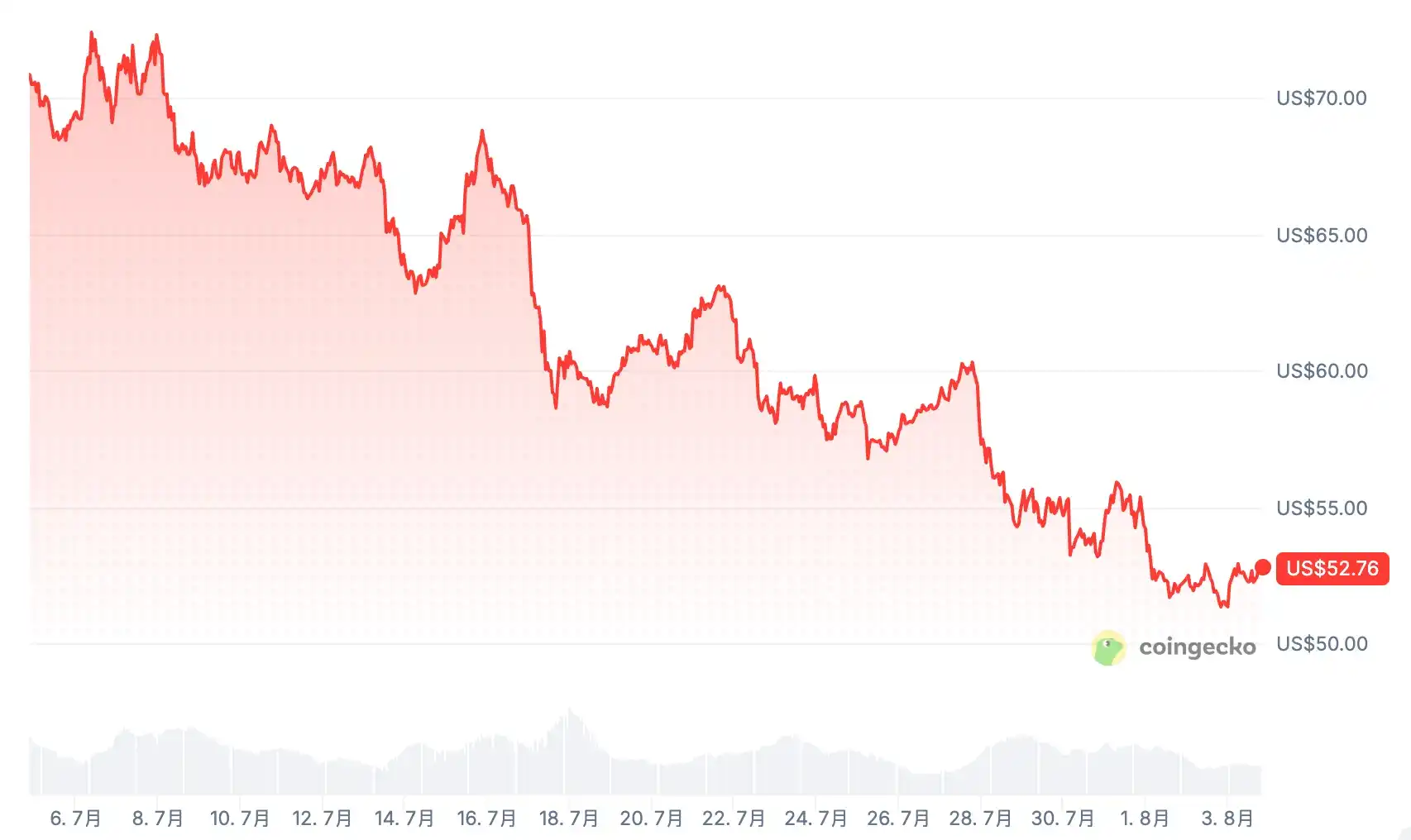
Behind this round of correction, ETF fund outflows and whale profit-taking are the main factors.

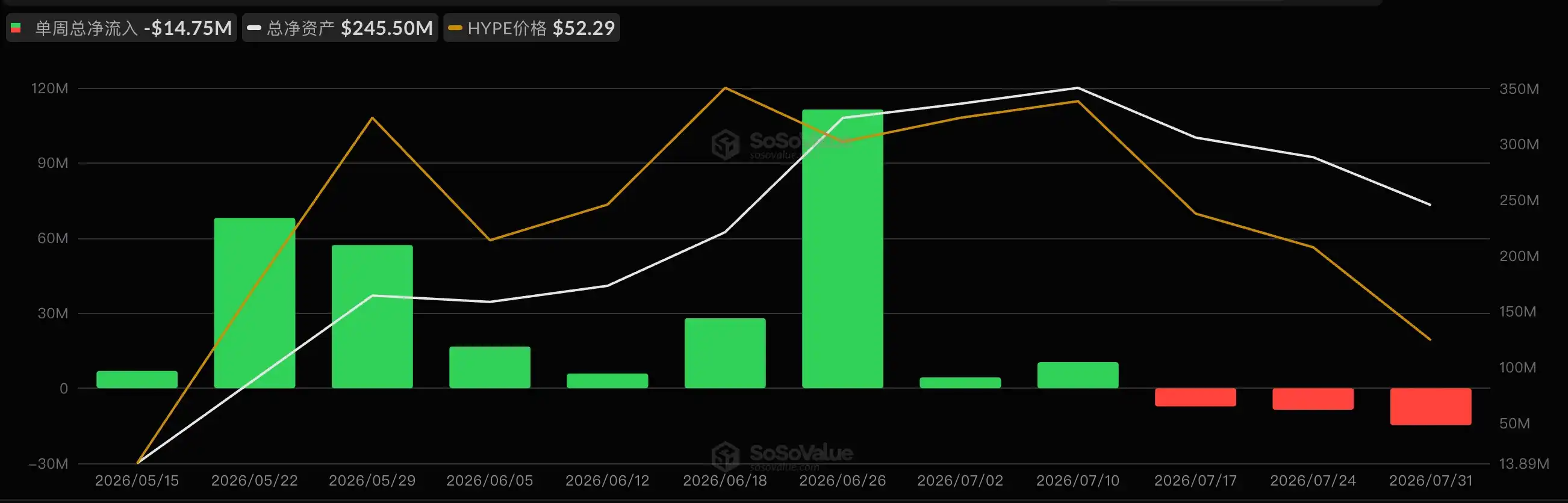
On one hand, inflows into HYPE spot ETFs have noticeably cooled. SoSoValue data shows that since late June, HYPE spot ETF inflows have gradually cooled and turned into net outflows. In the week of June 26th, weekly net inflows into HYPE spot ETFs once exceeded $110 million. Since then, inflow sizes have continuously shrunk. Entering July, ETFs saw consecutive net outflows, with cumulative net outflows for the month exceeding $15.16 million.
On the other hand, some institutional whales have recently conducted large on-chain operations. Multicoin Capital unstaked 1.96 million HYPE (worth ~$120 million) on July 22nd and transferred part of the tokens to exchanges; a Paradigm-linked wallet unstaked approximately 2.92 million HYPE (worth ~$171 million) on July 24th; an a16z-linked address also transferred about 437,000 HYPE (worth ~$28.38 million) to multiple trading platforms in mid-July. Additionally, addresses linked to Selini Capital, Bitwise, and market maker Cumberland also transferred HYPE to exchanges, with amounts ranging from several million to tens of millions of dollars.

However, these on-chain actions do not equate to selling. For example, Multicoin Capital co-founder Tushar Jain stated that unstaking was mainly for wallet rotation and privacy management needs, not for selling tokens; the founder of Selini Capital also responded that there was no dumping, and HYPE is still used in multiple business scenarios; the a16z-linked entity appeared to engage in high-sell, low-buy, repurchasing approximately $7.335 million worth of HYPE.

Aside from changes in fund flows, the decline in Hyperliquid's revenue has also weakened the HYPE buyback intensity, further affecting short-term market support. ASXN data shows that HYPE buybacks in July amounted to approximately $244,000, down 72.4% from $886,000 in June.
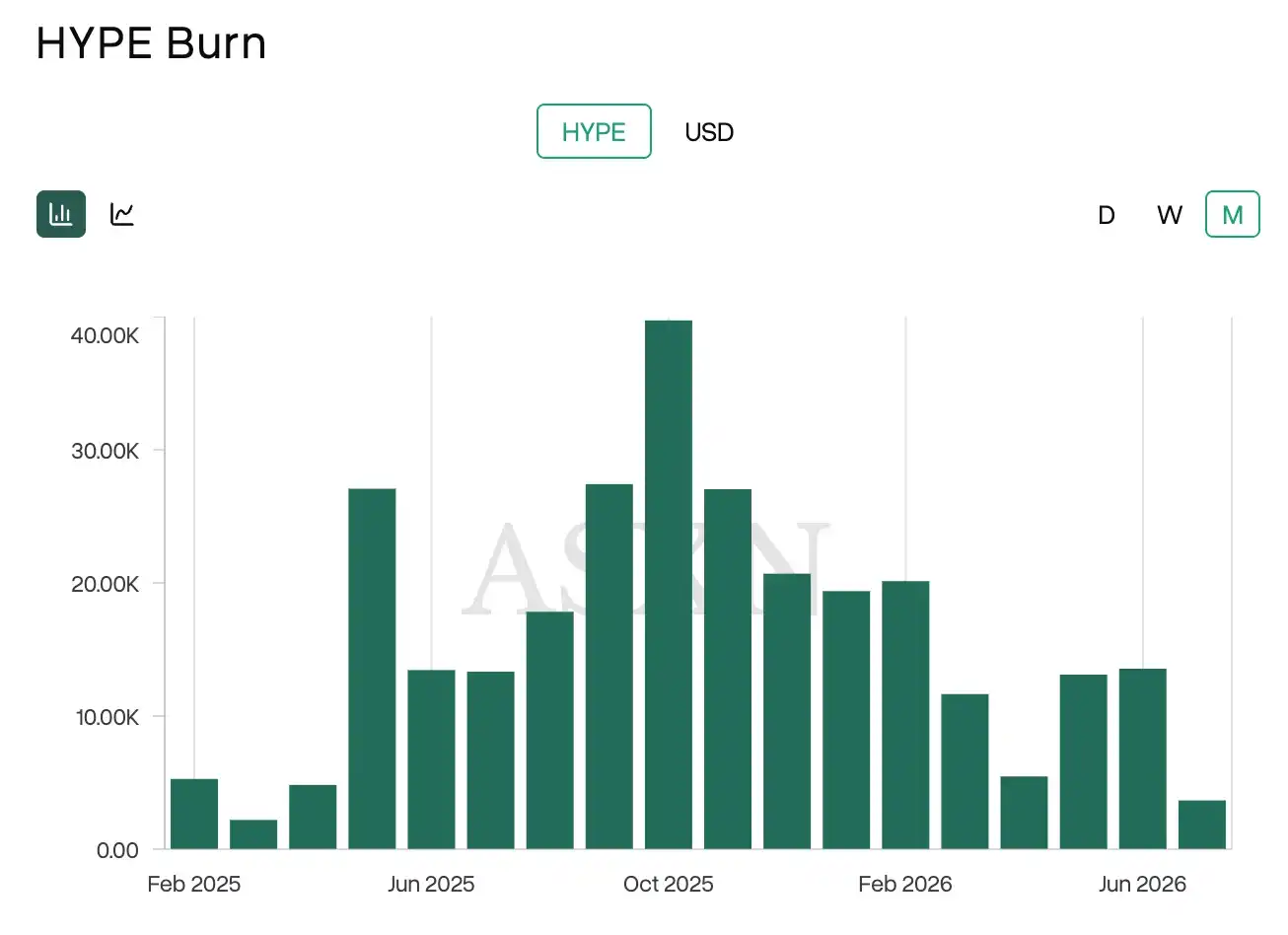
It's worth mentioning that team token unlocks have not created the large-scale selling pressure the market previously feared. According to a recent tweet by MLM, since HYPE team tokens began unlocking in December 2025, approximately 4.93 million HYPE have been allocated to team members, worth about $270 million at current prices, accounting for about 0.493% of the total supply. Of this, about 1.19 million were sold on the secondary market, cashing out about $32.5 million, and about 3.14 million were transferred to OTC platforms, valued at about $132 million at the time of transfer. In total, about 4.33 million HYPE were sold, amounting to about $165 million.

During the same period, the Assistance Fund has cumulatively repurchased about 9.8 million HYPE, investing about $364 million, averaging monthly repurchases of about 1.23 million HYPE worth $46 million. The repurchase speed is more than twice the selling speed of current and former team members.

This means the main pressure on HYPE currently is not from team unlocks, but rather from changes in market demand. Meanwhile, the Hyperliquid team seems intent on using OTC methods more to reduce the impact of unlocks on secondary market liquidity, while the Assistance Fund's continued buybacks have to some extent alleviated supply-side pressure on circulation.

In the short term, Trade.xyz, with its liquidity, user scale, and first-mover advantage, remains the absolute leader in the HIP-3 ecosystem, making it difficult for other deployers to pose a direct challenge. However, in the long term, as asset types continue to diversify, participation barriers keep lowering, and more infrastructure and capital forces enter, the HIP-3 ecosystem may experience larger-scale expansion.

For Hyperliquid, the continuous enrichment of its ecosystem and assets could not only expand trading demand but also potentially strengthen the platform's network effects, providing new growth space for HYPE's value capture.


Трендові криптовалюти

Пов'язані питання

QWhat has become the core growth driver for Hyperliquid's recent expansion, according to the article?

AThe core growth driver is the RWA (Real World Asset) trading demand brought by HIP-3. It now accounts for a significant portion of Hyperliquid's perpetual contract volume, shifting the platform's growth logic from native crypto assets to on-chain perpetual trading of stocks, commodities, and other real-world assets.

QHow has Hyperliquid's market share in the global perpetual contracts market changed recently?

AHyperliquid's market share in the global perpetual contracts market, measured by the 14-day rolling average of Open Interest (OI), has increased from 7.1% six months ago to 10.1% as of August 3.

QWho is the current dominant player in the HIP-3 ecosystem, and what strategy are new competitors like Paragon using to challenge it?

ATrade.xyz is the current dominant player in the HIP-3 ecosystem, holding a leading position due to its first-mover advantage. New competitors like Paragon are using a strategy of acquiring popular Tickers (e.g., focusing on AI-related and narrative-driven assets) to secure a foothold, differentiating themselves from Trade.xyz's focus on mainstream large-cap stocks.

QWhat are the two main factors cited for the recent price decline of the HYPE token?

AThe two main factors for HYPE's recent price decline are: 1) Cooling inflows into HYPE spot ETFs, which have turned into net outflows. 2) Large on-chain movements by institutional whales (like Multicoin Capital, Paradigm, a16z) involving unstaking and transferring HYPE to exchanges, which is perceived by the market as potential selling pressure, although some entities have stated these were not direct sales.

QHow has the Hyperliquid team managed the potential selling pressure from team token unlocks?

AThe team has managed potential selling pressure by: 1) Conducting a significant portion of sales through Over-The-Counter (OTC) platforms to minimize impact on secondary market liquidity. 2) The Aid Fund has been consistently buying back HYPE tokens from the market. The buyback rate (approx. 1.23 million HYPE per month) has been more than double the selling rate by current and former team members, helping to offset the supply pressure.

Пов'язані матеріали

Wall Street Morning Report: AI + Cloud Computing Takes Over the Market Again, Amazon Knocks on the Door of $3 Trillion

Wall Street's August began with a strong rally, driven by easing Middle East tensions as President Trump signaled progress on U.S.-Iran talks, prompting a sharp drop in oil prices. Major indices hit record or near-record highs, with the Dow Jones Industrial Average up 1.32%, the Nasdaq Composite surging 2.13%, and the S&P 500 rising 1.48%. The energy sector was the sole decliner. The AI and cloud computing narrative dominated the tech rally. The "Magnificent Seven" index jumped 3.6%. Amazon's market cap surpassed $3 trillion for the first time following robust AWS results, while Nvidia regained a $5 trillion valuation. Meta, Google, and Microsoft also posted significant gains. Other AI-related stocks like Palantir, CoreWeave, and various semiconductor and infrastructure companies saw strong advances. In other markets, gold held above $4,000, supported by central bank buying. Treasury yields fell as oil prices dropped. The U.S. dollar remained stable despite strong manufacturing data. Japan's substantial currency intervention raised concerns, but U.S. officials reassured markets about the mechanism used. Key events ahead include major industry conferences (Ai4 2026, FMS Summit) and earnings reports from companies like SpaceX, AMD, and Pfizer. The White House is also set to host a meeting with leading AI firms to discuss regulatory frameworks.

marsbit6 хв тому

Wall Street Morning Report: AI + Cloud Computing Takes Over the Market Again, Amazon Knocks on the Door of $3 Trillion

marsbit6 хв тому

The July Tech Stock Pullback: Which Funds Are Paying the Price for Buying High?

In July, China's technology stocks experienced a sharp correction, causing significant pain for actively managed mutual funds that aggressively increased their holdings in the sector during the second quarter. The sell-off saw major indices like the ChiNext and STAR 50 fall over 25% and 28% for the month, respectively. Funds that piled into tech at its June peak faced steep losses. Notably, several veteran "value investor" fund managers, known for long-term holdings in consumer staples, made dramatic shifts. Star managers like Zhang Kun (E Fund Blue Chip Selected) and Liu Yanchun (Invesco Great Wall Dingyi) drastically reduced positions in liquor stocks like Kweichow Moutai, switching instead to semiconductor and AI hardware companies like SMIC and Ingenic International. Data shows active equity funds' allocation to the electronics sector reached a historical high of 42.64% by end-Q2. Around 67 funds saw their TMT (Technology, Media, Telecom) weighting surge from an average of 6.75% to 54.99%. The consequences were severe in July: these high-TMT funds fell an average of over 20%, with 12 plunging more than 40%. Examples include Jinhua High-Quality Growth and Guoshou Anbao Wenhui, which fell 26.34% and nearly 40% respectively after raising TMT weights above 70%. The article also highlights issues of "style drift," where funds with names like "high-dividend" held high-P/E tech stocks instead, confusing investors. Newly launched funds suffered even more. For instance, Guotai Haitong New Energy RuiXuan Hybrid, launched in mid-June, saw its net asset value plummet to 0.5509 yuan by July 30, a loss of nearly 45%. Analysts note the extreme sector concentration mirrored past bubbles (e.g., 2021 new energy). The intense, crowded trade itself became a major risk. While tech stocks rebounded sharply on July 31, the funds that chased the high face a longer-term market test.

marsbit21 хв тому

The July Tech Stock Pullback: Which Funds Are Paying the Price for Buying High?

marsbit21 хв тому

Dalio's Warning: AI Bubble Is Here, Gold Is the Hard Asset

Ray Dalio, founder of Bridgewater Associates, warns that the AI sector is currently in a bubble, drawing parallels to historical examples like the 1929 crash and the dot-com bubble. He explains that revolutionary new technologies lead to excessive excitement and investment, often with investors ignoring price fundamentals and taking on debt, which ultimately creates unsustainable asset valuations. Dalio outlines three key signs that a bubble is about to burst: 1) Rising interest rates, which force asset sales for liquidity. 2) A significant increase in stock supply as companies issue more shares. 3) A shift in ownership from steadfast institutional investors to less knowledgeable, often leveraged, retail investors. To navigate the potential downturn, he strongly advocates for a diversified investment portfolio, criticizing cash as a poor long-term store of value due to inflation. He specifically recommends allocating 5-15% of a portfolio to gold, which he views as a unique "hard asset" and an effective hedge because it is no one else's liability. In contrast, he is skeptical of Bitcoin as "digital gold," citing potential vulnerabilities to future technologies like quantum computing and government intervention. Regarding the AI revolution, Dalio believes the primary beneficiaries will be capitalists who own the automating technology, potentially exacerbating wealth inequality as machines replace both physical and increasingly complex cognitive labor. However, he concludes that humans with exceptional intelligence and strong collaborative skills will continue to thrive by leveraging uniquely human traits like emotion and intuition that AI cannot replicate. Finally, touching on his theory of long-term cycles, Dalio suggests the world is currently approaching a significant inflection point in an approximate 80-year cycle of changing world orders.

marsbit50 хв тому

Dalio's Warning: AI Bubble Is Here, Gold Is the Hard Asset

marsbit50 хв тому

On the Eve of Circle's Earnings Report, Wall Street Shows Major Divergence in CRCL Valuation

On the eve of Circle (CRCL) releasing its quarterly earnings report, Wall Street analysts are deeply divided over the company's valuation. Morgan Stanley downgraded Circle from "Equal Weight" to "Underweight," slashing its price target from $106 to $38. Analyst James Faucette argues the market overestimates the growth potential of Circle's core USDC stablecoin, noting its circulation hasn't increased since Q3 2025 and new use cases beyond remittances and card spending are limited. He warns that slowing USDC growth could pressure the crucial "reserve income" and shift revenue toward lower-margin transaction fees. In stark contrast, TD Cowen initiated coverage with a "Buy" rating and an $82 price target. Analyst Bryan Bergin believes the market underestimates Circle's potential to evolve from a stablecoin issuer into a broader digital financial infrastructure platform. He forecasts a ~31% annual growth rate for USDC through 2030 and expects faster growth in fee-based revenue from services like payments, RWA tokenization, and its Arc network. A key external factor adding uncertainty is the stalled progress of the CLARITY Act in the US Senate, whose delay could dampen institutional adoption expectations for stablecoins. The core disagreement lies in whether Circle's future hinges on USDC circulation growth or a successful platform-based transformation. The upcoming earnings report is keenly awaited for insights into reserve income trends and the progress of newer business verticals.

marsbit2 год тому

On the Eve of Circle's Earnings Report, Wall Street Shows Major Divergence in CRCL Valuation

marsbit2 год тому

Торгівля

Спот

Популярні статті

Як купити HYPE

Ласкаво просимо до HTX.com! Ми зробили покупку Hyperliquid (HYPE) простою та зручною. Дотримуйтесь нашої покрокової інструкції, щоб розпочати свою криптовалютну подорож.Крок 1: Створіть обліковий запис на HTXВикористовуйте свою електронну пошту або номер телефону, щоб зареєструвати обліковий запис на HTX безплатно. Пройдіть безпроблемну реєстрацію й отримайте доступ до всіх функцій.ЗареєструватисьКрок 2: Перейдіть до розділу Купити крипту і виберіть спосіб оплатиКредитна/дебетова картка: використовуйте вашу картку Visa або Mastercard, щоб миттєво купити Hyperliquid (HYPE).Баланс: використовуйте кошти з балансу вашого рахунку HTX для безперешкодної торгівлі.Треті особи: ми додали популярні способи оплати, такі як Google Pay та Apple Pay, щоб підвищити зручність.P2P: Торгуйте безпосередньо з іншими користувачами на HTX.Позабіржова торгівля (OTC): ми пропонуємо індивідуальні послуги та конкурентні обмінні курси для трейдерів.Крок 3: Зберігайте свої Hyperliquid (HYPE)Після придбання Hyperliquid (HYPE) збережіть його у своєму обліковому записі на HTX. Крім того, ви можете відправити його в інше місце за допомогою блокчейн-переказу або використовувати його для торгівлі іншими криптовалютами.Крок 4: Торгівля Hyperliquid (HYPE)Легко торгуйте Hyperliquid (HYPE) на спотовому ринку HTX. Просто увійдіть до свого облікового запису, виберіть торгову пару, укладайте угоди та спостерігайте за ними в режимі реального часу. Ми пропонуємо зручний досвід як для початківців, так і для досвідчених трейдерів.

404 переглядів усьогоОпубліковано 2024.12.11Оновлено 2026.06.02

Як купити HYPE

Обговорення

Ласкаво просимо до спільноти HTX. Тут ви можете бути в курсі останніх подій розвитку платформи та отримати доступ до професійної ринкової інформації. Нижче представлені думки користувачів щодо ціни HYPE (HYPE).

活动图片