Are Rising U.S. Stocks Getting More Dangerous? Goldman Sachs: Downside Protection Mechanisms Have Almost Failed

marsbitОпубліковано о 2026-06-01Востаннє оновлено о 2026-06-01

Анотація

The US stock market rally is showing signs of becoming increasingly precarious as key downside protection mechanisms fail, according to Goldman Sachs. Derivatives strategist Brian Garrett notes that the S&P 500 options volatility skew has plunged to an 18-month low, indicating the market now prices an 8% probability for both a 10% drop and a 10% rise—a sign of "skew failure." Concurrently, Goldman's Panic Index hit a two-year low, reflecting minimal demand for tail-risk hedging. This complacency emerges amid a relentless market surge, with the S&P 500 setting new records frequently in 2024. Garrett highlights three major concerns: extreme concentration in the top ten stocks (40% of index weight), heavy reliance on AI-themed performance, and a price pattern eerily similar to the 1998-1999 period. Despite pervasive media pessimism, this fear is absent in options pricing. Downside hedge costs are historically low. Goldman suggests tactical trades: buying RSP outperformance options versus the SPX for a broadening rally, purchasing VIX calls for protection, and going long on Bitcoin ETF volatility. Hedge funds have been net buyers for two weeks, with sector rotation into financials and out of industrials. Notably, the global single-stock leveraged/ inverse ETF AUM has doubled to over $60 billion in two months, underscoring growing speculative activity.

The market's fear of downside risk has nearly vanished, and a core pricing mechanism in the options market is failing.

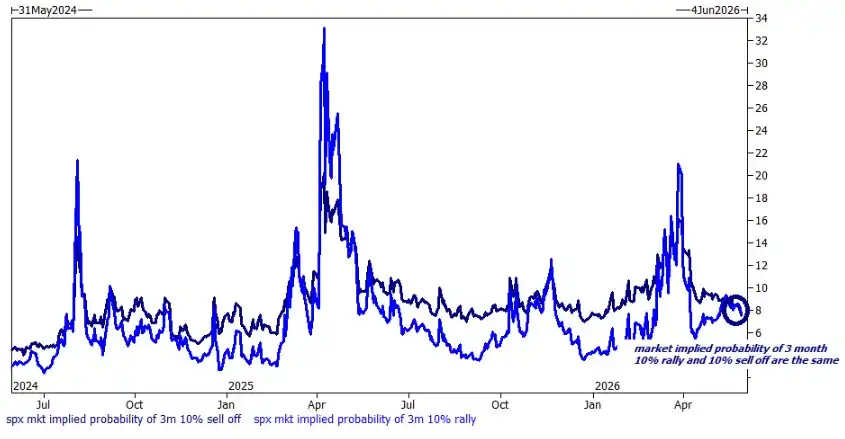
In a latest weekend report, Goldman Sachs derivatives strategist Brian Garrett pointed out that the volatility skew of S&P 500 options has fallen to an 18-month low. The market is pricing a roughly 8% probability for both a 10% decline and a 10% rise—a phenomenon directly characterized by Goldman's volatility team as 'Skew Failure.'

At the same time, the Goldman Sachs Panic Index closed in single digits, hitting a two-year low, indicating that market demand for hedging against tail risks has fallen to extremely low levels.
This signal appears against the backdrop of the U.S. stock market's continued surge. The S&P 500 has been hitting record highs on average every five trading days this year, and Micron's stock price surpassed $1,000 for the first time after hours on Sunday.

Garrett admitted that internal team discussions have evolved from 'Make it stop' in March to 'This is still going up?' in May. However, his own stance is shifting from cautious optimism to increasing pessimism, and he clearly listed several bearish reasons.

Three Bearish Signals Emerge, Cracks Appear Between Market Sentiment and Fundamentals

Garrett listed three major concerns in the current market.

First, market leadership is extremely narrow. The top ten weighted stocks in the S&P 500 now account for 40% of the index's weight, and the last four record highs occurred when overall market breadth was negative—a phenomenon that has never occurred before.

Second, thematic concentration is extremely high. Year-to-date, the S&P 500 excluding AI-related stocks has lagged the overall index by 700 basis points.

Third, price action is highly similar to history. Garrett noted that the 2026 price pattern closely resembles that of late 1998 to 1999.

Although bearish voices are flooding media headlines and social media, Garrett emphasized that this concern is not reflected in the pricing of the options market—at least, the fear of downside risk is almost nowhere to be seen.

Skew Failure: Downside Hedging Costs Fall to Historic Lows

Goldman's volatility team provided three key observations from the options market.

First, the S&P 500 volatility skew has fallen to an 18-month low. This move is driven by two forces: the put wing is unusually cheap, while the call wing is relatively expensive.

Second, the Goldman Sachs Panic Index closed in single digits last Friday, hitting a two-year low. This index synthesizes the two-year percentile rankings of VVIX, VIX, Skew, and at-the-money volatility.

Third, and most crucially: the market prices the probability of a 10% decline and a 10% rise as exactly the same, both around 8%. This means the options market no longer assigns extra premium to downside risk; the protective function of Skew has effectively failed.

Garrett pointed out that the direct implication of the above phenomena is: for investors looking to hedge correlation risk, the current hedging cost is extremely low.

Low-Cost Hedging Paired with Right-Tail Positioning

Based on the above assessment, Garrett provided several specific trade recommendations.

For investors bullish on market style rotation, expecting the rally to shift from concentration to dispersion, Goldman recommends buying RSP (Invesco S&P 500 Equal Weight ETF) outperformance options relative to SPX, with a 1-month 100% outperformance option costing about 145 basis points. It also recommends buying VIX call options as a hedging tool, noting that the term structure for August and beyond is extremely flat, with VVIX at 86.

For investors seeking simple downside protection, Garrett suggests directly buying S&P 500 put options—given the extremely low put skew, the payout structure is quite attractive.

Additionally, Goldman recommends going long Bitcoin ETF volatility with delta-neutral hedging. Garrett noted that Bitcoin has historically performed like a 'leveraged Nasdaq,' but its current pricing is at a two-year low and about 10 volatility points lower than SMH.

Fund Flows: Hedge Funds Net Buyers for Two Consecutive Weeks, Single-Stock ETF Assets Double

According to Goldman's latest Prime Brokerage data, hedge funds have been net buyers for two consecutive weeks, at the fastest pace this year, mainly reflected in long additions and macro short covering.

Significant sector rotation is evident: Financials (down 6% YTD) saw net buying, while Industrials (up 11.5% YTD) saw net selling.

On the futures side, end-user positioning has rebounded to near 2024 highs. Goldman's team specifically noted that levered ETFs are mechanically expanding their balance sheet size; CTA strategies are currently positioned near neutral, but systematic strategies show clear asymmetry towards the left tail—buying about $12 billion in a flat 1-month scenario versus selling about $100 billion in a down 1-month scenario.

Notably, global leveraged and inverse single-stock ETF assets under management have surpassed $60 billion, doubling in two months. The size of this niche market can no longer be ignored.

Пов'язані питання

QAccording to Goldman Sachs, what is currently malfunctioning in the equity options market and what does it indicate?

AGoldman Sachs states that the volatility skew (Skew) for S&P 500 options is malfunctioning, having dropped to an 18-month low. This indicates that the market is pricing the probability of a 10% decline and a 10% rise as virtually identical (both around 8%), meaning the protective mechanism against downside risk has nearly failed.

QWhat are the three major concerns or bearish signals listed by Goldman's Brian Garrett regarding the current market?

AThe three concerns are: 1) Extremely narrow market leadership, where the top 10 stocks account for 40% of the S&P 500 weight and recent highs occurred with negative market breadth. 2) High thematic concentration, with the S&P 500 ex-AI significantly underperforming the full index. 3) Price action that is highly similar to the 1998-1999 period.

QWhat is the Goldman Sachs Panic Index, and what level did it recently reach?

AThe Goldman Sachs Panic Index is a composite index that incorporates the 2-year percentile rankings of the VVIX, VIX, Skew, and at-the-money volatility. It recently closed in single digits, hitting a two-year low, signaling extremely low demand for hedging tail risks.

QWhat specific trading recommendations did Goldman Sachs provide based on its market analysis?

ARecommendations include: 1) Buying RSP (Invesco S&P 500 Equal Weight ETF) outperform options vs. SPX for investors betting on a market rotation. 2) Buying VIX call options for hedging. 3) Buying S&P 500 put options for direct downside protection. 4) Going long Bitcoin ETF volatility with delta-neutral hedging.

QWhat notable trend was observed in hedge fund activity and single-stock ETFs according to Goldman's prime brokerage data?

AHedge funds have been net buyers for two consecutive weeks at the fastest pace this year, driven by long additions and macro short covering. Meanwhile, the assets under management (AUM) for global leveraged and inverse single-stock ETFs surpassed $60 billion, doubling in two months.

Пов'язані матеріали

Vitalik: Building Index-Tracking Assets Based on Options Rather Than Debt

Vitalik Buterin proposes constructing index-tracking assets using synthetic options rather than debt-based mechanisms. The core problem is enabling exposure to a price index (T, e.g., USD/ETH) in a trust-minimized environment where only ETH is a trustless asset, relying solely on a decentralized oracle. Traditional approaches, like algorithmic stablecoins, use debt positions and require real-time, binding oracles for liquidations, which are difficult to secure. This article suggests a paradigm shift: eliminating liquidation and using options as the fundamental building block, requiring only a "slow" oracle. The design defines two synthetic assets, P and N, with parameters for the index T, a strike price S, and an expiry M. At any time, 1 ETH can be split to create a (P, N) pair or merged back. At expiry M, the oracle determines T's value x. P receives min(1, S/x) ETH, and N receives max(0, 1 - S/x) ETH. This structure inherently avoids insolvency risk (P+N=1) and can share an oracle with prediction markets. To gain stable exposure to T (e.g., USD), a user would hold deeply "in-the-money" P options (with S significantly below the current price) and periodically "roll" them to lower strikes as the price approaches the current strike, rebalancing their portfolio. This transfers the decision of *when* to act from a protocol-enforced liquidation (requiring a real-time oracle) to the user or an automated wrapper. Users can manage MEV risk and oracle dependency by choosing their rebalancing timing and data sources. A key trade-off is accepting some quadratic drift (deviation from perfect peg), estimated at 1-4% annualized volatility. Buterin argues this cost is reasonable compared to fiat currency volatility or equilibrium shifts in other stablecoins. The success of this model depends heavily on designing low-slippage market mechanisms for the rebalancing process, leveraging users' low time preference to execute trades patiently.

marsbit24 хв тому

Vitalik: Building Index-Tracking Assets Based on Options Rather Than Debt

marsbit24 хв тому

"Water Scarcity": The Hidden Fatal Flaw of AI Infrastructure

“Water Scarcity: The Hidden Vulnerability of AI Infrastructure” In June 2026, SpaceX revised its IPO prospectus to highlight a core resource constraint alongside power and processors: water. This move signals a pivotal shift where water scarcity has transformed from an operational cost to a major, uncontrollable investment risk, directly threatening AI data center expansion. The scale of the problem is immense. U.S. data centers consumed an estimated 17 billion gallons of water for direct cooling in 2023, with indirect water use for power generation exceeding 211 billion gallons. Giants like Google alone use billions of gallons annually, with single sites consuming volumes equivalent to a medium-sized city. This water is largely “consumptive,” evaporated into the atmosphere and lost. This massive demand is colliding with scarcity. Tech companies are building “water tigers” in arid regions, sparking community protests in places like Mexico and Arizona, where data centers can legally use millions of gallons daily—enough for tens of thousands of residents. These conflicts are not about illegality, but about a mismatch between historic water allocation frameworks and new, colossal demand. The consequences are real. Community opposition, largely centered on water, has reportedly stalled or canceled $64 billion in U.S. data center projects over two years. Simultaneously, investors are pressuring companies for greater water footprint transparency, viewing it as a financial risk, not just an ESG metric. Technological solutions like air or liquid cooling involve trade-offs between water and electricity use, with final choices dictated by local constraints. The irony is stark: while industry leaders envision AI as a utility “like water,” its physical infrastructure is straining real-world water supplies. The race for AI supremacy may ultimately be governed not by the fastest chip, but by the slowest water meter.

marsbit1 год тому

"Water Scarcity": The Hidden Fatal Flaw of AI Infrastructure

marsbit1 год тому

Global Card Issuance Enters a Compliance-Driven Era: WasabiCard is Building the Next-Generation Payment Infrastructure

Global card issuance is entering a compliance-driven era, with WasabiCard building next-generation payment infrastructure. The platform asserts that as stablecoins increasingly enter cross-border payments, corporate settlements, and global commerce, the industry is shifting focus from "availability" and "growth-driven" models to long-term, compliant operation under global frameworks. Competition will center on sustainable compliance and global infrastructure capabilities. Stablecoins are evolving from on-chain assets into key payment tools in global business, with card issuance acting as critical infrastructure connecting digital assets to traditional payment networks like Visa and Mastercard. This expansion has revealed structural issues, including cross-regional issuance, BIN resource management, and insufficient AML and risk controls. In response, the industry is moving away from reliance on "grey efficiency" towards prioritizing compliance, risk management, and long-term operational stability. WasabiCard outlines its strategy: collaborating with licensed principals and local partners for localized operations, building robust KYC/AML systems, strictly separating commercial and consumer BIN usage, and enhancing global issuance, payment, and cross-border fund flow infrastructure. The goal is to build stable, scalable payment infrastructure amid evolving global regulations, shifting industry competition from scale to infrastructure capability. As stablecoins integrate further with global commerce, payment infrastructure will become a fundamental, embedded component of internet business. WasabiCard will continue to develop capabilities in global card issuance, stablecoin payments, cross-border fund flows, and API-driven financial workflows.

marsbit1 год тому

Global Card Issuance Enters a Compliance-Driven Era: WasabiCard is Building the Next-Generation Payment Infrastructure

marsbit1 год тому

Торгівля

Спот
Ф'ючерси

Популярні статті

Як купити CORE

Ласкаво просимо до HTX.com! Ми зробили покупку CORE (CORE) простою та зручною. Дотримуйтесь нашої покрокової інструкції, щоб розпочати свою криптовалютну подорож.Крок 1: Створіть обліковий запис на HTXВикористовуйте свою електронну пошту або номер телефону, щоб зареєструвати обліковий запис на HTX безплатно. Пройдіть безпроблемну реєстрацію й отримайте доступ до всіх функцій.ЗареєструватисьКрок 2: Перейдіть до розділу Купити крипту і виберіть спосіб оплатиКредитна/дебетова картка: використовуйте вашу картку Visa або Mastercard, щоб миттєво купити CORE (CORE).Баланс: використовуйте кошти з балансу вашого рахунку HTX для безперешкодної торгівлі.Треті особи: ми додали популярні способи оплати, такі як Google Pay та Apple Pay, щоб підвищити зручність.P2P: Торгуйте безпосередньо з іншими користувачами на HTX.Позабіржова торгівля (OTC): ми пропонуємо індивідуальні послуги та конкурентні обмінні курси для трейдерів.Крок 3: Зберігайте свої CORE (CORE)Після придбання CORE (CORE) збережіть його у своєму обліковому записі на HTX. Крім того, ви можете відправити його в інше місце за допомогою блокчейн-переказу або використовувати його для торгівлі іншими криптовалютами.Крок 4: Торгівля CORE (CORE)Легко торгуйте CORE (CORE) на спотовому ринку HTX. Просто увійдіть до свого облікового запису, виберіть торгову пару, укладайте угоди та спостерігайте за ними в режимі реального часу. Ми пропонуємо зручний досвід як для початківців, так і для досвідчених трейдерів.

239 переглядів усьогоОпубліковано 2024.12.13Оновлено 2026.06.02

Як купити CORE

Обговорення

Ласкаво просимо до спільноти HTX. Тут ви можете бути в курсі останніх подій розвитку платформи та отримати доступ до професійної ринкової інформації. Нижче представлені думки користувачів щодо ціни CORE (CORE).

活动图片