Goldman Sachs Research Report Analysis: Chip Shortage to Persist Until 2028, Maintain Buy Recommendations

marsbitОпубліковано о 2026-06-01Востаннє оновлено о 2026-06-01

Анотація

Goldman Sachs Research Report Summary: Memory Shortage Until 2028, Maintain Buy Recommendations Goldman Sachs' latest Asia-Pacific equities report, "The 720," forecasts a sustained memory chip upcycle extending into 2028, driven by strong AI server demand visibility, limited supply growth, and binding long-term agreements. The firm believes the market significantly underestimates the cycle's duration, as evidenced by low P/E ratios for memory stocks. Key sector calls include raising 12-month price targets for Samsung Electronics and SK Hynix, and upgrading Kioxia from Hold to Buy, citing higher and more sustainable peak profits over the next 2-3 years. The report also highlights the broader AI hardware supply chain benefiting from hyperscaler capex acceleration. Recommendations include: * MediaTek (Buy) for its data center/ASIC pivot. * Eoptolink (Buy) on 1.6T optical module ramp-up. * Biren (Buy) for its AI chip migration. * Huaqin (Buy, newly covered) for its shift from consumer electronics ODM to AI data centers. * Lenovo (Buy) on the AI PC refresh cycle. Other notable mentions include China property developers (under an optimistic scenario), BYD for its affordable city NOA strategy, and select Japanese semiconductor equipment makers. A macro theme notes the divergence between AI-boom beneficiaries (e.g., Korea, Taiwan) and energy-importing economies facing inflationary pressure. The report concludes with standard disclaimers, noting that price targets are f...

Author: Tidal Research

On June 1st, Goldman Sachs released its daily Asia-Pacific stock summary, "The 720," featuring a long list of names on the cover including Samsung, SK Hynix, Kioxia, MediaTek, Lenovo, and BYD. It appears to be a comprehensive shopping list, but a closer read reveals its absolute core: memory chips.
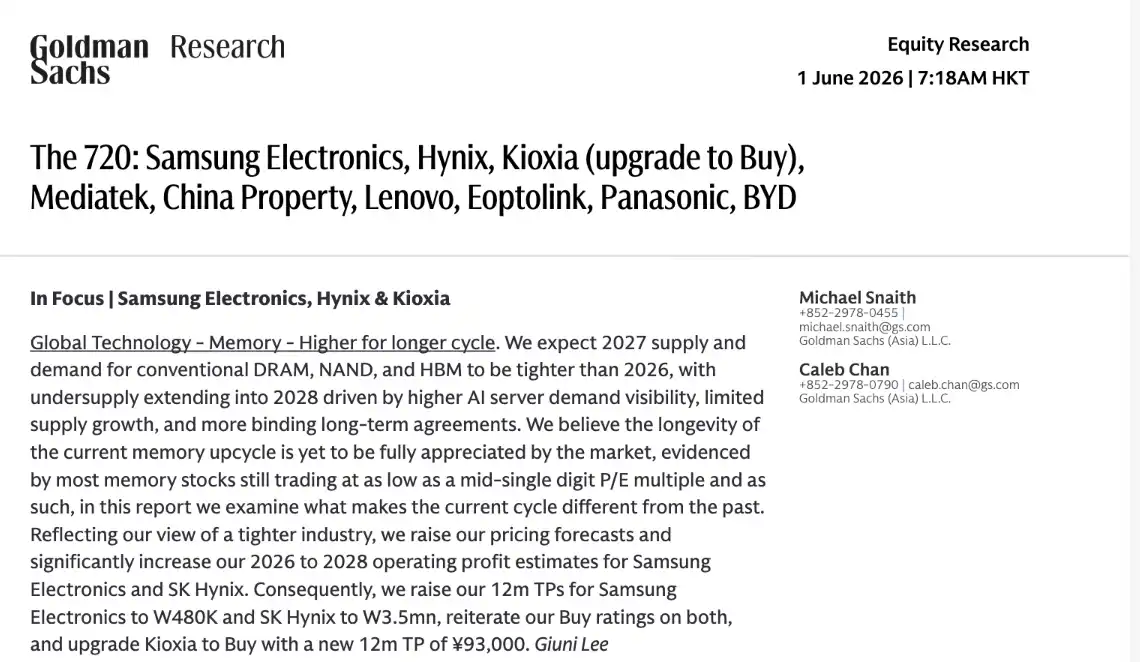
One of the most significant judgments in this Goldman Sachs report is that the current memory upcycle "will last longer" (higher for longer), with the shortage expected to persist all the way until 2028, a length vastly underestimated by the market. The evidence lies in valuations: most memory stocks are still trading at mid-single-digit price-to-earnings ratios, as if the market believes this is just another ordinary cyclical rebound, but Goldman Sachs sees it differently.

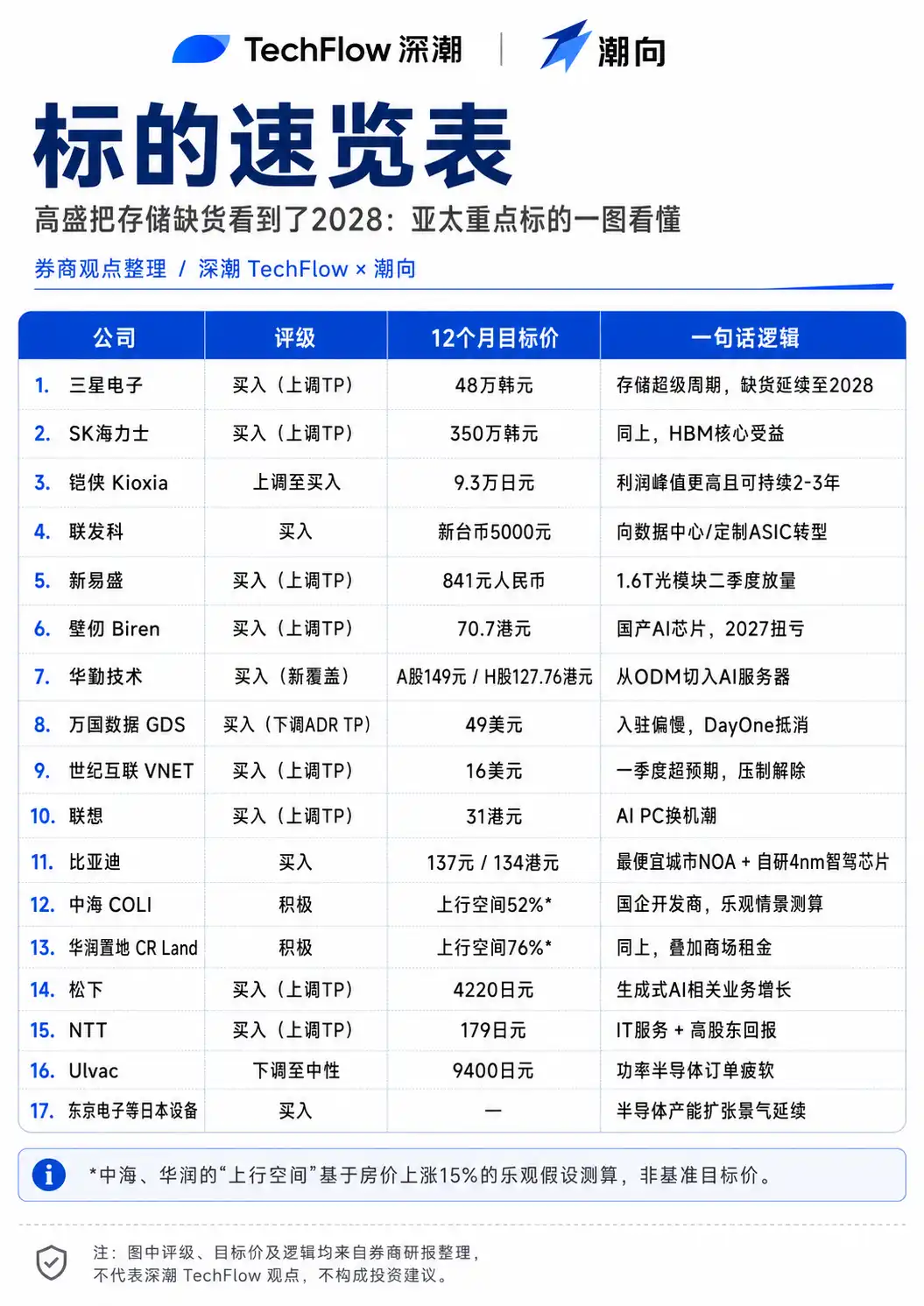
Below, we break it down by importance, concluding with a quick-reference table of targets.

Main Event: Memory Shortage to Last Until 2028, Three Companies Collectively Upgraded

Goldman Sachs compares this cycle to past ones and concludes this time is different. The reasons are threefold: higher visibility of AI server demand, limited supply growth, and increasingly firm long-term supply agreements (locking in orders and prices). Combined, these factors suggest that DRAM, NAND, and HBM supply-demand will be even tighter in 2027 than in 2026, with shortages extending into 2028.

The most intuitive evidence is Goldman's DRAM supply-demand chart. Negative numbers represent supply shortage; the deeper the deficit, the stronger the price support. Goldman has now revised its forecasts for 2026 to 2028 deeper into shortage territory. Specifically, the 2027 forecast was revised from an earlier -2.5% to -5.9%, more than doubling. In plain language: Goldman believes memory manufacturers will face increasing shortages in the next few years, meaning price increases can be sustained longer.

Regarding specific companies, three were collectively adjusted:

  • Samsung Electronics: 12-month price target raised to 480,000 KRW, Buy rating maintained.
  • SK Hynix: 12-month price target raised to 3.5 million KRW, Buy rating maintained.
  • Kioxia: Upgraded from Neutral to Buy, new price target set at 9,300 JPY.

Kioxia is the only rating upgrade in this report, and Goldman's logic is worth noting separately: it believes the profit peak of this cycle is higher than previously anticipated and can be maintained for two to three years, rather than surging and then falling back quickly. Based on this, Goldman has raised its operating profit forecasts for Kioxia for fiscal years 2027 to 2029 by 16% to 48% in one go and expects gross margins to remain at a high level around 80%. Predicting three years of sustainably high profits for a company in the strongly cyclical memory business is a very strong statement.

AI Computing Chain "Full Package": From Chips to Optical Modules to Data Centers

Beyond memory, this report touches upon nearly the entire AI hardware supply chain in China and Asia, unified by one main thread: global cloud hyperscaler capital expenditures are accelerating, and money is flowing down this chain.

  • MediaTek: Buy, price target set at 5,000 TWD. The highlight is its transition from mobile chips to data centers and custom ASICs (AI chips tailor-made for specific clients). The company's target is to achieve $2 billion in data center/AI ASIC revenue by 2026 and capture a 10% to 15% share of the $70-80 billion ASIC market by 2027.
  • Eoptolink: Buy, price target raised to 841 RMB. It manufactures optical modules, critical components for high-speed data transmission in AI data centers. Goldman is bullish on its 1.6T optical modules ramping up starting Q2 and accelerating in the second half, along with capacity expansion in Thailand. It raised profit forecasts for 2027 and 2028 by 5% and 6%, respectively.
  • Biren: Buy, price target raised to 70.7 HKD. A domestic Chinese AI chip manufacturer, its Bili166 product has received a first-tier security and reliability rating. Goldman expects it to turn profitable by 2027 as its product portfolio migrates to higher-performance, more expensive AI chips. Revenue forecasts for 2026 to 2030 were raised by 4% to 28%.
  • Huaqin: Buy, a newly covered target in this report. A-share price target set at 149 RMB, with simultaneous first-time coverage of its H-shares, target set at 127.76 HKD. The logic is its move from consumer electronics ODM into AI data centers, with expected revenue CAGR of 32% from 2025 to 2027.
  • Data Center Duo: GDS maintains Buy rating, but its ADR target is lowered to $49 (due to slower move-in rates, lower monthly service revenue, partially offset by higher valuation for overseas DayOne business); VNET maintains Buy rating, target raised to $16 (due to Q1 earnings beat, strong execution of capacity ramp-up, and removal of strategic investor overhang).
  • Lenovo: Buy, price target raised from 27 HKD to 31 HKD. The bet is on the AI PC refresh cycle. Goldman expects its notebook market share to expand to 28% by 2028, with AI notebook penetration reaching 66%, lifting overall average selling prices. Its profit forecasts for Lenovo's FY2027 and FY2028 are 22% and 25% higher than the Bloomberg consensus, indicating significant divergence.

Stocks Mentioned Outside the AI Main Theme

  • Chinese Real Estate (COLI, CR Land): Goldman is assessing the sustainability of the recent real estate sector rebound. It assumes an optimistic scenario where 15 key cities follow Shanghai and Shenzhen's property price recovery, leading to a 15% price increase by the end of 2028. Under this premise, it estimates cash profits for COLI and CR Land could expand by over 30% and over 50%, respectively, by 2028. Using a sum-of-the-parts valuation, Goldman suggests further upside potential of 52% for COLI and 76% for CR Land, maintaining a positive view on these stronger state-owned developers. Key point: this calculation is based on an optimistic assumption, not the base case forecast.
  • BYD: Buy, price target set at 137 RMB / 134 HKD. The highlight is its "Tianshen Eye B" City Navigation Guided Pilot (City NOA) becoming a 12,000 RMB option across its lineup at its Intelligent Driving Strategy Conference, making its entry-level City NOA-equipped model the cheapest in China at 78,800 RMB. It also unveiled its first self-developed 4nm intelligent driving chip, "Xuánjī A3," which is already in mass production. Goldman believes these engineering capabilities can boost high-end intelligent driving penetration, lower costs, and improve margins.
  • Japanese Semiconductor Equipment: Goldman maintains Buy ratings on Lasertec, Ebara, Disco, and Tokyo Electron. The only contrarian move was downgrading vacuum equipment manufacturer Ulvac (6728.T) from Buy to Neutral, lowering the target to 9,400 JPY, citing weak high-margin power semiconductor orders and slower-than-expected gross margin expansion.
  • Panasonic HD: Buy, price target raised from 4,000 JPY to 4,220 JPY, bullish on generative AI-related businesses (backup power, copper-clad laminate CCL, high-performance capacitors).
  • NTT: Buy, price target slightly raised from 176 JPY to 179 JPY, focusing on domestic IT service demand and the safety margin provided by a shareholder total return rate of around 5%.

A Macro Theme: AI Boom Clashes with Energy Crisis

Stringing together the individual stocks is Goldman's macro judgment: Emerging markets are being pulled in two by two opposing forces. On one side is the AI investment boom, and on the other is energy supply contraction due to the blockade of the Strait of Hormuz.

Tech-exporting economies like South Korea and Taiwan benefit from surging exports and current account surpluses; while energy-importing countries face rising inflation, weaker currencies, and fuel subsidies straining their finances. Goldman expects the Q4 average Brent crude price to be $90/barrel, continuing pressure on heavily oil-import-dependent economies. It recommends overweighting stocks in China, South Korea, Brazil, and South Africa. This line connects with the recent macro background of the Iran situation and oil prices.

Two other points directly affecting A-share capital flows:

Chinese imports surged 23.6% year-on-year in the first four months of this year, but Goldman believes this is a highly concentrated phenomenon, with gold and semiconductors accounting for about 65% of the import growth increment, not indicative of a continuous worsening of the external balance.

Regarding the CSI and CNI index semi-annual rebalancing, Goldman estimates it will trigger over $48 billion in two-way passive fund flows. The technology hardware & semiconductor and capital goods sectors are expected to see the largest inflows (approximately $3.1 billion and $1.4 billion, respectively), while healthcare and banks see the largest outflows. Newly added constituents "expected to receive the largest net passive inflows" include Huagong Tech, Yuanjie Tech, Huahong Semiconductor, GigaDevice, VeriSilicon, etc. For index rebalancing arbitrage funds, this is a clear signal.

Finally, as usual, Goldman left an Easter egg: 2026 World Cup winning probability forecast: Spain leads at 26%, followed by France at 19%, Argentina at 14%, Brazil at 8%, and England at 5%. The model penalized the defending champion Argentina; take it as a bit of fun.

Quick Reference Table of Targets
This article is TechFlow's compilation and interpretation of a third-party brokerage research report. The ratings, price targets, profit forecasts, and related judgments cited herein represent the views of the report's analysts and their affiliated institutions only. They do not represent the views of TechFlow and do not constitute any investment advice.

Please note the following three points when reading:

1. Price targets are analysts' expectations for a future period (typically 12 months). They are forecasts, not promises, and are subject to frequent adjustment based on company performance and market conditions.

2. Sell-side research reports are inherently bullish. It is common for brokerages to issue "Buy" ratings on covered companies, and some covered companies may have investment banking or other business relationships with the brokerage. A list predominantly featuring "Buy" ratings should be read with this inherent bias in mind.

3. The value of a research report lies in its mainline logic and the underlying assumptions it depends on, not any single price target. The logic for related targets holds only if the main theme holds; if the main theme is disproven, the entire chain of targets will come loose together. Focus on the logic, not just the price.

Markets involve risks; decisions should be made independently. This article should not be used as the basis for buying or selling any securities.
Пов'язані питання

QAccording to the Goldman Sachs report, what is the core reason for the prolonged shortage in the memory chip sector until 2028?

AThe report cites three core reasons: higher visibility of AI server demand, limited supply growth, and increasingly binding long-term supply agreements (LTA) that lock in orders and prices. The combination of these factors leads to a projected tighter supply-demand situation for DRAM, NAND, and HBM in 2027 than in 2026, extending the shortage into 2028.

QWhich memory company received a rating upgrade from Goldman Sachs in this report, and what was the key rationale?

AKioxia received a rating upgrade from Neutral to Buy. The key rationale is Goldman Sachs' belief that the profit peak in this cycle will be higher and more sustainable than previously thought, lasting two to three years. Consequently, they significantly raised Kioxia's operating profit forecasts for FY2027 to FY2029 by 16% to 48% and expect its gross margin to remain around a high level of 80%.

QWhat is the primary macro theme Goldman Sachs uses to connect the various stock recommendations in the report?

AThe primary macro theme is that emerging markets are being pulled in two opposite directions. On one side is the AI investment boom, benefiting tech-exporting economies. On the other side is energy supply contraction due to the blockade of the Strait of Hormuz, which pressures energy-importing countries with higher inflation, weaker currencies, and strained finances. This leads to a recommended overweight stance on stocks in China, South Korea, Brazil, and South Africa.

QBesides memory chips, what other major sector or theme did Goldman Sachs focus on for its stock recommendations, and name one related company.

ABesides memory chips, Goldman Sachs focused extensively on the AI compute hardware supply chain. One related company is MediaTek. The report highlights its transition from mobile chips to data centers and custom AI ASICs, with a company target of $2 billion in data center/AI ASIC revenue in 2026 and aiming for a 10%-15% share of the $70-80 billion ASIC market by 2027.

QWhat important disclaimer does the article provide regarding the investment ratings and target prices mentioned from the Goldman Sachs report?

AThe article states that the ratings, target prices, profit forecasts, and related judgments cited are solely the views of the Goldman Sachs analysts and represent the position of their institution. They do not represent the views of the publishing platform (Shenchao TechFlow) and do not constitute any investment advice. It reminds readers that target prices are predictions subject to change, that sell-side research has a natural bullish bias, and that the value lies in the core logic and its underlying assumptions, not just the price targets.

Пов'язані матеріали

Are Rising U.S. Stocks Getting More Dangerous? Goldman Sachs: Downside Protection Mechanisms Have Almost Failed

The US stock market rally is showing signs of becoming increasingly precarious as key downside protection mechanisms fail, according to Goldman Sachs. Derivatives strategist Brian Garrett notes that the S&P 500 options volatility skew has plunged to an 18-month low, indicating the market now prices an 8% probability for both a 10% drop and a 10% rise—a sign of "skew failure." Concurrently, Goldman's Panic Index hit a two-year low, reflecting minimal demand for tail-risk hedging. This complacency emerges amid a relentless market surge, with the S&P 500 setting new records frequently in 2024. Garrett highlights three major concerns: extreme concentration in the top ten stocks (40% of index weight), heavy reliance on AI-themed performance, and a price pattern eerily similar to the 1998-1999 period. Despite pervasive media pessimism, this fear is absent in options pricing. Downside hedge costs are historically low. Goldman suggests tactical trades: buying RSP outperformance options versus the SPX for a broadening rally, purchasing VIX calls for protection, and going long on Bitcoin ETF volatility. Hedge funds have been net buyers for two weeks, with sector rotation into financials and out of industrials. Notably, the global single-stock leveraged/ inverse ETF AUM has doubled to over $60 billion in two months, underscoring growing speculative activity.

marsbit21 хв тому

Are Rising U.S. Stocks Getting More Dangerous? Goldman Sachs: Downside Protection Mechanisms Have Almost Failed

marsbit21 хв тому

DAT Failure? Listed Companies Betting on HYPE Floating Profit of $12.5 Billion

Several public companies that adopted a "HYPE Treasury" strategy—holding significant reserves of the HYPE token from the Hyperliquid ecosystem—have achieved substantial paper gains, collectively exceeding $1.25 billion. This contrasts with the reported struggles of MicroStrategy's flagship BTC treasury strategy. The article profiles three such HYPE-focused treasury companies: 1. **Hyperliquid Strategies Inc. (PURR):** The largest holder, with approximately 22.3 million HYPE tokens valued at ~$1.636 billion, resulting in an unrealized gain of ~$1.22 billion. It has fully transitioned from a biotech firm to a dedicated crypto treasury, adding staking and validator operations to enhance returns. 2. **Hyperion DeFi (HYPD):** Holds around 2 million HYPE tokens (~$147 million value) with a gain of ~$49.4 million. It is deeply integrated into the Hyperliquid ecosystem, running a major validator node and building DeFi products for additional yield. 3. **Lion Group Holding (LGHL):** A smaller holder with ~194,000 HYPE tokens (~$14.14 million value), maintaining a long-term commitment to the token. The success of these HYPE treasuries is attributed not only to the token's significant price appreciation but also to active on-chain participation through staking, validation, and ecosystem integrations, creating a compounding "flywheel" effect. The article posits that while MicroStrategy's BTC strategy faces challenges, HYPE treasuries may offer a more sustainable model through deeper protocol engagement, with potential for further growth if HYPE's price rises as predicted by some analysts.

marsbit41 хв тому

DAT Failure? Listed Companies Betting on HYPE Floating Profit of $12.5 Billion

marsbit41 хв тому

DAT Failing? Listed Companies Betting on HYPE Have Floating Profits of $12.5 Billion

Facing a potential need to sell Bitcoin to pay dividends amid a $12.5B quarterly net loss, the crypto treasury strategy pioneered by Strategy appears strained. In contrast, public companies that adopted a similar strategy by betting on the HYPE token are seeing massive gains, with collective unrealized profits exceeding $1.25 billion. Three key HYPE treasury companies are highlighted: 1. **Hyperliquid Strategies Inc. (PURR):** The largest holder, with approximately 22.3 million HYPE tokens valued at ~$1.636 billion, resulting in ~$1.22 billion in unrealized gains. It has fully transitioned from a biotech firm to a native crypto treasury, focusing on staking and ecosystem participation via validator operations. 2. **Hyperion DeFi (HYPD):** Holds about 2 million HYPE tokens (~$147M value) with ~$49.4M in gains. It is deeply integrated into the Hyperliquid ecosystem, running a top validator node and building DeFi products to generate additional yield. 3. **Lion Group Holding (LGHL):** A smaller player holding ~193,775 HYPE tokens (~$14.14M value), maintaining a long-term holding strategy alongside other crypto assets. The article argues that HYPE treasuries have an advantage over Bitcoin-based ones like Strategy's. Their success stems not just from price appreciation but from active on-chain participation—staking, earning validator rewards, and engaging with ecosystem protocols—creating a compounding "flywheel" effect. With Hyperliquid dominating the on-chain perpetuals market and HYPE's tokenomics encouraging buys and burns, these treasuries are positioned to benefit further if HYPE's price rises as some predict. While the original Bitcoin treasury strategy isn't declared a failure, the current narrative highlights the outsized success of early movers into the HYPE ecosystem.

Odaily星球日报46 хв тому

DAT Failing? Listed Companies Betting on HYPE Have Floating Profits of $12.5 Billion

Odaily星球日报46 хв тому

Comics Illustration: Helping You Understand China's New Regulations on Outbound Investment

Summary: Understanding China's New Regulations on Overseas Investment The State Council has announced new regulations on overseas investment, effective July 1, 2026. The core message is not a prohibition on international investment, but a call for both companies and individuals to operate with strong regulatory awareness. Here are the key points: 1. **Scope is Broad:** The rules apply not only to companies but also to other organizations and individual residents. 2. **Definition of Investment is Wide:** It encompasses not just capital transfers but also asset contributions, obtaining equity or rights, financing, providing guarantees, and direct or indirect acquisition of rights related to overseas entities or assets. 3. **Companies Must Plan Comprehensively:** Beyond simple ownership charts, firms need clear plans covering the investing entity, required approvals or filings, fund transfer paths, and compliance with technology, data, and security reviews. 4. **Individuals Should Prioritize Compliance:** Before focusing on returns, individuals must first assess their eligibility, understand legal channels for capital outflow, know what they are acquiring, and identify responsible parties in case of issues. 5. **Penalties are Significant:** Violations can result in fines and potentially restrictions on future overseas investment activities. In essence, overseas investment remains possible, but it must be approached with regulatory compliance as a fundamental priority, not solely based on commercial opportunity. *Note: This is a general informational summary and does not constitute legal advice or investment recommendations.*

marsbit1 год тому

Comics Illustration: Helping You Understand China's New Regulations on Outbound Investment

marsbit1 год тому

Торгівля

Спот
Ф'ючерси

Популярні статті

Як купити CHIP

Ласкаво просимо до HTX.com! Ми зробили покупку USD.AI (CHIP) простою та зручною. Дотримуйтесь нашої покрокової інструкції, щоб розпочати свою криптовалютну подорож.Крок 1: Створіть обліковий запис на HTXВикористовуйте свою електронну пошту або номер телефону, щоб зареєструвати обліковий запис на HTX безплатно. Пройдіть безпроблемну реєстрацію й отримайте доступ до всіх функцій.ЗареєструватисьКрок 2: Перейдіть до розділу Купити крипту і виберіть спосіб оплатиКредитна/дебетова картка: використовуйте вашу картку Visa або Mastercard, щоб миттєво купити USD.AI (CHIP).Баланс: використовуйте кошти з балансу вашого рахунку HTX для безперешкодної торгівлі.Треті особи: ми додали популярні способи оплати, такі як Google Pay та Apple Pay, щоб підвищити зручність.P2P: Торгуйте безпосередньо з іншими користувачами на HTX.Позабіржова торгівля (OTC): ми пропонуємо індивідуальні послуги та конкурентні обмінні курси для трейдерів.Крок 3: Зберігайте свої USD.AI (CHIP)Після придбання USD.AI (CHIP) збережіть його у своєму обліковому записі на HTX. Крім того, ви можете відправити його в інше місце за допомогою блокчейн-переказу або використовувати його для торгівлі іншими криптовалютами.Крок 4: Торгівля USD.AI (CHIP)Легко торгуйте USD.AI (CHIP) на спотовому ринку HTX. Просто увійдіть до свого облікового запису, виберіть торгову пару, укладайте угоди та спостерігайте за ними в режимі реального часу. Ми пропонуємо зручний досвід як для початківців, так і для досвідчених трейдерів.

311 переглядів усьогоОпубліковано 2026.04.21Оновлено 2026.06.01

Як купити CHIP

Обговорення

Ласкаво просимо до спільноти HTX. Тут ви можете бути в курсі останніх подій розвитку платформи та отримати доступ до професійної ринкової інформації. Нижче представлені думки користувачів щодо ціни CHIP (CHIP).

活动图片