Bittensor jumps 28% as Anthropic restrictions fuel TAO’s $300 test

ambcryptoОпубліковано о 2026-06-15Востаннє оновлено о 2026-06-15

Анотація

Bittensor (TAO) surged 28% weekly, recovering from key support near $180.9 as buyers gained momentum. The price broke through resistance and the 20-day SMA, reaching ~$267.4 with strong volume and improving technical indicators like RSI and MACD. The rally was fueled in part by news that Anthropic restricted access to some AI models for foreign nationals, highlighting a weakness in centralized AI and boosting demand for decentralized AI projects like Bittensor. Attention now turns to the $280-$300.6 resistance zone. Maintaining support above the $244.7-$255 range is crucial for the bullish structure; losing it could lead to a retracement toward $210-$220. The sustainability of the move depends on continued demand beyond the initial headline-driven boost.

Bittensor [TAO] gained 9% in the last 24 hours, extending its weekly gain to 28% as buyers continued rebuilding momentum. The recovery began near the key $180.9 support zone.

There, repeated selling attempts failed to generate fresh downside pressure.

As sellers lost control, buyers gradually absorbed available supply and stabilized price action. This transition was followed by a brief consolidation phase, which suggested accumulation rather than continued distribution.
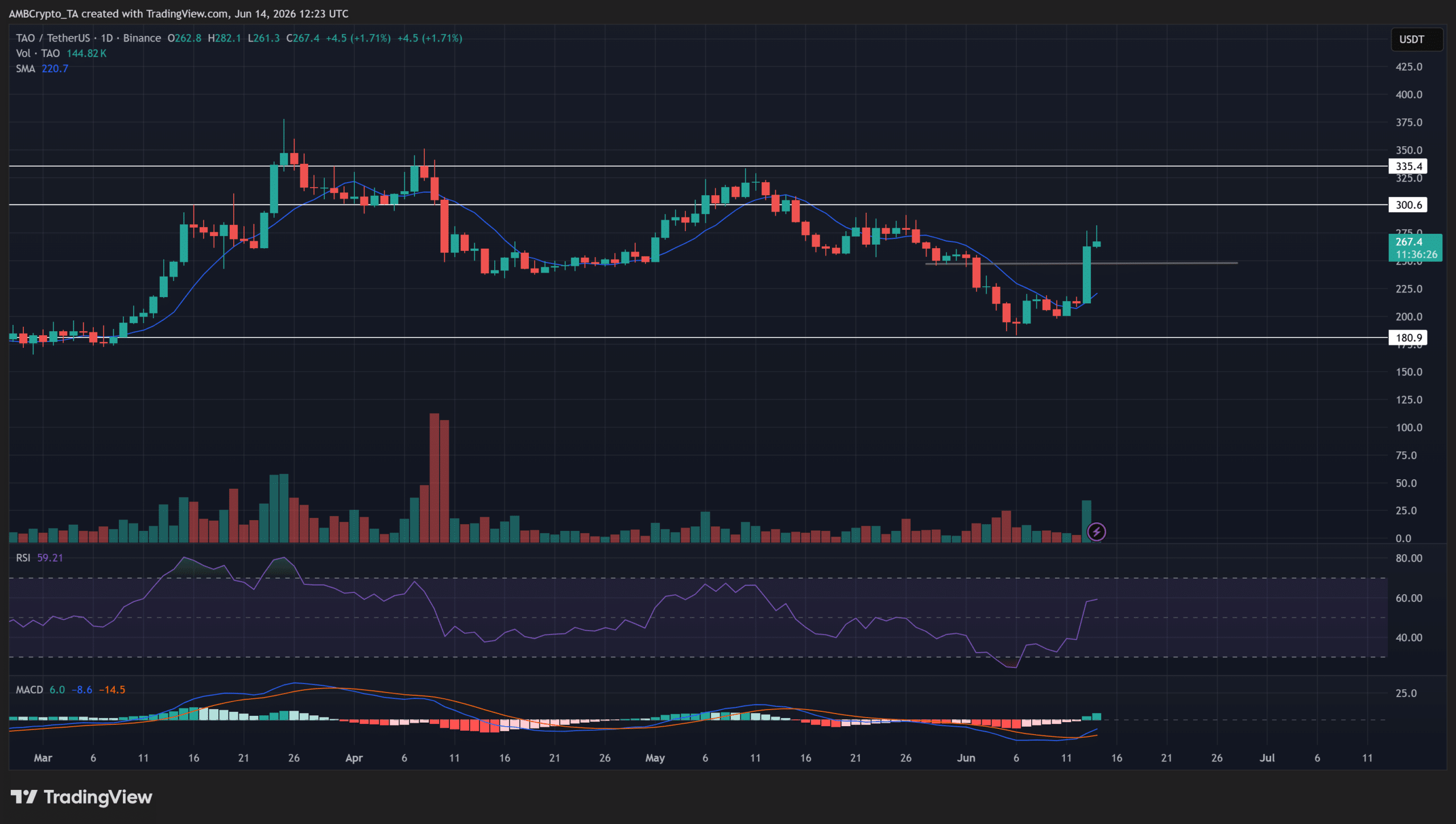
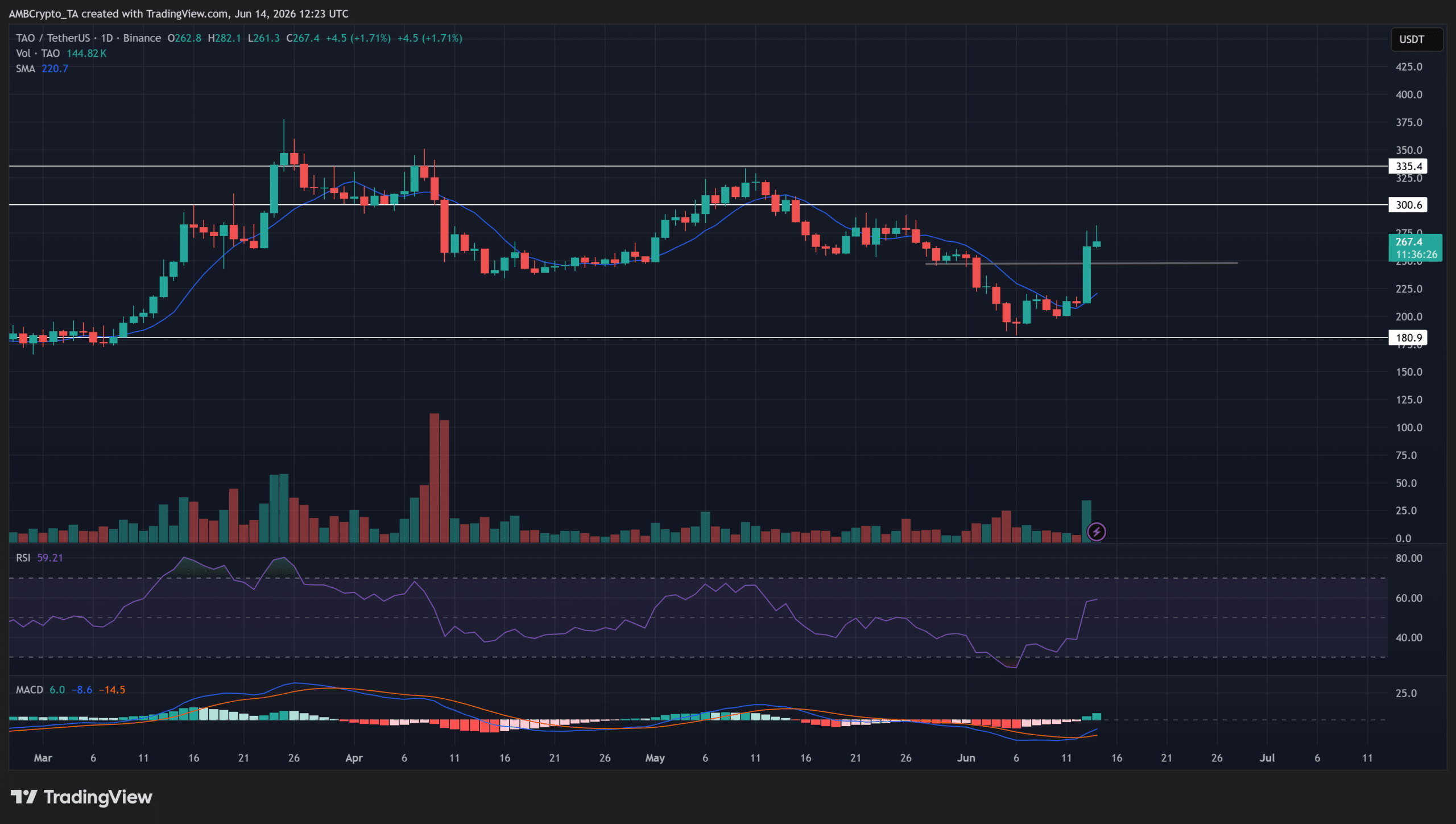
Source: TAO/USDT on TradingView

Momentum then accelerated sharply, lifting TAO from roughly $215 to $267.4 within two sessions. In the process, price reclaimed the 20-day SMA at $220.70 and pushed through a resistance area that had limited advances for weeks.

Volume expanded aggressively during the breakout, producing its strongest positive reading in nearly two months.

Meanwhile, RSI climbed to 59.2 from below 40, while MACD continued strengthening. Attention now turns to the $280-$300.6 region, where buyers and sellers will likely contest the recovery’s strength.

Anthropic’s move fuels TAO demand

Bittensor’s rally did not emerge in isolation. Anthropic announced that access to Fable 5 and Mythos 5 would be suspended for foreign nationals following a U.S. government directive. The decision immediately highlighted a key weakness of centralized AI systems.


Source: X

Access could be restricted by regulation, regardless of demand. That narrative quickly spilled into crypto markets. As a result, traders rotated toward decentralized AI projects, helping TAO extend its advance toward the $272-$279 range.

Volume climbed above $560 million, reinforcing the strength of the move. This reaction suggests buyers were responding to more than technical momentum alone.

However, the durability of the rally now depends on whether demand continues after the headline impact fades.

Can bulls force a break above $300?

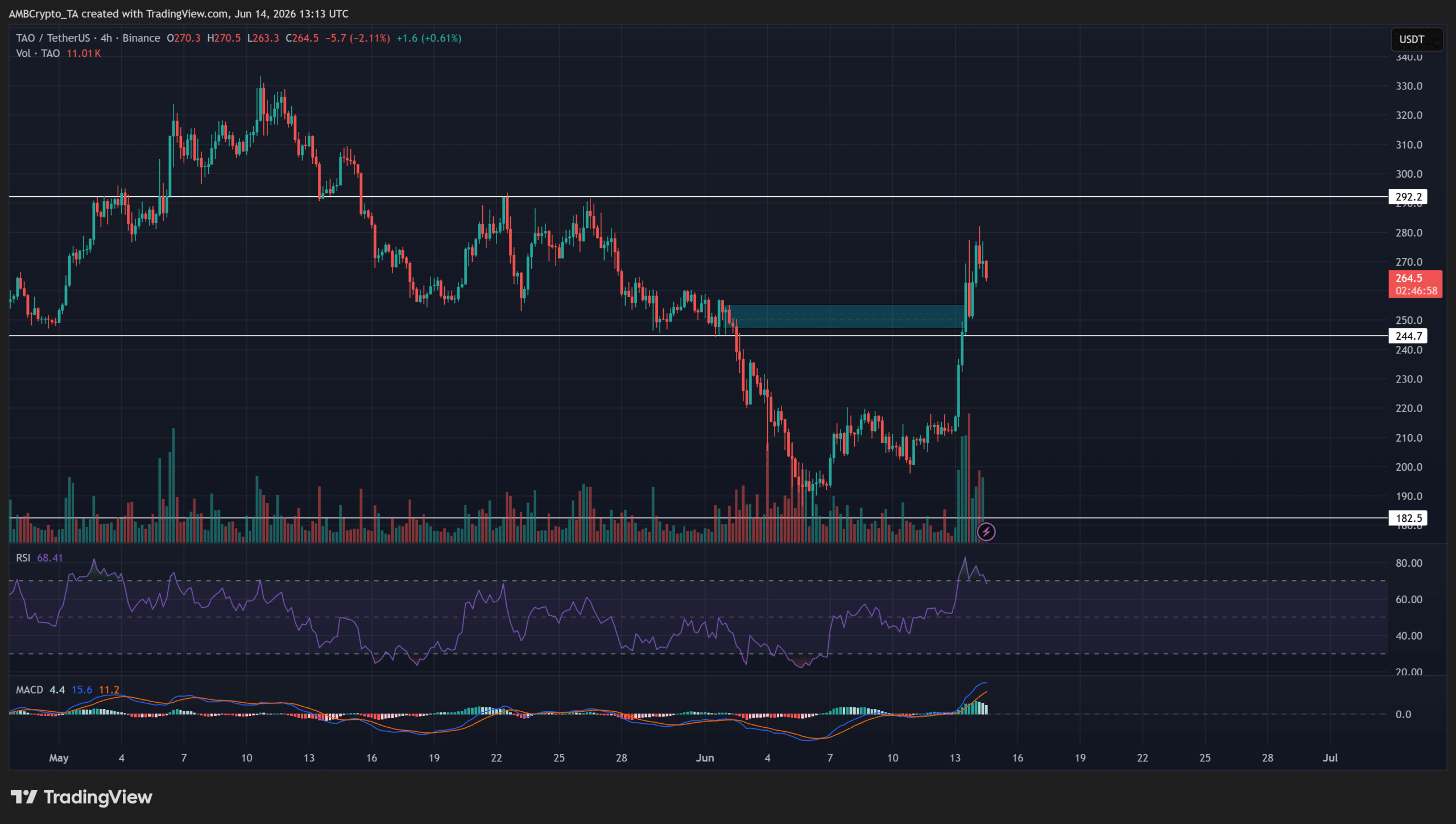
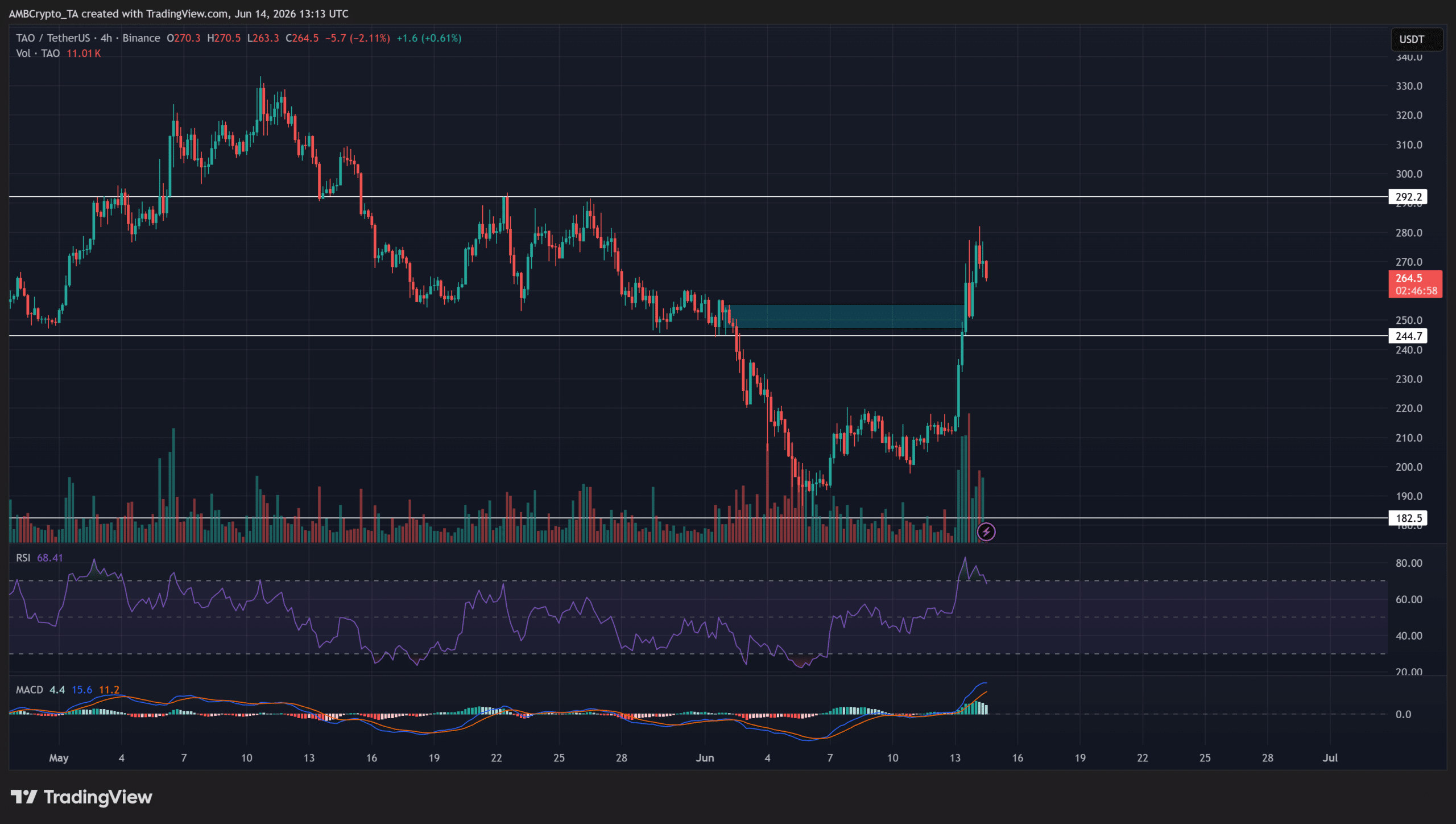
TAO’s sharp rebound has shifted attention toward whether buyers can maintain control above newly reclaimed levels. After rallying from the $182.5 liquidity sweep to $292.2, the price encountered resistance near a key May supply zone and began pulling back.
Source: TAO/USDT on TradingView

That reaction places the former $244.7-$255 consolidation range in focus. The area previously acted as resistance before the breakout and now serves as the market’s most important support zone.

Holding above it would preserve the recovery structure and keep $300 within reach. Losing it would expose TAO to a deeper retracement toward $210-$220 support.


Final Summary

  • Bittensor [TAO] reclaimed key resistance levels as rising volume and AI-driven demand strengthened the recovery structure.
  • TAO now faces a decisive $300 test, with support holding critical to preserving recent gains.

Пов'язані питання

QWhat was the main catalyst for Bittensor's (TAO) recent 28% price rally, according to the article?

AThe main catalyst was an announcement from Anthropic restricting access to its AI models (Fable 5 and Mythos 5) for foreign nationals. This highlighted a weakness in centralized AI systems and drove demand towards decentralized AI projects like Bittensor, fueling TAO's price surge.

QFrom which key support level did TAO's recovery begin, and to what level did it initially rally?

ATAO's recovery began near the key $180.9 support zone. Momentum then accelerated sharply, lifting the price from roughly $215 to $267.4 within two trading sessions.

QWhat is the critical support zone that TAO must hold to maintain its recovery structure and keep the $300 price target in reach?

AThe critical support zone is the former consolidation range of $244.7 to $255. This area previously acted as resistance before the breakout and is now the most important support zone. Holding above it is necessary to preserve the recovery structure.

QHow did technical indicators like RSI and volume behave during TAO's price breakout?

ADuring the breakout, the Relative Strength Index (RSI) climbed from below 40 to 59.2, indicating strengthening momentum. Volume also expanded aggressively, producing its strongest positive reading in nearly two months, reinforcing the strength of the move.

QWhat factor does the article suggest will determine the durability of TAO's rally beyond the initial headline impact?

AThe durability of the rally depends on whether demand for TAO continues after the initial impact of the Anthropic news headline fades. Sustained demand is needed to maintain the upward momentum.

Пов'язані матеріали

Blockchain Has Finally Started to Sail into the Mainstream After 18 Years

Blockchain Finds Its True Path After 18 Years: Becoming the Financial Backbone for AI Agents and Autonomy This analysis explores a pivotal shift in the blockchain and crypto investment landscape, driven by the dominance of AI. Major venture capital firms, including Variant, Paradigm, Haun Ventures, and YZi Labs, are moving beyond pure "crypto" investment theses. They are expanding their focus to AI, robotics, and frontier tech, signaling that blockchain is no longer seen as a standalone sector but as an underlying infrastructure layer. The core argument is that blockchain's killer application may not be user-facing apps, but rather providing the economic rails for the coming wave of AI agents, autonomous robots, and automated systems. Key capabilities like self-custody wallets, programmable stablecoins for micropayments, on-chain identity, and verifiable smart contracts are positioned as essential for a future where machines conduct economic activity. The recent $1.4 billion investment by Tether (via its venture arm) in German robotics company NEURA Robotics exemplifies this, aiming to embed Tether's wallet tools directly into robots for autonomous transactions. While many "AI + Crypto" projects remain superficial, the article concludes that true value lies where crypto is a necessary component—enabling machine-to-machine payments, agent autonomy, verifiable data provenance, and open financial settlement for the AI era. For crypto venture capital, this convergence with AI represents both an adaptation to shifting capital flows and a potential path to unlocking the large-scale, non-speculative utility the industry has long sought.

marsbit4 хв тому

Blockchain Has Finally Started to Sail into the Mainstream After 18 Years

marsbit4 хв тому

Blockchain has finally begun sailing toward the main channel after 18 years

After 18 years of development, blockchain technology is beginning to move from a specialized niche into mainstream adoption, according to a recent industry analysis. The shift is reflected in the changing strategies of major crypto venture capital firms, which are expanding their focus beyond pure "digital ownership" towards broader themes like "autonomy." The report highlights that leading VC firms like Variant, Paradigm, Haun Ventures, and YZi Labs are broadening their investment mandates to include not only crypto but also artificial intelligence (AI), robotics, biotech, and other frontier technologies. This reflects a recognition that the isolated "crypto investment" narrative is losing appeal to limited partners (LPs) as capital and attention increasingly flow toward AI and other high-growth tech sectors. A key emerging thesis is that blockchain's most significant future application may not be as a consumer-facing product, but as the underlying economic and settlement infrastructure for the AI era. As AI agents and autonomous systems become more prevalent, they will require programmable, global, and low-cost payment networks (like stablecoins), verifiable digital identities, and secure wallets to manage transactions and assets on behalf of users. The investment by stablecoin issuer Tether into robotics company NEURA, with plans to integrate its wallet technology, is cited as a prime example of this convergence. However, the article cautions that simply labeling projects as "AI + Crypto" is insufficient. True value lies in integrations where blockchain technology is essential—such as enabling machine-to-machine micropayments, verifiable data provenance for AI, or transparent governance for autonomous organizations—rather than being a superficial marketing add-on. In conclusion, while AI currently dominates the tech narrative and capital flows, it may ultimately create the real-world, high-frequency demand that the crypto industry has long sought. For crypto VCs and projects, the path forward is to position blockchain not as a competing sector, but as a critical foundational layer powering autonomy and economic activity in an AI-driven future.

链捕手10 хв тому

Blockchain has finally begun sailing toward the main channel after 18 years

链捕手10 хв тому

Y Combinator Co-founder: How to Make a Billion Dollars?

The Y Combinator co-founder argues that becoming a billionaire by founding a successful startup is not only possible but demonstrably achievable without unfair or unethical practices. He disputes a politician's claim to the contrary, using the example of a founder whose company grew at 93% monthly solely through creating a product users loved and recommended. The core mechanism is exponential growth. A conservative 15% monthly growth rate compounds to a 4384x increase over five years, which can easily lead to billion-dollar valuations and founder wealth. The process depends on two key variables: the growth rate and the duration it can be sustained. A high growth rate stems from a great product that users naturally promote, while a long duration requires a large enough market. For aspiring founders, especially young ones, the simplest path is to build something they and their friends genuinely need. Young people's current needs often predict future mass-market trends. He advises against actively "searching" for ideas, as this tends to filter out unconventional but promising ones. Instead, inspiration should come from working on interesting projects with friends, as many iconic companies (e.g., Apple, Facebook) started this way. Ultimately, building a massively valuable startup is not about exploitation but empathy: deeply understanding a user group and building a product that significantly improves their lives. This, powered by exponential growth in a large market, is the legitimate path to immense wealth creation.

Foresight News13 хв тому

Y Combinator Co-founder: How to Make a Billion Dollars?

Foresight News13 хв тому

The 800V Voltage Standard Championed by Nvidia: Which Infrastructure Providers Stand to Benefit?

NVIDIA is actively promoting the 800VDC architecture as a key direction for its next-generation AI factories and high-power racks, particularly for the upcoming Rubin and Kyber platforms. The primary driver is the rapidly increasing power density of AI racks, with designs like GB200/GB300 NVL72 reaching 120-140kW and future systems potentially hitting 180-220kW. At such high power levels, traditional low-voltage power delivery becomes inefficient due to massive current, leading to significant copper use, cable bulk, heat, and power loss. The 800VDC standard aims to increase efficiency by transmitting power at higher voltage and lower current to the rack before stepping it down locally for GPUs. NVIDIA claims this can improve efficiency by up to 5%, reduce total cost of ownership (TCO) by up to 30%, and cut copper usage by approximately 45%. This shift redefines infrastructure roles, pushing power engineering to the forefront alongside GPU performance. Key beneficiaries and ecosystem partners highlighted include: 1. **Power Infrastructure Providers:** Companies like Vertiv, Schneider Electric, Delta Electronics (台达电), and Korean firms LS Electric and HD Hyundai Electric are involved in designing next-gen AI factory power distribution, rack power supplies, and backup systems. 2. **Power Semiconductors:** Suppliers of SiC/GaN devices, such as Infineon and STMicroelectronics, are better suited for high-voltage, high-efficiency conversion in this new architecture. 3. **Connectivity & Structure:** The focus shifts to high-reliability components like busbars, high-voltage connectors, and advanced PCBs that meet stricter insulation and safety requirements. 4. **Liquid Cooling & Rack ODM:** As power and heat density rise, liquid cooling becomes critical. Full-rack system integrators (e.g., Dell, Wiwynn, Wistron) must now demonstrate robust pre-delivery testing capabilities, including burn-in testing under full load, requiring significant power and cooling infrastructure in their factories. The transition is not immediate for all data centers but is targeted at high-density AI factories. NVIDIA’s 800VDC ecosystem is in a preparatory phase, with full-scale production expected to align with the 2027 launch of Kyber rack-scale systems. The investment thesis revolves around which companies can demonstrate proven product integration, customer validation, and reliable delivery of complete, high-power AI rack systems, making power, cooling, and testing capabilities new critical variables in the AI infrastructure value chain alongside GPUs.

marsbit33 хв тому

The 800V Voltage Standard Championed by Nvidia: Which Infrastructure Providers Stand to Benefit?

marsbit33 хв тому

Did 'Unlimited Minting' Actually Happen? Zcash Founder Responds to Four Major Market Concerns

The Orchard shielding pool in the privacy cryptocurrency Zcash was recently found to have contained a critical counterfeiting vulnerability that existed for four years. This discovery caused significant market panic and a sharp drop in the price of ZEC, though it has since recovered partially. Zcash founder Zooko Wilcox addressed four key questions raised by the vulnerability. First, while it's unknown if the bug was exploited, he believes it likely was not, citing advanced, targeted discovery methods, a rapid response to freeze the pool, and the typical "smash-and-grab" nature of past crypto exploits. Second, he states that if no exploitation occurred, all legitimate user funds in Orchard are recoverable. However, cautious users moving funds should be aware of privacy trade-offs and other risks involved in transferring to transparent or Sapling pools. Third, users currently cannot independently verify that the total ZEC supply hasn't been inflated due to this bug. However, the proposed "Ironwood" network upgrade will restore this ability by permanently sealing the Orchard pool. This will prevent any counterfeit funds from circulating and allow anyone running a node to cryptographically verify that the supply cap has not been breached. Finally, regarding other undiscovered vulnerabilities, Wilcox notes that intensive ongoing audits by multiple teams, including using advanced AI-assisted tools, have so far found no other counterfeiting bugs. This provides increased, though not absolute, confidence. In conclusion, while assessments suggest the bug was likely unused and funds are safe, the core issue was the loss of user-verifiable supply integrity. The Ironwood upgrade is presented as the solution, aiming to restore trust by allowing users to independently verify Zcash's supply security without relying on third-party assurances.

marsbit34 хв тому

Did 'Unlimited Minting' Actually Happen? Zcash Founder Responds to Four Major Market Concerns

marsbit34 хв тому

Торгівля

Спот
Ф'ючерси

Популярні статті

Як купити GAIN

Ласкаво просимо до HTX.com! Ми зробили покупку GriffinAI (GAIN) простою та зручною. Дотримуйтесь нашої покрокової інструкції, щоб розпочати свою криптовалютну подорож.Крок 1: Створіть обліковий запис на HTXВикористовуйте свою електронну пошту або номер телефону, щоб зареєструвати обліковий запис на HTX безплатно. Пройдіть безпроблемну реєстрацію й отримайте доступ до всіх функцій.ЗареєструватисьКрок 2: Перейдіть до розділу Купити крипту і виберіть спосіб оплатиКредитна/дебетова картка: використовуйте вашу картку Visa або Mastercard, щоб миттєво купити GriffinAI (GAIN).Баланс: використовуйте кошти з балансу вашого рахунку HTX для безперешкодної торгівлі.Треті особи: ми додали популярні способи оплати, такі як Google Pay та Apple Pay, щоб підвищити зручність.P2P: Торгуйте безпосередньо з іншими користувачами на HTX.Позабіржова торгівля (OTC): ми пропонуємо індивідуальні послуги та конкурентні обмінні курси для трейдерів.Крок 3: Зберігайте свої GriffinAI (GAIN)Після придбання GriffinAI (GAIN) збережіть його у своєму обліковому записі на HTX. Крім того, ви можете відправити його в інше місце за допомогою блокчейн-переказу або використовувати його для торгівлі іншими криптовалютами.Крок 4: Торгівля GriffinAI (GAIN)Легко торгуйте GriffinAI (GAIN) на спотовому ринку HTX. Просто увійдіть до свого облікового запису, виберіть торгову пару, укладайте угоди та спостерігайте за ними в режимі реального часу. Ми пропонуємо зручний досвід як для початківців, так і для досвідчених трейдерів.

437 переглядів усьогоОпубліковано 2025.09.24Оновлено 2026.06.02

Як купити GAIN

Обговорення

Ласкаво просимо до спільноти HTX. Тут ви можете бути в курсі останніх подій розвитку платформи та отримати доступ до професійної ринкової інформації. Нижче представлені думки користувачів щодо ціни GAIN (GAIN).

活动图片