a16z Crypto Partner: Cash Flow is the Moat

链捕手Опубліковано о 2026-06-12Востаннє оновлено о 2026-06-12

Анотація

Title: a16z Crypto Partner: Cash Flow Is the Moat Summary: Historically, many of the best businesses were built by positioning themselves within the "flow of funds"—facilitating the creation and transfer of value within a network and taking a cut. The more value flows through, the larger the business grows. Cryptocurrency is the first modern technology natively built for this purpose. If a startup hasn't architected its product and business to benefit from these principles, it's missing a major opportunity. Thanks to stablecoins, capital and value now move at internet speed—globally settled, 24/7, with end-to-end programmability. Blockchains are inherently network businesses. Each transaction settles on a shared ledger, and every new participant strengthens the same underlying network. Network tokens amplify this effect. A well-designed token aligns all participants—users, developers, suppliers, validators, the protocol—around a single goal: growing the network. Participants are paid proportionally to their contributions, creating a transparent feedback loop between value flowing in the system and value accumulating to those building it. This model isn't new; crypto simply makes it more accessible and scalable for startups. The pattern is consistent: find where value flows and position yourself in the middle. Examples range from railroads (earning from freight) and Standard Oil to Google, Meta, and AWS (earning from attention, commerce, and compute flows, respectively). Fi...

Author: Jason Rosenthal, a16z Operating Partner

Compiled by: Hu Tao, ChainCatcher Highlights

Many of history's greatest businesses were built by positioning themselves in the "flow of funds" – facilitating the creation and transfer of value within a network and taking a cut. The more value that flows through the network, the larger the business typically grows.

Cryptocurrency is the first modern technology natively built for this purpose. If your startup hasn't yet architected its product and business to benefit from these principles, you're missing an opportunity. Thanks to stablecoins, funds and value now flow at internet speed – 24/7, with global settlement, and end-to-end programmability. Payment rails are frictionless, unit economics are transparent, and every dollar flowing globally is addressable.

The Specific Model

Blockchains are network businesses by design. Every transaction settles on a shared ledger. Every new participant strengthens the same underlying network that the next builder can use. As more people use and build on it, the network becomes more valuable for all users.

Most companies spend years manufacturing network effects on top of traditional infrastructure. Crypto founders inherit them as starting conditions.

Network tokens amplify this. A well-designed token aligns users, developers, suppliers, validators, and the protocol around a single outcome—growing the network—and pays each proportionally to their contribution. But the protocol's revenue belongs to the people who use it. No partner rebates, no side deals. Just a feedback loop between value flowing in the system and value accumulating in the hands of the people building and growing it.

This isn't a new model. Cryptocurrency just makes it accessible and scalable for startups for the first time.

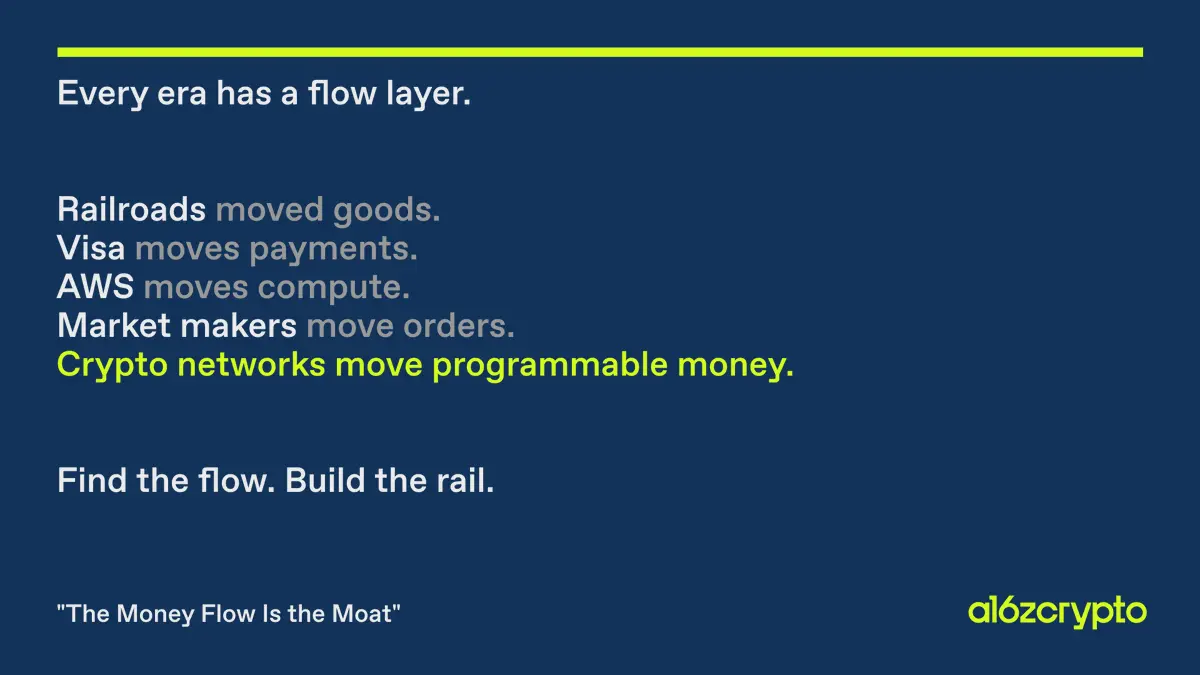
Railroads didn't make money on locomotives. They made money on every ton of grain, coal, and steel that crossed their tracks. Standard Oil, U.S. Steel, and AT&T were companies in the flow of funds. Google and Meta replaced print and TV not because their ads were better, but because they sat at the choke point where attention turned into commerce, enabling them to take a cut of trillions in commercial intent. AWS is in the flow of compute.

The pattern is consistent: find where value moves and put yourself in the middle.
Financial markets make this model even clearer. Visa processed $15.7 trillion in payment volume in FY 2024 and reported $35.9 billion in net income. Jane Street posted $20.5 billion in net trading income last year – more than Citigroup or Bank of America. The top five US market makers handled 87% of order flow payment: they don't predict markets; they sit in the flow of every order and earn more as volume grows.

These businesses share another trait: network effects. Visa is more useful to more merchants because there are more cards; more useful to more cardholders because more merchants accept it. Same with order flow – each additional broker tightens spreads, attracting more brokers, which attracts more flow.

Flow of funds plus network effects is one of the most durable business structures ever.

Your Margin Is My Opportunity

Bezos called it “your margin is my opportunity.” He was talking about retail, but it applies even more to traditional financial services – the world's largest pool of profit extraction. Payments, custody, lending, FX, securitization, settlement, market making, without exception. Visa and Mastercard charge 2–3% transaction fees on networks designed in the 1960s. Remittance corridors take 6–9%. Prime brokers and custodians take a piece of every securities trade. Even after the US moved to T+1 settlement in 2024, funds still sit idle overnight as a structural tax on everyone involved.

Each of these margins is a target. Compress the cost, increase the speed, and potentially expand the whole market. Stripe and Square proved this was possible in payments.

Crypto founders have the opportunity to build the next version – programmable, instant, global, and natively in the flow of funds.

And the frontier extends far beyond financial services. Compute and GPU markets. Memory chips. AI training data. Energy. Robotics. Space. Rare earth metals. Each is a category where global value can begin to move at volumes the existing rails were never designed to carry.

Each is greenfield for building a flow-of-funds business on programmable infrastructure from the ground up. These markets have no existing rails, no entrenched intermediaries, and nothing to defend.

As a founder, ask yourself:

1. Are you in the flow of funds today?

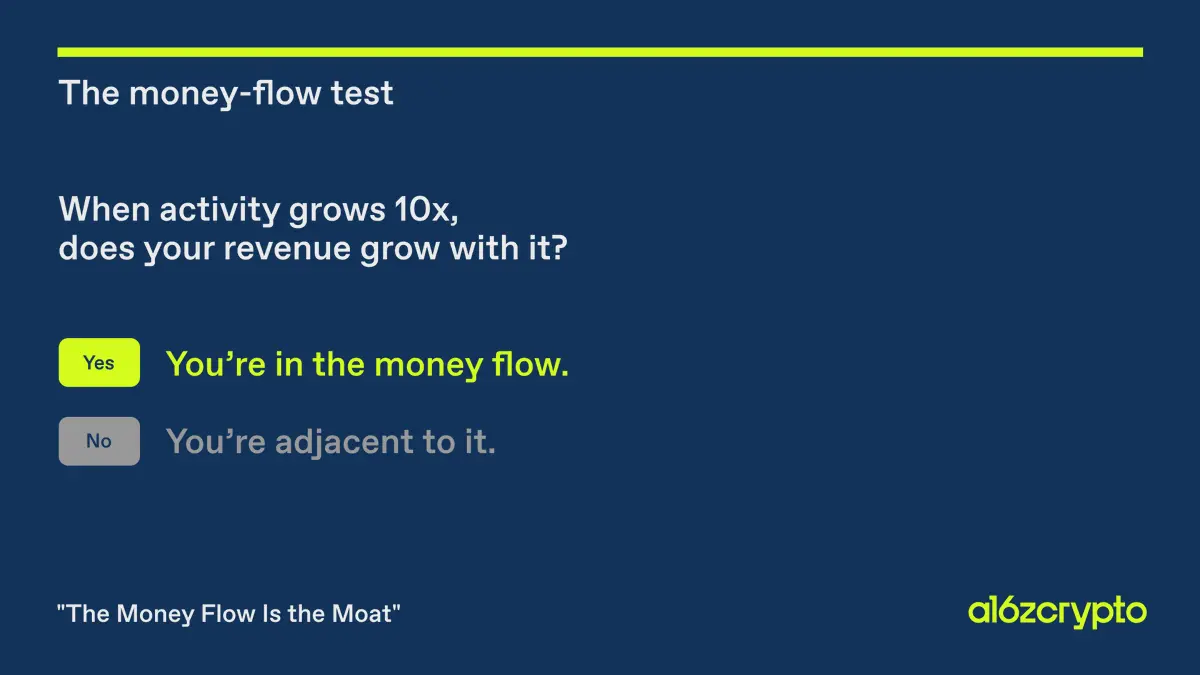
2. When the value of activity on your product grows 10x, does your revenue grow with it?

3. If you're building a new product, where in your target market is the profit extraction highest relative to the value being created?
The opportunity is there. Take it, get into the new flow, and let the network compound from there.

Пов'язані питання

QAccording to the article, what is the core principle shared by historically great businesses like railroads, Google, Meta, and AWS?

AThe core principle is that historically great businesses position themselves within the 'flow of funds.' They facilitate the creation and transfer of value within a network and capture a portion of it. The more value that flows through the network, the larger the business typically becomes.

QHow does the article describe the unique advantage that cryptocurrency provides for startups regarding business models?

ACryptocurrency is the first modern technology natively built for the 'flow of funds' model. It enables value to move at internet speed—24/7, settled globally, with end-to-end programmability. This gives startups the advantage of inheriting network effects from the start and building on programmable infrastructure where payment rails are frictionless.

QWhat two powerful business concepts, when combined, does the article claim create one of the most durable business structures ever?

AThe combination of being in the 'flow of funds' and having 'network effects' creates one of the most durable business structures ever. The flow of funds generates revenue, while network effects make the service more valuable as more participants join, creating a powerful, self-reinforcing cycle.

QWhat does the article suggest is the primary target for crypto founders looking to disrupt traditional industries?

AThe primary target is the high-profit margins extracted by entrenched intermediaries in traditional industries, especially in financial services (payments, custody, lending, FX, etc.). The article quotes Jeff Bezos: 'Your margin is my opportunity.' Crypto founders can build cheaper, faster, and more programmable alternatives.

QWhat are the three key questions the article advises founders to ask themselves about their business?

A1. Are you in the flow of funds today? 2. When the value of activity on your product grows 10x, does your revenue scale with it? 3. If you're building a new product, where in your target market is profit extraction highest relative to the value being created?

Пов'язані матеріали

NEAR to Airdrop 330,000 Tokens, Betting on TVL Reaching $70 Million

On June 11th, NEAR Protocol launched the Near@3.33 Milestone Incentive Program, targeting users of its Confidential Intents privacy cross-chain execution feature. The program will distribute 333,333 milestone tokens when the Confidential Intents Total Value Locked (TVL) reaches $70 million. Users must have conducted Confidential transactions on near.com and maintain a Confidential balance above $100 in any asset to qualify, with a single wallet capped at 2% of the current airdrop pool. The milestone tokens will be locked upon receipt and cannot be sold or transferred. They can only be converted 1:1 to NEAR tokens once NEAR's Volume Weighted Average Price (VWAP) maintains $3.33 or higher for three consecutive trading days. As of the report, Confidential Intents TVL exceeds $20.69 million, needing roughly a 3x increase to trigger the airdrop. Confidential Intents, launched in February 2026, is NEAR's privacy execution layer designed to prevent MEV, front-running, and strategy leaks by building confidentiality directly into the execution environment. Its TVL has grown from zero to approximately $15 million in about three months. NEAR token price, which surged from around $1 in April to a peak of $3.08, currently trades near $2. The program aims to boost user activity for Confidential Intents, with future incentive rounds planned as community engagement increases.

Foresight News18 хв тому

NEAR to Airdrop 330,000 Tokens, Betting on TVL Reaching $70 Million

Foresight News18 хв тому

Crypto Market Makers Are Collectively Seeking Change as Money Becomes Harder to Earn

**Summary: Crypto Market Makers Adapt as Margins Shrink** Leading crypto market maker GSR exemplifies a broader industry shift, moving beyond traditional market-making to become a full-service "Web3 investment bank." Its recent strategic acquisitions—including an SEC-registered broker-dealer, rebranded as GSR Securities—and purchases of token advisory firms aim to create an integrated platform covering token design, fundraising, listing, liquidity provision, and asset management. This includes launching an ETF and investing in tokenization platforms like Libeara, backed by a strategic investment from Standard Chartered's SC Ventures. This transformation is not unique to GSR. Other major players like Keyrock, B2C2, Wintermute, and DWF Labs are also expanding geographically, pursuing regulatory licenses (especially under frameworks like MiCA in the EU), and diversifying into over-the-counter (OTC) trading, asset management, and real-world asset tokenization. The driving force behind this collective pivot is a rapidly changing market. Profits from traditional altcoin market-making are declining due to fewer viable projects, reduced client budgets, increased competition, and smarter, more demanding clients. Simultaneously, regulatory pressures are mounting, making compliance a baseline cost. Extreme market events further expose teams lacking robust risk controls. Consequently, the crypto market-making business model is evolving from one reliant on information asymmetry and volatility to a more institutionalized, regulated, and service-diverse industry. Survival now depends on building systemic capabilities beyond mere liquidity provision.

marsbit24 хв тому

Crypto Market Makers Are Collectively Seeking Change as Money Becomes Harder to Earn

marsbit24 хв тому

Market Adjusts Following Google's $84.7 Billion Fundraising, AI Valuations Now Focus on Payback Speed

After Alphabet's announcement of an $84.75 billion equity financing round, market focus for AI investment is shifting from pure growth narratives to capital efficiency and payback periods. The core argument is that AI is being re-priced from a software-like growth story into a heavy-asset infrastructure cycle, requiring massive capital expenditure (CapEx) on chips, data centers, and power grids. While Alphabet's financing itself is not a distress signal—part of it is for administrative purposes like tax obligations on stock compensation—it highlights the enormous capital demands of AI infrastructure. This demand extends beyond tech giants to pure-play AI model companies (like OpenAI, Anthropic), data center REITs, and utilities. Major tech firms are projected to spend heavily on AI data centers in 2026, signaling a broad-based capital cycle the market must absorb. Consequently, valuation logic is changing. Investors are moving away from questions about who has the strongest AI narrative and are now prioritizing clear visibility into orders, stable cash flows, and the cost of capital. This has led to recent pressure on high-multiple AI software and semiconductor stocks, while "picks-and-shovels" hardware, data center, and power assets with firmer near-term demand may see relative support. The key going forward will be monitoring whether rising CapEx guidance across companies is matched by a timely monetization of AI investments into revenue and cash flow. The market's tolerance for high spending depends on demonstrable returns. While the long-term AI thesis remains intact, the valuation framework has fundamentally shifted to emphasize capital discipline and payback speed.

marsbit31 хв тому

Market Adjusts Following Google's $84.7 Billion Fundraising, AI Valuations Now Focus on Payback Speed

marsbit31 хв тому

Торгівля

Спот
Ф'ючерси

Популярні статті

Як купити FLOW

Ласкаво просимо до HTX.com! Ми зробили покупку Flow (FLOW) простою та зручною. Дотримуйтесь нашої покрокової інструкції, щоб розпочати свою криптовалютну подорож.Крок 1: Створіть обліковий запис на HTXВикористовуйте свою електронну пошту або номер телефону, щоб зареєструвати обліковий запис на HTX безплатно. Пройдіть безпроблемну реєстрацію й отримайте доступ до всіх функцій.ЗареєструватисьКрок 2: Перейдіть до розділу Купити крипту і виберіть спосіб оплатиКредитна/дебетова картка: використовуйте вашу картку Visa або Mastercard, щоб миттєво купити Flow (FLOW).Баланс: використовуйте кошти з балансу вашого рахунку HTX для безперешкодної торгівлі.Треті особи: ми додали популярні способи оплати, такі як Google Pay та Apple Pay, щоб підвищити зручність.P2P: Торгуйте безпосередньо з іншими користувачами на HTX.Позабіржова торгівля (OTC): ми пропонуємо індивідуальні послуги та конкурентні обмінні курси для трейдерів.Крок 3: Зберігайте свої Flow (FLOW)Після придбання Flow (FLOW) збережіть його у своєму обліковому записі на HTX. Крім того, ви можете відправити його в інше місце за допомогою блокчейн-переказу або використовувати його для торгівлі іншими криптовалютами.Крок 4: Торгівля Flow (FLOW)Легко торгуйте Flow (FLOW) на спотовому ринку HTX. Просто увійдіть до свого облікового запису, виберіть торгову пару, укладайте угоди та спостерігайте за ними в режимі реального часу. Ми пропонуємо зручний досвід як для початківців, так і для досвідчених трейдерів.

242 переглядів усьогоОпубліковано 2024.12.10Оновлено 2026.06.02

Як купити FLOW

Обговорення

Ласкаво просимо до спільноти HTX. Тут ви можете бути в курсі останніх подій розвитку платформи та отримати доступ до професійної ринкової інформації. Нижче представлені думки користувачів щодо ціни FLOW (FLOW).

活动图片