Over 13% APY, Apyx Is Bringing the 'Killer App for Bitcoin' On-Chain

Odaily星球日报Опубліковано о 2026-05-26Востаннє оновлено о 2026-05-26

Анотація

The article discusses the rise of high-yield stablecoins in DeFi, focusing on the Apyx protocol and its integration of STRC (Strategy's Bitcoin credit instrument) to generate sustainable on-chain yields. Apyx addresses a market need for stablecoins with yields exceeding typical DeFi offerings (often below 5-10%). Its core innovation is bridging STRC—a tradable, dividend-yielding equity instrument backed by Strategy's Bitcoin holdings—from traditional finance to the decentralized ecosystem. STRC offers a floating yield (over 12.3%) by converting Bitcoin's long-term appreciation potential into a "digital credit" product. Apyx employs a dual-token model: `apxUSD`, a stablecoin pegged to $1 for liquidity, and `apyUSD`, an interest-bearing token where yields accumulate (currently ~11% APY, targeting over 13%). The yield is derived from STRC dividends, providing a more sustainable income source compared to token-incentivized models. Since its February launch, Apyx has grown rapidly, with `apxUSD` becoming a top-20 DeFi stablecoin by issuance. The protocol enhances its utility and capital efficiency through deep integrations with major DeFi platforms: Morpho (for collateralized borrowing/lending), Curve (for low-slip liquidity pools), and Pendle (for trading and leveraging future yield via PT/YT tokens). Apyx is also running a multi-season points program leading to a Token Generation Event (TGE) and airdrop on October 13, 2026, incentivizing user engagement through activities li...

Original | Odaily Planet Daily(@OdailyChina)

Author | Liaoliao

The cryptocurrency market, particularly the decentralized finance (DeFi) sector, is perpetually in search of underlying assets that combine stability, high liquidity, and high yield. As the yields from traditional real-world assets (RWA, such as U.S. Treasuries) gradually stabilize, the DeFi market's craving for high-yielding, interest-bearing assets is fostering a new paradigm shift. Against this backdrop, stablecoin projects based on STRC are rising at a remarkable pace.

As the cornerstone of the crypto world, the evolution of stablecoins has progressed from early fiat-backed versions (like USDT, USDC), to crypto asset overcollateralized versions (like DAI), to algorithmic versions (like the imploded UST), and to the basis trade arbitrage versions (like USDe) that have emerged in recent years.

However, the current market pain point is that stablecoin yields below 10%, or even 5%, can no longer meet the risk premium demand of on-chain capital, while excessively high algorithmic yields often come with systemic risks like "death spirals."

STRC-driven stablecoin projects are filling this gap at an opportune time. Judging from TVL growth rates, on-chain capital flow directions, to community discussion heat, building stablecoins based on STRC has become one of the most watched niche sectors in the current DeFi market.

Especially with the support of yield protocols like Pendle and Morpho, these products have evolved beyond being mere "stablecoins" into a new asset form that combines stability, yield, and financial composability.

What is STRC?

STRC refers to a "Bitcoin Credit Facility" launched by the treasury company Strategy.

Odaily Note: For a detailed analysis of STRC, please refer to “In-depth Analysis of STRC: Strategy's New Magic Trick for Raising Money to Buy Bitcoin.”

Simply put, Strategy raises capital from the market by issuing STRC, then continuously uses the proceeds to buy Bitcoin. STRC holders receive a floating interest income exceeding 12.3%, paid monthly. Unlike traditional bonds, STRC is a preferred stock instrument, not debt, thus having no fixed maturity date. Simultaneously, its dividend rights are superior to common stock (MSTR), possessing strong "fixed-income-like" properties.

The most unique aspect of STRC is that it essentially transforms the long-term appreciation expectation of Bitcoin into a "Digital Credit" product acceptable to traditional capital markets.

To maintain STRC's value near its $100 face value, Strategy dynamically adjusts its dividend rate – increasing the yield to attract capital when STRC trades below par, and suppressing the premium by issuing more shares when it trades above.
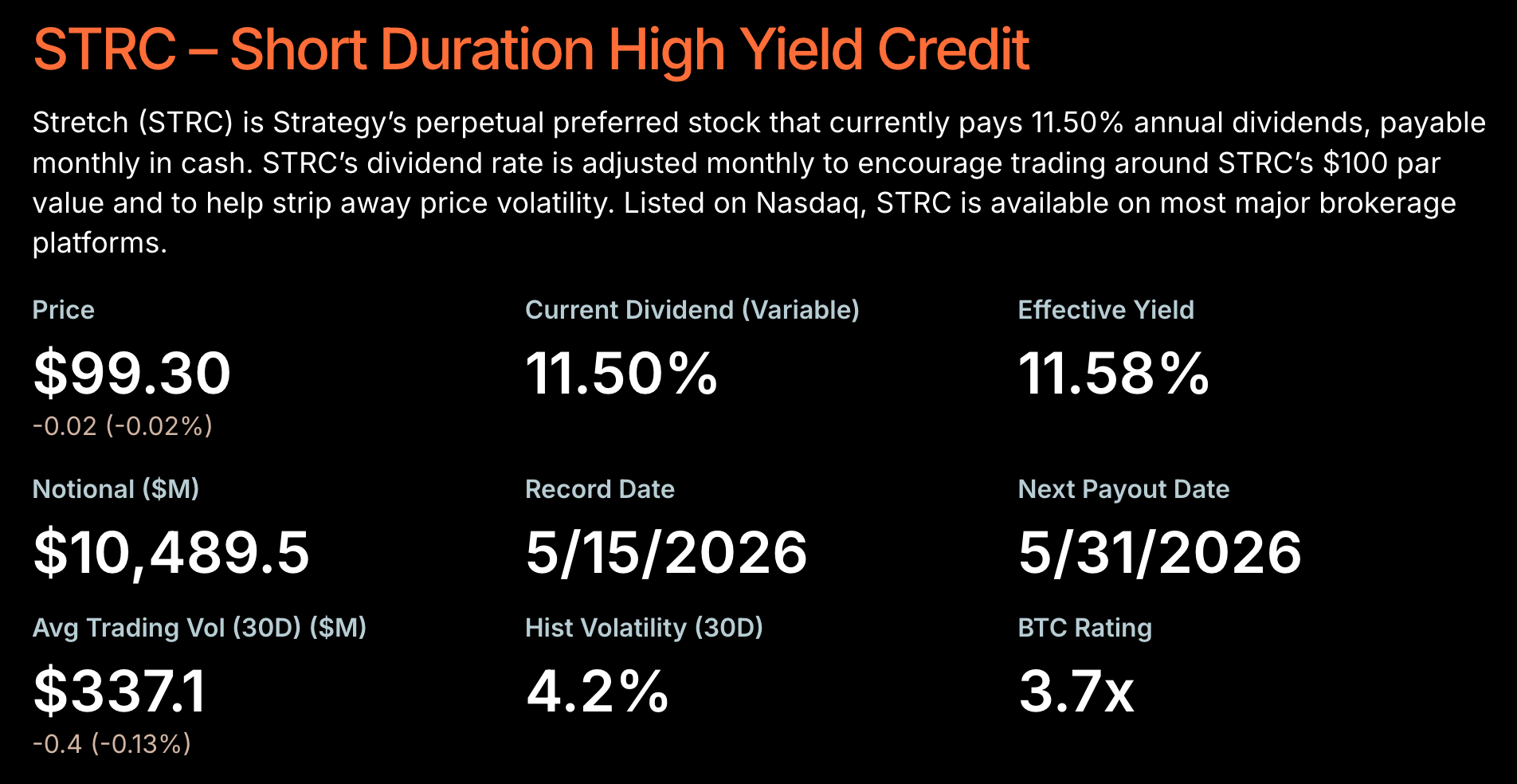
Since Strategy launched STRC, market reception has been quite positive, thanks to its relatively stable "peg" performance (successfully restored after a few brief deviations) and its considerable yield.

At the time of writing, the total issuance size of STRC has surpassed $10.4 billion, accounting for over 60% of the total preferred stock issuance in the global market for 2026.

Earlier this month, Strategy founder Michael Saylor stated in an interview with David Lin – Digital credit products like STRC are the killer application for Bitcoin (refer to Interview with Michael Saylor: I Did Say I'd Sell, But Never Net Sell).

However, traditional STRC shares typically circulate only among Wall Street hedge funds, compliant institutions, and high-net-worth accredited investors. On-chain DeFi users, due to barriers like access, compliance, and capital channels, find it difficult to directly access this high-yield product sweeping through traditional finance.

This is precisely where Apyx, the protagonist of this article, steps in.

What Apyx does is serve as a bridge between Wall Street's digital credit instruments and on-chain DeFi legos. Through innovative on-chain financial architecture, it brings STRC's excess yield opportunities on-chain, constructing the next generation of interest-bearing stablecoins with high liquidity, composability, and higher yields.

Deconstructing Apyx, Perhaps the Highest-Yielding Stablecoin in the Market

Unlike many stablecoin projects reliant on airdrop narratives and lacking real yield sources, Apyx's core competitiveness lies not just in "higher APY," but in its backing which combines traditional finance capital capabilities with on-chain protocol composability.

Regarding background, the core supporter behind Apyx is the NASDAQ-listed treasury company DeFi Development Corp. The latter not only participated in Apyx's incubation and strategic investment but also provided the critical bridge connecting traditional capital markets with the on-chain world.

In terms of product design, Apyx employs a dual-token model of apxUSD + apyUSD.

Among them, apxUSD is closer to a traditional stablecoin, pegged to $1, primarily serving as a medium of exchange and on-chain liquidity. apxUSD itself does not automatically accrue yield; it functions more like a highly liquid "base dollar asset," suitable for trading, payments, lending, etc.

The true embodiment of Apyx's core value is apyUSD – users can lock apxUSD to obtain apyUSD (a 20-day unlock period applies), the latter being similar to Lido's wstETH, with its price increasing continuously as underlying yield accumulates. In other words, apyUSD itself is the carrier of yield.
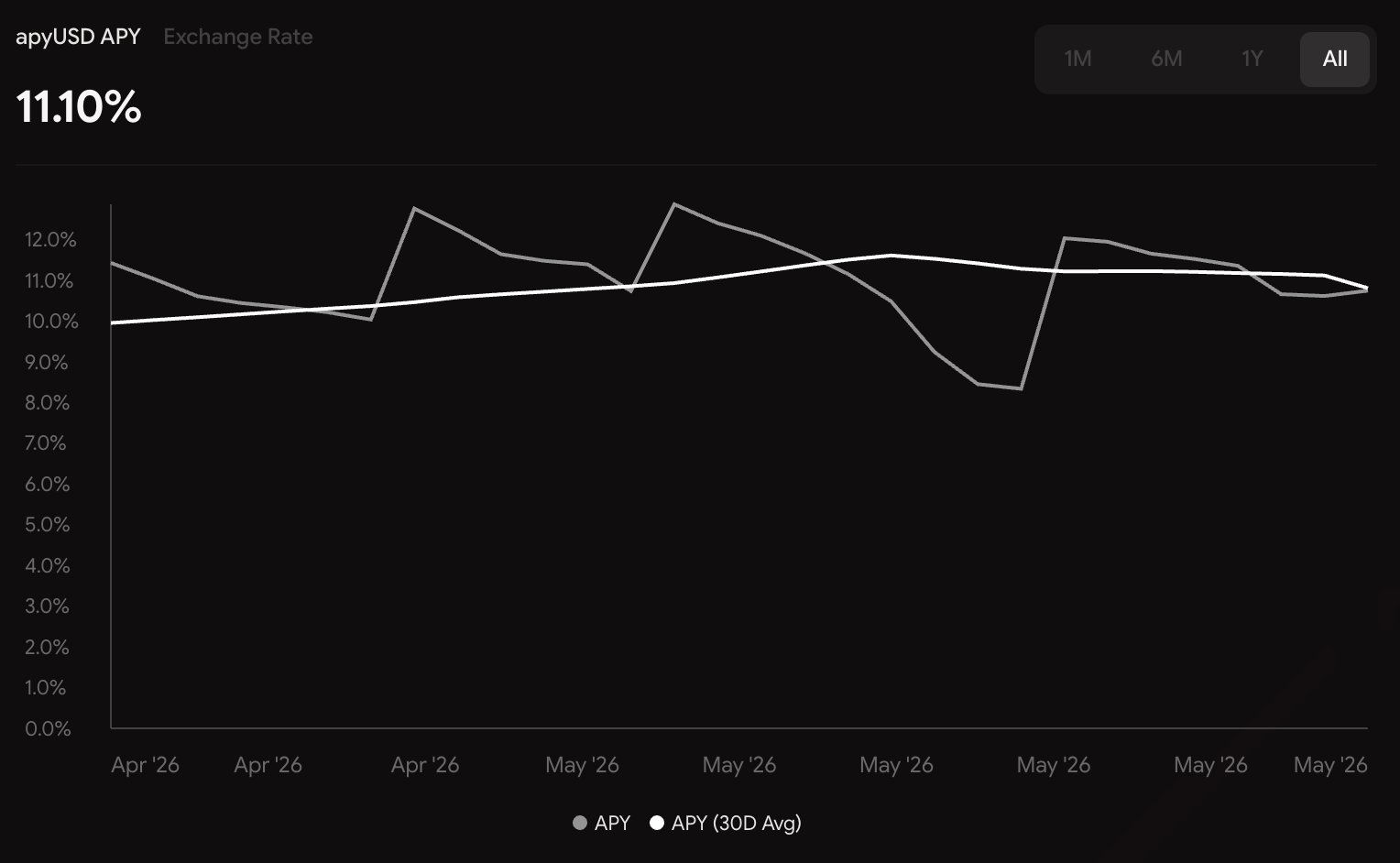
Currently, the real-time annualized yield for apyUSD is approximately 11%, with an expected annualized yield exceeding 13%. Against the backdrop of continuously declining yields for USD stablecoins overall, a stablecoin asset with a genuine yield source and double-digit yield is naturally exceptionally attractive.

Furthermore, it's crucial to emphasize that unlike many stablecoin projects relying on token subsidies to achieve short-term high yields, Apyx's core yield originates from STRC dividends, making the yield source more stable and sustainable.

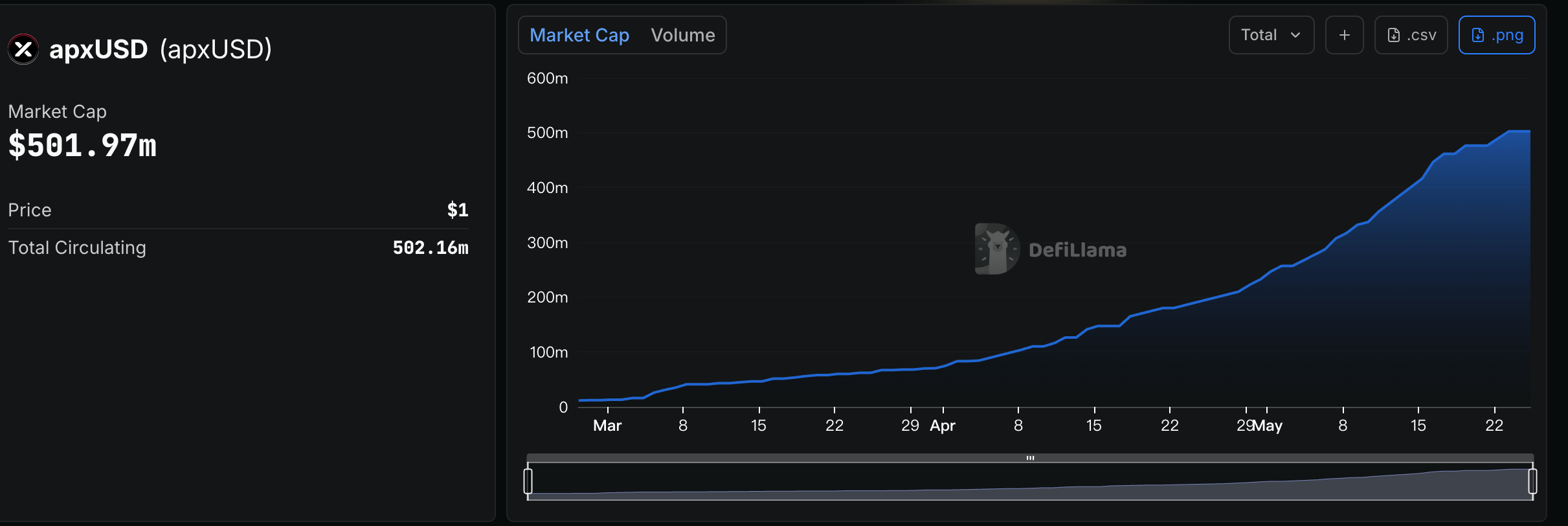
DefiLlama data shows that since its launch at the end of February this year, the issuance scale of apxUSD has rapidly reached 502 million tokens in less than three months, making it the 21st largest stablecoin protocol by issuance size in the DeFi world.
However, yield alone is insufficient to sustain a stablecoin ecosystem. What truly determines a protocol's ceiling is the asset's composability and liquidity efficiency. On this front, Apyx has clearly done extensive work – currently, Apyx is deeply integrated with several mainstream protocols including Morpho, Curve, and Pendle.

On Morpho, users can use apyUSD as collateral to borrow other assets, enabling operations like "earning yield while unlocking liquidity." For more aggressive players, even recursive lending can be employed to amplify yield exposure. Curve addresses liquidity issues. By constructing trading pools with apxUSD and mainstream stablecoins like USDC and USDT, Apyx ensures low slippage even during large-volume swaps, which is crucial for a stablecoin system.

As for Pendle, it might be the most explosive component within the entire Apyx ecosystem. Since Pendle can split yield-bearing assets into PT (Principal Token) and YT (Yield Token), apyUSD evolves beyond being just a "hold-to-earn-yield" asset into a tradable, leveragable, speculatable yield product – conservative users can lock in fixed yields via PT; more aggressive users can amplify bets on future yields by buying YT.

Precisely because of this high degree of composability, Apyx's ecosystem expansion speed is noticeably faster than many traditional stablecoin protocols.

In a sense, what Apyx is doing is not merely "issuing a high-yield stablecoin." It's more akin to attempting to establish an on-chain credit market centered around STRC.

Points Program and Point-Earning Strategies

In today's DeFi market, "points" are no longer just simple user incentive tools; they resemble a way to pre-price future token rights. Especially as the market re-enters a phase of liquidity competition, whether a project can continuously attract capital often depends on two things – whether the yield is sufficiently high, and whether the token expectation is sufficiently clear.

A significant reason for Apyx's rapid TVL accumulation in a short time is closely related to its current points system. According to the official plan, Apyx's points program follows a phased rollout model:

  • Season 1 concluded on May 22, 2026. The official has confirmed that 5% of the total token supply will be allocated to early participants in this stage;
  • Season 2 commenced immediately after Season 1 ended and will continue until October 11, releasing another 6% in token incentives;
  • After Season 2 concludes, Apyx will conduct its TGE and airdrop on October 13.

This rhythm is quite clever. On one hand, the Season deadlines naturally create "sprint windows," incentivizing capital inflows to accelerate before the end. On the other hand, the seamless transition from Season 1 to Season 2 avoids the common problem of "TVL collapse right after Season 1 ends" seen in many projects. Most importantly, Apyx has set a clear future TGE and airdrop date, providing users with more definite interaction expectations.

For the market, this means Apyx's airdrop expectation is not a short-term event but more like a liquidity war lasting several months. From the user's perspective, the more critical question is "how to earn points more efficiently."
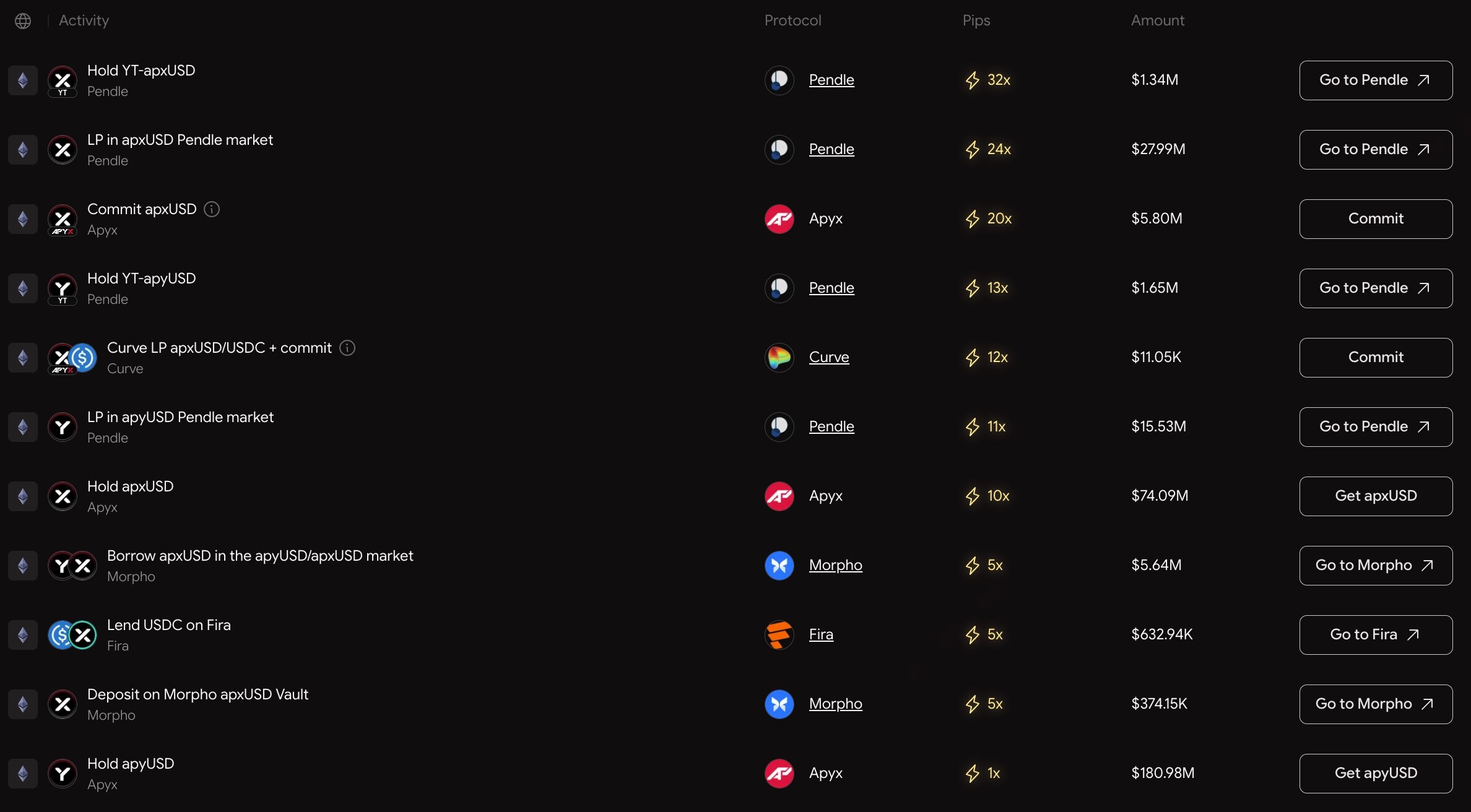
Apyx outlines point-earning efficiency for different operations on its official website, broadly categorized into "Basic Mode" and "Advanced Mode."

"Basic Mode" involves simply holding apxUSD (10x points) or apyUSD (1x point). "Advanced Mode" entails flexibly using the integrated protocols mentioned above, such as borrowing/lending apxUSD on Morpho (5x points), providing LP for apxUSD on Curve (12x points). The most efficient strategies revolve around Pendle: directly holding YT for apxUSD yields 32x points, and providing LP for apxUSD on Pendle also offers a 24x points multiplier.

Competitive Landscape of the Sector, and Apyx's Advantages

As an emerging sector still in its very early stages, the STRC-driven stablecoin market currently doesn't have many core players in the true sense. Judging by capital scale, market attention, and ecosystem expansion speed, the projects that have truly formed influence are essentially just Apyx and Saturn. In a sense, the entire "Digital Credit Stablecoin" sector is gradually evolving into a dual-leader competitive landscape.

Although Saturn launched earlier, Apyx has now surpassed it in terms of data metrics. Overall, Apyx's competitive advantages manifest in the following key dimensions.

First, absolute TVL size and underlying asset holdings advantage. Apyx established a clear strategic goal in its project positioning – to become the world's largest institutional holder of STRC. As of the end of April, holdings had reached $125 million (Saturn only $50 million). If Apyx achieves its strategic objective, it would essentially monopolize the on-chain yield distribution rights based on Strategy's digital credit at the source. Furthermore, for a stablecoin, Apyx's TVL size advantage translates to deeper trading pools, lower slippage for large swaps, and more robust liquidity efficiency, safely accommodating large capital inflows and outflows.

Second, higher yield, with no risk of yield pause. For the target clientele of Apyx and Saturn, the core demand is continuous and predictable yield. Compared to Saturn's sUSDat, Apyx's apyUSD static holding yield maintains an approximate 2% annualized yield advantage. Additionally, and very importantly, sUSDat's design is deeply tied to STRC's exchange rate. When STRC falls below the "Watermark" due to ex-dividend events or other reasons, YT-sUSDat's yield accumulation completely pauses, a problem Apyx does not have.

Third, clearer TGE expectations, and no VC sell-side pressure. Users in the crypto industry detest "indefinite points PUA." Compared to Saturn, Apyx has clearly disclosed the TGE date, the timing of each Season's points activities, and the allocated token amounts, making users psychologically more likely to stay. Moreover, Apyx's development did not involve VC funding, only minimal early investment, partly from the founding contributors themselves. This means there are no private round institutions dumping for profit before retail investors enter, making the token rewards corresponding to points more ideal.

Potential Risks and Outlook Expectations

It is crucial to clearly emphasize that Apyx's high yield does not equate to "risk-free." Essentially, Apyx remains a yield product built upon a Bitcoin credit structure, not a traditional risk-free dollar asset. Therefore, before discussing its growth potential, one must also acknowledge the risk sources behind it.

First, is the credit risk of the underlying asset itself. The core logic of STRC is built upon Strategy and its Bitcoin balance sheet. In other words, the market's acceptance of STRC's yield is fundamentally based on belief that Strategy can continuously utilize its Bitcoin assets to maintain its credit structure and perpetually execute financing, balance sheet expansion, and interest payments.

Should the Bitcoin market experience extreme volatility, such as a sharp crash in a short period, or a significant decline in market risk appetite towards Strategy's leveraged model, then STRC's market pricing, liquidity, and yield structure could all be impacted. While this "systemic risk" doesn't imply immediate protocol collapse, it does signify that Apyx's yield source is somewhat tied to the Bitcoin cycle itself.

Second, are the typical DeFi composability risks. Since Apyx is deeply integrated with protocols like Morpho, Curve, and Pendle, its ecosystem is built upon highly complex on-chain composability. The advantage of this structure is the极大提升资金效率; but the trade-off is that the system's risks become more coupled.

For instance, if a foundational protocol encounters a smart contract vulnerability, liquidity crisis, or abnormal liquidation mechanism, risks could propagate throughout the ecosystem via LP, collateral, and yield-splitting structures. Especially as recursive lending and high-leverage玩法 become more普及, market fluctuations can be further amplified.

Therefore, Apyx is better understood as a "medium-to-high risk, high yield" on-chain credit asset, not a replacement for traditional overcollateralized stablecoins. But it is precisely this risk stratification that gives Apyx its unique appeal in the current market environment.

The stablecoin market today faces an increasingly evident problem – yields are rapidly becoming homogenized. As U.S. Treasury yields recede and traditional arbitrage spaces narrow, the real yield most stablecoin protocols can provide is increasingly limited. The market needs new yield sources, and users are willing to bear a certain degree of risk for higher yields.

Over the past few years, from LSD, Restaking to Pendle yield trading, the entire DeFi market has essentially been validating one thing – users never reject risk; what they truly reject are assets with no "risk-reward ratio." The emergence of STRC恰好为市场提供了一种新的"风险 vs 收益"选项.

And over the past few months, the sustained growth in TVL for Apyx and the entire STRC sector demonstrates that the market is voting for this narrative with real capital.

Пов'язані питання

QWhat is STRC, and how does it generate high yields?

ASTRC is a 'Bitcoin credit instrument' issued by the company MicroStrategy. It is a form of preferred equity (not debt) that allows MicroStrategy to raise funds from the market to continuously buy Bitcoin. STRC holders receive a high, floating interest rate (over 12.3%, paid monthly). This effectively transforms the long-term appreciation expectation of Bitcoin into a 'Digital Credit' product with stable yield characteristics acceptable to traditional capital markets. Its yield is dynamically adjusted to maintain its price near a $100 par value.

QWhat are the two tokens in Apyx's model, and what are their respective functions?

AApyx uses a dual-token model. 1) apxUSD is a stablecoin pegged to $1, functioning primarily as a transaction medium and a source of on-chain liquidity for trading, payments, and lending. It does not automatically accrue yield. 2) apyUSD is the yield-bearing token. Users lock apxUSD to receive apyUSD (with a 20-day unlocking period). Its price increases over time as underlying yield accrues, making it the direct carrier of the protocol's returns.

QHow does Apyx achieve its high expected APY of over 13% for apyUSD?

AApyx's core yield is derived from the dividends paid by the underlying STRC assets. The protocol acts as a bridge, bringing the high-yield STRC product from traditional finance onto the blockchain. This provides a real, sustainable yield source rather than relying on temporary token subsidies, which differentiates it from many other high-APY stablecoin projects.

QWhat key DeFi protocols has Apyx integrated with to enhance its utility and capital efficiency?

AApyx has been deeply integrated with several major DeFi protocols: Morpho (for using apyUSD as collateral to borrow other assets, enabling leveraged yield strategies), Curve (for providing deep liquidity pools between apxUSD and other stablecoins like USDC/USDT, ensuring low slippage), and Pendle (for splitting apyUSD's yield into Principal Tokens (PT) and Yield Tokens (YT), allowing for fixed yield locking or speculative trading on future yields).

QWhat are the main potential risks associated with investing in or using Apyx?

AThe primary risks are twofold: 1) Underlying Asset Risk: Apyx's yield depends on STRC, which is tied to MicroStrategy's Bitcoin strategy. Extreme Bitcoin price volatility or a loss of market confidence in MicroStrategy's leveraged model could impact STRC's pricing, liquidity, and yield payments. 2) DeFi Composability Risk: Deep integration with protocols like Morpho and Pendle creates a complex, interconnected system. Smart contract vulnerabilities, liquidity crises, or liquidation issues in any integrated protocol could propagate risk throughout the Apyx ecosystem, especially when leverage is involved.

Пов'язані матеріали

To Those Ordinary People Who Haven't Invested in AI: You Think You're Late, You're Just Lacking Your Own Worldview

**Summary:** The article argues that ordinary investors feeling FOMO over missing the AI investment boom lack not timing, but their own independent worldview. Most people chase "what to buy" based on others' opinions (FOMO, envy) rather than fundamental analysis. This leads to costly mistakes: not knowing when to exit winning trades or cut losses on losing ones. The core solution is to develop a personal, long-term (5-10 year) worldview about societal shifts and technological bottlenecks. For most, building this from scratch (Path A) is too demanding. A practical alternative (Path B) is to follow the **capital expenditures (capex)** and strategic investments of visionary leaders, as their money reveals true conviction more reliably than their words. Five key figures to track for different AI perspectives are highlighted: Jensen Huang (NVIDIA, infrastructure), Elon Musk (Tesla/SpaceX/xAI, capex signals), Sam Altman (OpenAI, commercialization, but beware hype), Dario Amodei (Anthropic, technical/safety focus), and Liang Wenfeng (DeepSeek, efficiency/anti-consensus view). The article details how to read capex signals from hyperscalers' financial reports, NVIDIA's revenue breakdown, and strategic investments. It maps the complete AI产业链 (supply chain) from raw materials/energy to models/applications, explaining value flow and inter-dependencies (e.g., how a model release triggers demand across chips, memory, and optics). Finally, it provides an action plan: secure personal finances first, allocate a limited portfolio percentage (max 25%) to the theme, prefer broad ETFs (like QQQ), use dollar-cost averaging over 6-12 months, and write down strict investment rules beforehand to combat emotional errors during market volatility. The conclusion is that a stable, personally-held worldview enables disciplined, long-term investment far more than chasing short-term trends.

marsbit38 хв тому

To Those Ordinary People Who Haven't Invested in AI: You Think You're Late, You're Just Lacking Your Own Worldview

marsbit38 хв тому

Microsoft Halts Vibe Coding: "Burning Tokens" Is Now More Expensive Than Employees

Microsoft has halted the widespread internal use of Claude Code, withdrawing licenses from most employees by the end of its fiscal year, June 30, 2026. This reversal comes just six months after actively promoting the AI coding tool to boost productivity via "vibe coding"—where developers describe intent in natural language and let the LLM generate code. The core issue isn't the tool's effectiveness; internal reports suggest employees preferred Claude Code over Microsoft's own Copilot CLI. The problem is financial: the "copilot mode" adds a variable, consumption-based token cost on top of existing employee salaries without a proportional revenue increase. As usage grew, the token bills became unsustainable, leading to what sources describe as a cost-structure failure. Similar overruns have been reported at other firms like Uber. The article contrasts this with the approach of AI-native startups, exemplified by Y Combinator's philosophy. Here, high token consumption is strategic—it replaces, rather than supplements, human labor. Startups operate with tiny teams where AI agents handle work previously done by many, making the high token bill financially viable as it offsets much larger personnel costs. The conclusion is that "vibe coding" isn't dead, but its economics fail within traditional corporate structures that treat AI as a productivity add-on for existing staff. Success requires a foundational shift to an AI-native organization, where processes are built to be "legible to AI," and the company's core knowledge and assets reside in documented, AI-accessible systems rather than solely in employees' minds. The future divide will be between companies that merely add AI tools and those that redesign their organizations around them.

marsbit58 хв тому

Microsoft Halts Vibe Coding: "Burning Tokens" Is Now More Expensive Than Employees

marsbit58 хв тому

Торгівля

Спот
Ф'ючерси

Популярні статті

Що таке BITCOIN

Розуміння HarryPotterObamaSonic10Inu (ERC-20) та його позиції у крипто-просторі Останніми роками ринок криптовалют спостерігав за зростанням популярності мем-коінів, які привертають інтерес не тільки трейдерів, але й тих, хто шукає спілкування та розважальну цінність. Серед цих унікальних токенів є HarryPotterObamaSonic10Inu (ERC-20), інтригуючий проект, що поєднує культурні посилання з тканинами криптовалюти. Ця стаття досліджує ключові аспекти HarryPotterObamaSonic10Inu, вивчаючи його механізми, спільноту та його взаємодію з ширшим крипто-ландшафтом. Що таке HarryPotterObamaSonic10Inu (ERC-20)? Як випливає з його назви, HarryPotterObamaSonic10Inu є мем-коіном, побудованим на блокчейні Ethereum, класифікованим за стандартом ERC-20. На відміну від традиційних криптовалют, які можуть підкреслювати практичну корисність або інвестиційний потенціал, цей токен процвітає завдяки розважальній цінності та силі своєї спільноти. Проект спрямований на створення середовища, де зацікавлені користувачі можуть об'єднуватися, ділитися ідеями та брати участь у заходах, натхненних різноманітними культурними явищами. Однією з примітних особливостей HarryPotterObamaSonic10Inu є нульовий податок на транзакції. Цей привабливий елемент має на меті заохочувати торгівлю та участь у спільноті, позбавлену додаткових витрат, які можуть відлякувати дрібних трейдерів. Загальна пропозиція монет становить один мільярд токенів, що позначає намір підтримувати суттєву циркуляцію в межах спільноти. Творець HarryPotterObamaSonic10Inu (ERC-20) Походження HarryPotterObamaSonic10Inu дещо окутане таємницею; деталі про творця залишаються невідомими. Розвиток цього токена позбавлений впізнаваної команди або чіткої стратегії, що не є рідкістю в секторі мем-коінів. Натомість проект виник органічно, а його розвиток значною мірою залежить від ентузіазму та участі його спільноти. Інвестори HarryPotterObamaSonic10Inu (ERC-20) Щодо зовнішніх інвестицій та підтримки, HarryPotterObamaSonic10Inu також залишається невизначеним. Токен не зазначає жодних відомих інвестиційних фондів або значної організаційної підтримки. Натомість життєва сила проекту полягає в його базовій спільноті, яка інформує про його зростання та стійкість через колективні дії та залученість у крипто-просторі. Як працює HarryPotterObamaSonic10Inu (ERC-20)? Як мем-коін, HarryPotterObamaSonic10Inu функціонує передусім поза традиційними рамками, що часто регулюють вартість активів. Є кілька відмінних аспектів, що визначають, як працює проект: Транзакції без податку: Завдяки відсутності податкових зборів на транзакції, користувачі можуть вільно купувати та продавати токен, не турбуючись про приховані витрати. Залучення спільноти: Проект процвітає завдяки взаємодії спільноти, використовуючи соціальні медіа для створення шуму та сприяння залученню. Обговорення, обмін контентом та залученість є ключовими елементами, що допомагають розширити його охоплення та зміцнити лояльність серед прихильників. Відсутність практичної корисності: Слід зазначити, що HarryPotterObamaSonic10Inu не пропонує конкретної корисності в рамках фінансової екосистеми. Натомість він класифікується як токен, що призначений в основному для розваги та спільнотних активностей. Культурне посилання: Токен кмітливо вплітає елементи популярної культури, щоб привернути інтерес, зв'язуючи з ентузіастами мемів та крипто-стежками. HarryPotterObamaSonic10Inu ілюструє, як мем-коіни функціонують інакше, ніж традиційні криптовалютні проекти, увійшовши на ринок як інноваційні соціальні конструкти, а не утилітарні активи. Хронологія HarryPotterObamaSonic10Inu (ERC-20) Історія HarryPotterObamaSonic10Inu відзначена кількома значними етапами: Створення: Токен виник з вірусного мему, захопивши уяву багатьох крипто-ентузіастів. Конкретні дати створення недоступні, що підкреслює його органічний розвиток. Лістинг на біржах: HarryPotterObamaSonic10Inu з'явився на різних біржах, дозволяючи зручніший доступ і торгівлю спільноти. Ініціативи залучення спільноти: Ведення діяльності, спрямованої на покращення взаємодії спільноти, включаючи конкурси, кампанії в соціальних мережах та створення контенту від фанатів та прихильників. Плани на майбутнє: Дорожня карта проекту включає запуск колекції NFT, мерчандайзинг та електронну комерцію, пов'язану з його культурними темами, що далі залучає спільноту та намагається додати більше вимірів до його екосистеми. Ключові моменти про HarryPotterObamaSonic10Inu (ERC-20) Спільнотний підхід: Проект надає пріоритет колективному внеску та креативності, забезпечуючи, щоб участь користувачів була в центрі його розвитку. Класифікація як мем-коін: Це є його епігенез розважальної криптовалюти, що відрізняється від традиційних інвестиційних інструментів. Жодного прямого відношення до Bitcoin: Незважаючи на схожість у назві, HarryPotterObamaSonic10Inu є відмінним і не має жодного зв’язку з Bitcoin або іншими усталеними криптовалютами. Зосередженість на співпраці: HarryPotterObamaSonic10Inu створено для того, щоб надати простір для співпраці та обміну історіями серед його власників, забезпечуючи шлях для творчості та спільного зв'язку. Перспективи на майбутнє: Амбіція розширитися за межі початкової концепції в NFT та мерчандайз відкриває шлях для проекту потенційно потрапити в більш мейнстрімні сфери цифрової культури. Оскільки мем-коіни продовжують захоплювати уяву спільноти криптовалют, HarryPotterObamaSonic10Inu (ERC-20) вирізняється своїми культурними зв'язками та орієнтованим на спільноту підходом. Хоча він може не відповідати типовій моделі утилітарного токена, його суть полягає в радощах і товариськості, що підтримуються серед його прихильників, підкреслюючи еволюційну природу криптовалют в усе більш цифрову епоху. Оскільки проект продовжує розвиватися, важливо спостерігати за тим, як динаміка спільноти вплине на його траєкторію в постійно змінюваному ландшафті технології блокчейн.

1.9k переглядів усьогоОпубліковано 2024.04.01Оновлено 2024.12.03

Що таке BITCOIN

Як купити BTC

Ласкаво просимо до HTX.com! Ми зробили покупку Bitcoin (BTC) простою та зручною. Дотримуйтесь нашої покрокової інструкції, щоб розпочати свою криптовалютну подорож.Крок 1: Створіть обліковий запис на HTXВикористовуйте свою електронну пошту або номер телефону, щоб зареєструвати обліковий запис на HTX безплатно. Пройдіть безпроблемну реєстрацію й отримайте доступ до всіх функцій.ЗареєструватисьКрок 2: Перейдіть до розділу Купити крипту і виберіть спосіб оплатиКредитна/дебетова картка: використовуйте вашу картку Visa або Mastercard, щоб миттєво купити Bitcoin (BTC).Баланс: використовуйте кошти з балансу вашого рахунку HTX для безперешкодної торгівлі.Треті особи: ми додали популярні способи оплати, такі як Google Pay та Apple Pay, щоб підвищити зручність.P2P: Торгуйте безпосередньо з іншими користувачами на HTX.Позабіржова торгівля (OTC): ми пропонуємо індивідуальні послуги та конкурентні обмінні курси для трейдерів.Крок 3: Зберігайте свої Bitcoin (BTC)Після придбання Bitcoin (BTC) збережіть його у своєму обліковому записі на HTX. Крім того, ви можете відправити його в інше місце за допомогою блокчейн-переказу або використовувати його для торгівлі іншими криптовалютами.Крок 4: Торгівля Bitcoin (BTC)Легко торгуйте Bitcoin (BTC) на спотовому ринку HTX. Просто увійдіть до свого облікового запису, виберіть торгову пару, укладайте угоди та спостерігайте за ними в режимі реального часу. Ми пропонуємо зручний досвід як для початківців, так і для досвідчених трейдерів.

4.6k переглядів усьогоОпубліковано 2024.12.12Оновлено 2025.03.21

Як купити BTC

Що таке $BITCOIN

ЦИФРОВЕ ЗОЛОТО ($BITCOIN): Комплексний аналіз Вступ до ЦИФРОВОГО ЗОЛОТА ($BITCOIN) ЦИФРОВЕ ЗОЛОТО ($BITCOIN) — це проект на основі блокчейну, що працює в мережі Solana, який має на меті поєднати характеристики традиційних дорогоцінних металів з інноваціями децентралізованих технологій. Хоча він має таку ж назву, як і Bitcoin, який часто називають “цифровим золотом” через його сприйняття як засобу збереження вартості, ЦИФРОВЕ ЗОЛОТО є окремим токеном, розробленим для створення унікальної екосистеми в ландшафті Web3. Його мета — позиціонувати себе як життєздатний альтернативний цифровий актив, хоча деталі щодо його застосувань і функціональностей все ще розробляються. Що таке ЦИФРОВЕ ЗОЛОТО ($BITCOIN)? ЦИФРОВЕ ЗОЛОТО ($BITCOIN) — це токен криптовалюти, спеціально розроблений для використання в блокчейні Solana. На відміну від Bitcoin, який виконує широко визнану роль зберігання вартості, цей токен, здається, зосереджується на більш широких застосуваннях і характеристиках. Помітні аспекти включають: Інфраструктура блокчейну: Токен побудований на блокчейні Solana, відомому своєю здатністю обробляти швидкі та низьковартісні транзакції. Динаміка постачання: ЦИФРОВЕ ЗОЛОТО має максимальне постачання, обмежене 100 квадрильйонами токенів (100P $BITCOIN), хоча деталі щодо його обігового постачання наразі не розголошуються. Утиліта: Хоча точні функціональності не викладені, є вказівки на те, що токен може бути використаний для різних застосувань, потенційно пов'язаних з децентралізованими додатками (dApps) або стратегіями токенізації активів. Хто є творцем ЦИФРОВОГО ЗОЛОТА ($BITCOIN)? На даний момент особа творців і команди розробників, що стоять за ЦИФРОВИМ ЗОЛОТОМ ($BITCOIN), залишається невідомою. Ця ситуація є типовою для багатьох інноваційних проектів у сфері блокчейну, особливо тих, що пов'язані з децентралізованими фінансами та феноменом мем-коінів. Хоча така анонімність може сприяти культурі, орієнтованій на спільноту, вона посилює занепокоєння щодо управління та підзвітності. Хто є інвесторами ЦИФРОВОГО ЗОЛОТА ($BITCOIN)? Доступна інформація вказує на те, що ЦИФРОВЕ ЗОЛОТО ($BITCOIN) не має жодних відомих інституційних спонсорів або помітних венчурних капіталовкладень. Проект, здається, працює за моделлю “рівний до рівного”, зосереджуючись на підтримці та прийнятті спільноти, а не на традиційних шляхах фінансування. Його активність і ліквідність переважно розташовані на децентралізованих біржах (DEX), таких як PumpSwap, а не на встановлених централізованих торгових платформах, що ще більше підкреслює його підхід знизу вгору. Як працює ЦИФРОВЕ ЗОЛОТО ($BITCOIN) Операційні механізми ЦИФРОВОГО ЗОЛОТА ($BITCOIN) можна детальніше розглянути на основі його дизайну блокчейну та характеристик мережі: Механізм консенсусу: Використовуючи унікальний proof-of-history (PoH) Solana в поєднанні з моделлю proof-of-stake (PoS), проект забезпечує ефективну валідацію транзакцій, що сприяє високій продуктивності мережі. Токеноміка: Хоча конкретні дефляційні механізми не були детально описані, велике максимальне постачання токенів вказує на те, що воно може задовольняти мікротранзакції або нішеві випадки використання, які ще потрібно визначити. Інтероперабельність: Існує потенціал для інтеграції з більш широкою екосистемою Solana, включаючи різні платформи децентралізованих фінансів (DeFi). Однак деталі щодо конкретних інтеграцій залишаються невизначеними. Хронологія ключових подій Ось хронологія, яка підкреслює значні віхи, пов'язані з ЦИФРОВИМ ЗОЛОТОМ ($BITCOIN): 2023: Початкове розгортання токена відбувається на блокчейні Solana, позначене його адресою контракту. 2024: ЦИФРОВЕ ЗОЛОТО набуває видимості, оскільки стає доступним для торгівлі на децентралізованих біржах, таких як PumpSwap, що дозволяє користувачам торгувати ним проти SOL. 2025: Проект спостерігає спорадичну торгову активність і потенційний інтерес до ініціатив, очолюваних спільнотою, хоча на даний момент не зафіксовано жодних значних партнерств або технічних досягнень. Критичний аналіз Сильні сторони Масштабованість: Основна інфраструктура Solana підтримує високі обсяги транзакцій, що може підвищити утиліту $BITCOIN у різних сценаріях транзакцій. Доступність: Потенційно низька торгова ціна за токен може привабити роздрібних інвесторів, сприяючи більш широкій участі завдяки можливостям дробового володіння. Ризики Відсутність прозорості: Відсутність публічно відомих спонсорів, розробників або процесу аудиту може викликати скептицизм щодо стійкості та надійності проекту. Волатильність ринку: Торгова активність сильно залежить від спекулятивної поведінки, що може призвести до значної волатильності цін і невизначеності для інвесторів. Висновок ЦИФРОВЕ ЗОЛОТО ($BITCOIN) постає як цікавій, але неоднозначний проект у швидко розвиваючійся екосистемі Solana. Хоча він намагається використати наратив “цифрового золота”, його відхід від встановленої ролі Bitcoin як засобу збереження вартості підкреслює необхідність чіткішого розмежування його передбачуваної утиліти та структури управління. Майбутнє прийняття та адаптація, ймовірно, залежатиме від вирішення поточної непрозорості та більш чіткого визначення його операційних та економічних стратегій. Примітка: Цей звіт охоплює синтезовану інформацію, доступну станом на жовтень 2023 року, і можуть відбутися події, що виходять за межі дослідницького періоду.

75 переглядів усьогоОпубліковано 2025.05.13Оновлено 2025.05.13

Що таке $BITCOIN

Обговорення

Ласкаво просимо до спільноти HTX. Тут ви можете бути в курсі останніх подій розвитку платформи та отримати доступ до професійної ринкової інформації. Нижче представлені думки користувачів щодо ціни BTC (BTC).

活动图片