As Sygnum explained, this integration makes bitcoin, ether, litecoin, and solana available within the same web and mobile banking applications that clients already use for deposits, investments, and daily banking operations. This is important because a lack of demand was never the main obstacle to banks adopting cryptocurrencies.
The problem was the inconvenience arising when clients are forced to leave their bank's ecosystem, go through another registration process, and manage assets on a separate platform. Because all functionality remains within the existing Bancastato interface, for clients it appears more like adding another investment product rather than entering into entirely new financial relationships.
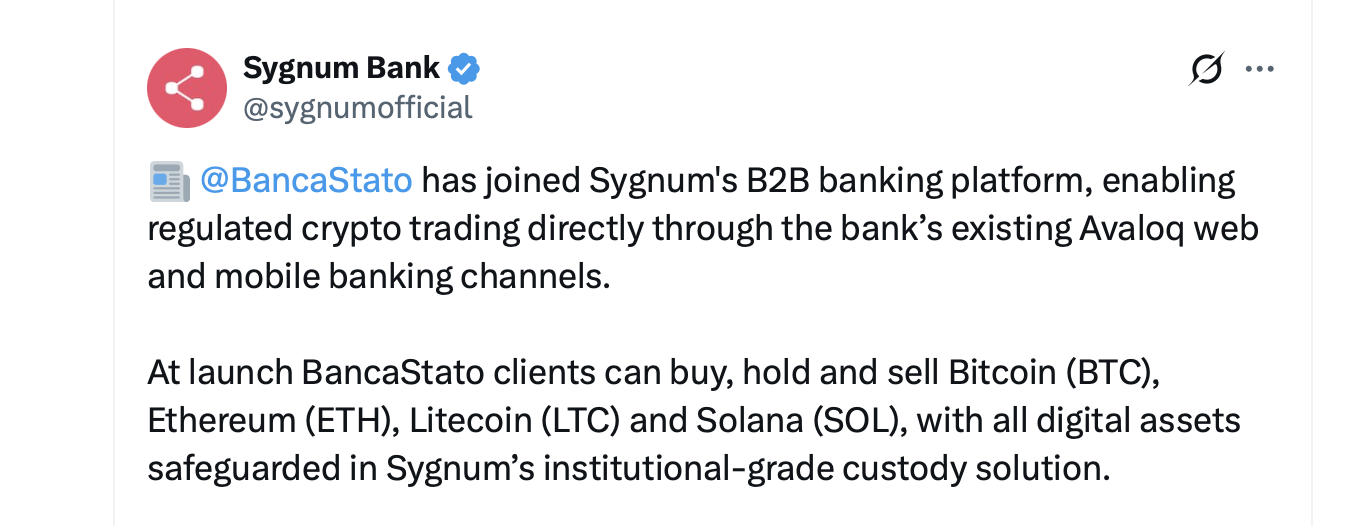
Thanks to this agreement, Bancastato also becomes the first bank to use the Avaloq banking environment in a "Software as a Service" (SaaS) model to provide cryptocurrency trading services via Sygnum's Application Programming Interface (API). In practice, this means the trading infrastructure works "behind the scenes," while clients continue to interact with the same banking platform they are already accustomed to.
Banks avoid overhauling core systems, and clients avoid the need to switch between applications every time they want to make a trade. Clients can place market orders by specifying either the desired amount of cryptocurrency or its value in US dollars. Sygnum executes each trade, while Bancastato maintains client relationships, branding, and the user interface.
This separation reflects a model becoming increasingly common in regulated financial services: banks retain client ownership, while specialized providers handle infrastructure that would otherwise require years of development, regulatory approvals, and ongoing maintenance. Sygnum also secures clients' digital assets through its institutional-grade custody platform.
Custody goes far beyond simply storing private keys. It includes multi-layered security measures, governance procedures, independent audits, and legal structures designed to segregate client assets from the bank's own balance sheet. This legal separation has become one of the defining characteristics expected by institutional clients, as it helps mitigate counterparty risk should a financial institution face operational or financial difficulties.
Sygnum Builds Infrastructure Lacking in Banks
Sygnum's Head of B2B, Fritz Jost, noted that this integration reflects the growing demand for regulated digital asset services that integrate directly into existing banking systems. He described the Bancastato launch as "an important step towards maturity and scalability in regulated digital asset infrastructure."
Bancastato CEO Kurzio De Gottardi explained that adding digital assets expands the bank's existing investment offering. This observation reflects a broader shift in traditional finance. Many regional banks no longer view cryptocurrency as a standalone product competing with traditional financial instruments. Instead, it is increasingly taking its place alongside currency, stocks, and managed portfolios as another asset class clients expect to access from a single account.
This strategy is at the core of Sygnum's business model. Instead of competing for retail deposits, this Zurich-based company provides the infrastructure for trading, custody, regulatory compliance, and settlement that partner institutions would otherwise have to develop, build, and maintain themselves. Over 25 banks and international financial institutions already use its B2B platform, including Zuger Kantonalbank, Luzerner Kantonalbank, Postfinance, and VZ Vermögenszentrum.
According to Sygnum, through these partnerships, regulated digital asset services are already available to more than a third of Switzerland's population via existing banking relationships. Bancastato extends this network into the country's Italian-speaking region, reinforcing another trend seen across Europe: regional banks are increasingly adopting digital assets without relinquishing their traditional role as community financial institutions.
Zurich Startup Evolves into a Regulated Banking Network
Sygnum's origins trace back to discussions held during the Singapore FinTech Festival in 2017. The company was incorporated in Switzerland in May 2018 and in Singapore a month later, establishing a dual-hub structure focused on Zurich's banking sector and Singapore's capital markets.
Zurich remains the company's operational and regulatory headquarters, providing depository services, compliance, risk management, product development, and technological support for partner institutions. In 2019, Sygnum obtained Swiss banking and securities dealer licenses, bringing the company under the supervision of the Swiss Financial Market Supervisory Authority (FINMA).
Its operational scope has since expanded to include licensed operations in Singapore, Abu Dhabi, and Liechtenstein. On June 30, Sygnum Europe received a Crypto-Asset Service Provider license under the EU's Markets in Crypto-Assets (MiCA) framework. Beyond market access, such authorizations reduce regulatory uncertainty for partner banks, giving them greater confidence that cross-border digital asset services can be provided under a unified legal framework rather than disparate local rules.
This expansion also underscores a practical reality within the traditional banking sector. Building institutional-grade crypto custody, compliance, and execution systems requires expertise that goes far beyond the traditional strengths of most banks. Many institutions have concluded that integrating proven infrastructure is faster, cheaper, and safer from an operational standpoint than attempting to build it from scratch.
Switzerland Brings Cryptocurrency into the Mainstream
The Bancastato launch also reflects Switzerland's broader evolution towards becoming one of the world's most mature and regulated digital asset markets. Research estimates suggest between 18% to 23% of Swiss residents own cryptocurrency, with ownership among some 18 to 24-year-olds reaching approximately 36%.
According to a Big Whale report published in March, by mid-2026, roughly 20 Swiss banks offered some form of cryptocurrency-related services to over 2.5 million customer accounts. UBS, Zürcher Kantonalbank, Postfinance, and cantonal banks in Zug, Lucerne, St. Gallen, Thurgau, and Ticino have implemented regulated offerings, with many opting to utilize the services of specialized infrastructure providers rather than building their own platforms.
This trend illustrates how Switzerland has approached digital assets differently than many other jurisdictions. Instead of creating a parallel financial system, regulators have largely incorporated cryptocurrencies into the existing banking supervision framework through licensing standards covering custody, trading, compliance, and Anti-Money Laundering (AML) requirements.
Combined with the concentration of blockchain companies in Zug's "Crypto Valley," this regulatory framework has provided financial institutions with a clearer path to launching regulated services without needing to overhaul their entire operational model.
end-content


















